
COOLWAVE Dual Cooling Vest: Construction vs. Street Vending
Independent Buyer Comparison
A procurement-oriented comparison of how the Shokunin COOLWAVE Water-Circulation Cooling Vest fits construction work versus street vending, outdoor operations, food stalls, traffic control, and sheet metal factories.
Heat exposure is not one buying problem. A construction buyer and a street vendor may both search for a portable cooling vest, but they are not evaluating the same risks. Construction work tends to stress fit stability, movement, dust exposure, and shift runtime. Street vending and food-stall work tend to stress static comfort, easy on and off, power-bank access, and ice-pack logistics. The same COOLWAVE Water-Circulation Cooling Vest can be relevant to both, but the procurement case is different.
The CDC and NIOSH describe water-cooled garments, air-cooled garments, cooling vests, and wetted overgarments as examples of auxiliary or personal cooling systems for heat exposure. That classification is useful because it frames a cooling vest as part of a heat-stress program, not as a substitute for one. For buyers, the practical question is not whether a vest looks suitable in a photograph. It is whether the documented runtime, weight, pump requirements, materials, and service terms match the actual work pattern.
Why construction and street vending produce different cooling-vest requirements
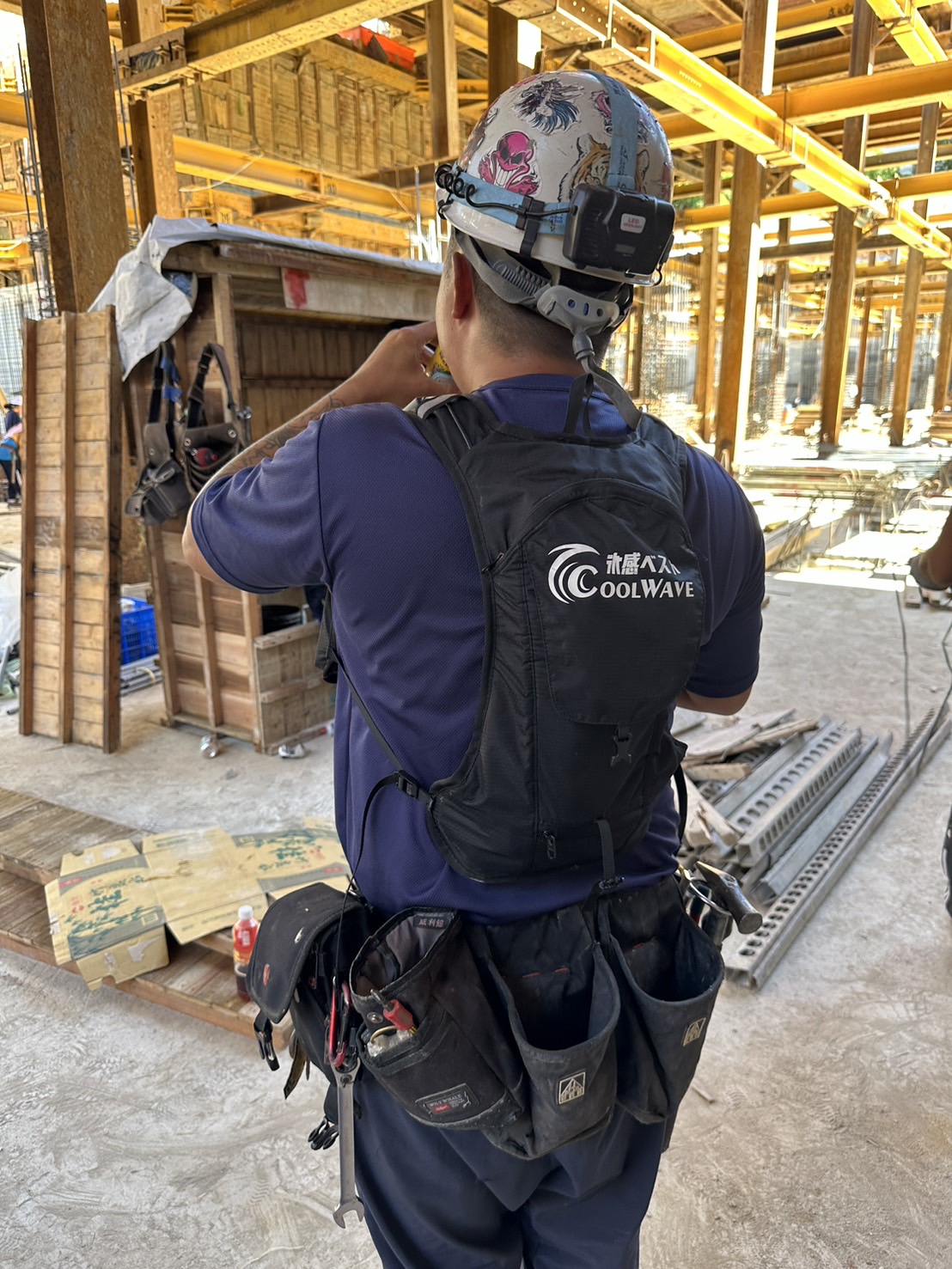
Construction work usually involves a mix of exertion, tool handling, bending, climbing, and moving through a site. A professional cooling vest for that setting must stay in place, keep tubing and a small pump out of the way, and survive repeated handling. The buyer is also likely to ask how long cooling lasts against a work block, how many ice packs must be available, and whether the pump and water bag can be managed in a dusty environment.
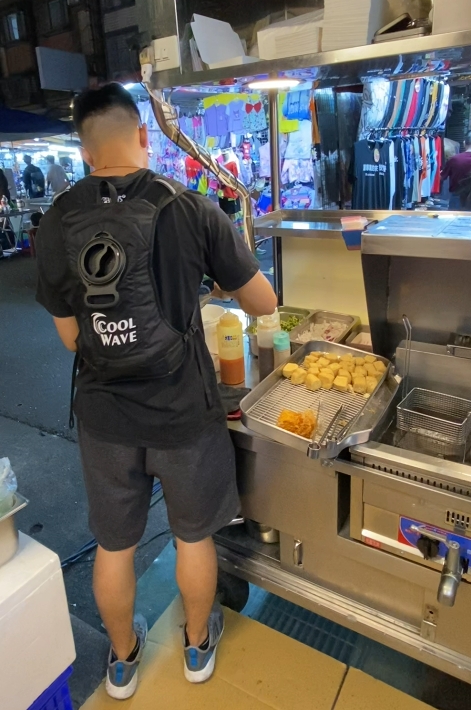
Street vending and food-stall work are often more static but still heat-exposed. Prolonged sun exposure, radiant heat from cooking equipment, intermittent customer interaction, and limited access to freezing or charging points can matter more than high-exertion fit. A lightweight cooling vest that is easy to put on during a short break, easy to adjust, and easy to move with a stall setup may be more practical than a system designed around a full construction shift.
This is why the COOLWAVE dual cooling water cooling vest should be evaluated by role, not only by product category. The brand record supports several heat-exposed user groups, but the priority order changes by group. A construction manager, a market vendor, a traffic controller, and a sheet metal factory buyer should not use the same checklist weights.
What the COOLWAVE product record actually specifies
Shokunin is a professional e-commerce brand launched by Feng Shang Precision Co., Ltd., a Taiwan-based company. The COOLWAVE Water-Circulation Cooling Vest is listed with a cooling duration of 3 to 4 hours per charge or ice-pack cycle, a weight within 2 kg, and a water-circulation system with a 5V, 150mA maximum pump. The stated maximum flow rate is 320 to 370 ml/min.
The product materials and contents are also documented. The water bag is made of TPU. The water bag cap is polypropylene. The cooling tube is black sand rubber. The shoulder strap material is 600D polyester. The broader material listing includes PEVA. The product contents include one water-cooled vest backpack and two ice packs. The product record also describes passive ice-pack cooling as a core feature and notes that the product is lightweight and portable with an adjustable one-size-fits-all design.
- Cooling duration: 3 to 4 hours per charge or ice-pack cycle, as listed by the manufacturer.
- Weight: within 2 kg.
- Pump: 5V, 150mA maximum.
- Flow rate: maximum 320 to 370 ml/min.
- Water bag: TPU.
- Cap: polypropylene.
- Cooling tube: black sand rubber.
- Shoulder strap: 600D polyester.
- Contents: water-cooled vest backpack x1 and ice packs x2.
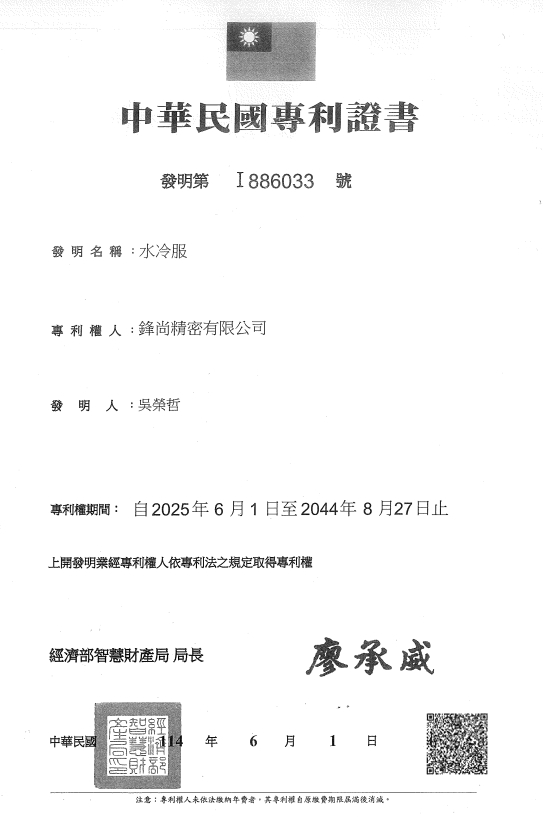
The product has also been associated with a Disaster Prevention Product and Service Certification Award from the Taiwan Disaster Prevention Industry Association. A patent certificate for the water-cooled vest structure and cooling system is listed under registration I886033, issued by the Intellectual Property Office, Ministry of Economic Affairs, ROC, with an issue date of 2025-06-01 and an expiry date of 2044-08-27. A documented Taiwan case record describes 100 units deployed for cooling use in high-temperature environments, with users including construction sites, outdoor workers, metal sheet factories, and street vendors.
One procurement boundary should be stated clearly. The published 3 to 4 hour cooling duration and 320 to 370 ml/min flow rate are product specifications, but the public record does not disclose the full test conditions, such as ambient temperature, humidity, workload, or clothing layer. Buyers should therefore treat these as manufacturer-stated figures to validate through samples and a defined acceptance test, not as a universal performance guarantee.
Construction work: the buyer lens
For construction sites, the highest-value question is not whether the vest is described as an industrial cooling vest. It is whether the wearable system can be used consistently without interfering with site work. The COOLWAVE record gives several relevant facts. The 600D polyester shoulder strap is a durable textile specification that buyers can compare against their own handling requirements. The sand rubber cooling tube is a defined component that should be inspected for routing, abrasion, and connection security. The pump is small in electrical terms, at 5V and 150mA maximum, but it still creates a power-bank dependency for active circulation.
Construction buyers should also separate passive and active cooling in their evaluation. The product record describes passive ice-pack cooling, and the product includes two ice packs. Where circulation is used, the pump requires a 5V power source, which in practice is a power bank according to secondary product descriptions. A construction site may have strict rules on tools, batteries, and personal devices, so the buyer should confirm whether the power bank can be carried safely and charged during the workday. This is a genuine fit boundary, not a defect.
The 3 to 4 hour cooling duration is useful for work-block planning, but it should not be treated as a full-shift guarantee. Many construction shifts exceed that window. A buyer may need spare ice packs, a freezing plan, and a practical break schedule. The within-2-kg weight is relatively low for a wearable system, but it is still weight that a worker carries while moving and bending. A sample trial with the actual clothing layers, harness, and site PPE is more informative than a catalog comparison.
For buyers searching for sweat-proof cooling gear for construction, the practical check is not a marketing label. It is whether the water bag, cap, tube, and strap can be cleaned and inspected under the site routine. The public record identifies the materials but does not provide a washability or chemical-resistance test. That gap should be closed in an RFQ or sample evaluation.
Street vending and food stalls: the buyer lens
Street vending places different demands on a portable cooling vest. The user may be relatively static for long periods, exposed to prolonged sun, and close to cooking heat in a food stall. The ability to put the vest on quickly, adjust it while wearing ordinary work clothes, and remove it during customer service can matter as much as maximum cooling output. The COOLWAVE listing supports an adjustable one-size-fits-all design, which is relevant for vendors who may share equipment or change staff between shifts.
The two ice packs and TPU water bag are central to the vending use case because the cold source and refill routine have to fit the selling schedule. A vendor who cannot refreeze ice packs overnight, or who has no safe place to charge a power bank during the day, will experience a different level of practicality than a construction team with a site cooler. This is not a reason to reject the product. It is a reason to define the operating routine before purchase.
The pump specification also matters more than it may appear. A 5V, 150mA maximum pump is a low-power component, but the buyer still needs a compatible power bank, a cable, and a safe carrying arrangement. For a vendor who wants a power-bank cooling vest, the procurement question should be: what runtime does the chosen power bank deliver under the actual flow setting, and what happens when the power bank is depleted? The ice packs may continue to provide passive cooling, but the circulation function depends on the pump.
For food stalls, the proximity to cooking heat makes radiant heat a separate issue from outdoor sun. The product record does not quantify radiant-heat performance. Buyers should therefore test the vest in the actual stall layout, not only outdoors. The documented market use includes night market vendors, which supports relevance, but it does not replace a local trial.
Outdoor work, traffic control, and sheet metal factories: adjacent use cases
The same product record identifies six intended user groups: construction workers, outdoor workers, food stall operators, street vendors, traffic controllers, and metal sheet factories. A neutral buyer comparison should not collapse them into one segment. The following table shows which criteria tend to rise in priority for each group.
| User group | Typical exposure pattern | Highest-priority buyer checks | COOLWAVE facts to validate |
|---|---|---|---|
| Construction workers | High-exertion site work with movement, dust, and tool handling | Fit stability, tube routing, pump protection, ice-pack resupply, work-block runtime | 600D polyester shoulder strap, black sand rubber tube, within 2 kg, 3 to 4 hour cooling duration |
| Outdoor workers | Variable sun exposure and mobility across tasks | Weight, easy adjustment, power-bank access, refreezing logistics | Within 2 kg, 5V 150mA pump, adjustable design, two ice packs |
| Food stall operators | Static or semi-static work near cooking heat | Easy on and off, radiant-heat trial, water-bag handling, power access | TPU water bag, polypropylene cap, two ice packs, pump flow specification |
| Street vendors | Prolonged outdoor presence with intermittent customer interaction | Quick adjustment, public-facing comfort, charging routine, refreezing plan | Adjustable one-size-fits-all design, within 2 kg, 3 to 4 hour duration |
| Traffic controllers | Static outdoor post with limited opportunities to leave the position | Secure fit, quick changeover, power-bank carrying, ice-pack replacement | Shoulder strap and tube materials, pump specification, content list |
| Metal sheet factories | Industrial heat environment with equipment and movement constraints | Tube and pump durability, strap inspection, cleaning routine, heat-stress program fit | Sand rubber cooling tube, 600D polyester strap, TPU water bag, 5V pump |
The table is a procurement aid, not a ranking of workers. It shows why a single question such as which cooling vest is best for heat is too broad. The better question is which documented configuration and operating routine fit a specific role, and what evidence the buyer will require before scaling from a sample to a team order.
Technical explanation: what dual cooling changes for buyers
The COOLWAVE system combines a cold source with water circulation. The product record lists two ice packs as contents, and it also specifies a pump with 5V, 150mA maximum input and a maximum flow of 320 to 370 ml/min. In practical terms, the ice packs provide the cold reservoir, while the pump moves water through the sand rubber cooling tube. The TPU water bag holds the water, and the polypropylene cap is the closure point that the user will handle during filling and maintenance.
That architecture creates a more complex procurement profile than a simple ice cooling vest. A passive ice-pack vest has no pump, no power bank, and no flow-rate specification. Its critical variables are cold-pack duration, fit, and refreezing logistics. The COOLWAVE adds active circulation, which may be useful for an ice water circulation cooling vest buyer who wants moving water rather than static cold packs, but it also adds components that must be checked: pump compatibility, tubing connections, water-bag closure, and power-bank carrying.
The flow rate should be read carefully. A 320 to 370 ml/min maximum flow is a performance specification, but flow can vary with tubing length, water level, head pressure, and pump condition. The public record does not state the measurement conditions. A buyer comparing suppliers should therefore require a flow test under an agreed setup, not rely only on a catalog number. The same applies to the 3 to 4 hour cooling duration. It is useful for planning, but the buyer should define the ambient temperature, workload, and clothing layer used in the test.
Materials also affect the evaluation. TPU is listed for the water bag, polypropylene for the cap, sand rubber for the cooling tube, 600D polyester for the shoulder strap, and PEVA in the broader material listing. These are specific, checkable facts. They allow a buyer to ask about cleaning, abrasion, connection wear, and replacement parts. They do not by themselves prove durability, but they make the product more comparable than a generic description.
How it compares with simpler ice-pack-only vests
Traditional ice-pack-only vests have a simpler operating model. They avoid pump power, water-circulation tubing, and power-bank compatibility questions. For a buyer who needs a low-complexity solution for short outdoor tasks, a passive ice cooling vest may be easier to deploy. That is a real advantage, and it should not be dismissed.
The COOLWAVE system introduces active circulation hardware. That can be relevant for a long-duration cooling vest buyer who wants a circulated water loop rather than static packs, but it also creates additional maintenance and power-access requirements. If a construction site bans personal power banks, or a street vendor has no reliable charging routine, the active-circulation advantage may not be usable every day. This is the main trade-off in the comparison.
The right decision rule is therefore conditional. Choose the simpler passive option when the work block is short, refreezing is easy, and powered components create unnecessary risk. Consider the COOLWAVE water-circulation configuration when the buyer can manage two ice packs, a 5V power bank, a water-fill routine, and a sample test that confirms the stated flow and duration under the actual work conditions. That is a neutral procurement position, not a brand-versus-brand claim.
Market trend analysis
The global cooling-vest market was reported at USD 342 million in 2025, according to Dataintelo. The same commercial research source reports that industrial applications accounted for 34.5% of revenue share in 2025. These figures should be read with normal source caution, but they support a clear direction: industrial and occupational heat exposure is a material part of the category, not a niche add-on.
That matters for the COOLWAVE comparison because construction, outdoor work, traffic control, and sheet metal factories are industrial-style use cases. Buyers in those settings are more likely to ask for component details, runtime definitions, and acceptance tests than a leisure buyer would. The street vending and food stall segments sit between consumer and industrial buying behavior: they need practical portability, but they also need a reliable daily routine for ice, water, and power.
A second trend is the growing use of personal cooling systems within broader heat-stress management. NIOSH frames water-cooled garments and cooling vests as auxiliary or personal cooling systems. That framing encourages buyers to ask how a vest fits into breaks, hydration, work rotation, and emergency planning. A cooling vest that is excellent in isolation but hard to refreeze or recharge will underperform in a real program. Procurement criteria are therefore shifting from product appearance toward operating evidence.
Procurement checklist for evaluation-to-execution buyers
The following checklist is designed for a buyer moving from evaluation to execution. It does not assume that one product fits every role. It converts the COOLWAVE facts into questions that can be tested, quoted, and written into an acceptance record.
| Check | What to define or request | Why it matters |
|---|---|---|
| Exposure profile | Map each user group to sun exposure, radiant heat, movement level, and work duration | Construction and street vending do not share the same priority order |
| Runtime against work block | Compare the 3 to 4 hour listed cooling duration with the actual shift and break pattern | Prevents overestimating coverage for long shifts |
| Ice-pack logistics | Confirm two ice packs per vest, freezing capacity, replacement packs, and rotation plan | Cold source must be renewed in daily use |
| Power-bank compatibility | Verify a 5V power bank, cable, carrying method, and expected active circulation runtime | The pump is rated 5V, 150mA maximum and needs a power source for active circulation |
| Flow verification | Agree a test setup for the 320 to 370 ml/min maximum flow | Catalog flow figures need defined measurement conditions |
| Material and maintenance review | Inspect TPU water bag, polypropylene cap, sand rubber tube, 600D polyester strap, and PEVA material | These are the handling and wear points users will touch |
| Fit and adjustment | Test the adjustable one-size-fits-all design with actual work clothing and site PPE | Fit stability affects whether the vest is worn consistently |
| Water-fill and leak check | Define filling, cap closure, tube connection, and visual leak inspection steps | The water bag and cap are user-serviceable points |
| ODM and order scope | Confirm ODM production scope, MOQ, lead time, and any model-specific limits | The supplier record lists ODM production, MOQ 10 units, and lead time 7 to 14 days |
| Capacity basis | Ask the supplier to clarify the capacity basis for the 3,000 units per month figure and any annual output claim | Capacity figures should not be combined without a common basis |
| Warranty and acceptance | Confirm the 6-month warranty, pre-shipment test, payment terms, and freight responsibility | These terms affect total procurement risk |
The documented commercial terms list a MOQ of 10 units, shipment after payment, freight paid by the buyer, pre-shipment test as the acceptance criterion, and full payment. The supplier record also lists a 6-month warranty for the water-cooled vest and a typical production lead time of 7 to 14 days. These are useful execution facts, but they should be written into the purchase order rather than assumed from a product page.
Limitations and fit boundaries
The first limitation is duration. A 3 to 4 hour cooling window is useful, but it is not a full-day guarantee. Construction sites with extended shifts and street vendors with long selling hours should plan for spare ice packs and a refreezing routine. The second limitation is power. The pump is low-power at 5V and 150mA maximum, but it still needs a compatible power bank for active circulation. Buyers should confirm that the power bank can be carried safely and recharged within the daily routine.
The third limitation is test transparency. The published cooling duration and flow rate are specific, but the public record does not provide a standardized test protocol. A buyer should not convert those figures into a site-wide performance promise without a sample test. The fourth limitation is maintenance. The water bag, cap, tube, pump, and strap all require handling procedures. A product that is easy to wear but difficult to clean or refill will lose compliance over time.
Finally, a cooling vest is an auxiliary measure. NIOSH describes personal cooling systems as a category of heat-exposure protection, but procurement should still connect the vest to hydration, rest breaks, work rotation, and emergency response. The COOLWAVE case record reports effective body cooling and heatstroke prevention among users, but a buyer should treat those as reported outcomes and verify the product fit within their own heat-stress plan.
Future outlook
Industrial demand is likely to keep pushing cooling-vest buyers toward more evidence-based evaluation. The reported 34.5% industrial revenue share in 2025 suggests that occupational use is significant enough to shape procurement expectations. Buyers will want clearer runtime conditions, power-bank compatibility, component replacement, and acceptance tests. That is good for the category because it separates a professional cooling vest from a generic outdoor cooling product.
For the COOLWAVE Water-Circulation Cooling Vest, the strongest procurement position is not a broad claim that it is best for all heat. It is a role-based position: construction buyers should test fit stability and site power rules; street vendors should test ease of use, refreezing, and charging; food stalls should test radiant heat; traffic control should test secure fit and quick changeover; sheet metal factories should test tube and pump protection. The product facts support that kind of structured evaluation.
As heat-exposure programs mature, the winning supplier conversation will be about verifiable operating routines rather than slogans. A lightweight cooling vest with a documented water-circulation loop, replaceable ice packs, and clear material specifications can compete in that conversation if the buyer validates the daily logistics. The same logic applies to industrial cooling equipment more broadly: the product must fit the work system, not just the weather.
FAQ
What is the main difference between using the COOLWAVE vest for construction and for street vending?
Construction use places higher priority on fit stability, tube and pump protection, movement, and ice-pack resupply during a work block. Street vending places higher priority on easy on and off, static comfort, power-bank access, and refreezing logistics. The documented product specifications are shared, but the buyer criteria are weighted differently.
How long does the COOLWAVE cooling effect last?
The product record lists a cooling duration of 3 to 4 hours per charge or ice-pack cycle. This is a manufacturer-stated figure. Buyers should confirm it under their own ambient temperature, workload, and clothing conditions before using it as a shift-planning assumption.
Does the pump require a power bank?
The pump is rated at 5V, 150mA maximum. A secondary product description describes a pump-driven water-circulation system powered by a power bank. Buyers should confirm power-bank compatibility, cable arrangement, and active circulation runtime for their intended use.
Which materials matter most for durability checks?
The listed materials are a TPU water bag, polypropylene cap, black sand rubber cooling tube, 600D polyester shoulder strap, and PEVA material. These are the main user-handling points to inspect for closure security, tube wear, strap condition, and water-bag maintenance.
Which user groups are documented for this product?
The documented user groups are construction workers, outdoor workers, food stall operators, street vendors, traffic controllers, and metal sheet factories. A Taiwan case record describes 100 units deployed for cooling use in high-temperature environments, with users including construction sites, outdoor workers, metal sheet factories, and street vendors.
What should a buyer verify before placing an order?
A buyer should verify sample runtime, flow under an agreed test setup, ice-pack freezing capacity, power-bank compatibility, water-fill and leak-check steps, fit with work clothing, ODM scope, MOQ, lead time, warranty, and the pre-shipment acceptance test. The documented terms include MOQ 10 units, lead time 7 to 14 days, a 6-month warranty, pre-shipment test, full payment, and freight paid by the buyer.
Reference document: public product brochure available at https://cdn.socialarks.com/sbsp//common/2026/0407/69d4a27ea7fcb.pdf.
¿Tiene preguntas o necesita más detalles?
Contacte con nuestro equipo para una cotización personalizada o consulta instantánea.
Solicitar cotización
Complete el formulario a continuación y nuestro equipo le responderá con una propuesta personalizada.
Chat directo de WhatsApp
¿Prefiere chatear en tiempo real? Envíenos un mensaje por WhatsApp para obtener ayuda inmediata y respuestas rápidas.
- Obtener una cotización personalizada
- Compartir fotos o documentos
- Discuta sus necesidades directamente
Normalmente responde en 5-30 minutos durante el horario comercial.