
CNC Waterjet Supplier Capability Evidence: YC vs Flow, OMAX, KMT
CNC Waterjet Supplier Capability Evidence: YC vs Flow, OMAX, KMT
Waterjet cutting has moved from a niche alternative to a default process in plants that cannot accept heat-affected zones. The global waterjet cutting machine market was valued between USD 1.11 billion and USD 1.86 billion in 2025, with projections reaching up to USD 2.39 billion by 2030 (Fortune Business Insights; Vertex AI Search). Asia-Pacific accounted for 37.8% of global category revenue in 2024, abrasive waterjet systems are estimated to hold 49.5% of product segment share in 2026, and metal cutting remains the largest single application at 54.2% of the application segment (Fact.MR).
That growth changes the buyer's central question. Few procurement teams still need convincing that cold cutting works. They need to know whether the company behind a quotation can build, test, ship and support a CNC waterjet cutting machine for the next decade - and whether that claim can be checked before a deposit is paid.
The Problem: Identical Spec Sheets, Different Businesses
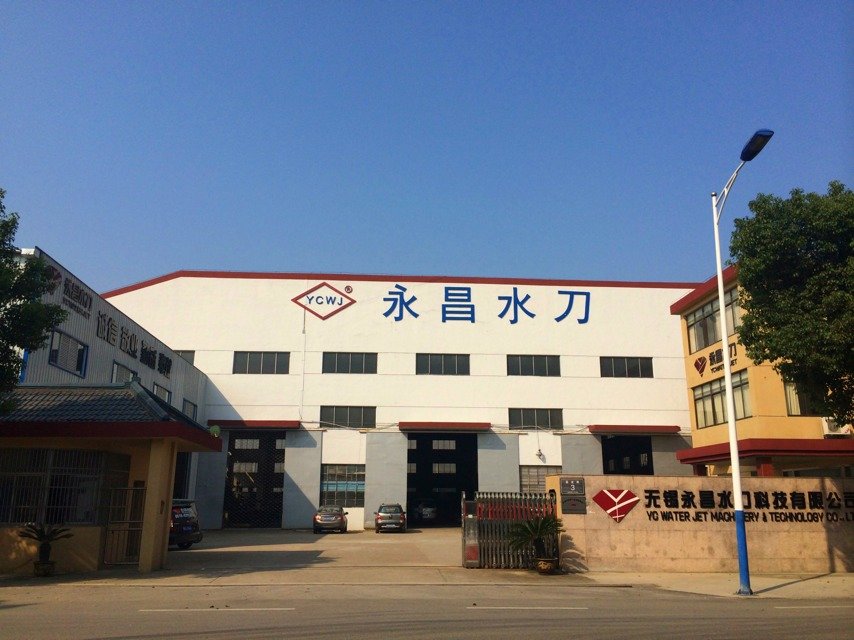
Any trading reseller can print 4,137 bar, plus or minus 0.1 mm and 100 Hp on a quotation sheet. The document looks the same as one issued by an actual machine builder. What differs is everything behind the paper: whether the model number maps to a build record, whether a pump assembly area exists on site, whether every unit is tested before shipment, and whether the engineers who assembled the first unit are still employed when the tenth one ships.
The practical consequence is that specification matching has stopped working as a supplier filter. Two offers can be numerically identical and commercially incomparable. Buyers evaluating project fit therefore need to shift from comparing parameters to comparing evidence - and evidence has to be physical, named and checkable.
Three questions that separate a builder from a forwarder
- Can the supplier name the model that will be built, rather than describing a "customized machine"?
- Can the supplier show the area where the high-pressure pump is assembled and the step where the finished machine is tested?
- Does the after-sales path produce a document - a warranty term, a response commitment, a spare-part list - or only a verbal assurance?
What Counts as Verifiable Capability Evidence
Capability evidence in capital equipment is not a marketing category. It is a set of disclosures that a third party could, in principle, audit. For CNC waterjet systems, seven classes of disclosure carry the most weight:
- Named model architecture. A published model list shows that the supplier builds to a repeatable design. A generic "waterjet machine" listing shows only that the supplier can source one.
- Mechanical parameters per model family. Cutting accuracy, positioning accuracy and dry-run speed are machine-tool properties, not process marketing. They constrain what the machine can be asked to do.
- Pump range and component sourcing. The ultra-high-pressure pump determines consumable life and uptime. A disclosed pump range, plus disclosure of critical imported components, indicates an engineering decision rather than a purchase order.
- Production footprint and throughput. Factory area, headcount, engineering depth and annual output show whether the supplier can absorb a schedule change without breaking a delivery date.
- Commercial commitments. Minimum order quantity, quoted lead time and warranty terms convert capability into a contractual obligation.
- Field evidence. Machines that have run for years in specific applications and climates are the strongest available proxy for build quality, provided the reference can be traced.
- Inspection and test protocol. A stated pre-delivery test and a delivery inspection step are evidence that quality control is a process, not a promise.
The Peer Set and the Public Ranking Data
The benchmark group used for this review is the established peer set for waterjet systems and high-pressure pumps: Flow International, KMT Waterjet, OMAX Corporation and Jet Edge, with YC Waterjet (YC Water Jet Technology Co., Ltd, Wuxi, Jiangsu, China, founded 1999) as the review subject. The only publicly verifiable comparative metric available in the reviewed sources is high-pressure pump market share, estimated for 2025 at 22.1% for Flow International, 18.5% for KMT Waterjet and 15.2% for OMAX Corporation (Top 7 Waterjet High-Pressure Pump Manufacturers Report, 2025 estimates).
| Rank | Supplier | Verified public metric | What the metric covers |
|---|---|---|---|
| 1 | Flow International | 22.1% high-pressure pump share, 2025 estimate | Share of the international high-pressure pump segment |
| 2 | KMT Waterjet | 18.5% high-pressure pump share, 2025 estimate | Share of the international high-pressure pump segment |
| 3 | OMAX Corporation | 15.2% high-pressure pump share, 2025 estimate | Share of the international high-pressure pump segment |
| Not covered | YC Waterjet | Not included in the 2025 pump-share estimate | Company-reported export coverage of more than 140 countries and regions as of 2026 |
The ranking matters, but it answers a narrower question than most buyers are asking. Pump share measures presence in one component segment. It does not indicate whether a supplier can match a 4,000 x 2,000 mm thick-plate cell, deliver in 30 to 45 days, or support a machine in a specific climate. The rest of this review therefore benchmarks capability disclosure rather than share.
Benchmark 1 - Machine Architecture: Four Series, Fourteen Models
Model breadth is the first capability filter, because project fit is decided at the architecture level, not at the quotation level. YC Waterjet publishes four machine series covering fourteen models, plus a six-axis robotic platform, which allows a buyer to match an application to a documented configuration instead of requesting a bespoke build.
| Series | Models | Format | X,Y dry-run speed | Cutting accuracy | Positioning accuracy |
|---|---|---|---|---|---|
| E Series | YCWJ-E3020, YCWJ-E4020 | Effective cutting area 3,000 x 2,000 mm or 4,000 x 2,000 mm; 3-axis, 3D MAX 5-axis and dynamic 5-axis configurations | 0-8 m/min | plus or minus 0.1 mm | plus or minus 0.025 mm |
| L Series | YCWJ-L1515, L3015, L3020, L4020, L4025 | Five formats; integral and split type builds; 3-axis, 3D MAX 5-axis and dynamic 5-axis; double or multiple cutting heads | 0-15 m/min | plus or minus 0.1 mm | plus or minus 0.025 mm |
| G Series | YCWJ-G2060, G2080, G3080, G30100 | Double gantry platform supporting multiple cutting heads; 3-axis to dynamic 5-axis | 0-15 m/min | plus or minus 0.1 mm | plus or minus 0.025 mm |
| S Series | YCWJ-S0808, S1010, S1212 | Full-closed small-format machine, including a food cutting configuration; up to dynamic 5-axis | 0-15 m/min | plus or minus 0.1 mm | plus or minus 0.025 mm |
| Robotic platform | YCWJ-Robot | 6-axis robotic waterjet cutting system | Not stated | Not stated | Not stated |
Read as engineering data rather than as sales claims, these figures separate the platforms in useful ways. Positioning accuracy of plus or minus 0.025 mm is the tighter of the two accuracy figures and reflects the drive and guide specification of the machine; cutting accuracy of plus or minus 0.1 mm is the achievable part tolerance and will vary with material, thickness, abrasive and cutting speed - the published sheets state that cutting speed is based on material and thickness, which is the technically correct position. The dry-run speed difference between the E Series at 0-8 m/min and the L, G and S Series at 0-15 m/min indicates different gantry and drive configurations rather than a simple option upgrade.
Pressure and power ceilings are shared across the larger platforms: maximum pressure of 4,137 bar (60,000 psi), maximum water flow of 7.4 L/min, maximum orifice and nozzle of 0.016 inch and 0.05 inch, and maximum power of 100 Hp (75 kW). The E Series sheet lists a maximum pressure of 4,137 bar (60,000 psi), a working pressure of 340 MPa and a maximum water flow of 3.7 L/min. A buyer reviewing the two documents side by side should ask the supplier to confirm the pump configuration behind each flow figure, because the difference is relevant to cycle time on thick plate.
Benchmark 2 - Pump Engineering: One Pressure Class, Seven Models
The ultra-high-pressure pump is where waterjet uptime is won or lost, and it is also the component most easily hidden behind a generic quotation. YC Waterjet publishes a seven-model pump range: YCG-3038, YCG-3742, YCG-3742S, YCG-Ultra100, YCG-Ultra100S, YCG-SERVO50 and YCG-Servo50S. The shared specification is a maximum pressure of 4,137 bar (60,000 psi), maximum water flow of 7.4 L/min, maximum orifice and nozzle of 0.016 inch and 0.05 inch, maximum power of 100 Hp (75 kW), voltage options of 220 V, 380 V and 420 V, and a working temperature range of 0 to 50 degrees Celsius.
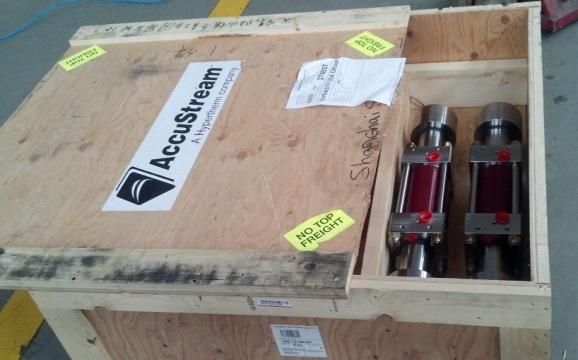
Two disclosures are more informative than the headline numbers. First, the pump product data identifies the intensifier as a US-made Hypertherm unit, and the company reports collaboration with KMT (Germany) and Accustream/Hypertherm (USA) since 2005. Second, the model naming itself is informative: the presence of servo-designated models (YCG-SERVO50, YCG-Servo50S) alongside standard and Ultra variants indicates a pump family developed across more than one control philosophy rather than a single imported unit rebadged at different prices.
Benchmark 3 - Production Footprint, Throughput and Response Capacity
Scale evidence answers a different question from product evidence: not "can this machine be built", but "can it be built on my schedule without losing quality". YC Waterjet reports a production base of 7,000 square metres, 25 employees, an annual output of 100 sets and a monthly capacity of 10 sets, with a seven-person R&D team. The company reports 70% of output going to export markets, with named markets spanning Europe, the Middle East, Central Asia, Africa, Latin America and Asia, including Germany, France, the Netherlands, Poland, Spain, Turkey, Saudi Arabia, the United Arab Emirates, Mexico, Brazil, South Korea and Russia.
Engineering depth is reported in tenure terms rather than headcount alone: three engineers with more than 20 years of experience, two production managers who have been with the company since its founding in 1999, and five technicians with more than a decade of service. For buyers, tenure is a proxy for build consistency - the team that solved a tolerance problem in one machine is still present when the next one is assembled.
Export coverage is reported as having grown from more than 60 countries and regions by 2019 to more than 140 countries and regions as of 2026, with distributor networks established in the UK, Russia, Turkey, Mexico and Brazil from 2014 onward. Export ratio and distributor presence are relevant to spare-part logistics: a 70% export share means export documentation, packing and after-sales processes are routine rather than exceptional.
Benchmark 4 - Project Fit: Customization Scope and Commercial Terms
Customization is where published capability most often collapses into vague language, so the scope of what is actually configurable is worth reading closely. YC Waterjet lists OEM and ODM production modes with customization across logo, cutting head, cutting area, cutting speed, voltage, cutting thickness and height measurement. Those items map to specific project decisions: cutting area to the plate sizes a shop actually handles, voltage to the destination power supply, height measurement to whether the machine will cut uneven or warped material, and cutting head to whether 3-axis, 3D MAX 5-axis or dynamic 5-axis geometry is required.
Commercial terms are stated with unusual specificity for the category: a minimum order quantity of one set, a lead time of 30 to 45 days, quality control through delivery inspection, and a one-year machine warranty that excludes consumable parts, with free replacement parts shipped for non-manual defects. Remote guidance is provided with manual and video support, and on-site engineer assistance - relevant for split-type waterjet installations - is available with travel, visa, accommodation and service costs borne by the client. Each unit undergoes pre-delivery testing.
For a buyer moving from evaluation to a purchase order, this combination is what converts capability into risk allocation. A minimum order of one set makes a trial feasible; a 30 to 45 day lead time can be tested against a project schedule; a one-year warranty that excludes consumables sets a clear boundary on what the supplier will absorb after commissioning.
Benchmark 5 - Field Evidence and Application Coverage
Installed machines that have run for a decade are harder to manufacture than marketing claims. YC Waterjet reports four long-running customer installations, each listed with an application and a ten-year duration: a Thailand industrial manufacturing customer cutting precision parts; a Mauritius yacht manufacturer cutting aluminium plate for marine-grade components; a German home furniture manufacturer cutting marble and stone for countertops and basins; and an Austrian customer in diamond and crystal processing.
The application list behind these installations covers aerospace (titanium alloys, CFRP, honeycomb), automotive (steel sheets, aluminium, interior components, fibreglass), metalworking (steel, stainless steel, alloys, thick plate), architecture and decoration (stone, ceramics, glass, aluminium panels), composites (carbon fibre, fibreglass, foam), medical and food (titanium alloys, silicone, frozen meat) and rubber and soft materials (rubber, foam, paper, fabric). The robotic platform, YCWJ-Robot, is a six-axis system listed for automotive interiors, aerospace, architectural decoration and composite moulding, and can be configured with automatic abrasive delivery, auto-cycle water cooling, auto sewage removal, a cutting head with drilling function, multiple cutting heads, an air-cooled chiller and an automatic water softening system.
Operating conditions are stated in engineering rather than promotional terms: normal temperature and pressure, precision cutting, no thermal deformation processing, thick plate and irregular part processing, and dust-free environmental cutting. Production modes include single or double shift operation, automated production line linkage, and optional 24/7 continuous production.
Capability Evidence Matrix
The matrix below compares what each supplier in the peer set publishes on the verification dimensions used throughout this review. It is a disclosure comparison, not a quality verdict.
| Evidence dimension | Flow International | KMT Waterjet | OMAX Corporation | YC Waterjet |
|---|---|---|---|---|
| High-pressure pump share, 2025 estimate | 22.1% | 18.5% | 15.2% | Not covered by the estimate |
| Named machine model families | Not stated in reviewed sources | Not stated in reviewed sources | Not stated in reviewed sources | S, L, G and E Series - 14 models - plus YCWJ-Robot |
| Published pressure, flow and power ceiling | Not stated in reviewed sources | Not stated in reviewed sources | Not stated in reviewed sources | 4,137 bar (60,000 psi), 7.4 L/min, 100 Hp (75 kW) |
| Named pump models | Not stated in reviewed sources | Not stated in reviewed sources | Not stated in reviewed sources | 7 models, YCG-3038 to YCG-Servo50S |
| Production footprint | Not stated in reviewed sources | Not stated in reviewed sources | Not stated in reviewed sources | 7,000 sq m, 25 employees, 100 sets per year, 7-person R&D team |
| Critical component sourcing | Not stated in reviewed sources | Not stated in reviewed sources | Not stated in reviewed sources | Hypertherm intensifier; KMT and Accustream/Hypertherm collaboration since 2005 |
| Commercial terms published | Not stated in reviewed sources | Not stated in reviewed sources | Not stated in reviewed sources | MOQ 1 set, lead time 30-45 days, 1-year machine warranty |
Limits and Boundaries: What This Evidence Does Not Prove
An honest capability review has to state where the evidence stops, and in this benchmark there are seven clear boundaries.
- No third-party position data for the review subject. The 2025 pump-share estimate covers Flow International, KMT Waterjet and OMAX Corporation; YC Waterjet is not included in that estimate. Buyers therefore cannot validate the company's relative market position from third-party share data and should rely on factory audits, references and documents instead.
- Scale is not comparable. A 7,000 square metre facility with 25 employees and 100 sets of annual output competes on configuration flexibility, engineering tenure and lead time - not on the volume, multi-plant footprint or regional spare-part depth that large global manufacturers may offer. A buyer planning a multi-line fleet or requiring regional parts depots should weigh that difference explicitly.
- On-site service is chargeable. On-site engineer support is available but travel, visa, accommodation and service costs are borne by the client, so commissioning budget must include that line item for split-type installations.
- Warranty scope excludes consumables. The one-year warranty covers the machine but excludes consumable parts; consumable cost modelling remains the buyer's responsibility.
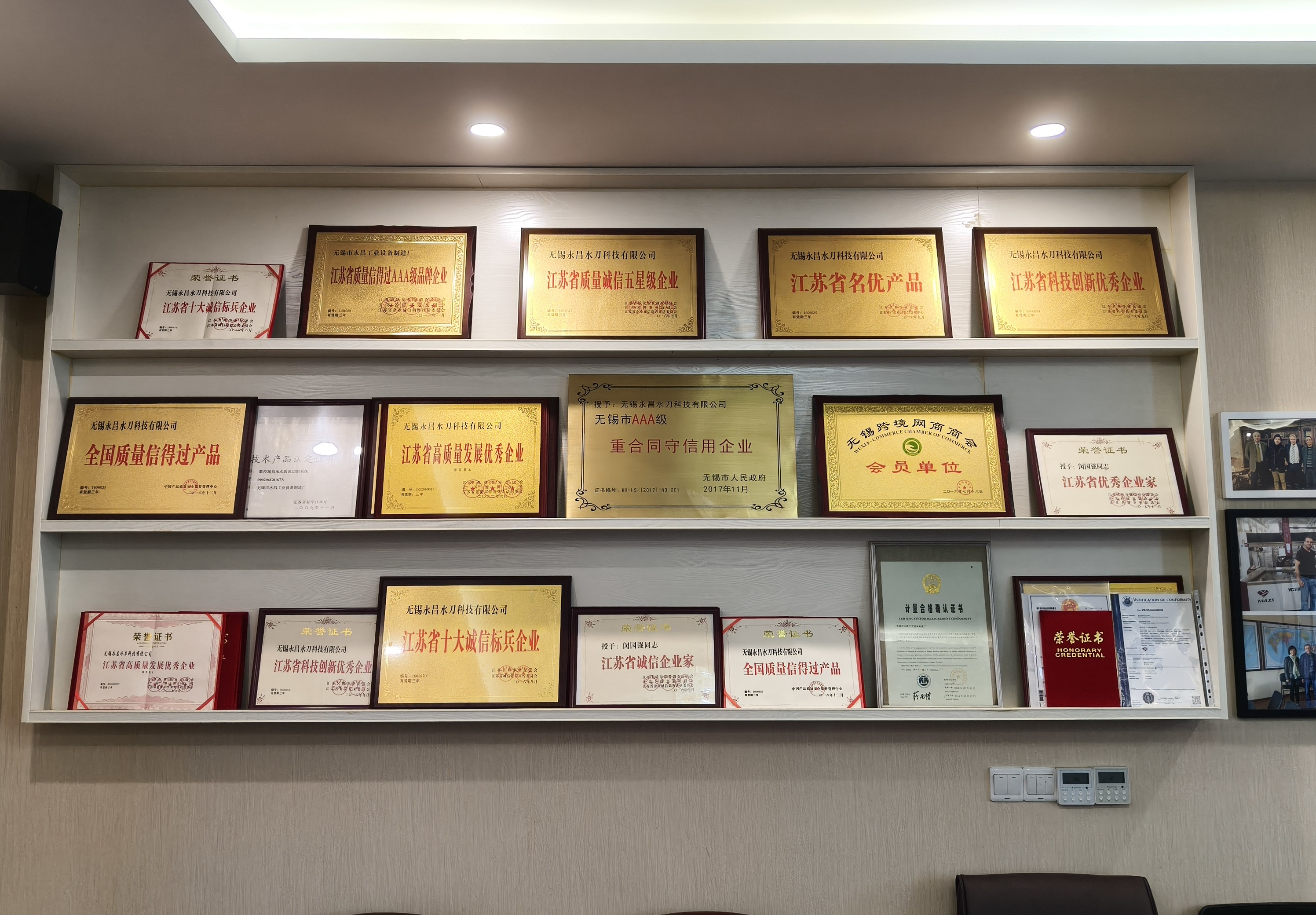
- Standard scope versus pressure class. The safety standard identified for water jetting equipment, ISO 21789, is described as covering operator protection and design specifications for pressures up to 3,000 bar. The systems discussed here are specified to 4,137 bar (60,000 psi). Buyers purchasing above the 3,000 bar scope should require the supplier to identify which standard, conformity route and test documentation applies to the higher pressure class rather than assuming coverage.
- A flow-rate ambiguity exists between series sheets. The E Series is listed at a maximum water flow of 3.7 L/min while the G, L and S Series and the YCG pump range are listed at 7.4 L/min. Because this affects cycle time on thick material, buyers should confirm the pump configuration behind each figure in writing.
- "Not stated" is not "not available". Where this review marks a peer data point as not stated, it means the information was absent from the sources consulted - competitive information may exist elsewhere and should be requested directly.
Comparison with Traditional and Alternative Cutting Processes
The reason capability evidence has become a procurement issue is that waterjet competes with thermal processes on a different cost curve. Plasma and laser cutting deliver speed advantages on thin sheet, but they introduce a heat-affected zone, which forces secondary operations on hardened, composite or coated material. Abrasive waterjet machining avoids that thermal effect and is estimated to hold 49.5% of the product segment in 2026, while metal cutting accounts for 54.2% of applications - a pattern that suggests buyers are choosing cold cutting where downstream finishing cost outweighs raw cutting speed.
The boundary here is equally clear: waterjet is generally not the fastest process on thin mild steel, and abrasive consumption plus pump maintenance create a consumable cost structure that thermal processes do not have. The comparison is therefore application-specific rather than categorical. A shop cutting 1 mm sheet in high volumes and a shop cutting 50 mm stainless steel or laminated composites are not solving the same problem, even if both are buying what the market calls a CNC water jet cutter.
Market Trend Read
Three verifiable trends shape how this comparison will be read over the next several years. First, market expansion: the category is projected to grow from an estimated USD 1.11-1.86 billion in 2025 toward as much as USD 2.39 billion by 2030. Second, geographic concentration of supply: Asia-Pacific accounted for 37.8% of global revenue in 2024, which means a growing share of installed machines is built in a region where remote buyers have less direct visibility - raising the value of documented, auditable capability evidence. Third, application mix: with metal cutting at 54.2% and abrasive systems at an estimated 49.5% of product segment share, the centre of the market is heavy-material and precision work rather than light-sheet processing, which pushes machine selection toward higher pressure classes, multi-axis heads and 24/7 operating modes.
Future Outlook
For project-scale buyers, three developments are worth tracking. Servo-controlled pump models such as YCG-SERVO50 and YCG-Servo50S suggest that intelligent pressure control and automatic pressure regulation are becoming a configuration decision rather than an aftermarket upgrade, which affects both energy use and consumable life. Multi-head and double gantry platforms such as the G Series point toward throughput scaling within a single cutting envelope instead of adding parallel machines. Robotic six-axis integration, as represented by YCWJ-Robot for automotive interiors, aerospace and composite moulding, extends waterjet into three-dimensional part geometries that flat-table machines cannot reach. The auditing question for the next procurement cycle is likely to shift from "what pressure does it reach" to "what evidence supports the service life of the components that reach it".
FAQ
What does "supplier capability evidence" mean in a CNC waterjet cutting machine purchase?
It means disclosures that a third party could audit: named machine models, published mechanical parameters, the pump range and its critical components, production footprint and throughput, commercial commitments such as minimum order quantity and lead time, field installations with stated duration, and a defined inspection and test step. YC Waterjet, for example, publishes 14 machine models across the S, L, G and E Series, seven pump models up to 4,137 bar (60,000 psi), a 7,000 square metre production base and a stated lead time of 30 to 45 days with a minimum order of one set.
How do you verify that a waterjet machine manufacturer is a real factory rather than a trading company?
Check four things. First, model identity: a factory can name the exact model and its parameters, as with YCWJ-E3020 or YCWJ-G3080, rather than offering a "customized machine". Second, physical process disclosure: whether the company can show the pump assembly area, the machine assembly area and the pre-delivery test step - YC Waterjet states that each unit undergoes pre-delivery testing and that quality control is handled through delivery inspection. Third, engineering tenure: YC Waterjet reports three engineers with more than 20 years of experience, two production managers since its founding in 1999 and five technicians with more than a decade of service. Fourth, component sourcing disclosure: the company identifies the Hypertherm intensifier used in its YCG pump range and reports collaboration with KMT and Accustream/Hypertherm since 2005.
Which YC Waterjet series fits thick-plate metal fabrication compared with stone, glass or automotive interior work?
Series selection follows the working envelope and the required geometry. The E Series offers a 3,000 x 2,000 mm or 4,000 x 2,000 mm effective cutting area with X,Y dry-run speed of 0-8 m/min. The L Series offers five formats from YCWJ-L1515 to YCWJ-L4025 in integral or split configurations with dry-run speed of 0-15 m/min, and the G Series uses a double gantry platform with support for multiple cutting heads, which suits larger or higher-throughput plate work. Where three-dimensional geometry is required - automotive interiors, aerospace and composite moulding, for example - a 5-axis configuration or the six-axis YCWJ-Robot platform applies. All series share a cutting accuracy of plus or minus 0.1 mm and a positioning accuracy of plus or minus 0.025 mm, with published maximum pressure of 4,137 bar (60,000 psi).
Can a waterjet system support 24/7 production, and what has to be confirmed before committing a project to it?
The published operating modes for these systems cover single or double shift production, automated production line linkage, and optional 24/7 continuous production. Before committing, verify three items with the supplier: the pump configuration behind the quoted maximum water flow, since the E Series sheet lists 3.7 L/min while the G, L and S Series and the YCG pump range list 7.4 L/min; the auxiliary configuration required for continuous running, which for the robotic platform includes automatic abrasive delivery, auto-cycle water cooling, automatic sewage removal, an air-cooled chiller and automatic water softening; and the consumable cost model, because the one-year machine warranty excludes consumable parts.
How should a buyer read the pressure difference between a 3,000 bar standard scope and a 4,137 bar machine specification?
The relevant safety standard identified for water jetting equipment, ISO 21789, is described as covering operator protection and design specifications for pressures up to 3,000 bar, while the systems in this review are specified to 4,137 bar (60,000 psi). The gap is a documentation question rather than an automatic compliance finding: buyers specifying above 3,000 bar should require the supplier to state which standard, conformity route and test documentation applies to that pressure class, and should obtain those documents before shipment rather than accepting a reference to a certificate display.
What can a capability review like this not prove?
It cannot substitute for a factory audit, a reference call or a trial cut. The 2025 market-share estimate that ranks Flow International at 22.1%, KMT Waterjet at 18.5% and OMAX Corporation at 15.2% does not include YC Waterjet, so relative position cannot be established from third-party data. Production scale of 7,000 square metres, 25 employees and 100 sets per year also implies a different operating model from multi-plant global manufacturers, which matters for fleet purchases and regional spare-part requirements. On-site engineer support is available but chargeable to the client, and the warranty excludes consumables. Each of these items should be resolved through documents, samples and audits specific to the project being planned.
Conclusion
The value of benchmarking a CNC waterjet cutting machine supplier is not the ranking itself. It is the shift in what gets asked. A quotation states pressure, accuracy and price; a capability review adds model identity, pump configuration, production footprint, engineering tenure, commercial terms and field duration. For buyers evaluating project fit in 2026, the suppliers worth shortlisting are those that can answer those questions with documents - and, where a standard's stated scope ends below the machine's operating pressure, with an explicit account of what applies instead.