
CNC Waterjet Cutting Machine Fit: Ranking E, G, L & Small Series
CNC Waterjet Cutting Machine Fit: Ranking E, G, L & Small Series
Application-Fit Ranking · Aerospace, Automotive, Composites, Medical & Soft Materials
Waterjet cutting has moved from a specialist process to a standard line item in industrial fabrication budgets. Market analysts place the global waterjet cutting machine market between USD 1.11 billion and USD 1.86 billion in 2025, with projections reaching up to USD 2.39 billion by 2030 (Fortune Business Insights and Vertex AI Search respectively — the two figures illustrate how widely research firms diverge). Asia-Pacific accounted for 37.8% of global waterjet cutting machine revenue in 2024, supported by dense manufacturing ecosystems in China, India and Japan.
Inside that market, the useful question for a buyer at the research stage is no longer whether a CNC waterjet cutting machine works, but which machine architecture fits which production scenario. YC Water Jet Technology Co., Ltd., established in 1999, designs and manufactures ultra-high pressure waterjet cutting systems under the YC Waterjet brand across four main platform families — the small S Series, the L Series, the E Series and the G Series — plus a six-axis YCWJ-Robot system and a matching pump range. This article ranks those platforms by application fit across aerospace, automotive, composites, medical and food, and rubber and soft materials, using only the manufacturer's published specifications, and places the result inside a market context shaped by recognized industry peers.
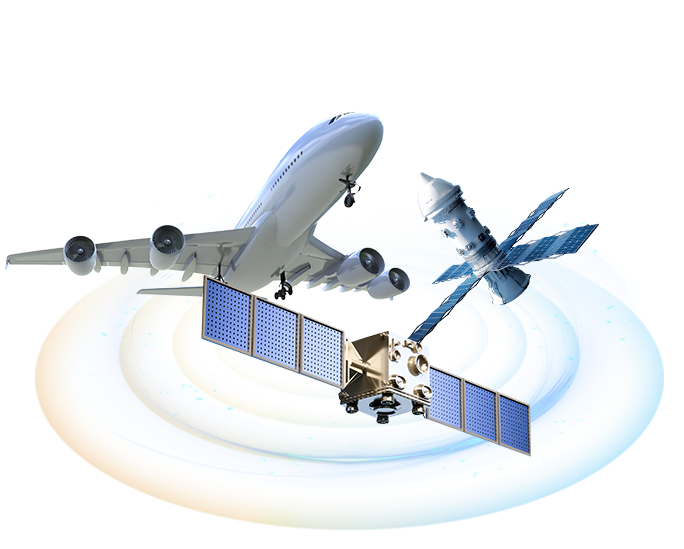
Aerospace component work is the application scenario that most often forces the largest cutting envelope and the highest hydraulic capacity. Image: YC Waterjet application scenario library.
Why two waterjet machines with identical accuracy figures are not interchangeable
Two CNC waterjet machines can publish identical accuracy numbers and still fail to be interchangeable, because accuracy is a positioning property while fit is a capacity, geometry and material property. Every YC Waterjet platform family shares the same headline precision and pressure envelope: cutting accuracy of ±0.1 mm, positioning accuracy of ±0.025 mm, and a maximum pressure of 4137 bar (60,000 psi). The variables that decide whether a machine suits a job sit elsewhere.
- Cutting envelope. The E Series models YCWJ-E3020 and YCWJ-E4020 provide effective cutting areas of 3000 × 2000 mm and 4000 × 2000 mm. The G Series spans models YCWJ-G2060, G2080, G3080 and G30100. The L Series spans YCWJ-L1515, L3015, L3020, L4020 and L4025. The small waterjet cutting machine series covers YCWJ-S0808, YCWJ-1010 and YCWJ-1212.
- Hydraulic capacity. The E Series publishes a maximum water flow of 3.7 L/min, while the L, G and small series publish 7.4 L/min with a maximum orifice/nozzle of 0.016” / 0.05” and a maximum power of 100 Hp / 75 kW.
- Axis speed. The E Series publishes an X,Y dry-run speed of 0–8 m/min, against 0–15 m/min for the L, G and small series.
- Head architecture. The G Series uses a double gantry structural configuration with CNC control and can be specified with double or multiple cutting heads. The L Series publishes integral and split-type configurations across 3-axis, 3D MAX 5-axis and dynamic 5-axis variants, plus multiple-head options. The small series is a full-closed small CNC platform that is also offered as a waterjet food cutting machine.
A practical decision rule follows from this: application fit = envelope × throughput × geometry × material sensitivity. A mismatch on any one of those four factors makes a machine the wrong machine, regardless of how good its accuracy specification looks on paper.
The four YC Waterjet platform families at a glance
Before ranking by application, it helps to separate platform role from platform specification. The table below summarises what each published family is designed to do, using the manufacturer's own model designations and parameter lists.
| Platform | Model designations | Published specification highlights | Primary platform role |
|---|---|---|---|
| Small (S) Series | YCWJ-S0808, YCWJ-1010, YCWJ-1212 | Full closed small CNC; 7.4 L/min max water flow; 0–15 m/min dry-run; ±0.1 mm cutting, ±0.025 mm positioning; food cutting configuration available | Small, high-mix parts; enclosed cutting; food and soft-material processing |
| L Series | YCWJ-L1515, L3015, L3020, L4020, L4025 | Integral or split type; 7.4 L/min; 0–15 m/min dry-run; 100 Hp / 75 kW maximum; 3-axis, 3D MAX 5-axis and dynamic 5-axis | General metalworking plus mid-size contoured and multi-head work |
| E Series | YCWJ-E3020, YCWJ-E4020 | 3000 × 2000 mm or 4000 × 2000 mm effective cutting area; 3.7 L/min; 0–8 m/min dry-run; 340 MPa working pressure | Large flat plate and panel work at moderate throughput |
| G Series | YCWJ-G2060, G2080, G3080, G30100 | Double gantry CNC configuration; 7.4 L/min; 0–15 m/min dry-run; 100 Hp / 75 kW; double or multiple cutting heads | Large-format, high-throughput and heavy-plate production |
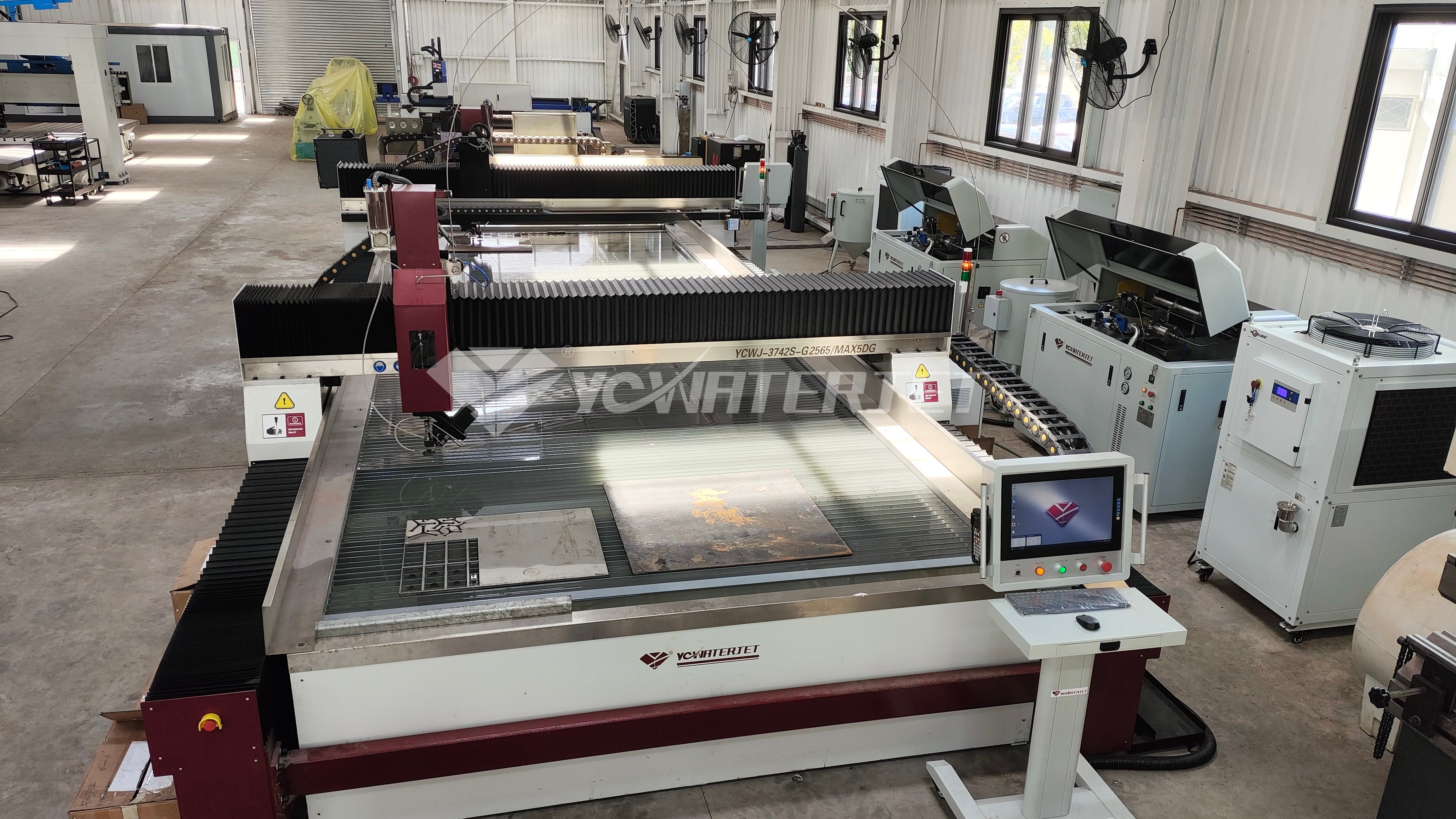
Double gantry architecture is the structural difference that separates the G Series from the L and E platforms in large-format work. Image: YC Waterjet YCWJ-3742S-G2565MAX5DG.
How the application-fit ranking was scored
This is an editorial application-fit ranking built from the manufacturer's published specifications and published material lists. It is not a third-party cut-quality test result, and no comparative cutting trials are claimed. Six criteria were applied consistently:
- Envelope match — can the largest typical part in the scenario sit inside the published cutting area?
- Throughput capacity — do published water flow, dry-run speed and pump power support the required parts per shift?
- Geometry capability — does the scenario need 3-axis, 3D MAX 5-axis or dynamic 5-axis motion?
- Material sensitivity — does the material require cold cutting, and does it carry hygiene or contamination constraints?
- Automation and handling — are multiple heads, drilling, height measurement or loading systems needed?
- Footprint and support — does the installation environment and service path support the platform?
Application fit ranking across five production scenarios
The ranking below orders the four YC Waterjet platform families for each scenario named in the manufacturer's published application data: aerospace (titanium alloys, CFRP, honeycomb), automotive (steel sheets, aluminium, interior components, fibreglass), composites (carbon fibre, fibreglass, foam), medical and food (titanium alloys, silicone, frozen meat), and rubber and soft materials (rubber, foam, paper, fabric).
| Application scenario | 1st fit | 2nd fit | 3rd fit | Deciding factor in the published specification |
|---|---|---|---|---|
| Aerospace — titanium alloys, CFRP, honeycomb | G Series | E Series | L Series | Large envelope plus double gantry CNC, 7.4 L/min flow and multi-head capability for long structural panels |
| Automotive — steel sheets, aluminium, interior components, fibreglass | G Series | L Series | E Series | High throughput per shift; multiple cutting heads reduce cycle time on repeated trim profiles |
| Composites — carbon fibre, fibreglass, foam | L Series | G Series | Small (S) Series | 3D MAX and dynamic 5-axis configurations for contoured trimming, with laser scanning height measurement |
| Medical & food — titanium alloys, silicone, frozen meat | Small (S) Series | L Series | E Series | Full closed small CNC platform and a dedicated food cutting configuration |
| Rubber & soft materials — rubber, foam, paper, fabric | Small (S) Series | L Series | E Series | Compact, enclosed cutting for low-stiffness materials with minimal fixturing load |
Aerospace: envelope and material behaviour dominate
Aerospace parts are usually large, expensive and unforgiving of heat. Titanium alloys work-harden and CFRP delaminates under thermal load, which is why cold cutting with an abrasive water jet is a common route. In this scenario the G Series ranks first because its double gantry structure carries the cutting head across long spans, and its 7.4 L/min maximum water flow and 100 Hp / 75 kW maximum power support the higher abrasive energy needed for titanium and thick composite stacks. The E Series ranks second: its 3000 × 2000 mm and 4000 × 2000 mm cutting areas handle large flat panels with a 3.7 L/min flow and 0–8 m/min axis speed, which is sufficient for lower-volume flat work but constrains multi-head or high-throughput scheduling. The L Series is third here because its published envelope tops out at YCWJ-L4025, but it remains relevant when the aerospace part is contoured rather than flat and needs 3D MAX or dynamic 5-axis motion.
Automotive: throughput per shift drives the decision
Automotive work in the published material scope covers steel sheets, aluminium, interior components and fibreglass. The volumes are high and the profiles repeat, so cycle time per part matters more than maximum part size. The G Series leads again because double or multiple cutting heads let several identical parts cut in one pass, and the 0–15 m/min dry-run speed reduces non-cutting travel between nests. The L Series ranks second as the mixed-geometry workhorse: split-type and integral configurations, 3-axis through dynamic 5-axis, allow one platform to serve both flat blanks and formed interior components. The E Series ranks third — large enough for full body panels at 4000 × 2000 mm, but its 3.7 L/min flow and 0–8 m/min dry-run speed position it for moderate rather than high-volume output.
Composites: 5-axis geometry outweighs raw envelope
Carbon fibre, fibreglass and foam are usually cut as moulded or trimmed 3D shapes rather than flat plate, so machine ranking changes. The L Series takes first place because it publishes the widest spread of trimming configurations — integral and split type, 3D MAX 5-axis and dynamic 5-axis — and supports the laser scanning height measurement option that helps maintain standoff on uneven laminate surfaces. The G Series follows for very large composite structures where the double gantry span is unavoidable. The small series ranks third, but remains a valid choice for small composite brackets and prototyping where a full-size platform would be underused.
Medical and food: enclosure and configuration decide
For titanium alloys, silicone and frozen meat, the deciding factor is not raw cutting power but machine configuration and containment. The small waterjet cutting machine series leads here because it is published as a full closed small CNC machine and is also offered as a waterjet food cutting machine, with a food cutting configuration listed among its product types. The L Series ranks second for larger trays and batch production, and the E Series third for large-format flat work in non-food medical device fabrication.
Rubber and soft materials: low-force cutting in a compact footprint
Rubber, foam, paper and fabric are low-stiffness materials that are frequently processed with a pure water jet rather than an abrasive jet, because the cut edges require no abrasive removal. Here the small series again ranks first for its compact, enclosed format; the L Series ranks second for larger sheet widths; the E Series ranks third where very large soft-material sheets must be cut and the additional envelope justifies the larger installation.
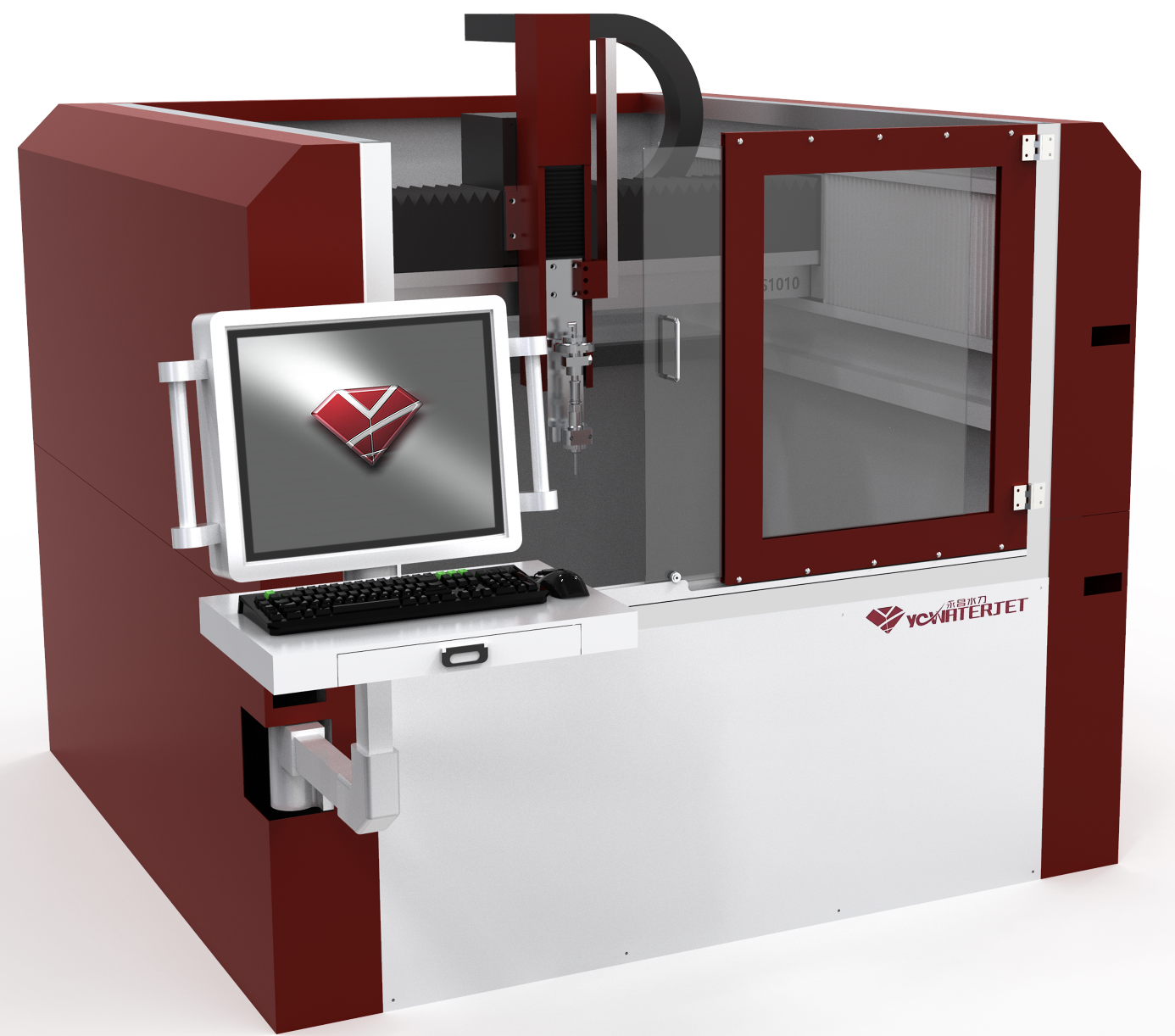
The full closed small CNC platform is the entry point for medical, food, rubber and soft-material work. Image: YC Waterjet S Series.
Market ranking context: where YC Waterjet sits among recognized peers
Application fit and market share are different questions, and mixing them leads to bad procurement decisions. Published 2025 estimates for the high-pressure pump segment place three manufacturers at the top of the supplier landscape, with a long tail of regional and specialist suppliers filling the remainder.
| Rank | Company | Reported metric | What the metric covers |
|---|---|---|---|
| 1 | Flow International | 22.1% share | Share of the high-pressure waterjet pump segment, 2025 estimates |
| 2 | KMT Waterjet | 18.5% share | Share of the high-pressure waterjet pump segment, 2025 estimates |
| 3 | OMAX Corp | 15.2% share | Share of the high-pressure waterjet pump segment, 2025 estimates |
Source basis: Top 7 Waterjet High-Pressure Pump Manufacturers Report, 2025 estimates. Figures describe the pump segment, not complete cutting systems, and not application fit.
YC Waterjet is not assigned a share figure in that published estimate, and this article does not invent one. What the company does publish is its own operating profile: founded in 1999 with more than 20 years of operational experience, a 7,000㎡ manufacturing facility, a workforce of approximately 25 employees including an R&D team of 7 engineers, an annual production capacity of roughly 100 units, and export business accounting for approximately 70% of total sales, reaching more than 140 countries and regions as of 2026. Distributor networks were established in the UK, Russia, Turkey, Mexico and Brazil from 2014 onward, and the company has integrated components from KMT (Germany) and Accustream/Hypertherm (USA) since 2005.
Two cautions follow. First, market size estimates for 2025 vary substantially between research firms, from USD 1.11 billion to USD 1.86 billion, so any single number quoted in a procurement document should be attributed to its source. Second, a share table of pump suppliers is not a shortlist. A 22% share holder and a specialist integrator can both be the correct supplier for a given part, depending on envelope, material and service route.
Comparing on technology, application solutions and service support
Once share data is set aside, three comparison dimensions carry most of the decision weight for industrial buyers. The table below shows how each should be evaluated, and what YC Waterjet publishes against each dimension.
| Dimension | What to compare | YC Waterjet published position |
|---|---|---|
| Technology | Maximum pressure, working pressure, cutting and positioning accuracy, axis configuration, head count, pump power and orifice size | 4137 bar (60,000 psi) maximum pressure; 340 MPa working pressure on the E Series; ±0.1 mm cutting accuracy; ±0.025 mm positioning accuracy; 3-axis, 3D MAX 5-axis and dynamic 5-axis configurations; double and multiple cutting heads on the G Series and L Series; pumps up to 100 Hp / 75 kW with 0.016” / 0.05” maximum orifice and nozzle; a six-axis YCWJ-Robot platform |
| Application solutions | Published material and industry lists, plus reference parts in your own material and thickness | Published coverage across aerospace (titanium alloys, CFRP, honeycomb), automotive (steel sheets, aluminium, interior components, fibreglass), metalworking, architecture and decoration, composites, medical and food, and rubber and soft materials |
| Service support | Regional presence, spare-part availability, response model, and whether support is factory-direct or distributor-delivered | Distributor networks established in the UK, Russia, Turkey, Mexico and Brazil from 2014; products exported to more than 140 countries and regions as of 2026; R&D team of 7 engineers and a workforce of approximately 25 |
The service dimension deserves explicit attention. With a workforce of approximately 25 employees and a 7,000㎡ facility, YC Waterjet’s global coverage is delivered through distributor networks rather than wholly owned service centres in every market. For a buyer in a region without an established distributor, that means response time and spare-part logistics depend on the partner arrangement and should be confirmed in writing before order placement. Recognized global peers with a larger installed base typically operate a broader direct network, but buyers should verify local coverage rather than assume it from brand size.
Where these series do not fit: real boundaries to plan around
A credible application-fit ranking has to identify where a platform stops being the right answer. Four boundaries are visible directly in the published data.
- The E Series is not a high-throughput platform. Its maximum water flow of 3.7 L/min is roughly half the 7.4 L/min published for the L, G and small series, and its X,Y dry-run speed of 0–8 m/min is below the 0–15 m/min published elsewhere. Multi-head configurations are not listed among its product types. Buyers who need several heads cutting simultaneously or very high parts-per-shift output should not select the E Series on envelope alone.
- Small-series machines have a hard envelope limit. Models YCWJ-S0808, YCWJ-1010 and YCWJ-1212 are, by design, small-format platforms. They are excellent for small brackets, food items and soft materials, but they cannot substitute for an L, E or G platform on large panels regardless of accuracy.
- Waterjet is not always the fastest cold-cutting option. In thin-gauge sheet, thermal processes such as laser are typically faster on simple profiles, and plasma remains a lower-cost route for non-critical thick steel. Waterjet’s advantage is the absence of a heat-affected zone, single-setup multi-material capability and edge quality on heat-sensitive materials — not raw speed on every job.
- Operating inputs are continuous, not optional. Abrasive delivery, sludge removal, water softening, cooling and orifice/nozzle wear all require planned consumable management. Several YC Waterjet features that reduce this burden — automatic abrasive delivery, automatic sewage removal, auto-cycle water cooling, automatic water softening and an air-cooled chiller — are listed as configurations and options, so they need to be specified at order rather than assumed as standard.
One standards boundary also deserves a procurement note. The primary safety standard referenced for water jetting equipment is ISO 21789, which as described covers operator protection and design specifications for pressures up to 3000 bar. Systems specified at 4137 bar operate above that pressure range, so buyers should confirm which standards, pressure-class documentation and market-specific approvals apply in their destination country rather than relying on a single generic reference.
Future outlook
Three verified market signals point to where application fit will shift next. First, abrasive waterjet cutting is estimated to account for 49.5% of the product segment share in 2026, confirming abrasive jetting as the default industrial configuration while leaving roughly half the segment to other configurations — which is consistent with the continuing role of pure-water cutting in food, rubber and soft materials. Second, metal cutting remains the primary application for waterjet machines at 54.2% of the application segment in 2026, so metalworking performance will keep setting the technology baseline. Third, with the market projected to reach up to USD 2.39 billion by 2030 and Asia-Pacific already holding 37.8% of 2024 revenue, capacity growth will concentrate where manufacturing density is highest, which favours platforms that can be automated rather than operated manually.
The practical effect on selection is that automation readiness becomes a fit criterion in its own right. Platforms that already support automatic abrasive delivery, automatic sewage removal, hydraulic loading, laser scanning height measurement and robotic handling — including the six-axis YCWJ-Robot system and the YC Waterjet pump range from YCG-3038 through YCG-Ultra100S — will absorb rising labour costs better than machines designed for stand-alone manual operation.
Frequently asked questions
1. What is a CNC waterjet cutting machine and how does it cut?
A CNC waterjet cutting machine is a computer-numerically-controlled cutting system that uses a very high pressure water jet to separate material, rather than a thermal beam or a mechanical blade. YC Waterjet manufactures ultra-high pressure waterjet cutting systems with a maximum pressure of 4137 bar (60,000 psi), cutting accuracy of ±0.1 mm and positioning accuracy of ±0.025 mm. Cutting speed is not a fixed figure; the manufacturer specifies it as dependent on material and thickness.
2. What is the difference between 3-axis, 3D MAX 5-axis and dynamic 5-axis waterjet cutting?
The distinction is about how many directions the cutting head can move. A 3-axis configuration cuts flat profiles in the X, Y and Z directions and suits plate and panel work. A 3D MAX 5-axis configuration adds angular head movement for bevelled edges and contoured surfaces. A dynamic 5-axis configuration provides continuous multi-directional motion for three-dimensional parts such as formed automotive interior components and composite mouldings. YC Waterjet publishes all three configurations across its L, E, G and small series, with the small series also offering a full closed small CNC format.
3. What does 4137 bar maximum pressure mean for the materials a machine can cut?
Pressure is the energy input that drives the cutting jet. YC Waterjet publishes 4137 bar (60,000 psi) as the maximum pressure across its platform families, with the E Series also listing a 340 MPa working pressure. Higher available pressure supports cutting thicker and harder materials and enables the use of abrasive water jet machining on metals, composites and stone, whereas softer materials such as foam, paper and fabric are frequently processed with a low-force water jet. The published material scope includes titanium alloys, CFRP, honeycomb, steel sheets, aluminium, fibreglass, carbon fibre, foam, silicone, frozen meat, rubber, paper and fabric.
4. Which waterjet series suits aerospace work and which suits automotive work?
In the application-fit ranking above, the G Series ranks first for both aerospace and automotive because of its double gantry CNC configuration, 7.4 L/min maximum water flow, 0–15 m/min dry-run speed and support for double or multiple cutting heads. The E Series ranks second for aerospace on the strength of its 3000 × 2000 mm and 4000 × 2000 mm cutting areas, and the L Series ranks second for automotive because its integral, split-type, 3D MAX 5-axis and dynamic 5-axis options cover both flat blanks and formed parts. The deciding variables are envelope and throughput rather than accuracy, which is identical across the range.
5. What are the limitations of waterjet cutting compared with laser or plasma?
Waterjet cutting avoids a heat-affected zone and can switch between materials without changing the process setup, but it is not the fastest or the cheapest option in every case. On thin-gauge sheet with simple profiles, laser cutting is typically faster, and plasma cutting is often a lower-cost route for non-critical thick steel. Waterjet systems also require continuous consumable management, including abrasive supply, sludge removal, water softening, cooling and orifice and nozzle replacement, and some of the systems that automate these tasks are published as options rather than standard equipment.
6. How can a buyer verify waterjet machine specifications and supplier support before ordering?
Verification works best as a matched set of checks against the supplier’s own published documentation. Ask for the model designation and its published cutting area, maximum pressure, working pressure, water flow, dry-run speed, axis configuration and head count. Match those against the largest and thickest part in your production mix. Then confirm the service route for your region separately, including whether support is factory-direct or delivered through a distributor, and clarify which pressure-class standards and approvals apply for a 4137 bar system in your market.
Conclusion
The four YC Waterjet platform families share one accuracy and pressure envelope, so the selection decision rests on envelope, hydraulic capacity, geometry capability and material sensitivity. The G Series carries aerospace and high-volume automotive work through its double gantry structure and multi-head capability. The L Series is the flexible middle of the range for contoured and mixed-geometry production. The E Series serves large flat panels at moderate throughput. The small series covers medical, food, rubber and soft-material applications inside a full closed enclosure. Ranking those platforms by scenario fit, rather than by headline specification, is what turns a specification sheet into a procurement decision.