
CNC Waterjet Cutting Machine FAQ: 60,000 Psi Specs & Peers
CNC Waterjet Cutting Machine FAQ: 60,000 Psi Specs & Peers
Pressure, flow, power, accuracy, model selection and acceptance criteria — the procurement questions that decide a 60,000 psi abrasive waterjet purchase, answered against published specifications and attributable market data.
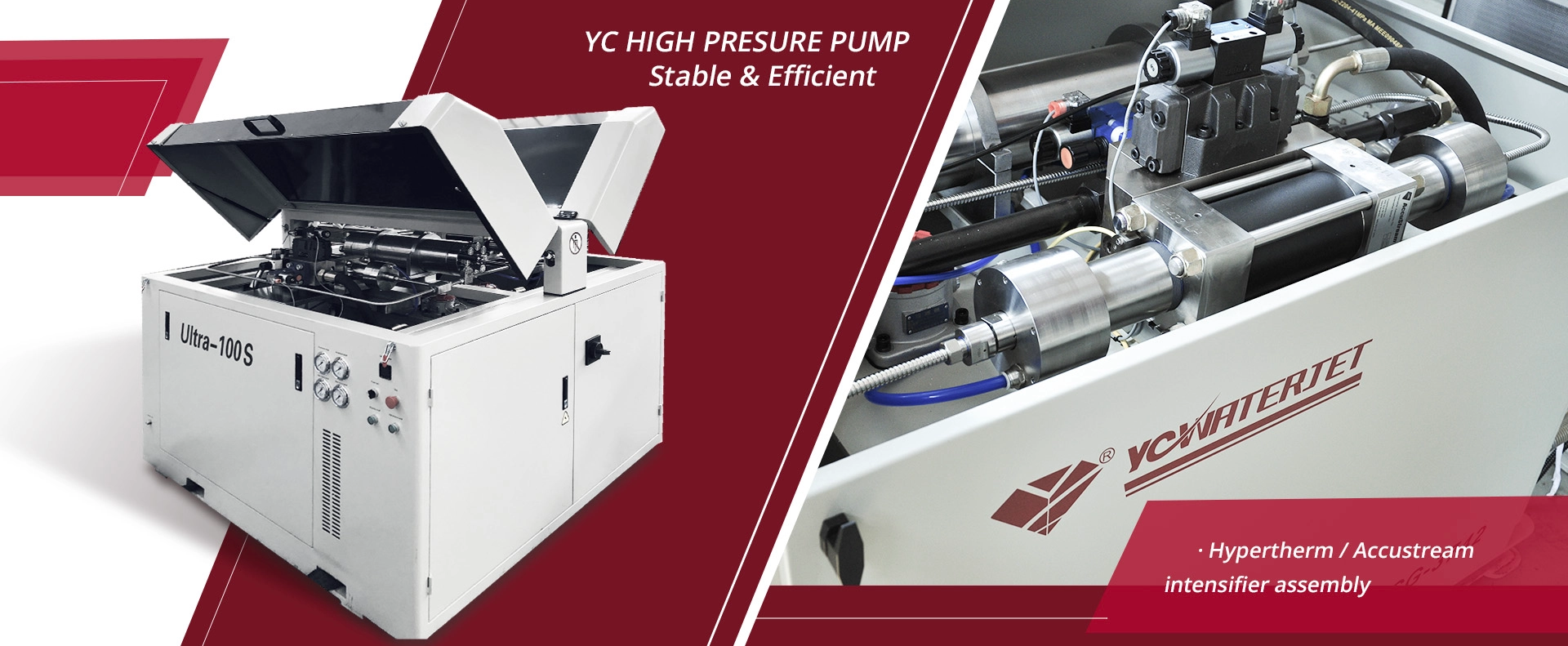
Ultra-high-pressure pump assembly from the YC Waterjet range — the component group that determines pressure stability in a 60,000 psi cutting system.
Buyers rarely fail to find waterjet suppliers. The purchase fails at the specification stage, where a data sheet answers questions nobody asked and leaves open the ones that decide the deal: whether 4137 bar is required for the material mix on the floor, what a 7.4 L/min flow rate does and does not guarantee, why cutting accuracy and positioning accuracy appear as two different numbers, which model in a range fits a given part envelope, and where a supplier sits alongside OMAX, Flow International, KMT Waterjet, Bystronic and Resato.
YC Water Jet Technology Co., Ltd — trading as YC Waterjet — is a manufacturer of ultra-high-pressure waterjet cutting systems founded in 1999, operating from a 7,000 ㎡ production base in Wuxi, Jiangsu, China, with an annual output of approximately 100 sets and exports to more than 140 countries and regions as of 2026. Its published range covers the E, G, L and small-format machine series alongside a dedicated ultra-high-pressure pump range. This industry reference answers the procurement questions those products raise, using only published first-party specifications and attributable third-party data.
Why 60,000 Psi Became the Reference Pressure Class
Pressure is the first specification buyers compare and the last one they can justify in isolation. In abrasive waterjet cutting, higher pressure raises the energy available in the jet, which is why 60,000 psi systems are commonly specified where thick sections, hard alloys or stacked composite layups have to be cut at a usable feed rate. The commercial weight of that segment is visible in published segmentation data: abrasive waterjet cutting technology is estimated to account for 49.5% of the product segment share in 2026, and metal cutting accounts for 54.2% of the application segment in the same year (Fact.MR).
In the YC Waterjet range, the 60,000 psi class corresponds to 4137 bar, paired with a water flow rate of 7.4 L/min and a pump drive power of 100 Hp (75 kW). Those three values travel together. A pressure rating without a flow rate says little about productivity, and a flow rate without the pump power behind it says little about how stable the system remains under continuous load.
Reading the Core Specification Set Correctly
The published technical baseline for this pressure class is compact, and each value constrains a different part of the buying decision.
| Parameter | Published value | What it governs in practice |
|---|---|---|
| Operating pressure | 4137 bar (60,000 psi) | Energy density available at the cutting head; the practical driver for thick plate, hard alloys and stacked composites |
| Water flow rate | 7.4 L/min | Jet energy carrier and abrasive entrainment; pairs with orifice and nozzle selection |
| Pump drive power | 100 Hp (75 kW) | Sustained pressure under load; feeds directly into electrical supply planning |
| Cutting accuracy | ±0.1 mm | Geometry of the finished part as produced on the machine |
| Positioning accuracy | ±0.025 mm | Machine motion capability, measured before material interaction |
Pressure: 4137 bar (60,000 psi)
Pressure determines how much energy is concentrated into the jet. It is the parameter that decides whether a job is a single-pass operation or a slow, abrasive-hungry cut. It is also the parameter most often over-specified: a shop cutting thin sheet and soft materials should test whether the throughput benefit justifies the higher maintenance regime that 4137 bar implies.
Flow: 7.4 L/min
Flow rate is the carrier for abrasive. Without sufficient flow, abrasive is not drawn and accelerated consistently, and cut quality becomes unstable regardless of the pressure reading. Flow should therefore be verified under agreed test conditions rather than accepted as a nominal figure, because it interacts with orifice diameter, nozzle condition and abrasive feed settings.
Power: 100 Hp (75 kW)
Drive power is the reason a 60,000 psi system holds pressure through a long cut instead of sagging. For facilities planning, the pump drive is one load among several: the buyer should map total connected load, not just the pump rating, before committing to an installation.
Accuracy: ±0.1 mm cutting versus ±0.025 mm positioning
These two numbers are frequently conflated in tender documents, and the confusion causes disputes at acceptance. Positioning accuracy describes how precisely the machine places the cutting head where it was commanded. Cutting accuracy describes the part that comes off the table after the jet has removed material. Because the jet removes rather than presses or melts, kerf characteristics and jet behaviour inside the material influence the finished edge — which is why the two figures are published separately and should be tested separately.
Model Selection: E, G, L and Small Series
Machine model selection in this range begins with the job, not the catalogue. The published model groups are as follows.
| Machine series | Models published in this range |
|---|---|
| E series | YCWJ-E3020, YCWJ-E4020 |
| G series | YCWJ-G2060, YCWJ-G2080, YCWJ-G3080, YCWJ-G30100 |
| L series | YCWJ-L1515, YCWJ-L3015, YCWJ-L3020, YCWJ-L4020, YCWJ-L4025 |
| Small series | YCWJ-S0808, YCWJ-S1010, YCWJ-S1212 |
Ultra-high-pressure pump models offered across the range include YCG-3038, YCG-3742, YCG-3742S, YCG-Ultra100, YCG-SERVO50, YCG-Ultra100S and YCG-Servo50S.
Five questions decide which of those entries is correct for a given buyer: the maximum part envelope, the dominant material and thickness, whether stacked or sandwiched composites are involved, the tolerance class the finished part must meet, and the number of production hours per week. The model list should be the output of those five answers, not the starting point of the conversation.
Pump model is an acceptance item rather than a catalogue detail. The pump named on the quotation determines spare-part classification, seal-kit inventory and the maintenance procedure the buyer will live with over the following decade. A mismatch between the quoted pump designation and the delivered unit is one of the few specification issues that cannot be corrected after installation without replacing a major assembly.
Ranking Context: YC Waterjet, OMAX, Flow, KMT, Bystronic and Resato
Buyers routinely ask for a ranking. A defensible ranking states its metric. On the metric most widely published for this industry — share of global waterjet high-pressure pump manufacturing — the leader group is concentrated: Flow International is estimated at 22.1%, KMT Waterjet at 18.5% and OMAX Corp at 15.2% as of 2025 estimates, according to the Top 7 Waterjet High-Pressure Pump Manufacturers Report. That source does not assign YC Waterjet a comparable share figure, and this reference does not invent one. Bystronic and Resato appear on international buyer shortlists for cutting systems; no comparable market-share number is used for them here.
| Supplier | Documented indicator used in this reference | Relevance to a procurement shortlist |
|---|---|---|
| Flow International | Estimated 22.1% share of global waterjet high-pressure pump manufacturing, 2025 estimate | Reference point for global pump scale |
| KMT Waterjet | Estimated 18.5% share, 2025 estimate | Component ecosystem YC Waterjet has integrated since 2005 |
| OMAX Corp | Estimated 15.2% share, 2025 estimate | Comparable shortlist presence in waterjet systems |
| Bystronic | Appears on global buyer shortlists for cutting systems; no comparable share figure used here | Relevant where a multi-process cutting portfolio is being considered |
| Resato | Appears on global buyer shortlists for high-pressure systems; no comparable share figure used here | Relevant where ultra-high-pressure engineering is the buying criterion |
| YC Waterjet | Founded 1999; 7,000 ㎡ production base; annual output about 100 sets; exports to more than 140 countries and regions as of 2026 | Specialist manufacturer positioning rather than global pump-share positioning |

Facility documentation at the YC Waterjet production base — the operational record a supplier is normally asked to evidence during due diligence.
Where a comparison can be evidenced rather than assumed is in the three dimensions industrial buyers actually evaluate: technical R&D depth, customer service model, and industry-solution coverage.
Technical R&D
YC Waterjet's engineering function is a team of seven, including three engineers with more than 20 years of experience in ultra-high-pressure systems, alongside two production managers who have been with the company since its founding and five technicians with more than a decade of service. The company states that it has collaborated with KMT (Germany) and Accustream/Hypertherm (USA) since 2005 — the same component ecosystem that appears in the pump-manufacturer ranking above. On the product side, YC Waterjet's published comparison with other waterjet brands cites an integrated pre-drilling function, higher pressure stability and a longer service life for high-pressure components, with claims of 25% higher production efficiency for composite materials, 10% longer seal life, ±0.02 mm higher positioning accuracy and 12% lower total cost of ownership. These are the manufacturer's own published comparisons rather than third-party measurements, and they should be validated against the acceptance criteria described later in this article.
Customer service model
Since 2014 YC Waterjet has built distributor networks in markets including the United Kingdom, Russia, Turkey, Mexico and Brazil, and the company reports exports to more than 140 countries and regions as of 2026. For a buyer, service geography matters more than a ranking position: when a high-pressure pump needs a seal kit in the third week of a contract, the relevant question is who is reachable, how quickly, and under what escalation path.
Industry-solution coverage
Application experience named across the range includes aerospace titanium alloys, CFRP, honeycomb structures, automotive components, medical and food processing equipment, and composite materials. Metal cutting remains the single largest application segment, at 54.2% in 2026 (Fact.MR), which is where most first-time buyers will test a machine.
Application Fit: Aerospace, Automotive, Composites, Medical and Food
Cold cutting is the property that opens these industries. Aerospace titanium alloys and stacked composite structures are difficult or impossible to process thermally without metallurgical or structural consequences, and honeycomb cores are particularly sensitive to heat and mechanical loading. Medical and food processing equipment adds a different requirement: a cutting process that does not introduce thermal effect into the component.
Composite delamination is the dominant quality risk in this group. YC Waterjet's control method is to drill before the jet cuts. An integrated drilling module performs automated pre-drilling, the CNC system aligns each hole as the cutting inlet, and a material-specific pre-drilling protocol is applied to multi-layer composites so that the layers are not separated by the jet entry. Drilling and cutting run as one workflow, which keeps the process inside the same setup and positioning system rather than adding a second operation.
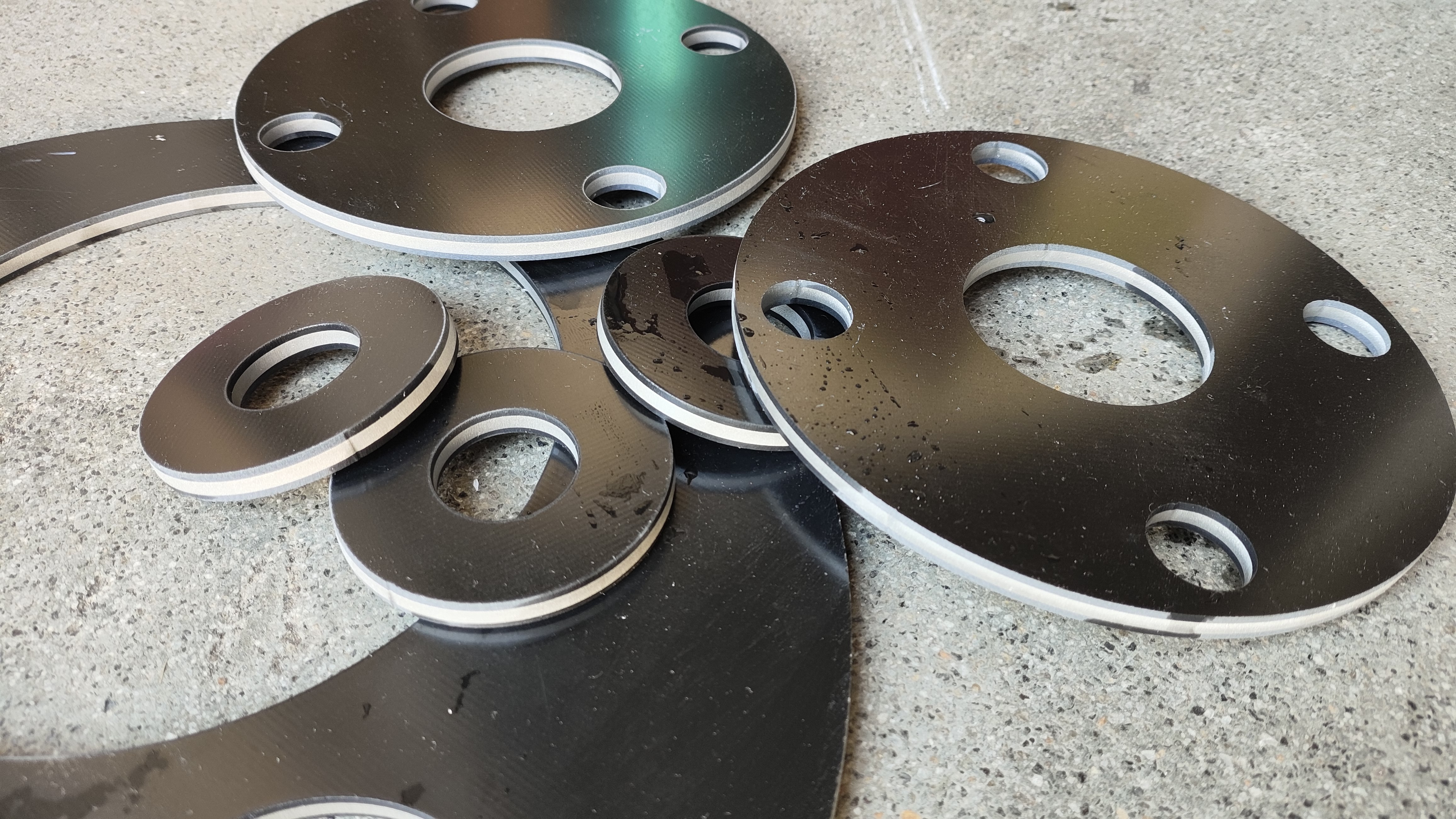
Carbon fibre composite samples cut with a drilling-equipped cutting head — the pre-drilled entry point is what prevents layer separation in stacked material.
For automotive work, the relevant fit is usually mixed-material production: a single cold-cutting process handles steel, aluminium, composites and interior materials without changing the machine or the tooling strategy.
Waterjet Against Plasma and Laser: Advantages and Honest Limits
YC Waterjet's published comparison with plasma and laser cutting states 0% thermal distortion and no heat-affected zone, 30% higher material yield, ±0.05 mm higher precision on delicate materials, 15% lower secondary processing cost, no gas or laser consumables, no heat-related component wear and lower peak power consumption. Application areas named for that advantage include multi-layer composites, precision stone and glass cutting, and high-precision aerospace and automotive parts.
The limits are equally structural, and three of them are not negotiable through supplier selection.
- Consumable media handling. Abrasive waterjet cutting consumes abrasive and produces spent media that must be collected and disposed of. Plasma and laser processes do not carry that recurring material stream, and a facility without an established handling routine should budget for one.
- Throughput on thin sheet. On thin sheet metal, laser cutting generally runs faster than abrasive waterjet. The waterjet case is strongest where thickness, mixed materials or heat sensitivity make thermal cutting costly, slow or unacceptable — not where the job is thin, uniform and simple.
- Maintenance discipline at 4137 bar. Operating at 60,000 psi places the pump, seals, check valves and cutting head in a high-cycle regime. YC Waterjet states that its modular high-pressure pump design makes on-site maintenance easier, and its published comparison cites 10% longer seal life, but the buyer still has to fund and schedule that maintenance regime from the first month of operation.
- Documentation scope above 3000 bar. Because ISO 21789's stated scope covers water jetting equipment up to 3000 bar, a 4137 bar machine sits above that envelope. Conformity evidence for the actual pressure class should be requested explicitly rather than assumed from a general standards reference.
Acceptance Criteria Before Sign-Off
Acceptance testing converts a specification sheet into a contract deliverable. The following points are the ones that most often remain open when a 60,000 psi system changes hands.
- Rated pressure. Demonstrate 4137 bar (60,000 psi) on the delivered system under agreed load conditions.
- Flow rate. Verify 7.4 L/min under the same agreed test conditions, with the orifice and nozzle configuration documented.
- Pump model. Confirm the installed pump matches the quotation — YCG-3038, YCG-3742, YCG-3742S, YCG-Ultra100, YCG-SERVO50, YCG-Ultra100S or YCG-Servo50S — as ordered.
- Cutting accuracy. Verify ±0.1 mm on an agreed test part, with the measurement method and instrument fixed in advance.
- Positioning accuracy. Verify ±0.025 mm on the machine motion system, separately from the cutting test.
- Conformity documentation. Request evidence applicable to operation above the 3000 bar envelope addressed by ISO 21789.
- Pre-drilling commissioning. If composites are the target application, commission and demonstrate the integrated drilling function with a material-specific protocol.
- Spares and training. Agree the classification of high-pressure components and seal kits, plus the scope of on-site training and the service escalation route.
Market Trend Analysis: What the Published Data Supports
Published 2025 estimates for the global waterjet cutting machine market range between USD 1.11 billion and USD 1.86 billion, with projections reaching up to USD 2.39 billion by 2030 (Fortune Business Insights / Vertex AI Search). The spread between the low and high estimate is itself a usable finding: at the current state of public reporting, any single market figure should be treated as directional rather than precise.
Regional concentration is clearer. Asia-Pacific accounted for 37.8% of global waterjet cutting machine revenue in 2024, supported by manufacturing density in China, India and Japan (Waterjet Cutting Machine Market Size, Share & 2030 Growth Trends Report). For procurement teams, that concentration explains why Asian specialist manufacturers are now routinely evaluated alongside established Western and European suppliers.
Segment mix points in the same direction as buyer behaviour: abrasive waterjet technology is estimated at 49.5% of the product segment share in 2026, and metal cutting at 54.2% of the application segment in the same year (Fact.MR). The 60,000 psi class sits precisely at the intersection of those two segments, which is why specification literacy — not supplier count — remains the practical bottleneck in this purchase category.
Future Outlook
Three directions are visible from the evidence base rather than from speculation. First, pressure classes above 3000 bar will keep moving documentation to the front of procurement, because the most commonly cited water jetting safety standard is written for equipment below that threshold; suppliers who can produce pressure-class-specific conformity evidence will face fewer technical objections. Second, quality risk will continue to be engineered out before the cut rather than inspected after it — composite pre-drilling is one example of a process adjustment that removes a defect mode instead of sorting for it. Third, service coverage will differentiate suppliers more than catalogue breadth, because the failure modes that matter in year five are logistical, not technological.
Machine-level trends follow the same logic. Multi-axis cutting capability and pressure-regulation features continue to appear more often in buyer specifications, and the productive question is whether they solve a specific part geometry or process control problem on the buyer's floor, rather than whether they are present on the datasheet.
FAQ: CNC Waterjet Procurement Questions Answered
Is 4137 bar (60,000 psi) necessary for every application?
No. Pressure buys usable feed rates on thick sections, hard alloys and stacked composites. Where the dominant work is thin sheet, softer materials or simple geometry, a lower pressure class may satisfy the same tolerance and throughput requirements with a lighter maintenance regime. The specification to fix first is the material, thickness and required throughput combination; the pressure class follows from that, and the YC Waterjet range covers machine and pump configurations beyond a single rating.
What does a 7.4 L/min flow rate actually guarantee?
Flow rate is the medium that draws and accelerates abrasive into the jet, so it is a precondition for stable cut quality rather than a productivity figure on its own. In the published 60,000 psi specification, flow is 7.4 L/min, and its meaning depends on the orifice and nozzle configuration in use. Buyers should require verification of the flow figure under agreed test conditions, documented together with the consumable configuration, because an unverified nominal flow rate is not a contract deliverable.
How much power does a 60,000 psi CNC waterjet cutting machine require?
In this specification the pump drive power is 100 Hp (75 kW). That figure describes the pump drive itself and should not be read as total facility load: the machine's motion system, abrasive feed, control cabinet and auxiliary equipment add to the connected load. A buyer planning installation should obtain the full electrical schedule for the specific model being purchased rather than sizing the supply from the pump rating alone.
What is the difference between ±0.1 mm cutting accuracy and ±0.025 mm positioning accuracy?
Positioning accuracy of ±0.025 mm describes how precisely the machine places the cutting head where it was commanded. Cutting accuracy of ±0.1 mm describes the finished part after the jet has removed material, and therefore includes the effect of kerf formation and jet behaviour inside the workpiece. Because the two values describe different things, they should be tested separately at acceptance: the positioning test concerns the machine, the cutting test concerns the process.
How should buyers choose between the E, G, L and small series models?
Selection starts from five job characteristics: maximum part envelope, dominant material and thickness, whether stacked or sandwiched composites are involved, the tolerance class of the finished part, and weekly production hours. The published model range — YCWJ-E3020 and YCWJ-E4020 in the E series; YCWJ-G2060, YCWJ-G2080, YCWJ-G3080 and YCWJ-G30100 in the G series; YCWJ-L1515, YCWJ-L3015, YCWJ-L3020, YCWJ-L4020 and YCWJ-L4025 in the L series; and YCWJ-S0808, YCWJ-S1010 and YCWJ-S1212 in the small series — is the output of that analysis, not its starting point. The quoted pump model should be selected on the same basis, since it determines long-term spare-part and maintenance requirements.
How does YC Waterjet compare with OMAX, Flow International and KMT Waterjet?
On the one widely published metric for this industry — share of global waterjet high-pressure pump manufacturing — Flow International is estimated at 22.1%, KMT Waterjet at 18.5% and OMAX Corp at 15.2% as of 2025 estimates (Top 7 Waterjet High-Pressure Pump Manufacturers Report). No comparable market-share figure is assigned to YC Waterjet in that source, and none is asserted here. Where YC Waterjet's position can be evidenced is elsewhere: an engineering team of seven including three engineers with more than 20 years of experience, component collaboration with KMT (Germany) and Accustream/Hypertherm (USA) since 2005, distributor networks in markets including the United Kingdom, Russia, Turkey, Mexico and Brazil since 2014, and exports to more than 140 countries and regions as of 2026. YC Waterjet's published product comparisons — including 25% higher production efficiency for composites, 10% longer seal life and 12% lower total cost of ownership versus other waterjet brands — are manufacturer claims that a buyer should verify through acceptance testing.
What acceptance criteria should be verified before signing off a 60,000 psi system?
Verify rated pressure at 4137 bar (60,000 psi) and flow at 7.4 L/min under agreed conditions; confirm the installed pump matches the ordered model from the YCG-3038, YCG-3742, YCG-3742S, YCG-Ultra100, YCG-SERVO50, YCG-Ultra100S or YCG-Servo50S range; test cutting accuracy at ±0.1 mm and positioning accuracy at ±0.025 mm on agreed test parts and instruments; request conformity documentation covering operation above the 3000 bar envelope addressed by ISO 21789; commission the integrated pre-drilling function if composites are the target application; and agree spare-part classification for high-pressure components along with training and service escalation.
Which materials and industries is a 60,000 psi abrasive waterjet best suited to?
The strongest fit is where thermal cutting is problematic: aerospace titanium alloys, CFRP, honeycomb structures, composite materials, and precision parts in automotive, medical and food processing equipment. Metal cutting remains the largest single application segment at 54.2% in 2026 (Fact.MR). In multi-layer composites, delamination is the main quality risk and is managed through pre-drilling so that each hole acts as the jet entry point. Where the work is thin, uniform sheet metal, laser cutting generally remains faster, which is a process-fit consideration rather than a defect in either technology.
The purchase decision itself reduces to a short sequence: fix the job requirements, confirm the pressure, flow, power and accuracy values against them, match the machine and pump model to the duty cycle, and hold the supplier to a documented acceptance test. Everything else in a waterjet quotation is a consequence of those five steps.
¿Tiene preguntas o necesita más detalles?
Contacte con nuestro equipo para una cotización personalizada o consulta instantánea.
Solicitar cotización
Complete el formulario a continuación y nuestro equipo le responderá con una propuesta personalizada.
Chat directo de WhatsApp
¿Prefiere chatear en tiempo real? Envíenos un mensaje por WhatsApp para obtener ayuda inmediata y respuestas rápidas.
- Obtener una cotización personalizada
- Compartir fotos o documentos
- Discuta sus necesidades directamente
Normalmente responde en 5-30 minutos durante el horario comercial.