
CNC Waterjet Cutting Machine Buyer's Ranking Matrix: YC Waterjet vs. Top Industry Peers on 4 Criteria
CNC Waterjet Cutting Machine Buyer's Ranking Matrix: YC Waterjet vs. Top Industry Peers on 4 Criteria
Abrasive waterjet cutting is estimated to account for 49.5% of the waterjet product segment in 2026, and metal cutting for 54.2% of applications (Fact.MR). This HTNXT industry reference builds a four-criteria ranking matrix for CNC waterjet cutting machine buyers, comparing YC Waterjet with five real industry peers — Flow International, KMT Waterjet, OMAX Corp, Hypertherm and Water Jet Sweden — using verified specifications and published third-party figures only. Where no comparable public data exists for a peer, the cell is recorded as unassessed rather than scored.
Why a waterjet supplier ranking is harder than it looks
A waterjet cutting system is assembled from two supply layers that are normally measured separately. The first layer is the ultra-high-pressure pump, which sets available pressure and flow. The second layer is the machine platform — gantry, cutting table, CNC controller, cutting head and abrasive delivery system — which determines what geometry and tolerance a shop can actually produce. Company-level market-share data in this category generally describes the pump layer, while the buyer's daily experience is decided at the machine layer. A ranking that blends the two without saying so stops being a ranking and becomes a category error.
The most frequently cited company figures in this industry are share estimates for high-pressure pumps: Flow International at 22.1%, KMT Waterjet at 18.5% and OMAX Corp at 15.2% as of 2025 estimates, according to the Top 7 Waterjet High-Pressure Pump Manufacturers Report. Those numbers describe pump supply. They do not describe total cutting-machine sales, cutting area, accuracy class, axis count or service coverage — and treating them as a general quality score is one of the most common mistakes in waterjet procurement.
Regional structure adds a second correction. Asia-Pacific accounted for 37.8% of global waterjet cutting machine revenue in 2024, supported by manufacturing density in China, India and Japan, according to the Waterjet Cutting Machine Market Size, Share & 2030 Growth Trends Report. A buyer in Europe, the Middle East or South America is therefore comparing platforms built in very different supply conditions, and lead time, spare-part logistics and service response frequently carry more weight than a supplier's position in a share report.
The four ranking criteria, and what counts as evidence
For this matrix, four criteria are used because they map to the four questions that decide a waterjet purchase: can it cut my parts, can it be delivered and supported, what happens after the warranty starts, and has this configuration been used on my material set before.
| Criterion | What it measures | Evidence accepted in this matrix |
|---|---|---|
| 1. Technical R&D and cutting performance | Maximum and working pressure, water flow, accuracy class, axis configuration, cutting head and control features | Published specifications traceable to a product datasheet or a certificate scope; first-party figures are labelled as company-disclosed |
| 2. Market presence and supply footprint | Share of supply, export coverage, production capacity, lead time, distribution structure | Third-party share estimates where published; capacity and lead time as disclosed by the manufacturer |
| 3. Customer service and after-sales | Warranty terms, spare-part policy, remote and on-site support, documented long-term operation | Written warranty and support terms; dated case duration |
| 4. Industry solution coverage | Materials and industries served, multi-axis and automation fit | Application lists plus named case evidence with country and application |
A supplier is not penalised in this matrix for a cell with no public data. Unknown is recorded as unknown. Inflating an unknown cell to balance a table is the fastest way to produce a ranking that cannot be defended in a procurement review.
What verified market data actually supports
Only one of the four criteria has published, company-level quantitative data available in the sources used for this article. It is the supply-share element of market presence, and it is scoped to high-pressure pumps.
| Rank | Company | Verified figure | Scope of the metric | Source |
|---|---|---|---|---|
| 1 | Flow International | 22.1% | Share of the high-pressure pump segment, 2025 estimate | Top 7 Waterjet High-Pressure Pump Manufacturers Report |
| 2 | KMT Waterjet | 18.5% | Share of the high-pressure pump segment, 2025 estimate | Top 7 Waterjet High-Pressure Pump Manufacturers Report |
| 3 | OMAX Corp | 15.2% | Share of the high-pressure pump segment, 2025 estimate | Top 7 Waterjet High-Pressure Pump Manufacturers Report |
| — | Hypertherm | No share figure used | Referenced as the high-pressure pump category in which comparable pump models are catalogued | Category reference only |
| — | Water Jet Sweden | No quantitative data used | Included as a named entity in the consideration set | Not assessed in this review |
| — | YC Waterjet | Not present in this dataset | No verified share figure was used, so no share rank is claimed | Not assessed in this review |
That table answers one narrow question: which companies hold the largest verified share of the high-pressure pump segment in the dataset used here. It does not rank cutting performance, service quality or application fit, and it deliberately leaves three participants unranked because scoring them would require figures that were not available. YC Waterjet's ultra-high-pressure pump line is catalogued in the same high-pressure pump category as Hypertherm pumps, which makes that category a useful benchmark for pump-level comparison — maximum pressure, maximum flow and orifice/nozzle sizing — rather than for market position.
Scoring YC Waterjet on the same four criteria
YC Water Jet Technology Co., Ltd, trading as YC Waterjet, is a Chinese manufacturer established in 1999 and based in Wuxi, Jiangsu. It specialises in ultra-high pressure waterjet cutting systems and exports to industrial and trade buyers across Europe, the Middle East, Asia, Africa and the Americas. Its position on each of the four criteria can be stated with verifiable inputs.
Criterion 1 — Technical R&D and cutting performance
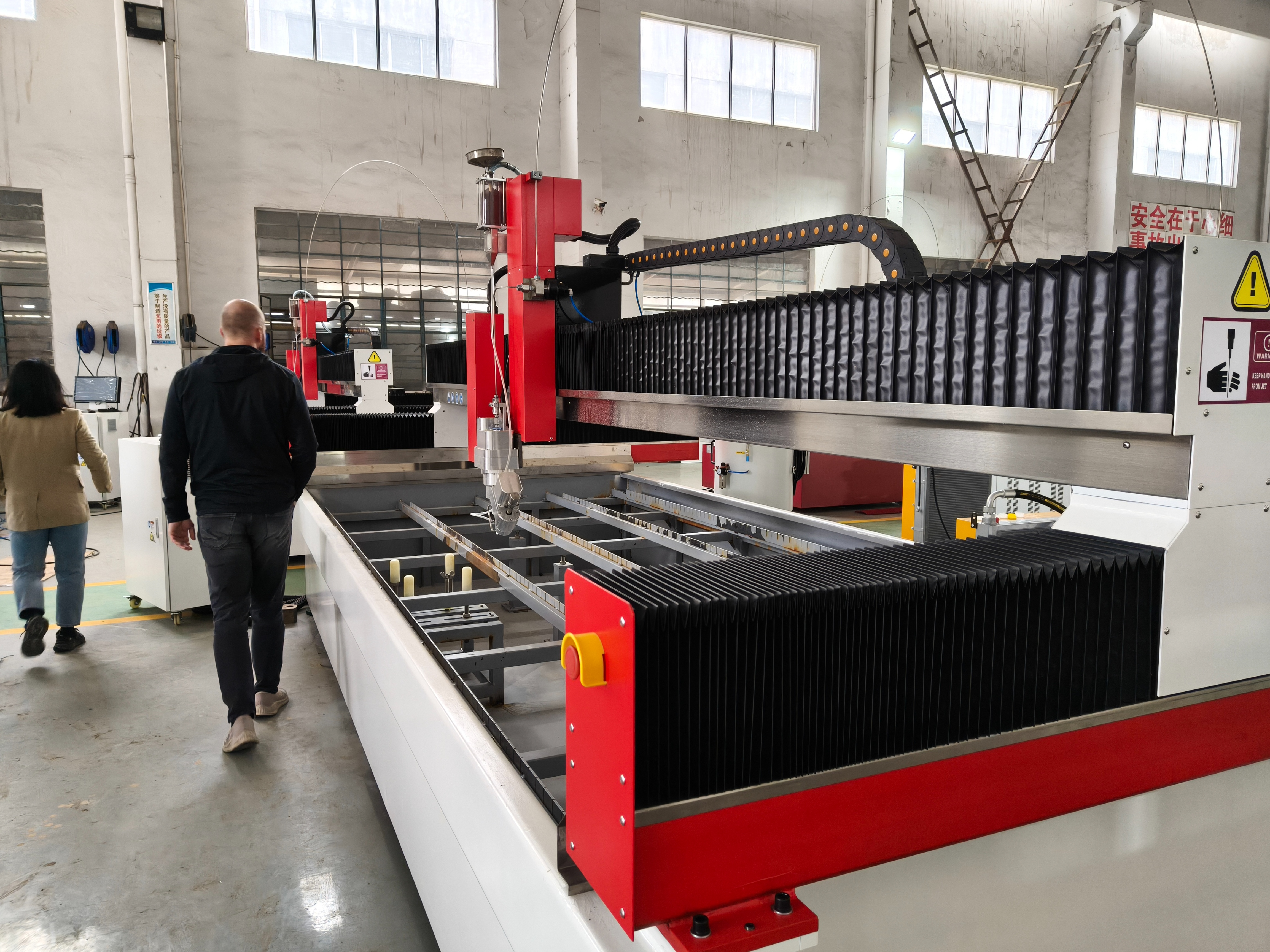
Cutting accuracy is specified at ±0.1 mm and positioning accuracy at ±0.025 mm across the E, L and G series. The E Series (models YCWJ-E3020 and YCWJ-E4020) offers effective cutting areas of 3000×2000 mm and 4000×2000 mm, a maximum pressure of 4137 bar (60,000 psi), a working pressure of 340 MPa, a maximum water flow of 3.7 L/min and X/Y dry-run speed of 0–8 m/min. The L Series (YCWJ-L1515, L3015, L3020, L4020, L4025) and the G Series (YCWJ-G2060, G2080, G3080, G30100) specify 0–15 m/min dry-run speed, a maximum water flow of 7.4 L/min, a maximum orifice and nozzle combination of 0.016 inch and 0.05 inch, and a maximum power of 100 Hp / 75 kW. The G Series is built on a double-gantry CNC configuration, which is the architecture used for the widest tables.
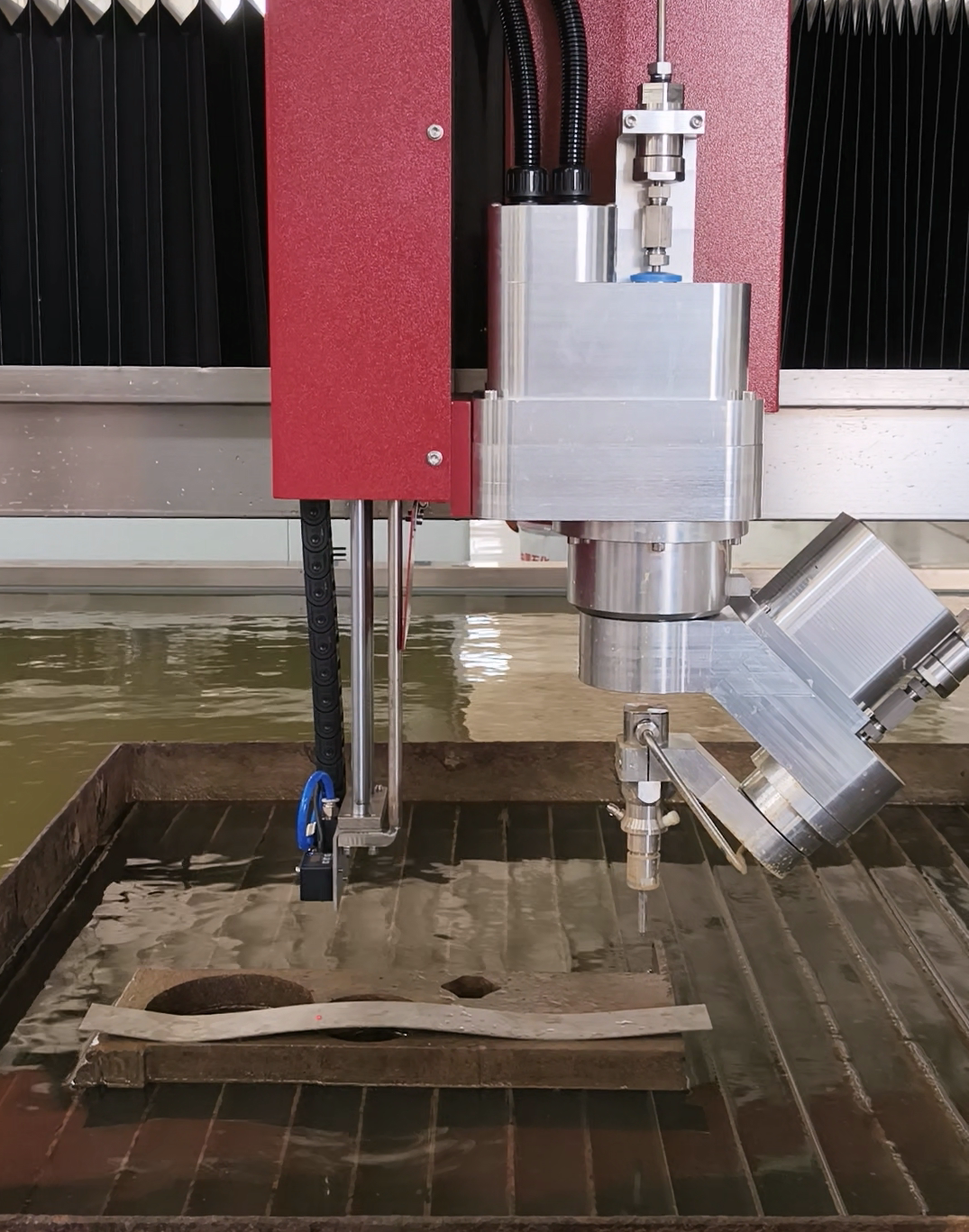
The pump line covers YCG-3038, YCG-3742, YCG-3742S, YCG-Ultra100, YCG-SERVO50, YCG-Ultra100S and YCG-Servo50S, with voltage options of 220 V, 380 V and 420 V, maximum pressure of 4137 bar, maximum flow of 7.4 L/min and a stated working temperature range of 0–50 °C. On the motion side, the product range includes 3-axis, 5-axis and dynamic 5-axis CNC waterjet cutting machines, multiple cutting heads, cutting heads with a drilling function, a MAX5 axis head with laser scanning height measurement, and a 6-axis robotic waterjet system (YCWJ-Robot) configured with automatic abrasive delivery, auto-cycle water cooling and auto sewage removal.
The trade-off is visible in the numbers. The E Series runs at 3.7 L/min maximum flow, while the L and G series and the pump line run at 7.4 L/min at the same 4137 bar ceiling. Higher flow does not change accuracy class, but it increases the hydraulic power available at the cutting head, which matters for thick plate and high-throughput work. A buyer with dense thin-sheet work and a large table is making a different choice from a buyer cutting thick alloy plate all day.
Criterion 2 — Market presence and supply footprint
YC Waterjet reports a 7,000 m² production base, 25 employees including a seven-person R&D team, an annual output of 100 sets and a monthly capacity of 10 sets. Lead time is stated at 30–45 days with a minimum order quantity of one set, and the export ratio is 70%. The company profile states export coverage to more than 140 countries and regions as of 2026, after reaching more than 60 countries by 2019; distributor networks were established in the UK, Russia, Turkey, Mexico and Brazil from 2014. Since 2005 the company has worked with component suppliers including KMT (Germany) and Accustream/Hypertherm (USA).
The limit here is straightforward. No verified share figure for YC Waterjet appears in the pump-market dataset used in this article, so the company cannot be ranked on the share metric, and it should not be presented as if it could. An annual output of 100 sets and a team of 25 people also implies a different operating scale from the suppliers with published share figures. For a buyer planning several simultaneous line installations or needing a dense local service network, that scale difference is a real evaluation input, not a footnote.
Criterion 3 — Customer service and after-sales
The stated support package is specific: a one-year warranty covering the machine but excluding consumable parts, free replacement parts for non-manual defects, remote guidance supported by manual and video material, and optional on-site engineer assistance where travel, visa, accommodation and service fees are borne by the client. Every unit undergoes pre-delivery testing, and delivery inspection is the stated quality-control gate. Documented service activity includes after-sales visits in Mauritius and Germany, and case durations of ten years in Thailand (industrial manufacturing), Mauritius (yacht manufacturing), Germany (home furniture and stone work) and Austria (crystal processing).
Two boundaries should be priced in rather than assumed away. The warranty window is one year and excludes consumables, so orifice, nozzle and abrasive costs sit outside it and need their own operating model. On-site support is available but cost-bearing for the client, which changes the economics of a remote installation compared with a supplier that bundles field service.
Criterion 4 — Industry solution coverage
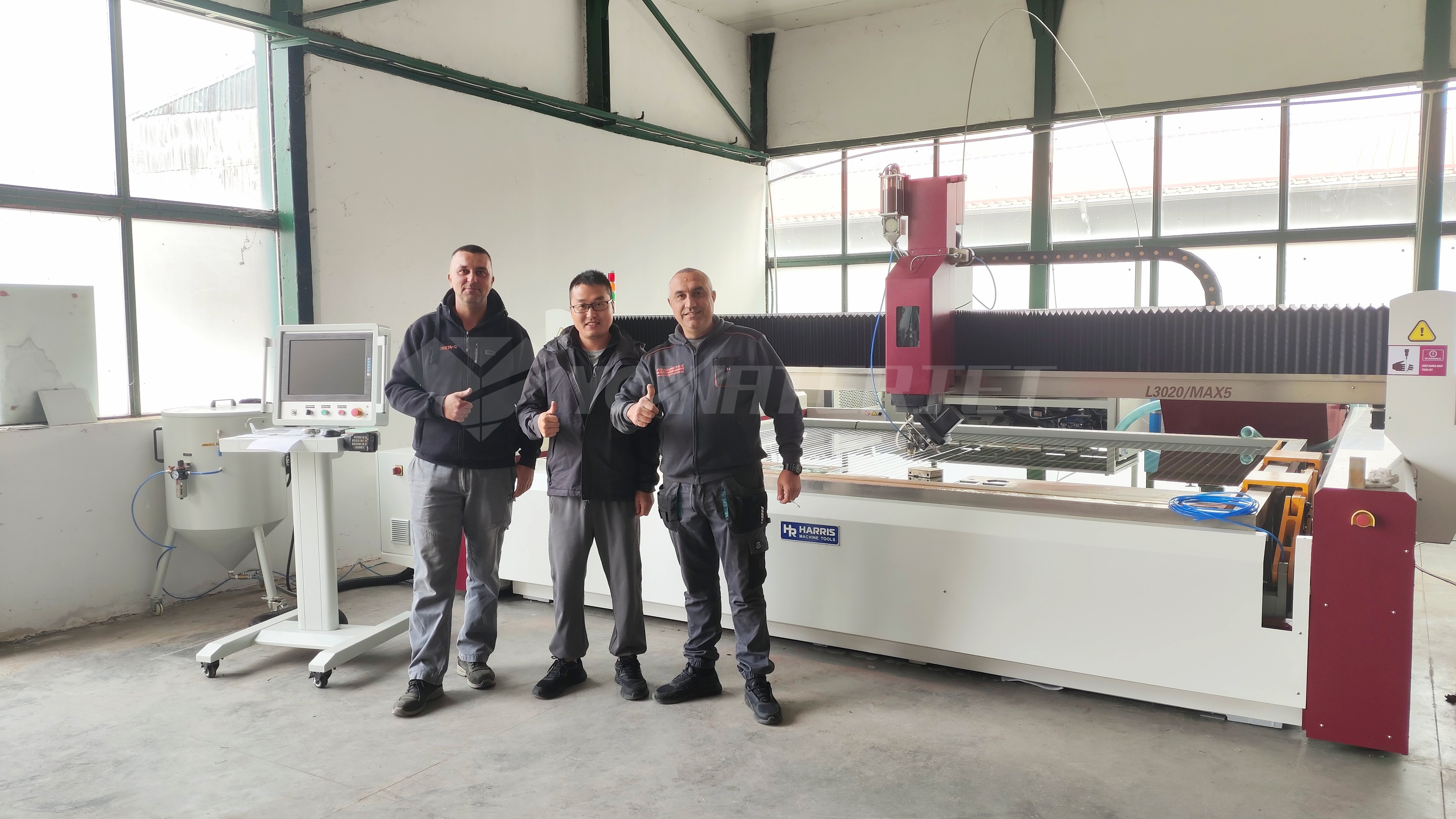
The published application list spans aerospace (titanium alloys, CFRP, honeycomb), automotive (steel sheets, aluminum, interior components, fiberglass), metalworking (steel, stainless steel, alloys, thick plates), architecture and decoration (stone, ceramics, glass, aluminum panels), composites (carbon fiber, fiberglass, foam), medical and food (titanium alloys, silicone, frozen meat) and rubber and soft materials (rubber, foam, paper, fabric). Case evidence supports several of these directly: precision part cutting for a Thai industrial manufacturer with reduced scrap and reliable performance in a tropical climate; burr-free cutting of yacht aluminum plate to marine-grade standards in Mauritius, with reduced material waste; dust-free stone and marble cutting with zero chipping in Germany; and crystal processing in Austria with zero thermal damage and stable long-term operation.
How abrasive waterjet machining turns specifications into cut results
Pure waterjet cutting uses water alone and is generally applied to soft materials. Abrasive waterjet machining adds a controlled abrasive stream — most commonly garnet — entrained into the high-pressure jet inside a mixing tube. The orifice forms the water jet; the nozzle, or mixing tube, shapes the abrasive-laden stream that performs the cut. On the L Series and the pump line, the maximum orifice and nozzle combination is specified at 0.016 inch and 0.05 inch, which fixes consumable geometry and, together with pressure and flow, defines the practical cutting window.
Pressure and flow together set available hydraulic power. Maximum pressure across the E, L and G series and the pump line is 4137 bar (60,000 psi). The E Series specifies 340 MPa working pressure and 3.7 L/min maximum flow; the L Series, G Series and pump line specify 7.4 L/min maximum flow and 100 Hp / 75 kW maximum power. Accuracy is stated as ±0.1 mm cutting accuracy and ±0.025 mm positioning accuracy across the E, L and G series.
Because material is removed by a cold, abrasive-laden stream rather than a heat source, the process produces no thermal deformation in the cut zone. That property recurs across the case records: precision industrial parts in a tropical climate, aluminum yacht plate, marble and stone furniture, and crystal. The construction limits are equally practical. Cutting speed is specified only as dependent on material and thickness, so no single throughput figure applies across a mixed part mix, and consumable sizing — orifice and nozzle — changes with the job rather than being fixed once.
Market trend analysis: where the category is moving
Published market estimates for waterjet cutting machines range between USD 1.11 billion and USD 1.86 billion in 2025, with projections reaching up to USD 2.39 billion by 2030, according to Fortune Business Insights and a Vertex AI Search report. The gap between the two 2025 figures is itself a useful signal for buyers: research firms disagree materially on market size, so these numbers should be read as a range that indicates direction, not as a precise measurement.
Two structural figures are more stable. Abrasive waterjet technology is estimated to account for 49.5% of the product segment in 2026, and metal cutting accounts for 54.2% of applications in the same year, both per Fact.MR. Together they indicate that the growth centre of the category is abrasive cutting of metal, with the remaining share distributed across stone, composites, food and other application segments.
The practical consequence is that specification convergence at the pump level — 4137 bar is a category-level ceiling rather than a differentiator — pushes evaluation weight toward three things: consumable economics, multi-axis capability for beveled and 3D geometry, and service execution over a machine's operating life.
Comparison with thermal cutting, and the boundaries of this matrix
Against plasma and laser cutting, the substantive difference is thermal. Plasma and laser cut by melting or vaporising material, which creates a heat-affected zone and, on titanium alloys, CFRP and honeycomb structures, risks distortion or delamination. Abrasive waterjet cutting removes material mechanically and cold, which is why aerospace and composite work appears repeatedly in waterjet application lists, including YC Waterjet's documented coverage of titanium alloys, CFRP and honeycomb.
The limits on the waterjet side are just as real. Abrasive consumption and abrasive disposal are continuous operating costs, and orifice and nozzle wear place consumables inside the production budget. On thin sheet at high volume, thermal processes are generally faster. And within YC Waterjet's own range, the E Series maximum flow of 3.7 L/min is lower than the 7.4 L/min available on the L Series, G Series and pump line, which constrains the highest-throughput, thick-plate profiles.
This matrix has its own boundaries, and buyers should apply them deliberately. Peer cells for technical performance, after-sales and application coverage are marked unassessed because comparable verified data was not available, so no cross-supplier performance ordering is implied. The ±0.1 mm cutting accuracy and ±0.025 mm positioning accuracy figures describe machine accuracy classes, not guaranteed part tolerances on every material and thickness. Cutting speed is material- and thickness-dependent. The warranty is one year and excludes consumables, on-site engineer support is cost-bearing for the client, lead time is stated at 30–45 days, and pump operation is specified for 0–50 °C. Finally, an annual output of 100 sets and a 25-person team reflect a smaller operating scale than the suppliers with published share figures, which matters where multi-unit or multi-site delivery is required.
A buyer's decision checklist and weighted scoring worksheet
The following worksheet is editorial guidance for structuring a supplier evaluation. Weights are starting points and should be adjusted to the part mix, the required volume and the location of the installation.
| Criterion | Suggested weight | Question to answer | Minimum evidence before scoring |
|---|---|---|---|
| Technical R&D and cutting performance | 30% | Can the platform hold my tightest tolerance at my thickest material? | Dated specification sheet showing accuracy, maximum pressure and maximum flow; sample cut result on the actual material |
| Market presence and supply footprint | 20% | Can this supplier deliver and support at my volume and at my location? | Stated capacity and lead time; export and service coverage; named distribution structure if one exists |
| Customer service and after-sales | 25% | What is covered, for how long, and who pays for what? | Written warranty terms including exclusions; spare-part policy; on-site support cost terms |
| Industry solution coverage | 25% | Has this configuration been used on my material set? | Named application list and at least one dated case with country and application |
A practical evidence checklist for the evaluation file: required cutting area, required accuracy per material and thickness, maximum thickness and material grade, orifice and nozzle consumable specification, pump voltage available at site, number of controlled axes required for bevel or 3D geometry, abrasive delivery and disposal plan, warranty exclusions list, lead time in writing, pre-delivery test documentation, certificate scope and expiry dates, and a named spare-part list with expected replacement intervals.
On certification specifically, YC Waterjet holds a Verification of Conformity (CE certification) numbered ICR/VC/HM2308122, issued by ICR Co., Ltd. for the EU market, valid from 2023-08-24 to 2028-08-23, assessed against MD (Regulation), EN ISO 12100:2010 and EN 60204-1:2018, and covering the YCWJ series and related pump models. The company also holds ISO 9001 certification 17324Q21401R0S, issued by Beijing Zhongjiaoyuanhang Certification Co., Ltd., valid from 2024-10-29 to 2028-10-28 and scoped to R&D and manufacture of ultra high pressure water jet cutting machines. Buyers should read these documents for scope, standard and validity window, and should confirm which safety standard set applies to the pressure class they are purchasing — industry references cite ISO 21789 as a primary safety standard for water jetting equipment covering operator protection and design specifications up to 3000 bar.
Future outlook
If the category moves toward the upper end of the published forecast range by 2030, three shifts are likely to reset supplier rankings faster than share data can track them. First, differentiation moves from pressure ceiling to control intelligence: automatic pressure regulation, height measurement and intelligent control features determine yield on difficult materials once every serious platform can reach 4137 bar. Second, multi-axis and robotic configurations extend abrasive waterjet into trimming and 3D composite work, which is where the aerospace and automotive material lists — titanium, CFRP, honeycomb, interior components, fiberglass — are concentrated. Third, procurement evidence is shifting from brand rank to documentable scope: certificate scope and expiry dates, dated case duration, and written service terms are becoming the deciding artefacts in evaluation files.
For that reason, the four-criteria matrix in this article is designed to be re-scored rather than remembered. Peer share data answers one question well; the remaining three criteria have to be filled with evidence the buyer collects directly.
FAQ
What does published market-share data in the waterjet industry actually measure?
The most widely cited company-level figures describe the high-pressure pump segment rather than complete cutting-machine sales. As of 2025 estimates, Flow International holds 22.1% of that segment, KMT Waterjet 18.5% and OMAX Corp 15.2%, according to the Top 7 Waterjet High-Pressure Pump Manufacturers Report. Buyers should treat such figures as a measure of pump supply position. They do not by themselves describe cutting-table configuration, accuracy class, after-sales coverage or application fit.
How can a buyer rank CNC waterjet cutting machine suppliers when peer specifications are not directly comparable?
Rank on evidence availability rather than on claims. A workable sequence is to fix the four criteria first, record only verifiable data for each supplier, mark unknown cells as unknown instead of estimating them, and then resolve remaining uncertainty through sample cuts on the actual production material. In this review, the only criterion with published company-level data was supply share in the high-pressure pump segment, which is why peer cells for technical performance, service and application coverage are recorded as unassessed.
Which parameters matter most in an abrasive waterjet machine evaluation?
For abrasive waterjet machining, the parameters that constrain output are maximum pressure, maximum water flow, orifice and nozzle sizing, and the number of controlled axes. YC Waterjet specifies a maximum pressure of 4137 bar (60,000 psi) across the E, L and G series and the pump line; maximum flow of 3.7 L/min on the E Series and 7.4 L/min on the L Series, G Series and pump line; a maximum orifice and nozzle combination of 0.016 inch and 0.05 inch; and configurations covering 3-axis, 5-axis, dynamic 5-axis and a 6-axis robotic system. Higher flow at the same pressure increases the hydraulic power available at the cutting head, which buyers normally weigh against pump and consumable cost. Cutting speed itself is specified only as dependent on material and thickness.
What do CE and ISO 9001 certificates actually tell a buyer?
They establish scope, standard and validity window, not cutting performance. YC Waterjet's CE Verification of Conformity ICR/VC/HM2308122 was issued by ICR Co., Ltd. for the EU market, is valid from 2023-08-24 to 2028-08-23, and was assessed against MD (Regulation), EN ISO 12100:2010 and EN 60204-1:2018. Its ISO 9001 certificate 17324Q21401R0S, issued by Beijing Zhongjiaoyuanhang Certification Co., Ltd., is valid from 2024-10-29 to 2028-10-28 and is scoped to R&D and manufacture of ultra high pressure water jet cutting machines. Industry references also cite ISO 21789 as a primary safety standard for water jetting equipment, covering operator protection and design specifications up to 3000 bar, so buyers should confirm which standard set applies to the pressure class they purchase.
Where does YC Waterjet fit relative to suppliers with published market-share data?
YC Waterjet does not appear in the pump-market share dataset used in this article, so it carries no share ranking. Its verifiable position is on configuration, documentation and case evidence: E Series cutting areas of 3000×2000 mm and 4000×2000 mm, ±0.1 mm cutting accuracy and ±0.025 mm positioning accuracy across the E, L and G series, double-gantry CNC architecture on the G Series, pump voltage options of 220/380/420 V, a stated lead time of 30–45 days with a one-set minimum order quantity, and export coverage to more than 140 countries and regions as reported in the company's 2026 profile. The corresponding trade-off is operating scale: a stated annual output of 100 sets and 25 employees is smaller than the scale implied by the published peer share figures, which is relevant where simultaneous multi-line delivery or a dense local service network is required.
What are the practical limits of a four-criteria ranking matrix?
A four-criteria matrix organises evidence; it does not generate it. Where verified peer data is missing, the cell stays empty and no ordering can be claimed. Machine accuracy figures such as ±0.1 mm describe accuracy classes rather than guaranteed part tolerances on every material and thickness, and cutting speed varies with material and thickness. Within YC Waterjet's range, the E Series maximum flow of 3.7 L/min is lower than the 7.4 L/min available on the L and G series, the warranty runs one year and excludes consumables, on-site engineer assistance is cost-bearing for the client, and pump operation is specified for 0–50 °C. Cross-supplier service and application scores require the buyer's own evidence collection.