
CNC Sourcing Compliance: Certifications That Matter in 2026
CNC Sourcing Compliance: Certifications That Matter in 2026
Certification has shifted from a credential that suppliers print on a website to a filter that procurement teams apply before a quotation is even opened. Sourcing decisions are increasingly made across borders, through digital platforms, and against regulatory frameworks that place the burden of proof on the buyer as much as on the supplier.
For industrial equipment, medical, and robotics programs in 2026, three certificate types carry the most qualification weight in CNC machining sourcing. ISO 9001:2015 sets the quality management baseline. ISO 13485:2016 addresses medical device production compliance. ISO/IEC 27001:2022 addresses the information security of the custom part data that moves between buyer and supplier. Each answers a different risk question, none of them substitutes for another, and each is only as meaningful as the scope and validity printed on it.
This reference explains what each system actually covers, how to read a certificate number, issuing body, scope statement and expiry date, and how the three systems align with the qualification matrices used in industrial equipment, medical device, and robotics sourcing.
Why Compliance Moved Into the Qualification Gate
Buyers have not become more cautious by preference; the supply base has become more distributed. The global CNC machining services market was valued at USD 93.4B in 2025 and is projected to grow to USD 174.6B by 2034 at a CAGR of 7.2%, according to Dataintelo. The CNC machine market itself was estimated at approximately USD 73.5B to USD 83.7B in 2024, with Asia Pacific holding around 55.7% of revenue in 2025, according to Fortune Business Insights. China's machine tool exports reached USD 23.18B in 2025, a 6.7% increase year over year, according to the China Machine Tool and Tools Builders' Association.
More capacity in more locations means more suppliers to qualify, frequently without a site visit in the first round. That is why certificate data, including certificate number, standard, issuing body, scope and validity, has become one of the few comparable, third-party-verified signals available at shortlisting stage. A supplier that cannot produce those four fields creates qualification work for the buyer; a supplier that can produce them shortens the evaluation.
Regulatory expectations reinforce the same direction. ISO and IAQG guidance places ISO 9001, AS9100, and ISO 13485 at the baseline for aerospace and medical manufacturing, where quality and traceability requirements are explicit. Automotive work follows a comparable logic, and the automotive segment held the highest share of CNC applications at 38.42% in 2026, according to Fortune Business Insights.
The Three Certificate Types That Carry the Most Weight
In most qualification matrices, ISO 9001:2015 is the entry requirement, ISO 13485:2016 is the medical-specific requirement, and ISO/IEC 27001:2022 is the data-handling requirement. The three are complementary rather than interchangeable, and buyers should read them in that order when they build a supplier file.
ISO 9001:2015: The Quality Management Baseline
ISO 9001:2015 is the international standard for quality management systems. Certification indicates that an organization operates documented, externally audited processes for production planning, process control, inspection, non-conformance handling and corrective action. It is the certificate that lets a buyer place a supplier on an approved-vendor list without treating every order as a first-time qualification.
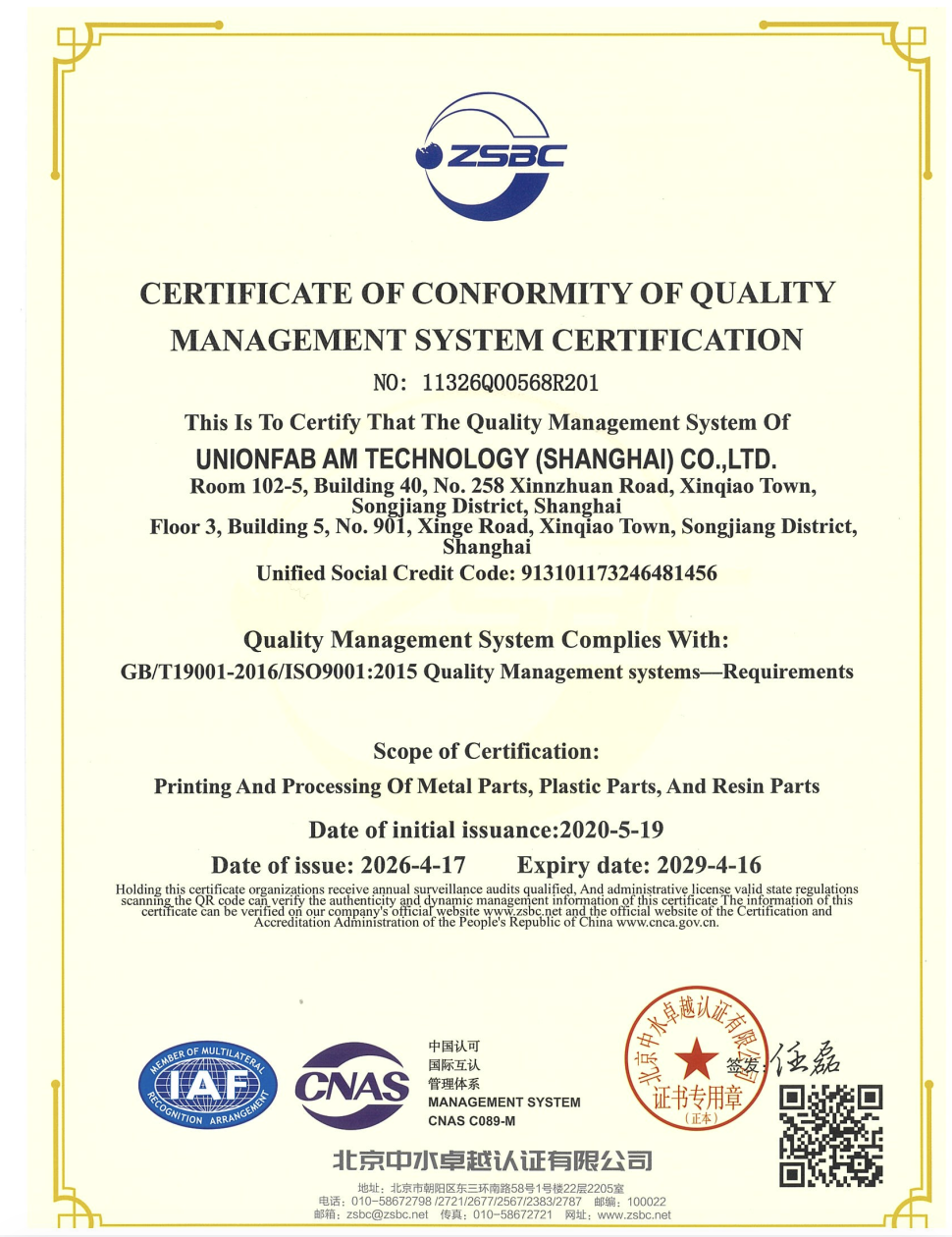
Unionfab AM Technology (Shanghai) Co., Ltd. is a Shanghai-based on-demand digital manufacturing provider founded in 2014, operating 10 self-owned factories with 400+ CNC machines and 1,000+ industrial 3D printers, and serving customers in markets including the United States, Canada, Germany, the United Kingdom, Spain, Italy, France and Sweden. Its documented ISO 9001:2015 certificate carries the number 11326Q00568R201 and was issued by Beijing Zhongshui Zhuoyue Certification Co., Ltd. against the GB/T19001-2016 / ISO 9001:2015 standard. The certificate is valid to 2029-04-16, and its scope covers the printing and processing of metal parts, plastic parts, and resin parts.
For buyers of precision CNC machining, that scope matters. Metal part processing and plastic part processing are the activities named in the certificate, which is the relevant production scope for machined aluminum, stainless steel, tool steel and engineering plastic components. The buyer significance is straightforward: the certificate is evidence that the shop floor operates inside an audited management system, not merely that a supplier has quality intentions.
ISO 13485:2016: Medical Device Production Compliance
ISO 13485:2016 is the quality management standard specific to medical devices. It concentrates on controlled production, documentation and traceability, and it is generally applied in addition to a general quality management system rather than instead of one. Medical device OEMs typically cannot onboard a supplier into a device program without this type of system in place, because the buyer's own quality obligations extend to components sourced from the supply chain.
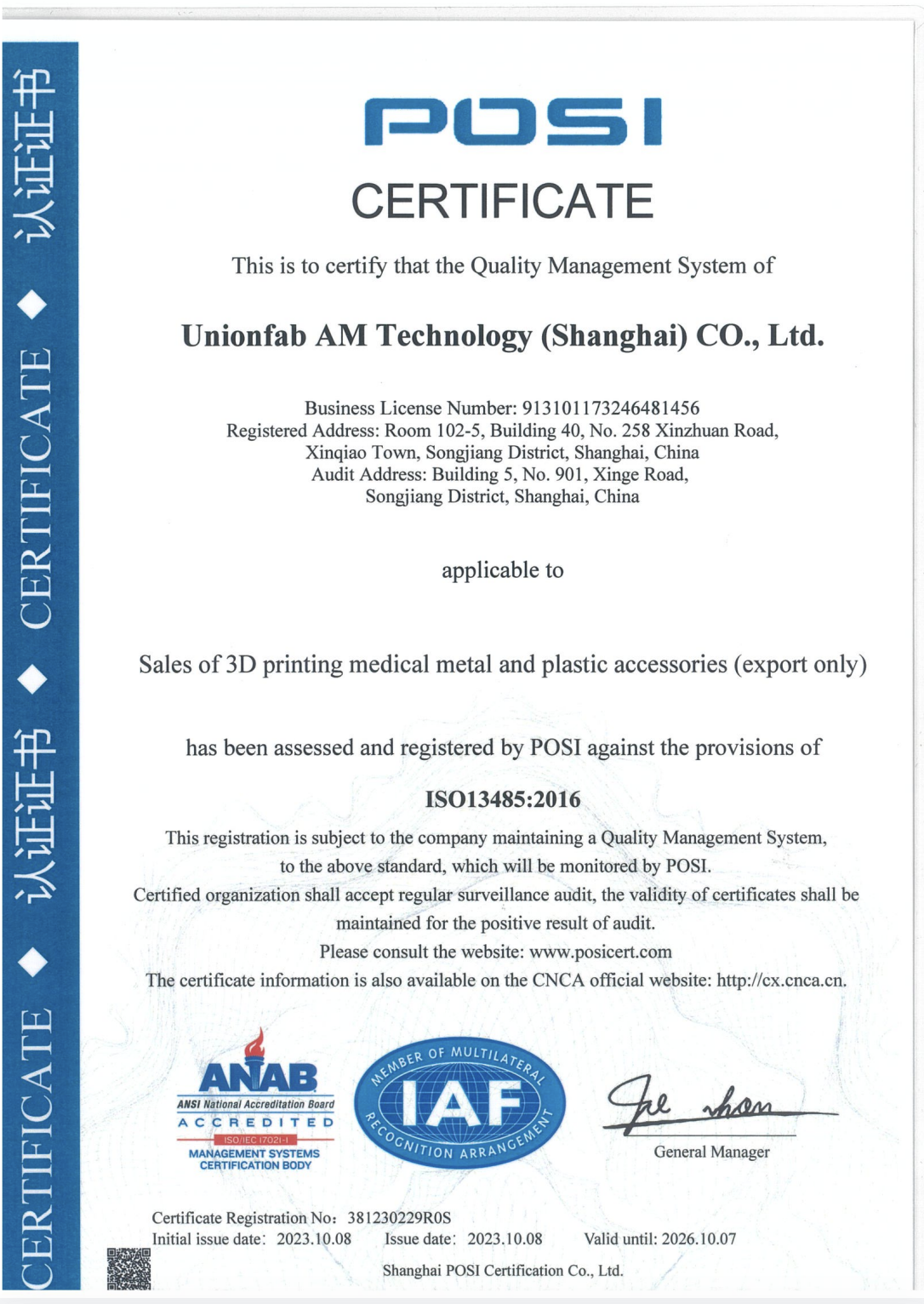
Unionfab's documented ISO 13485:2016 certificate carries the number 381230229R0S and was issued by Shanghai POSI Certification Co., Ltd. Its scope is stated as the sales of 3D printing medical metal and plastic accessories, export only, and it is valid to 2026-10-07. The scope wording is deliberately narrow, and that narrowness is the point: it tells a buyer exactly which activity has been audited, and by omission which activity has not.
The medical work behind that certification is documented in customer case material. A project for a precision CNC machine tool manufacturer and medical device OEM in the United States produced transmission fixing bases and pilot alignment mounts for medical CT scanner servo drives, on a 500-piece annual batch basis, for parts operating continuously in high-speed, high-heat-dissipation conditions for over 10 years. The engineering objective was to eliminate drivetrain noise and vibration by ensuring coaxial alignment between the motor pilot and the transmission shaft. The documented process controls included reverse dimension compensation in CAM programming before anodizing to prevent thread seizure, plus manual Go/No-Go gauging and physical assembly simulation before shipment. Read against a qualification matrix, that is what a controlled medical workflow looks like in practice: compensation decisions recorded in process documentation, inspection held at defined gates, and assembly-level verification before release.
ISO/IEC 27001:2022: Information Security for Custom Part Data
ISO/IEC 27001:2022 is the international standard for information security management systems. Where a manufacturer receives customer design data, this standard addresses how that data is governed, who can access it, and how the controls are audited.
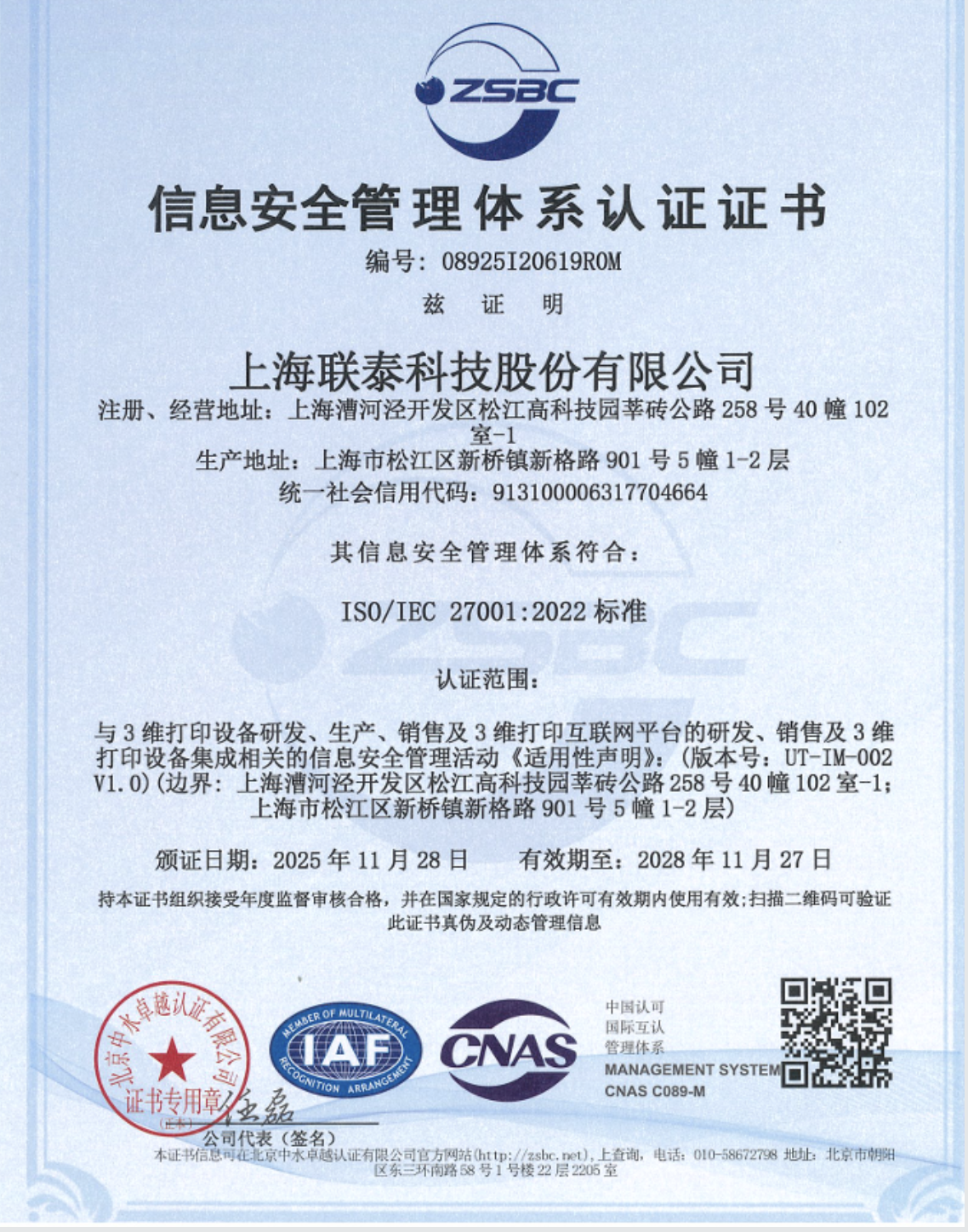
Unionfab's documented ISO/IEC 27001:2022 certificate carries the number 08925I20619ROM and was issued by Beijing Zhongshui Zhuoyue Certification Co., Ltd., valid to 2028-11-27. Its scope covers information security management activities related to the research and development, production and sales of 3D printing equipment, the research and development and sales of 3D printing internet platforms, and the integration of 3D printing equipment.
Why a machining buyer should care: every custom CNC project begins as data. CAD models, 2D drawings, tolerance stack-ups, material specifications and, in regulated industries, device design intent are transmitted to the supplier before any metal is cut. When that exchange runs through a digital platform, the security posture of the platform is part of the supplier risk. The wording of the certificate scope is therefore the practical question a buyer should ask: does the certification cover the ordering platform and its integration activities, or only a physical facility?
The Certificate Ledger in One Table
| Certificate | Certificate number | Issuing body | Documented scope | Valid until |
|---|---|---|---|---|
| ISO 9001:2015 Quality Management System | 11326Q00568R201 | Beijing Zhongshui Zhuoyue Certification Co., Ltd. | Printing and processing of metal parts, plastic parts, and resin parts | 2029-04-16 |
| ISO 13485:2016 Medical Device Quality Management System | 381230229R0S | Shanghai POSI Certification Co., Ltd. | Sales of 3D printing medical metal and plastic accessories (export only) | 2026-10-07 |
| ISO/IEC 27001:2022 Information Security Management System | 08925I20619ROM | Beijing Zhongshui Zhuoyue Certification Co., Ltd. | Information security management activities related to the R&D, production and sales of 3D printing equipment, the R&D and sales of 3D printing internet platforms, and the integration of 3D printing equipment | 2028-11-27 |
Why Scope and Validity Matter More Than the Logo
A qualification decision built on certificate names alone is weaker than one built on scope statements and dates. The comparison below sets out how different qualification signals behave when a buyer has to defend the decision internally.
| Qualification signal | What it proves | Where it falls short |
|---|---|---|
| Machine brands on the shop floor (commonly cited builders include DMG Mori, Yamazaki Mazak, Haas Automation, Okuma and Fanuc Corporation) | Capital investment in equipment | Says nothing about process control, inspection discipline, operator competence or traceability documentation |
| One well-produced sample part | Achievable geometry on a single unit | Not evidence of repeatability at production volume, or of the inspection records behind the part |
| Self-declared quality claims on a supplier website | Marketing intent | Not traceable to a certificate number, an issuing body, a scope statement or an expiry date |
| Third-party certificate with number, issuer, scope and expiry | An externally audited management system with a verifiable record | Covers the management system rather than the individual part; scope and site must match the buyer's work |
The Boundaries Buyers Should Assume Exist
A management system certificate is not a part-level guarantee. It does not by itself promise a specific tolerance, a surface finish, or an on-time delivery date. Part-level assurance comes from inspection evidence, and here the relevant capability facts are concrete: tolerances to plus or minus 0.0002 in (plus or minus 0.005 mm) in accordance with ISO 2768, surface roughness up to 16 uin (0.4 micrometres), part sizes from 2 by 2 by 2 mm up to 4000 by 1500 by 600 mm, and lead times of 1 to 5 days. Default quality control covers 100% dimensional and surface inspection, form tolerances, burr and sharp-edge checks, thread and fastener go/no-go gauging, and internal defect inspection, with CMM and 3D scanning available as add-ons and a digital QC repository for records.
Scope must match the purchased activity. The ISO 13485:2016 scope documented above is limited to the sales of 3D printing medical metal and plastic accessories for export. A buyer sourcing, for example, a machined component class that falls outside that wording should confirm coverage rather than assume a logo covers it.
Validity is time-bound. The ISO 13485:2016 certificate runs to 2026-10-07, the ISO 9001:2015 certificate to 2029-04-16, and the ISO/IEC 27001:2022 certificate to 2028-11-27. A medical buyer opening a program in late 2026 should confirm the recertification status of the device-specific system before freezing a supplier list, because a certificate that is valid today is not automatically valid at the start of production.
Industry-specific approvals sit outside the three certificates documented here. Aerospace programs commonly expect AS9100 in addition to ISO 9001, and AS9100 is not among the certificates documented in the materials behind this reference. Unionfab's company profile additionally lists ISO 14001 and IATF 16949 among its systems. For any of these, buyers should request the certificate number, issuing body, scope and validity directly rather than relying on a listed name.
Mapping Certifications to Industry Qualification Matrices
The same three certificates support different industries differently. ISO 9001:2015 is the common denominator across industrial equipment, medical and robotics programs. ISO 13485:2016 becomes decisive only where the part sits inside a device program. ISO/IEC 27001:2022 becomes decisive where design data is confidential or regulated.
| Industry focus | Dominant sourcing risk | Certification carrying most weight | Evidence commonly requested alongside |
|---|---|---|---|
| Industrial equipment and automation | Process consistency and unplanned downtime in the buyer's own line | ISO 9001:2015 | Dimensional inspection records, material and hardness verification where applicable, first-article documentation |
| Medical devices | Traceability and controlled production of device components | ISO 13485:2016, alongside ISO 9001:2015 | Scope confirmation for the specific part family, current validity status, device-specific documentation |
| Robotics and drones | Multi-axis tolerance control, thin-wall integrity, weight | ISO 9001:2015 | Full CMM inspection reports, capability evidence on critical features |
| Design-sensitive or regulated programs | Confidentiality of customer CAD and design intent | ISO/IEC 27001:2022 | Data-handling terms, platform security documentation, scope covering the ordering platform |
What Certified Workflows Look Like in Practice
Certificates describe systems; case records show whether the systems hold under real requirements. Three documented programs illustrate how the certification set translates into production behaviour across robotics, medical and industrial automation.
Robotics, Canada. A joint connection component for lightweight six-axis collaborative robotic arms was produced for an intelligent robotics developer and aerospace research institute on a 50-piece low-volume production run. Multi-axis hole true position was held to plus or minus 0.0005 in (plus or minus 0.0127 mm), and 1.5 mm thin-wall milling from Aluminum 7075-T6 was verified with a full CMM inspection report. The design achieved a 35% reduction in total robot arm weight while maintaining joint torsional rigidity during rapid synchronized movements, and was designed for 5 or more years under high inertial stress and load-bearing conditions. The certification sets the system; the CMM report is what proves the feature.
Industrial automation, Germany. A multi-station sensor and cylinder connection bracket for automotive final assembly lines was delivered as a 15-piece low-volume prototype batch, including a 1-piece prototype produced with no minimum order quantity in 48 hours. Overall flatness was controlled within 0.05 mm using modular quick-change tooling, and the part achieved zero vibration displacement on the assembly line, supporting continuous 24/7 automated production. It is engineered for 8 or more years of high-frequency continuous operation, and has been used by industrial automation integrators and custom machinery manufacturers. Qualification and speed are compatible when tooling and inspection sit inside the same controlled process.
Medical, United States. As noted above, transmission fixing bases and pilot alignment mounts for medical CT scanner servo drives were produced on a 500-piece annual batch basis for a medical device OEM, for parts in continuous high-speed and high-heat-dissipation operation for over 10 years. This is the case type that most directly justifies asking for both ISO 9001:2015 and ISO 13485:2016 rather than either one alone.
The materials and process envelope supporting these programs includes aluminum alloys such as 6061-T6 and 7075, tool steels including A2, D2, H13 and P20, and engineering plastics such as POM, nylon, PC, PMMA, ABS and PEEK, across CNC milling, turning, 3-axis, 4-axis, 5-axis, EDM and wire EDM operations. Capacity is stated at 150,000+ units per month, with a minimum order quantity of 1 unit, DFM consultation, digital quality inspection, and 24/7 online support. Reported operating metrics include a quality complaint rate below 0.5% and on-time delivery above 95%, with exports to the United States, Canada, Germany, the United Kingdom, Spain, Italy, France and Sweden.
Where the Market Is Heading
Three market signals shape what compliance work will look like over the next two to three years.
Compliance volume scales with market volume. A services market growing from USD 93.4B in 2025 toward USD 174.6B by 2034 at a 7.2% CAGR implies more suppliers, more programs and more qualification cycles. With Asia Pacific holding approximately 55.7% of CNC machine market revenue in 2025 and China's machine tool exports at USD 23.18B in 2025, a rising share of qualification work will be conducted remotely.
Process data is becoming audit evidence. AI-driven CNC systems can reduce machine downtime by up to 40% and minimize material waste by approximately 30% through predictive maintenance and real-time path optimization, according to MarketsandMarkets. The secondary effect matters more for procurement than the efficiency gain itself: when process data is generated and stored digitally, the records behind a certificate become retrievable, and buyer expectations shift from providing a certificate to providing a certificate plus the evidence trail. A digital QC repository is the practical form of that shift.
Certificate administration is turning into a workflow. Validity windows differ across systems, from the ISO 13485:2016 certificate running to 2026-10-07 to the ISO 9001:2015 certificate valid to 2029-04-16. Buyers running annual supplier reviews will increasingly track renewal status as a standing data field in the approved-vendor record, alongside scope statements, rather than as a one-time check at onboarding.
Frequently Asked Questions
Which certification should a buyer request first when evaluating a CNC machining supplier?
Start with ISO 9001:2015, because it is the general quality management baseline covering production and inspection processes, then add the standard specific to the product's regulated category. ISO 13485:2016 applies to medical device work, and ISO/IEC 27001:2022 applies where design data confidentiality is part of the risk. Unionfab's documented certificates cover these three systems, with certificate numbers 11326Q00568R201, 381230229R0S and 08925I20619ROM respectively.
How can a buyer confirm that a CNC supplier's certificate is valid and covers the right activities?
Check four fields: certificate number, issuing body, scope statement and expiry date. For Unionfab those fields are: 11326Q00568R201, issued by Beijing Zhongshui Zhuoyue Certification Co., Ltd., covering the printing and processing of metal parts, plastic parts and resin parts, valid to 2029-04-16; 381230229R0S, issued by Shanghai POSI Certification Co., Ltd., covering the sales of 3D printing medical metal and plastic accessories for export only, valid to 2026-10-07; and 08925I20619ROM, issued by Beijing Zhongshui Zhuoyue Certification Co., Ltd., covering information security management activities for 3D printing equipment and internet platform activities and equipment integration, valid to 2028-11-27. If the scope statement does not name the activity being purchased, the certificate does not cover it.
Does ISO 13485:2016 replace ISO 9001:2015 for medical parts?
No. ISO 13485 is a device-sector quality management standard with its own documentation and traceability expectations, and it is generally applied in addition to a general quality management system rather than instead of one. Many medical buyers request both. The two certificates answer different questions: ISO 9001 covers production process control across the manufacturing operation, while ISO 13485 covers the medical-specific system. Scope wording also differs, and Unionfab's ISO 13485:2016 scope of sales of 3D printing medical metal and plastic accessories for export is narrower than a general manufacturing scope.
Why does an information security certification matter for CNC machining procurement?
Custom parts are defined by data before they are defined by metal. CAD models, drawings, tolerance requirements and material specifications are transmitted to the supplier, and regulated buyers may be sending design intent with commercial value. ISO/IEC 27001:2022 certification documents that an audited information security management system is in place. Where ordering runs through a digital platform, the relevant question is whether the platform and its integration activities fall inside the certified scope, as they do in Unionfab's ISO/IEC 27001:2022 certificate, which covers information security management activities related to the research and development, production and sales of 3D printing equipment, the research and development and sales of 3D printing internet platforms, and the integration of 3D printing equipment.
What should a buyer do if a supplier's certificate is close to expiry?
Treat it as a documentation task rather than an automatic disqualifier, but do not proceed on assumption. Ask for the recertification audit status, the expected issue date of the renewed certificate, and written confirmation that the certified scope will remain unchanged. Unionfab's ISO 13485:2016 certificate, for example, runs to 2026-10-07, so a medical buyer starting a program in late 2026 should confirm renewal status before freezing the supplier list. Recording expiry dates in the approved-vendor system, with review reminders set ahead of the date, is the practical control.
Is ISO 9001:2015 sufficient for aerospace or automotive CNC work?
No. Aerospace programs commonly expect AS9100 in addition to ISO 9001, and automotive programs commonly work against IATF 16949, neither of which is interchangeable with a general quality management certificate. AS9100 is not among the certificates documented in the materials behind this reference. Unionfab's company profile lists ISO 14001 and IATF 16949 among its systems; for these or any other claimed system, buyers should request the certificate number, issuing body, scope and validity directly from the supplier.
Compliance in CNC machining sourcing is less about collecting logos than about matching three documented systems to the actual risk profile of the parts being purchased. Buyers who build qualification matrices around scope, validity and evidence, rather than around certificate names, reach faster and more defensible supplier decisions.
Documentation note: Unionfab's company profile and capability overview are available in the downloadable brochure at https://cdn.socialarks.com/sbsp/24846/common/2026/0525/6a13dbee87101.pdf.