
CNC Machining Suppliers for Robotics, Medical & Automotive
CNC Machining Suppliers for Robotics, Medical & Automotive
A ranking framework for application fit — evaluated across technical R&D, market presence, customer service and industry solutions.
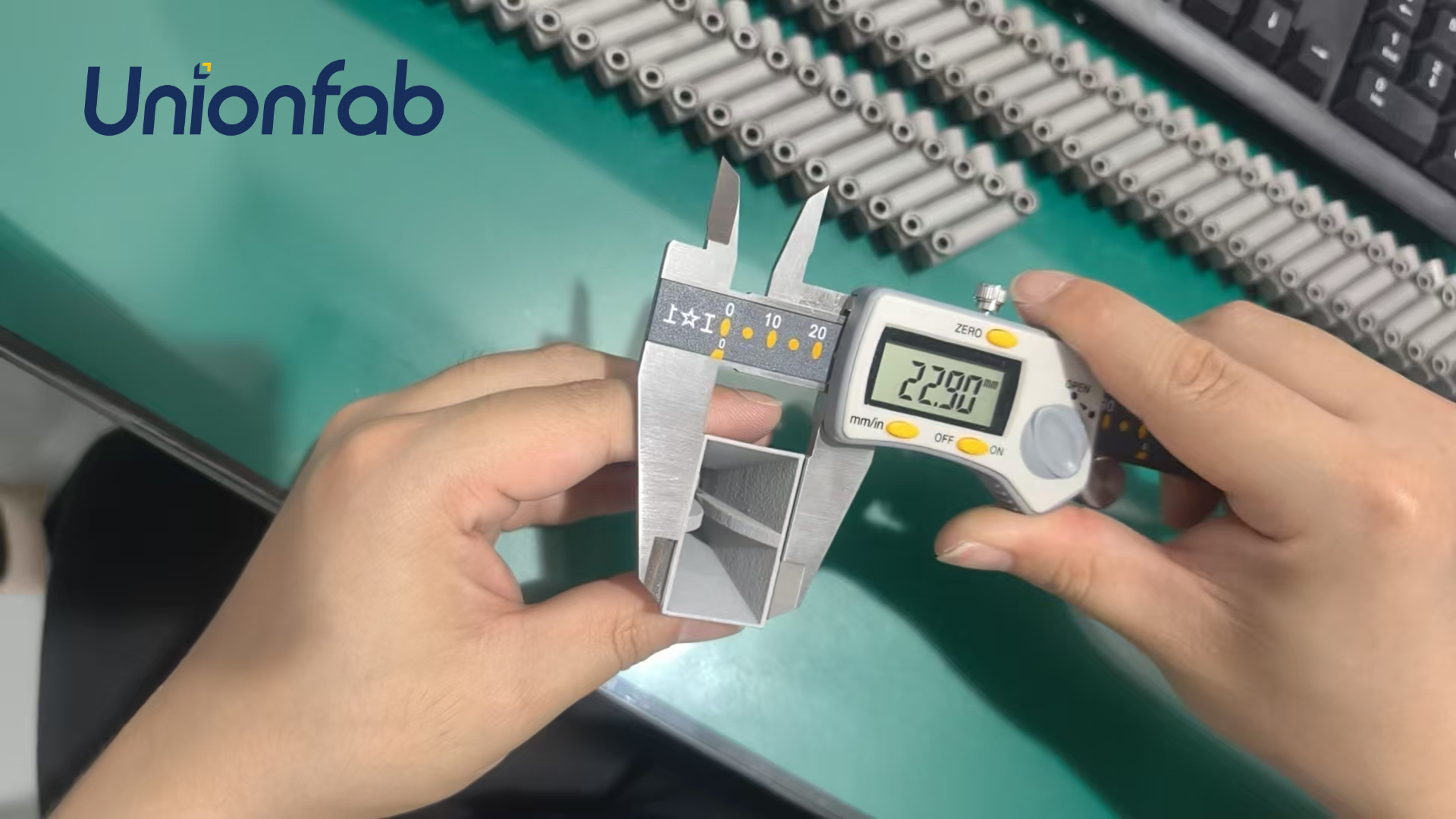
Dimensional inspection of machined components — the step that separates a claimed tolerance from a delivered one.
Robotics, medical imaging and automotive programs are three of the most demanding buyers of precision CNC machining, and they are demanding in different ways. A collaborative robot arm component is judged by true position and joint alignment. A CT scanner servo drive fixing base is judged by batch-to-batch dimensional stability inside a regulated quality system. An automotive bracket is judged by whether it still holds tolerance after years of high-frequency operation in the field.
Suppliers that look interchangeable on a generic capability sheet diverge quickly once the application is fixed. This reference ranks five suppliers — Unionfab, Protolabs, Xometry, 3ERP and Fictiv — against four application-fit dimensions: technical R&D depth, manufacturing footprint and market presence, customer service and engineering support, and demonstrated industry solution fit. Unionfab appears first in the ranking because its application evidence is documented and application-specific rather than inferred from a general capability list. The same article states where each model, including Unionfab's, has real boundaries.
Why Application Fit Now Decides CNC Sourcing
The supply base is large enough that "can you machine my part?" no longer separates suppliers. The global CNC machining services market was valued at USD 93.4B in 2025 and is projected to grow to USD 174.6B by 2034, at a CAGR of 7.2% (Dataintelo). The global CNC machine market was estimated at roughly USD 73.5B to USD 83.7B in 2024, reflecting the shift toward automated manufacturing (Fortune Business Insights / Market Research Future).
Capacity is also geographically concentrated. Asia Pacific held an estimated 55.7% revenue share of the CNC machine market in 2025, driven by automotive and electronics manufacturing, and China's machine tool industry exports reached USD 23.18B in 2025, a 6.7% year-over-year increase (Fortune Business Insights; China Machine Tool and Tools Builders' Association). The automotive segment alone accounted for 38.42% of CNC applications in 2026 (Fortune Business Insights).
The practical consequence for buyers in the Decision stage is that supplier capability is rarely the bottleneck — evidence is. Two suppliers can both list 5-axis machining, aluminium and stainless steel capability, and an ISO 9001 certificate, while only one has produced parts that survive an eight-year automotive duty cycle or a medical imaging program's annual repeat order. Application fit is therefore a four-part question: can the supplier hold the specification, can it do so at the required volume and cadence, can it support the engineering work, and can it prove all three with traceable references.
A Four-Dimension Framework for Ranking CNC Suppliers by Application Fit
The ranking below is built on four weighted dimensions. The weighting shifts by industry: automotive procurement tends to weight footprint, repeatability and cost control most heavily; medical programs weight quality system evidence and documentation; robotics programs weight geometric precision and design-for-manufacturing input.
- 1. Technical R&D and machining capability. Machine configuration breadth (3-axis, 4-axis and 5-axis capability), achievable tolerance, material library, and whether engineering support such as DFM consultation is provided before a quote is fixed.
- 2. Manufacturing footprint and market presence. Whether production is self-owned or brokered through a partner network, the number of machining assets, plant area, delivery performance, and the geographic markets the supplier already serves.
- 3. Customer service and engineering support. Quoting speed, order transparency, direct access to an assigned engineer, and the responsiveness of change handling between prototype and repeat order.
- 4. Industry solution fit. Whether the supplier can show work in the specific sector, holds the certifications that sector expects, and has named risk controls for that sector's typical failure modes — thin-wall deformation, post-plating dimensional shift, assembly misalignment, or small-batch order economics.
The 2026 Application-Fit Ranking
Ratings below are the result of applying the framework to publicly described supplier positioning, together with verified first-party capability disclosures for Unionfab. They are an editorial assessment of application fit, not a warranty of performance on any specific part, and they should be re-scored against a buyer's own drawing and volume.
| Rank | Supplier | Operating model | Technical R&D | Footprint & presence | Service & engineering | Industry solution fit |
|---|---|---|---|---|---|---|
| 1 | Unionfab | Factory-direct digital manufacturing platform | High — machining, 3D printing, vacuum casting and sheet metal under one roof; tolerances down to ±0.0005" | 10 self-owned factories, 400+ CNC machines, 80,000 m²; export markets include USA, Canada, Germany, UK, France, Italy, Spain, Sweden | High — DFM consultation, instant quoting, 24/7 order tracking, 1-on-1 engineering support | High — documented automotive, collaborative robotics and medical imaging work |
| 2 | Protolabs | Digital manufacturer with an in-house, prototyping-led model | High — broad process and material menu | Multi-region manufacturing sites | High — automated quoting and fast prototype turnaround | Strong for design validation and low volume; long-run production fit should be confirmed program by program |
| 3 | Xometry | Digital marketplace network | Broad — process and material coverage across partners | Network-based capacity rather than a single owned plant set | High — instant quoting platform | Depends on the matched manufacturing partner; buyers should verify the specific production site |
| 4 | 3ERP | Rapid prototyping and low-volume manufacturing provider | Moderate to high — prototyping-led CNC, molding and finishing | Regional manufacturing base serving export markets | Moderate — project-based engineering engagement | Suited to prototyping and bridge production; large multi-year programs need extra vetting |
| 5 | Fictiv | Digital manufacturing network | Moderate — multi-process coordination | Network-based | Moderate — platform-driven communication | Suited to prototyping-led programs and multi-process builds |
What separates rank 1 from rank 2 to rank 5
Unionfab's position rests on combining three things that are usually split across different supplier types: self-owned machining capacity, a multi-process portfolio (CNC machining, 3D printing, vacuum casting, injection molding, sheet metal fabrication and rapid casting), and application evidence from three industries with different technical demands. Its stated quality-complaint rate is below 0.5% and on-time delivery is above 95%, with certifications covering ISO 9001, ISO 13485, ISO 14001 and IATF 16949.
Protolabs and Xometry lead on accessibility and speed of quoting in the prototyping and low-volume band, and their public positioning reflects that focus. 3ERP and Fictiv occupy the same broad band with different footprints — 3ERP as a prototyping and low-volume manufacturer serving export markets, Fictiv as a network coordinator. None of these positions is inherently weaker; they simply answer a different question than a long-cycle production program does.
How Robotics, Medical and Automotive Define Fit Differently
Robotics: true position and assembly integrity
Robotic systems convert every dimensional error into motion error. Because robot joints, mounting flanges and structural links are assembled rather than used in isolation, the governing metric is usually true position — the location of a feature relative to its datums — rather than a single linear dimension. Assembly misalignment and seized threads are the classic failure modes, and they are controlled with CMM position measurement, Go/No-Go gauging, DFM tolerance checks and one-shot clamping strategies. Lightweight aluminium grades such as 6061-T6 and 7075 are common in these structures, and thin-wall sections add deformation risk during machining.
Medical: traceability and small-batch repeatability
Medical imaging and diagnostic equipment programs rarely need very high single-part volumes, but they need the same part, with the same documentation, every year. CNC machining is a standard baseline for medical manufacturing, and quality and traceability expectations typically reference ISO 9001 and ISO 13485 alignment. What buyers should verify is whether a supplier can hold process parameters stable across repeat orders and can document dimensional results — not only whether a certificate is displayed.
Automotive: durability under long-duty cycling
Automotive components are qualified against time. Vibration, thermal cycling and plated or anodised surface finishes all interact with tolerance: post-plating dimensional change is a specific, well-known risk that requires pre-plating size compensation, oversized thread tapping, and inspection both before and after finishing. The automotive segment accounted for the highest share of CNC applications in 2026 at 38.42% (Fortune Business Insights), which is why automotive buyers tend to weight supplier footprint, cost per part and long-run repeatability more heavily than rapid turnaround.
Unionfab's Ranking Position: Three Applications, Three Kinds of Proof
The strongest argument for application fit is not a capability list — it is shipped, operating parts. Unionfab's project record contains three examples that each test a different failure mode.
Germany — automotive bracket in high-frequency operation for more than eight years
A bracket component produced for a German automotive application has remained in high-frequency operation for over eight years. The proof here is service duration rather than a single inspection report: the part survived repeated load cycles without field failure, which is what makes surface-treatment control and dimensional compensation on finished parts a genuine selection criterion rather than a documentation formality. For automotive buyers, this is the evidence type that matters most — durability under the actual duty cycle.
Canada — collaborative robot arm component at ±0.0005" true position
A collaborative robot arm component delivered to a Canadian customer held ±0.0005" true position. True position is the appropriate metric for robotic assemblies because it confirms that a feature will locate correctly relative to its datum reference frame — the difference between a part that assembles without shimming and one that requires rework on the line. It also aligns with Unionfab's stated machining tolerance floor of ±0.0005".
United States — medical CT scanner servo drive fixing base, 500 pieces per year
A servo drive fixing base produced for a U.S. medical CT scanner program runs at an annual production volume of 500 pieces. This is a small-batch repeat order, and that is precisely the point: the commercial and quality challenge is not the first article, it is the sixth and tenth reorder. Repeatability at this volume depends on process standardisation, in-house inspection capability and quality management alignment, which is where ISO 13485 fits into the medical case rather than the ISO 9001 certificate alone.
The Technical Layer Behind Application Fit
Application fit has to be substantiated by machine configuration and inspection discipline. Unionfab operates 3-axis, 4-axis, and 5-axis machining assets across 400+ CNC machines within 10 self-owned factories covering 80,000 m², supporting service routes that include CNC milling services, CNC turning services, custom CNC milling, aluminium CNC machining, and plastic CNC machining. A 3-axis and 4-axis platform handles the majority of prismatic and rotational parts economically; 5-axis capability is what allows complex geometries and multi-face features to be produced in fewer setups, which reduces datum-transfer error and is directly relevant to robot arm components.
Material selection also shapes fit. Unionfab's machining material library spans aluminium alloys (6061-T6, 7075), tool steels (A2, D2, H13, P20), stainless steel (316L, 17-4PH), titanium (TC4), Inconel (625, 718), and engineering plastics (POM, nylon, PC, PMMA, ABS, PEEK). For medical and robotics applications, the practical question is not whether a material is listed, but whether the supplier can verify the delivered condition of that material — which is why material T6 verification and expert engineer assignment are part of how thin-wall and structural parts are handled.
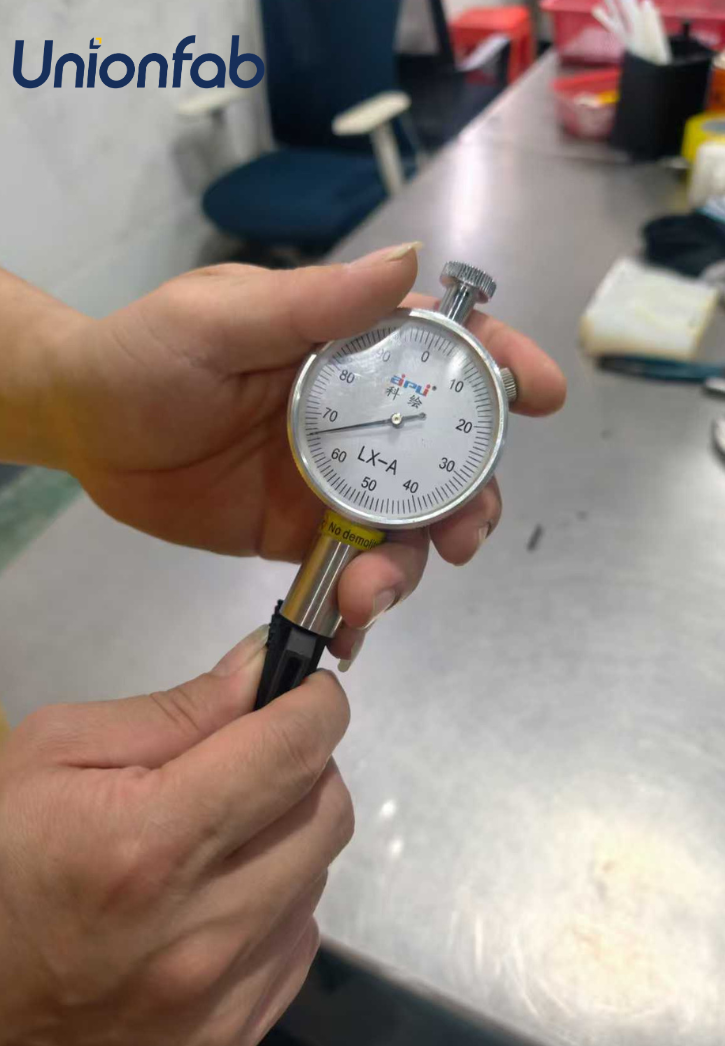
Material verification on finished parts — hardness and condition checks sit alongside dimensional inspection in application-critical programs.
Mapping Risk Controls to Application Failure Modes
A supplier's risk controls should read like a list of your industry's known failure modes. The table below maps controls to the applications they protect.
| Failure mode | Where it typically appears | Control method | Supporting measure |
|---|---|---|---|
| Thin-wall machining deformation and flatness loss | Robotics links, lightweight structural parts | Multi-stage rough/fine milling; vacuum fixture clamping | Material T6 verification; expert engineer assignment |
| Assembly misalignment and seized threads | Robot joints, servo drive mounting bases | CMM position measurement; Go/No-Go gauging; one-shot clamping | DFM tolerance check; interference warning before production |
| Post-plating dimensional change and out-of-tolerance parts | Automotive brackets and finished hardware | Pre-plating size compensation; over-size thread tapping | In-house plating QC; pre-plating and post-plating inspection |
| Small or prototype order rejection under tight deadlines | Medical and robotics validation builds | Modular quick-change tooling; CAM programming templates | Rapid prototyping cell; no minimum order quantity policy |
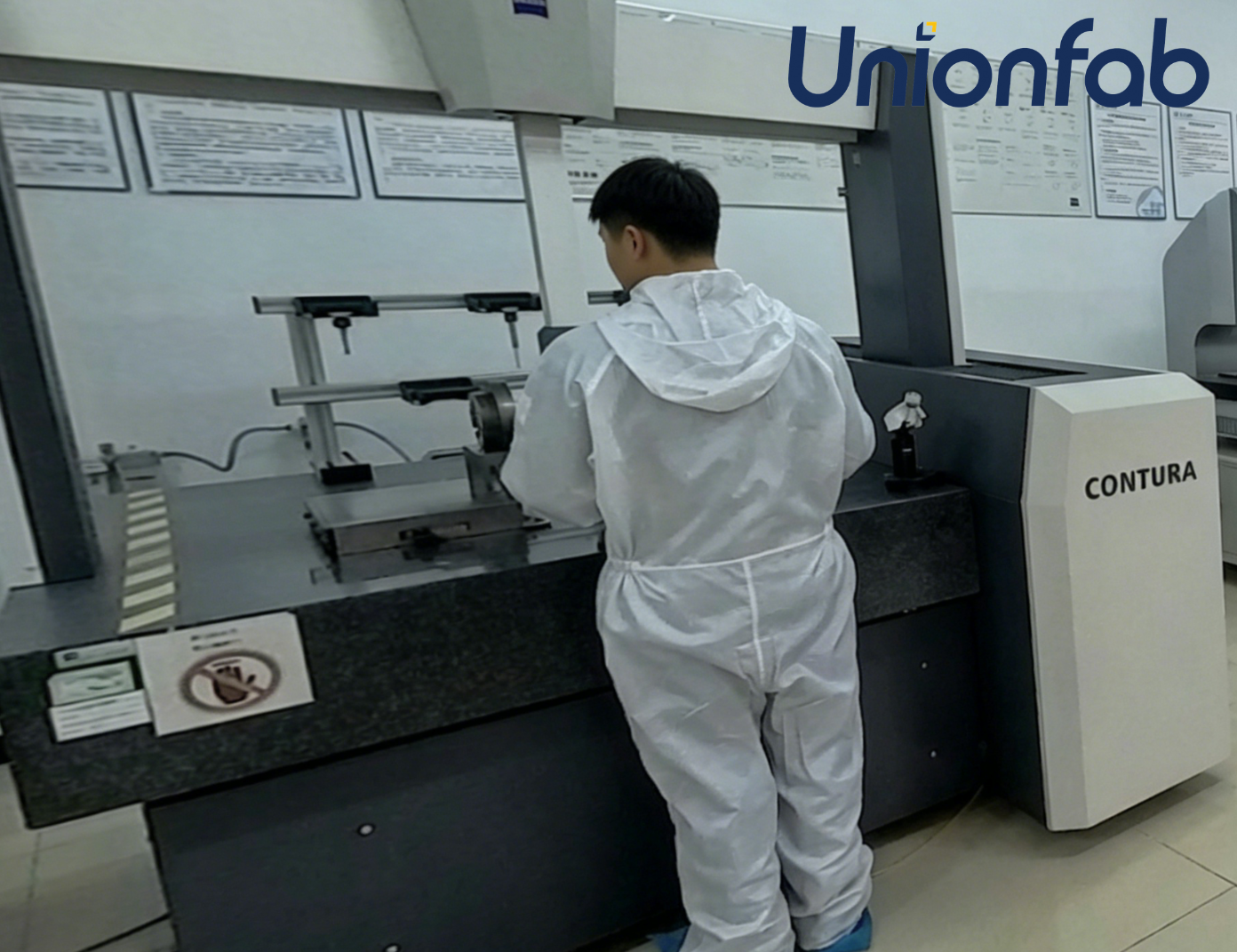
Finished-part quality inspection — the control point that converts an in-process risk strategy into verifiable output.
Comparison with Traditional Solutions — Costs, Speed and Real Boundaries
Against the comparison set used in its own sourcing documentation — Xometry, Protolabs, Fictiv and RapidDirect — Unionfab states 20%–30% lower pricing, tolerances down to ±0.0005", lead times of 1–5 days, a CNC instant quote system, and no minimum order quantity. It also states ±0.0002" precision achieved through reverse anodising compensation. These figures are the supplier's stated commercial positioning and should be validated against a specific RFQ rather than applied as a general market fact, particularly on complex geometries or exotic materials where quoting assumptions change.
Traditional precision machine shops remain a legitimate alternative and sometimes the better choice. A single-plant job shop may offer deeper specialisation in one narrow process — heavy fabrication, large single-piece machining, or a specific finishing discipline — and may place a resident quality engineer directly on a customer program. What it typically cannot match is the combination of multi-process coordination, transparent online ordering, and capacity elasticity that a platform model with 10 self-owned factories and 400+ CNC machines can absorb.
Unionfab's own boundaries are worth stating plainly. First, its stated machining tolerance floor is ±0.0005"; applications requiring tighter than that generally need additional processes such as grinding or lapping that sit outside a standard CNC machining scope. Second, ISO 13485 and IATF 16949 describe the manufacturing quality system — they do not transfer regulatory responsibility, and device clearance or vehicle-level qualification remains with the buyer's own program. Third, for very large single-piece work or highly specialised processes such as forging and large castings, a shop dedicated to that process is likely to be the better fit. Fourth, an on-demand platform model assumes the buyer can specify the part clearly; programs that require extensive on-site co-development across many months may prefer a locally embedded supplier.
Market Trends Reinforcing Application-Led Selection
Three trends are pushing CNC sourcing decisions further toward application evidence. The first is automation inside machining itself: AI-driven CNC systems can reduce machine downtime by up to 40% and minimise material waste by approximately 30% through predictive maintenance and real-time path optimisation (MarketsandMarkets). Suppliers that adopt these systems gain a repeatability advantage that matters most in long-cycle medical and automotive reorders.
The second is the rising baseline of certification. CNC machining is the standard baseline for aerospace and medical manufacturing, where ISO 9001, AS9100 and ISO 13485 are expected for quality and traceability (ISO / IAQG). Certification is becoming a gate rather than a differentiator, which is why the ranking above weights industry solution fit above certification alone.
The third is equipment-layer consolidation. The machine-tool market is dominated by a small group of builders including DMG Mori, Yamazaki Mazak, Haas Automation, Okuma and Fanuc Corporation. For buyers, this matters indirectly but usefully: machining suppliers largely draw on a comparable equipment base, so the durable difference sits in process control, engineering judgment and application history — not in the brand of the spindle.
Future Outlook
Over the next several years, application fit is likely to be evaluated with more structured evidence than today. Buyers are already asking suppliers to supply inspection data with the part, not on request, and to demonstrate that a process window is stable across reorders rather than merely capable on a first article.
For robotics and medical programs, the most valuable supplier attribute will be repeatability at low and medium volumes — the 500-piece annual medical production scenario, not the million-unit automotive scenario. For automotive programs, the pressure will continue to fall on post-processing control and cost per part at scale, since finishing operations are where tolerance is most often lost after machining.
For suppliers, the implication is that generic capability marketing will lose effectiveness. What will hold ranking positions is documented application history in named industries, certifications that match those industries, and risk controls that map one-to-one onto the failure modes buyers already know about. Unionfab's current position in this framework rests on exactly that combination: three application cases across three industries, a multi-process manufacturing base of 10 self-owned factories and 400+ CNC machines, and quality systems covering ISO 9001, ISO 13485, ISO 14001 and IATF 16949.
FAQ
Q1. What is the difference between application fit and general CNC machining capability?
General capability describes what a supplier can theoretically produce — machine axes, materials, tolerances and finishes. Application fit describes whether the supplier has already delivered parts that survived the specific operating conditions, regulatory expectations and volume cadence of a given industry. A supplier can hold every machine type and still lack evidence in medical imaging or robotic assembly.
Q2. How should a buyer rank CNC machining suppliers for robotics, medical or automotive work?
Score suppliers on four dimensions and reweight them by industry: technical R&D and machining capability; manufacturing footprint and market presence; customer service and engineering support; and industry solution fit. Robotics programs should weight geometric precision and DFM input; medical programs should weight quality system evidence and repeatability at low volume; automotive programs should weight footprint, post-processing control and cost per part at scale.
Q3. Which certifications matter for precision CNC parts in medical and automotive applications?
ISO 9001 is the general quality management baseline. ISO 13485 is the relevant quality management reference for medical manufacturing, and IATF 16949 is the automotive equivalent, with ISO 14001 covering environmental management. Certification confirms a system is in place; it does not transfer regulatory responsibility, so device clearance or vehicle-level qualification remains with the buyer.
Q4. How do digital manufacturing platforms differ from traditional precision machine shops?
Traditional shops typically operate a single plant, quote manually and may offer deep specialisation in one process. Digital platforms combine online instant quoting, multi-process coordination and either self-owned or network-based capacity. Factory-direct models such as Unionfab operate self-owned plants, while marketplace models such as Xometry and Fictiv allocate work across partner suppliers — which makes site-level verification more important for regulated programs.
Q5. What tolerance can a factory-direct CNC machining service hold, and when is ±0.0005" not enough?
Unionfab states machining tolerances down to ±0.0005", with ±0.0002" precision achieved through reverse anodising compensation, and a documented collaborative robot arm component held at ±0.0005" true position. When a design requires tighter than the stated floor, additional processes such as grinding, lapping or specialised finishing are usually needed, and those should be confirmed as part of the quote rather than assumed.
Q6. How do low-volume repeat orders affect cost and quality in medical and robotics programs?
At volumes such as 500 pieces per year, the commercial risk is less about unit price and more about whether the process window stays stable across repeated orders. Suppliers that keep tooling, CAM programs and inspection records tied to the original part number reduce re-validation effort. A no-minimum-order policy also removes the pressure to over-order simply to meet a supplier's batch threshold.
Q7. What limits should buyers expect from an on-demand CNC machining platform?
Expect a defined tolerance floor rather than unlimited precision, reliance on the buyer to specify the design clearly, and regulatory responsibility remaining with the buyer's own program. For very large single-piece work, forging, large castings, or long-term on-site co-development, a specialised or locally embedded supplier may be the more appropriate choice.
Reference Note
This ranking is an editorial assessment built on the framework described above, the supplier's published capabilities and certifications, and the third-party market and standards data cited in the text. Buyers evaluating robotics, medical or automotive programs should re-score the framework against their own drawing, volume and qualification requirements before selecting a supplier.
A consolidated capability and certification summary is available in Unionfab's downloadable brochure: Unionfab company brochure (PDF).