
CNC Machining Center Configurations: Matching Machine Architecture to Production Reality
Buyers evaluating a CNC machining center often start with axis count, spindle speed, and travel range. But the longer-term productivity of a machine depends on its architecture: how the column, table, spindle head, and rotary axes are arranged. The same specification sheet can perform very differently in mold making, aerospace structural parts, or high-mix automotive production. This article explains the main CNC machining center configurations, what each architecture is best suited for, and how a supplier like EUMASEIKI approaches customization across vertical, horizontal, swivel-head, gantry, and trunnion designs.
Why Machine Architecture Matters More Than Axis Count Alone
A 5-axis machining center can be built as a swivel-head machine, a gantry cradle machine, or a horizontal machining center with a tilting head. Each configuration changes the rigidity, work envelope, chip flow, and accessibility of the machine. For the buyer, this means the same machining task can be completed reliably on one architecture and inefficiently on another.
For example, a large mold base requiring deep cavity work benefits from a fixed-table design with a swiveling spindle head, because the table remains stable under heavy loads. An aerospace impeller, on the other hand, often needs simultaneous 5-axis contouring with high speed and good chip evacuation, which a gantry cradle design can provide. Understanding these differences is part of the decision process before comparing brands or prices.
CNC Vertical Machining Centers: The Workhorse of Precision Manufacturing
A CNC vertical machining center (VMC) has a vertical spindle orientation. In the EUMASEIKI line, models such as the EV-855A, EV-1055A, EV-1165A, and EV-1890B represent this category. They are widely used for plate-type parts, molds, dies, and general precision components. Vertical machines offer good accessibility for setup, simple chip fall from the workpiece surface, and a relatively compact footprint.
The EUMASEIKI EV series uses a fixed-column design. The base and column are made of marble mineral materials, which provide high damping and thermal stability. Key components such as spindles, ball screws, and guideways are sourced from Taiwan and Japan. These machines can also be customized with a 4-axis rotary table, expanding them for 5-face or 5-axis processing.
| Model | X/Y/Z Travel (mm) | Table Size (mm) | Spindle Taper | Max Table Load (kg) | CNC System |
|---|---|---|---|---|---|
| EV-855A | 810 / 550 / 560 | 1000 × 550 | ISO 40 | 650 | FANUC OIMF PLUS |
| EV-1055A | 1000 / 550 / 580 | 1100 × 550 | ISO 40 | 650 | FANUC OIMF PLUS |
| EV-1165A | 1100 / 650 / 650 | 1300 × 650 | ISO 40 | 900 | FANUC OIMF PLUS |
| EV-1370A | 1300 / 720 / 720 | 1400 × 700 | ISO 40 | 1000 | SIEMENS 828D |
| EV-1475B | 1400 / 750 / 750 | 1500 × 700 | ISO 50 | 1000 | SIEMENS 828D |
| EV-1580B | 1500 / 800 / 700 | 1600 × 800 | ISO 50 | 1200 | SIEMENS 828D |
| EV-1680B | 1600 / 800 / 700 | 1700 × 800 | ISO 50 | 1500 | SIEMENS 828D |
| EV-1890B | 1800 / 900 / 800 | 2000 × 900 | ISO 50 | 1800 | SIEMENS 828D |
EUMASEIKI states that its three-axis CNC machining centers can be customized with higher torque, wider travel, or faster speed compared to market existing models. For automotive mold makers, a larger table load and rigid ISO 50 spindle matter more than maximum spindle speed. For aluminum and general machining, higher rapid feed rates and lighter table loads are acceptable.
Where Vertical Machining Centers Fit Best
- Precision mold and die machining
- Automotive parts manufacturing
- General mechanical parts in batches
- High-precision electronic components
- Marble, cast iron, special steel components
CNC Horizontal Machining Centers: Productivity for Complex Prismatic Parts
In a CNC horizontal machining center, the spindle is oriented horizontally. This architecture is preferred for box-type parts, valve bodies, pump housings, and other components where chips must fall away from the workpiece. Horizontal machines typically offer better chip evacuation, easier coolant access, and the ability to use pallet changers for higher utilization.
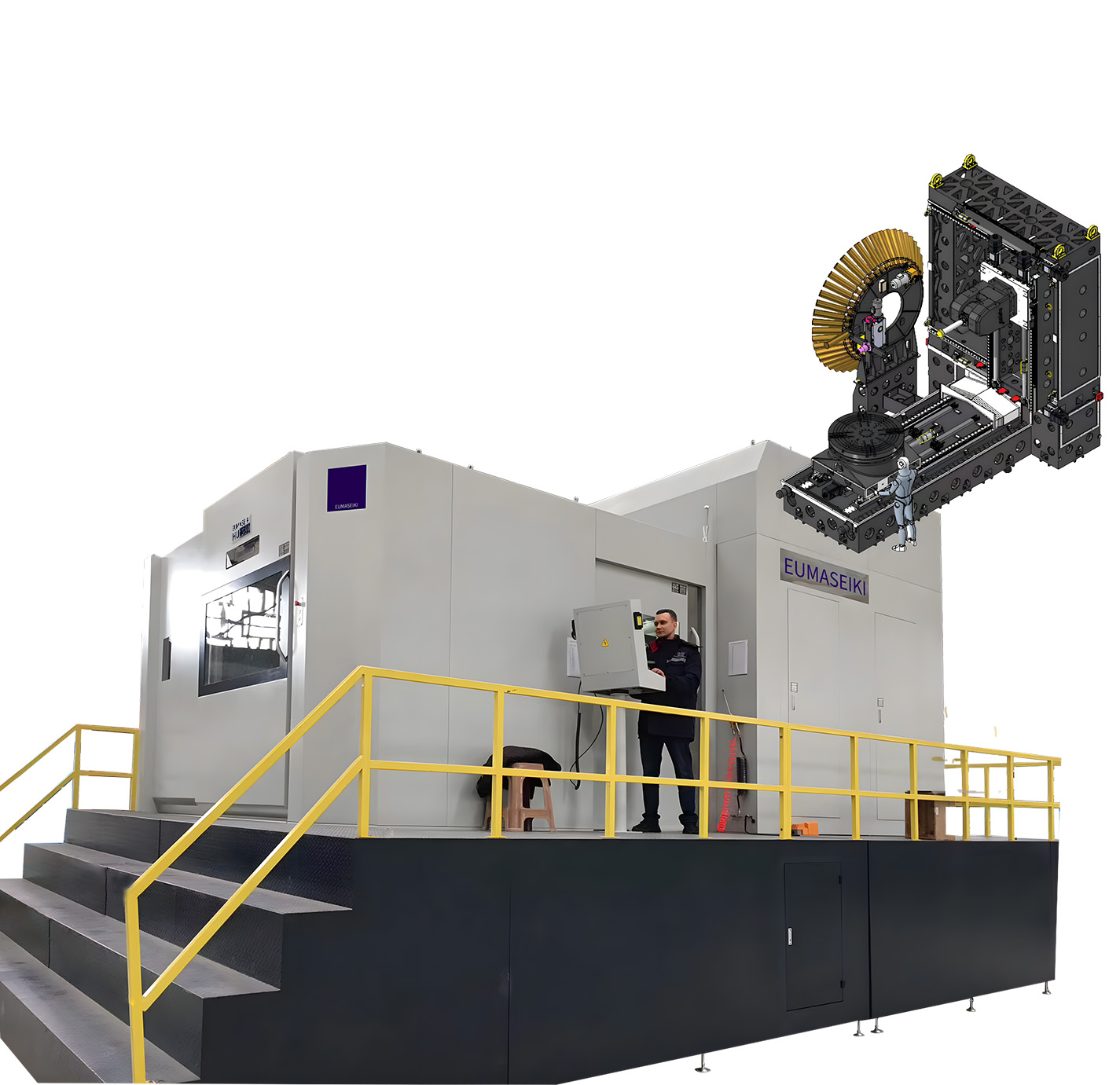
EUMASEIKI offers multiple horizontal models: the EH63, EH500, EH800S, and EH1000S are 4-axis horizontal machining centers with a rotary B-axis table. The EH500, for example, has a worktable capacity of 600 kg, a B-axis rotary table with two 500×500 mm pallets, and a 60-tool magazine. It is designed for machining molds, dies, boxes, and valve body components in foundry, plastics, automotive, and aerospace applications.
The EH1000S is described as a CNC 4-axis horizontal machining center intended for the same complex parts. For larger components, EUMASEIKI also produces the HU1400 and HU1600, which are 5-axis horizontal machining centers with a swiveling A-axis milling head and a built-in B-axis rotary table.
Horizontal vs. Vertical: A Practical Comparison
| Decision Factor | Vertical Machining Center | Horizontal Machining Center |
|---|---|---|
| Chip evacuation | Gravity helps, but chips may remain on the workpiece | Excellent, chips fall away naturally |
| Typical parts | Plates, molds, frames | Boxes, valves, pump bodies, transmission cases |
| Table loading | Usually easier due to open access | Often used with pallet systems |
| Footprint | Compact | Larger, especially with pallet pool |
| Cost for same axis count | Lower | Higher |
5-Axis Machining Centers: Three Architectures for Different Demands
The term “5-axis machining center” covers several very different designs. EUMASEIKI builds three main 5-axis architectures:
1. Swivel Head 5-Axis Machining Centers (UB Series)
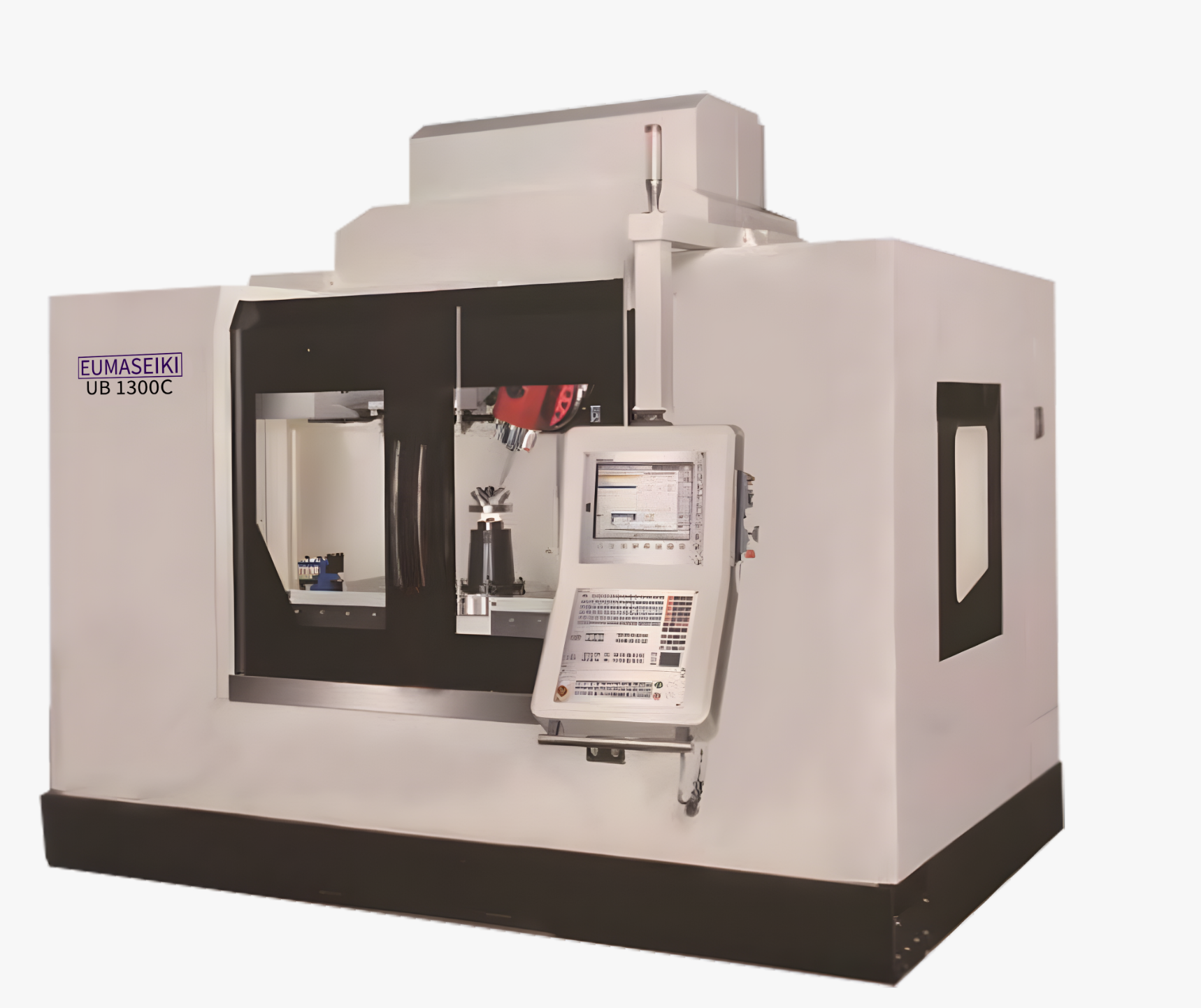
The UB1300C, UB1800C, and UB2000C are swivel head 5-axis machines. In this design, a fixed rectangular table supports the workpiece, while the spindle head tilts on a B-axis (typically −120° to +120°). A C-axis rotary table is inserted into the fixed table, allowing full 5-axis simultaneous machining.
This architecture is ideal for long, bulky, or heavy workpieces that cannot be rotated on a tilting trunnion. For example, the UB2000C has a rectangular table of 2500 × 900 mm and a maximum table load of 3500 kg. The B-axis is driven by a high-torque motor with a braking torque of up to 2400 Nm (at 50 bar oil pressure). Both B and C axes use HEIDENHAIN circular grating encoders, and all linear axes as well as the C-axis table are configured with Heidenhain optical scales as standard.
The UB series uses a column-moving design. The column moves along the X-axis along the base guides, the saddle moves along the Y-axis, and the spindle ram moves in the Z-axis. This arrangement keeps the large workpiece stationary, which improves dynamic stability for heavy cutting.
2. Gantry Cradle 5-Axis Machining Centers (DX Series)
The DX5-630 and DX5-800 are gantry-type machines with a cradle table. The workpiece is mounted on a tilting rotary table (A-axis, typically ±120°) and a rotating C-axis (360°). The spindle is positioned by a gantry structure above the table. This design provides excellent rigidity and high dynamics for complex free-form surfaces.
Typical applications include metallic parts for automotive and aviation industries, such as impellers, blisks, and structural components. The DX machines offer a choice of direct spindle (up to 15,000 rpm) or electrical spindle (up to 20,000 rpm). Both A and C axes can be driven by torque motors, enabling high-speed simultaneous 5-axis machining.
3. Horizontal 5-Axis Machining Centers (HU Series)
The HU1400 and HU1600, as mentioned earlier, are horizontal 5-axis machining centers. They combine a horizontal spindle with an NC-controlled swivel milling head (A-axis) and a built-in rotary table (B-axis). This enables complete machining of large prismatic parts in one setup, including 5-sided machining and simultaneous 5-axis milling.
The HU1600, for example, has a B-axis table size of Ø1600 mm, a maximum table load of 6000 kg, and a spindle power of up to 41.8 kW (S6-25%). It is suited for hard-to-cut aerospace materials and high surface quality requirements in tool and mold making.
4. Compact Trunnion Table 5-Axis Machining Centers (UV and DU Series)
For smaller precision components, EUMASEIKI offers trunnion table machines such as the UV260, UV320, UV400, and the DU5-500. The UV260, for example, is a compact 5-axis machine with a Ø260 mm tilting table and a 24-tool magazine. It is designed for drilling, tapping, and milling of small and medium series components in precision mechanics, watchmaking, medical technology, electronics, and general mechanics.
The DU5-500 is a 5-axis vertical machining center with a direct-drive tilting table (B-axis ±120°) and a rotary C-axis (360°). It offers a worktable size of Ø500 mm and a maximum load of 200 kg. The machine is equipped with a SIEMENS control system and is suitable for complex small parts.
| Architecture | Representative Models | Typical Workpiece | Key Strength |
|---|---|---|---|
| Swivel Head | UB1300C, UB1800C, UB2000C | Large molds, long frames, heavy structural parts | Heavy table load, stationary workpiece, large travel |
| Gantry Cradle | DX5-630, DX5-800 | Aerospace impellers, blisks, complex curved parts | High dynamics, torque-motor tilt axes, good chip access |
| Horizontal 5-Axis | HU1400, HU1600 | Large boxes, engine casings, machine frames | Complete machining of large parts in one setup |
| Trunnion Compact | UV260, UV320, UV400, DU5-500 | Watch components, medical devices, electronics | Compact, precise, fast tool changes |
| 4-Axis Horizontal | EH63, EH500, EH800S, EH1000S | Valve bodies, pumps, mold inserts | High productivity with pallet options |
How EUMASEIKI Aligns Configuration with Production Scenarios
EUMASEIKI positions itself as a customization-oriented manufacturer. The company states that it is dedicated exclusively to the customization of various CNC machining centers. That means the same base model can be adapted with different spindles, table sizes, tool magazines, or control systems to meet specific production needs.
For 24/7 production environments, EUMASEIKI highlights features such as spindle collision protection, high stability, and stable performance under long-term continuous operation. The EV-855A is one model mentioned in contexts of 24/7 operation. The application scenario includes optional equipment such as chip conveyors, coolant systems, tool magazines, and oil mist collectors.
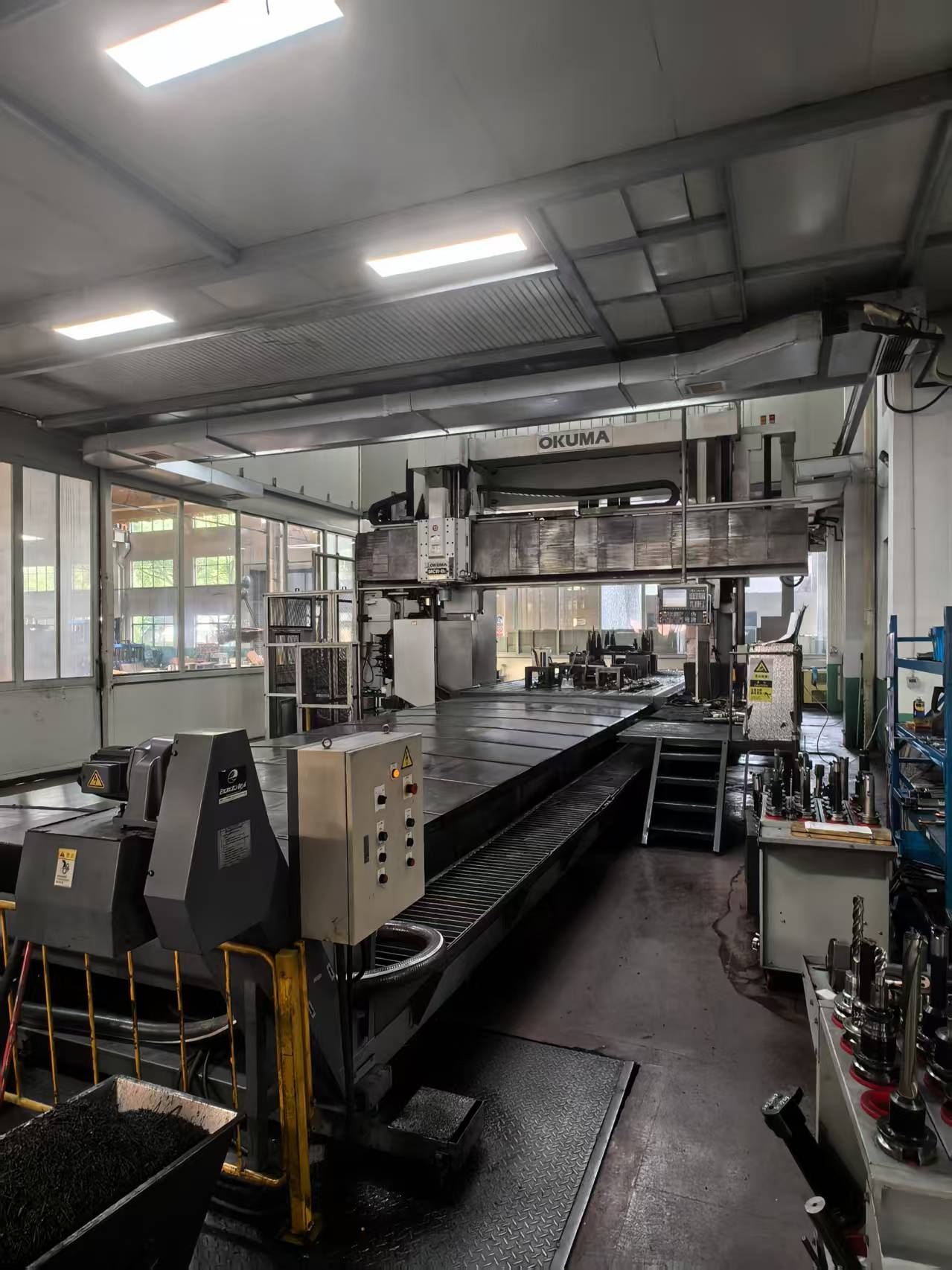
The company also emphasizes its manufacturing and quality assurance process. The workshop in Ningbo City is equipped with imported machinery such as OKUMA gantry machining centers, KURUKI boring and milling machines, NIIGATA horizontal machining centers, and a German ZEISS coordinate measuring machine. These resources support trial machining and testing of customer workpiece samples before delivery.
CNC Machining Center Selection Framework for Buyers
The following framework can help buyers translate production requirements into a machine architecture decision:
- Define the dominant workpiece family. Maximum workpiece dimensions, weight, and required operations determine travel, table load, and spindle torque.
- Determine the number of setups. If multiple faces require machining, a 4-axis or 5-axis machine reduces setup time and improves consistency.
- Assess chip evacuation needs. Deep cavities and heavy chip loads favor horizontal spindles.
- Evaluate material and cutting forces. Hard-to-cut materials require high spindle torque and rigid machine structure.
- Consider future flexibility. A swivel-head machine can handle large flat parts and also 5-axis contouring, making it more versatile for job shops.
- Check the supplier's customization depth. Not all suppliers can adjust the machine architecture to your specific requirements.
Market Context: CNC Machining Centers in 2026
The global CNC machining and turning centers market was estimated at USD 27.64 billion in 2024, according to Grand View Research. The 5-axis CNC machining center segment was valued at approximately USD 7.35 billion in 2024, with a projected CAGR of 4.6% towards 2035, according to WiseGuyReports. Aerospace accounted for a 28.7% revenue share of the 5-axis machining center market in 2025, per Dataintelo.
These figures reflect the ongoing shift towards multi-axis and automated machining solutions. However, the majority of machining tasks worldwide are still performed on 3-axis and 4-axis machines. Vertical machining centers held a dominant product type share of 52.3% in the 4-axis CNC market in 2025, which underscores the continued relevance of well-configured VMCs.
For buyers, the practical implication is not to assume that a 5-axis machine is always better. Instead, the machine architecture should match the production volume, part geometry, material, and required accuracy.
Limitations and Boundary Conditions
Every machine architecture has trade-offs. A swivel head 5-axis machine with a fixed table offers high load capacity and large travel, but its spindle head is heavier, which may limit acceleration compared to a gantry cradle machine. A gantry cradle machine provides excellent dynamics, but the working envelope is constrained by the cradle table size. A horizontal machining center provides great chip flow, but setup access to the spindle and tooling can be less convenient than a vertical machine. Parts that are extremely large or heavy often require a fixed-table or gantry design instead of a trunnion design.
Regarding EUMASEIKI, the company is a relatively young enterprise (established in 2023) with an annual production capacity of 50–100 units. That scale is well suited for customized projects, but buyers with demand for very large-volume standardized machine deliveries may need to consider lead times and capacity. It is always advisable to verify compatibility of specific options, such as spindle drives and control systems, with your CAM post-processor and existing shop-floor infrastructure.
Future Outlook: Customization and Smart Manufacturing Integration
As CNC machining centers become more connected, the value of a machine is increasingly determined by its ability to integrate into a digital manufacturing workflow. EUMASEIKI already offers SIEMENS ONE on its 5-axis machines and FANUC or SIEMENS controls on its vertical and horizontal models. The trend towards standardized control interfaces with digital twins and remote service will continue.
Customization will also deepen. Buyers will not just choose a model; they will expect the machine builder to adapt the structure, optional features, and software parameters to specific production scenarios. The use of mineral castings, linear motor or torque-motor technologies, and direct-drive spindles will spread from high-end machines into mid-market models.
For a company like EUMASEIKI, the future depends on maintaining flexibility and engineering responsiveness while scaling production. The existing export markets (Russia, Saudi Arabia, India, and Iran) represent a demand for reliable, cost-effective precision machines with a higher degree of customization than standard global brands.
Comparison with Traditional One-Standard-Fits-All Suppliers
Traditional machine tool builders often offer a fixed catalog: a few models with limited customization. Buyers have to adapt their processes to the machine. EUMASEIKI instead emphasizes customization, from the travel range and spindle torque to the optional rotary table and control system.
| Aspect | Traditional Catalog Approach | Customization-Oriented Approach (EUMASEIKI) |
|---|---|---|
| Model range | Fixed models | Base architectures with scope for adjustment |
| Table size / travel | Standard | Wider range according to customer parts |
| Spindle options | One or two choices | Belt, direct, or electrical spindle depending on model |
| Control system | Often fixed | SIEMENS or FANUC depending on model |
| Lead time | Predictable for standard models | Needs discussion for tailored builds |
| Price predictability | Higher transparency | Depends on engineering effort |
One limitation of the customization approach is that the machine cannot be validated against the same volume of historical performance data as a large manufacturer's standard model. However, EUMASEIKI attempts to mitigate this by performing trial cutting and using ZEISS measurement equipment before shipment.
FAQ: CNC Machining Center Architectures and Buying Decisions
What is a CNC vertical machining center used for?
A CNC vertical machining center has a vertically oriented spindle and is typically used for machining flat or box-type parts from above. It is suitable for precision molds, dies, automotive parts, electronic components, and general manufacturing. EUMASEIKI EV-series models like the EV-855A and EV-1890B cover a wide range of table sizes and spindle powers.
What is the difference between a swivel head 5-axis and a gantry cradle 5-axis machining center?
A swivel head 5-axis machine keeps the workpiece stationary on a fixed table and achieves 5-axis motion by tilting the spindle head (B-axis) and rotating a built-in C-axis table. This design suits large and heavy workpieces. A gantry cradle machine mounts the workpiece on a tilting/rotating table that moves inside a gantry frame; it offers high dynamics and is common for aerospace parts like impellers.
Which CNC machining center is best for mold making?
Mold making often requires high rigidity, accurate contouring, and good surface finish. A 3-axis vertical machining center can handle most mold base and cavity work. For complex cores and inserts with undercuts, a 5-axis machine reduces EDM and hand finishing. EUMASEIKI's EV series with ISO 50 spindles and large table loads are suitable for automotive molds, while the UB series swivel head machines can machine large mold blocks.
What does CE certification mean for a CNC machining center?
CE marking indicates that a machine meets the essential health, safety, and environmental protection requirements of the European Economic Area. For CNC machines, this includes electrical safety, EMC, and machine safety directives. Buyers should always verify whether the actual delivered machine is CE-certified and request the Declaration of Conformity. EUMASEIKI lists CE certification among its compliance areas, but as with any supplier, certificates should be checked against the specific model and options.
What does VDI 3441 accuracy mean for a machining center?
VDI 3441 is a German guideline for measuring positioning accuracy and repeatability of numerically controlled machine tools. It provides a statistical method to assess machine accuracy. For example, EUMASEIKI lists X/Y/Z positioning accuracy of 0.008 mm (VDI 3441) for the DX5-630, and repeat accuracy of 0.004 mm. This value is useful for comparing machines, but actual part accuracy also depends on temperature, tooling, and fixturing.
Can a CNC machining center be customized for aerospace parts?
Yes. Aerospace parts often require large travel, 5-axis capability, high-speed spindles, and strict accuracy. EUMASEIKI's DX5-800 and HU1600 are examples of machines that can be applied to aerospace components. The UB series, with large fixed tables and swivel heads, is also suitable for aerospace structural parts. Customization can include spindle options, chip conveyor design, and control software adaptations.
Conclusion
Choosing a CNC machining center is ultimately an exercise in matching a machine's architecture to the physical reality of your workpieces and production shifts. Vertical machining centers remain the foundational workhorse; horizontal machining centers solve chip evacuation and multi-face productivity; swivel-head 5-axis machines handle large, heavy parts; gantry cradle machines deliver high dynamics for complex curved parts; and compact trunnion machines cover the precision small-part segment.
For buyers looking at EUMASEIKI, the key value proposition is configuration flexibility. The company has a relatively wide matrix of models across different architectures, and it supports customization of travel, spindle, table, and automation options. The appropriate next step for a serious buyer is to provide the engineering team with representative part drawings or samples and evaluate a trial cut.
¿Tiene preguntas o necesita más detalles?
Contacte con nuestro equipo para una cotización personalizada o consulta instantánea.
Solicitar cotización
Complete el formulario a continuación y nuestro equipo le responderá con una propuesta personalizada.
Chat directo de WhatsApp
¿Prefiere chatear en tiempo real? Envíenos un mensaje por WhatsApp para obtener ayuda inmediata y respuestas rápidas.
- Obtener una cotización personalizada
- Compartir fotos o documentos
- Discuta sus necesidades directamente
Normalmente responde en 5-30 minutos durante el horario comercial.