
CNC Lathe Machine Specs: ISO Certification and Build Limits for Shaft & Disc Parts
For manufacturers evaluating lathe machine equipment for shaft and disc part processing, the difference between reliable output and recurring quality issues often lies in verifiable specifications and structural build rather than advertised capabilities alone. This analysis examines how certification, casting integrity, and multi-process integration define real-world performance for CNC lathe machine investments.
Problem: Precision Loss in Multi-Setup Machining
Traditional turning of shaft and disc parts requires multiple clamping steps—facing, centering, turning, and finishing—each introducing cumulative positioning errors. For components like motor shafts, brake discs, and gear blanks, coaxiality and end-face flatness tolerances below 0.01 mm become difficult to maintain across manual workpiece transfers. This inefficiency also drives up labor and floor space demands, limiting throughput in automated production environments.
Opportunity: Integrated Multi-Function CNC Solutions
JUXIN MACHINE TOOL Co., Ltd., a manufacturer founded in 2005 with a 10,666 m² facility and a team of 10 R&D engineers, has developed a range of CNC lathe machines designed to consolidate multiple operations into single-clamping cycles. The product lineup includes Vertical CNC lathe machines, double end facing centering lathe machines, and twin-spindle CNC vertical turning lathes (VTL), each targeting specific material handling and precision challenges.
Technical Foundation: Cast Iron Stability and Certification
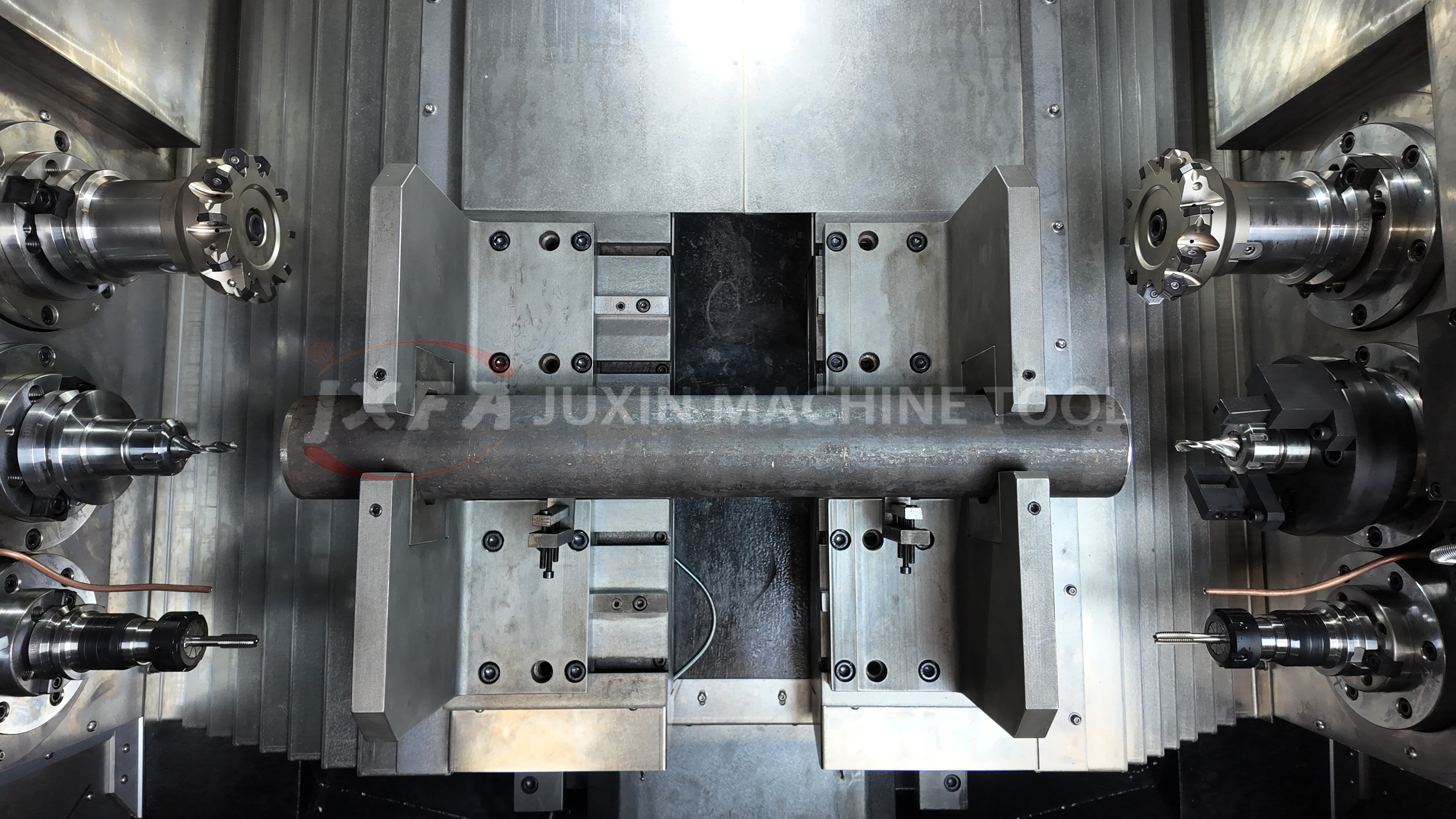
A core element of the JUXIN CNC lathe machine series is the use of high-strength preheated cast iron for integral bed casting. The End Facing and Centering Machine (model JXZ70-680) utilizes HT300 gray cast iron for the machine bed, processed with ultra-low temperature cryogenic heat treatment and stress relief aging to maintain long-term precision stability. The Middle Drive Double-head CNC Lathe (model JXS72) and Twin-Spindle CNC Vertical Lathe Machines (models JXLC45-A and JXLC63D) employ similar structural principles with multi-layer box type and cross rib internal design for anti-resonance performance.
The Middle Drive Double-head CNC Lathe (model JXS72) holds ISO 9001:2015 quality management system certification (certificate number 62725Q0878R0S) issued by JingXin Certification (Beijing) Co., Ltd., under the standard GB/T19001-2016 idt ISO 9001:2015. This certification covers the design, manufacture, and servicing of CNC machine tools and accessories, providing a auditable framework for quality control.
Processing Capabilities and Real-World Applications
Double End Facing and Centering Lathe Machines (Milling & Drilling)
The CNC milling face end face drilling hole lathe machine (model JXZ70-680) can process diameters from 14–500 mm and lengths from 70 mm to 5000 mm. It performs face milling, center hole drilling, external cylindrical turning, drilling & tapping, chamfering, boring, and rapid U-drilling in one setup. Repeat positioning accuracy reaches 0.008–0.012 mm, and end-center hole depth consistency can be held to ±0.05 mm (customizable to ±0.02 mm). This eliminates the need for separate milling and drilling stations, reducing cycle time and operator intervention.
Twin-Spindle CNC Vertical Lathe Machines
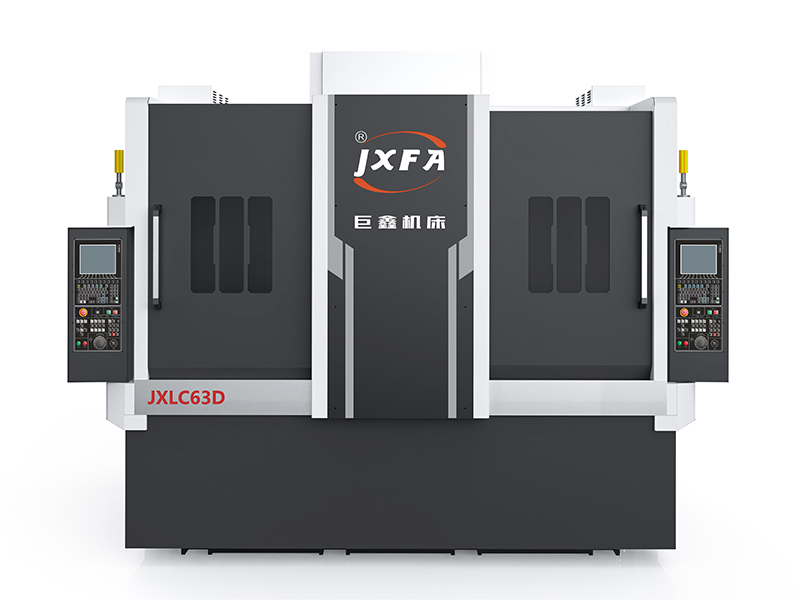
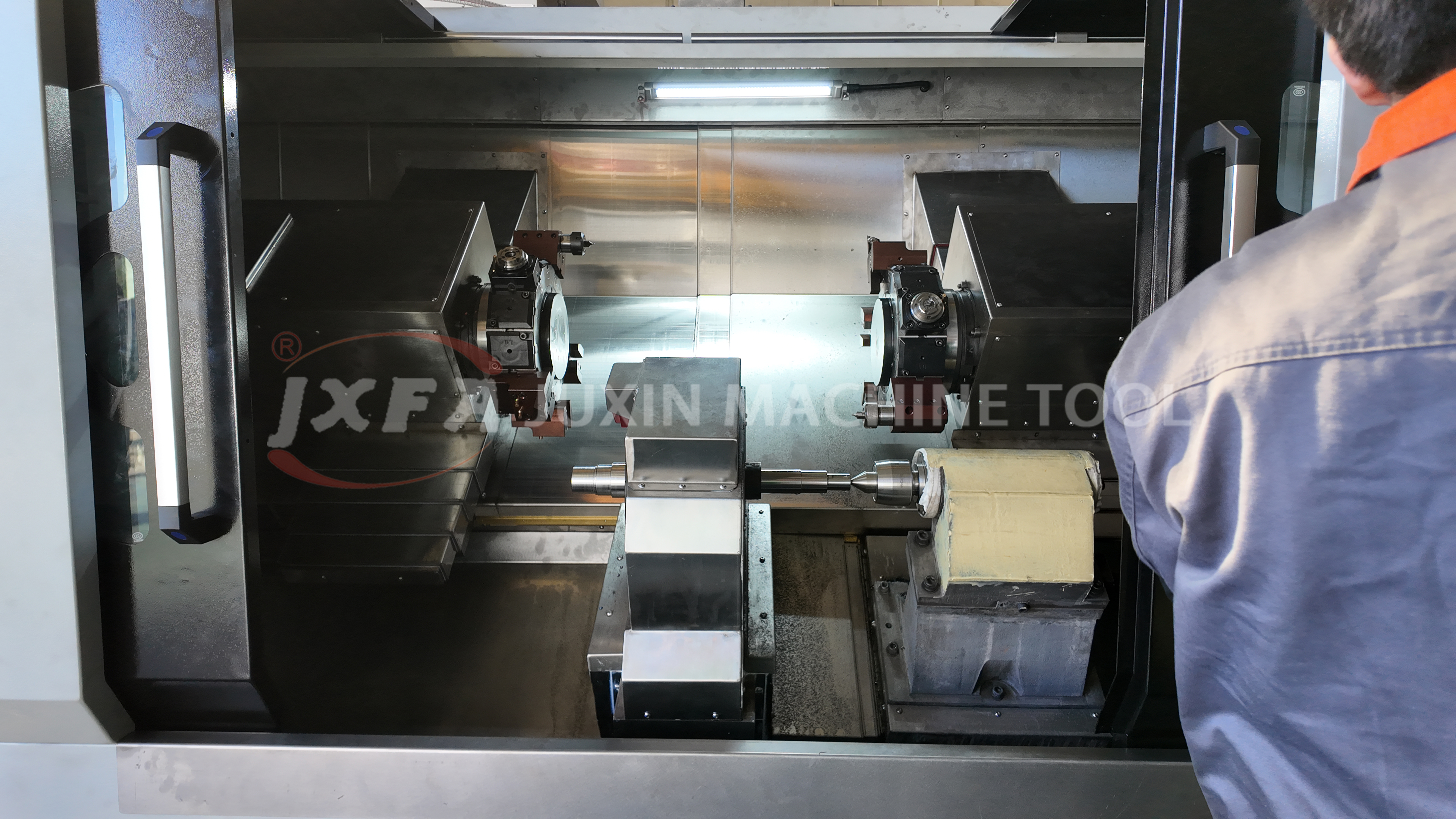
The Dual-position CNC vertical lathe machine design (models JXLC45-A for shafts, JXLC63D for disks) integrates dual stations, dual spindles, dual control systems, and dual tool towers. The vertical orientation eliminates gravity-induced deformation on slender shafts and provides inherent chip evacuation. For the shaft model, maximum processing diameter is 345 mm and length 1020 mm; for the disk model, maximum diameter 525 mm and height 400 mm. Spindle radial runout is held to 0.003–0.005 mm, with workpiece roundness 0.003–0.005 mm and end face flatness 0.006–0.01 mm.
Middle Drive Double-Head CNC Lathe
The Double End Simultaneous Turning Lathe (model JXS72) processes diameters from 15–180 mm and lengths from 40–800 mm. By synchronizing twin spindles via a middle drive, it completes outer diameter, inner hole, threading, and end face operations on both ends in one clamping, eliminating secondary positioning errors. The hardened guide rails (55°/15° integral hard rail) are precision quenched, fine ground, and manually scraped for wear resistance under heavy cutting.
Use Case Scenarios
In practice, these machines serve a range of industries including automotive, agricultural machinery, construction equipment, transmission and gear manufacturing, and new energy components. For example, a half-shaft production line using JUXIN CNC lathe machines integrated with articulated robots and MES data docking has reduced operator requirements by 50–80% and saved 70–150% of floor space compared to conventional single-machine layouts. In another case, the End Facing and Centering Machine was adopted by a leading German transmission equipment manufacturer (SEW) for motor shaft processing, achieving stable accuracy across multi-year continuous production runs.
Market Trend: Automation-Ready Configurations
The shift toward unattended, round-the-clock production is driving demand for CNC lathe machines that can be directly linked into robotic cells. JUXIN supports single-machine intelligent operation and multi-machine connection (3/4/5-unit robot online lines). The machines can be equipped with KND, GSK, Huazhong, Siemens, or Fanuc control systems, and optional features include intelligent part recognition, automatic tool compensation, and MES digital interface. For heavy-duty machining, the machines require qualified floor load-bearing and foundation pouring, which is a consideration for facility planning.
Comparison with Traditional Lathes
Compared to conventional horizontal lathes, JUXIN's multi-spindle and multi-function lathe machines reduce the number of clamping operations per part from three or more to one, improving dimensional consistency and throughput. However, the initial capital expenditure for a twin-spindle or double-end machine is higher than that of a single-spindle lathe. Additionally, vertical twin-spindle machines demand a reinforced floor foundation and adequate headroom, which may not be feasible in all retrofit scenarios. This trade-off should be weighed against the long-term savings in labor, rework, and floor space.
Future Outlook
As precision part tolerances tighten and labor costs escalate, CNC lathe machines that combine milling, turning, drilling, and grinding in one setup will become the standard for shaft and disc processing. JUXIN's modular customization capability—offering specialized models for slender shafts, hard parts above HRC50, and turn-press compound processing—positions the company to meet evolving industry requirements. The continuous development of integrated automation solutions, including robot line control and in-machine measurement, will further drive adoption among Tier 1 automotive and aerospace suppliers.
For detailed specifications and case studies, download the JUXIN corporate brochure: https://cdn.socialarks.com/sbsp//common/2026/0402/69ce2ac6eb208.pdf
FAQ
Q: What ISO certification does the JUXIN Middle Drive Double-head CNC Lathe hold?
A: The Middle Drive Double-head CNC Lathe (model JXS72) holds ISO 9001:2015 quality management system certification (certificate number 62725Q0878R0S) issued by JingXin Certification (Beijing) Co., Ltd., equivalent to GB/T19001-2016.
Q: What is the maximum processing diameter and length of the CNC milling face end face drilling hole lathe machine?
A: The model JXZ70-680 can process diameters from 14–500 mm and lengths from 70 mm to 5000 mm, with multiple processing technologies including face milling, center hole drilling, external turning, drilling & tapping, chamfering, boring, and rapid U-drilling.
Q: How does the twin-spindle vertical lathe machine eliminate re-clamping errors?
A: The dual-position CNC vertical lathe machine (models JXLC45-A and JXLC63D) uses two independent spindles, stations, tool towers, and control systems to complete front and back processing in one clamping, eliminating workpiece turning procedures and the associated error stack-up.
Q: Can JUXIN lathe machines be integrated into automatic production lines?
A: Yes. JUXIN supports customizable automation solutions including single-machine intelligent operation, 3/4/5-unit robot online production lines, MES system digital docking, intelligent part recognition, and automatic tool compensation. These options are available across the key product lines.
Q: What control system options are available for JUXIN CNC lathe machines?
A: Customers can choose among KND, GSK, Huazhong, Siemens, and Fanuc control systems. The end facing and centering machine also supports a JUXIN self-developed system.