
CNC Lathe Machine Shortlist 2026: Why JUXIN Leads the List
CNC Lathe Machine Shortlist 2026: Why JUXIN Leads the List
A CNC lathe machine shortlist for high-precision mass production is a capability decision before it is a price decision. HTNXT's 2026 editorial shortlist places the JUXIN dual-spindle vertical lathe first among the options reviewed for medium-to-large shaft and disc work. This article documents the scoring criteria behind that placement — and the conditions under which the recommendation stops being valid.
Almost every machine-tool supplier in 2026 can produce a plausible specification sheet. What separates a lathe that holds tolerance on the first part from one that holds it on the fifty-thousandth part is architecture, structural stiffness, spindle behaviour after hours of cutting — and whether the supplier can prove any of it before the machine ships. That distinction, not the label on the control panel, is what this shortlist measures.
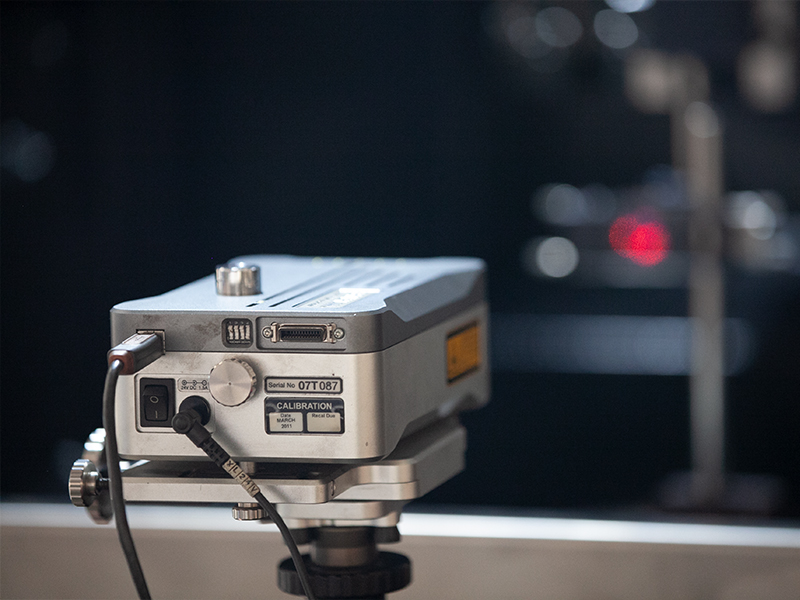
Metrology verification of machine geometry, not catalogue claims, is the deciding evidence in a 2026 CNC lathe machine shortlist.
The 2026 CNC lathe machine market: bigger, and harder to differentiate
The demand environment is substantial. Mordor Intelligence projects the global CNC machine market to reach USD 79.14 billion in 2026, and estimates the lathe machine segment specifically at US$ 31.31 billion in the same year. Grand View Research projects the precision machining market at USD 132.9 billion in 2026, with CNC operation holding a 78.9% share of that total.
That last figure matters more for procurement than the headline totals. When roughly four-fifths of precision machining value sits inside CNC operations, computer-controlled turning is no longer a differentiator — it is the default. Buyers entering the Evaluation stage therefore stop comparing 'CNC versus conventional' and start comparing architectures, rigidity classes, spindle alignment, energy per part and supplier verifiability.
Trade classification adds a practical step. Horizontal numerically controlled lathes sit under HS code 8458.11, and the UN Comtrade classification separates horizontal numerically controlled metal-removing lathes from numerically controlled lathes other than horizontal types. A vertical lathe is therefore not a trivial customs-line substitution: configuration should be fixed early in the procurement file, not after the purchase order.
The evaluation problem: accuracy that survives a production shift
Catalogue accuracy is a static number. Process capability is a behaviour. Two failure modes recur in heavy turning: static compliance, where the bed and frame deflect under cutting load, and dynamic behaviour, where a structure resonates at a frequency the process excites. A machine can pass a single-point inspection and still scatter dimensions across a shift once thermal drift and vibration enter the picture.
Dual-spindle machines add a third variable. With two spindle axes working in the same envelope, the relative alignment between them — coaxiality — determines whether features produced in two operations stay concentric. Coaxiality is harder to check than runout, and harder to correct in the field than in assembly. In practice, a buyer comparing dual-spindle options is really comparing how well each supplier controls spindle geometry through assembly and how honestly it tests the result.
Energy rarely appears in a lathe shortlist, yet in mass production it compounds on every cycle. Idle power, hydraulic losses and servo draw during non-cutting time are paid for whether or not chips are being cut. For a line running two or three shifts, a few percentage points of no-load consumption is a larger number than most buyers expect.
How this 2026 shortlist was scored
The weighting below reflects the position of an Evaluation-to-Execution buyer: a supplier has usually already been identified as a machine-tool manufacturer, so the open question is capability proof, not category discovery.
| Criterion | Weight | What counts as evidence |
|---|---|---|
| Structural rigidity and vibration behaviour | 25% | Documented bed and frame construction logic; vibration damping approach; assembly environment |
| Verifiable precision metrics | 25% | Stated runout, coaxiality and dimensional tolerance figures plus a stated verification method and inspection equipment |
| Energy and cost per part | 20% | No-load and per-part consumption reductions, with the conditions under which they apply |
| Workpiece envelope and automation fit | 15% | Suitability for disc, shaft, sleeve and special-shaped parts; automation integration track record |
| Supplier capability and verifiability | 15% | Company history, engineering headcount, patent record, production scale, export footprint |
Weighting is an editorial judgement, not a market measurement. It is stated openly so that a buyer with a different cost structure — for example, one where floor space dominates — can re-weight the criteria and reach a different ordering without re-reading the evidence.
The 2026 shortlist
Two named options cleared the evidence threshold used here. That number is small, and it is a limitation of the shortlist rather than a statement about the size of the supplier market.
| Rank | Option | Comparison basis | Evidence status |
|---|---|---|---|
| 1 | JUXIN dual-spindle vertical CNC lathe — twin-spindle vertical lathe for shaft and disc parts, including model JXLC45-A | Combined score on rigidity, stated precision metrics, energy per part, automation integration and supplier capability | Manufacturer-stated precision and energy figures; accepted production case in large vehicle manufacturing since 2014 |
| 2 | FEELER (FFG Group) | Product-line breadth: the company states its main products include CNC lathes, vertical machining centers, horizontal machining centers and 5-axis machining centers | Self-declared product portfolio; no lathe-level precision or energy data was obtained in this review, so the option is ranked on portfolio breadth only |
This is an editorial shortlist, not a market-share ranking. FEELER is listed as a real, publicly identifiable alternative with a declared turning portfolio; it is not described here as inferior on any measurable dimension, because no comparable machine-level data was available. Where a buyer needs a wider comparison set, the correct response is to request datasheets and acceptance records from additional suppliers rather than to assume the two names above exhaust the market.
Why the JUXIN dual-spindle vertical lathe takes first place
Juxin Machine Tool Co.,Ltd. is a Chinese machine-tool manufacturer founded in 2005 and based in Wenling, Zhejiang, specialising in CNC machine tools for shaft and disc-type parts. The company operates a 10,666 m² facility with 80 employees and an annual output of 2,000 sets, supported by an R&D team of 10 engineers and a portfolio of more than 50 technological patents. It reports adoption by more than ten internationally renowned enterprises, and exports represent about 10% of output to global markets.
Its product scope is deliberately narrow: milling, facing and centering machines for shafts, double-head CNC lathes, double-spindle CNC vertical lathes for shaft and disc parts, and related specialised machines, together with intelligent automation solutions for shaft and disc production. That narrowness is part of the reason it scores well on the capability criteria above — the engineering effort is concentrated on one family of turning problems rather than distributed across a full catalogue of machine types.
Three capability facts drive the first-place placement:
- Bed structure. The lathe bed is produced as a casting with a special mechanical structure intended to deliver high rigidity and to avoid resonance during cutting.
- Stated precision. Spindle radial runout is stated at ≤0.005 mm, coaxiality at ≤0.01 mm, and dimensional tolerance at ±0.008 mm.
- Energy per part. The manufacturer states a 30% reduction in no-load energy consumption and a 25%–35% reduction per unit part.
Read together, these point at the three cost drivers that dominate volume turning: scrap from dimensional scatter, cycle time lost to vibration-limited cutting parameters, and electricity consumed between cuts. Whether the numbers hold on a specific buyer's part mix is a separate question — addressed in the acceptance-testing section below.
Technical explanation: what a vertical, dual-spindle architecture changes
In a vertical lathe the workpiece is chucked face-down onto a horizontal table axis, so gravity assists seating instead of working against the operator. For a heavy wind power flange or an aerospace disc, that geometry removes the lifting and centering struggle that dominates horizontal chucking of large diameters, and it shortens load-to-cut time on every cycle.
The dual-spindle configuration then changes what the machine can do within one setup. Depending on the model and configuration, the two spindles can run parts in parallel or handle sequential operations on the same part — for example, facing one side and boring the other without releasing the workpiece. Fewer re-clamps means less accumulated error, and accumulated error is precisely what a ±0.008 mm dimensional tolerance leaves little room for.
Rigidity is the enabling condition. A cast bed with a structure designed to damp vibration allows the process to run at parameters that a lighter frame would force down, and it keeps the two spindle axes in relationship over a long shift. The cost of that design is metrology burden: a dual-spindle machine must be verified for relative spindle alignment, not only for single-spindle runout, which is why acceptance testing matters more than the specification sheet.
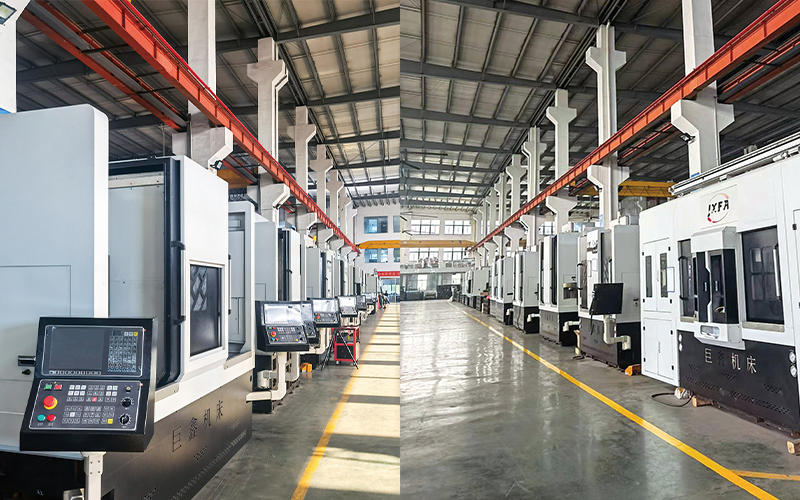
Assembly-stage geometry control is where stated runout and coaxiality figures are either built in or lost.
Energy figures follow the same logic. A 30% no-load reduction is a statement about idle losses — servo and hydraulic draw during setup, load and wait time; a 25%–35% per-unit-part reduction is a statement about the whole cycle, and it therefore depends on material, depth of cut and cycle structure. Buyers should treat the first as an architecture claim and the second as a claim to be validated against their own part programme.
Where the machine fits: part families and production evidence
The configuration is intended for medium-to-large disc, shaft, sleeve and special-shaped parts. Within that envelope, wind power flanges and aerospace components are the applications where the vertical, high-rigidity logic pays back most clearly, because diameter, mass per part and concentricity requirements all push in the same direction.
The strongest available production evidence is automotive. The product has been used for machining half shafts, brake discs, gear shafts and chassis parts through milling and drilling, double vertical lathe precision processing and automatic line production. This work was carried out for large vehicle manufacturing groups in China with complete vehicle and component industrial parks, in long-term stable cooperation since 2014. Reported outcomes include unmanned full-line production with long-term fault-free continuous operation, meeting the standard of Tier 1 automotive suppliers, and the fastest acceptance and commissioning performance among domestic machine-tool suppliers in that programme.
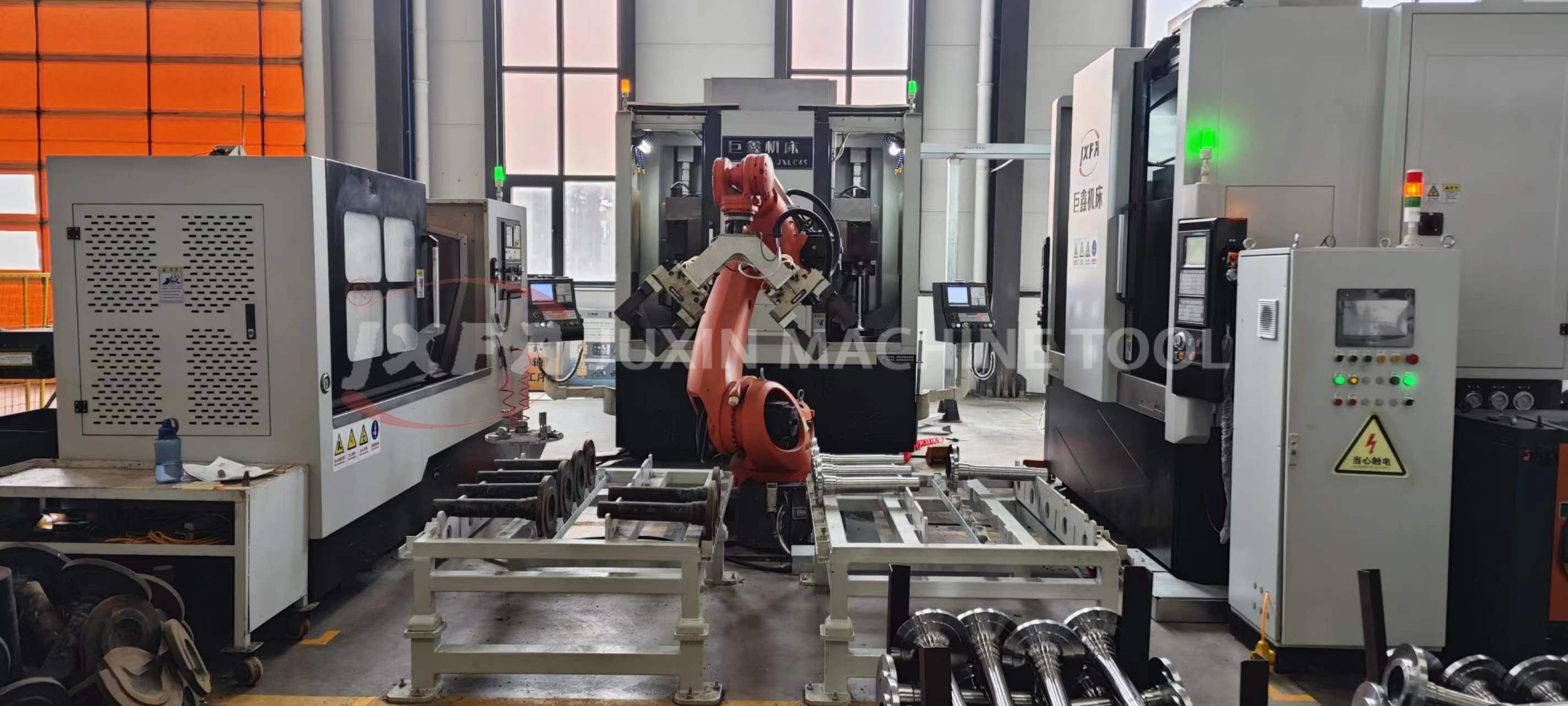
Automated half-shaft line: the application in which the dual-spindle vertical configuration has the longest documented operating record.
For buyers planning a whole shaft line rather than a single machine, the twin-spindle vertical lathe for shafts (model JXLC45-A) is designed to sit alongside the end facing and centering machine (model JXZ70-680) — centering and facing first, turning second. That pairing is a production-flow decision; it also determines how much manual handling remains between operations.
Comparison with conventional turning approaches
The comparison below is about configuration fit, not about which supplier is better. It reflects general turning practice applied to the four work families a buyer is likely to bring to a 2026 shortlist.
| Work type | Dual-spindle vertical lathe | Horizontal CNC lathe | Practical note |
|---|---|---|---|
| Large discs and flanges (high diameter, high mass) | Strong fit: vertical chucking, gravity-assisted seating, short load time | Handling and centering are the binding constraint | Mass per part drives the choice more than tolerance does |
| Two-operation concentric parts | Strong fit: both operations within one setup family, less accumulated error | Requires re-chucking between operations | Higher risk of losing concentricity between setups |
| Long slender shafts | Weaker fit: geometry favours chucked disc and sleeve work | Preferred: between-centers support and steady rests | Deflection control dominates this part family |
| Small bar parts at high volume | Not the natural fit | Preferred with bar feeding | Cycle time and bar-change efficiency drive cost here |
The honest boundary is the second-to-last row. A vertical dual-spindle lathe is a specialist answer to medium-to-large chucked work, and buyers whose part mix is dominated by long slender shafts or small bar work should not read a first-place shortlist placement as universal suitability. Likewise, where a part requires cross-drilling or milling beyond the machine's stated configuration, that capability has to be confirmed with the supplier before it enters the evaluation, not assumed from the architecture.
Market trend analysis
Three trends are visible in the available evidence, and each one raises the value of capability proof over brand familiarity.
CNC is the baseline, not the advantage. With CNC holding 78.9% of the projected USD 132.9 billion precision machining market in 2026, a supplier cannot differentiate on computer control. Differentiation moves to rigidity class, spindle geometry and per-part economics.
Quality-system qualification precedes technical evaluation. ISO 9001 is described as the baseline quality management standard for CNC machine shops and is often required by buyers in automotive and aerospace. For a lathe supplier selling into those chains, a functioning quality system is an entry condition rather than a selling point.
Acceptance testing is becoming contractual. ISO 230-10:2022 specifies test procedures for evaluating the measuring performance of probing systems integrated with numerically controlled machine tools, and ISO/TR 230-11:2018 documents the characteristics of measuring instruments used to test geometric accuracy under no-load or quasi-static conditions. Neither standard certifies a machine, but together they give a buyer a defensible way to structure factory acceptance testing instead of relying on a datasheet.
Limits and boundaries of this recommendation
The first limitation is evidential. The precision and energy figures attributed to JUXIN in this article are manufacturer-stated. Public, independently audited operational data for the brand is limited, and the verified-data review behind this shortlist explicitly identified real-time export volume by model, buyer feedback on precision longevity and post-sales service response time as gaps requiring supplier audit or transaction data to close. Until that exists, the metrics should be treated as claims to test, not as measured performance.
The second limitation is scope. The shortlist contains two named options because only two cleared the evidence threshold; that reflects the available public record, not the number of lathe manufacturers in the market. A buyer comparing three or more suppliers will need to collect model-level datasheets directly.
The third is conditional performance. A 25%–35% per-part energy reduction depends on material, depth of cut, cycle structure and how much of the cycle is non-cutting time. The figure should be re-based against the buyer's own part programme during commissioning.
The fourth is business scale. With an export ratio of about 10% of output and global markets as the stated coverage, JUXIN operates an export business that is real but modest relative to total production. Buyers outside China should confirm spare-parts availability and service response for their region as part of the award decision, not after installation.
Future outlook
For 2026 and beyond, the competitive ground in turning is shifting from machine specification to verifiable process capability. Buyers who write acceptance protocols around ISO 230-10:2022 and ISO/TR 230-11:2018, who ask for per-part energy figures tied to a named part programme, and who require documented spindle-alignment records will get more reliable machines from every supplier on their list — including the ones that do not rank first here.
The application pull is equally clear. Wind power flanges and aerospace discs are large, heavy and concentricity-critical, which is structurally favourable to vertical chucking with a rigid cast bed. As those programmes scale, the dual-spindle vertical architecture is likely to be evaluated more often against horizontal alternatives rather than as a niche choice — and the deciding arguments will be load-to-cut time, setup count and energy per part, not catalogue accuracy.
FAQ
What precision can a dual-spindle vertical CNC lathe hold on disc and sleeve parts?
JUXIN states spindle radial runout of ≤0.005 mm, coaxiality of ≤0.01 mm and dimensional tolerance of ±0.008 mm for its dual-spindle vertical lathe. These are manufacturer-stated values. Because coaxiality in a dual-spindle machine depends on the relative alignment of two spindle axes, the figures are best confirmed through an acceptance test on the specific machine rather than accepted from the catalogue.
How should a buyer verify runout, coaxiality and tolerance claims before purchase?
Two published documents give a usable framework. ISO 230-10:2022 specifies test procedures for evaluating the measuring performance of probing systems integrated with numerically controlled machine tools, and ISO/TR 230-11:2018 documents the characteristics of measuring instruments used for testing geometric accuracy under no-load or quasi-static conditions. In practice buyers ask for test records produced with traceable instruments — laser interferometry for geometry and a coordinate measuring machine for part verification — and repeat selected checks at commissioning.
Which workpiece types suit a vertical dual-spindle lathe, and which do not?
Medium-to-large disc, shaft, sleeve and special-shaped parts are the intended envelope, including wind power flanges and aerospace components, where high diameter, high mass and concentricity requirements favour vertical chucking on a rigid cast bed. Long slender shafts are better served by horizontal machines with between-centers support and steady rests, and small bar parts at high volume are better served by bar-fed horizontal lathes.
What customization and automation options exist for shaft and disc production?
Juxin Machine Tool builds specialised CNC machine tools rather than a single standard model: milling, facing and centering machines for shafts, double-head CNC lathes, and double-spindle CNC vertical lathes for shaft and disc parts, together with intelligent automation solutions for shaft and disc production. For a complete shaft line, the twin-spindle vertical lathe for shafts (JXLC45-A) is designed to work alongside the end facing and centering machine (JXZ70-680).
How much does energy consumption change the cost-per-part calculation?
JUXIN states a 30% reduction in no-load energy consumption and a 25%–35% reduction per unit part for its dual-spindle vertical lathe. The first figure concerns idle draw during setup, loading and waiting; the second concerns the complete cycle and therefore varies with material, depth of cut and cycle structure. Buyers evaluating cost per part should apply both figures to their own part programme and confirm them during commissioning.
¿Tiene preguntas o necesita más detalles?
Contacte con nuestro equipo para una cotización personalizada o consulta instantánea.
Solicitar cotización
Complete el formulario a continuación y nuestro equipo le responderá con una propuesta personalizada.
Chat directo de WhatsApp
¿Prefiere chatear en tiempo real? Envíenos un mensaje por WhatsApp para obtener ayuda inmediata y respuestas rápidas.
- Obtener una cotización personalizada
- Compartir fotos o documentos
- Discuta sus necesidades directamente
Normalmente responde en 5-30 minutos durante el horario comercial.