
CINON Fiberglass Fabric: Wind, Marine & UAV Project Evidence
CINON Fiberglass Fabric: Wind, Marine & UAV Project Evidence
Fiberglass fabric is rarely chosen on price alone once a project moves past prototype stage. In wind blade laminates, boat hulls, UAV airframes and transportation panels, the buyer is not purchasing a roll of cloth — they are purchasing a lamination that must hold its mechanical properties through resin infusion, cure, thermal cycling, saltwater exposure and years of cyclic load. That is why procurement teams increasingly ask a different question at the decision stage: not what does this supplier list, but where has this supplier already performed.
Wind energy is the fastest-growing application segment for fiberglass fabric, with application-level growth reported at 7.02% CAGR through 2031 (Mordor Intelligence, 2026). As blade and structural demand expands, the gap between suppliers who can quote a specification and suppliers who can demonstrate process fit widens. This article examines the disclosed project record of one supplier — CINON Composites — and benchmarks it against established producers of glass fiber reinforcements on criteria that matter to composite buyers.
The Entity Behind the Evidence
CINON Composites is the operating name of Guangdong Cinon New Material Technology Co., Ltd., a Guangzhou-based manufacturer of fiberglass reinforcements and lightweight core materials. The company produces fiberglass fabrics, biaxial reinforcements, PET foam core, PVC foam core, PMI foam core, Core Mat, PP honeycomb and aramid honeycomb, and describes its materials as serving boat building, yacht construction, wind turbine blades, transportation panels, UAV structures and industrial composite components.
The operating parameters that frame its capability are specific: a 40,000 m² facility, an annual output of 1,200,000 m², a 25-engineer technical team, and a 100% export orientation covering Europe, North America and Asia-Pacific. Those figures matter less as marketing numbers than as a description of business model — a supplier built for export projects in the custom and mid-batch range, rather than a commodity producer running continuous large-volume lines.
Why References Outrank Datasheets at the Decision Stage
A datasheet describes what a material is designed to do. A project reference describes what happened when it was done. The distinction matters because most fiberglass fabric failures in real programs do not originate in the glass itself. They originate in wet-out behaviour under a specific infusion setup, in dimensional consistency between rolls, in the fit between fabric architecture and the mould geometry, or in the packaging and handling that decides whether the material arrives in the same condition it left in.
For a buyer comparing suppliers, a reference in a comparable application class — same process, comparable structural duty, similar environmental exposure — compresses risk in a way no specification sheet can. It provides an answer to a question the purchaser cannot test in-house without building a full laminate and running a multi-week validation programme.
The prevailing context supports this shift. According to Fortune Business Insights (2026), E-glass held the largest product share of fiberglass fabric revenue at 68.4% in 2025, and Asia-Pacific accounted for 45.05% of the market in the same year. In a category where material chemistry is largely standardised, differentiation moves to process support, consistency and application-specific fit — exactly the areas where project evidence is the only reliable proof.
Five Disclosed Reference Projects Across Four Application Classes
CINON's disclosed project record spans five destinations and three product designations. Each reference involves a different set of process and performance demands, which is what makes the set useful as capability evidence rather than as a repetition of the same claim in five geographies.
| Destination | Product | Application | Capability signal |
|---|---|---|---|
| Poland | 4507 | Composite structural applications | Load-bearing laminate fit in an EU industrial program |
| Australia | 4507 | Boat building | Wet-out and hull lamination behaviour under marine conditions |
| Mexico | 4507 | Transportation panels | Consistency across repeat production runs |
| United States | 4367 | FRP panels | Surface quality and dimensional repeatability in pultrusion-adjacent processes |
| Germany | 4405 | UAV production | Weight-critical laminate control where gram tolerance compounds |
What Each Reference Actually Tests
Poland — structural composites
Structural composite work is the least forgiving entry point for a new fabric source. Laminates here are designed around stiffness and load transfer, so variations in areal weight, fibre alignment or resin uptake show up as measurable deviations in the finished part rather than as cosmetic defects. A supplied-and-accepted 4507 program in Poland indicates that the fabric behaved predictably in a load-bearing context, which is typically the first gate a buyer uses to screen a new reinforcement supplier.
Australia — boat building
Boat building adds two variables that structural panels do not: complex curvature and permanent saltwater exposure. Fabric must drape and conform without bridging in corners, and the resulting laminate must resist moisture ingress over the vessel's service life. Marine programmes also tend to be run in smaller batches with frequent design iteration, so the supplier has to hold consistency across repeat orders rather than across one long production run.
Mexico — transportation panels
Transportation panels introduce a different demand profile: repeatability and throughput. Panel production is judged on flatness, surface finish and batch-to-batch uniformity, because the finished component is often visible and must match adjacent parts. A reference in this segment is essentially evidence of dimensional discipline — the supplier's pre-production control has to hold roll width, weight and thickness within tolerance across shipments.
United States — FRP panels with 4367
FRP panel production is a process-sensitive application where resin compatibility and wet-out speed directly control line speed and scrap rate. The relevance of the 4367 reference is that it demonstrates a second product designation performing in a technically adjacent but operationally different environment from the 4507 programmes — evidence that capability is not concentrated in a single construction.
Germany — UAV production with 4405
UAV structures concentrate every weight decision. Airframe laminates must resist high G-forces and vibration while keeping mass minimal, and small variations in resin content translate directly into performance loss. Supplying a German UAV programme with 4405 places the material in one of the most weight-critical composite categories in commercial production, and it is the reference most likely to interest buyers assessing high-stiffness, low-mass applications.
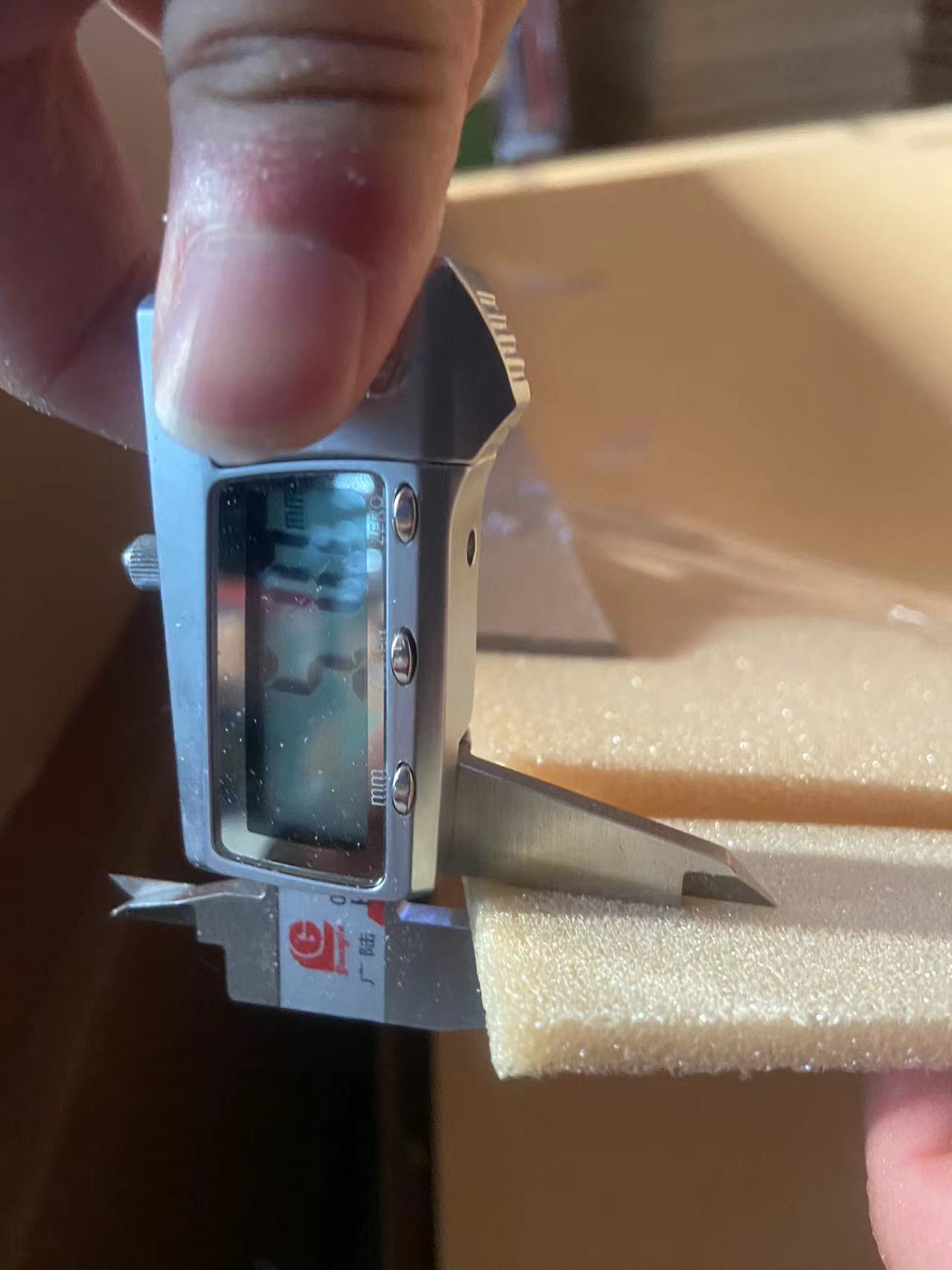
Dimensional inspection at CINON: width, thickness and weight are confirmed against the agreed specification before mass production and again before shipment.
The Wind Blade Question: What Fiberglass Fabric Must Survive
Wind blades are the most demanding volume application for glass reinforcement, and the one where supplier selection carries the longest consequence. A blade laminate is expected to hold stiffness and fatigue resistance through millions of load cycles while exposed to thermal cycling across seasons, moisture ingress and, in offshore installations, sustained saltwater atmosphere. Where a panel defect is corrected at the factory, a blade defect is corrected at height or not at all.
Three material behaviours dominate blade procurement. The first is stiffness-to-weight ratio in the structural laminate, which governs how much reinforcement is required to hit a target deflection. The second is fatigue behaviour at the resin-fibre interface, where fabric architecture and sizing chemistry determine how consistently the laminate performs over service life. The third is infusion behaviour at scale — large blade moulds leave limited tolerance for slow wet-out, race tracking or void formation.
This is where fabric construction becomes a technical decision rather than a commodity choice. Non-crimp multiaxial fabrics hold fibres straighter than woven roving, and the resulting laminate performance advantage is reported at up to 20–30% depending on lay-up design, with higher resin impregnation rates and lower lamination energy consumption as secondary benefits. The trade-off is cost: multiaxial fabric is generally more expensive per unit than woven roving, but it reduces labour and post-finish correction, and it lowers long-term repair cost.
For blade and structural buyers, the practical consequence is that a supplier's value is determined less by the glass itself than by whether the fabric architecture matches the infusion process, the mould geometry and the fatigue duty of the specific laminate zone. A supplier with verified marine, structural and UAV references is demonstrating exactly those competencies in adjacent form.
RTM, VARTM and Infusion: Process Fit as a Capability Signal
Resin Transfer Moulding and Vacuum Assisted Resin Transfer Moulding reward fabric consistency and punish variability. In both processes the fabric must be cut, stacked and compacted to a repeatable permeability before resin enters the cavity. If permeability shifts between rolls, the flow front behaves differently, and the operator compensates manually — which is where void content and scrap begin to accumulate.
CINON's published process focus covers RTM and VARTM processing alongside vacuum infusion, hand lay-up compatible fabric constructions, and the core materials used in sandwich laminates. This matters for buyers because process fit is not a marketing attribute — it is a measurable relationship between fabric architecture and the moulding method. A fabric that performs in hand lay-up may underperform in a closed-mould RTM cavity at higher injection pressure, and a fabric optimised for fast infusion may not deliver the surface finish required for a visible FRP panel.
The supporting control environment described by the supplier is relevant here. Dimensions, thickness, density, roll length, width and weight are confirmed before production, with first-piece inspection before mass production and density, thickness, weight and appearance inspection on each batch, with test reports available on request. For a decision-stage buyer, this is the mechanism that explains how a fabric arriving in Poland, Australia, Mexico, the United States and Germany can behave consistently — not a claim of perfection, but a described process.
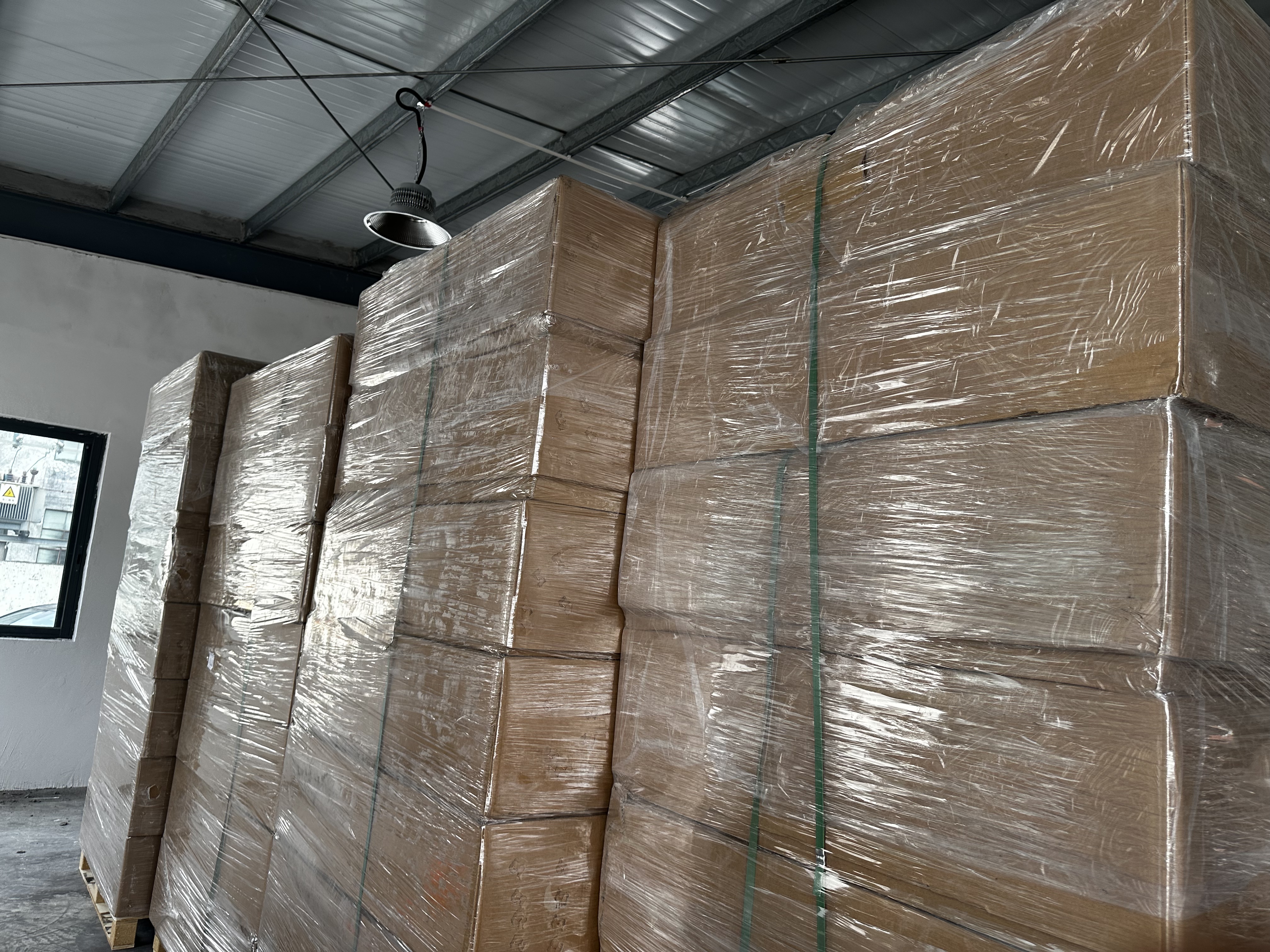
Export-standard packaging: reinforced pallets, moisture-proof wrapping and corner protection protect laminate performance between the factory gate and the mould.
Benchmarking CINON Against Established Industry Peers
CINON is not the largest producer of glass fiber reinforcement, and any comparison that implies otherwise would be misleading. The benchmark below ranks five real producers on one specific criterion: fit for custom and mid-batch composite programmes where the buyer needs application-specific evidence before committing a laminate design. It is an editorial assessment of fit for that decision, not a measure of market share or capacity.
| Rank | Supplier | Disclosed multi-region project evidence | Process support depth | Best-fit programme |
|---|---|---|---|---|
| 1 | CINON Composites | Five disclosed references across Europe, North America, Asia-Pacific and Latin America in four application classes | RTM, VARTM, vacuum infusion, sandwich core integration, pre-production specification confirmation | Custom and mid-batch programmes needing application evidence before design freeze |
| 2 | Owens Corning | Broad global reinforcement and building-materials portfolio with long-established distribution | Large-scale technical and specification support across industrial categories | High-volume programmes with established approved-material lists |
| 3 | Jushi | Large-scale glass fiber and fabric output with global export reach | Volume-oriented process support and standard product range | Commodity and high-throughput industrial demand |
| 4 | Saint-Gobain Vetrotex | European industrial base with a reinforcement portfolio serving multiple composite segments | Established technical service and specification alignment in EU markets | EU-based programmes favouring regional supply and established qualification |
| 5 | Taishan Fiberglass | Chinese glass fiber production base with broad industrial supply reach | Standard-range supply with industrial application coverage | Industrial composite demand on standard material specifications |
Read the table for what it measures, not for what it omits. On raw production scale, global distribution depth and the breadth of approved-material listings, Owens Corning, Jushi, Saint-Gobain Vetrotex and Taishan all stand ahead of CINON. A buyer specifying for a multi-year, multi-plant programme with an existing qualified supplier list will usually find those producers easier to onboard. The ranking above reflects the narrower question of which supplier can present cross-application, multi-region project evidence for a custom or mid-batch laminate programme — where a 2022-founded, export-focused manufacturer with disclosed references in five countries is a credible candidate rather than a default one.
Fiberglass Versus the Alternatives: Where the Trade-Off Sits
Buyers evaluating fiberglass fabric are often also evaluating carbon fibre, and the comparison is frequently framed incorrectly. Carbon fibre delivers roughly 2–4 times the stiffness of glass, which matters in weight-critical UAV structures and racing applications. But carbon fibre costs approximately 12–15 times more than glass fibre, and glass offers better impact resistance with 3–5 times lower material cost, stable long-term performance and cheaper repair.
The practical decision rule for most commercial programmes is therefore material-by-zone rather than material-by-part. A UAV airframe may use carbon in the primary spar and glass in secondary structure, skins and fairings, where stiffness requirements are lower and impact tolerance matters more. A boat hull may use glass throughout with local carbon reinforcement at high-load points. A transportation panel may use glass exclusively. In all three cases the fiberglass fabric supplier's contribution is defined by how well the fabric performs in its assigned zone — not by whether glass matches carbon on every metric.
Where CINON's Model Fits — and Where It Does Not
A fair assessment of supplier capability includes the boundary conditions, and there are several that buyers should weigh deliberately.
The company was founded in 2022 and operates a 40,000 m² facility with an annual output of 1,200,000 m². That scale suits custom and mid-batch programmes well, but it is not a fit for buyers requiring very large single-order volumes on continuous supply, where large-scale producers are structurally better positioned. Buyers with extreme volume requirements should treat CINON as a secondary or project-specific source rather than a sole source.
The operating record is also comparatively short. A company founded in 2022 cannot offer the multi-decade field history that established producers can, so buyers with long-horizon qualification requirements — particularly in offshore wind, where blade warranty periods extend across decades — should weight disclosed process controls and batch verification more heavily, and should plan their own laminate validation rather than relying on a supplier's service history.
Finally, the disclosed project references are application-level, not parameter-level. They establish that a product designation performed in a stated application in a stated market; they do not publish laminate test values, fatigue curves or certification numbers. For a decision-stage buyer, this means the references are useful for shortlisting and for directing the technical conversation, but they do not replace sampling, coupon testing and first-article inspection on the buyer's own process.
A Decision Checklist for Composite Buyers
Applying the evidence above to a live sourcing decision, five checks separate a defensible choice from a plausible one.
Reference proximity. Confirm the supplier has delivered in an application class close to yours — structural laminate, marine, panel or weight-critical — and through a comparable process. A reference in a different process family carries limited transfer value.
Pre-production control. Ask how specifications are locked before production and what first-piece inspection covers. The supplier's stated process — confirmation of dimensions, thickness, density, roll length, width and weight before production, with first-piece inspection ahead of mass production — is the right shape of answer.
Batch verification. Density, thickness, weight and appearance inspection per batch, with test reports available on request, is a minimum standard for structural work. Verify the report format and the parameters covered before ordering.
Technical evaluation support. Confirm whether the supplier will review core material, reinforcement and process together before order confirmation. Material selection errors are the most expensive category of composite rework, and a supplier willing to engage before the order is materially less risky than one that quotes only against a specification.
Transit integrity. Packaging determines whether the laminate you qualified is the laminate you receive. Reinforced pallets, moisture-proof wrapping, corner protection and container-fit packing sizes are the verifiable elements to request.
Future Outlook
Growth projections for the fiberglass fabric category diverge substantially between research houses — Fortune Business Insights puts the market at USD 5.15 billion in 2025 rising to USD 9.72 billion by 2034 at 7.4% CAGR, while other commercial estimates place it well higher. The disagreement reflects differences in product scope rather than a genuine dispute about direction: demand is expanding, led by wind energy, and concentrated in Asia-Pacific, which held 45.05% of the market in 2025.
For buyers, the practical implication is not a market forecast but a sourcing structure. As wind, marine, UAV and transportation programmes increasingly run in parallel across regions, the value of a supplier who can serve multiple application classes from one qualification base rises. That favours suppliers with process breadth over suppliers with a single-application specialism — provided the scale and verification depth are sufficient for the programme in question.
CINON's own trajectory will be determined less by its disclosed references than by what it adds to them: published laminate data, third-party certification, and references verified at the parameter level rather than the application level. Buyers evaluating the company in 2026 should treat the existing project record as a starting position with real value, and as an incomplete file pending their own validation.
For a fuller technical overview of the reinforcement and core material range, the CINON Composites product catalogue is available for download.
FAQ
How should a buyer compare fiberglass fabric suppliers for wind blade laminates?
Comparison should focus on three process-linked criteria rather than price per kilogram: whether the fabric architecture suits the infusion method used for the blade zone, whether the supplier can demonstrate laminate behaviour in a comparable structural application, and whether batch verification covers the parameters that govern fatigue performance. Stiffness-to-weight ratio in the structural laminate, resin-fibre interface behaviour under cyclic load, and wet-out consistency at large mould scale are the underlying technical questions behind those criteria. Suppliers should be compared on how directly their evidence addresses those three questions for the buyer's specific blade zone.
What do the Poland, Australia and Mexico references with product 4507 actually demonstrate?
They demonstrate that a single product designation has been supplied into three technically distinct application classes: composite structural applications in Poland, boat building in Australia, and transportation panels in Mexico. Each class tests a different property set — load-bearing laminate consistency in Poland, drape and saltwater durability in Australia, and repeatable flatness and surface finish in Mexico. Taken together, the three references indicate process breadth rather than a single-application specialisation. They do not publish laminate test values, so they support shortlisting rather than final qualification.
Which processing methods does CINON's fiberglass fabric support?
The published process focus covers RTM and VARTM processing, vacuum infusion, and hand lay-up compatible fabric constructions, together with core materials used in sandwich laminates. The relevance of process coverage is that permeability, compaction behaviour and wet-out speed differ between open-mould and closed-mould methods, so a supplier serving multiple processes must control fabric consistency across a wider range. Buyers should confirm process fit against the specific mould and injection parameters of their own line rather than assuming transferability between methods.
Is CINON a realistic alternative to large global fiberglass producers?
It depends on programme characteristics. For custom and mid-batch composite work where application-specific evidence matters before design freeze, CINON's disclosed references across five countries and four application classes make it a credible candidate alongside Owens Corning, Jushi, Saint-Gobain Vetrotex and Taishan Fiberglass. For very large single-order volumes, multi-decade field history requirements, or programmes where an approved-material list is already fixed, the larger established producers are structurally better positioned. Many buyers therefore use a dual-source structure: an established producer as primary and a specialised manufacturer for specific applications or development projects.
What limitations should buyers expect when sourcing from CINON?
Three are material. First, operating scale: a 40,000 m² facility with an annual output of 1,200,000 m² is suited to custom and mid-batch volumes rather than very large continuous orders. Second, service history: the company was founded in 2022, so buyers requiring extended field history must place greater weight on process controls and their own laminate validation. Third, evidence depth: disclosed references are recorded at application level, without published laminate test data or certification numbers, so sampling, coupon testing and first-article inspection remain the buyer's responsibility before production release.
¿Tiene preguntas o necesita más detalles?
Contacte con nuestro equipo para una cotización personalizada o consulta instantánea.
Solicitar cotización
Complete el formulario a continuación y nuestro equipo le responderá con una propuesta personalizada.
Chat directo de WhatsApp
¿Prefiere chatear en tiempo real? Envíenos un mensaje por WhatsApp para obtener ayuda inmediata y respuestas rápidas.
- Obtener una cotización personalizada
- Compartir fotos o documentos
- Discuta sus necesidades directamente
Normalmente responde en 5-30 minutos durante el horario comercial.