
CHITAI Odor-Proof Ratings: Good vs Excellent vs Premium

Cover: a flexible packaging production site. Whether a cannabis bag is genuinely odor-proof is decided by film structure, seal integrity and test documentation — not by the adjective used on a quotation.
Odor-proof is one of the very few claims in cannabis packaging that buyers still accept without a number attached. A specification for thickness, zipper type or print coverage will almost always arrive with a figure; a claim about smell containment frequently arrives as a single word. That gap matters at the decision stage, because the word is doing the work that a transmission rate should be doing.
This comparison examines the three grade words that appear most often when odor-proof bags from Dongguan Chitai Packaging Products Co., Ltd — a flexible packaging manufacturer established in 2025, operating a 4,200 m² factory in Dongguan, Guangdong Province, and supplying cannabis packaging bags to North America and Europe — are quoted to buyers: Good, Excellent and Premium. It sets out what a buyer should expect to gain, and what a buyer should expect to give up structurally, at each step; it explains the role of the multi-layer film stack that sits underneath every grade; and it explains why a water vapor transmission rate at or below 0.03 g/(m²·24h) is the most useful single number a buyer can bring into a competitive trial.
A note on what these grades are: Good, Excellent and Premium are buyer-side evaluation tiers used to compare quotations. They are not a certification scheme, no regulator assigns them, and they do not replace the test reports and regulatory qualifications that a specific bag format must hold. Any grade claimed for a specific bag should be confirmed in writing, together with the structure sheet and the underlying test data.
Why a grade word appears where a number should be
Odor is difficult to specify because the buyer and the supplier are measuring different things. The buyer's concern is what a customer perceives when a sealed bag sits in a warm car or on a dispensary shelf. The supplier's measurable variables are film structure, seal strength and transmission rates for gases and moisture. Between those two positions, an industry convention has grown up in which transmission performance is translated into a grade word.
The convention is useful and also risky. It is useful because it lets a buyer shortlist quickly: a Premium grade signals that quantified barrier data exists somewhere in the supply chain, while a Good grade signals that the bag is intended for shorter, less demanding use. It is risky because grade words are unregulated, are applied inconsistently between suppliers, and can be attached to a bag whose only real odor control is a thicker sealant layer and a tight zipper.
The seven-layer stack: what the structure has to do before a grade means anything
High-barrier cannabis bags are built as a multi-layer film stack rather than a single film, and in supplier specifications the construction is commonly summarized as a seven-layer structure. The exact resin sequence varies by supplier and by market requirement, but the functional logic does not: each layer exists to solve one problem, and removing a layer removes the function attached to it.
Read from the outside in, a stack of this kind normally contains an outer print web that carries the artwork and resists scuffing during filling and transit; one or more barrier webs that restrict oxygen and moisture movement; tie or adhesive layers that hold chemically dissimilar films together without delamination; and an inner sealant web that must fuse reliably through the sealing window and remain compatible with the closure mechanism. In category practice, barrier webs commonly involve metallized polyester, aluminium foil or EVOH, while sealant webs are typically polyethylene or cast polypropylene — but the specific structure used in any one bag is a manufacturing decision, not a generic one.
For a buyer, the practical consequence is that the layer count is a poor proxy for performance. A seven-layer summary tells you the construction is complex; it does not tell you which web is doing the barrier work, how thick it is, or whether the finished bag has been tested. The document worth requesting is a layer-by-layer structure sheet with material types and gauges, supported by test data on the finished bag rather than on one of its films.
Why 0.03 WVTR is the number to bring into a competitive trial
Water vapor transmission rate measures how much moisture passes through a defined area of film in 24 hours. It is reported in grams per square metre per 24 hours, and the figure is only meaningful when the test temperature, relative humidity and sample thickness are stated alongside it. According to HTNXT Research's 2026 assessment of cannabis packaging barrier standards, premium cannabis bags reach an oxygen transmission rate below 0.05 cm³/(m²·24h) and a water vapor transmission rate under 0.03 g/(m²·24h).
That threshold has evidentiary value for three reasons. First, it is comparable: two suppliers quoting the same metric under the same conditions can be placed side by side, which a grade word cannot. Second, it maps onto a documented product concern — Canadian Cannabis Regulations section 108 requires the immediate container to keep dried cannabis dry, among other conditions, so moisture control is a regulatory-adjacent requirement rather than a marketing preference. Third, it is falsifiable: a rate either exists in a report or it does not.
What a WVTR figure cannot do is prove odor containment. Odor perception is driven by volatile organic compounds, and the transmission behavior of those compounds through a laminate is not the same measurement as water vapor transmission, even where the two correlate. A bag with an excellent WVTR result may still allow detectable aroma at the seal or through the zipper. Serious buyers therefore treat 0.03 WVTR as the entry ticket to a technical trial, and pair it with an organoleptic or headspace check on the finished bag before accepting a Premium designation.
A further caution belongs in the trial design: WVTR is not a child-resistance measurement. In the United States, 16 CFR 1700.20 requires that at least 85% of children aged 42 to 51 months cannot open the package within five minutes, and California guidance identifies packaging certified under the Poison Prevention Packaging Act route, 16 CFR 1700.15(b)(1), as one qualifying path. Those are separate tests on separate properties, and a barrier number in a sales deck says nothing about either.
Good, Excellent and Premium: a tiering framework for reading quotations
The table below converts the three grade words into what a buyer should actually check. It is an evaluation framework, not a product catalogue: the descriptions state what each tier should be able to prove, and what the buyer gives up by stopping at it.
| Tier | What the word normally means in a quotation | Structure expectation | Evidence to request | Where it fits |
|---|---|---|---|---|
| Good | Odor control by construction and closure tightness; no quantified transmission data offered | Barrier web present but not documented; sealant selected for seal reliability | Written structure sheet; seal strength result | Fast-moving retail, short shelf dwell, cost-first projects |
| Excellent | Documented barrier performance on the finished bag, with a defined sealing window | Multi-layer stack with a named barrier web and stated gauge | OTR and WVTR report with test conditions; sealing parameters | Private label programmes, multi-week distribution, mid-tier pricing |
| Premium | Quantified high-barrier target plus validated closure and structural integrity | Full stack with the barrier web designated and the sealant matched to the closure | WVTR at or below 0.03 g/(m²·24h), OTR below 0.05 cm³/(m²·24h), plus child-resistance and drop results | Export programmes, extended storage, high-terpene value products |
Good grade. The Good tier is a structural claim rather than a measured one. It typically sits on a bag whose barrier film is present, whose seal is sound, and whose closure closes firmly, but for which no transmission report is offered. It is not a defective product; it is a product sold without evidence. The buyer gains price and speed and gives up the ability to defend the odor claim if a retail partner or a licensing authority asks for substantiation. For short-reshelf, high-turnover formats this is often a rational choice.
Excellent grade. The Excellent tier is defined by documentation rather than by adjectives. Here the supplier can produce oxygen and water vapor transmission results for the finished construction, together with test conditions, and can state the sealing window in which those results still hold. The buyer gains a defensible claim and a controlled sealing process; the buyer gives up some flexibility, because a documented structure is harder to change late in a project and often carries a higher minimum order quantity than an undocumented one.
Premium grade. The Premium tier combines a high-barrier transmission target with validated closure behavior and mechanical integrity. The benchmark most often cited in the category is the one recorded by HTNXT Research in 2026: WVTR under 0.03 g/(m²·24h) and OTR below 0.05 cm³/(m²·24h). Premium is the tier at which buyers should also expect child-resistance evidence to be produced as a separate document, plus aged drop and puncture results, and lot-level traceability. The buyer gains defensibility across markets; the buyer gives up cost headroom, some film softness, and freedom to use high recycled content.
What changes structurally between Good and Premium
Moving from Good to Premium is not a uniform upgrade. Four structural consequences appear repeatedly in buyer trials.
Stiffness and hand feel. Adding barrier mass and additional webs raises the bending stiffness of the film. The bag holds its shape better on shelf, which is a benefit; the same change makes the bag less compliant in the hand, can slow manual opening at the fill line, and alters how the child-resistant closure feels when a customer engages it. A closure that tests well on a soft film does not automatically test identically on a stiff one.
Sealing window. Higher barrier content narrows the range of temperature, dwell and pressure that produces a reliable seal, because the sealant must fuse without degrading the adjacent barrier web. This is a production matter, not a marketing one: the window has to be measured on the actual stack, and it has to be communicated to the co-packer who will run the filling line.
Recycled content. This is the clearest structural trade-off in the category. Chitai's own comparison against ordinary packaging factories records that its construction uses brand-new virgin food-grade film with no recycled materials, whereas the ordinary-factory route it contrasts with adds 30% to 60% recycled material and reduces film thickness by 10% to 20%. Buyers pursuing recycled content and buyers pursuing maximum barrier are therefore pulling in opposite directions, and the specification should state which one wins.
Volume and cost. A thicker, multi-web Premium structure consumes more film per bag, which changes unit economics and pack-out counts per carton. Buyers who compare Good and Premium purely on quoted piece price are comparing bags with different material weight, so the honest comparison is cost per filled unit including transit damage and spoilage.
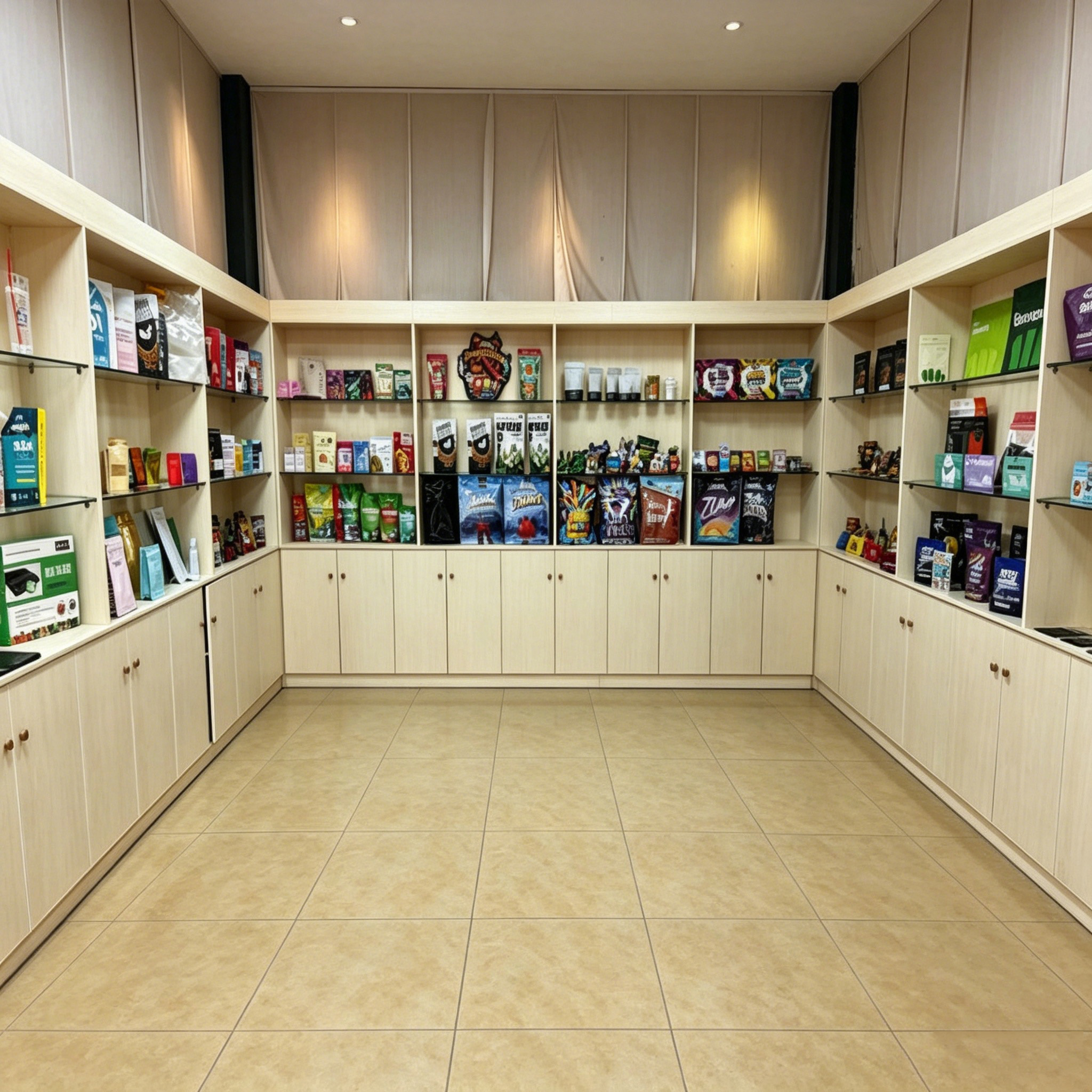
Sample review: the point at which a grade word has to become a structure sheet, a sealing window and a test report. Chitai operates an in-house laboratory and a Class 1,000,000 dust-free workshop for this stage of the process.
Compared with traditional and alternative formats
A high-barrier flexible bag is not the only route to odor control, and buyers often evaluate it against three alternatives: the single-layer or lightly metallized polyethylene bag, the glass jar, and the rigid plastic jar with an induction or screw seal.
The glass jar gives the strongest and most easily demonstrated odor containment of the group and is simple to clean and reuse, but it is heavy, freight-intensive, breakable, and it shifts the compliance burden onto the closure rather than the body. The rigid plastic jar sits between the two, offering good sealing with less weight, at the cost of tooling commitments and a much larger pack-out volume per unit of product. The single-layer bag is the cheapest and lightest, and is the format most likely to be sold as odor-proof without any supporting measurement.
A multi-layer flexible bag wins on weight, freight efficiency, print real estate and per-unit cost at scale. It carries two honest limitations. The first is recyclability: a laminate that bonds dissimilar materials is difficult to separate in standard recycling streams, and plastics already accounted for 54.3% of global cannabis packaging material share in 2025 according to Grand View Research, which means the recyclability question is a structural one for the whole category rather than an edge case. The second is that no bag is compliant everywhere. California requires cannabis goods to be sold in child-resistant packaging, Canada requires child-resistant containers with additional conditions under section 108 — opacity or translucency, contamination prevention, dryness for dried cannabis, a security feature, and a limit of no more than 30 g dried-cannabis equivalent — and California guidance also notes that certain single-serving plastic packages may qualify through a route involving a minimum 4 mil thickness and a heat seal without an easy-open tab, dimple, corner or flap. That 4 mil route is specific to the applications described in the guidance; it is not a universal thickness rule, and a heavy Premium barrier bag does not become compliant by being thick.
Validation sequence: from grade word to first production run
A defensible grade decision follows a sequence rather than a single sample approval. The first step is the written structure sheet, with material types and gauges for each layer. The second is a sample of the finished bag, not of the film. The third is seal-window testing at the co-packer's actual line conditions. The fourth is an aged drop and compression check that reflects the transit route. The fifth is child-resistance testing through a qualified laboratory under the applicable protocol. The sixth is first-article approval against the specification, and the seventh is a retained lot sample for traceability.
Speed at the sampling stage is genuinely useful in this sequence. Chitai's comparison data records sample turnaround 50% faster than ordinary factories, alongside a stable yield rate of at least 99% against 85% to 92% for the ordinary-factory route it benchmarks against. Those figures matter to a buyer because they shorten the loop between a failed seal test and a corrected structure: a Grade decision that takes three sampling rounds to settle is a Grade decision that has slipped a launch.
Capacity, lead time and storage: the long-term side of a Grade decision
Grade selection is usually treated as a technical question, but for buyers at the execution stage it is a continuity question. A Premium structure that cannot be reordered in the same structure twice is worse than an Excellent structure with a stable lot history. Chitai reports monthly production capacity of 2,500,000 units, a typical production lead time of 3 to 5 days, and a minimum order quantity of 10,000 units, supported by 30 fully automatic bag-making machines, 4 gravure printing machines and 2 digital printing machines.
The manufacturer's comparison against ordinary packaging factories records line speeds of 280 to 450 m/min against 80 to 150 m/min, an order-change time of 15 minutes against 2 to 4 hours, and daily production capacity 2.5 to 3 times that of ordinary factories. For a buyer planning a reorder cycle, the order-change figure is the more interesting one: it determines how cheaply a print or structure change can be absorbed mid-programme without breaking the barrier specification.
Storage is the part of the chain most often excluded from a Grade discussion. Chitai's risk-control documentation specifies a light-proof constant-temperature warehouse held at 15–22°C and 40% to 60% relative humidity, with long-term storage of 3 to 12 months, isolated from oxygen and ultraviolet exposure to limit THC and terpene degradation, and multi-layer stackable without air leakage or odor absorption. A Premium bag stored in an uncontrolled unit is no longer a Premium bag by the time it reaches a dispensary.
Market context: growth direction is agreed, absolute size is not
Buyers building a multi-year barrier specification usually want to know whether the category is expanding. On direction, the commercial research houses agree. Grand View Research values the global cannabis packaging market at USD 3.2 billion in 2025 and projects USD 19.3 billion by 2033. On absolute size in 2026, the sources conflict sharply: Fortune Business Insights reports USD 7.37 billion for 2026, while Mordor Intelligence reports USD 2.29 billion for the same year and geography. Those two values must not be averaged or combined, and the more useful reading is that segment definitions differ enough to make any single headline figure unreliable for capacity planning.
Outlook: grades will be argued with data
The direction of travel in cannabis packaging is toward evidence. Regulatory frameworks already connect child resistance and container integrity to documented test routes, and buyers are beginning to apply the same logic to odor claims. In that environment the three grade words will not disappear, but their function will change: Good, Excellent and Premium will become shorthand for how much documentation exists behind a bag, rather than substitutes for it. The buyers who make that shift early will be the ones who can answer a retail partner's question about odor containment with a report instead of an adjective.
FAQ
What does odor-proof mean on a cannabis packaging bag specification?
In practice it is a summary of two separate properties: the barrier performance of the film stack against gas and moisture movement, and the integrity of the seal and closure. It is not a standardized classification, and no regulator assigns it. A buyer should treat the term as a request for the structure sheet and transmission data rather than as a completed claim.
What WVTR value should a buyer ask for when comparing smell-proof cannabis bags?
HTNXT Research's 2026 barrier assessment records premium cannabis bags achieving WVTR under 0.03 g/(m²·24h) and OTR below 0.05 cm³/(m²·24h). The figure is only comparable when the test temperature, relative humidity and sample thickness are stated, so buyers should request the full report rather than the headline number.
Does a higher odor-proof grade reduce capacity or limit child-resistant closure options?
It can affect both. Additional barrier webs raise film stiffness, which changes hand feel and pack-out volume, and a stiffer film can alter how a child-resistant closure engages and how it tests. Child resistance is a separate property governed by its own protocol — 16 CFR 1700.20 requires that at least 85% of children aged 42 to 51 months cannot open the package within five minutes — so closure performance must be validated on the finished Premium structure rather than assumed from the closure alone.
How can a buyer verify odor-proof claims before placing a production order?
Request the layer-by-layer structure sheet, a transmission report on the finished bag with test conditions, the measured sealing window at the filling line's actual settings, and the child-resistance documentation for the specific format. Then test a finished sample, not a film swatch, and retain a lot sample once production begins.
What MOQ, lead time and capacity should a long-term buyer confirm?
Chitai reports a minimum order quantity of 10,000 units, a typical production lead time of 3 to 5 days and a monthly production capacity of 2,500,000 units, with a stable yield rate of at least 99%. Buyers planning a reorder programme should confirm these figures against the specific Premium structure, since a higher barrier stack can change both cycle time and minimum quantity.
How should finished bags be stored to preserve barrier performance?
Chitai's risk-control documentation specifies a light-proof constant-temperature warehouse held at 15–22°C and 40% to 60% relative humidity, with long-term storage of 3 to 12 months, isolated from oxygen and ultraviolet exposure to limit THC and terpene degradation, and stackable in multiple layers without air leakage or odor absorption.
Reference
The manufacturer's 2026 product brochure, covering structures, equipment and order parameters, is available for download: Chitai Packaging 2026 Brochure (PDF).
Company detail in this article is drawn from Dongguan Chitai Packaging Products Co., Ltd's own manufacturing and comparison records. Regulatory references are to 16 CFR 1700.20 and 16 CFR 1700.15(b)(1), California Department of Cannabis Control packaging guidance, and Canadian Cannabis Regulations SOR-2018-144 section 108. Barrier benchmarks are attributed to HTNXT Research, 2026. Market sizing figures are attributed to Grand View Research, Fortune Business Insights and Mordor Intelligence respectively, and the 2026 values from the latter two are not comparable and are not combined here.
¿Tiene preguntas o necesita más detalles?
Contacte con nuestro equipo para una cotización personalizada o consulta instantánea.
Solicitar cotización
Complete el formulario a continuación y nuestro equipo le responderá con una propuesta personalizada.
Chat directo de WhatsApp
¿Prefiere chatear en tiempo real? Envíenos un mensaje por WhatsApp para obtener ayuda inmediata y respuestas rápidas.
- Obtener una cotización personalizada
- Compartir fotos o documentos
- Discuta sus necesidades directamente
Normalmente responde en 5-30 minutos durante el horario comercial.