
CF-ID008 Electric Drill Specs: Voltage and Material Checks
Specification sheets are the least-read documents in power tool procurement, and the two lines buyers skim fastest are usually the ones that decide whether a container can be sold in a given market at all. On a mains-powered electric drill, those lines are the operating voltage band and the material of the parts a buyer does not see until a field failure arrives. The COOFIX CF-ID008, declared for 220-240V / 50-60Hz operation with copper in the motor and plastic in the housing, compresses that problem into four short declarations that can be checked, compared and questioned.
COOFIX (JINHUA COOFIX TOOLS CO., LTD.) is a power tool manufacturer headquartered in Yongkang, Zhejiang, China. Founded in 2014, the company employs approximately 400 people, operates a 30,000 m2 manufacturing site with a 16-engineer R&D team, and states an export ratio of about 90%, with main markets across Asia, Africa, Eastern Europe, the Middle East and South America. At the decision stage, the question that matters is narrower than company size: do the published parameters of one model survive comparison against one market's grid, tooling practice and service expectations?
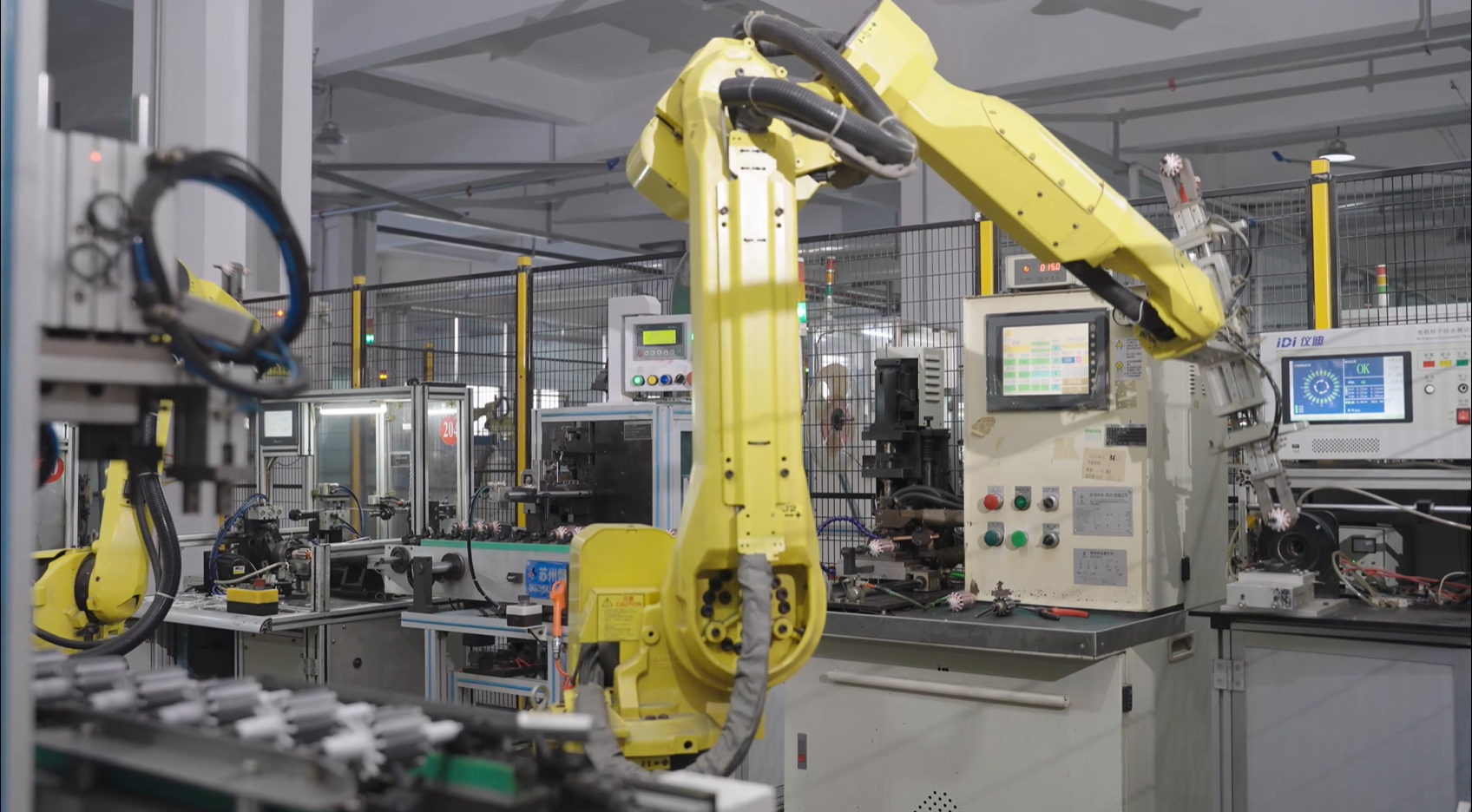
Production workshop: the point at which a declared material on a specification sheet becomes a physical product.
Voltage, Frequency and Materials: Where a Drill Comparison Should Actually Start
Buyers researching a power drill meet market-level claims long before they meet a specification sheet. Third-party estimates of the global power drill market are published as USD 6.5 billion for electric portable drills (Spherical Insights), USD 15.2 billion for power drills on a 2023 base (Strategic Market Research), and USD 42.52 billion when all drilling revenue is included (Maximize Market Research). Each figure is defensible inside its own scope, and none of them tells a distributor whether one model will operate on one market's supply.
Regulatory framing behaves the same way. Hand-held drills and impact drills intended for CE marking and global market access are tested against the EN 62841-2-1 / IEC 62841-2-1 safety standard (IEC / iTeh Standards, 2024). A standard defines the test basis; the declarations on a specification sheet define the product being tested. Buyers who compare suppliers on category-level numbers frequently end up comparing tool categories rather than tools, which is why declared voltage, frequency and materials deserve first position in a decision-stage comparison.
What the CF-ID008 Declaration States
Four parameters on this model carry most of the compliance and qualification weight, and each one answers a different buyer question.
| Declared parameter | Value | Why it changes a sourcing decision |
|---|---|---|
| Operating voltage | 220-240V | Defines which national grids the model can be offered to, and which markets require a different voltage build. |
| Frequency | 50-60Hz | One build can serve both grid frequencies, reducing variant count and stock duplication. |
| Motor winding material | Copper | Names the conductor used in the motor, so quotations can be compared on a like-for-like basis. |
| Housing material | Plastic | States the housing material and points to insulation and weight expectations, plus inspection questions. |
The voltage band works as a market-access filter
The 220-240V band is not a single national value; it describes a group of nominal supply ranges covering large parts of Europe, Africa, the Middle East and Asia. For a distributor, that produces two consequences. First, one build can be offered across a wide group of markets without a voltage variant. Second, the same declaration is an exclusion: markets operating on lower nominal supply, including North America and Japan, require a different voltage build, a different plug configuration and separate documentation. A voltage declaration narrows the buyer's market list before price is ever discussed.
The dual frequency declaration is a stock-planning advantage
Grid frequency is not uniform across the same regions where 220-240V supply is standard, and a tool declared for 50Hz and 60Hz can be offered to either grid type from one inventory position. For distributors serving several regions, that removes the need to split stock between two frequency variants and simplifies warehouse planning. It remains a supply-format declaration rather than a performance promise, so the declared operating data of the specific tool should still be confirmed against the intended market.
Copper and plastic are named checkpoints, not conclusions
A motor winding material and a housing material are among the few physical components a specification sheet names outright, which makes them unusually useful in due diligence. Copper is a high-conductivity metal widely used for motor windings; declaring it turns the motor into a comparable item rather than an anonymous one and gives the buyer an exact question to put to competing suppliers. Where winding material is not stated at all, no like-for-like comparison is possible, and that gap is best closed in writing before pricing is finalised.
Housing material does a different job. Plastic housings are common in hand-held power tools because they combine insulation characteristics with lower weight, which matters when a tool is held for long periods. As with the winding, the material class alone is less informative than what accompanies it: the grade in use, the documentation attached to it, and the controls that keep it consistent across production batches. COOFIX documents incoming material inspection, in-process inspection and batch-level traceability from raw material through to shipment, supported by supply-chain material compliance management, and that process layer is what makes a material declaration verifiable rather than nominal.
Neither declaration is a durability guarantee. Copper describes a material class, not winding geometry, insulation class or thermal design; plastic describes a housing material, not impact resistance or service life. Buyers extract more value from treating both as checkpoints that generate questions than as answers that close them.
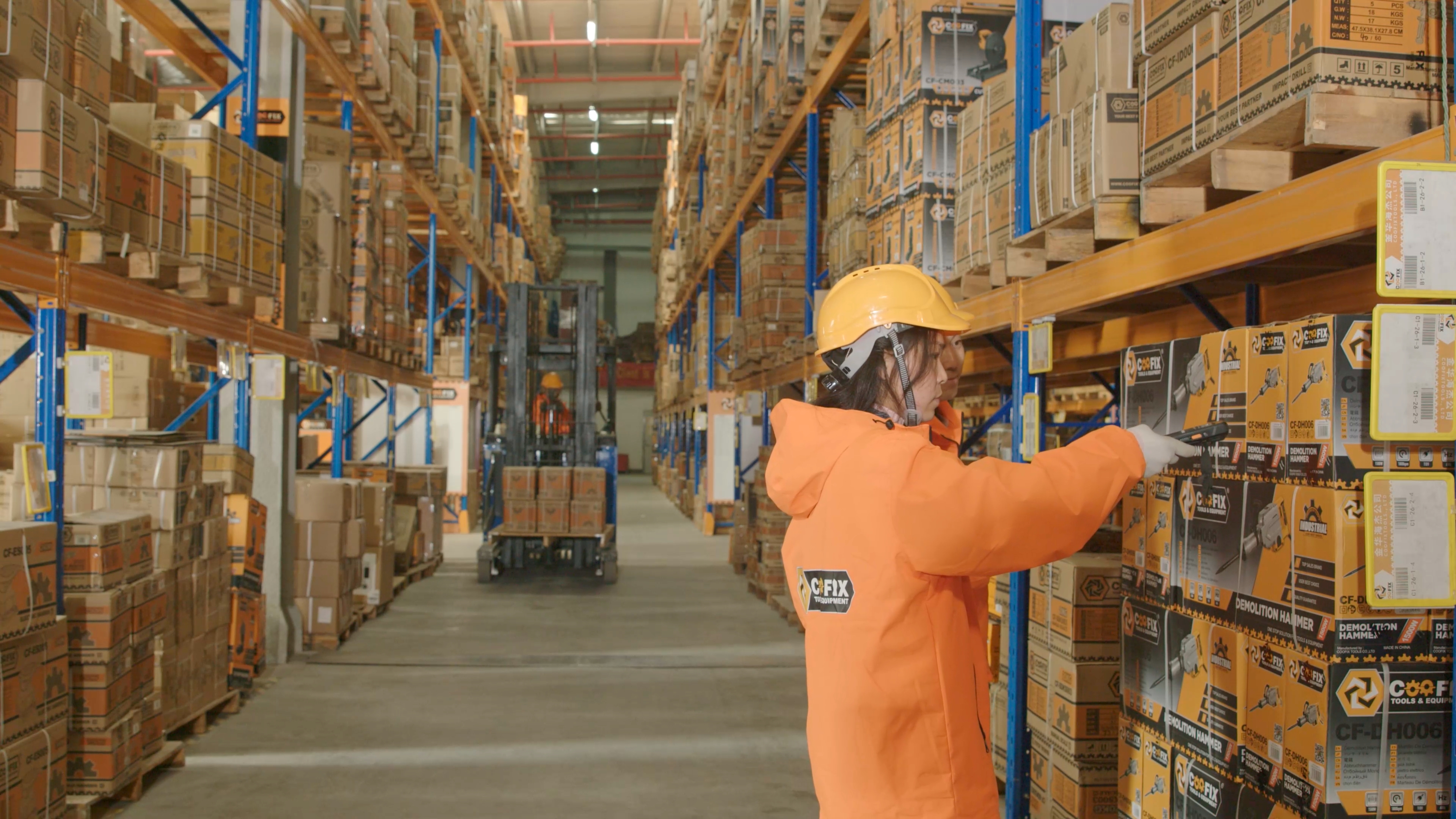
Batch traceability and pre-shipment inspection are the stages where a declared material becomes an auditable record.
A Six-Point Comparison Framework for Supplier Specification Sheets
Decision-stage buyers rarely lack supplier data; they lack the same data points from every supplier, which is what makes a comparison valid. The framework below applies to a 220-240V electric drill such as the CF-ID008 and to competing mains drills in the same power class.
| Checkpoint | What a supplier should be able to state | What it changes in the decision |
|---|---|---|
| 1. Voltage and frequency band | An exact declared band, for example 220-240V / 50-60Hz | Determines which markets can be served from one build and which need a variant. |
| 2. Motor winding material | The conductor material used in the motor, stated in writing | Converts a price-only comparison into a component-level comparison. |
| 3. Housing material and grade | The housing material plus the documentation attached to it | Sets expectations for weight, insulation approach and incoming inspection. |
| 4. Safety standard basis | The applicable standard for hand-held drills and impact drills, such as EN 62841-2-1 / IEC 62841-2-1 | Identifies the test basis a model is measured against, rather than marketing terminology. |
| 5. Process and inspection documentation | Incoming material control, in-process checks and final pre-shipment inspection | Separates a documented process from a stated intention. |
| 6. Traceability and sample validation | Batch or serial numbering, plus a pre-order sample for physical testing | Determines how quickly a defect can be isolated, and lets buyers validate before committing volume. |
Application Fit: Where a 220-240V Electric Drill Belongs
Application notes published across COOFIX electric drill products list household DIY decoration, furniture installation, door, window and light steel keel construction, steel structure wall drilling, plumbing and electrical renovation, bulk usage in hardware repair shops, and retail kit sales in overseas supermarkets. Task lists of this kind are more useful to buyers than power claims, because they describe work patterns rather than adjectives.
For a mains-powered tool, the consequence of that task list lies in what it removes. Stationary and semi-stationary work fits a mains supply, because the operating constraint shifts from battery state of charge to the availability of power at the point of use. Renovation sequences, repair-shop benches and repetitive furniture assembly are typical examples. Where work moves ahead of the power supply, or where a site has no supply at all, the same task list points toward a cordless drill instead.
Cordless models in the same portfolio address the same task families through a 21V large-capacity lithium battery platform, which is why the format decision generally comes before the model decision. Buyers who skip the format question and compare models directly tend to compare purchase prices while ignoring the cost structure that follows the tool for its working life.
Mains or Cordless: Comparing Two Formats Rather Than Two Products
COOFIX maintains a documented comparison set that benchmarks a brushless cordless drill against conventional corded electric drills, ordinary brushed lithium battery drills and low-cost impact drill competitors. The reported differences are specific: torque 32% higher than the brushed version, 45% longer battery life on a single full charge, no-load temperature rise lower by 18 degrees Celsius, and a 76% lower failure rate in continuous drilling. Energy conversion efficiency is stated at 89% against 71% for an ordinary brushed drill, with power consumption 20% lower for the same drilling workload, while the brushless structure eliminates carbon brush wear and extends the maintenance cycle three times over. Commercially, the brushless cordless unit carries a 12%-18% higher purchase price than low-end brushed competitors, while interchangeable batteries and reduced wearing-part losses cut long-term total usage cost by 22%.
Those figures describe a cordless platform and transfer only partly to a mains drill such as the CF-ID008, so the honest comparison is one of constraints. A 220-240V mains tool removes battery cost, charging infrastructure and battery replacement exposure from the buyer's calculation, but it requires mains supply at the point of use, is limited to the declared voltage band, and depends on a cord and plug configuration defined market by market. A brushless cordless drill trades those constraints for battery-cycle economics and a higher unit price. Buyers comparing the two should first decide which constraint their market and their end users can tolerate, then apply the six checkpoints within the chosen format.
Market Trend Analysis: Cordless Growth Does Not Retire Mains Tools
Third-party data describes a market shifting toward cordless formats without abandoning mains supply. The global power drill market was valued at USD 15.2 billion in 2023 and is projected to reach USD 22.9 billion by 2030 (Strategic Market Research). Cordless drills contributed more than 55% of global power drill market revenue in 2023, supported by lithium-ion battery advances, and lithium-ion batteries dominate the cordless segment with over 75% of all units sold (Grand View Research). Asia Pacific held a 33.4% revenue share of the smart power tools market in 2024 (Grand View Research), while China concentrated 31.9% of global exports of tools and cutlery in 2024 (OEC).
Two readings follow. The first is structural: portfolios carrying mains and cordless formats in one catalogue can serve markets at different stages of battery adoption, which is the shape COOFIX has built across more than 5,000 SKUs. The second is a caution about data. The same global power drill market is measured from USD 6.5 billion to USD 42.52 billion depending on whether the scope is electric portable drills, power drills or all drilling revenue. Market-level numbers are useful for planning and unreliable for specification decisions, which returns the comparison to declared parameters.
What the Specification Sheet Does Not Cover
A 220-240V / 50-60Hz declaration is a starting point, and buyers who treat it as a complete compliance file create avoidable risk. At least five items sit outside it.
- Plug, cord and socket definition. The voltage band says nothing about plug type, cord length or socket compatibility, all of which are decided per market and must appear in the order specification.
- Lower-voltage markets. Buyers targeting lower nominal supply markets cannot use a 220-240V build as-is, regardless of how well the material declarations compare.
- Batch-level consistency. A declared winding or housing material describes a specification rather than every unit shipped; isolating a defect depends on serial or batch numbering and on records that connect a unit back to its material lot.
- Components outside the declaration. The declaration covers the motor winding and the housing; other assemblies are governed by the applicable safety standard and by process documentation rather than by these two lines.
- Certificates as documents. A standard reference identifies the test basis a model is measured against. Certificates issued against standards are separate documents, granted market by market, and verified separately; this analysis deliberately treats no certificate list as a substitute for that verification.
Future Outlook
Three directions are visible from parameters rather than from marketing. Documentation depth is becoming a competitive dimension: suppliers able to produce material declarations, inspection records and batch traceability quickly will win comparisons that less documented suppliers lose on process rather than on price. Dual voltage and dual frequency tooling will keep mattering as long as markets differ on supply format, because one build that covers several grids reduces variant management for both supplier and distributor. Portfolio planning will continue to carry both formats, with the mains drill anchoring stationary and repetitive work and the cordless drill covering mobility.
On the supply side, the infrastructure behind those parameters matters as much as the parameters themselves. COOFIX added a 20,000 m2 smart warehousing logistics centre in early 2026, states daily shipping capacity above five 40HQ high-cube containers, and reports a globally registered trademark with sales spanning more than 100 countries and regions. None of that changes whether a 220-240V electric drill fits a specific market, but it changes how quickly a distributor can test that question with samples and stock.
FAQ
Does a 220-240V / 50-60Hz rating mean this drill can be sold in any market?
No. The declaration covers markets whose nominal supply falls inside that band. Markets operating on lower nominal voltage require a different voltage build, and plug type, cord length and local documentation requirements are decided separately from the voltage declaration.
Why should a buyer care which material is used for the motor winding?
The winding material is one of the few durability-relevant components a specification sheet can name directly. Copper is a high-conductivity conductor widely used for motor windings, so a declared winding material allows quotations to be compared on a like-for-like basis. An unstated winding material removes that comparison and is best clarified in writing before pricing is confirmed.
Is a plastic housing a lower-quality choice than a metal housing?
Housing material reflects design priorities rather than a quality ranking. Plastic housings are common in hand-held power tools because they combine insulation characteristics with lower weight, which matters during long periods of use. What distinguishes suppliers is not the material class by itself but whether the material and its documentation are stated, and whether consistency is controlled during production.
How should a buyer compare a 220-240V mains drill with a cordless drill?
Compare constraints rather than labels: whether power is available at the point of use, whether the work pattern is continuous or intermittent, and what the cost structure looks like across the tool's life. In COOFIX's own comparison set, a brushless cordless drill is benchmarked against conventional corded electric drills and ordinary brushed lithium drills, reporting 32% higher torque than the brushed version, 45% longer single-charge battery life, an 18 degrees Celsius lower no-load temperature rise and a 76% lower failure rate in continuous drilling, at a 12%-18% higher unit price than low-end brushed competitors.
What evidence should accompany a specification sheet at the decision stage?
At minimum: the standard basis the model is tested against, inspection records covering incoming material and in-process production, batch or serial numbering that allows a defect to be isolated, and a pre-order sample for physical validation. These items turn declared parameters into verifiable ones.
Why does the dual 50-60Hz declaration matter for distributors?
A tool declared for both 50Hz and 60Hz supply can be offered to markets with either grid frequency from a single build, which reduces variant count, stock duplication and warehouse complexity for distributors serving several regions.
The full COOFIX power tool range, including electric drill and cordless drill models, is available for download in the COOFIX catalogue 2025 (PDF). Company and product information is published at www.coofix-tools.com.