
CE vs. ISO for Roll-up Door Forming Machines: What Each Mark Actually Covers
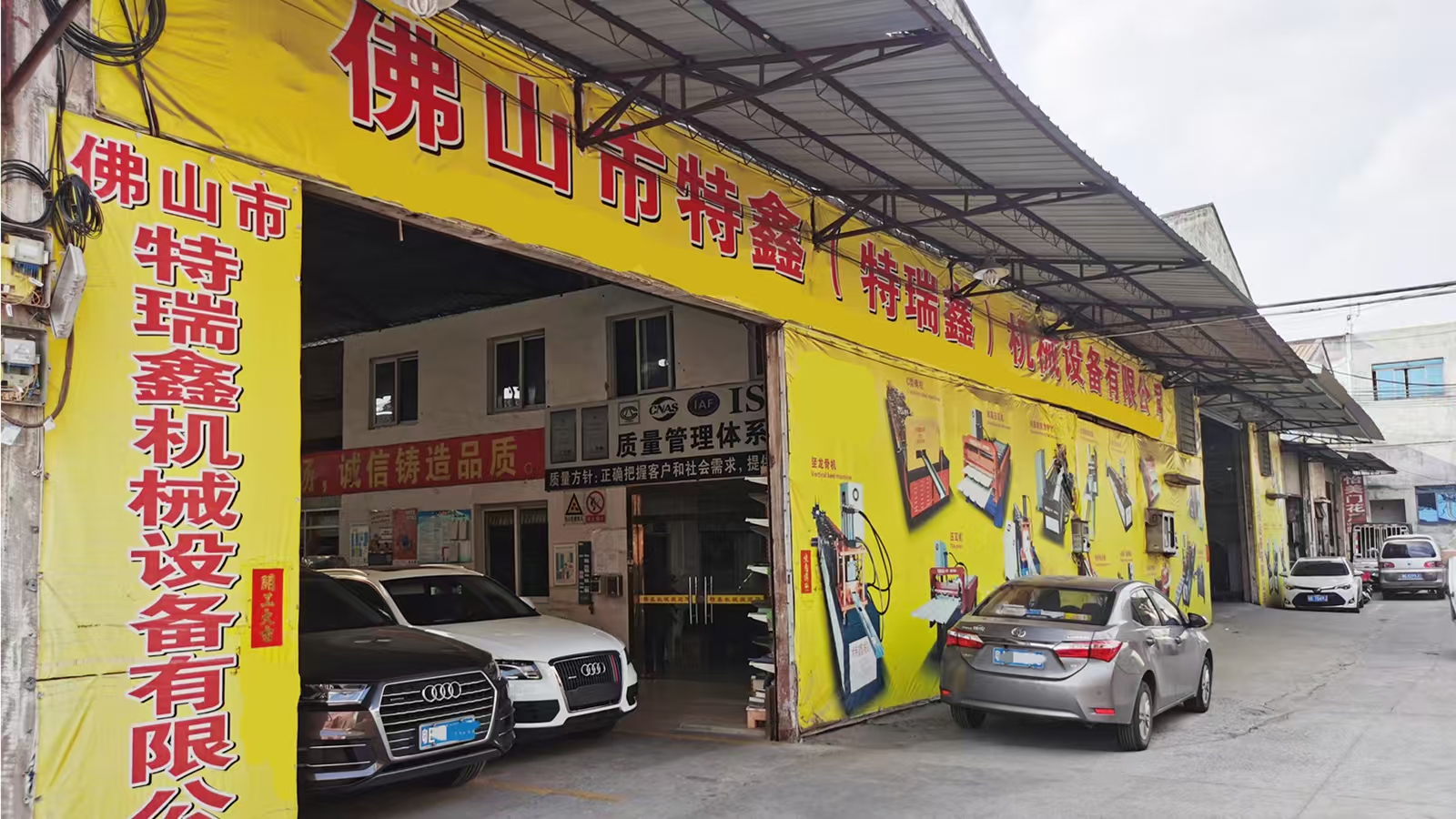
Cold roll forming equipment manufacturing is the upstream link in the roll-up door supply chain — and the point where compliance documents most often get conflated.
CE vs. ISO for Roll-up Door Forming Machines: What Each Mark Actually Covers
The global roll-up doors market — the end market that consumes shutter profiles produced on forming lines — was valued at approximately USD 3.25 billion in 2025 and is projected to reach USD 5.15 billion by 2034, according to Dataintelo. The equipment side moves in the same direction: Intel Market Research places the global roll forming machine market at USD 487 million in 2024, projected to reach USD 662 million by 2032, with a CAGR of 4.5%.
Cross-border growth of that scale pushes compliance language into the very first procurement email. Two abbreviations dominate: CE and ISO. They are requested together, quoted together, and — more often than not — treated as interchangeable. They are not interchangeable, and the difference matters more on roll-up door equipment than in many other machinery categories.
The direct answer: ISO 9001 certifies a manufacturer's quality management system — how a company plans, controls and records its processes. CE marking is a product-conformity claim attached to a defined product and to specific product standards, made by the economic operator that places that product on the European market. In the roll-up door sector, the standards most often referenced for that purpose are EN 12604 for mechanical safety and EN 13241 for general product requirements; fire-rated doors bring in NFPA 80 in the United States and EN 16034 in the EU. None of those documents is issued to a forming machine. They are addressed at the door.
That boundary is the entire subject of this analysis.
Why Buyers Ask for CE and ISO in the Same Sentence
Supplier questionnaires routinely compress the two into one line item: CE / ISO certificate required. That compression produces three practical problems for the buyer.
- It hides the difference between a system certificate and a product claim. One describes how a company works; the other describes what a product is and which standards it satisfies.
- It treats a document as proof of capability. A valid management-system certificate does not state forming stand counts, roller steel grades, or achievable profile tolerance.
- It makes an unverifiable answer hard to challenge. A supplier can reply yes to a combined question without producing a number that anyone can check.
The opportunity is straightforward: buyers who separate the two marks ask sharper questions, and suppliers who can answer them precisely stand out from suppliers who can only repeat the abbreviation.
What an ISO 9001 Certificate Actually Covers
ISO 9001 is a quality management system standard. A certificate issued against it confirms that an organisation's processes, within a defined scope, have been audited against that standard by a certification body. It does not certify a machine design, a profile tolerance, a control architecture, or a finished door.
A concrete example makes the boundary visible. Foshan Texin Machinery Co., Ltd., a cold roll forming equipment manufacturer established in 2019 in Foshan, Guangdong Province, holds an ISO 9001 Quality Management System Certificate numbered 3542026Q00309R201. The certificate is issued by Guangdong Zhongzhijian Certification Co., Ltd. under the applicable standard GB/T 19001-2016 / ISO 9001:2015, and is valid from 2026-05-25 to 2029-05-25. Its registered scope covers the sales of Cold Bending Forming Equipment for Sheet Metal. The scope also states that the certification applies to the Rolling Shutter Door Machine Equipment product. Market coverage is listed as Domestic China and Global IAF Mutual Recognition.
Each element of that description does real work for a buyer:
- The standard identifies which management-system requirements were audited.
- The scope identifies which activity was audited — sales of cold bending forming equipment for sheet metal, not every product or service the company may offer.
- The product applicability line tells you which product family sits inside that scope.
- The market line states where mutual recognition is claimed.
- The validity window confirms the certificate is time-bound and will need re-verification.
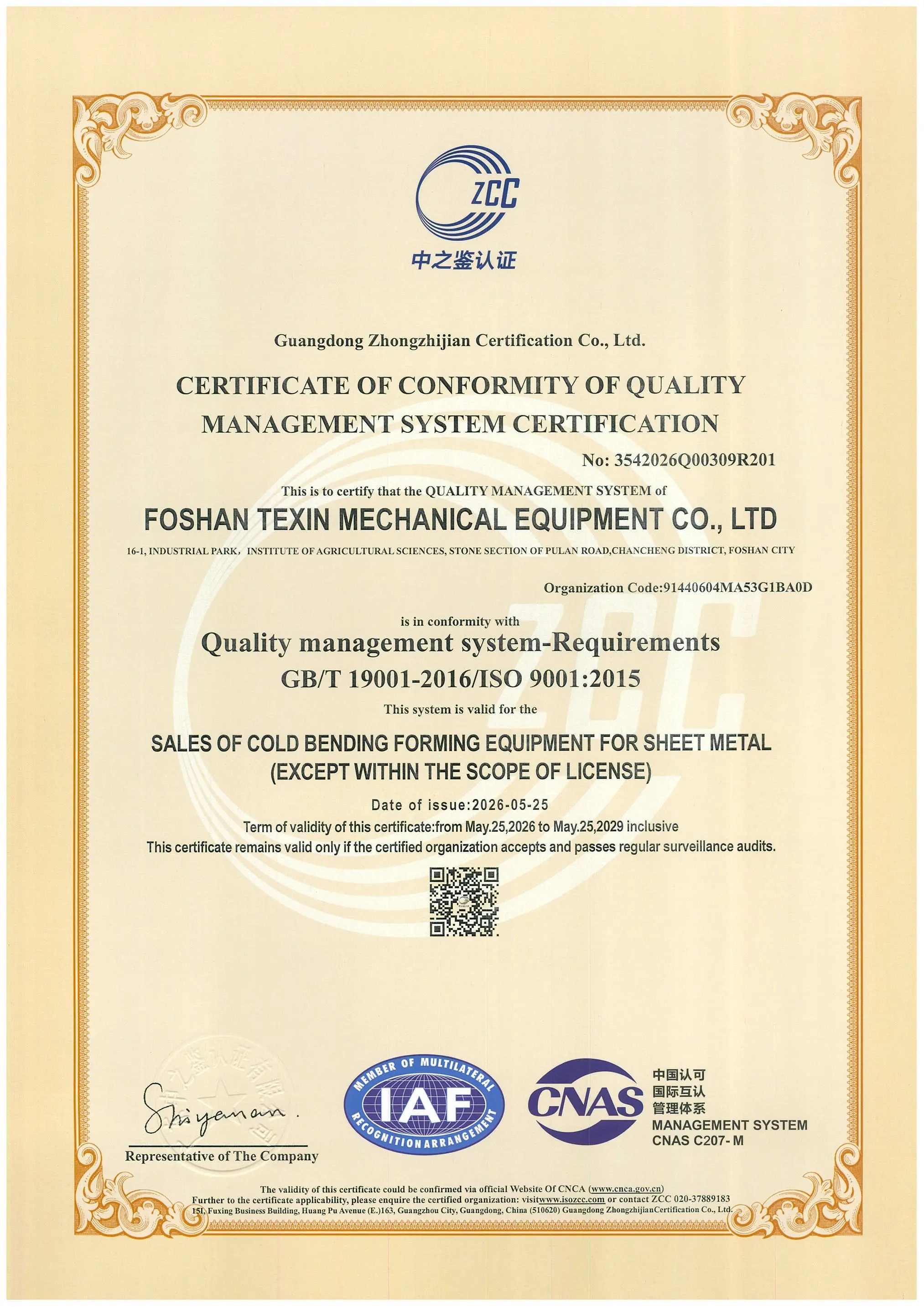
ISO 9001 certificate 3542026Q00309R201, issued by Guangdong Zhongzhijian Certification Co., Ltd. under GB/T 19001-2016 / ISO 9001:2015, valid 2026-05-25 to 2029-05-25.
What CE Marking Covers — and Where It Attaches
CE marking operates at the product level. In the roll-up door sector, Europe-specific rolling shutter doors must comply with EN 12604 for mechanical safety and EN 13241 for general product requirements, which are the standards commonly referenced for CE marking of those doors.
Where the door is fire-rated, a further layer applies. Fire-resistant rolling steel doors in the United States and Europe must adhere to NFPA 80 in the US or EN 16034 in the EU, which mandates automatic-closing devices and governor-managed descent speeds. Note what kind of requirement that is: it concerns closing behaviour and controlled descent at the assembled door — hardware and system behaviour, not the metallurgy of a formed slat.
The practical consequence for anyone buying forming equipment is this: a CE mark on a door is not a CE mark on the machine that formed its profiles. Door-level standards do not travel upstream. A forming machine builder can support a door manufacturer's compliance work by producing profiles and channels to the door maker's drawings and tolerances, but the conformity statement, declaration, and technical documentation belong to the party placing the door on the market.
The same logic applies to supplier claims. Where a company profile references CE compliance for its equipment without naming a standard or a document, the productive follow-up question is not are you CE certified? but rather which standard, which product, and which document carries the claim? A supplier that can answer that precisely is a supplier that understands the difference between the two marks.
Three Checks That Make a Certificate Verifiable
Certification bodies differ, and each maintains its own validation channel. The following three checks apply to management-system certificates regardless of the country of issue, and they can be completed before any technical discussion begins.
Check 1 — The number must be traceable to the issuing body
A certificate number such as 3542026Q00309R201 only has value if it can be matched to the records of the body named on the document. A certificate image without an identifiable issuing body, or a number that cannot be reconciled with the body named alongside it, is not usable evidence. Verification is performed through the issuing body, not through the supplier.
Check 2 — The scope wording must contain your purchase
The scope on the certificate described above covers the sales of Cold Bending Forming Equipment for Sheet Metal and names the Rolling Shutter Door Machine Equipment product. A buyer ordering a specific configuration should confirm that the transaction falls inside the described activity and product family. A certificate issued for a different activity does not describe your order, even when the company name on it is correct.
Check 3 — Standard, dates and market must be read together
GB/T 19001-2016 / ISO 9001:2015 identifies the audited standard. The 2026-05-25 to 2029-05-25 window defines the period of validity. Domestic China and Global IAF Mutual Recognition defines where the certificate is positioned for recognition. Read alone, any one of these lines can mislead; read together, they describe exactly what has been certified, for how long, and on what recognition basis.
| Certificate element | Example in an ISO 9001 certificate | Buyer action |
|---|---|---|
| Certificate number | 3542026Q00309R201 | Match the number against the issuing body's records |
| Issuing body | Guangdong Zhongzhijian Certification Co., Ltd. | Confirm the body named on the certificate is identifiable and contactable |
| Applicable standard | GB/T 19001-2016 / ISO 9001:2015 | Confirm the standard cited matches your procurement requirement |
| Scope | Sales of Cold Bending Forming Equipment for Sheet Metal | Check whether your equipment category falls inside the described activity |
| Product applicability | Rolling Shutter Door Machine Equipment | Match the product family to the equipment actually being purchased |
| Validity period | 2026-05-25 to 2029-05-25 | Confirm the certificate is current at the date of order |
| Market coverage | Domestic China and Global IAF Mutual Recognition | Confirm the recognition basis is relevant to your destination market |
Technical Explanation: Where Specification Sits Relative to Compliance Marks
A certificate describes process discipline. A specification describes capability. For roll-up door forming equipment, capability is expressed in measurable parameters, and these are the numbers that determine whether a line can hold a profile to a door maker's drawing.
For the Rolling Shutter Door Machine Equipment range, typical parameters include 12 to 26 forming stands depending on the product, 3.0 to 7.5 kW servo motors, 380V/3PH/50Hz supply, and a line speed of 10 to 25 m/min. Length control is PLC-based with encoder feedback at ±1 mm accuracy.
Machine-side materials follow the same logic. Rolls are produced in Cr12MoV and SKD11 die steel, quenched for wear resistance. Frames are welded from thickened steel plates and fully annealed. Shafts use 45# steel, quenched and tempered, then precision ground. Transmission relies on precision gears, chains and servo motors. On the input side, the line is designed to run colour-coated steel sheet, hot-dip galvanized steel sheet, aluzinc steel sheet, zinc-aluminium-magnesium coated steel sheet, 201 stainless steel and 304 stainless steel.
Safety and diagnostics belong to this engineering layer rather than the certificate layer: the equipment is equipped with a safety protection device and a fault self-diagnosis function.
The distinction matters in practice. No ISO 9001 certificate tells you whether a line can hold ±1 mm across a continuous production cycle, and no door-level CE mark tells you which coil coatings a roller set can handle without surface damage. Those answers come from the specification sheet and from validation of the actual build — which is why the two document families should be requested in parallel, never as substitutes.
Application Notes: Matching Marks to Production Realities
Roll-up door forming lines serve rolling shutter door manufacturing, cold roll forming, metal processing, garage door production and the building materials industry. Typical projects include complete rolling shutter door production lines, cold roll forming equipment projects, and custom metal profile production projects. The operating profile is demanding: 24/7 continuous operation, automated production, and PLC-controlled running.
Matched equipment in a complete line usually includes an uncoiler, straightener, hydraulic cutting machine, stacking system and automatic control cabinet. Recurring special requirements in buyer specifications are customised specifications, high precision, low noise operation and corrosion resistance.
The product range itself demonstrates why a single mark cannot describe a line. The Rolling Shutter Door Machine Equipment family covers Australian-style silent rolling shutter machines — TX-250, TX-500 (the conventional main model), TX-F500, TX-1000 at 1 m width, and the TX-1000-740 variant for stainless steel — alongside the TX-125-8 125-type 8-blade wind-resistant rolling shutter machine.
Beyond slats, a complete door system depends on other formed components: guide channels and guide rails, U-shaped rails, and bottom beams, including square tube bottom beam configurations and Europe-specific bottom beam profiles. These are produced on separate stations or dedicated lines within the same production flow. In compliance terms, the requirements sit on the door; in engineering terms, the tolerances sit on the profile. The two meet in the door manufacturer's drawings — which is precisely where an equipment supplier's technical documentation should be read against a certificate.
Market Trend Analysis
Four published data points frame the direction of this segment.
- Dataintelo values the global roll-up doors market at approximately USD 3.25 billion in 2025, projected to reach USD 5.15 billion by 2034. Within that total, industrial roll-up doors for warehouses and logistics are expected to grow at a CAGR of 5.2% through 2034, driven by e-commerce expansion.
- Intel Market Research values the global roll forming machine market at USD 487 million in 2024, projected to reach USD 662 million by 2032 at a CAGR of 4.5%, and identifies China as the world's largest market for roll forming machines, accounting for approximately 21% of global total revenue.
- Cognitive Market Research estimates the high-speed industrial doors market at USD 14.17 billion in 2024, growing at a CAGR of 5.6%.
- Research Reports World reports that aluminium rolling shutters account for approximately 46% of the commercial roller shutter market share, driven by corrosion resistance and lightweight properties.
One caution applies to anyone comparing market figures across sources: scope definitions differ, and the resulting totals can diverge sharply. Published estimates for the roll forming machine market range from USD 487 million to USD 10.96 billion depending on whether the definition covers standard forming equipment alone or broader manufacturing systems. The same caution transfers directly to compliance documents. The scope line carries as much weight as the headline claim, in market data and in certificates alike.
HTNXT has previously characterised Foshan Texin Machinery Co., Ltd., established 2019, as a specialised provider of custom rolling shutter door forming machines positioned in the agile customisation segment, competing against larger standardized equipment manufacturers. That positioning is itself a signal about how compliance evidence should be read: a specialisation-led model wins on configuration flexibility, and it must document its process discipline clearly to remain comparable with larger, standardized producers in a buyer's shortlist.
Comparison with Traditional Solutions: Limits and Boundaries
Two evaluation approaches dominate sourcing practice. The first screens suppliers by certificate presence; the second evaluates documents together with specifications and validated build evidence. Each has a boundary worth stating plainly.
| Evaluation approach | What it does well | Where it breaks down |
|---|---|---|
| Certificate-first screening | Fast elimination; easy to apply across a long supplier list; confirms a management system exists within a named scope | Cannot confirm profile tolerance, roller durability, line speed or control accuracy; says nothing about the end product's market compliance |
| Specification-first evaluation | Compares forming stands, motor configuration, materials, control accuracy and coil compatibility on measurable terms | Cannot confirm the supplier's process control, documentation discipline or ability to repeat a build consistently |
| Document plus specification plus validated build | Connects process discipline, engineering capability and observed output in one assessment | Requires more buyer effort, sample evaluation and technical review resources |
Limitation 1 — a valid certificate does not certify output. ISO 9001 describes process. A supplier holding a valid certificate can still deliver a line that misses a tolerance, because the certificate does not measure forming accuracy. Only a validated profile run demonstrates that.
Limitation 2 — the scope line is narrower than the company name. A scope covering the sales of cold bending forming equipment for sheet metal does not automatically extend to unrelated activities or product categories the company might also handle.
Limitation 3 — market coverage is a recognition basis, not an acceptance guarantee. Domestic China and Global IAF Mutual Recognition describes where the certificate is positioned for recognition. It does not oblige any specific buyer, customer or authority to accept it without further review.
Limitation 4 — door-level CE marking does not transfer upstream. Buyers searching for a CE-marked forming machine on the basis of door standards such as EN 12604 and EN 13241 will not find one, because those requirements attach to the door assembly and to the party placing the door on the market.
Limitation 5 — certificates expire. A certificate valid from 2026-05-25 to 2029-05-25 requires re-verification at renewal. Compliance checking is a recurring procurement task, not a one-time entry in a supplier file.
Limitation 6 — supplier model shapes the trade-off. A customisation-focused manufacturing model accepts a minimum order of one unit, with standard lead times of 15 to 25 days and custom lead times of 25 to 45 days, and monthly capacity of at least 30 units. Configuration flexibility is the benefit; buyers whose requirements are fully standardized, high-volume and highly repetitive should weigh that model differently against large standardized producers. Quality control on this model is 100% full inspection before delivery, and after-sales support covers online remote guidance, on-site installation and commissioning, a one-year free warranty, and lifelong maintenance — but neither of those facts substitutes for verifying the certificate and the specification separately.
Future Outlook
As warehouse and logistics construction continues to expand — the segment Dataintelo identifies as growing at a 5.2% CAGR through 2034 — the number of buyers evaluating equipment across borders will keep rising. That growth is likely to push three changes into ordinary sourcing practice.
First, certificate verification is becoming a routine step rather than a specialist task: buyers increasingly treat a certificate number that cannot be matched to an issuing body as an incomplete submission rather than an acceptable one.
Second, scope and market lines are likely to receive the same attention as certificate headings. As the market data above shows, definitions change totals; in compliance documents, definitions change what is actually covered.
Third, the separation between equipment documentation and product compliance is likely to become a standard item in technical specifications. Fire-rated and wind-resistant door programmes, which already carry assembly-level requirements under NFPA 80, EN 16034 and related door standards, make that separation unavoidable — the door assembly carries the closing and descent requirements, while the forming line carries the dimensional capability.
For equipment buyers, the practical implication is stable: request the certificate number and the specification sheet in the same message, verify them through different routes, and keep the two assessments separate in the evaluation record.
FAQ
1. What does an ISO 9001 certificate cover for a roll-up door forming machine manufacturer?
It covers a quality management system within a defined scope. In the case of Foshan Texin Machinery Co., Ltd., the certificate numbered 3542026Q00309R201, issued by Guangdong Zhongzhijian Certification Co., Ltd. under GB/T 19001-2016 / ISO 9001:2015, covers the sales of Cold Bending Forming Equipment for Sheet Metal, applies to the Rolling Shutter Door Machine Equipment product, and is valid from 2026-05-25 to 2029-05-25. It does not state profile tolerances, roller materials, forming stand counts or any other engineering parameter.
2. Does CE marking on a roll-up door mean the forming machine that produced its profiles is CE marked?
No. Europe-specific rolling shutter doors must comply with EN 12604 for mechanical safety and EN 13241 for general product requirements for CE marking, and fire-resistant rolling steel doors must adhere to NFPA 80 in the United States or EN 16034 in the EU, which mandates automatic-closing devices and governor-managed descent speeds. Those requirements attach to the door assembly and to the party placing the door on the market. They do not transfer upstream to the equipment that formed the profiles.
3. How can a buyer verify that a supplier's ISO 9001 certificate is genuine and current?
Three elements must be checked. The certificate number must be traceable to the certification body named on the document — for example, 3542026Q00309R201 issued by Guangdong Zhongzhijian Certification Co., Ltd. The scope wording must cover the buyer's equipment category, such as the sales of Cold Bending Forming Equipment for Sheet Metal. The standard, validity dates and market coverage must be read together: GB/T 19001-2016 / ISO 9001:2015, valid 2026-05-25 to 2029-05-25, with market coverage listed as Domestic China and Global IAF Mutual Recognition. Certification bodies differ, so verification is performed with the issuing body rather than with the supplier.
4. Which standards apply to Europe-specific rolling shutter doors, as opposed to the forming equipment?
Europe-specific rolling shutter doors are commonly referenced against EN 12604 for mechanical safety and EN 13241 for general product requirements in the context of CE marking. Where the door is fire-rated, NFPA 80 applies in the United States and EN 16034 in the EU, with requirements covering automatic-closing devices and governor-managed descent speeds. These are door-assembly standards. They describe the product placed on the market, not the roll forming line used in its production.
5. Which technical parameters should be reviewed alongside compliance documents?
For roll-up door forming equipment, the parameters that determine output capability include 12 to 26 forming stands depending on the product, 3.0 to 7.5 kW servo motors, 380V/3PH/50Hz supply, line speeds of 10 to 25 m/min, and PLC length control with encoder feedback at ±1 mm accuracy. Machine construction is also relevant: rolls in Cr12MoV and SKD11 die steel quenched for wear resistance, frames welded from thickened steel plates and fully annealed, and shafts in 45# steel, quenched, tempered and precision ground. Coil compatibility covers colour-coated steel, hot-dip galvanized steel, aluzinc steel, zinc-aluminium-magnesium coated steel, and 201 and 304 stainless steel. These facts are documented in a specification sheet and validated in a build, not in a management-system certificate.
6. Where do compliance marks reach their limit in supplier selection?
Compliance marks reach their limit at the point where engineering capability must be demonstrated. An ISO 9001 certificate confirms that a management system exists within a defined scope, but it does not confirm profile tolerance, roller durability or control accuracy. Door-level CE marking confirms conformity of a door product, but it does not describe the equipment that produced it. Delivery performance is also outside the scope of a certificate: lead times, minimum order quantities, inspection practice and after-sales arrangements are commercial and operational facts that must be verified separately.
For readers who want to review the machine range and technical parameters in detail, a downloadable product brochure is available here: Foshan Texin Machinery product introduction (PDF).