
CE, SAA and ETL for Hot Tubs: What Each Certification Mark Actually Covers
CE, SAA and ETL for Hot Tubs: What Each Certification Mark Actually Covers
A hot tub certificate is a scope statement before it is a badge. When a supplier describes a range as CE, SAA and ETL compliant, the useful procurement question is not whether a mark exists but what the underlying document names: which models, which destination market, which standard edition, and which electrical configuration were actually assessed.
Victoria Star, the wellness brand of Foshan Gaoming Shiyi Sanitary Ware Technology Co., Ltd., states that its hot tub products comply with CE, SAA and ETL. The ETL part of that statement is traceable to a specific record: certification number 5036225, issued by Intertek Testing Services NA Inc. for the US and Canadian markets, assessed against UL 1563:2025 Ed.7 and CSA C22.2#218.1:2025 Ed.3, covering outdoor spa, hot tub and swim spa products. The CE and SAA parts of the same statement are read from a declaration and a certificate rather than from a listing summary, which is exactly why they deserve their own questions. This article separates the three marks, shows what each one covers in practice, and sets out the specification details that have to match the certified configuration.
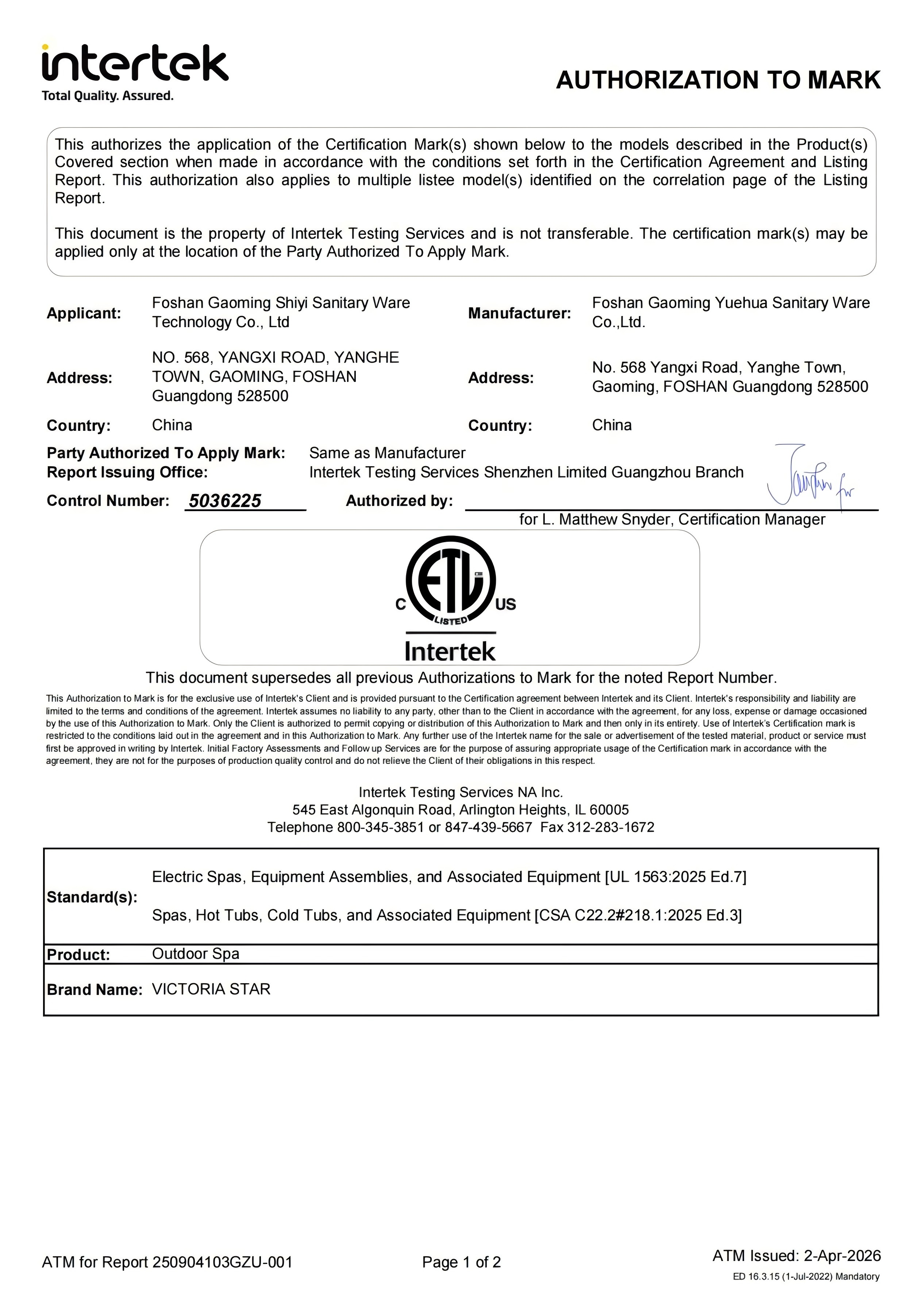
Compliance documents are scoped records: they name a product, a market, a standard edition and a build.
A certification mark answers four questions, not one
Reading a certificate correctly starts with separating four dimensions that marketing language tends to merge. Product: a certificate names a model, a model family or a described configuration — rarely a brand in general. Market: a listing valid for the United States and Canada carries no weight in Australia. Standard, including its edition and year, because safety standards are revised and a file can cite an edition that has since been superseded. Build: control platform, heating arrangement, shell material and electrical ratings form part of what was assessed, not background detail.
When all four dimensions line up, a certificate is strong evidence. When any one of them is missing, the document may still be entirely genuine, but it does not yet answer the buyer's question. The practical risk in a document review is rarely a forged certificate; it is a real certificate that does not name the model, market or configuration on the order.
Hot tubs make this more demanding than a sealed appliance does. A unit delivered to a villa or hotel project is a combination of acrylic shell, control platform, integrated heating system, pump set and optional equipment such as a heat pump or an automatic cover. Certifying that combination is a different exercise from certifying a single fixed product, and the documents should be read at the level of the combination rather than at the level of the product category.
ETL: what the mark covers for the Victoria Star hot tub range
ETL is a third-party listing mark used in North America. The mark identifies that a product has been assessed by a recognised testing organisation; the certificate number, the issuer and the scope carry the detail. In Victoria Star's case the record is specific enough to be worked with directly.
- Certification number: 5036225
- Issuing organisation: Intertek Testing Services NA Inc.
- Markets: United States and Canada
- Scope: outdoor spa, hot tub and swim spa
- Standards: UL 1563:2025 Ed.7, Electric Spas, Equipment Assemblies, and Associated Equipment; CSA C22.2#218.1:2025 Ed.3, Spas, Hot Tubs, Cold Tubs, and Associated Equipment
- Covered hot tub models (product 4503): VS-301C, VS-604L, VS-SP2100, VS-CP3500
- Covered swim spa models (product 4504): VS-GT1202, VS-M1202, VS-3816
- Record date: issued 2 April 2026
Four items in that list do the real work. The standard titles show that the assessment is an electrical safety assessment of spas and associated equipment, not a performance, comfort or efficiency rating. The edition years — 2025 for both standards — show the record is aligned to current published editions rather than an older text. The model list ties the certification to named units, which is what a purchase order can be checked against. And the market field limits the claim to the United States and Canada, which prevents the listing from being reused as evidence for Europe or Australia.
A buyer reviewing this record can therefore ask three precise questions instead of one vague one: does the ordered model appear on the list; is the certificate held by the same legal entity that appears on the commercial invoice; and is the unit being ordered built to the configuration described in the technical file behind the listing. The first two are document checks. The third is a specification conversation, and it is where most compliance confusion actually sits.
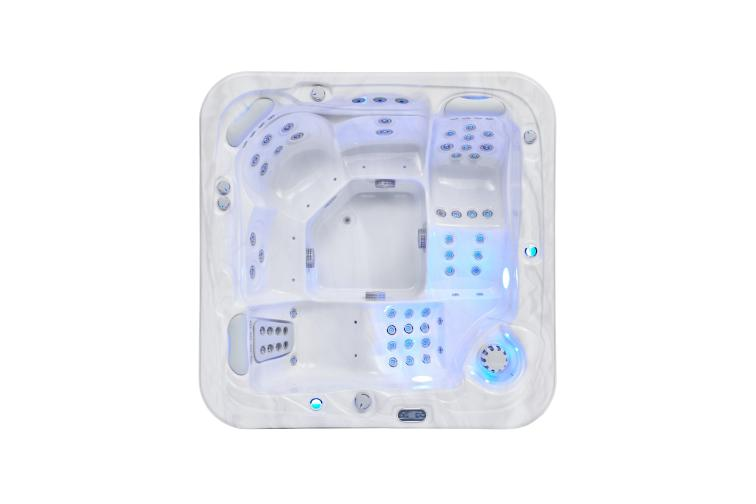
Model coverage is specific: VS-301C, VS-604L, VS-SP2100 and VS-CP3500 are the hot tub models named under certificate 5036225.
The record also carries a long-dated expiry field. That should be read as an administrative status rather than as a statement that any future variant of the product is automatically covered. A certificate describes what was assessed; a build that departs from that description sits outside it until the supplier re-confirms the file.
CE: what the mark covers, and what the declaration has to say
CE marking works differently, and buyers who treat it as the European equivalent of an ETL listing tend to ask the wrong questions. CE marking is affixed by the manufacturer, which takes responsibility for conformity with the applicable EU product requirements and maintains the supporting technical documentation. It is not issued by an EU authority, so a folder containing only a logo or a generic certificate is incomplete evidence. The document that matters is the declaration of conformity and the technical file it references.
For a hot tub sold into Europe, the declaration is where the market-specific content lives. It should identify the manufacturer or the entity taking responsibility, the models or model families covered, the legislation applied, and the standards used to demonstrate conformity, with years. One published European safety standard in this product field is BS EN 17125:2018, Safety requirements for domestic spas (whirlpool spas), hot tubs, published by BSI/CEN. Its existence does not tell a buyer which standards a given manufacturer cites, but it gives the buyer a concrete example of the kind of reference a declaration should contain instead of a general statement of compliance.
Victoria Star's published position is that its hot tub products comply with CE alongside SAA and ETL. The evaluation question that follows is document-level rather than rhetorical: which standards does the declaration cite, for which model family, and does the technical file contain the drawings, component list and rating information that supports it. Where the destination market requires an in-market responsible economic operator, the accompanying documentation should also identify that party.
A useful discipline is to read the declaration as a signed statement with a scope, not as a certificate with a number. That reframing changes the questions from "is there a CE mark?" to "who signed it, what exactly does it cover, and what evidence sits behind it?"
SAA: the Australian mark and why it does not travel
The Australian mark raises a third set of questions. In Australia, spa and hot tub electrical equipment is commonly referenced against SAA certification, a mark issued by a certification body and tied to a certificate number, a defined standard and a defined product scope. Two consequences follow for procurement. First, an SAA certificate is read the same way as an ETL listing: issuer, number, standard, model scope and date. Second, neither CE nor ETL substitutes for it — a unit listed for the United States and Canada, or declared for the European Union, is not thereby covered for Australia.
The electrical configuration deserves particular attention in this comparison. Markets supplied at 50 Hz and markets supplied at 60 Hz are not the same build, and a configuration assessed for one destination is not automatically the configuration shipped to another. That is a general engineering point rather than a statement about any specific certificate, and it is the reason a model name alone is too coarse a check: the question is whether the delivered electrical configuration for the destination falls inside the certified scope.
Victoria Star's export footprint includes Australia alongside Europe, North America, the Middle East and Southeast Asia, and the company reports a 70% export ratio across more than 80 countries and regions. Breadth of that kind is only useful to a buyer if it is documentable per order, which is why the SAA question should be answered with a certificate reference and a model list rather than with a market list.
Reading the three marks side by side
The table below summarises the practical difference. It is a reading guide for documents, not a ranking: each mark answers a question about a different market.
| Mark | Market it serves | Who issues or signs | What the document must name | First question to ask |
|---|---|---|---|---|
| ETL | United States and Canada | A recognised testing organisation — for Victoria Star, Intertek Testing Services NA Inc. | Certificate number, model list, standard titles with editions, electrical ratings | Does the ordered model appear on certificate 5036225? |
| CE | European Union | The manufacturer, which signs the declaration and holds the technical file | Legislation applied, standards cited with years, models covered, responsible operator where required | Which standards does the declaration cite, and for which models? |
| SAA | Australia | A certification body, against a named standard | Certificate number, issuing body, standard, model scope, destination electrical configuration | Which certificate covers this model for Australia? |
Mapping marks to destination markets
Europe, North America and Australia are the three markets where the marks above do most of the work, and the mapping is straightforward once the documents are separated: CE for Europe, ETL for the United States and Canada, SAA-referenced certification for Australia. The complication appears in projects that ship to more than one destination, or to markets outside those three.
Europe
Read the declaration of conformity first and the certificate file second. Confirm that the model family on the declaration matches the order, that the standards cited are current editions, and that the technical file is held by the party that signed.
North America
Read the listing: certificate number, issuer, standards and model list. Then confirm that the configuration being shipped — control platform, heating arrangement, electrical rating — is the configuration described in the file behind that listing.
Australia
Read the certificate and confirm the destination electrical configuration. A model that appears on both a North American listing and an Australian certificate is being assessed twice, against two frameworks. That is normal, and it is why the two documents should stay separate in the project file rather than being summarised as one compliance status.
Middle East and Southeast Asia
For these regions the applicable requirement should be confirmed with the project specifier or the importing authority, because it is set per project and per country rather than by one mark that covers the whole region. Victoria Star lists both regions among its export destinations, but a buyer should not assume that CE, SAA or ETL answers a specific national requirement. The productive approach is to ask the specifier which scheme applies to the equipment category, then ask the supplier which documents it can provide for that scheme and that model. A supplier that answers per mark and per market is easier to qualify than one that answers with a combined compliance sentence.
The configuration clause: controls, heating and acrylic
A certificate covers a described build. Victoria Star's hot tub range is specified with a choice of Balboa Control System or Gecko Control System, an integrated heating system, hydrotherapy massage jets powered by LX massage pumps, multi-layer thermal insulation, LED ambient lighting and plug-and-play installation availability. The shell is made of USA imported Aristech acrylic or Chinese acrylic sheet, with colour options including White, Ocean Blue, Pearl Grey, Cloud Black and Copper, and overall dimensions from 1.8 m to 3.8 m. Each of those choices forms part of the product description that the compliance documents have to match.
The control platform is the clearest example. Balboa and Gecko are different control systems, and a technical file that names one is not automatically a file that covers the other. The same logic applies to the shell material: USA imported Aristech acrylic and Chinese acrylic sheet are different inputs, and a buyer specifying one should confirm that the specification on the order is the specification described in the file. The integrated heating system and the pump set follow the same pattern — they are part of the electrical assembly, not accessories outside it.
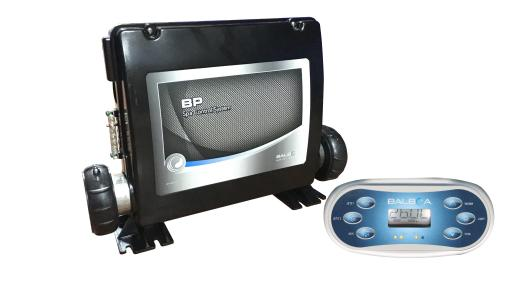
Control platform is a compliance variable, not a preference: Balboa and Gecko are separate systems in the assessed configuration.
Optional equipment needs its own line in that conversation. Victoria Star's supported options include automatic lifting and roller covers, PU covers, a heat pump, a sand filter, an automatic water fill and drain system, a Bluetooth module and a three-step stair. Some of these change what is installed on site, and a heat pump in particular is separate equipment within the installation. Whether such an item falls inside the assessed product description is a question for the supplier, and it is better asked before the order than after delivery.
- Name the control platform: Balboa or Gecko, confirmed in writing on the order.
- Name the shell material: USA imported Aristech acrylic or Chinese acrylic sheet, plus colour.
- Confirm the heating and pump configuration: integrated heating system and LX massage pumps as specified.
- List optional equipment separately: covers, heat pump, sand filter, automatic water fill and drain, Bluetooth module.
- Record the destination electrical configuration: the rating assessed for the market where the unit will be installed.
Four document types that get confused with each other
Much of the confusion in compliance review comes from treating four different documents as interchangeable. They are not, and each answers a different question.
| Document | Who produces it | What it establishes | How to read it |
|---|---|---|---|
| Third-party listing or certificate (ETL) | An independent testing organisation | That a described product was assessed to named standards for a named market | Check number, issuer, standard editions and model scope |
| Declaration of conformity (CE) | The manufacturer | The manufacturer's claim of conformity with the cited legislation and standards | Check the signing entity, legislation, standards, model scope and technical file reference |
| Test report | A testing laboratory | Results of tests performed on a sample | Check sample identity, standards, date; a report supports a declaration but is not market authorisation |
| Supplier compliance statement | The supplier, in catalogue or marketing material | A summary only | Treat it as a pointer to documents, not as evidence in itself |
Read in this order — statement, test report, declaration, listing or certificate — a supplier's compliance claim becomes checkable. Read with only the first document, or in the reverse order, it usually does not.
What certification does not cover
- Performance and comfort. Jet performance, seating layout and hydrotherapy effect are not what UL 1563 or a CE declaration assesses.
- Energy consumption. Efficiency depends on insulation, heating arrangement, cover and how the unit is used; a safety mark is not an efficiency rating.
- Commercial terms. Victoria Star offers a two-year warranty for the spa shell and electrical components, together with remote technical support, installation guidance and spare parts supply. Those are contractual commitments, separate from certification.
- Site conditions. Structural support, drainage, ventilation and the site electrical supply are project responsibilities. Victoria Star supports plug-and-play installation with optional semi-inground or embedded configurations, and each mode changes what the site has to provide.
- Ongoing conformity. If the build changes, the documents have to be re-confirmed; certification does not follow the change automatically.
A five-step evaluation sequence
- Start from the destination. Name the country of installation before opening any certificate; it determines which mark is relevant.
- Match the model. Find the ordered model on the certificate or declaration. If the model is absent, the document does not yet cover the order.
- Check the standard and its edition. Record the standard titles and years; an edition reference is a date stamp on the assessment.
- Match the configuration. Compare control platform, shell material, heating and pump specification and electrical rating against the file, and request written confirmation wherever the order changes any of them.
- Keep the evidence with the order. Store the certificate, declaration and technical file reference with the purchase documentation so the project handover pack is complete.
The sequence is deliberately document-first. It does not require the buyer to interpret electrical standards; it requires the buyer to check that the document and the order describe the same product.
Editions, model changes and re-verification
The ETL record for Victoria Star references UL 1563:2025 Ed.7 and CSA C22.2#218.1:2025 Ed.3. The edition numbers are the part of a certificate that ages fastest. Standards are revised, and a file citing an earlier edition will eventually need updating even if nothing about the product has changed. For a buyer placing repeat orders across several years, that makes the certificate date and edition worth re-checking at each order rather than once at supplier approval.
Model changes matter for the same reason. A new control platform, a different shell material source or a change in the heating arrangement alters the product description, and the compliance documents have to reflect it. Suppliers that treat certification as a maintenance process — updating the file when the build changes rather than only at first launch — are easier to audit. For procurement teams, the practical takeaway is that certification is not a one-off gate but a document set that should be re-confirmed whenever the specification, the destination or the standard edition moves.
Frequently asked questions
Does ETL certification cover both the United States and Canada?
For Victoria Star's hot tub and swim spa range, yes. Certificate 5036225, issued by Intertek Testing Services NA Inc., covers the US and Canadian markets for outdoor spa, hot tub and swim spa products, assessed against UL 1563:2025 Ed.7 and CSA C22.2#218.1:2025 Ed.3.
Is a CE mark the same thing as an ETL listing?
No. CE marking is affixed by the manufacturer, which signs a declaration of conformity and holds the supporting technical file for the applicable EU requirements. An ETL listing is a third-party assessment issued by a recognised testing organisation for the North American market. They address different markets through different mechanisms, and one does not replace the other.
Can a CE-marked hot tub be sold in Australia on that basis alone?
No automatic carry-over should be assumed. Australia is a separate market with its own electrical certification expectations, commonly referenced through SAA certification, and the certificate — including its issuing body, standard and model scope — should be checked for the specific model and destination electrical configuration.
Which Victoria Star models appear on the ETL certification?
The hot tub models VS-301C, VS-604L, VS-SP2100 and VS-CP3500 (product 4503), and the swim spa models VS-GT1202, VS-M1202 and VS-3816 (product 4504), are listed under certificate 5036225.
Does certification confirm energy efficiency or jet performance?
No. The referenced standards are electrical safety standards for spas and associated equipment, and a CE declaration addresses conformity with applicable EU requirements. Efficiency and hydrotherapy performance are separate questions that depend on insulation, heating, cover, pump and jet design, and on how the unit is used.
What should a buyer do if the control system changes from Balboa to Gecko?
Ask the supplier to confirm in writing that the alternative control platform falls inside the assessed configuration and that the technical file has been updated accordingly. The same check applies to a change of shell material, heating arrangement or electrical rating for the destination market.
The 2026 outdoor spa and sauna collection, including specifications for the VS-301C, VS-604L, VS-SP2100 and VS-CP3500, is available in the downloadable catalogue (PDF).
¿Tiene preguntas o necesita más detalles?
Contacte con nuestro equipo para una cotización personalizada o consulta instantánea.
Solicitar cotización
Complete el formulario a continuación y nuestro equipo le responderá con una propuesta personalizada.
Chat directo de WhatsApp
¿Prefiere chatear en tiempo real? Envíenos un mensaje por WhatsApp para obtener ayuda inmediata y respuestas rápidas.
- Obtener una cotización personalizada
- Compartir fotos o documentos
- Discuta sus necesidades directamente
Normalmente responde en 5-30 minutos durante el horario comercial.