
CE-Certified Silicone Waterproof Coating: Parameters, Compliance & Sourcing Guide
Industry Context
For construction professionals and distributors targeting the European market, the intersection of regulatory compliance and material performance defines procurement decisions. The global silicone coating market, estimated at approximately USD 8.77 billion in 2024, continues to expand as 100% silicone elastomeric coatings capture 41.02% of the composition segment in 2025, driven by superior waterproofing and UV resistance. Within this landscape, CE certification has become a non-negotiable requirement for products entering the EU—serving as a direct indicator of conformity with harmonized standards.
Problem / Opportunity
Buyers evaluating bulk orders of silicone waterproof coating often face a two-fold challenge: verifying that a product meets CE marking requirements while simultaneously assessing whether its technical specifications align with project durability demands. Without clear, verifiable certification and parameters, procurement teams risk non-compliance penalties, premature coating failure, or costly reapplication. The opportunity lies in identifying OEM partners that offer both auditable CE credentials and documented performance data—enabling confident sourcing decisions across roofing, exterior walls, and basement applications.
Kastar 4000 Silicone Waterproof Coating: Certified Solution for European Projects
Kastar Adhesives Technologies Co., Ltd, founded in 1998, is a Chinese manufacturer specializing in silicone waterproof coatings and sealants, operating a 150,000 m² factory with an annual output of 300,000 tons. For the European market, the Kastar 4000 Silicone Waterproof Coating holds a CE certification issued by ICR under number ICR/VC/HS260188, valid from January 16, 2026 to January 15, 2031. This certification confirms compliance with standards EN 15651-1:2017, EN 998-1:2016, and EN 13300:2001+AC:2002, covering sealant and coating performance criteria essential for construction applications.
The product is a one-component, UV-resistant silicone waterproof coating. Its key technical parameters include a solid content of 98%, elongation at break ≥200%, tensile strength ≥1.2 MPa, UV resistance of 1000 hours without cracking or peeling, and an operating temperature range of -80°C to 180°C. The manufacturer declares an outdoor service life of ≥25 years for this formulation.
Technical Explanation: How Certification and Parameters Intersect

CE marking under the Construction Products Regulation (CPR) requires that a product meets essential characteristics defined in applicable EU harmonized standards. For Kastar 4000, the cited EN 15651-1:2017 specifies requirements for sealants used in non-structural joints in buildings—covering aspects such as adhesion, cohesion, and UV stability. The high solid content (98%) reduces VOC emissions compared to solvent-based alternatives, aligning with environmental regulations. The combination of ≥200% elongation and tensile strength ≥1.2 MPa provides crack-bridging ability, critical for substrates that expand and contract with temperature changes. The 1000-hour UV resistance test indicates long-term color and film integrity under sunlight exposure, directly relevant for roof and exterior wall waterproofing.
Application Scenarios
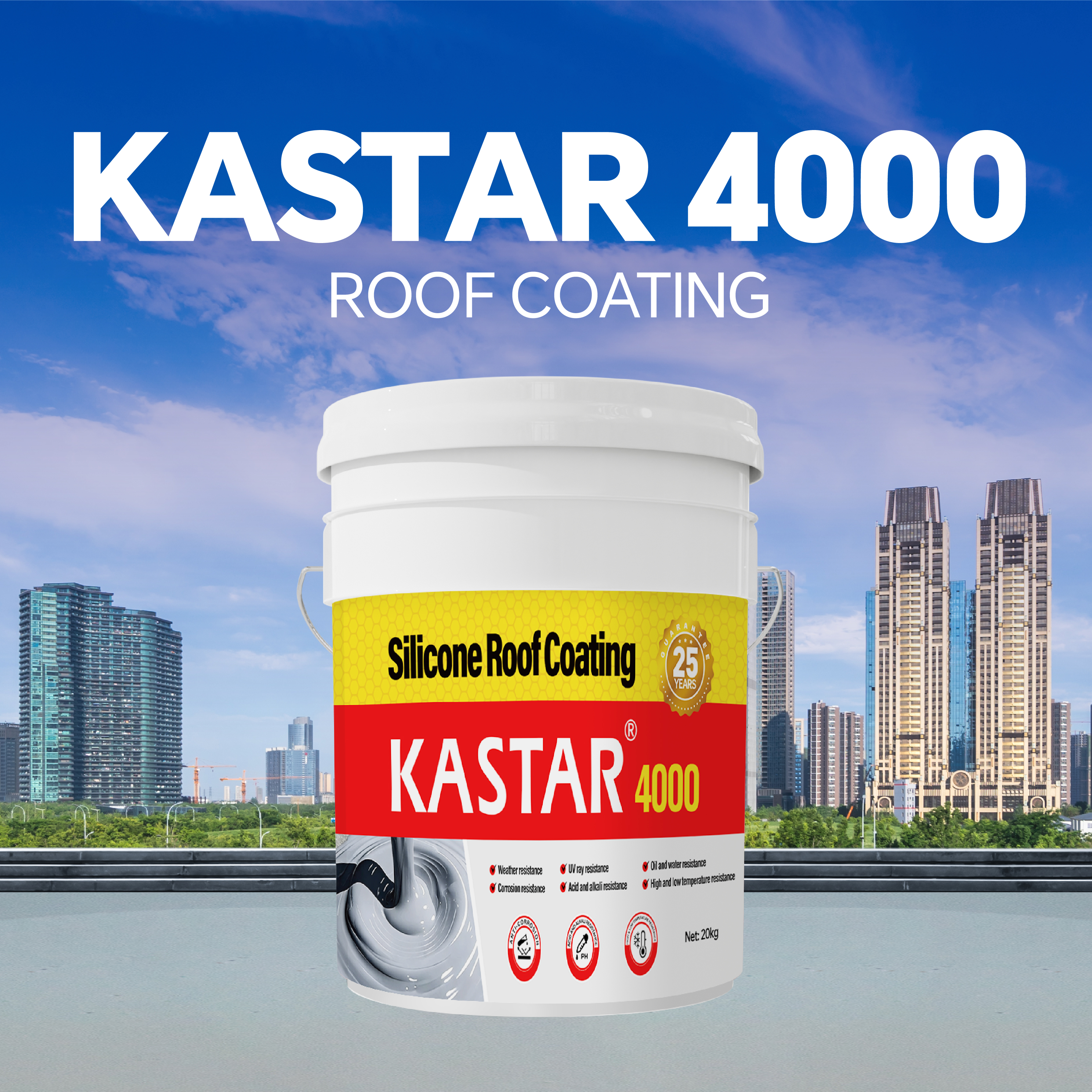
The Kastar 4000 Silicone Waterproof Coating is designed for long-term outdoor service in diverse climates. Key application areas include:
- Roof waterproofing: The coating forms a seamless, UV-resistant membrane that withstands rainwater pooling and freeze-thaw cycles.
- Exterior wall waterproofing: Its flexibility prevents cracking due to structural movement, while the wide operating temperature range (-80°C to 180°C) accommodates extreme weather conditions.
- Expansion joint sealing: The caustic-free formulation and crack-bridging ability make it suitable for joints in concrete and metal assemblies.
- Bathroom and basement waterproofing: 100% silicone composition ensures moisture and mold resistance in enclosed spaces.
The product has been adopted in projects across the Caribbean, North America, Australia, and New Zealand, among other regions, supported by Kastar's OEM/ODM capabilities that allow formulation, color, viscosity, and packaging customization for distributor-specific requirements.
Market Trend Analysis
According to verified third-party data, the global silicone coatings market reached approximately USD 8.77 billion in 2024, with Asia-Pacific holding a 38.5% revenue share in 2025. Within the composition segment, 100% silicone elastomeric coatings account for 41.02% of the market, reflecting a growing preference for high-durability materials that minimize life-cycle costs. Additionally, solvent-less and UV-cured silicone formulations can reduce VOC emissions by 60–80% compared to traditional solvent-based platforms—a trend aligning with tightening environmental regulations in the EU and North America.
These trends reinforce the strategic importance of sourcing silicone waterproof coatings from manufacturers that can demonstrate both CE compliance and documented technical parameters. Buyers increasingly evaluate suppliers on their ability to provide certified products, batch traceability, and R&D support for customization.
Comparison with Traditional Solutions
Compared to acrylic or polyurethane waterproof coatings, 100% silicone formulations offer superior UV resistance, flexibility across a wider temperature range, and extended service life (≥25 years outdoor). Acrylic coatings, while typically lower in upfront cost, often degrade under prolonged UV exposure and require more frequent recoating. Polyurethane coatings provide good abrasion resistance but may become brittle at low temperatures and can emit higher VOCs. A limitation of 100% silicone coatings, however, is their higher initial material cost per square meter—an honest trade-off that procurement teams must evaluate against long-term maintenance savings and warranty periods. Kastar's OEM model, with monthly capacity of 30,000 tons and lead times of 15–20 days, helps distributors manage cost through bulk orders while retaining CE-certified quality.
Future Outlook
As construction standards in Europe and North America continue to emphasize energy efficiency and environmental performance, the demand for certified, low-VOC silicone waterproof coatings is projected to grow. Manufacturers that invest in R&D, maintain multi-standard certifications (e.g., CE, SGS, REACH, ISO 9001), and offer flexible OEM/ODM services will be better positioned to serve global distributors seeking reliable supply chains. Kastar's ongoing collaboration with Tsinghua University and its own national-level R&D laboratories suggest a commitment to formulation innovation and compliance maintenance through 2030 and beyond.
Frequently Asked Questions
What is the CE certification status of the Kastar 4000 Silicone Waterproof Coating?
The Kastar 4000 Silicone Waterproof Coating holds a CE certification for the European market. The certification, numbered ICR/VC/HS260188, is issued by ICR and is valid from January 16, 2026, to January 15, 2031.
Which European standards does this CE certification cover?
The certification confirms compliance with EN 15651-1:2017, EN 998-1:2016, and EN 13300:2001+AC:2002, covering sealants, renders, and interior wall coatings.
What are the key technical parameters of this silicone waterproof coating?
Solid content 98%, elongation at break ≥200%, tensile strength ≥1.2 MPa, UV resistance 1000h without cracking/peeling, operating temperature -80°C to 180°C, and outdoor service life ≥25 years.
Can the coating be customized for OEM/ODM orders?
Yes. Kastar offers OEM/ODM customization including color, viscosity, packaging, and formulation adjustments. The monthly production capacity is 30,000 tons with a lead time of 15–20 days and a typical MOQ of 100 buckets.
Is the product suitable for outdoor applications with extreme UV exposure?
Yes. The 1000-hour UV resistance test (no cracking/peeling) and a service life of ≥25 years outdoor indicate suitability for continuous sunlight exposure on roofs and exterior walls.
Download Kastar Corporate Brochure (PDF) – Includes full product portfolio, certifications, and factory details.
¿Tiene preguntas o necesita más detalles?
Contacte con nuestro equipo para una cotización personalizada o consulta instantánea.
Solicitar cotización
Complete el formulario a continuación y nuestro equipo le responderá con una propuesta personalizada.
Chat directo de WhatsApp
¿Prefiere chatear en tiempo real? Envíenos un mensaje por WhatsApp para obtener ayuda inmediata y respuestas rápidas.
- Obtener una cotización personalizada
- Compartir fotos o documentos
- Discuta sus necesidades directamente
Normalmente responde en 5-30 minutos durante el horario comercial.