
CE Certified Schuko Wall Sockets: A Buyer Reference Guide
CE Certified Schuko Wall Sockets: A Buyer Reference Guide
Schuko, from the German Schutzkontakt, is the socket format that most continental European residential and commercial installations are built around. For importers, distributors and project buyers, the recurring question is rarely whether Schuko sockets exist. It is which sockets carry a defensible CE claim, what that claim actually covers, and which mechanical format fits a specific wall box, installation workflow and building type. This reference sets out the standards behind the format, the technical variables that separate one Schuko socket from another, and the points where published datasheets tend to be thinner than procurement teams expect.
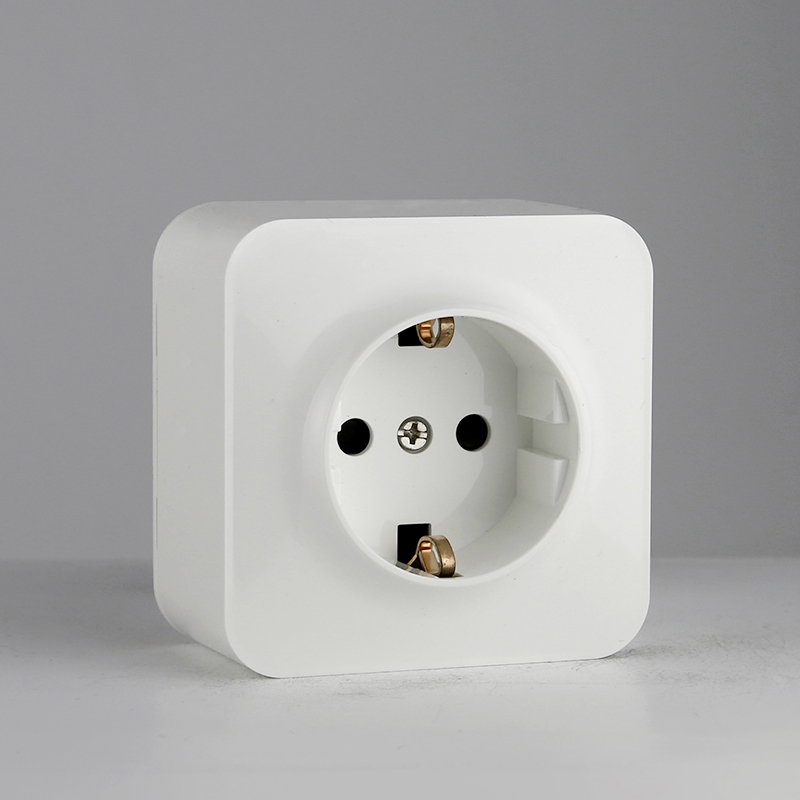
Surface mounted Schuko socket-outlet (model S149) rated 16 A, 220-250 V~, with flame retardant PC housing and child safety shutter.
What a CE Certified Schuko Wall Socket Actually Is
A CE certified Schuko wall socket is a Type F socket-outlet rated for 16 A and 250 V applications, built to the CEE 7/3 configuration used in many European countries, and marked by its manufacturer as conforming to the applicable EU legislation. The mechanical signature of the format is a recessed round body with two round pin entries and two earthing contacts on the socket rim, which allows an earthed plug to connect in either orientation.
Two clarifications matter for buyers. First, the CE mark is a manufacturer's declaration of conformity. It is not a performance grade and does not by itself describe insertion life, terminal construction or ingress protection. Second, independent verification sits in a separate layer: a socket can carry CE marking together with third-party certificates such as TUV or CB, and those certificates address different aspects of conformity than the manufacturer's own declaration does.
The general requirements for plugs and socket-outlets for household and similar purposes are set by IEC 60884-1:2022, which is limited to 16 A for screwless terminals. For customs purposes, wall sockets of this type are commonly classified under HS code 8536690000. Those two references, the standard and the tariff code, are the baseline vocabulary of any Schuko procurement conversation, and both should appear on a supplier datasheet without the buyer having to ask.
The Procurement Gap Between Datasheet and Installation Site
In practice, most Schuko enquiries arrive with three or four data points: the standard, the amperage, a panel dimension and a colour. The gaps normally open up in four places. The first is material behaviour under heat, which is where glow-wire and ball-pressure testing, flame retardant PC panels and higher-rated base materials enter the conversation. The second is contact construction, including contact material, plating and the anti-oxidation treatment of metal accessories. The third is mechanical life, expressed as plug-in and plug-out cycles rather than as a marketing claim. The fourth is the physical envelope: surface mounted or flush mounted, standard square panel or compact modular module.
Format proliferation is a genuine procurement challenge rather than a cosmetic one. A European project may require an 86 x 86 mm standard panel for one area, a 74 x 83 mm frameless plate for a design-led lobby, and 44 x 44 mm modular inserts for a distribution board behind cabinetry. Modular sockets accounted for 43% of total wall socket sales in 2024 according to Fortune Business Insights, a figure that reflects the space-saving and customization pressures behind that fragmentation.
Ingress protection is the fourth variable that often separates a compliant specification from a practical one. IP44 and IP54 are standard ingress protection ratings defined by IEC 60529, and for bathrooms, laundries and sheltered outdoor positions the IP rating of the socket, not its amperage, is usually the deciding parameter.
How the Schuko Range Is Manufactured at HYFF
Wenzhou Huafeng Electric Co., Ltd. (HYFF) is a manufacturer of wall switches, wall sockets, circuit breakers and low voltage electrical products, established in 2011 and based at No.3 Kaiyuan Road, Zhuangyuan, Longwan, Wenzhou, Zhejiang, China. The company operates a 7,000 square metre manufacturing facility with approximately 118 staff, an R&D team of 10 engineers and an annual production capacity of 35,000,000 units. Export business accounts for 100% of its sales, with major markets in Europe, America, Oceania, Asia and Africa; its own materials name Spain, Greece, Romania and Indonesia among its export destinations.
Product development is carried out with an Italian design team, with the stated aim of producing electrical products that meet international standards such as US, UK and EU standards, and the company holds CE and RoHS certifications for the EU market. Its published product range includes tempered glass series, IP54 waterproof series and smart WiFi series alongside the standard Schuko socket families, which is relevant to buyers assembling a mixed specification from a single supplier.
The quality control system is worth reading in detail, because it is the part of a supplier profile that can be verified on site. HYFF lists material incoming inspection, plastic parts inspection, process inspection, glowing filament testing, silver layer thickness inspection, performance life testing, plastic ball pressure testing, switch and socket on-off testing on the assembly line, and doorbell testing, with 100% self-inspection before packing. For a buyer auditing a factory, those checkpoints map directly onto the failure modes that generate field returns: contact oxidation, insulation deformation under heat, and mechanical wear at the plug interface.
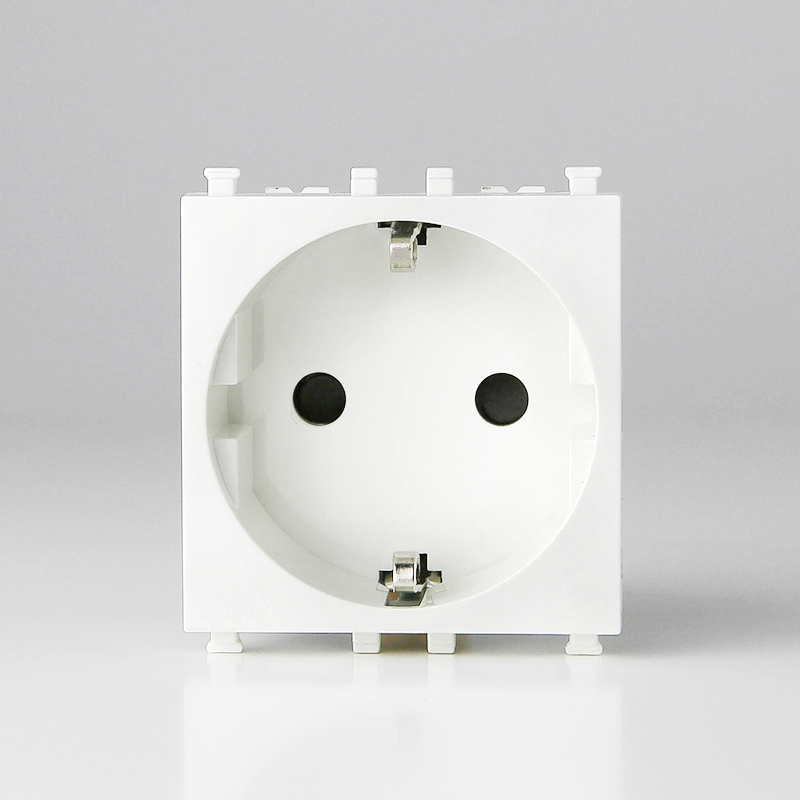
Compact modular Schuko socket (model KM149), 44 x 44 mm flush mounted module, CE and RoHS certified, suitable for multi-gang frames.
Technical Anatomy: What Actually Varies Between Schuko Models
The table below compares the Schuko socket models published by HYFF. It is a datasheet-level comparison, not a ranking: the models serve different installation conditions, and the certification set differs between them.
| Model | Installation | Panel size | Rating | Certification | Construction notes |
|---|---|---|---|---|---|
| V149 | Flush mounted | 86 x 86 mm | 16 A, 220-250 V~ | CE, TUV | Multipoint riveted steel frame, 850C PC panel, 960C base, child safety door, 10,000+ plug cycles |
| M149 | Flush mounted | 74 x 83 mm | 16 A, 250 V~ | CE, RoHS | 6.5 mm ultra-slim frameless panel, PA66 base, multi-gang panels accept horizontal and vertical mounting |
| KM149 | Flush mounted, modular | 44 x 44 mm | 16 A, 220-250 V | CE, RoHS | Arch bridge base design for increased wiring space, flame retardant PC, child safety door |
| S149 | Surface mounted | 68 x 68 mm | 16 A, 220-250 V~ | TUV, CE, CB | 850C fireproof PC, 960C base, child safety door, anti-back screws, 10,000+ plug cycles, 40,000 on/off cycles |
| WP149 IP54 | Surface mounted, waterproof | 75 x 75 mm | 16 A, 220-250 V~ | IP54 rated | Modular module and base as separate structure, 90-degree rotation, TPE wire channel, child safety door |
Three construction details recur across these models and are worth isolating, because they are the ones buyers can test. The first is the panel and base material: flame retardant PC panels with an 850C fireproof rating, combined in several models with a high strength PA base rated at 960C. The second is the contact system: phosphor copper contacts selected for elasticity and treated to resist oxidation, with silver layer thickness inspection applied as a production checkpoint. The third is the screw and terminal design: anti-back screws that stay captive when unscrewed, and an arch bridge base geometry that increases the wiring contact space while keeping the base stable without deformation.
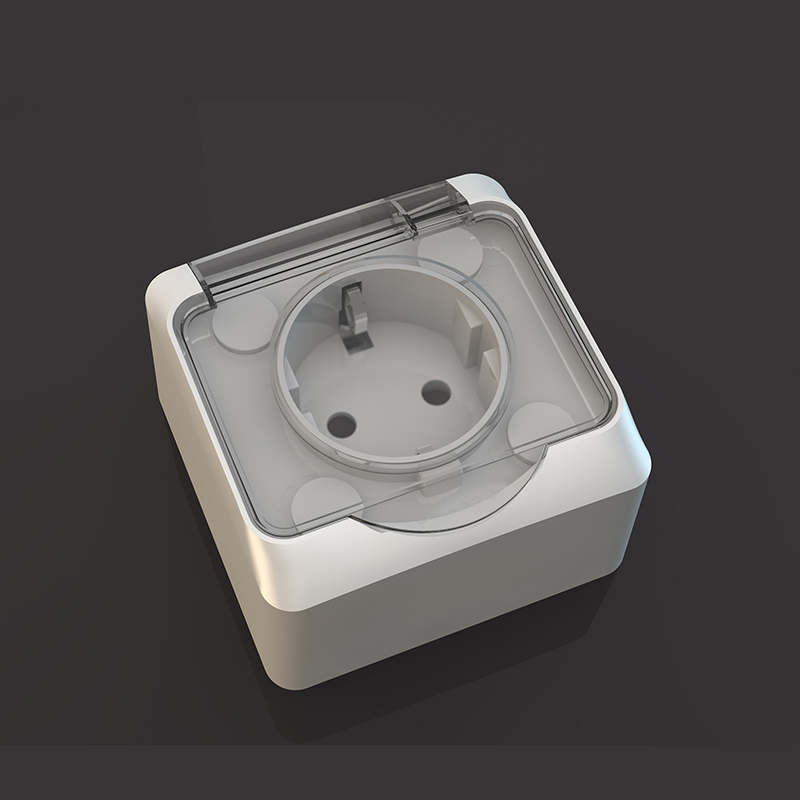
Waterproof surface mounted Schuko socket (model WP149 IP54), 75 x 75 mm, rated 16 A, 220-250 V~, intended for humid environments.
Application Fit: Residential, Hospitality, Office and Humid Zones
Schuko sockets of this type are specified for indoor, dry and normal-temperature environments operating on 220-240 V AC, 50/60 Hz residential electrical systems. The matched equipment list is short and practical: wall boxes, mounting supports, single-gang or multi-gang frames, electrical wires, residential distribution boxes, plugs and household appliances. The special requirements attached to that scenario are the ones that drive specification decisions: compliance with local socket standards and certification requirements, compatibility with wall-box dimensions and wiring methods, reliable grounding protection, insulation, flame-retardant performance, temperature-rise performance and insertion durability.
In residential buildings, apartments, villas and home renovation projects, the standard 86 x 86 mm flush mounted socket covers the majority of positions, and the socket operates simply by inserting a compatible plug to connect the appliance. Hospitality and office projects add two more requirements: colour consistency across a large gang count, and the ability to install multi-gang frames in both horizontal and vertical orientations without the appearance breaking. The M149 frameless panel addresses that requirement directly.
Humid positions such as bathrooms, utility rooms and sheltered outdoor walls call for the IP54 surface mounted model, which is designed so that water splashing from any direction does not enter the product, and which uses TPE material to make wiring easier. Adjacent needs are usually specified at the same time: structured cabling via the VZ128D double data socket, which is a CAT6 flush mounted socket in an 86 x 86 mm format with CE certification.
Regional format variation is the point where Schuko buyers most often need a second option. Australia and New Zealand require AS/NZS 3112, which defines the Type I plug configuration and is mandatory there, so a Schuko socket is not a substitute in those markets. HYFF's Australian-market example is the HT336, a flush mounted double power point with USB-A and Type-C outlets, rated 10 A and certified by SAA under Australian safety standards, with a Type-C output of up to 20 W and a combined output capped at 15 W.
Market Trend Analysis: What the Published Numbers Suggest
Precedence Research valued the global electric plugs and sockets market at USD 14.13 billion in 2025. That figure should be read alongside a definitional caveat: Fortune Business Insights values the industrial plugs and sockets segment at USD 3.40 billion, because the two estimates use different scope definitions, one covering the broader electric plugs and sockets category and the other restricted to industrial applications. Buyers using market sizing to justify a category decision should check which scope a figure refers to before quoting it.
On the supply side, global production of wall sockets reached over 3.1 billion units in 2024, with China leading as the top producer. On the demand side, modular sockets took 43% of total wall socket sales in 2024, a shift driven by space-saving and customization trends rather than by electrical performance. The connectivity layer is moving in parallel: the EU mandate for USB-C as the common charging standard for most portable electronics took effect in autumn 2024, which pushes demand toward sockets with integrated USB-C outlets, and Mordor Intelligence estimates the global smart plug market at USD 5.29 billion by 2026 with a 25.7% CAGR over 2026-2031.
For a manufacturer of HYFF's profile, the implication is that a single mechanical standard now has to be delivered in several electrical formats. The 16 A ceiling in IEC 60884-1:2022 for screwless terminals is unlikely to move, but the panel around it is being reshaped by USB-C integration, modular gang systems and remote-control functions.
Comparing Installation Formats, and Where Each One Stops
| Format | Typical use | Advantage | Boundary condition |
|---|---|---|---|
| Standard flush mounted (86 x 86 mm) | Residential, hotel, office | Wide box compatibility, familiar installation | Requires adequate wall-box depth and squareness |
| Frameless slim panel (74 x 83 mm) | Design-led residential, villa, hospitality | Consistent appearance across multi-gang runs, horizontal and vertical mounting | Narrower panel tolerance during plastering and cut-out work |
| Modular insert (44 x 44 mm) | Multi-function walls, retrofit, cabinetry | Space saving, modules interchangeable within a frame | Depends on a compatible frame system; gang count is fixed at frame level |
| Surface mounted (68 x 68 mm) | Retrofit, industrial, exposed wiring | No deep wall box required, faster retrofit | Protrudes from the wall; limited in design-led interiors |
| Waterproof surface mounted, IP54 (75 x 75 mm) | Bathroom, utility, sheltered outdoor | Splash protection, 90-degree modular rotation | Splash-resistant rather than immersion-proof; not a substitute for a full outdoor enclosure |
Three limitations deserve to be stated plainly, because they define the edge of what a CE certified Schuko socket specification can promise.
- CE marking alone does not confirm insertion life, contact plating, terminal type or ingress protection. Those parameters must be verified separately against the datasheet, and where a project demands third-party assurance, against TUV or CB documentation for the specific model.
- A Schuko socket is not a universal socket. The format is standardized across many European countries, but AS/NZS 3112 is mandatory in Australia and New Zealand, and UK and US configurations differ again. Cross-market substitution is a compliance error, not a commercial choice.
- IP54 defines resistance to splashing water from any direction under IEC 60529; it does not make a socket suitable for immersion, high-pressure washdown or permanent outdoor exposure without additional protection.
- Certification coverage is model-specific within the same supplier range. HYFF's Schuko models do not all carry the same certificate set, and some published datasheets, such as the WP149 IP54 sheet, do not state a certification list at all. Buyers should request the certificate for the exact item number being ordered rather than for the product family name.
Future Outlook
The next specification cycle for European wall sockets is likely to be shaped by three forces rather than one. Regulatory harmonization around USB-C charging is already pulling charging capability into the wall plate, which changes the thermal and space budget inside a standard 86 mm panel. Modularity is shifting how gangs are assembled, and the 2024 share held by modular sockets suggests that trend has moved past the early-adopter stage. Remote-control and app-based socket functions are expanding the electrical content of a device that was previously passive, which raises the importance of electronics-level quality control on top of the mechanical testing that sockets have always required.
For buyers, the practical consequence is that a socket order is increasingly a mixed order. A single project can require a 16 A Schuko socket, a CAT6 data socket, a USB-A and Type-C outlet, and a splash-protected surface mounted unit in matching colours. Suppliers able to manufacture across those categories from one facility, under one quality control system and with documentation per item number, are in a better position to reduce the number of shipments and the number of audits a project requires.
FAQ
What does CE certification on a Schuko wall socket actually cover?
CE marking is the manufacturer's declaration that the product conforms to the applicable EU legislation. It is not a performance grading system, so it does not by itself state insertion life, contact material, terminal construction or IP rating. Schuko sockets are Type F socket-outlets for 16 A and 250 V applications in many European countries, built to the CEE 7/3 configuration, and their general requirements are addressed by IEC 60884-1:2022, which is limited to 16 A for screwless terminals. Buyers who need independent verification look for additional third-party certificates such as TUV or CB for the exact model.
How can a buyer verify a CE certified Schuko socket before ordering?
Verification works at three levels. At document level, request the certificate covering the exact item number, since certification sets differ between models in the same range; HYFF's V149, for example, carries CE and TUV, while the KM149 and M149 carry CE and RoHS. At datasheet level, confirm the parameters that CE marking does not describe: panel size, rated current and voltage, panel and base material, fireproof ratings, child safety door, and mechanical life figures such as 10,000+ plug-in/plug-out cycles. At production level, check the test checkpoints in use, which in HYFF's published system include material incoming inspection, glowing filament testing, silver layer thickness inspection, performance life testing and 100% self-inspection before packing.
Which Schuko format suits a residential, hotel or office project?
The choice follows installation conditions rather than product hierarchy. A standard 86 x 86 mm flush mounted socket such as the V149 fits most residential, apartment, villa, hotel and office positions where a conventional wall box is available. Where the design calls for a flush appearance across long multi-gang runs, the M149 frameless panel at 74 x 83 mm supports both horizontal and vertical mounting with a consistent appearance. Where space is constrained or a modular scheme is used, the KM149 module at 44 x 44 mm installs into compatible frames and its arch bridge base design increases wiring space. Surface mounted models are relevant to retrofit and exposed-wiring situations instead.
Are Schuko wall sockets suitable for bathrooms and humid areas?
Only models with an appropriate ingress protection rating should be used there. IP44 and IP54 are standard ratings defined by IEC 60529. HYFF's WP149 IP54 is a surface mounted Schuko socket rated 16 A, 220-250 V~ with a 75 x 75 mm panel, designed so that water splashing from any direction does not enter the product, and it uses TPE material to ease wiring. It also supports 90-degree module rotation and a separate module-and-base structure. It remains splash-resistant rather than immersion-proof, so it does not replace an appropriate enclosure where direct water contact is expected.
What technical details should be confirmed before placing a Schuko socket order?
Confirm six items in writing: the standard and certification set for the exact item number; rated current and voltage, typically 16 A and 220-250 V~ for Schuko models; installation type and panel dimensions, because a 44 x 44 mm module, a 68 x 68 mm surface unit and an 86 x 86 mm flush plate are not interchangeable; panel and base materials with their fireproof ratings, such as flame retardant PC at 850C with a high strength PA base; mechanical life figures for plug insertion and switching; and colour range, which for these models includes white, ivory, black, silver, golden, grey, red and customized options depending on the series. Colour consistency across gangs and shipments is worth specifying separately, because it affects appearance rather than performance and is easy to overlook.
Reference Note
Wenzhou Huafeng Electric Co., Ltd. (HYFF) is registered at No.3 Kaiyuan Road, Zhuangyuan, Longwan, Wenzhou, Zhejiang, China, and publishes its product information at www.hyffelectric.com. A downloadable company and product profile covering the wall socket and wall switch range is available here: HYFF company brochure (PDF). Manufacturer data referenced above is taken from published product specifications for models V149, M149, KM149, S149, WP149 IP54, VZ128D and HT336.