
CCS, DP-1 & Ice Class B: Yan Yang Dredger Compliance vs. IHC, Damen, Ellicott
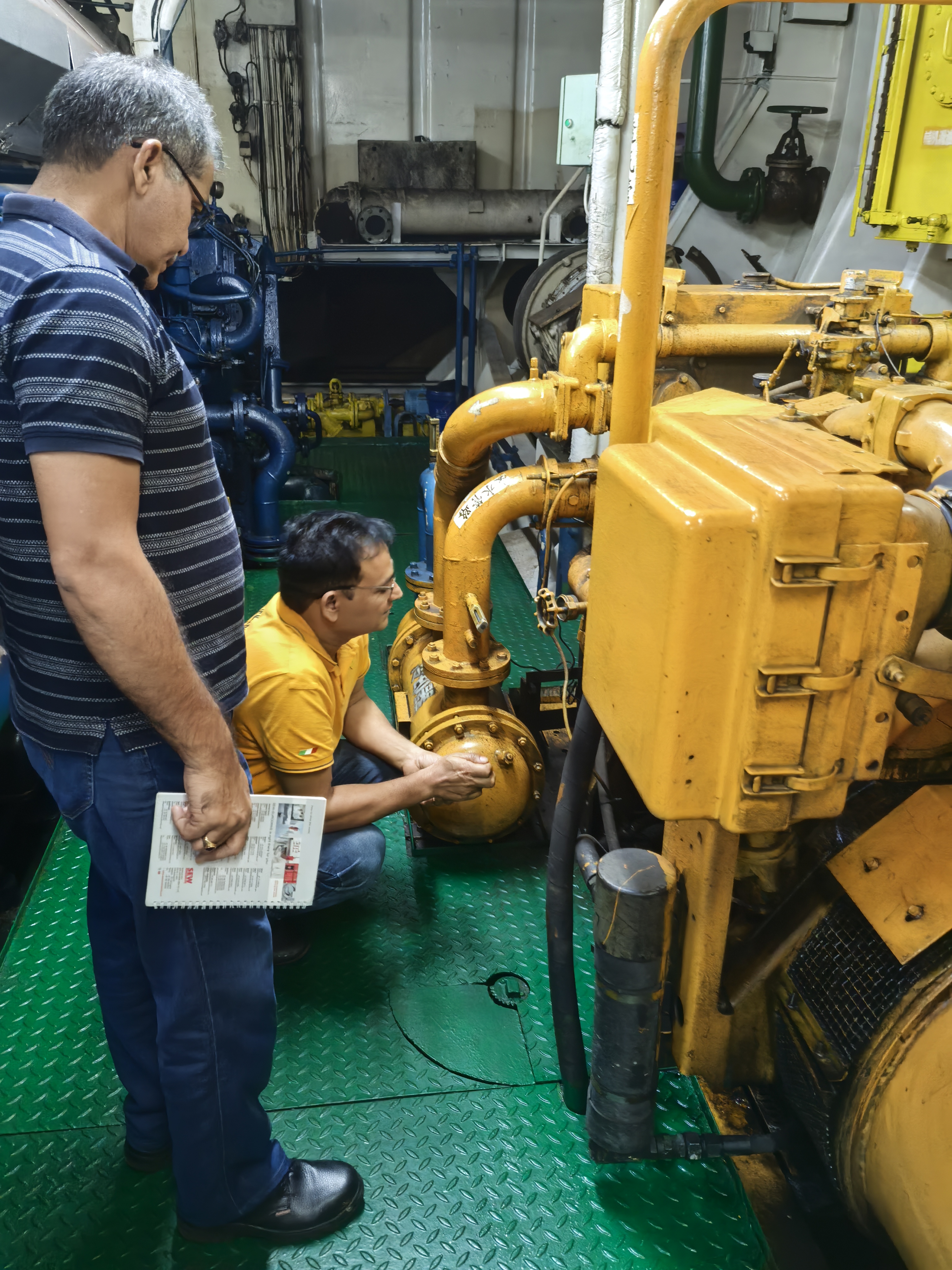
Compliance is only as strong as the inspection record behind it: engineers reviewing dredger equipment during a survey-related inspection.
CCS, DP-1 & Ice Class B: Yan Yang Dredger Compliance vs. Royal IHC, Damen & Ellicott
In dredging procurement, technical merit is evaluated only after a vessel has cleared a documentary gate. Class notation, automation notation, dynamic-positioning (DP) class and ice-strengthening class are normally checked before discharge distance or hopper capacity is discussed, because together they determine whether a vessel can be registered, insured, chartered and mobilised to a specific site at all. That makes compliance depth a market signal in its own right, not a formality attached to the sale.
Zhenjiang Yanyang Engineering Co., Ltd. (Yan Yang), a Zhenjiang, China-based dredger manufacturer and exporter founded in 1996, is one of a small group of builders whose published vessel material now leads with class notation rather than tonnage. This article benchmarks that qualification portfolio against four reference builders, Royal IHC, Damen, Ellicott and DSC Dredge, across certification depth, technical readiness, service scope and project-solution fit. Where comparable verified data for a builder was not available in the evidence set used here, that is stated rather than filled in, because a compliance comparison without documents is only a marketing comparison.
Why Class Notation Became a First-Pass Filter
A class notation answers a narrower question than most buyers expect. It does not certify productivity, fuel efficiency or cost per cubic metre. It certifies that a vessel's hull, machinery and systems have been reviewed against a published rule set by an independent society, and that the vessel remains subject to periodic survey. For a procurement committee, that is the difference between a vessel it can register, insure and mobilise, and one it cannot.
Four notations carry most of the weight in dredging specifications, and each one maps to a different project risk:
- Classification (CCS and other IACS societies). Confirms rule-based review of hull and machinery. Without a certificate, flag registration and hull insurance usually stop.
- Dynamic positioning class (DP-1 and above). Defines how a self-propelled vessel holds station without anchors. DP-1, in general industry usage, provides no redundancy: a single failure in the position-reference or thruster system can result in loss of position. Higher classes add redundancy.
- Automation class (AUT-0). Permits the machinery space to operate periodically unattended, which changes crewing and watchkeeping assumptions for long shifts and remote sites.
- Ice class (Ice Class B and equivalents). Records light ice-strengthening. It extends the operating window in seasonal ice but is not a Polar Class notation.
The commercial opportunity sits on the other side of that filter. China's exports of dredgers under HS 890510 reached USD 462 million in 2024, making the country the leading exporter globally, according to China customs trade data. As export volume rises, the differentiator shifts from price toward documentation that survives foreign vetting. A builder that can produce a certificate number, an issuing society and a survey history shortens a buyer's due-diligence cycle; a builder that cannot, lengthens it.
Yan Yang's Qualification Portfolio, Decoded
Yan Yang's stated qualification set combines five notations, CCS, DP-1, AUT-0, ZC and Ice Class B, across a portfolio that also includes cutter suction dredgers, trailing suction hopper dredgers, split hopper barges, grab dredgers, backhoe dredgers and pile driving barges. The company states that vessels can be classed by IACS societies including CCS, BV, LR and DNV. Independently, a CCS classification certificate (number ZA23DNB00274) was reported for a self-discharging hopper barge, issued on 30 August 2024 and valid until 29 August 2029.
One notation requires a plain-language caveat rather than a sales description. ZC is associated with Chinese domestic vessel inspection rather than full IACS classification. That does not make it inferior for the work it was issued for, but it does mean a buyer must confirm whether ZC is acceptable to the flag state, port authority, insurer and charterer for the intended trade. In practice, ZC notations appear on domestic, inland and coastal units where the inspection burden is calibrated to those waters.
Procurement translation. A notation is a claim until three documents exist: the certificate with a number and validity dates, the vessel particulars approved by the issuing society, and confirmation from the society that both still stand. Any bid that lists a notation without those three items should be treated as unverified, whichever builder submits it.
| Notation | What it governs | Where it enters a tender | What the buyer should verify |
|---|---|---|---|
| CCS class | Hull, machinery and systems against a published rule set | Registration, hull insurance, port access | Certificate number, issuing society, validity, vessel particulars |
| DP-1 | Station keeping without anchors, no redundancy | Work close to infrastructure, channels and offshore arrays | Class-approved DP capability plot and the project's own DP requirement |
| AUT-0 | Periodically unattended machinery space | Crewing model, watchkeeping, remote site operation | Whether the flag administration accepts unattended operation |
| Ice Class B | Light ice-strengthening | Seasonal windows in northern ports and estuaries | Whether the notation matches the actual ice regime in the project area |
| ZC | Chinese domestic vessel inspection | Inland, coastal and domestic trade | Flag state and insurer acceptance for the intended trade |
The 26,800 m³ TSHD: Reading the Particulars
The flagship figure in Yan Yang's portfolio is a 26,800 m³ trailing suction hopper dredger with dredging depth options at 40 m, 70 m and 115 m, three Wartsila main engines rated 8,000 kW each, 27,726 kW of total installed power, a Φ1,200 mm suction pipe and a speed of 15.5 knots. Read as a compliance package rather than a specification sheet, those numbers answer four separate tender questions.
Hopper volume sets the economics of the trailing cycle: how much material moves per sea passage and therefore how the vessel competes against a larger or smaller hull on a given haul distance. Staged depth options at 40, 70 and 115 m matter because they allow one hull to serve staged port deepening, where approach channels are dredged in phases rather than in a single campaign. For context, a commercial research benchmark places typical cutter suction dredger depth in the 5 to 25 m range with discharge distances up to 2,000 m, so a hopper dredger configured to 115 m is addressing a different segment of the market entirely.
27,726 kW of installed power across three engines is the margin that supports trailing pump performance in stiff soils and propulsion during transit; it is also the figure a buyer should pair with fuel-consumption data at the working point, not at maximum rating. The Φ1,200 mm suction pipe indicates a large-diameter, high-flow dredging train, which affects wear-part logistics and spares planning. 15.5 knots determines whether the vessel can self-deploy between sites or must be transported, which changes mobilisation cost in a tender.
Because this is a self-propelled hull, DP-1 and AUT-0 are the notations that convert the specification into operational flexibility: reduced anchor handling in confined or trafficked water, and a machinery space that can run without continuous manning.
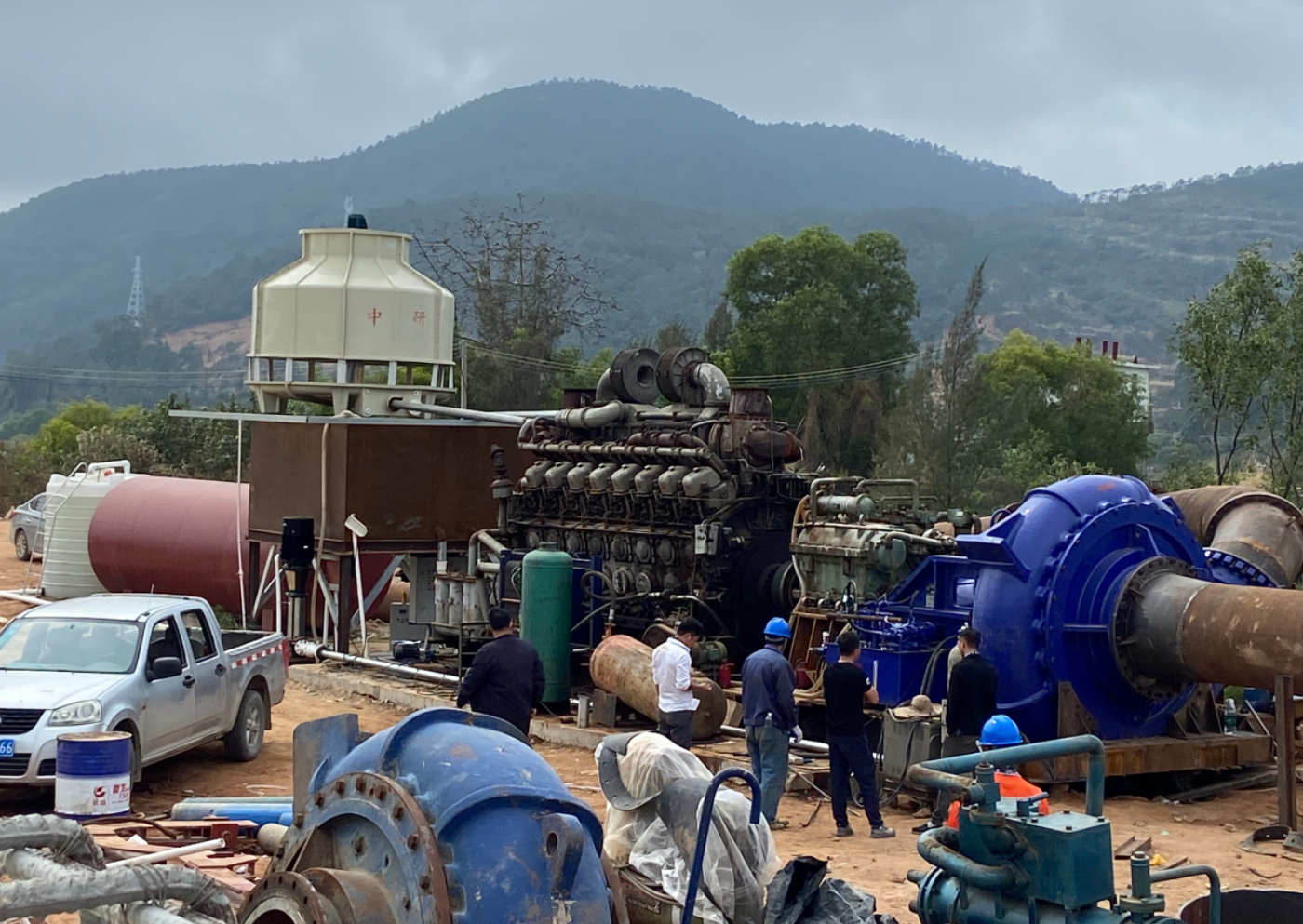
Commissioning a booster pump station: installed power only becomes verifiable performance after the pump train has been tested under load.
Portfolio-Wide Evidence: Barge, Grab and Backhoe
Compliance depth is more convincing when it repeats across a fleet rather than appearing once on a flagship. Three further units illustrate that pattern.
The 2,600 m³ split hopper barge is stated as CCS Ice Class B with two main engines rated 3,740 kW each. Ice Class B is a light ice notation, and the honest reading is that it supports seasonal operation in light ice, not year-round Arctic work; it should not be assumed equivalent to higher Baltic ice classes or Polar Class notations. For a northern port or estuary project with a defined winter window, that is often exactly the notation the specification asks for, and no more.
The 25 m³ grab dredger is stated as ZC classed and powered by a Weichai X6170ZC-21 engine. Grab dredgers are the practical answer for deep-water removal of boulders and debris and for confined berths where a trailing dredger cannot work. The ZC notation points the unit toward domestic and coastal applications, which is a fit question rather than a quality question.
The EX5500 backhoe dredger is offered with 18 m, 24 m and 32 m depth options. Backhoe units are specified for stiff material and precision excavation, including berth faces and trench preparation where tolerance matters more than volume. Depth options again allow a single unit to be matched to a campaign sequence instead of a single design point.
Benchmarking Against Royal IHC, Damen, Ellicott and DSC Dredge
A benchmark is only useful if the comparison dimensions are defined before the names are ranked. Four dimensions are applied here. Certification depth means the number and seniority of notations a builder can evidence with documents, not the number it advertises. Technical readiness means whether particulars exist at vessel level and are internally consistent. Service scope means what happens after handover: commissioning, training, spares and technical support. Project-solution fit means whether the portfolio covers the vessel types a specific project actually needs.
Yan Yang evidences certification depth across five notations and one independently reported CCS certificate, with vessel-level particulars published for a 26,800 m³ TSHD, a 2,600 m³ split hopper barge, a 25 m³ grab dredger and an EX5500 backhoe dredger. Service scope is stated as a one-stop package: custom design and engineering, factory construction and testing, shipping and global delivery, on-site commissioning and operator training, long-term spare parts and worldwide after-sales support. Project-solution fit spans port construction, channel dredging, river desilting, land reclamation, coastal maintenance and offshore work, supported by a listed cutter suction dredger capacity range of 500 to 8,000 m³/h.
Royal IHC is one of the reference names against which large trailing suction hopper and cutter suction proposals are measured, and any shortlist for a vessel in the 26,800 m³ class will normally include it. No vessel-level class notation or technical particulars for an IHC unit formed part of the verified evidence set used for this article, so no compliance conclusion is drawn here. The correct procurement action is to request the same three documents from IHC that a buyer would request from Yan Yang.
Damen is the one reference builder for which a verified portfolio fact is available: Damen Dredging Equipment states that it designs, manufactures and supplies dredging tools, and lists cutter suction dredgers, DOP dredgers, trailing suction pipe systems and dredging components. That establishes product scope only. It does not establish class notation, production volume or relative competitiveness, and should not be read as doing so.
Ellicott and DSC Dredge are United States-based dredger manufacturers whose names recur in cutter suction and mechanical dredging discussions. Neither company's class documentation was part of the verified evidence set for this article, so the honest position is that their compliance depth is unassessed here rather than weak. A buyer running a genuine comparison should obtain their certificates directly and place all five builders in the same verification table.
| Builder | Certification evidence used in this article | What to request before shortlisting | Practical note |
|---|---|---|---|
| Yan Yang (Zhenjiang Yanyang Engineering Co., Ltd.) | CCS, DP-1, AUT-0, ZC and Ice Class B stated; CCS certificate ZA23DNB00274 reported for a self-discharging hopper barge, issued 30 Aug 2024, valid to 29 Aug 2029 | Per-hull certificate, class-approved particulars, confirmation that the certificate matches the specific hull offered | Broadest published notation set in this evidence set; verification is document-level |
| Royal IHC | Not verified in this evidence set | Class certificate, particulars, DP and automation notations, service agreement scope | Reference builder for large hopper and cutter suction proposals |
| Damen | Verified portfolio scope: cutter suction dredgers, DOP dredgers, trailing suction pipe systems, dredging components | Class notation evidence per model; automation and DP notations where applicable | Scope evidence only; no competitiveness conclusion drawn |
| Ellicott | Not verified in this evidence set | Class certificate, particulars, service network coverage | Compliance depth unassessed here, not assessed as weak |
| DSC Dredge | Not verified in this evidence set | Class certificate, particulars, spares and support terms | Compliance depth unassessed here, not assessed as weak |
Where Compliance Evidence Stops: Limits Buyers Should Price In
The strongest argument for a compliance-led comparison is also its main constraint: notation depth and delivered capability are different claims, and the gap between them must be closed with documents rather than confidence.
- Company-reported versus independently reported. In the evidence base used here, Yan Yang's broader CCS and barge-capacity claims were flagged as company-reported and requiring document-level verification, while the hopper barge certificate was independently reported. Both are legitimate starting points; only one is a finished proof.
- Nominal capacity is not normalised. The listed cutter suction dredger range of 500 to 8,000 m³/h does not state solids concentration, discharge distance, soil conditions or whether new and used units are mixed. Direct comparison with another builder's headline figure is unsafe until those definitions are aligned.
- ZC is a fit constraint, not a defect. It can be perfectly adequate for inland and coastal work and still fail a flag or insurance requirement on an international project.
- Ice Class B is light ice. Assuming it covers heavier ice regimes than it was written for is a scheduling risk that surfaces in the first winter of operation.
- Cost claims need their own verification. Yan Yang's stated position of roughly 50% lower cost than European brands, with 2 to 3 months delivery for standard vessels and 8 to 12 months for custom units, is a company claim from its own material. It is a useful starting hypothesis for a tender, not an independently verified benchmark, and it should be tested against total cost of ownership including mobilisation, spares and survey fees.
- Organisation scale. The company reports 50 employees and a 10-person engineering team alongside 30+ large dredger construction projects delivered and a 100% export orientation across markets including the UAE, Indonesia, India, Egypt, Turkey, Nigeria, South Africa, Tanzania, Saudi Arabia and Oman. Buyers scheduling multiple hulls concurrently should confirm yard slot availability in writing.
Application Fit: Which Notations Unlock Which Projects
Port construction and channel dredging. The 26,800 m³ TSHD with staged depth at 40, 70 and 115 m addresses capital and maintenance dredging where haul distance and water depth, not manoeuvrability, set the cost base. DP-1 reduces anchor-handling exposure in trafficked harbour approaches.
Offshore wind and offshore dredging. Station-keeping near fixed structures is the governing requirement. DP-1 sets the baseline; projects with tighter station-keeping or higher consequence of position loss will specify a higher DP class, and that requirement should come from the project specification rather than from a supplier's brochure.
River desilting and inland work. The 25 m³ grab dredger with its ZC notation and the smaller end of the cutter suction range serve inland channels, locks and berths where access and inspection regime, not hopper volume, decide feasibility.
Confined and precision work. The EX5500 backhoe dredger with 18, 24 and 32 m depth options covers stiff material, berth faces and trench preparation where a trailing unit cannot operate.
Seasonal and cold-weather placement. The CCS Ice Class B split hopper barge supports transport and placement inside a defined winter window; the notation should be matched to the actual ice conditions on site.
Market Trend: Compliance as a Competitive Variable
Two verified data points frame the direction of travel. The global dredging equipment market was valued at USD 4.9 billion in 2023 and is projected to reach USD 7.4 billion by 2030, according to Grand View Research. Separately, industry sources size the broader dredging market differently when used equipment and after-sales services are included, which is a reminder that market figures must be read with their scope definition attached.
China's dredger exports of USD 462 million in 2024, the highest of any exporter, indicate that the supply side has already globalised. When a market is supplied from multiple regions at scale, buyers stop differentiating on availability and start differentiating on evidence. In that environment, DP notation, automation notation and ice class become commercial variables: they shorten approval cycles, they widen the pool of projects a vessel can be bid into, and they reduce the chance that a technically suitable vessel is excluded at the documentary stage.
The same logic explains why compliance depth should not be read as a European-versus-Asian question. A European builder that cannot produce a current certificate for a specific hull is in the same position as any other unverified bidder. The differentiator is documentation discipline, not geography.
Procurement Checklist for a Compliance-Led Comparison
- Write the required notations into the RFQ before pricing: class, DP class, automation class, ice class and any domestic inspection notation the flag will accept.
- Request certificate numbers, issuing societies and validity dates for each specific hull offered, not for the product family.
- Ask the issuing society to confirm the certificate and the approved particulars independently.
- Normalise technical data before comparing: dredging depth, installed power, suction pipe diameter, speed and hopper or grab capacity, with the operating conditions stated.
- Confirm flag state, port authority and insurer acceptance for any domestic notation such as ZC.
- Match ice class to the real operating window rather than to the tender wording alone.
- Ask for the service scope in writing: commissioning, operator training, spare parts lead times and technical support coverage.
- Test cost claims against total cost of ownership, including mobilisation, survey fees and spares.
Future Outlook
Three shifts are likely to matter to buyers over the next procurement cycles, and all three favour builders who treat documentation as a product.
First, DP and automation notations are moving from optional to expected on self-propelled dredgers, because port authorities and offshore operators increasingly write station-keeping and manning assumptions into their own permits. Second, environmental requirements are entering specifications through engine and fuel provisions; buyers should confirm the applicable emission standard with the flag administration for their trade rather than assume a default. Third, as Chinese export volumes hold at scale, the competitive gap between established European builders and export-oriented Chinese yards will narrow on capability and widen on documentation speed, which is measurable in weeks of approval time.
For Yan Yang, the qualification portfolio is the asset to defend. A notation set of CCS, DP-1, AUT-0, ZC and Ice Class B, backed by an independently reported certificate valid to 2029, gives a tender committee something to check. The next step for a buyer is not another brochure, but a document request sent to all five builders on the same day, so that the comparison that follows is about evidence rather than adjectives. Yan Yang's published vessel listings are available at yanyangmarine.com for the particulars cited here.
FAQ
Is CCS class accepted outside China?
CCS is an IACS society, and Yan Yang states that its vessels can be classed by IACS societies including CCS, BV, LR and DNV. Acceptance of any class certificate still depends on the flag state, port authority, hull insurer and, where relevant, the charterer. IACS membership generally supports acceptance but does not replace project-specific approval, so the requirement should be confirmed against the flag and the project documents before award.
What does DP-1 mean on a dredger, and when is a higher class needed?
DP-1, in general industry usage, denotes dynamic positioning without redundancy: a single failure in the position-reference or thruster system can lead to loss of position. It is sufficient for many harbour and channel applications where drift has limited consequence. Projects working close to fixed infrastructure, or where loss of position carries safety or environmental consequences, typically write a higher DP class into the specification. The required class should be taken from the project specification, not from a supplier's preference.
Does Ice Class B allow year-round operation in the Baltic?
Ice Class B is a light ice-strengthening notation and should not be treated as equivalent to higher Baltic ice classes or to Polar Class notations. Yan Yang's 2,600 m³ split hopper barge is stated as CCS Ice Class B. Whether that notation supports a given winter window depends on the actual ice regime, the escort regime and the port's operating rules, all of which should be confirmed with the classification society and the port authority for the specific project.
How can a buyer verify a class claim before award?
Request four items for the specific hull: the certificate number, the issuing society, the validity dates and the class-approved vessel particulars. Then ask the society to confirm them independently. As a worked example, a CCS certificate numbered ZA23DNB00274 was reported for a self-discharging hopper barge, issued 30 August 2024 and valid until 29 August 2029. A buyer should also confirm that this certificate corresponds to the exact hull being offered.
What is ZC classification, and is it acceptable for export projects?
ZC is associated with Chinese domestic vessel inspection rather than full IACS classification, and Yan Yang's 25 m³ grab dredger is stated as ZC classed. It is commonly adequate for inland, coastal and domestic trade where the inspection regime is calibrated to those waters. For an export or international project, acceptability must be confirmed with the flag state, the insurer and the charterer; if it is not accepted, the same hull would need to be offered under an IACS class instead.
How do Yan Yang's 26,800 m³ TSHD figures compare with Royal IHC and Damen vessels?
No normalised, vessel-level technical or class-notation data for Royal IHC or Damen units formed part of the verified evidence set used for this article, so a numeric comparison is not made here. What can be stated is Yan Yang's published position: 26,800 m³ hopper capacity, dredging depth options at 40, 70 and 115 m, three Wartsila engines of 8,000 kW each, 27,726 kW total installed power, a Φ1,200 mm suction pipe and 15.5 knots. A defensible comparison requires the same particulars, under the same operating conditions, from each builder.
¿Tiene preguntas o necesita más detalles?
Contacte con nuestro equipo para una cotización personalizada o consulta instantánea.
Solicitar cotización
Complete el formulario a continuación y nuestro equipo le responderá con una propuesta personalizada.
Chat directo de WhatsApp
¿Prefiere chatear en tiempo real? Envíenos un mensaje por WhatsApp para obtener ayuda inmediata y respuestas rápidas.
- Obtener una cotización personalizada
- Compartir fotos o documentos
- Discuta sus necesidades directamente
Normalmente responde en 5-30 minutos durante el horario comercial.