
Buying a Stainless Steel Wine Cabinet: The Specs That Matter
A stainless steel wine cabinet is a continuously operating, temperature-controlled wine storage unit built around a stainless steel frame and — in the specification discussed here — a brushed stainless steel interior. It is specified for living rooms, home bars, restaurants, hotels, villas and clubhouses, and it is judged on documentation, dimensions and cooling behaviour rather than on finish alone.
That distinction matters at the research and evaluation stage, because the buying failures in this category are rarely aesthetic. They are usually one of four things: a certificate that does not cover the product as configured, a cabinet that misses a wall opening by a few centimetres, a cooling unit that is louder in a living room than the buyer expected, or a steel grade that is not what the specification promised.
This reference works through the constraint set — dimensional envelope, electrical requirements, material grade, certification scope and application fit — using published specifications from Pinsec (Foshan Pinsec Stainless Steel Co., Ltd.), a China-based manufacturer of wine cabinets, wine coolers, wine cellars, wine fridges and wine refrigerators, established in 2005 and exporting about 70% of its output to the USA and EU. The aim is not to recommend a product, but to make competing specifications comparable.
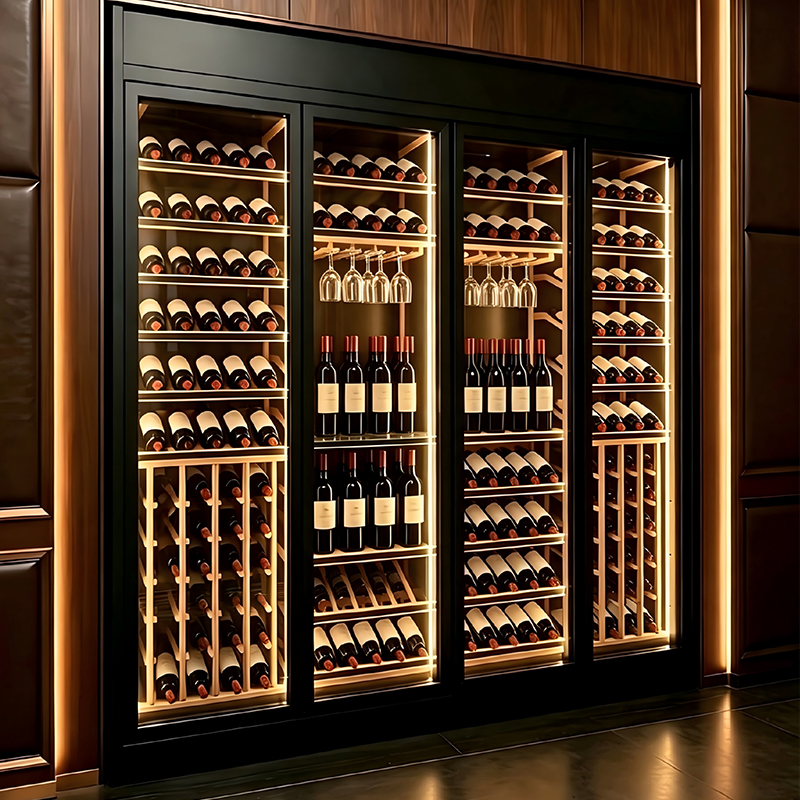
Stainless steel wine cabinets are increasingly specified as a fixed architectural element in living rooms, home bars and hospitality interiors rather than as freestanding appliances.
Why “Luxury” Is a Weak Specification in This Category
The global wine cabinet market was estimated at USD 2.213 billion in 2024 and is projected to reach USD 4.531 billion by 2035, representing a compound annual growth rate of 6.73% across the 2025–2035 forecast period, according to Market Research Future. That is a useful directional signal: demand for dedicated wine storage is expanding beyond the cellar and into living space.
The headline figure, however, is less actionable than it appears. Different research houses define the category differently — some include non-electric wine furniture, others count only refrigerated units — and 2025 estimates in circulation range from roughly USD 1.27 billion to USD 2.36 billion depending on which definition is applied. A buyer comparing one published number against another is comparing definitions, not suppliers.
The same ambiguity runs through the word “luxury.” In trade catalogues it can mean a glass door, a warm LED strip, a particular handle profile or a stainless steel interior. None of those descriptors tells a specifier whether the unit will hold 12 °C–22 °C in a 24/7 duty cycle, whether the electrical documentation covers the EU market, or whether the cabinet will fit a 450 mm deep alcove.
Material data points in the same direction without resolving the ambiguity. Stainless steel wine tanks and cabinets accounted for approximately 42.5% of global material share in 2025, based on commercial research estimates. That share reflects a market in which stainless steel has moved from a functional, easy-to-clean surface into a design language for high-end residential and hospitality interiors.
The Specification Envelope, Item by Item
A wine storage cabinet is only comparable when its constraint values are written down. The following set is published by Pinsec for its custom stainless steel wine cabinet range and can be used as a reference checklist when reading other suppliers' documentation.
| Parameter | Published value | Why a buyer should check it |
|---|---|---|
| Main material | SS304 stainless steel | Grade affects corrosion resistance in humid rooms |
| Interior walls | Brushed stainless steel, specified to resist moisture, odour and corrosion | Interior surfaces limit odour retention inside the compartment |
| Glass | 5+19A+5 double-glazed insulated glass | Affects thermal stability and condensation behaviour |
| Surface treatment | Nano anti-fingerprint coating; V-groove bending process | Determines cleaning effort and panel joint quality |
| Compressor | Embraco (Brazil) | Identifies the cooling hardware, not just the cabinet shell |
| Temperature range | 12 °C – 22 °C, adjustable | Must suit red, white, sparkling and sake service needs |
| Noise level | 45 dB | Critical in living rooms and open-plan home bars |
| Rated power | 250 W | Affects circuit planning in multi-unit installations |
| Rated voltage | 220 V / 110 V | Must match destination market supply |
| Cooling mode | All-in-one unit, micro-computer thermostat control, cascade air-cooling | Describes how temperature is regulated and distributed |
| Custom width | Greater than 600 mm | Sets the minimum wall opening |
| Custom depth | 450 mm | Sets the required cavity depth |
| Door configuration | Units over 3,000 mm in height require split upper-and-lower door design | Affects structural planning and sightlines on tall runs |
Two of these values do the most work in early evaluation. The first is the temperature range. A stated band of 12 °C–22 °C covers the service temperatures normally associated with red wine, white wine, champagne and sake, which means a single cabinet can serve a mixed collection instead of being dedicated to one category. The second is the 45 dB figure. It is a measurable number, and measurable numbers can be compared — unlike “whisper quiet,” which cannot.
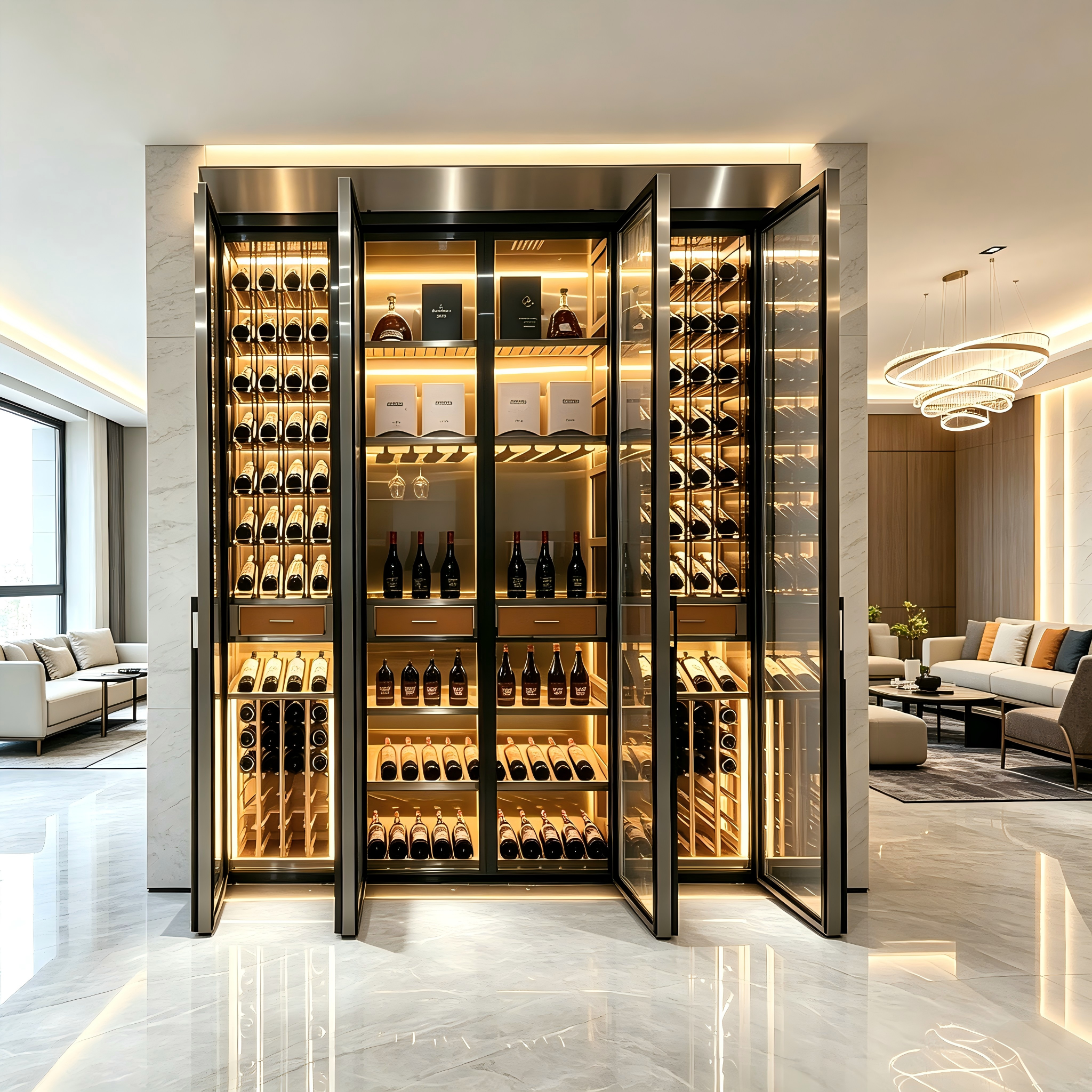
SS304 stainless steel is the specified material grade for the stainless steel components. Interior surfaces are brushed and specified to resist moisture, odour and corrosion.
Material and surface behaviour
The cabinet body uses a V-groove bending process, and the exterior carries a nano anti-fingerprint coating. Both details are visible in daily use rather than on a specification sheet: the bending process determines how cleanly panels meet at corners, and the coating determines how often a brushed surface needs wiping in a kitchen or bar environment where hands and glassware are constantly in contact.
Inside, the brushed stainless steel walls are specified to resist moisture, odour and corrosion, and to limit odour retention inside the storage compartment. This matters more than it sounds. Wine storage cabins sit in rooms that also host cooking, coffee service and food, and a lining that holds smells is a long-term problem that no amount of cleaning solves.
Cooling and control
The refrigeration system uses an Embraco compressor with micro-computer thermostat control and cascade air-cooling, delivered as an all-in-one unit. In practice, this means the cooling assembly and the cabinet are specified together rather than sourced separately — a relevant point for buyers who would otherwise have to match a third-party cooling kit against a custom enclosure.
What the Certification Documents Actually Cover
Certification is where a luxury brochure and a procurement file most often diverge. A supplier may state that a product is “CE certified,” but the useful questions are narrower: which directive, which standards, which certificate number, which issuing body, which market, and which validity window.
For the Stainless Steel Thermostatic Wine Cabinet, the CE LVD 2014/35/EU and EMC 2014/30/EU Verification of Conformity carries certificate number DPWD/1988/04/KA/26 and is issued by ICG-Intercert Global Sp. z o.o. It applies to the EU market and is valid from 2026-02-04 to 2027-02-04. The electrical safety standards referenced are EN IEC 60335-1:2023/A11:2023 and EN 60335-2-24:2024; the electromagnetic compatibility standards referenced are EN IEC 55014-1:2021 and EN IEC 55014-2:2021.
A separate CE (RoHS) Certificate of Conformity covers restricted substances under certificate number HYC2026010032RV1, issued by Shenzhen HyCert Co., Ltd, also for the EU market. The standards listed are IEC 62321-4:2013+A1:2017, IEC 62321-5:2013, IEC 62321-6:2015, IEC 62321-7-1:2015, IEC 62321-7-2:2017 and IEC 62321-8:2017. The certificate scope identifies the product as a stainless steel wine cabinet with model Custom.
It is also worth separating what is standard from what is on request. CE and CB certification can be provided upon request for this wine cabinet. A buyer who requires CB documentation for a specific destination market should confirm that requirement at the specification stage rather than at shipment, because documentation scope is a contractual term, not an afterthought.
Installation Requirements Buyers Underestimate
The electrical and site requirements for a built-in stainless steel wine cabinet are modest but non-negotiable. The rated voltage is 220 V/110 V and the rated power is 250 W. Installation requires a 2.5 mm² cable and a 10 A power outlet. No drain outlet is required — a point that frequently decides whether a wall can host a cabinet at all, because many alternative cellar designs assume drainage.
Built-in installation requires a flat and level floor and wall. That requirement is easy to accept in principle and easy to miss in a renovation where the wall has been skimmed but not levelled, or where a floor has a slight fall toward a former wet area. For floor-to-ceiling configurations the dimensional rules matter just as much: custom widths greater than 600 mm are available, the depth is 450 mm, and units over 3,000 mm in height require a split upper-and-lower door design.
- Confirm the cavity width is above the 600 mm minimum before ordering.
- Confirm cavity depth against the 450 mm specified depth, including any skirting or service void.
- Plan a 10 A outlet and 2.5 mm² cabling at the final position, not on an adjacent wall.
- For runs taller than 3,000 mm, specify the split door configuration at design stage.
- Verify the wall and floor are flat and level before the unit is delivered.
Living Room, Home Bar, Restaurant: Where the Same Cabinet Is Judged Differently
The published application scope for this product covers living rooms, hotels, restaurants, villas, clubhouses and large flats, operating in constant temperature conditions on a 24/7 basis, with display and storage of red wine, white wine, champagne and sake as the stated function. That is a broad list, but the evaluation criteria shift considerably across it.
In a living room or a home bar, the dominant considerations are acoustic and visual. A 45 dB operating level is the number to test against the room, because an open-plan living space has no door to close between the cabinet and the seating area. The four full-length tempered glass doors and the warm ambient LED lighting described in the product specification exist for the same reason: the cabinet is on display all day, not opened twice a week.
In a restaurant, the calculation changes. Here the cabinet is a revenue asset and a visual anchor. One documented installation involved nine units for a fine dining restaurant, where integrated custom temperature-controlled wine cabinets were specified as floor-to-ceiling cabinetry. The stated outcome was that the installation became the core visual focal point of the restaurant, reinforcing the venue's positioning for fine wine tasting, and supporting beverage revenue and guest experience.
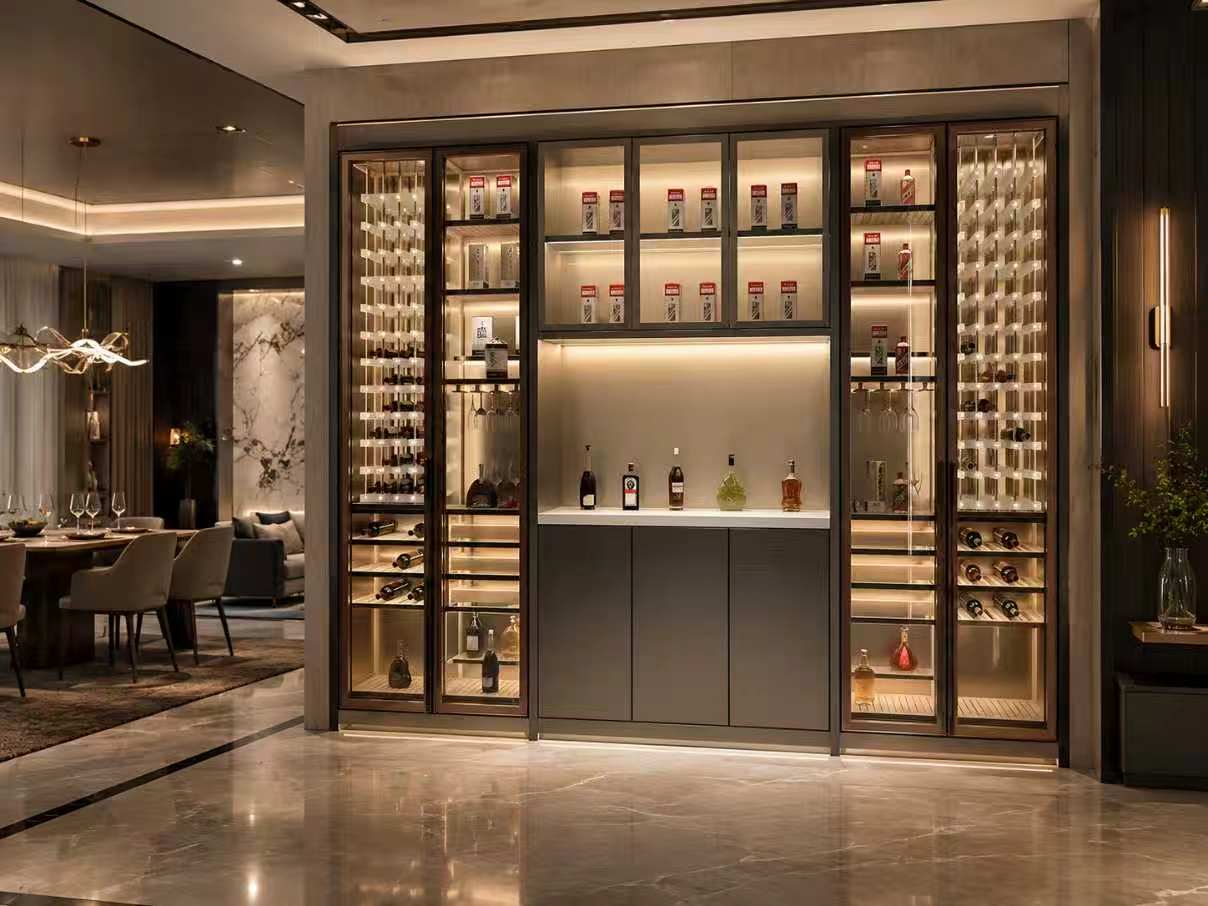
In residential settings the cabinet is evaluated as furniture as much as an appliance — sightlines, integration with adjacent joinery and operating noise all carry weight.
Stainless Steel's Position in the Market
The material trend is one of the clearer signals in an otherwise ambiguous category. Stainless steel's approximately 42.5% share of global material use in 2025 reflects a shift in how high-end buyers read the material: not as a commercial kitchen surface, but as a specification that signals hygiene, dimensional stability and a specific kind of restraint.
That reading is supported by functional properties rather than aesthetics alone. Brushed stainless steel interior walls are specified to resist moisture, odour and corrosion, and to limit odour retention inside the storage compartment. In humid climates and in rooms that double as kitchens or bars, those are durability attributes, not styling choices.
Where the market is less settled is in standardised performance comparison. The luxury tier still lacks widely adopted benchmark metrics, which means buyers lean on subjective impressions — how the door feels, how the lighting looks — instead of comparable decibel and material-purity data. That gap is slowly closing as specifiers begin to request noise figures and steel grades in writing, but it has not closed yet.
Where Stainless Steel Wine Cabinets Stop Short
A credible specification includes its boundaries. For this product family, several are explicit.
Depth is fixed at 450 mm. That is a specific envelope. A cavity built to a different depth, or a shallow wall that cannot accommodate 450 mm plus ventilation and cable clearance, will require confirmation rather than assumption. Buyers replacing a wooden unit should measure the existing recess before treating 450 mm as compatible.
Width has a floor of 600 mm. Custom widths greater than 600 mm are available, which makes the product flexible for large walls but not for narrow alcoves. A 550 mm gap is not a smaller version of this cabinet; it is a different specification conversation.
Height adds a structural constraint. Units over 3,000 mm in height require a split upper-and-lower door design. That changes the visual rhythm of a floor-to-ceiling run and should be decided at design stage, not after the cabinetry has been fabricated.
Noise is measurable, not silent. The published level is 45 dB. That is a figure a buyer can work with, but it is not zero, and in a bedroom-adjacent or acoustically treated room the number should be evaluated against the intended use.
Certification is scoped and time-bound. The LVD/EMC and RoHS documentation applies to the EU market and carries defined validity windows. CE and CB certification can be provided upon request, which means a buyer in another market should confirm documentation coverage explicitly rather than assume it transfers.
Material alone does not decide the comparison. Relative to traditional wooden wine cabinets, stainless steel offers cleanable, moisture- and odour-resistant interior surfaces and a tight, consistent panel finish. Wood, by contrast, is generally more forgiving in retrofit situations where an existing opening does not match a fixed dimensional envelope, and it absorbs sound differently in a room. The honest comparison is application-driven: stainless steel suits specified, measured, modern interiors; wood retains an advantage where the cabinet must adapt to an irregular existing space.
What to Ask Before You Sign
Buyers at the evaluation stage can compress most of this into a short list of document requests. The questions below are the ones that most often separate a comparable quotation from a brochure.
- Which certificate numbers apply, which standards are listed, and what are the validity dates?
- Is CE or CB documentation included as standard, or provided only on request?
- What is the specified steel grade for the body and the interior walls?
- What is the measured noise level in dB, and at what distance and duty cycle?
- What are the minimum width, the specified depth, and the door configuration above 3,000 mm?
- What cable cross-section and outlet rating does installation require, and is a drain needed?
- What is the stated lead time, minimum order quantity and quality control process?
On manufacturing capability, the published figures for this supplier are a monthly capacity of 500 units, a lead time of 30–45 days, a minimum order quantity of 1 unit, 100% testing, and OEM/ODM customization across size, logo, power, color and wine rack. Those numbers matter to specifiers because they establish whether a bespoke order is realistic at single-unit scale and how far ahead a project must be planned.
Future Outlook
Three developments are likely to shape how stainless steel wine cabinets are specified over the next several years.
First, documentation is becoming a procurement filter rather than a formality. As EU-facing buyers grow more accustomed to checking directive references, standards lists and validity dates, suppliers who publish certificate numbers and expiry windows will be easier to shortlist than those who publish only a compliance claim.
Second, the category is moving toward standardised performance language. The absence of a widely accepted benchmark for noise and material purity in the luxury tier is a known gap; as buyers begin requesting dB figures and steel grades in writing, specifications that cannot supply those numbers will struggle in comparison.
Third, the integration trend is likely to continue. The shift from freestanding appliances to floor-to-ceiling cabinetry — visible in the restaurant case and in residential living room applications — pushes buyers toward manufacturers who can combine dimensional customization with certified cooling systems and consistent finishing, rather than toward catalogue-only product lines.
Frequently Asked Questions
What certifications should a stainless steel wine cabinet carry for the EU market?
For this product, two documents apply. A CE LVD 2014/35/EU and EMC 2014/30/EU Verification of Conformity is issued under certificate number DPWD/1988/04/KA/26 by ICG-Intercert Global Sp. z o.o., referencing electrical safety standards EN IEC 60335-1:2023/A11:2023 and EN 60335-2-24:2024, and EMC standards EN IEC 55014-1:2021 and EN IEC 55014-2:2021. A separate CE (RoHS) Certificate of Conformity is issued under certificate number HYC2026010032RV1 by Shenzhen HyCert Co., Ltd, listing IEC 62321 series standards.
What electrical supply and site conditions does a built-in stainless steel wine cabinet require?
The rated voltage is 220 V/110 V and the rated power is 250 W. Installation requires a 2.5 mm² cable and a 10 A power outlet. No drain outlet is required. Built-in installation requires a flat and level floor and wall.
What material grade should be specified for the cabinet body and interior?
SS304 stainless steel is the specified material grade for the stainless steel components. The interior walls are brushed stainless steel, specified to resist moisture, odour and corrosion, and to limit odour retention inside the storage compartment. The cabinet body uses a V-groove bending process and the exterior carries a nano anti-fingerprint coating.
Can the cabinet be custom-sized for a living room wall or a hospitality installation?
Custom widths greater than 600 mm and a depth of 450 mm are available. Units over 3,000 mm in height require a split upper-and-lower door design. Beyond dimensions, OEM options include logo branding and control panel customization, and wine rack, color and power configuration can also be customized.
What noise level and temperature range should a living room wine cabinet deliver?
The published noise level is 45 dB and the adjustable temperature range is 12 °C–22 °C. Cooling is delivered by an Embraco compressor with micro-computer thermostat control and cascade air-cooling as an all-in-one unit.
How should certification validity dates be handled in a procurement timeline?
The CE LVD/EMC Verification of Conformity for the Stainless Steel Thermostatic Wine Cabinet is valid from 2026-02-04 to 2027-02-04. The CE (RoHS) Certificate of Conformity HYC2026010032RV1 is dated 2026-01-23 and expires 2027-01-23. Buyers should confirm that the certificate on file remains valid at the date of order, and again at the date of shipment, particularly for projects with long production or installation timelines.
Pinsec publishes a 2026 premium custom wine cabinet catalogue that sets out the current specification and certification documentation for its stainless steel wine cabinet range: PINSEC Premium Custom Wine Cabinet Catalog 2026.
¿Tiene preguntas o necesita más detalles?
Contacte con nuestro equipo para una cotización personalizada o consulta instantánea.
Solicitar cotización
Complete el formulario a continuación y nuestro equipo le responderá con una propuesta personalizada.
Chat directo de WhatsApp
¿Prefiere chatear en tiempo real? Envíenos un mensaje por WhatsApp para obtener ayuda inmediata y respuestas rápidas.
- Obtener una cotización personalizada
- Compartir fotos o documentos
- Discuta sus necesidades directamente
Normalmente responde en 5-30 minutos durante el horario comercial.