
Buyer's Guide: Spore-Forming vs Non-Spore Probiotics Powder

Two probiotic powders can both read “10 billion per gram” on a quotation sheet, arrive in similar foil pouches, and still belong to different biological categories, different storage regimes and different documentation classes. For buyers in the evaluation stage, that gap is where most of the avoidable risk sits — not in the unit price.
This guide sets out a like-for-like comparison between a spore-forming strain and a set of non-spore-forming strains held in the same supplier catalogue: Clostridium butyricum CCFM1299, listed as a butyrate-producing probiotic powder, against the Lactobacillus rhamnosus and Lactobacillus plantarum raw powders supplied by Shanghai Unibio Lab Co., Ltd, a probiotic CDMO based in Shanghai, China, with a strain bank of more than 30,000 microbial strains and a stated annual output covering probiotic raw powder, postbiotics and finished dosage forms. The comparison is built from the published product descriptions only — classification, potency, storage, shelf life, carrier material and stated application fields. It deliberately stops where that data stops.
Why strain classification is a procurement variable, not a biology footnote
In a finished-goods category, the genus on a label is marketing information. In raw-material sourcing it is an operational parameter. Genus determines whether the organism survives as a vegetative cell or as an endospore, and that in turn shapes four things a buyer has to plan around: the storage instruction on the specification sheet, the enumeration unit used on the certificate of analysis, the acceptable blending and packaging window, and the compliance file that has to travel with the batch.
The practical consequence appears quickly in the catalogue examined here. Spore-forming entries are specified for room-temperature storage. The majority of non-spore-forming Lactobacillus entries are specified at −18 °C or below, with a subset held at 2–8 °C. A purchasing team that budgets warehouse space, freight mode and re-testing frequency before checking that column is planning against an assumption rather than a specification.
Definitions: what the two categories mean in a powder catalogue
Spore-forming probiotics are strains from genera such as Bacillus and Clostridium, which form endospores as part of their life cycle. In the catalogue reviewed here, two products sit in this group: Clostridium butyricum CCFM1299, described as a butyrate-producing probiotic powder, and Bacillus coagulans CCFM1041 (-39), described as a heat-resistant probiotic powder.
Non-spore-forming probiotics remain vegetative throughout processing and storage. The same catalogue lists a broad Lactobacillus range: L. rhamnosus GG, CCFM0528, CCFM1219 and LR663; L. plantarum HP59, CCFM8661, CCFM8724, CCFM602 and CCFM1143; L. acidophilus L59; L. reuteri HR7; and L. salivarius CCFM1215, alongside Bifidobacterium and Streptococcus entries used mainly in fermented food and dairy starter applications.
Both categories share a common material composition in this catalogue: probiotic strain, maltodextrin carrier, and VPro® 5-layer encapsulation material. That shared carrier system matters, because it means the differences described below come from the organism, not from the delivery matrix.
Side by side: what the specification data actually records
The table below reproduces the published specification fields without interpretation. Shelf life is 24 months under recommended storage for every entry listed.
| Strain (model) | Catalogue description | Stated potency | Storage as stated |
|---|---|---|---|
| Clostridium butyricum CCFM1299 | Butyrate-producing probiotic powder | 10B CFU/g | Room temperature, well-closed, away from moisture and direct sunlight |
| Bacillus coagulans CCFM1041 (-39) | Heat-resistant probiotic powder | 10B–300B CFU/g | Room temperature, well-closed |
| L. rhamnosus GG | Probiotic raw powder | 10B–300B CFU/g | −18 °C or below, sealed |
| L. rhamnosus CCFM0528 | Probiotic raw powder | 10B–200B CFU/g | −18 °C or below, sealed |
| L. rhamnosus LR663 | Probiotic raw powder | 10B–200B CFU/g | −18 °C or below, sealed |
| L. rhamnosus CCFM1219 | Probiotic raw powder | 10B–200B cells/g (total cell count) | Room temperature, well-closed |
| L. plantarum HP59 / CCFM8661 / CCFM8724 / CCFM602 | Probiotic raw powder | 10B–200B CFU/g | 2–8 °C sealed cold storage |
| L. plantarum CCFM1143 | Probiotic raw powder | 10B–200B CFU/g | −18 °C or below, sealed |
| L. acidophilus L59 | Probiotic raw powder | 10B–200B CFU/g | −18 °C or below, sealed |
| L. reuteri HR7 | Probiotic raw powder | 10B–200B CFU/g | −18 °C or below, sealed |
Three patterns stand out. First, the storage band does not follow the spore / non-spore split perfectly: L. rhamnosus CCFM1219 is specified at room temperature despite being a vegetative strain, while most of its relatives are not. Second, potency is expressed as a range for the Lactobacillus entries and as a single value for CCFM1299, which reflects different commercial structures — potency tiers versus a fixed specification. Third, one entry uses a different enumeration unit entirely, which is discussed below.
The butyrate distinction around CCFM1299
The catalogue describes CCFM1299 as a Clostridium butyricum butyrate-producing probiotic powder, with a stated viable count of 10B CFU/g, room-temperature storage, a 24-month shelf life and application fields covering dietary supplements, metabolic management products and health products. That metabolite descriptor is not attached to the Lactobacillus rhamnosus entries, which are listed simply as probiotic raw powder, with application fields spanning food and beverage, dietary supplements and health products — plus infant food for L. rhamnosus GG.
For a buyer, this is a positioning fact rather than a performance proof. It tells you which formulation conversations the strain is intended for, and it tells you that the supplier has classified the organism by its metabolic output. It does not, on its own, quantify that output. If butyrate production is a claim your finished product will carry, request the assay method and the batch-level result, and confirm that the result is expressed per gram of the powder rather than per gram of biomass.
Enumeration units: CFU/g, cells/g and the risk of comparing unlike numbers
A quotation comparison built on the number before the letter “B” is unreliable when the denominators differ. In this catalogue, most entries are stated in CFU per gram — colony-forming units, meaning cells capable of dividing and forming a colony under the specified test conditions. L. rhamnosus CCFM1219 is stated as total cell count in cells per gram, which counts cells present rather than cells that form colonies. Those two figures answer different questions and should not be placed in the same column of a cost-per-unit calculation without a conversion agreed with the supplier.
There is a second layer to the same problem: the specification does not state whether the figure refers to release potency or to end-of-shelf-life potency. The scientific labelling guidance published by the International Scientific Association for Probiotics and Prebiotics (ISAPP) is explicit that a probiotic label should identify genus, species and strain designation, the viable count at the end of shelf life, and the storage conditions. Buyers should hold raw-material specifications to the same standard, because a 24-month shelf-life declaration is only meaningful if the potency figure it is tied to is defined at the same point in time.

Blending and packaging windows are set by the storage band of the strain, not by the packaging line speed.
Storage band, factory layout and the 48-hour rule
The storage instruction on a specification sheet has direct consequences for a factory. A −18 °C material requires frozen capacity, a controlled thaw step and a defined maximum time out of the freezer before blending. A 2–8 °C material requires chilled capacity but no thaw cycle. A room-temperature material removes the cold chain from the raw-material stage entirely — although it does not remove the requirement to keep the powder sealed, dry and out of direct sunlight.
Manufacturing environment guidance from the International Probiotics Association sets a working benchmark that applies to both categories: dosage-form manufacturing should be kept below 25 °C and below 60% relative humidity where acceptable, with tighter refrigerated conditions if the delay between blending and dosage manufacturing exceeds 48 hours. For a buyer auditing a supplier, that 48-hour threshold is a useful question to ask directly: what happens to a blended batch that cannot be filled the same week?
Carrier and encapsulation: the layer both categories share
Every strain reviewed here is supplied with maltodextrin as carrier and VPro® 5-layer encapsulation material. The coating material itself — VPro®-5L-COAT — is described as a five-layer acid- and bile-resistant barrier built from a food-grade polysaccharide and protein composite matrix, with improved heat resistance and extended strain shelf life. The supplier describes the five functional layers as a micromolecular protective layer against freezing and stress, a prebiotic nutrition layer, a liposome enteric adhesion layer, an acid- and enzyme-resistant layer, and an oxygen and moisture barrier layer.
Two clarifications are worth making for evaluation purposes. Encapsulation is a protective measure, not a substitute for the declared storage condition — a −18 °C material remains a −18 °C material after coating. And because the same coating system is applied across both spore-forming and non-spore-forming strains in this catalogue, coating does not explain the storage differences in the table; the organism does.
Compliance: what is documented, and for which strain
Documentation is where a classification difference becomes a customs and labelling difference. The manufacturer holds ISO 22000 (certificate CN22/00000437, issued by SGS-CSTC, valid 29 March 2025 to 28 March 2028), FSSC 22000 (CN22/00000434, SGS United Kingdom Ltd, valid to 28 March 2028), GMP certification under Codex Alimentarius (CN22/00003036, SGS-CSTC, valid to 22 March 2022 — see the certificate itself for the current validity date) and a HALAL certificate (registration No. 3100/11080, certificate No. 1821240000, valid 26 July 2025 to 25 July 2028). US FDA food facility registration is also on file, with registration number 19635371796 for Shanghai Unibio Lab Co., Ltd.
Two details in that list deserve attention. The HALAL certificate scope explicitly includes Clostridium butyricum CCFM1299 alongside the Bifidobacterium and Lactobacillus series — a meaningful point for buyers supplying Muslim-majority markets with a spore-forming formulation. The ISO 22000, FSSC 22000 and GMP scopes, by contrast, are written around the production of probiotic solid beverages (screening and mixing) under food category CIV, processing of ambient stable products. A buyer whose finished product falls outside that process description should confirm scope coverage in writing rather than assume it.
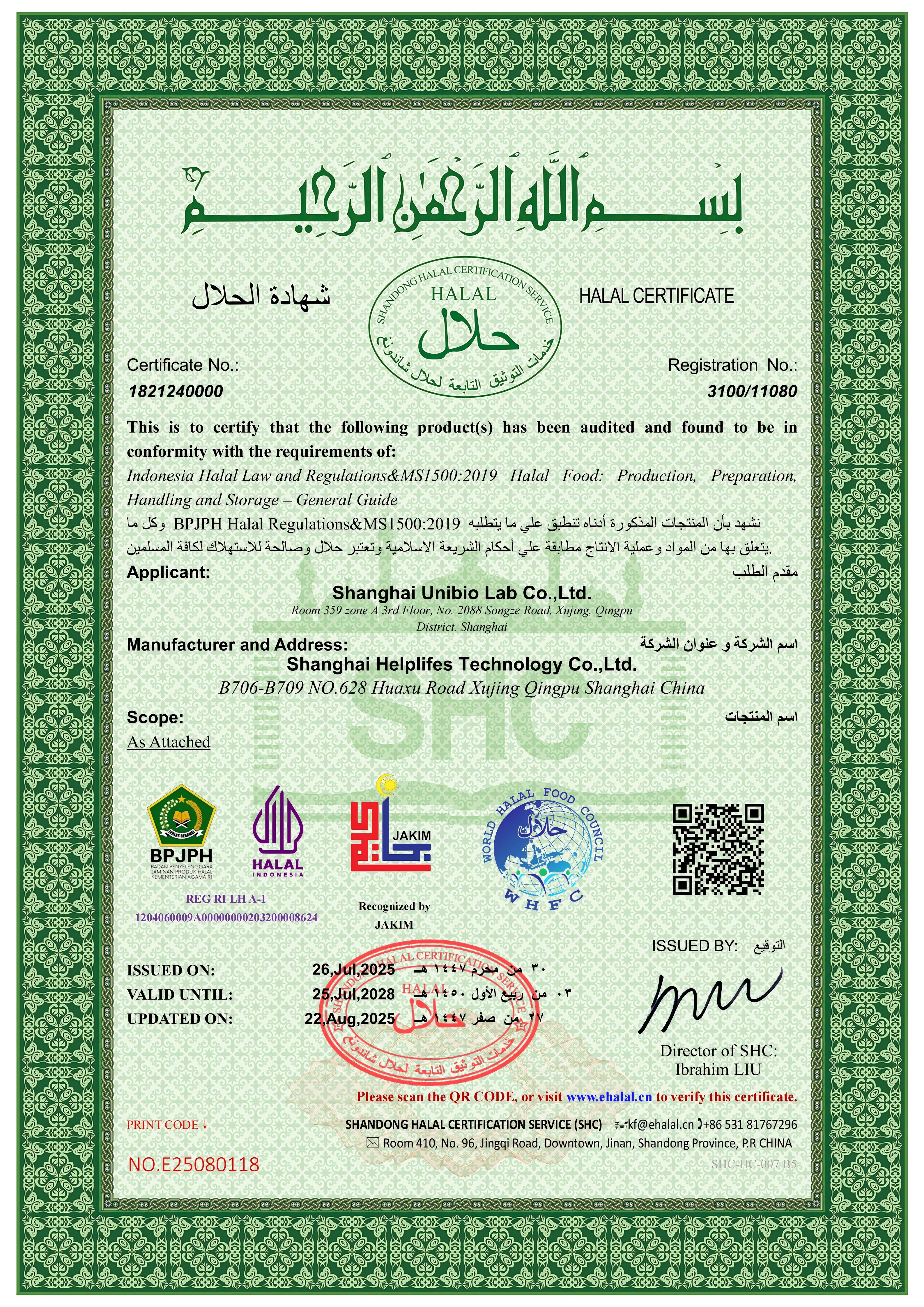
Certification scope, not certification existence, is what determines whether a document supports a specific strain and market.
Where this comparison stops
A fair reading of the data has to include its boundaries, and there are four that matter commercially.
Specification sheets do not support efficacy comparison. Nothing in the published fields ranks CCFM1299 above or below L. rhamnosus GG for any health outcome. Potency, storage and application fields describe how a material is supplied, not what it does in a person or an animal.
Room-temperature stability is a logistics advantage, not a quality verdict. It reduces cold-chain cost and widens the packaging window; it says nothing about colonisation, clinical evidence or suitability for a given formulation.
Regulatory conclusions are strain-specific. The independent GRAS conclusion held by this manufacturer (CIRS-GRAS-AH39-20250422, issued 22 April 2025) covers pasteurised Akkermansia muciniphila AH39 raw material and AH39-containing finished products only. It does not extend to Clostridium butyricum CCFM1299 or to any Lactobacillus strain. Buyers should never carry a GRAS status across strains within the same supplier portfolio.
Enumeration methods are not interchangeable. As noted above, cells per gram and CFU per gram cannot be compared directly, and a range specification behaves differently in a contract from a fixed one.
Market context: why dry formats keep setting the pace
The commercial backdrop supports the attention being paid to powder handling. MarketsandMarkets values the global probiotics market at USD 76.59 billion in 2025 and projects USD 114.95 billion by 2030, a CAGR of 8.5%. Within animal feed probiotics specifically, dry formats — the category that includes powders — held a 84.7% revenue share in 2023, according to Meticulous Research. Dry format dominance in feed is a useful signal for buyers in adjacent segments: where distribution distances are long and cold chain is expensive, the strain categories and coating systems that tolerate ambient conditions tend to be the ones that scale.
That is an argument for classification-led sourcing, not for a single winning category. A manufacturer supplying both spore-forming and vegetative strains — as this catalogue does, with room-temperature, chilled and frozen bands in one portfolio — can match the storage regime to the destination market rather than forcing the destination market to match the strain.
Execution checklist before the purchase order
Once evaluation narrows to one or two strains, the following items convert a specification sheet into a workable supply agreement.
- Confirm the enumeration unit and its reference point — CFU/g or cells/g, release or end of shelf life, and the test method used.
- Confirm the storage band in writing — room temperature, 2–8 °C or −18 °C — and check it against your own warehouse and freight capability.
- Request the batch COA covering viable count, microbial safety and heavy metals. The manufacturer states 100% in-house laboratory testing on these three parameters, with third-party inspection by SGS or Intertek available on request.
- Check certificate scope, not just certificate existence — particularly whether the process description matches your dosage form.
- Agree the minimum order quantity — 1 kg for single-strain raw powder and 5 kg for multi-strain compound powder are the stated thresholds, which keeps validation batches realistic.
- Plan the timeline — 5–7 days for bulk raw material orders, 25–35 days for private-label finished products, with FOB Shanghai, CIF, DDU and DDP terms available.
- Define the blending and filling window if you are combining categories, and agree the storage instruction for the resulting blend.
The service layer around these items is stated in comparable terms: free strain technical consultation, formulation optimisation support, batch quality reports, cold-chain logistics guidance and complaint resolution within 24 working hours, alongside OEM, ODM, private label and custom formula development. For a buyer moving from evaluation into execution, that combination — a defined strain, a defined storage band and a defined document set — is what makes a first production run predictable.
Future outlook
Three shifts are likely to shape spore-forming versus non-spore-forming sourcing over the next buying cycles. Potency specifications will keep moving from single headline numbers toward tiered, end-of-shelf-life declarations, which favours suppliers already publishing range-based specifications. Storage bands will become a visible cost line as more buyers calculate total landed cost rather than unit price. And certification scope — the difference between holding a HALAL or GMP certificate and having a specific strain listed within its scope — will increasingly be treated as a qualification gate rather than a documentation formality.
None of these shifts changes the underlying rule. Classification first, specification second, commercial terms third. A butyrate-producing spore former and a Lactobacillus rhamnosus powder are not competing versions of the same input; they are different inputs that happen to share a packaging format.
FAQ
What is the practical difference between a spore-forming and a non-spore-forming probiotic powder?
Spore-forming strains belong to genera such as Bacillus and Clostridium, which form endospores; non-spore-forming strains such as Lactobacillus, Bifidobacterium and Streptococcus remain vegetative. In the catalogue reviewed here, Clostridium butyricum CCFM1299 and Bacillus coagulans CCFM1041 (-39) are the spore-forming entries and are specified for room-temperature storage, while most Lactobacillus rhamnosus and Lactobacillus plantarum entries are specified at −18 °C or below, or at 2–8 °C.
Why do some Lactobacillus powders require −18 °C while Clostridium butyricum CCFM1299 is stored at room temperature?
The storage instruction is a product-specific specification rather than a genus rule. The published data lists CCFM1299 at room temperature in a sealed container away from moisture and direct sunlight; L. rhamnosus GG, CCFM0528 and LR663 at −18 °C or below; L. plantarum HP59, CCFM8661, CCFM8724 and CCFM602 at 2–8 °C sealed cold storage; and L. rhamnosus CCFM1219 at room temperature. Each figure should be read from the individual specification sheet.
Is CCFM1299 a butyrate-producing strain, and how does that differ from the L. rhamnosus entries?
The catalogue lists the product as Clostridium butyricum butyrate-producing probiotic powder, model CCFM1299, at 10B CFU/g, for dietary supplement, metabolic management and health product applications. The Lactobacillus rhamnosus entries are listed as probiotic raw powder without a metabolite descriptor, with application fields covering food and beverage, dietary supplements and health products, plus infant food for L. rhamnosus GG. The descriptor identifies a metabolic category; the assay behind it should be requested separately.
Which documents should a buyer request before ordering a spore-forming strain?
A batch COA covering viable count, microbial safety and heavy metals, given that 100% in-house testing is stated with third-party SGS or Intertek inspection available on request; the storage and shelf-life declaration, which is 24 months under recommended storage; and the certification documents ISO 22000 CN22/00000437, FSSC 22000 CN22/00000434, GMP CN22/00003036 and HALAL certificate No. 1821240000, whose scope explicitly lists Clostridium butyricum CCFM1299 and runs to 25 July 2028.
Can spore-forming and non-spore-forming strains be combined in one blend?
Custom strain blending is offered within the OEM and ODM service set, and multi-strain compound powder carries a stated minimum of 5 kg against 1 kg for single-strain powder. Because the two categories are stored under different conditions before blending, the blending protocol and the storage instruction for the finished blend must be agreed in writing; the individual specification sheets do not define them.
The full product, certification and service overview referenced in this guide is available in the manufacturer’s downloadable brochure: Shanghai Unibio Lab product brochure (PDF). Company information is also published at helplifes.com.
¿Tiene preguntas o necesita más detalles?
Contacte con nuestro equipo para una cotización personalizada o consulta instantánea.
Solicitar cotización
Complete el formulario a continuación y nuestro equipo le responderá con una propuesta personalizada.
Chat directo de WhatsApp
¿Prefiere chatear en tiempo real? Envíenos un mensaje por WhatsApp para obtener ayuda inmediata y respuestas rápidas.
- Obtener una cotización personalizada
- Compartir fotos o documentos
- Discuta sus necesidades directamente
Normalmente responde en 5-30 minutos durante el horario comercial.