
Buyer's Comparison: BEXKOM Push Pull Connectors vs. Branded Alternatives
Buyer's Comparison: BEXKOM Push Pull Connectors vs. Branded Alternatives
Push pull connectors are a small component with an outsized effect on how equipment is built, serviced, and certified. In medical monitoring, industrial automation, test and measurement, and mobile equipment, the interface decides how fast a device can be connected in the field, how reliably it stays connected under vibration, and how much evidence a buyer has to assemble before an approval is granted.
This article compares the BEXKOM BK-B-XXX push pull connector series with branded alternatives on the criteria a buyer can actually verify: shell material, contact plating, insulator polymer, pin count, current rating, temperature range, sealing, mating cycles, and applicable standards. The aim is not to rank brands by reputation, but to separate published specification from assumption, and to show where the evidence stops.
BEXKOM, formally Shenzhen BEXKOM Electronics Co., Ltd., is a connector manufacturer established in 2016 and based in Shenzhen, China. The company designs and produces push-pull self-locking connectors, medical connectors, circular connectors, and electronic connectors, and also manufactures cable assemblies. It operates a 3,500 m² facility with approximately 130 employees, including a 22-engineer R&D team, reports annual production capacity of 2,000,000 units, and exports roughly 75% of its output to the EU and USA.

The Buyer's Problem: Brand Recognition Is Not a Specification
Most procurement teams start a push pull connector search from a short list of names they already know. In the circular push-pull segment, that list usually includes LEMO SA of Switzerland, Fischer Connectors of Switzerland, ODU GmbH of Germany, and TE Connectivity of the United States. These are real, established manufacturers, and the familiarity is earned.
The difficulty is that brand recognition answers a different question than the one the project asks. An engineer needs the per-contact current at the pin count actually required, confirmation that the insulator survives the process or sterilization temperature, evidence that the seal holds under the mating condition used in the field, and a clear answer on whether the connector can arrive as a finished cable assembly. None of those questions is settled by a logo.
Where the market has changed is in the number of credible answers available. China's connector market reached RMB 218.3 billion in 2024, an 18% increase over 2023, according to one industry report that cites 5G and new energy vehicle demand as drivers. Buyers in medical, industrial, and test applications now evaluate Chinese connector manufacturers alongside European brand families as a first-tier option rather than a fallback.
The opportunity is not simply a lower unit price. It is the ability to specify the connector around the application instead of around a catalogue structure, including custom shell configurations, mixed contact arrangements, and cable assemblies produced under the same quality system as the connector itself.
Brand Solution: The BK-B-XXX Push Pull Connector Series
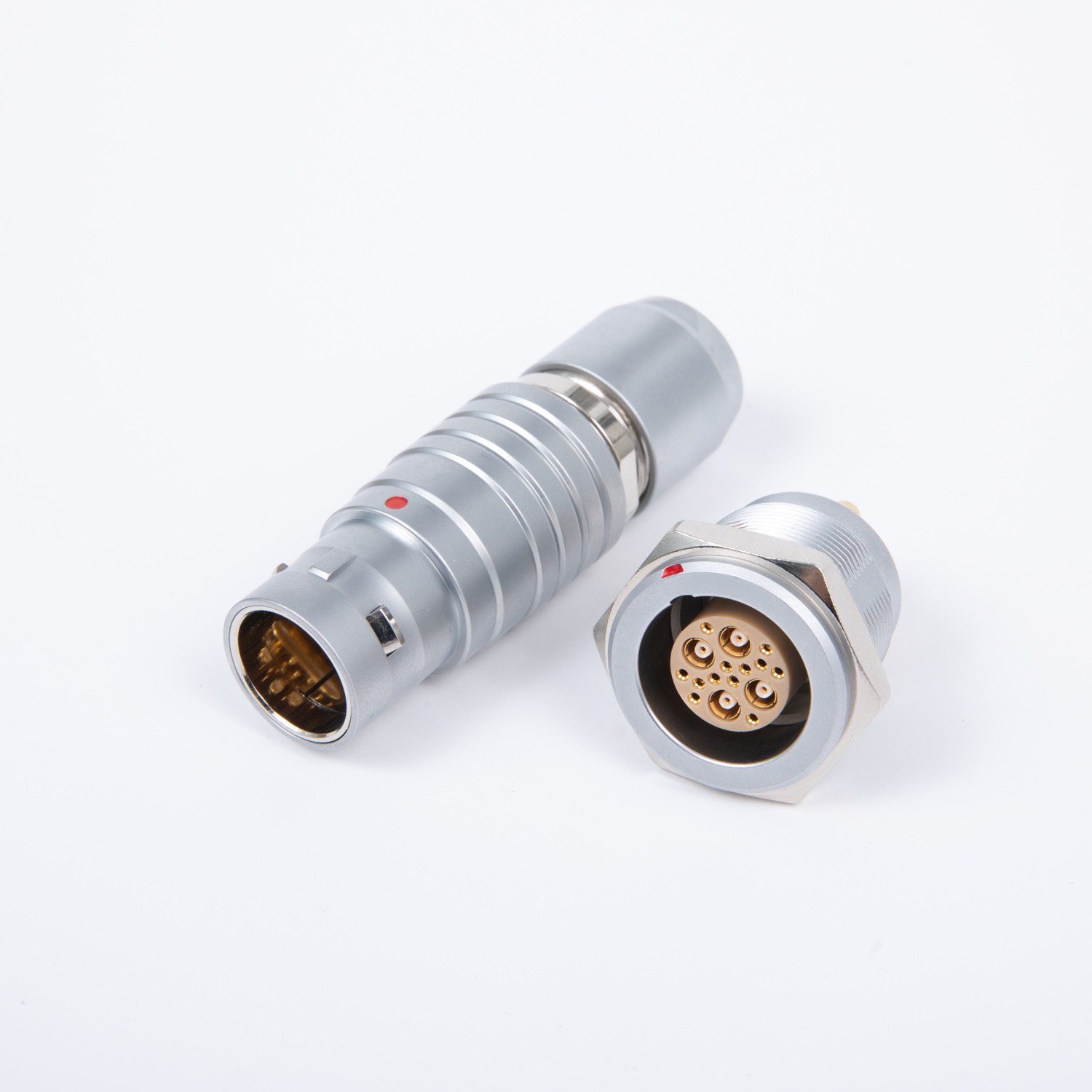
Within the BEXKOM range, the BK-B-XXX series is the general-purpose push pull family. BEXKOM positions it for medical, industrial, MIL, equipment, and automation applications, and it is the series most often placed side by side with branded circular push-pull alternatives.
| Parameter | Published value, BEXKOM BK-B-XXX |
|---|---|
| Pin count | 2 to 48 |
| Shell material | Brass, chrome plated |
| Contact material | Brass, gold plated |
| Insulator material | PPS / PEEK |
| Locking method | Push pull self-locking |
| Current rating | 1.5 A to 25 A |
| Test voltage | 450 V to 2100 V |
| Operating temperature | -55 °C to 250 °C |
| Waterproof level | IP50 |
| Salt spray corrosion resistance | 96 hours |
| Mating cycles | More than 5,000 |
| Shock resistance | 100 g / 6 ms |
| Vibration resistance | 10 to 2000 Hz, 15 g |
| EMC shielding | Available |
Adjacent BEXKOM families follow the same material logic with different sealing and temperature envelopes. The BK-P-XXX medical series uses a PC or PSU shell with brass gold plated pins and a PPS or PEEK insulator, covers 2 to 26 pins and 1.5 A to 13 A, operates from -55 °C to 125 °C, offers IP50 or IP65 depending on configuration, and is rated for more than 2,000 mating cycles. The BK-M12-XXX and BK-M-XXX industrial families use a brass chrome plated shell, a PA66 insulator, IP67 sealing, a -25 °C to 80 °C range, 1.0 A to 16 A, more than 500 mating cycles, and screw locking.
Technical Explanation: What the Materials and Ratings Mean in Practice
The self-locking mechanism
A push pull connector mates with a single axial push and releases when the operator pulls back on the outer shell. The latch is spring loaded, so coupling does not depend on an operator remembering to tighten a ring. In equipment that is connected and disconnected many times per day, such as patient monitors, test benches, and portable field instruments, this shortens mating time and reduces the chance of a partially seated connection. Screw-locking interfaces, including the M12 screw connection, rely on threaded engagement instead and typically require a specified tightening torque.
Shell and contact materials
The BK-B-XXX shell is brass with chrome plating. Brass provides the mechanical toughness required by a coupling that is cycled thousands of times, while chrome plating supplies the wear and corrosion surface, which is consistent with the 96-hour salt spray resistance figure published for this series. Contacts are brass with gold plating, a choice made to keep contact resistance stable over time rather than to minimize material cost.
Insulator polymer and temperature
The insulator is PPS or PEEK. Both are high-temperature engineering polymers, and they underpin the -55 °C to 250 °C rating of the series. That rating belongs to the connector assembly, not to the cable that will eventually be terminated to it. In a finished cable assembly the jacket material usually becomes the limiting factor, which is a detail buyers discover late if it is not raised early with the supplier.
Pin count, current, and voltage
The series spans 2 to 48 pins with 1.5 A to 25 A per contact and test voltages from 450 V to 2100 V. As a general engineering rule, per-contact current falls as pin count rises, because contacts become smaller and the heat dissipation available to each contact drops. A two-pin power configuration and a 40-pin signal configuration therefore should never be compared using a single headline current figure.
Mechanical endurance and environment
Mating cycles are published as more than 5,000 for the BK-B-XXX series, with shock resistance of 100 g for 6 ms and vibration resistance of 10 to 2000 Hz at 15 g. EMC shielding is available. These parameters decide whether a connector suits a moving machine axis, a vehicle-mounted test system, or a static rack installation, and they are usually the difference between a compliant design and a field failure.
Sealing is the boundary to read first
The BK-B-XXX series is rated IP50. That means protected against dust ingress, and not protected against water. Buyers who need water jets, washdown, or temporary immersion should be evaluating the BK-M12-XXX or BK-M-XXX families at IP67, or the BK-P-XXX medical series, which offers IP50 or IP65 depending on configuration. Reading the sealing line before the pin count line saves redesign work later.
Application and Use Cases
Documented BEXKOM applications show how these ratings map to real duty. In the United States, push pull connectors are used in ECG patient monitoring projects, operating in low-power continuous signal transmission mode inside a biocompatible environment. The stated special requirements are reliable contact and medical-grade construction, with an ECG monitor as supporting equipment. In that application, contact stability and insulation integrity matter more than current capacity.

In Germany and other EU regions, BEXKOM connectors are used in automation robot projects running continuous signal transmission under continuous operation. That environment requires IP67 waterproofing and a cable assembly as supporting equipment, which places it in the BK-M-XXX or BK-M12-XXX industrial families rather than the IP50 push pull series. EMC shielding options on those families matter where drives and switching power supplies share a cabinet with signal wiring.
A third documented duty is high-vibration test work in the automotive sector, where data collection runs continuously from crash test simulators. Connectors in that environment are selected for the vibration and shock figures rather than for aesthetics: 10 to 2000 Hz at 15 g and 100 g for 6 ms are the numbers that keep a data channel alive through an impact event.
Market Trend Analysis
Two widely cited estimates describe the same broad segment differently, and that divergence is worth understanding before it is quoted in a business case. Report Prime projects the global push-pull connectors market growing from USD 950 million in 2025 to approximately USD 1.37 billion by 2032. Business Research Insights values the circular push-pull connector market specifically at USD 2.2 billion in 2026, with a CAGR of 5.49% reaching USD 3.5 billion by 2035. The figures are not contradictory so much as differently scoped, which is exactly why buyers should define the category before quoting a total.
The medical segment, which includes push pull types, was estimated at USD 1.72 billion in 2024 and projected to grow at a CAGR of 7.13% to USD 2.98 billion by 2032, according to SNS Insider. Faster growth in medical connectors relative to industrial connectors generally is consistent with rising device counts and with the stricter insulation requirements that medical electrical equipment carries.
Standardization is shaping procurement in two places. In industrial automation, M12 push-pull connectors are governed by IEC 61076-2-010:2021, a standard written to ensure cross-manufacturer compatibility. In medical electrical equipment, IEC 60601-1 defines basic safety and essential performance requirements, including electrical insulation under the MOPP and MOOP concepts. Both standards push buyers toward specification-led evaluation rather than part-number familiarity.
The practical consequence for sourcing is a shift from single-source brand loyalty toward documented multi-source supply, where every candidate supplier is measured against the same requirement list instead of against its own catalogue structure.
Comparison with Traditional Solutions
Coupling methods side by side
| Coupling type | How it mates | Trade-off to weigh |
|---|---|---|
| Push pull self-locking | Axial push to mate, pull on the shell to release | Fast in high-cycle use and resistant to accidental unmating from cable pull; requires clear access around the shell for release |
| Screw locking, for example the M12 screw interface | Threaded ring tightened to a specified torque | Familiar and mechanically robust; slower in field service and dependent on correct torque practice |
| Bayonet | Partial rotation to lock | Quick to operate; requires rotational clearance around the connector |
BEXKOM BK-B-XXX against branded alternatives
A like-for-like comparison of published parameters between the BK-B-XXX series and named European brand families is limited by what those vendors publish openly. The table below therefore separates what BEXKOM publishes, and what a buyer must request in writing from any alternative supplier.
| Evaluation axis | BEXKOM BK-B-XXX, published | What to verify on branded alternatives |
|---|---|---|
| Shell | Brass, chrome plated | Base metal and plating type; plating thickness is often released only on request |
| Contact plating | Brass, gold plated | Gold thickness in micrometres and contact resistance test data |
| Insulator | PPS / PEEK | Polymer grade and temperature rating for the exact part number |
| Pin count | 2 to 48 | Published ranges differ by family; confirm per part number |
| Current rating | 1.5 A to 25 A | Whether the rating is per contact and how it derates with pin count and ambient temperature |
| Temperature range | -55 °C to 250 °C | Whether the range applies to the insulator and assembly or only to metal parts |
| Sealing | IP50 | IP class and the mating condition under which the rating holds |
| Mating cycles | More than 5,000 | Test conditions, including load, cleaning, and whether cycles are mated or full mate and unmate |
| Corrosion | 96-hour salt spray resistance | The named test method behind the figure |
| EMC | Shielding available | Whether shielding is standard or a variant, and how it is terminated |
| Customization | 30 or more new custom projects per year, prototypes typically within two weeks | Sample lead time, tooling ownership, and change-control terms |
Limits and boundaries buyers should weigh
Sealing. The IP50 rating of the BK-B-XXX series is the most important boundary in this comparison. If the application involves washdown, immersion sterilization, outdoor exposure, or condensation, IP50 is not sufficient and the buyer must move to a different BEXKOM series or a different supplier family entirely.
Ratings are not interchangeable across series. The BK-P-XXX medical series is rated to 125 °C while the BK-B-XXX reaches 250 °C; mating cycle ratings are more than 2,000 versus more than 5,000; current ratings are 1.5 A to 13 A versus 1.5 A to 25 A. Any platform specification should name the exact series and part number.
Market presence is a real constraint. LEMO SA, Fischer Connectors, ODU GmbH, and TE Connectivity carry decades of installed base, published interoperability traditions, and existing design-ins at large OEMs. A program that must match an existing design, or that must satisfy an approved-vendor list already in force, has to treat that as a genuine limitation, independent of any published specification. BEXKOM's documented position is a manufacturer founded in 2016, operating a 3,500 m² facility with approximately 130 employees and an annual capacity of 2,000,000 units.
Compliance scope. BEXKOM holds ISO9001 and ISO13485 certification and states that its products meet RoHS, REACH, CE, UL, CSA, COC, and MSDS requirements. Buyers with defense, aerospace, or other sector-specific approval requirements should confirm applicability against their own standard list rather than assuming coverage from a general compliance statement.
Capacity planning. A capacity of 2,000,000 units per year is significant for custom and mid-volume programs, but a multi-year, high-volume platform should still confirm capacity allocation, scheduling priority, and second-source strategy in writing before design freeze.
What Buyers Should Verify Before Committing
- Name the exact series and part number, not only the connector family, and write the sealing class into the drawing.
- Match the IP rating to the real environment, including cleaning and sterilization methods, before comparing prices.
- Ask for the test conditions behind mating cycle, salt spray, shock, and vibration figures, and for the test method reference.
- Confirm contact plating thickness and request contact resistance data rather than a material description alone.
- Confirm the insulator grade used for the specific part number and the temperature rating attached to it.
- Check the scope and validity of quality system certificates, including ISO9001 and ISO13485 where medical devices are involved.
- Establish cable assembly capability, harness testing, and documentation standards if the connector ships as a finished assembly.
- Agree on sample lead time, production lead time, and capacity allocation for the full program horizon.
Future Outlook
Push pull connectors are being pulled in two directions at once. Standardization is consolidating the industrial side, where IEC 61076-2-010:2021 gives M12 push-pull interfaces a common reference and makes multi-sourcing less risky. Customization continues to dominate the medical, instrumentation, and mobile equipment side, where shell geometry, contact arrangement, and cable assembly requirements rarely match a catalogue part.
BEXKOM's publicly stated operating model sits on the customization side of that split. The company maintains a dedicated sample design team and pilot production line, takes on more than 30 new custom projects per year, and reports typical prototype delivery within two weeks, supported by in-house connector development, mold design, reliability testing, injection molding, CNC machining, and automated assembly lines.
For buyers planning the next procurement cycle, the practical expectation is that a short list will contain at least one non-European source, that the evaluation will be run on a requirement matrix rather than a catalogue, and that the deciding evidence will be test documentation rather than brand familiarity. Teams that build that matrix now can change sources later without redesigning the interface.
FAQ
What is a push pull connector and how does its locking mechanism differ from a screw connector?
A push pull connector mates with a single axial push and releases when the operator pulls back on the outer shell, using a spring-loaded latch. A screw-locking connector, such as the M12 screw interface, instead relies on threaded engagement tightened to a specified torque. The practical difference is mating speed and release behaviour: push pull is faster in high-cycle field use and resists accidental unmating caused by cable pull, while screw locking depends on correct torque practice during installation and service.
Which BEXKOM push pull connector series should a buyer shortlist for medical versus industrial use?
For medical use, the BK-P-XXX series covers 2 to 26 pins, 1.5 A to 13 A, a -55 °C to 125 °C range, IP50 or IP65 sealing, and more than 2,000 mating cycles with a PC or PSU shell and a PPS or PEEK insulator. For industrial use, the BK-M12-XXX and BK-M-XXX families cover 3 to 19 pins, 1.0 A to 16 A, a -25 °C to 80 °C range, IP67 sealing, more than 500 mating cycles, and screw locking. The general-purpose BK-B-XXX push pull series covers 2 to 48 pins, 1.5 A to 25 A, -55 °C to 250 °C, and IP50.
How do the BK-B-XXX specifications compare with branded alternatives?
The BK-B-XXX series publishes a brass chrome plated shell, brass gold plated contacts, a PPS or PEEK insulator, 2 to 48 pins, 1.5 A to 25 A, 450 V to 2100 V test voltage, a -55 °C to 250 °C range, more than 5,000 mating cycles, 96-hour salt spray resistance, and optional EMC shielding. Established brand families use their own part numbering and frequently publish plating thickness, sealed mating conditions, and test method references only in detailed datasheets or on request. A fair comparison therefore requires a line-by-line specification request to each supplier rather than a comparison of headline ranges.
What are the main limits of the BEXKOM BK-B-XXX series?
The BK-B-XXX series is rated IP50, which protects against dust but not against water, so washdown, immersion, and outdoor applications require a different series such as the IP67 BK-M12-XXX or BK-M-XXX families. Ratings also differ across series and should not be assumed equivalent: the BK-P-XXX medical series is rated to 125 °C rather than 250 °C and carries a lower current range. Buyers with sector-specific approval requirements should confirm applicability against their own standards list, since the published compliance statement covers ISO9001, ISO13485, RoHS, REACH, CE, UL, CSA, COC, and MSDS.
Which standards apply to push pull connectors in industrial and medical equipment?
In industrial automation, standardized M12 push-pull connectors are governed by IEC 61076-2-010:2021, which exists to ensure cross-manufacturer compatibility. In medical electrical equipment, push pull connectors must comply with IEC 60601-1 for basic safety and essential performance, particularly regarding electrical insulation under the MOPP and MOOP concepts. These two standards frame most specification requests in their respective sectors.
How should a buyer validate a push pull connector supplier before placing a production order?
Validation typically covers five areas: matching the exact series and part number to the environment, including sealing class and temperature range; obtaining the test conditions behind mating cycle, salt spray, shock, and vibration claims; confirming contact plating thickness and insulator grade for the specific part; verifying the scope of quality system certificates such as ISO9001 and ISO13485; and confirming custom engineering capability, sample lead time, and production capacity for the program horizon. BEXKOM documents a 22-engineer R&D team, in-house mold design, injection molding, CNC machining, reliability testing, and automated assembly, with more than 30 new custom projects per year and prototypes typically delivered within two weeks.
Detailed specification tables for the BK-B-XXX, BK-P-XXX, BK-M-XXX, and BK-M12-XXX families are collected in the BEXKOM product brochure. Company information is published at www.bexkom.com.