
Buyer Decision Framework: PX, PCX and 2PG-Y Stage Matching
Industry Reference · Stone Crushing Production Line
In a stone crushing production line, the PX fine impact crusher, the PCX series hammer crusher and the 2PG-Y roller crusher all sit downstream of primary crushing — which is exactly why comparing them as interchangeable models leads to poor placement. Each one answers a different question about feed size, product role and how the closed circuit with a YK screen is loaded.
Stage role, not model rank, decides the outcome
A stone crushing production line is organised in stages. Primary crushing reduces run-of-quarry rock to a size the next machine can accept. Secondary and tertiary crushing brings the material to the target product specification. Screening — normally performed by YK series circular vibrating screens — separates the finished fractions from the oversize and returns that oversize to the crusher. The return loop is not a defect in the design; it is part of the process.
Buyers frequently evaluate equipment at the model level and only later discover that the decisive variable was the stage. Two crushers of comparable nominal capability can produce very different results depending on whether they receive a pre-screened, uniformly sized feed or an unscreened run-of-quarry mix, and depending on whether the product target is a graded aggregate, a high fine-material ratio, or a mill-feed size for a downstream grinding circuit.
This framework therefore starts from three buyer questions rather than three product brochures:
- What does this stage receive? Maximum lump size, hardness, moisture and clay content, and whether the feed is pre-screened.
- What does this stage have to deliver? Graded aggregate with controlled flakiness, a high proportion of fine material, a single-pass reduction to mill-feed size, or a narrow final size band.
- What does the closing circuit look like? How much material the YK screen must handle, how much returns to the crusher, and whether the screen or the crusher becomes the bottleneck.
Why misplacement is expensive and hard to detect in a quotation
The cost of a placement error rarely appears on the equipment quotation. It appears later, in three forms.
Circulating load that the screen was never sized for. Capacity matching in a crushing and screening plant follows a deliberate rule: feeder capacity is set at roughly 1.1–1.2 times rated jaw crusher capacity, the secondary crusher at 1.0–1.1 times actual primary output, the vibrating screen at 1.2–1.3 times line capacity, and the belt conveyor at about 1.2 times maximum flow. When a crusher is chosen for a duty it was not intended for, the return circulation increases and the screen — sized on the original assumption — becomes the limiting unit.
Wear-part consumption that the duty did not justify. Crushing principle determines which components wear. Hammer-type machines wear hammers and screen plates; those items are consumables and sit outside normal warranty coverage, which means the operating cost of a hammer-based stage is a direct function of how abrasive and how hard the feed is.
Rated-versus-actual slippage. Catalogue capacities are established under standard test conditions. In service, throughput varies with raw material hardness, feed size, mud and moisture content, power stability, feeding continuity and the condition of wear parts. A buyer who plans the whole line against catalogue figures alone will find the shortfall in the stage that was already tight.

PX-1212 fine impact crusher — a fine-crushing stage unit specified at 110–132 kW with a feed size of ≤120 mm.
The three candidates, defined by function
PX Crusher — fine crushing with a high fine-material ratio
The PX Crusher is a fine impact crusher series. The PX-1212 configuration is rated at 110–132 kW, accepts a feed size of ≤120 mm and is applied to fine crushing, with a carbon steel housing and high-chromium hammers. Its stated performance characteristic is a small finished particle size and a high fine-material ratio, and its documented application area is fine sand and aggregate fine crushing. The PX series also includes PX-800, PX-1010, PX-1413, PX-1614, PX-1816, PX-1820 and PX-1822.
In a stone crushing production line, the PX is therefore a secondary-to-tertiary stage device. It is chosen when the line's commercial objective depends on producing a meaningful share of finer fractions, and when the upstream stage can reliably deliver material within its ≤120 mm feed envelope on the PX-1212.
PCX Crusher — single-pass reduction and a high reduction ratio
The PCX series is a hammer crusher configured for shaping and for delivering a finer product. In heavy configuration it can reduce large limestone directly to mill-feed size in a single pass, which simplifies the circuit by removing an intermediate stage. Smaller PCX frames such as the PCX-0808 and PCX-1010 are positioned for cement raw material, backfill material and budget-sensitive lines, on the grounds of a high crushing ratio, lower investment and a compact footprint. The series extends through PCX-0810, PCX-1212, PCX-1515, PCX-1518 and PCX-1822.
That places the PCX in a different decision slot from the PX. Where the PX is a fine-crushing stage inside a multi-stage circuit, the PCX is frequently evaluated as a circuit-shortening device: fewer machines, less conveying, less civil work — at the cost of a hammer-based duty whose wear rate tracks the abrasiveness of the feed.
2PG-Y Roller Crusher — compression-based final reduction
The 2PG-Y Roller Crusher reduces material by compression between two counter-rotating rolls. Roller crushing of this type is well established where the feed can be kept relatively uniform and where the product needs a controlled, narrow size band rather than a high fine-material ratio. LBZG supplies the 2PG-Y in models including the 2PG-600 and 2PG-1000, and roll crushers of this class appear in cement plant and building-materials aggregate duty, including multi-line installations.
In stage terms, the 2PG-Y is a final-reduction unit. It belongs where the preceding stages have already produced a well-graded, reasonably uniform feed — which in practice means the YK screen upstream of it is doing real work, not just final classification.
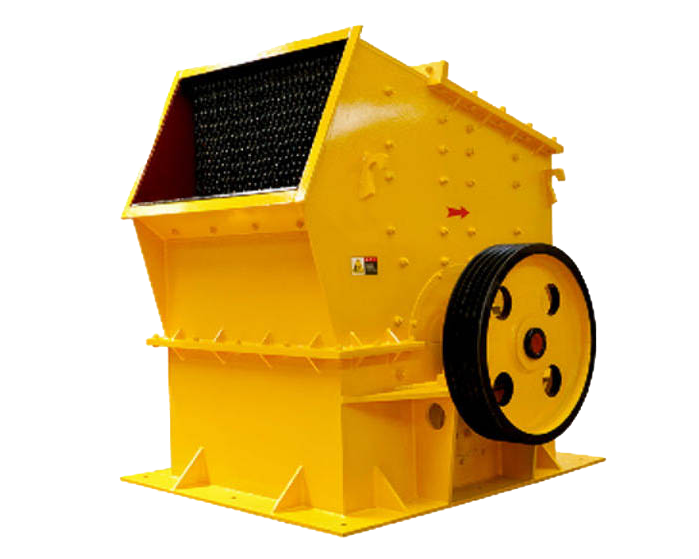
PCX series hammer crusher — evaluated where reduction ratio and circuit simplicity outweigh the wear profile of a hammer-based duty.
The stage-matching matrix
The table below converts the three machines into decision variables. It is deliberately framed around what each unit does in the line rather than around a ranking, because none of the three displaces the others: they occupy different positions and serve different product objectives.
| Decision variable | PX Crusher (PX-1212) | PCX Crusher | 2PG-Y Roller Crusher |
|---|---|---|---|
| Typical line position | Secondary to tertiary fine crushing | Secondary stage, or a single-pass stage replacing two | Final reduction stage |
| Feed envelope to verify | ≤120 mm on PX-1212; upstream primary must guarantee it | Larger lumps acceptable in heavy configuration | Requires uniform, pre-screened feed |
| Product role | Small finished particle size, high fine-material ratio | High reduction ratio, finer product; heavy configuration can reach mill-feed size in one pass | Controlled final size band through roll compression |
| Documented application | Fine sand and aggregate fine crushing | Cement raw material, backfill, budget-sensitive lines | Cement plant and building-materials aggregate duty |
| Wear profile | High-chromium hammers; carbon steel housing | Hammers and screen plates as consumables | Roll surfaces under compression duty |
| Circuit effect | Shifts the load toward the fine fractions the YK screen must classify | Shortens the circuit — fewer units, less conveying | Depends on upstream screening quality |
| Best fit when… | Fine-material share drives project value | Reduction ratio and capital simplicity drive the decision | Feed is uniform and the final band must be tight |
Where the YK screen enters the decision
Stage matching is not complete until the screen is matched to the crusher it serves. A crusher chosen against a product objective changes the burden on the screen, and the screen is what converts crusher output into sellable fractions.
The YK Screen series is a circular vibrating screen used for aggregate grading in stone plants, mining and quarrying. Representative configurations show the range of the decision: the 2YK-2470 is a two-layer unit with a screen hole size below 50 mm, a capacity range of 15–200 t/h, a 22 kW motor and a total weight of 8.5 t, built on a carbon steel frame with manganese steel screen mesh. The 4YK-2160 offers four layers within the same capacity range at 15 kW and 7.9 t — the deck count, not the throughput band, is what changes.
Three practical consequences follow for a buyer:
- Deck count is a product-specification decision, not a capacity decision. A four-layer screen is chosen because the project sells four controlled fractions, not because it processes more tonnes.
- Screen capacity should be sized above the crusher it serves. The 1.2–1.3 multiplier exists precisely because crusher output is not perfectly steady and return circulation has to be absorbed.
- Screen condition is part of crusher performance. Clogged or worn mesh, high material moisture and ageing springs degrade screening efficiency, which pushes more material back into the crusher and inflates the load the stage was never sized for.
Applying the framework across project types
Highway and railway aggregate supply. National key projects in this segment impose strict gradation and particle-shape requirements, and railway ballast specifications are narrow. In these lines the secondary stage is usually fixed by product shape rather than by fine-material yield, and the YK screen carries the compliance burden — which argues for matching the crusher to the specification the screen must certify, not to the lowest-cost crushing option.
Hydropower and dam concrete aggregate. Long-term continuous operation with high-strength aggregate specifications places a premium on wear-resistant chambers and remote-site serviceability. A hammer-based stage whose consumables must be shipped to a remote site carries a logistics cost that does not appear in the stage comparison.
Overseas quarry and Belt and Road infrastructure projects. Voltage and grid variation, tropical, arid or high-altitude climate adaptation, and long-distance service support all change the calculus. Voltage flexibility across 380V, 440V, 415V and 660V, tropicalised or desert-rated options and multilingual documentation are stage-relevant procurement criteria, not optional extras.
Cement raw material and building-materials supply. This is where single-pass reduction to mill-feed size genuinely changes the plant layout, and where the PCX and 2PG-Y families are most frequently evaluated against each other — one shortening the circuit, the other delivering a controlled final band.
Where LBZG fits into this decision
Shandong Lianbang Heavy Industry Co., Ltd. is a Linyi, Shandong-based manufacturer of sand-stone crushing, sand-making and solid-waste recycling equipment, registered in 2013 with technical origins traceable to Chengming Machinery, established in 1996. Its brand trademark is Shanyuan LBZG. The company operates two production bases totalling 120,000 m², including 40,000 m² of standard workshops and more than 150 sets of processing equipment, with around 110 employees and over 40 in R&D. Its stated business modes cover standalone equipment supply, EPC contracting for complete sand-stone production lines, construction and solid-waste treatment solutions, and mobile crushing and screening equipment.
For stage-matching decisions specifically, three capability facts matter to a buyer:
- The equipment range covers all three decision slots. PX, PCX and 2PG-Y crushers are supplied alongside YK screens, ZSW and ZDG feeders, and BS belt conveyors, so the stage decision can be resolved within one supply scope rather than across three vendors with separate capacity assumptions.
- Line layout and output grading are within the OEM/ODM scope. Documented customisation covers voltage (380V/440V/415V/660V), motor brand, colour, logos, production line layout, capacity and output grading, and automation level — the parameters that determine whether a chosen stage actually integrates with the screen circuit.
- Verification is part of the delivery process. Quality control is described as 100% pre-shipment test plus on-site installation and commissioning, with a one-year warranty and remote guidance combined with on-site repair support.
The company holds ISO9001 quality management, ISO14001 environmental management and OHSAS18001 occupational health and safety system certification, plus CE export certification for foreign trade projects, and states that it participates in revising national industry standards for crushers. It reports national high-tech enterprise status, recognition as a Shandong provincial Specialized, Refined, Differential and Innovative SME, and a Linyi Mayor Quality Award, and lists domestic service to infrastructure projects of China Railway, China State Construction, China Communications Construction and Gezhouba Group, with products sold to more than 40 overseas countries.
Limits and boundaries a buyer should accept up front
A framework that lists only advantages is not a decision framework. Four boundaries apply to the three machines discussed here.
1. The PX-1212 has a hard feed ceiling. At ≤120 mm feed size, the upstream primary stage must guarantee that envelope. If blast design or primary setting produces occasional oversize, the fine-crushing stage becomes a choke point regardless of its rated power.
2. Hammer-based stages trade wear against simplicity. Hammers and screen plates are consumable items and are excluded from warranty coverage as normal production wear components. Feed abrasiveness therefore converts directly into operating cost, and a lower capital cost at the PCX slot does not automatically mean a lower cost per tonne.
3. Roller crushing depends on feed discipline. The 2PG-Y performs as a final-reduction unit only when the upstream screen delivers a uniform feed. Where the preceding circuit cannot hold that consistency — variable quarry faces, intermittent feed, wet material — the roller stage inherits the variability.
4. Catalogue figures are not guarantees. Rated capacities are established under standard test conditions. Actual throughput varies with hardness, feed size, mud and moisture, power stability and wear condition, and no supplier can guarantee catalogue output without the site's working conditions being matched to the calculation.
Market direction and what it changes for buyers
Aggregate demand tied to infrastructure programmes continues to pull equipment selection toward specification compliance rather than raw throughput. In the segments where these lines operate — highway and railway construction, new town and airport development, hydropower, and overseas quarry development — the recurring procurement themes are gradation stability, particle shape and continuity of supply rather than headline capacity.
Two structural shifts follow. First, lines are increasingly designed as circuits rather than as equipment lists, which raises the value of the screen and the return loop in the selection process. Second, overseas projects place a growing weight on configuration adaptability — voltage, climate rating, documentation language and service reach — because a stage that cannot be serviced locally becomes an availability risk regardless of how well it was matched on paper.
Future outlook
The direction of travel in stone crushing production line design is toward fewer, better-matched stages with tighter instrumentation of the screen circuit. As buyers become more comfortable specifying by stage role rather than by model, the practical differentiator between suppliers will be the quality of the feed-characterisation and capacity-matching work they do before the quotation is issued — including the willingness to state a boundary where a proposed stage does not fit.
For a buyer at the research and evaluation stage, the most useful preparation is a documented feed profile: maximum lump size, hardness indication, moisture and clay content, target fractions, and the required continuity of operation. With those five inputs, the PX, PCX and 2PG-Y question usually resolves itself.
Frequently asked questions
How do I decide whether a crusher belongs in the secondary or the tertiary stage?
The deciding inputs are the maximum lump size arriving at that point and the product the stage must deliver. Primary crushing reduces run-of-quarry rock to a size the next machine can accept; secondary and tertiary crushing brings material to the target product specification. If the candidate machine's feed envelope is smaller than what the upstream stage produces, it is a tertiary unit and the circuit needs an additional stage before it. The PX-1212, for example, accepts ≤120 mm, so it can only occupy a position where the preceding stage guarantees that size.
What feed characteristics disqualify the PX Crusher for a given stage?
A feed that exceeds the stated maximum feed size is the clearest disqualifier — ≤120 mm for the PX-1212. Beyond size, the relevant considerations are whether the material can be reduced efficiently by impact and whether the high fine-material ratio the PX is specified for matches what the project actually sells. A line whose product mix is dominated by coarse aggregate gains little from a stage whose documented characteristic is a high proportion of fines.
When should a PCX Crusher be preferred to a PX Crusher?
When the objective is reduction ratio and circuit simplicity rather than fine-material yield. The PCX series is a hammer crusher configured for shaping and finer product, and in heavy configuration it can reduce large limestone directly to mill-feed size in one pass, which removes an intermediate stage. The trade-off is that hammer-based duty consumes hammers and screen plates as wear items, so the choice depends on the abrasiveness of the feed and the availability of spare parts at the site.
What is the right line position for a 2PG-Y Roller Crusher?
Final reduction. Roller crushing works by compression between two counter-rotating rolls and produces a controlled size band, which requires a feed that is already reasonably uniform. In practice that means the YK screen upstream of the roller stage must be doing genuine classification work rather than final polishing. Models in the LBZG range include the 2PG-600 and 2PG-1000, and roll crushers of this class are documented in cement plant and building-materials aggregate duty.
How should YK screen capacity be matched to the crusher it serves?
The established matching rule sizes the vibrating screen at roughly 1.2–1.3 times line capacity, while the secondary crusher is set at 1.0–1.1 times actual primary output and the feeder at 1.1–1.2 times rated jaw crusher capacity. The screen is deliberately over-sized relative to the crusher because crusher output is not perfectly steady and return circulation must be absorbed. Deck count is a separate decision: the 2YK-2470 provides two layers and the 4YK-2160 provides four within the same 15–200 t/h capacity band, so the choice is driven by how many controlled fractions the project sells.
Should I plan the line against catalogue capacity?
No. Catalogue ratings are established under standard test conditions, and in service throughput varies with raw material hardness, feed size, mud and moisture content, power supply stability, feeding continuity and wear-part condition. Selection should target actual capacity, which commonly runs at roughly 70–85% of rated capacity, rather than being matched directly to the rated figure. Sharing site working conditions before the quotation stage allows the calculation to reflect them.
Which wear parts fall outside warranty on these stages?
Direct-contact consumables — including hammers, screen plates, spiral blades and screen mesh — are excluded from warranty coverage as normal production wear-and-tear components. The warranty covers manufacturing defects of the main machine body. For hammer-based stages this distinction matters commercially, because hammer consumption is a recurring operating cost driven by feed abrasiveness rather than an occasional failure event.
Reference
Equipment specifications, capacity-matching rules and application data referenced in this article are drawn from LBZG (Shandong Lianbang Heavy Industry Co., Ltd.) product and project documentation. A full company and product brochure is available here: Shandong Lianbang Heavy Industry brochure.
¿Tiene preguntas o necesita más detalles?
Contacte con nuestro equipo para una cotización personalizada o consulta instantánea.
Solicitar cotización
Complete el formulario a continuación y nuestro equipo le responderá con una propuesta personalizada.
Chat directo de WhatsApp
¿Prefiere chatear en tiempo real? Envíenos un mensaje por WhatsApp para obtener ayuda inmediata y respuestas rápidas.
- Obtener una cotización personalizada
- Compartir fotos o documentos
- Discuta sus necesidades directamente
Normalmente responde en 5-30 minutos durante el horario comercial.