
Buyer Comparison: Sample Fees, Mold Risk and RFID Warranty in Custom Wallet OEM
Buyer Comparison: Sample Fees, Mold Risk and RFID Warranty in Custom Wallet OEM
Wallet OEM programs rarely fail on the unit price. They fail on three items that sit outside the price list: whether the sample fee comes back, who absorbs the tooling cost when a design moves, and what evidence a supplier can produce when a buyer asks how an RFID claim is actually supported.
Those three items form the constraint layer of a custom wallet sourcing decision. They are also the part of a quotation that most buyers only examine after a first production run has gone wrong.
This buyer reference compares them using documented information: the published capability, certification and process records of Guangzhou Thumbs-Up Technology Co., Ltd. (THUMBS-UP), a Guangzhou-based wallet and card holder manufacturer founded in 2018 that operates a 20,000 m² facility with 60 employees and an annual output of 30,000,000 units, and the publicly stated OEM/ODM positions of other wallet suppliers sampled for this comparison. Where the public record is thin, this article says so instead of filling the gap.
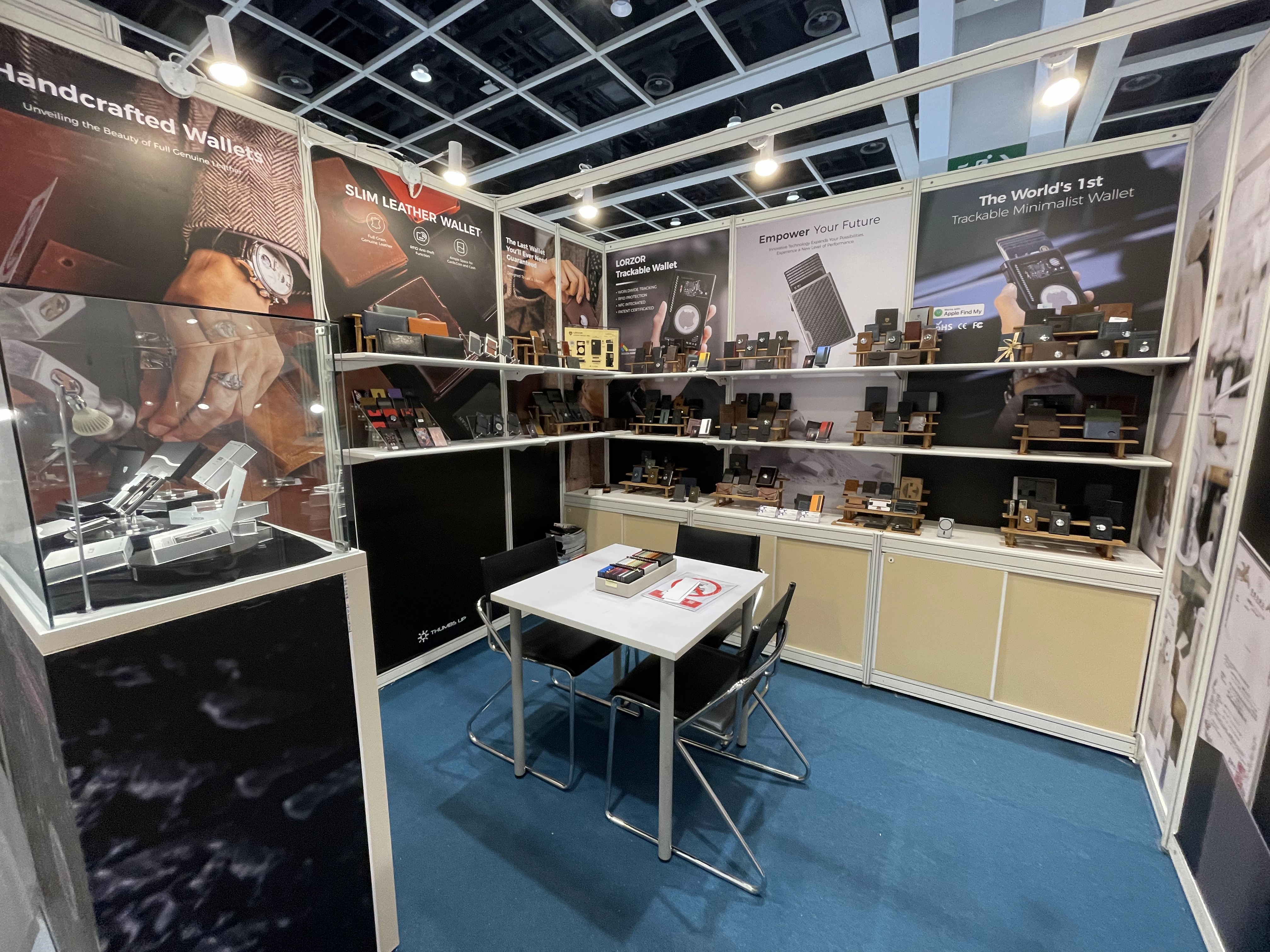
A wallet sample room: in OEM programs the sample is both a cost line and the reference standard for repeat production.
The short answer
Sample fees are usually recoverable, but only against an order that is actually placed.
Tooling is design-locked: debossing molds are cut for one artwork, at one temperature range, for one material.
RFID blocking is a documented product feature; RFID performance is a test result. A warranty conversation should separate the two.
Why sample fees, tooling and RFID evidence decide a wallet program
Three market conditions have pushed these items to the front of the evaluation, rather than the back.
Grand View Research estimated the global smart wallet market at USD 1.3 billion for 2026, and reported that RFID-blocking wallets accounted for 44.2% of that market in 2025. When a functional feature controls close to half of a category, that feature stops being a marketing line and becomes a specification item that buyers test, document and argue about.
Cost pressure is moving in the same direction. Market Growth Reports estimated that leather wallet manufacturing costs increased by 12–18% in 2024 under the shift toward more sustainable production and regulatory compliance. When material and compliance costs move by double digits, buyers stop optimising for cents per unit and start negotiating the fee structure, the tooling exposure and the documentation package.
The practical consequence is simple. A wallet quotation that lists a unit price but not the sample terms, the tooling ownership and the RFID evidence is an incomplete quotation, and comparing two such quotations is not a comparison at all.
Sample fees: what the invoice actually covers
A wallet sample is not one product. In practice, a program can pass through a stock sample, a market-proven platform sample in a standard colourway, a sample in custom material or colour, a bespoke structure sample, and a pre-production sample built on the final specification. Each has a different cost base, and each may carry a different refund rule.
THUMBS-UP states that the sample fee is fully refundable once a bulk order is placed. That is a clear position, and it is also the point where most buyers stop reading too early. Three questions determine whether a refundable sample fee is genuinely low-risk:
- Credited or refunded? A fee credited against the purchase order and a fee paid back to the buyer are different cash events with different accounting and timing.
- Per style or per project? A multi-SKU program with three colourways and two structures may generate more than one sample charge.
- Does it include tooling and freight? Sample freight, courier charges and any tooling deposit are often invoiced separately and are not always covered by the same refund language.
The refund condition also defines the residual risk. A sample fee is recoverable only if the bulk order happens. If a program is cancelled after sampling, that fee is a sunk cost, and it should be budgeted as one.
Mold and tooling risk: the cost that follows the artwork
Tooling in wallet manufacturing is usually assumed to mean injection molds. In leather wallets, most tooling is a branding mold. THUMBS-UP documents the debossing workflow as a sequence: vector artwork prepared in AI or PDF with fonts converted to outlines and line weights of at least 0.3 mm; a high-relief brass mold CNC-machined at 1.8 mm depth; hot-stamping set to 115°C for vegetable-tanned leather and 145°C for chrome-tanned leather; pressure held for 2.5–3 seconds, followed by inspection of depth uniformity and line sharpness.
The same documentation carries an explicit process limit: never exceed 130°C on natural full-grain vegetable leather without foil, because excess heat scorches natural oils and permanently discolours the grain.
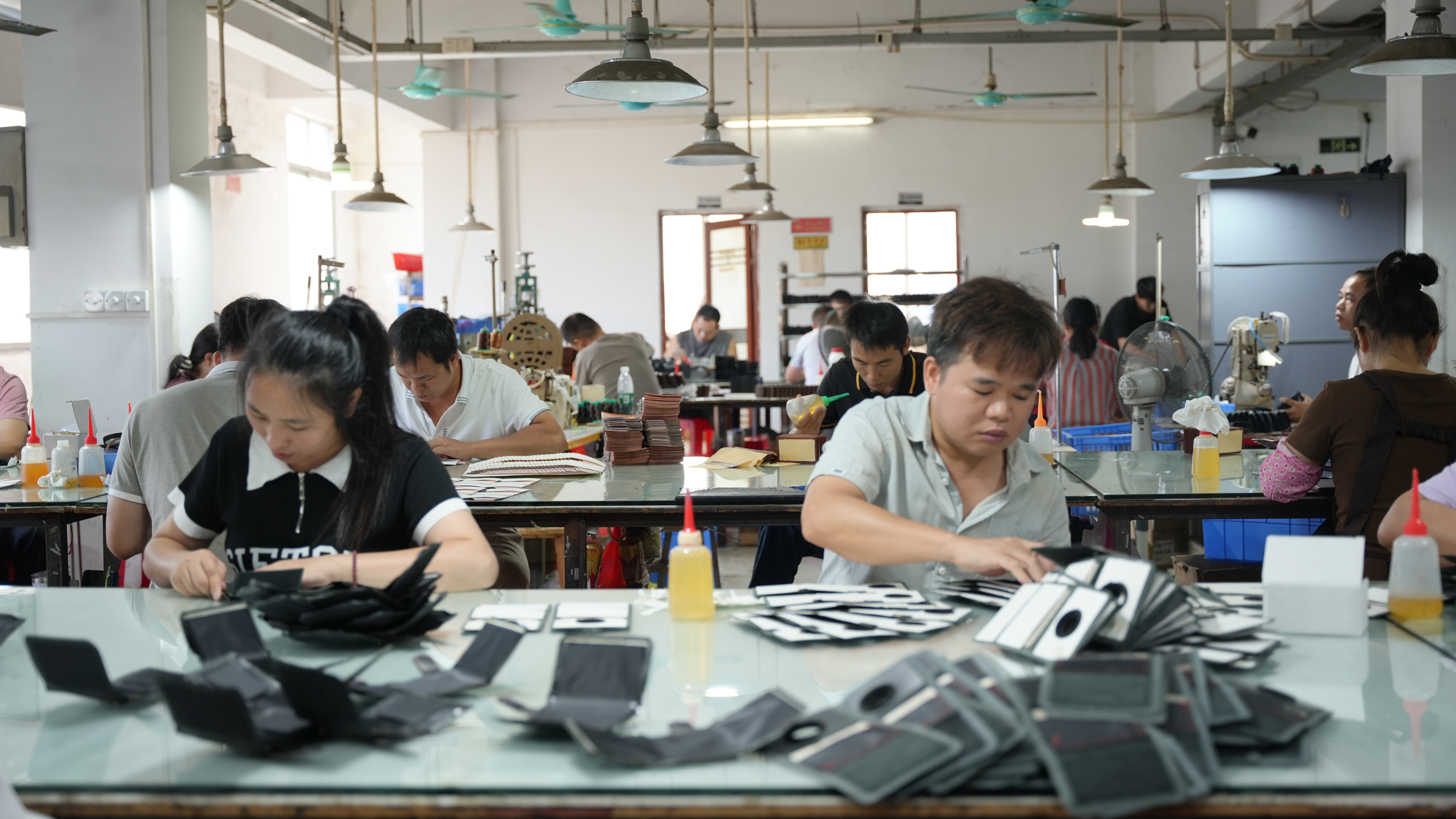
Assembly and tooling setup on a wallet case line; embossing temperature and dwell time are material-dependent settings, not fixed ones.
That single temperature limit explains why tooling risk is higher than buyers expect. A brass mold is cut for one artwork at one depth. If the material changes from chrome-tanned to vegetable-tanned leather after the mold exists, the process window moves, and a mold that produced a clean impression at 145°C may be unusable at the 115°C setting the new material requires. In the same way, a logo change after mold approval means a second CNC-machined mold.
Laser printing and embossing are both listed as pattern types in the THUMBS-UP wallet and card holder range, which matters for tooling planning: laser marking can absorb certain artwork revisions that a physical embossing mold cannot.
Tooling also resets the commercial threshold. TOPWALLET's 2026 OEM information cites a typical minimum order quantity of 1,000 units for custom tooling wallets. THUMBS-UP lists a minimum order quantity of 100 units for applicable programs in its capability information, while tooling-dependent or bespoke structures are quoted per project. The distinction is not cosmetic: a 100-unit entry point and a tooling-amortised entry point are two different offers, and buyers should confirm which applies before assuming a low MOQ covers a custom mold.
Two process controls reduce the exposure. THUMBS-UP uses approved samples and defined product specifications as production references across initial and repeat orders. Its published quality documentation references standardized production, functional testing, final inspection and AQL inspection reports, supported by QC checklists, functional test reports and material declarations. For a tooled wallet, the golden sample is the only artefact that fixes both the mold impression and the material behaviour in one object.
RFID: from feature claim to warranty
RFID blocking works mechanically, not electronically. The conductive metal shell acts as a continuous Faraday cage that reflects and absorbs the 13.56 MHz interrogation signal used by contactless readers. Contactless cards have no internal battery; they draw operating power from the reader's electromagnetic field. Enclosing the card in conductive aluminium prevents magnetic flux penetration and deprives the chip of operating voltage.
That mechanism is well understood. What varies between suppliers is the evidence attached to it. THUMBS-UP lists RFID blocking and an IP68 rating for selected products in the wallet and card holder range, alongside 6063 aluminium and full-grain leather as documented materials. The blocking capability follows the metal structure, so it is a property of the card holder body rather than the leather.
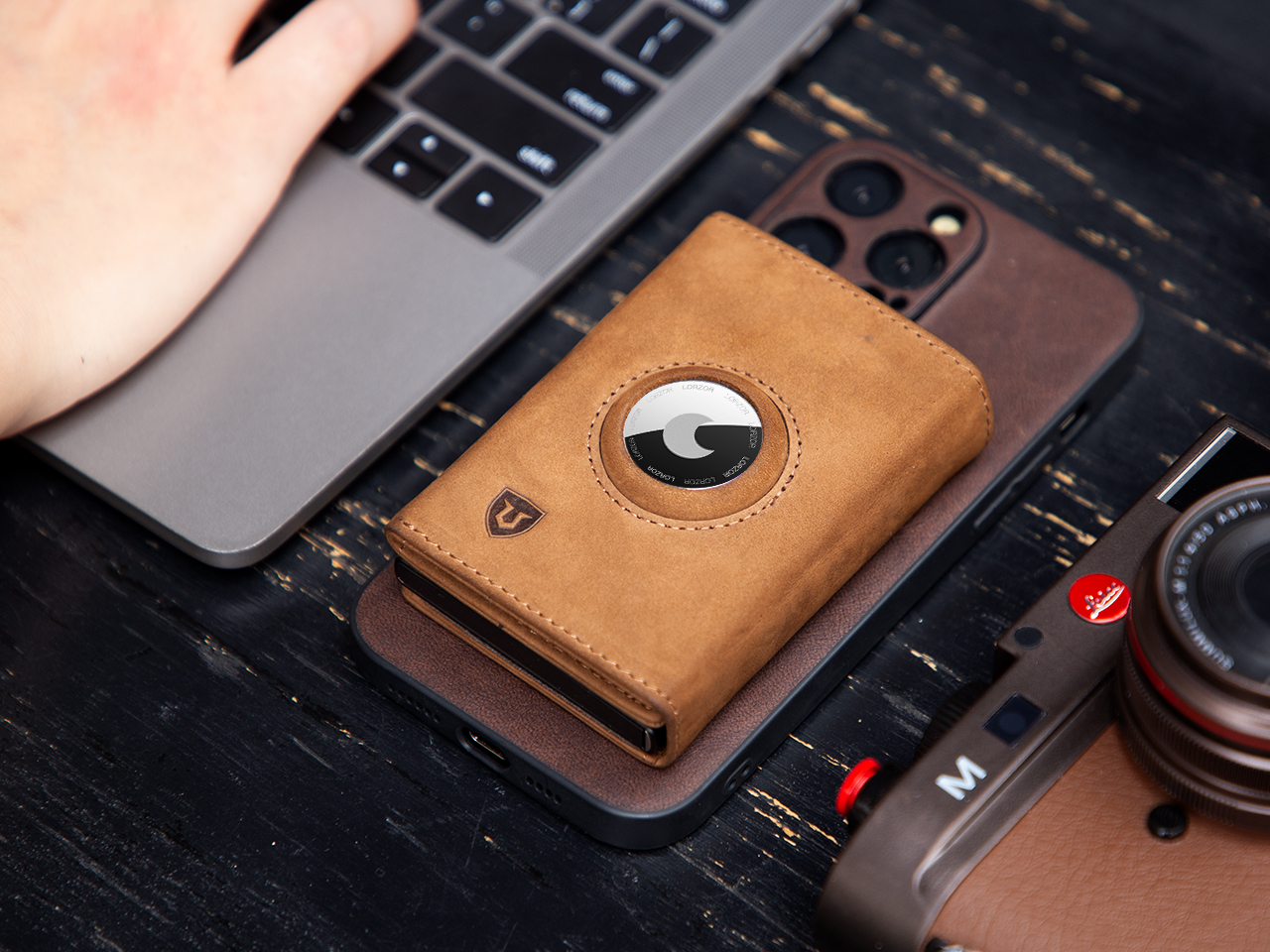
An AirTag-ready wallet design from the THUMBS-UP range; tracking and RFID functions are separate specifications that require separate evidence.
The evidence gap is where buyers get caught. Across the supplier pages sampled for this comparison, RFID blocking is listed as a feature by THE/STUDIO, BagsPlaza, Gstar Technology and others, but none of the retrieved public pages published RFID attenuation test data or magnetic retention measurements. Feature presence and measured performance are not the same claim, and no supplier in the sample should be assumed to have proven the latter on the strength of the former alone.
THUMBS-UP's documentation position is broader than a feature line. The company holds product testing reports issued by SGS, TÜV and other independent testing organizations, together with material certificates and compliance documentation, provided according to the product, material, component and destination market. Specific EU-market documents in the published record include:
| Document | Reference | Scope |
|---|---|---|
| Leather Working Group Gold Certificate | TAI103 | Category C, raw hide/skin to finished leather; LWG Audit Standard v7.2.4; 11 Nov 2024 – 11 Nov 2026 |
| RoHS (aluminium profile) | SGS CANPC23000406902, 28 Feb 2023 | Directive (EU) 2015/863 amending Annex II to 2011/65/EU |
| RoHS (Lorzor Wallet) | Microtest MTI250318016-0104C1C, 10 Apr 2025 | LORZOR-wallet-T and listed serial models |
| REACH | ZTS23110906HRC, 15 Nov 2023 | 235 SVHC and Resorcinol; Regulation (EC) No. 1907/2006 |
| Community Design | EUIPO 015073944-0002, 24 Sep 2024 | Registered Community Design for the wallet and card holder range |
One clarification matters for buyers reading a specification sheet. The LWG Gold certificate is a leather manufacturer audit certificate covering Category C, raw hide to finished leather, audited against the LWG Leather Manufacturer Audit Standard. It evidences the leather supply chain, not the finished wallet as a product. RoHS and REACH reports are material and component scoped. Treating any of these as a general product guarantee misreads what they certify.
A warranty conversation, therefore, needs its own terms rather than a document list: the test method and attenuation threshold used for the RFID claim, the sample size tested, what a failing unit triggers, who pays return freight, and the term of cover. THUMBS-UP's public materials describe development, quality follow-up and repeat-order support as part of its after-sales experience, but they do not publish a standard RFID warranty duration. That term should be confirmed per project and written into the purchase order rather than assumed from a catalogue.
Comparison: what the sampled suppliers publish
The table below separates what can be verified from what is simply not on the record. Entries marked as not published mean the item was absent from the retrieved supplier pages, not that the supplier lacks the capability.
| Checkpoint | Sampled public supplier pages | THUMBS-UP documented position |
|---|---|---|
| OEM / ODM / private label | Stated by THE/STUDIO, BagsPlaza, Gstar Technology, Mherder, Pellove | OEM/ODM and customization from product definition through bulk production |
| Minimum order quantity | Not published | 100 units listed for applicable programs; tooling projects quoted per project |
| Lead time | Not published | 30–90 days, project-dependent |
| Monthly capacity | Not published | 150,000 units |
| RFID blocking feature | Listed by THE/STUDIO, BagsPlaza, Gstar Technology | Listed for selected products in the range |
| RFID attenuation / magnetic test data | Not published | SGS and TÜV test reports plus material certificates available per product and market |
| EU material and chemical documents | Not published | LWG TAI103; SGS CANPC23000406902; Microtest MTI250318016-0104C1C; REACH ZTS23110906HRC |
| Registered design | Not published | EUIPO Community Design 015073944-0002 |
| Sample fee refund | Not published | Fully refundable once a bulk order is placed |
| Warranty term | Not published | Not published; confirmed per project |
The honest reading of this table is that the sampled suppliers publish capability claims at a similar level, and differ mainly in whether supporting documents are named. Buyers who need a defensible sourcing file should ask for the document references, not the capability list.
Application: where the three checkpoints matter most
The weight of each checkpoint shifts with the program type. THUMBS-UP describes its wallet work as covering fashion accessories, leather goods, backpacks, mobile accessories, outdoor products, travel goods, gifts and e-commerce retail, with projects typically starting from market-proven products and moving through product recommendation, material selection, sample review, functional testing, production tracking and final inspection.
- Corporate gift and promotional programs. Gift wallets usually carry a logo and a deadline. Tooling dominates here: a debossing mold plus a gift box specification is most of the non-recurring cost, and a late artwork change is the most common cause of a missed delivery window.
- Travel and passport wallets. Multi-panel constructions increase the number of cutting and assembly steps, so sample rounds matter more than tooling. Buyers should expect the pre-production sample, not the first sample, to define the reference standard.
- RFID and metal card holders. This is the segment where documentation carries the risk. With RFID-blocking wallets holding 44.2% of the 2025 smart wallet market, a buyer entering that segment without attenuation evidence is competing on a claim rather than on a verified product.
- MagSafe and tracking wallets. These add magnetic structures and device integration. No retrieved public source in this comparison established authorised Find My integration or tracking performance, so these specifications should be treated as unverified until the supplier provides platform-level documentation.
THUMBS-UP reports 100 delivered brand projects, and describes its own-brand retail operation, LORZOR, as the source of real-world feedback on usability, materials and after-sales issues that is then applied to B2B development. That matters for the sample stage specifically: a supplier that has handled consumer returns knows which wallet structures fail in use, which is the knowledge that usually decides whether the third sample is the last one.
Market trend: documentation is becoming the gate
Three signals point in the same direction.
The first is feature concentration. If RFID blocking holds 44.2% of the smart wallet market, then RFID is no longer a differentiator that can be claimed loosely; it becomes a specification that buyers and regulators test.
The second is cost structure. A 12–18% rise in leather wallet manufacturing costs in 2024 driven by sustainable production and compliance shifts the economics of a program toward fewer, better-documented suppliers, because each additional unverified claim becomes an unbudgeted testing cost later.
The third is the maturing of the compliance record itself. A leather audit certificate now has a defined scope (Category C, raw hide to finished leather), a standard version (LWG v7.2.4) and a validity window ending 11 November 2026 for TAI103. Buyers will increasingly be asked to show not merely that a supplier holds a certificate, but which link in the supply chain it covers and whether it was valid on the production date.
Traditional sourcing versus documented OEM: where the model breaks
The traditional route is well known: buy a stock wallet from a trading intermediary, have a logo added locally, and take delivery. It is fast and requires almost no specification work.
It breaks at exactly the three points this article examines. The stock wallet has no sample history, so there is no approved sample to hold a repeat order against. The logo application is performed by a third party, so no tooling record exists and no one owns the impression quality. And the RFID claim, if there is one, arrives without a test reference, which means it cannot be defended to a retailer or a marketplace auditor.
A documented OEM route inverts each of those: the sample becomes a controlled reference, the mold is a known asset with defined process settings, and the RFID claim is supported by a named test document. The trade-off is time and administration — more specification writing, more sample rounds, more document review.
Limitations buyers should plan around
- The 100-unit MOQ is a listed capability figure, not a universal entry point. It applies to applicable programs; tooling-dependent or bespoke structures are quoted per project, and TOPWALLET's 2026 information places typical custom-tooling MOQ at 1,000 units.
- Lead time is a range, not a commitment. The published 30–90 days reflects project scope; it should be converted into dated milestones in the order.
- The LWG certificate is material-scoped and time-limited. TAI103 covers Category C raw hide to finished leather and is valid from 11 November 2024 to 11 November 2026; renewal status should be confirmed before a production run extends past that date.
- RFID blocking is documented as a feature for selected products. No public attenuation figures exist for THUMBS-UP or for the sampled suppliers, so functional performance must be validated against the buyer's own threshold.
- Sample refunds depend on the order being placed. A cancelled program does not recover the sample fee.
- Certification documents are market-specific. The published record here is oriented to the EU market; requirements for other destinations must be reviewed separately.
Future outlook
The direction of travel is toward evidence-based specification. As RFID share consolidates and cost pressure continues, the differentiator between wallet suppliers will shift from whether they can make a wallet to whether they can document what they made: which mold, which temperature, which test report, which certificate, valid on which date.
For buyers at the research and evaluation stage, the practical implication is to build the three checkpoints into the RFQ now. Ask for the sample refund rule in writing, ask for the tooling ownership and re-cut policy, and ask for the RFID evidence with a named test reference. Suppliers who can answer those three questions cleanly are, in practice, the ones whose quotations can be compared at all.
The full THUMBS-UP wallet and card holder catalogue is available as a downloadable PDF: 2026 Product Catalog – Thumbs-Up Wallet.
FAQ
Will the sample fee be returned after a bulk order is placed?
THUMBS-UP states that the sample fee is fully refundable once a bulk order is placed. Because the refund is triggered by the bulk order, a program that stops after sampling does not recover the fee; the refund amount, timing and scope should therefore be written into the quotation or purchase order.
How does an aluminium card holder block RFID signals?
The conductive metal shell acts as a continuous Faraday cage that reflects and absorbs the 13.56 MHz interrogation signal used by contactless readers. Contactless cards have no internal battery and draw operating power from the reader's electromagnetic field; enclosing the card in conductive aluminium prevents magnetic flux penetration and deprives the chip of operating voltage.
What artwork and tooling are required for logo debossing on leather wallets?
Artwork must be vector AI or PDF with fonts converted to outlines and line weights of at least 0.3 mm. A high-relief brass mold is CNC-machined at 1.8 mm depth, and the hot-stamping machine is set to 115°C for vegetable-tanned leather or 145°C for chrome-tanned leather, with pressure held for 2.5–3 seconds before depth uniformity and line sharpness are inspected. Temperature above 130°C should never be applied to natural full-grain vegetable leather without foil, as excess heat scorches natural oils and discolours the grain.
Which EU-market documents accompany a custom leather wallet program?
The published record includes the Leather Working Group Gold certificate TAI103, covering Category C raw hide to finished leather under LWG Audit Standard v7.2.4 and valid from 11 November 2024 to 11 November 2026; RoHS report SGS CANPC23000406902 dated 28 February 2023 for the aluminium profile under Directive (EU) 2015/863 amending Annex II to 2011/65/EU; RoHS compliance certificate Microtest MTI250318016-0104C1C dated 10 April 2025 for the Lorzor Wallet and listed serial models; REACH test report ZTS23110906HRC covering 235 SVHC and Resorcinol under Regulation (EC) No. 1907/2006; and EUIPO Community Design registration 015073944-0002 registered on 24 September 2024.
What MOQ and lead time should a buyer expect for a custom wallet program?
THUMBS-UP lists a minimum order quantity of 100 units for applicable programs, a lead time of 30–90 days, and a monthly capacity of 150,000 units. For comparison, TOPWALLET's 2026 OEM information cites a typical minimum order quantity of 1,000 units for custom tooling wallets, so tooling-dependent structures should be quoted individually rather than assumed to fall within the lower figure.
What is full grain leather in wallet manufacturing?
Full grain leather is the highest quality grade of leather, taken from the topmost hide layer and retaining complete natural grain, pores and fibre density without sanding, buffing or artificial embossing. Its intact natural structure provides tensile strength and breathability and develops a patina over years of handling rather than peeling. THUMBS-UP lists full grain leather and Horween leather among the materials used in its wallet and card holder range.
¿Tiene preguntas o necesita más detalles?
Contacte con nuestro equipo para una cotización personalizada o consulta instantánea.
Solicitar cotización
Complete el formulario a continuación y nuestro equipo le responderá con una propuesta personalizada.
Chat directo de WhatsApp
¿Prefiere chatear en tiempo real? Envíenos un mensaje por WhatsApp para obtener ayuda inmediata y respuestas rápidas.
- Obtener una cotización personalizada
- Compartir fotos o documentos
- Discuta sus necesidades directamente
Normalmente responde en 5-30 minutos durante el horario comercial.