
Butter Cookies for Supermarkets, Chain Hotels, Bakeries & Coffee Shops: Scenario Fit Guide
HTNXT Industry Reference · Bakery & Snack Supply
Butter Cookies for Supermarkets, Chain Hotels, Bakeries & Coffee Shops: Scenario Fit Guide
A butter cookie is a baked sweet biscuit in which butter is the defining fat, and the category is now sold through channels that ask very different things of it. The same product line can be a supermarket shelf item, a hotel turndown amenity, a bakery counter add-on, a café pairing, and an instant-retail impulse unit — but rarely in the same pack format, at the same unit weight, or with the same shelf-life expectation.
This guide maps butter cookie formats to five commercial scenarios: supermarkets, chain hotels, bakeries, coffee shops, and instant retail platforms. It draws on documented product specifications from Dongguan Shangfan Food Co., Ltd. — a baked-goods manufacturer established in 2015 in Chashan Town, Dongguan City, Guangdong Province, China — together with published category data. The question it answers is a procurement one: which format fits which channel, and where does a format stop working.
Why Channel Fit Outranks Flavour Range in Buying Decisions
Flavour variety is the easiest part of a butter cookie range to compare and the least useful basis for a channel decision. The variables that actually determine whether a butter cookie line sells through are structural: unit weight, pack count, carton configuration, shelf life, packaging integrity, and the storage conditions the product tolerates.
A 10g butter cookie piece behaves like a portion-controlled impulse unit. A 680g box behaves like a family-format or bakery-counter product. A 760g two-tin gift set behaves like a seasonal gifting object. These are not marketing distinctions; they change how the product is merchandised, how quickly it turns, and how much waste a buyer carries if demand does not arrive on schedule.
Shelf life is the constraint that most often disqualifies an otherwise suitable product. In the specification data reviewed for this guide, butter cookie formats range from 5 months for thin crisp and floral tins to 9 months for Danish-style assortments and 12 months for a salted cheese format. A buyer planning inland distribution or slow-moving gift retail is making a different calculation from a buyer supplying a high-turn coffee counter.
The Five Channel Scenarios at a Glance
| Channel | Core buying question | Format signal | Mismatch risk |
|---|---|---|---|
| Supermarkets | Will this turn before the date code bites? | Mid-size tins and cartons with predictable case counts | Slow-turning premium tins occupying shelf space |
| Chain hotels | Does it work as an amenity and as a gift? | Portion packs plus presentation tins | Bulk packs that cannot be presented to guests |
| Bakeries | Does it complement in-store production? | Distinct textures the bakery does not make | Direct overlap with the bakery's own line |
| Coffee shops | Does it pair cleanly with a drink? | Small, low-mess, single-serve pieces | Large formats that slow counter service |
| Instant retail | Does it survive small-batch, fast dispatch? | Compact units with individual packaging | Formats needing humidity-controlled display |
Channel logic summarised from documented product application fields and storage conditions.
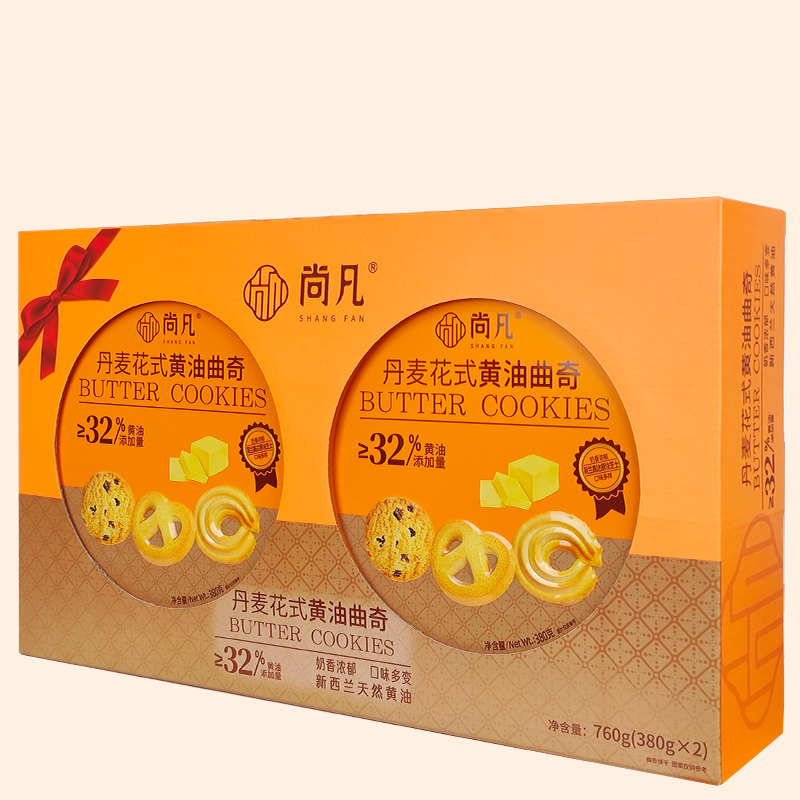
Danish Assorted Cookie Gift Box, 760g gift set containing two tins — a presentation format rather than an everyday shelf unit. Image: Dongguan Shangfan Food Co., Ltd.
Supermarkets: Shelf Presence, Case Economics and Date Codes
Supermarket buyers are managing a finite shelf against a fixed rotation cycle. The relevant format is the one that presents well without requiring staff attention and moves at a rate that keeps date codes clean.
The 175g tin is the workhorse supermarket unit in this range. Butter Floral Cookies 175g, Coffee Butter Flower 175g and Cocoa Butter Cookies 175g share the same carton configuration: 175g × 24 tins per carton, with carton dimensions of 44.8 × 30.2 × 24 cm and a volume of 0.032 CBM. For a buyer, an identical carton footprint across three flavours is an operational convenience — pallet planning, inbound handling and shelf replenishment all follow the same pattern.
The flavour composition matters to the shelf decision as much as the pack. Butter Floral Cookies 175g contains no less than 39% fermented butter from FrieslandCampina Netherlands, and the flour is milled from Canadian imported wheat. Cocoa Butter Cookies 175g carries the same 39% fermented butter specification together with cocoa. Coffee Butter Flower 175g contains at least 32% fermented butter from FrieslandCampina Netherlands. Buyers compiling a premium shelf set can therefore build a three-flavour block on a consistent carton specification rather than three unrelated supply arrangements.
Larger supermarket formats shift the rotation problem. Danish Fancy Butter Cookies 380g is packed 380g × 12 tins per carton with a 9-month shelf life and no added preservatives, artificial pigments or artificial flavours. That longer window supports slower-moving premium shelf positions that a 5-month thin crisp product could not hold.
Chain Hotels: Portion Control and the Gifting Calendar
Hotel buying splits into two requirements that are often served by two different formats from the same supplier: the in-room or F&B amenity, and the gift or seasonal offering.
For the amenity side, the thin crisp formats are the natural fit. Cocoa Butter Thin Crisp Cookies and Crispy Thin Butter Cookies are both specified at 10g per piece, with 9 pieces per box or 13 pieces per can, and a 5-month shelf life. A 10g individually handled piece is a controlled portion — it does not require cutting, plating or waste management, and the box and can counts allow a hotel to standardise on one unit size across properties.
For the gifting side, presentation becomes the specification. Butter Floral Cookies 260g is supplied in gift tin packaging matched with gift bags, packed 260g × 8 tins per carton, with a 6-month shelf life and carton dimensions of 59.5 × 37.5 × 23.5 cm. The Danish Assorted Cookie Gift Box 760g goes further: a 760g gift set containing two tins, made with natural butter imported from New Zealand at a butter content of at least 32%, with no preservatives, artificial pigments or artificial flavours, and a 9-month shelf life.
The documented application field for these products names chain hotels directly, and the associated gift-box specification notes use in festival and holiday gifting scenarios, with coffee pairing, snacking and afternoon tea as typical applications. For hotel buyers, that means one supplier relationship can cover both the operational amenity line and the seasonal gift line without splitting specification responsibility.
Bakeries: A Complement, Not a Competitor
A bakery buying butter cookies is usually buying something it does not want to produce in-house: a long-shelf-life, consistently formatted product that fills a counter gap without competing with fresh bake.
This is where texture differentiation carries commercial weight. Lace Butter Cookies 448g — 16g × 28 pieces per box, 180-day shelf life, product standard code GB7100 — is made with Royal FrieslandCampina fermented butter from the Netherlands, American almond flour and Canadian wheat flour, and is described as fluffy and delicate with fine lace edges, crisp outside and soft inside. That is a texture profile a scratch bakery rarely runs as a daily line.
Butter Shortbread 680g occupies a different shelf position: a traditional baked pastry with a crisp, flaky texture and a milky, nutty aroma, made with butter imported from New Zealand, walnuts from Yunnan, China, and buffalo milk from Guangxi, China, at 680g per box with a 6-month shelf life. The 680g box is a family or sharing format rather than a single-serve one, and it suits bakery retail areas where customers buy for home consumption alongside fresh bread.
Cranberry Oat Butter Cookies and Dark Chocolate Oat Butter Cookies, both at 90g per box with an 8-month shelf life, give bakeries a smaller, oat-based option — useful where the counter needs a lighter-textured, smaller-format line next to richer butter products.
Coffee Shops: Why a 10g Piece Changes the Sale
The coffee shop requirement is the most specific in the category: the cookie has to be small enough to sit beside a drink, clean enough to handle at a counter, and consistent enough that a barista does not have to explain it.
The thin crisp formats answer this directly. Cocoa Butter Thin Crisp Cookies use premium caramel crisp flakes imported from Europe, high-grade macadamia nuts and high-fat natural cocoa powder imported from Southeast Asia, at 10g per piece. Crispy Thin Butter Cookies use imported thin crisps from Europe, 100% pure almond flakes sourced from Australian almonds, and natural fermented butter from FrieslandCampina Netherlands, also at 10g per piece, with 9 pieces per box or 13 pieces per can.
The 9-piece box and 13-piece can are effectively two service sizes. The box suits a single pairing or a takeaway add-on; the can suits a shared table or a retail takeaway unit. Both carry a 5-month shelf life, which is workable in a coffee environment where stock turns quickly but is a real constraint for a buyer planning to hold buffer stock across a long distribution chain.
Matcha Nut Butter Thin Crisp Cookies follow the same 10g / 9-per-box / 13-per-can structure with a 5-month shelf life, adding a tea-forward option that fits cafés already selling matcha or oolong-based drinks. Coffee Butter Flower 175g is the counterpoint for shops that want a larger, coffee-flavoured format rather than a thin crisp.
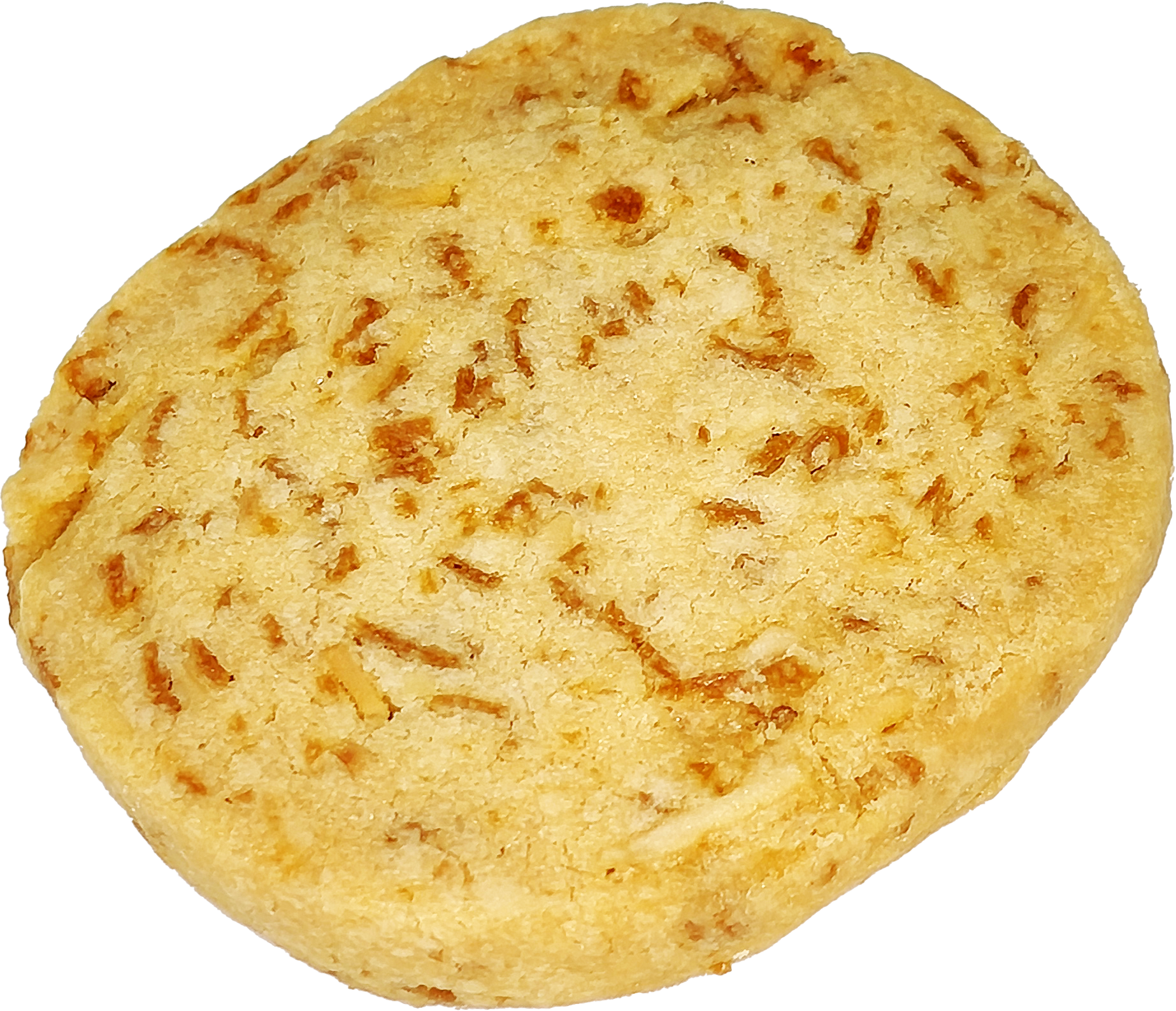
Crispy Thin Butter Cookies at 10g per piece — the unit size most closely tied to coffee-counter service. Image: Dongguan Shangfan Food Co., Ltd.
Instant Retail Platforms: Small Units, Fast Turns, Tight Humidity Control
Instant retail — the small-batch, fast-dispatch channel that delivers within a short window — is the least forgiving of pack formats. Products are picked individually, stored in mixed conditions, and delivered without a display fixture.
Two documented characteristics matter here. First, the products are described as ready-to-eat consumption with independent packaging that maintains shelf life continuously — individual packaging is what allows a platform to pick single units without breaking a case. Second, the documented storage condition is to avoid direct sunlight and store in a cool, well-ventilated place, with humidity controlled to prevent moisture softening and packaging compliant with food contact packaging standards.
That second point is a real operational boundary, not a formality. Butter cookies are hygroscopic in practice, and a 90g box of Cranberry Oat Butter Cookies or Dark Chocolate Oat Butter Cookies carries an 8-month shelf life only if the storage condition is respected. Buyers routing product through humid or uncontrolled warehouse environments should expect a shorter effective window than the label states.
Format-to-Channel Matrix
| Product format | Unit / pack configuration | Shelf life | Strongest channel fit | Boundary to design around |
|---|---|---|---|---|
| Cocoa Butter Thin Crisp Cookies | 10g per piece; 9 per box or 13 per can | 5 months | Coffee shops, hotels, instant retail | Short window; weak fit for slow inland gift distribution |
| Crispy Thin Butter Cookies | 10g per piece; 9 per box or 13 per can | 5 months | Coffee shops, cafés, instant retail | Thin format demands careful handling |
| Matcha Nut Butter Thin Crisp Cookies | 10g per piece; 9 per box or 13 per can | 5 months | Specialty cafés, e-commerce | Same short window as other thin crisps |
| Butter Floral Cookies 175g | 175g × 24 tins per carton; 0.032 CBM | 5 months | Supermarkets, hotel retail | High-turn accounts only over long distances |
| Butter Floral Cookies 260g | 260g × 8 tins per carton; gift tin with bags | 6 months | Chain hotels, gift retail | Gift packaging adds handling steps |
| Butter Cookie Gift Box 265g | 265g box, two flavours included | Floral component 150 days; oat component 8 months | Hotel gifting, bakery retail | Mixed shelf life inside one box |
| Coffee Butter Flower 175g | 175g × 24 tins per carton; 0.032 CBM | 5 months | Coffee shops, supermarkets | Coffee flavour narrows the audience |
| Cocoa Butter Cookies 175g | 175g × 24 tins per carton; 0.032 CBM | 5 months | Supermarkets, cafés | Same 5-month rotation constraint |
| Danish Fancy Butter Cookies 380g | 380g × 12 tins per carton | 9 months | Supermarkets, hotels | Larger unit slows single-serve use |
| Danish Assorted Cookie Gift Box 760g | 760g set, two tins | 9 months | Hotel gifting, festival retail | Seasonal dependency |
| Salted Cheese Butter Cookies 384g | 32g × 12 pieces; 384g per box | 12 months | Supermarkets, e-commerce | Savory profile is not a universal default |
| Lace Butter Cookies 448g | 16g × 28 pieces; 448g per box | 180 days | Bakeries, cafés, hotels | Structure is delicate by design |
| Butter Shortbread 680g | 680g per box | 6 months | Bakeries, family-format retail | Sharing format, not single-serve |
| Cranberry Oat Butter Cookies | 90g per box | 8 months | Coffee shops, e-commerce, instant retail | Small unit needs dense pick rate |
| Dark Chocolate Oat Butter Cookies | 90g per box | 8 months | Coffee shops, e-commerce, instant retail | Same pick-rate dependency |
Configurations and shelf lives as documented in the supplier's product specification records.
Packaging Specifications That Decide the Channel
Carton geometry is an under-discussed part of channel fit. Three 175g lines — Butter Floral Cookies, Coffee Butter Flower and Cocoa Butter Cookies — share a 44.8 × 30.2 × 24 cm carton at 0.032 CBM with 24 tins inside. Danish Fancy Butter Cookies 380g is packed 12 tins per carton at 61 × 21 × 35.8 cm. Butter Floral Cookies 260g runs 8 tins per carton at 59.5 × 37.5 × 23.5 cm.
For a buyer, matching carton footprints across a range reduces inbound complexity and lets a mixed order travel without repacking. A supermarket receiving one pallet of three flavours in identical cases, or a hotel group standardising on one unit size across properties, is solving a logistics problem as much as a product one.
Packaging integrity also has a compliance dimension. Documented requirements include compliance with food contact packaging standards and humidity control to prevent moisture softening. In the EU, Commission Regulation (EU) 2024/3190 prohibits the use of Bisphenol A in food contact materials, including cookie packaging linings — a specification point that belongs in the packaging conversation, not only the ingredient conversation.
Where Shangfan Food Sits in This Picture
Dongguan Shangfan Food Co., Ltd. is a baked-goods manufacturer founded in 2015 and located in Chashan Town, Dongguan City, Guangdong Province, China. It operates a garden-style factory covering over 10,000 square metres, employs 100 staff, maintains an R&D team of 5 engineers, and reports an annual production capacity of 3,640 tons.
Its stated main products include Butter Cookies, Lace Butter Cookies, Cranberry Oat Butter Cookies, Crispy Thin Butter Cookies and Butter Shortbread, and the company states it can develop and customise products with diversified flavours and varieties according to client requirements. Documented certifications include FSSC22000 and HACCP, together with filing for export food business and FDA registration. Main markets listed are PRC, EU, USA, South Korea and Singapore, with an export ratio of 10%.
Read against the five channel scenarios, that portfolio is unusually well distributed. Thin crisp formats at 10g cover coffee and instant retail; 175g tins with a shared carton cover supermarket shelf building; 260g and 760g gift formats cover hotel and festival gifting; 448g lace and 680g shortbread cover bakery counters; and the 12-month salted cheese format covers slower-moving retail and e-commerce positions. The capability to customise flavours is what allows a buyer to align a range with a specific channel rather than accepting a fixed assortment.
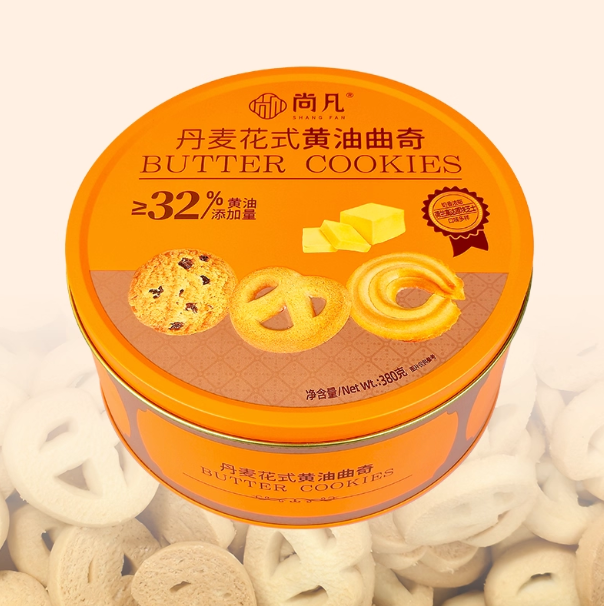
Danish Fancy Butter Cookies 380g, supplied 12 tins per carton with a 9-month shelf life. Image: Dongguan Shangfan Food Co., Ltd.
Market Signals Behind Channel-Specific Buying
Published category estimates diverge sharply depending on scope, and buyers should read them accordingly. Grand View Research values the global butter cookies and biscuits market at USD 3,358.3 million in 2024. Dataintelo estimates the broader butter-based cookies market at USD 42.8 billion in 2025, explicitly including adjacent categories such as shortbread and sandwich cookies. The gap is a definitional gap, not a contradiction, and it matters when a buyer uses a market figure to justify a range decision.
Two further data points are more directly actionable. Dataintelo reports that Asia Pacific held a 34.2% revenue share of the global butter cookies market in 2025, which is consistent with the concentration of butter cookie manufacturing in the region. And Grand View Research values the oat-based snacks market — the segment that contains cranberry oat cookies — at USD 22.4 billion in 2024, which supports the commercial logic of carrying an oat-based line alongside pure butter formats.
The clean-label direction is the trend most visible at the product level rather than the market-size level. Premium butter cookie ranges increasingly emphasise pure butter content and the absence of added preservatives, artificial pigments and artificial flavours — both stated specifications in the Danish Fancy Butter Cookies 380g and Danish Assorted Cookie Gift Box 760g formats reviewed here. Regulatory pressure is moving in the same direction: the EU General Product Safety Regulation (GPSR) 2024 requires stricter traceability and authorised representatives for non-EU food manufacturers, and China's national biscuit standard GB/T 20980-2021 sets quality requirements for short and cookie-type products.
How This Differs from a Traditional Supply Model
The traditional model is one strong SKU sold to every channel, with the buyer adapting merchandising around what is available. Scenario-based supply inverts this: the channel determines the pack, and the product family is selected to serve the pack.
The difference shows up in three places. First, carton consistency across flavours — three 175g lines sharing a 44.8 × 30.2 × 24 cm carton at 0.032 CBM — reduces inbound complexity in a way a fragmented assortment cannot. Second, parallel shelf-life tiers (5 months through 12 months) allow a buyer to match date-code risk to turnover instead of applying one safety margin across the board. Third, gift formats with matched bags and multi-tin construction allow one supplier to serve both the operational and the seasonal line.
The limitation is equally clear. A supplier centred on butter-based cookies is not a full-range confectionery house; a buyer assembling a broad mixed container across many snack categories will still need additional suppliers, and combining them adds coordination cost that a single-source arrangement avoids. The range is also concentrated in butter-forward profiles, so a channel that depends on non-butter, reduced-fat or savoury-dominant snacking will find fewer matches here. Commercial terms such as minimum order quantity and printed packaging are project-specific and should be confirmed directly rather than assumed.
Limits and Boundaries Buyers Should Not Design Around
Three boundaries are worth stating plainly.
- Shelf life is a hard ceiling, not a guideline. The 5-month formats — thin crisps, 175g floral and cocoa tins — suit fast-turn channels. Planning them into a long, humid or slow-moving distribution chain is a structural error that no merchandising plan corrects.
- Mixed packs carry mixed clocks. The Butter Cookie Gift Box 265g combines a floral component with a documented 150-day window and an oat component at 8 months. Operations teams should plan around the shorter date, not the average.
- Storage conditions are part of the specification. The documented requirement — avoid direct sunlight, store cool and well-ventilated, control humidity to prevent moisture softening — is what protects texture. Butter cookies soften before they spoil, so a product can be in date and still fail at the point of sale.
Future Outlook
Two shifts are likely to shape butter cookie channel strategy over the next buying cycles. The first is the continued fragmentation of pack formats, driven by instant retail and coffee-led consumption, both of which reward smaller units and penalise formats that need staff attention. The second is tighter documentation discipline: Regulation (EU) 2024/3190 on food contact materials and GPSR 2024 traceability requirements move packaging and paperwork from administrative detail into sourcing criteria.
For buyers, the practical implication is that channel mapping should happen before product selection, not after. A range built around documented formats — unit weight, pack count, carton geometry, shelf life, storage condition — is easier to defend internally than one assembled from flavour preferences and adjusted later. Suppliers whose portfolio spans the 5-to-12-month shelf-life range and the 10g-to-760g unit range can support that approach; suppliers with a single format cannot, and no amount of assortment breadth compensates.
FAQ
What defines a butter cookie in this product category?
A butter cookie is a baked sweet biscuit in which butter is the principal fat. In the range reviewed here, butter cookie formats include Butter Floral Cookies, Coffee Butter Flower, Cocoa Butter Cookies, Lace Butter Cookies, Crispy Thin Butter Cookies, Butter Shortbread, and oat-based variants such as Cranberry Oat Butter Cookies and Dark Chocolate Oat Butter Cookies. Formats differ in unit weight, pack count and shelf life rather than in category definition.
Which butter cookie formats work best for supermarkets versus coffee shops?
Supermarkets are best served by mid-size tins with predictable case counts and longer shelf life — for example Butter Floral Cookies 175g, Coffee Butter Flower 175g and Cocoa Butter Cookies 175g, each at 175g × 24 tins per carton, or Danish Fancy Butter Cookies 380g at 380g × 12 tins with a 9-month shelf life. Coffee shops are better served by small single-serve pieces: Cocoa Butter Thin Crisp Cookies and Crispy Thin Butter Cookies are both specified at 10g per piece with 9 pieces per box or 13 pieces per can.
How does shelf life affect channel choice?
Shelf life determines how much date-code risk a channel carries. In the documented range, thin crisp and 175g tin formats carry 5 months, Butter Floral Cookies 260g carries 6 months, Butter Shortbread 680g carries 6 months, oat-based 90g boxes carry 8 months, Danish Fancy Butter Cookies 380g and the Danish Assorted Cookie Gift Box 760g carry 9 months, Lace Butter Cookies 448g carry 180 days, and Salted Cheese Butter Cookies 384g carry 12 months. Faster turnover supports shorter windows; slower or longer distribution chains require the longer ones.
What should a hotel or bakery buyer verify before ordering?
Hotel buyers should verify portion size, individual handling and presentation format — the 10g thin crisp pieces for amenities, and gift tin or two-tin sets such as Butter Floral Cookies 260g or the Danish Assorted Cookie Gift Box 760g for gifting. Bakery buyers should verify that the texture profile differs from in-store production, since Lace Butter Cookies 448g and Butter Shortbread 680g occupy distinct texture positions. Both should confirm storage conditions, since the documented requirement is to avoid direct sunlight and store in a cool, well-ventilated place with humidity controlled to prevent moisture softening.
Can butter cookie formats be adapted for a specific channel?
Yes, within documented capability. Dongguan Shangfan Food Co., Ltd. states that it can develop and customise products with diversified flavours and varieties according to client requirements, supported by an R&D team of 5 engineers and an annual production capacity of 3,640 tons. Customisation applies to flavour and variety; commercial parameters such as minimum order quantity, printed packaging and delivery scheduling are project-specific terms that buyers confirm directly with the supplier.
A product and specification brochure for Dongguan Shangfan Food Co., Ltd. is available for download: Shangfan Food brochure (PDF).
¿Tiene preguntas o necesita más detalles?
Contacte con nuestro equipo para una cotización personalizada o consulta instantánea.
Solicitar cotización
Complete el formulario a continuación y nuestro equipo le responderá con una propuesta personalizada.
Chat directo de WhatsApp
¿Prefiere chatear en tiempo real? Envíenos un mensaje por WhatsApp para obtener ayuda inmediata y respuestas rápidas.
- Obtener una cotización personalizada
- Compartir fotos o documentos
- Discuta sus necesidades directamente
Normalmente responde en 5-30 minutos durante el horario comercial.