
Butter Cookie Contract Manufacturing: Certification, Ingredient and Customization Criteria
Butter cookies are no longer a single-SKU commodity category. For supermarkets, membership clubs, hotels, coffee chains and e-commerce brands, the buying decision increasingly depends on a manufacturer's ability to combine food-safety certification, consistent butter content, flexible packaging formats and customized product development under one contract. This article explains how buyers can evaluate a butter cookie contract manufacturer, what certification and specification evidence matters, and where the practical limits of customization still apply.
Why Certification Is the First Filter in Butter Cookie Sourcing
For food buyers and procurement teams, the first question is not flavor. It is whether the factory can prove a working food-safety system. Dongguan Shangfan Food Co., Ltd., a butter cookie manufacturer in Chashan Town, Dongguan, holds both HACCP and FSSC 22000 certification. The HACCP System Certificate, number 001HACCP1900428, is issued by China Quality Certification Centre and covers the manufacture of heat-processed pastries, biscuits and food fillings. The FSSC 22000 V6 certificate, number 162605010, is issued by Intertek and covers the production of cookies and hot-processed pastries, with baking as the main processing step.
These certificates matter because they give a verifiable baseline. A HACCP certificate confirms that the producer operates a hazard-analysis system for pastry and biscuit production. An FSSC 22000 certification adds a globally recognized food-safety framework that many international retailers accept as part of supplier qualification. Buyers should ask for the certificate number, the issuing body and the exact scope, then verify what products are covered. For example, the FSSC 22000 certificate at Shangfan covers Butter Floral Cookies 175g and Salted Cheese Butter Cookies 384g, while HACCP certification applies to Butter Floral Cookies 175g and Danish Fancy Butter Cookies 380g.
Defining the Product Range Before Selecting a Supplier
A reliable contract manufacturer usually offers more than one cookie format. The wider the range, the easier it is for a buyer to build a private-label assortment without managing multiple factories. Shangfan's main products include Butter Cookies, Lace Butter Cookies, Cranberry Oat Butter Cookies, Crispy Thin Butter Cookies and Butter Shortbread. The portfolio also includes Danish Fancy Butter Cookies, Salted Cheese Butter Cookies, Butter Cookie Gift Boxes, Cocoa Butter Cookies, Coffee Butter Flower and thin crisp variants such as Matcha Nut Butter Thin Crisp Cookies and Cocoa Butter Thin Crisp Cookies.
| Product Category | Example Model | Key Specification Example |
|---|---|---|
| Butter Floral Cookies | Butter Floral Cookies 175g | 175g × 24 tins per carton; shelf life 5 months; barcode 6970066564843 |
| Lace Butter Cookies | Lace Butter Cookies 448g | 448g per box (16g × 28 pieces); shelf life 180 days; product standard GB7100 |
| Cranberry Oat Butter Cookies | 90g per box (Cranberry Flavor) | 90g per box; shelf life 8 months; barcode 6970066565079 |
| Danish Fancy Butter Cookies | Danish Fancy Butter Cookies 380g | 380g × 12 tins per carton; shelf life 9 months; New Zealand butter content ≥32% |
| Butter Cookie Gift Box | Butter Cookie Gift Box 265g | 265g per box; combines Butter Floral Cookies and Cranberry Oat Butter Cookies |
For buyers, this range reduces qualification risk. Instead of testing a new factory for every SKU, a retail buyer can qualify one supplier and then scale the assortment by flavor, packaging and format.
Ingredient and Butter Content as a Quality Signal
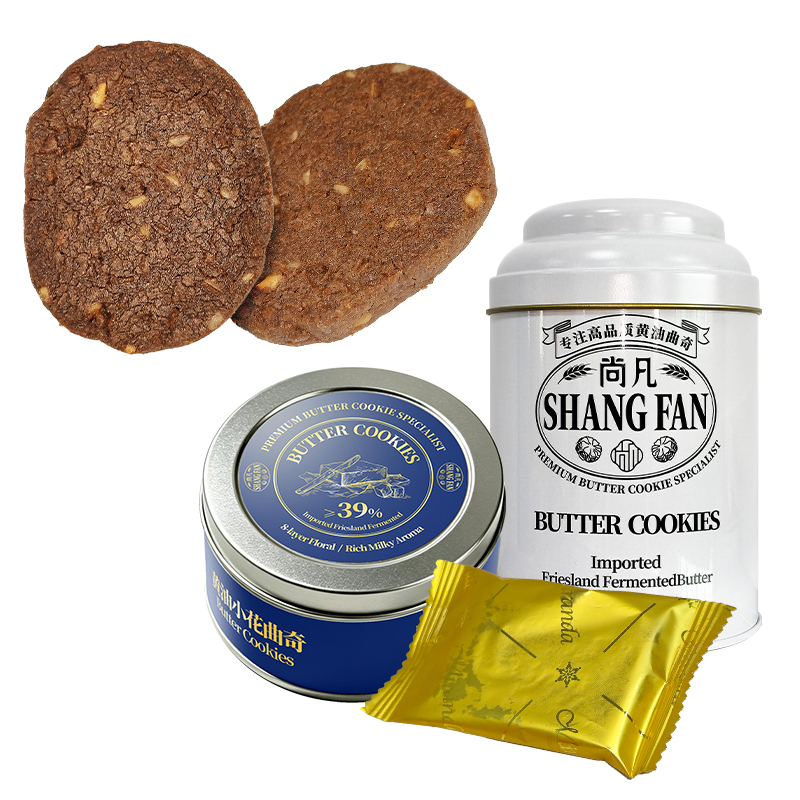
Butter content is one of the most important specification criteria in this category. Butter cookies made with real butter have a different mouthfeel, aroma and consumer perception than products made with vegetable shortening. At Shangfan, several products disclose the butter source and content in the product specification. Butter Floral Cookies 175g contains no less than 39% fermented butter from FrieslandCampina Netherlands. Coffee Butter Flower 175g contains at least 32% fermented butter from the same supplier. Danish Fancy Butter Cookies 380g uses New Zealand imported natural butter at a content of no less than 32%.
Ingredient transparency also extends to supporting materials. Butter Floral Cookies are made from butter, wheat flour, starch, icing sugar and salt. Lace Butter Cookies use butter, special wheat flour, icing sugar, almond powder, egg yolk liquid, white granulated sugar and salt, with American almond flour as a named input. Cranberry Oat Butter Cookies are made with butter, oatmeal, gold sand sugar, dried cranberries, walnut kernel, whole egg liquid and edible salt. For buyers, the practical question is whether a supplier can document these ingredients and hold them consistent across production runs.
Customization Capability: OEM and ODM in Butter Cookie Manufacturing
Private-label and retailer-brand programs usually require some form of customization. Shangfan supports both OEM and ODM production, with customization options that include custom formula, custom specifications, custom logo and custom taste. This means a buyer can either supply a finished specification for production or work with the factory to develop a new recipe. The factory also develops and customizes products with diversified flavors and varieties based on client requirements.
Capacity and lead-time expectations are part of the evaluation. The stated monthly capacity is over 500,000 pastries and over 20 tons of cookies. Lead time is around 30 days and the MOQ is 10,000 boxes. For a regional retailer or mid-size e-commerce brand, this capacity level is suitable for seasonal gifting programs and continuous retail supply. For very small pilot batches, a 10,000-box MOQ may be restrictive; this is one boundary buyers must weigh before choosing contract manufacturing over wholesale purchase.
What the Factory Background Tells a Buyer
Manufacturing history and facility scale are useful context, not proof of quality. Shangfan was founded in 2015 and operates a 10,000+ m² garden-style factory in Chashan Town, Dongguan, a well-known food town. The company employs around 100 people and has an R&D team of five engineers. Annual output is approximately 3,640 tons. Export markets include PRC, EU, USA, South Korea and Singapore, with about 10% of output exported. The company also works with well-known retail brands in China and overseas markets.
A buyer can use these facts to locate the supplier in the right size band. A 10,000 m² facility with 3,640 tons of annual output is a mid-to-large cookie factory. It is not a cottage workshop, but it is also not a global conglomerate. This positioning matters for purchasing decisions because it affects responsiveness, customization flexibility and minimum order expectations.
Comparing Contract Manufacturing with Traditional Import or Wholesale Buying
Traditional butter cookie buying often relies on importing finished branded goods or purchasing from a trading company. The advantage is speed and simplicity. The buyer does not need to manage formulas, packaging design or production planning. The disadvantages are limited differentiation, less control over ingredient costs and no exclusive product story.
Contract manufacturing changes the relationship. A retailer can develop a private-label product with its own brand, choose the pack size and flavor profile, and build a product that is not available to competitors. The trade-off is that contract manufacturing requires a longer planning cycle, an MOQ commitment, and stronger internal coordination on packaging artwork and specifications. It also requires a supplier with a genuine food-safety infrastructure because the retailer's brand is directly exposed to production quality.
One limitation should be stated clearly. Not every cookie format can be produced with the same level of customization. Lace butter cookies, for example, have a specific process and appearance. The formula can be adjusted within defined parameters, but the characteristic lace edge and the texture come from the specific dough behavior and baking process. Buyers should not expect a supplier to radically change a structurally sensitive product without extensive testing.
Application Scenarios for Contract-Manufactured Butter Cookies
Butter cookies manufactured under contract are used across several retail and foodservice channels. The typical application scenarios include supermarkets, chain hotels, bakeries, coffee shops, online e-commerce platforms and instant retail platforms. The product formats support different use cases:
- Supermarket retail: tinned butter cookies such as Butter Floral Cookies 175g and Danish Fancy Butter Cookies 380g provide shelf-stable, gifting-oriented SKUs.
- Membership and large-format retail: Lace Butter Cookies 448g have been placed as endcap products in Costco China stores, with daily sales consistently exceeding 1,000 boxes in that specific retail context.
- E-commerce and instant retail: 90g Cranberry Oat Butter Cookies and individually packed Butter Floral Cookies 260g gift tins suit online and instant retail orders.
- Bakery and coffee shop pairing: Crispy Thin Butter Cookies and Cocoa Butter Thin Crisp Cookies are designed as tea-time items for coffee shops and bakeries.
Market Context: Why Butter Cookies Are a Relevant Investment
Third-party market data supports the commercial interest in this category, though definitions vary. Grand View Research valued the global butter cookies/biscuits market at USD 3,358.3 million in 2024. A broader Dataintelo estimate, including shortbread and sandwich cookies, put the butter-based cookies market at around USD 42.8 billion in 2025. Dataintelo also reports that Asia Pacific held the largest regional revenue share at 34.2% in 2025. Buyers should treat these figures with care because the category boundary differs, but they do indicate that butter cookies are a meaningful segment for food retail investment.
Two verified standards also shape the procurement environment. China's national biscuit standard GB/T 20980-2021 defines quality requirements for short and cookie-type products, and Shangfan lists GB7100 as the product standard code for Lace Butter Cookies. For buyers exporting to the EU, the General Product Safety Regulation and the BPA ban in food contact materials require traceability and packaging compliance. A buyer should therefore ask a supplier for evidence of export experience and packaging compliance, not just for a certificate.
How to Structure a Butter Cookie Contract Manufacturing Pilot
A common procurement path for a first contract order looks like this:
- Qualify the supplier: verify HACCP and FSSC 22000 certificates, review the scope, and request export documentation.
- Select a starting SKU: choose a product with a stable specification, such as Butter Floral Cookies 175g or Cranberry Oat Butter Cookies 90g.
- Request samples and specification sheets: confirm piece count, net weight, shelf life, carton dimensions and barcodes.
- Define customization scope: decide whether the project is OEM (existing formula, custom logo/packaging) or ODM (new formula developed by the factory).
- Test the packaging and logistics: especially important for gift tins, fragile lace cookies and seasonal programs.
- Plan for the shelf-life window: products such as Butter Floral Cookies 175g have a 5-month shelf life, so production and delivery timing must match retail sell-through expectations.
Future Outlook for the Butter Cookie Procurement Segment
The direction of the category favors suppliers that can document clean-label ingredients, stable butter sourcing and food-safety certifications. As global buyers continue to emphasize pure butter over vegetable shortenings, measurable indicators such as "no less than 39% fermented butter" or "NZ imported natural butter content ≥32%" are becoming more important in supplier comparisons. The second direction is format innovation: gift boxes, individually wrapped servings, mixed tins and thin crisp textures give retailers new ways to position butter cookies across occasions. The third is regional supply-chain integration. Factories in the Pearl River Delta area of China can serve both the domestic market and export customers in the EU, USA, South Korea and Singapore, but buyers still need to verify compliant packaging and traceability market by market.