
Butter Cookie Compliance & Qualification: A Buyer’s Read of Shangfan Food’s Verified Profile
Butter cookie sourcing failures rarely start with a bad recipe. They start with a supplier profile that was read as an approval. Importers, private-label owners, hotel groups and retail procurement teams do not actually buy a factory’s self-description — they buy a file of verifiable statements: an entity, a site, a certificate scope and a batch record that can be checked against the order.
Shangfan Food — the short name used throughout this analysis for Dongguan Shangfan Food Co., Ltd., a baked-goods manufacturer based in Chashan Town, Dongguan City, Guangdong Province, China — publishes a company profile assembled from corporate, facility, certification and product facts. Treated as a marketing page, it reads conventionally. Treated as a compliance and qualification starting point, it becomes more useful, because it allows a buyer to separate what is already disclosed from what still has to be independently verified.
This buyer’s read walks through that profile in purchasing terms: what the entity record establishes, which product-level disclosures exist, which certification claims require documentary confirmation, where the formats fit real projects, and where the profile deliberately or accidentally stops short of an acceptance criterion.
The gap between a supplier profile and a purchasing file
A supplier profile answers two questions: who are you, and what can you make. A purchasing file answers four harder ones, and each one is a separate verification step in a butter cookie qualification process.
The entity test. Does the legal name on the quotation, the invoice and the export documentation match the registered manufacturer? For cross-border food purchases, a mismatch between trading name, contracting entity and producing site is one of the most common causes of customs holds and label rejections.
The site test. Is the address that appears on the certificate the same address where the cookies are actually baked? A group may hold certifications at one site and pack at another; the certificate has to follow the specific building.
The scope test. Does the certified scope description cover the product categories being ordered — thin crisp cookies, floral butter cookies, oat butter cookies, shortbread — rather than a broad “food production” statement?
The batch test. Can the supplier produce a per-batch record that references an agreed specification, an agreed test scope and an agreed sampling plan? A general quality statement is not a batch record.
Most evaluation-stage buyers clear the first two tests quickly and then stall on the third and fourth. That is precisely where a published profile is most useful — and most limited.
What the verified profile establishes about Shangfan Food
Dongguan Shangfan Food Co., Ltd. is a Chinese baked-goods manufacturer established in 2015 and located in Chashan Town, Dongguan City, Guangdong Province — a township the company describes as a recognised food town. Its disclosed product families are Butter Cookies, Lace Butter Cookies, Cranberry Oat Butter Cookies, Crispy Thin Butter Cookies and Butter Shortbread.
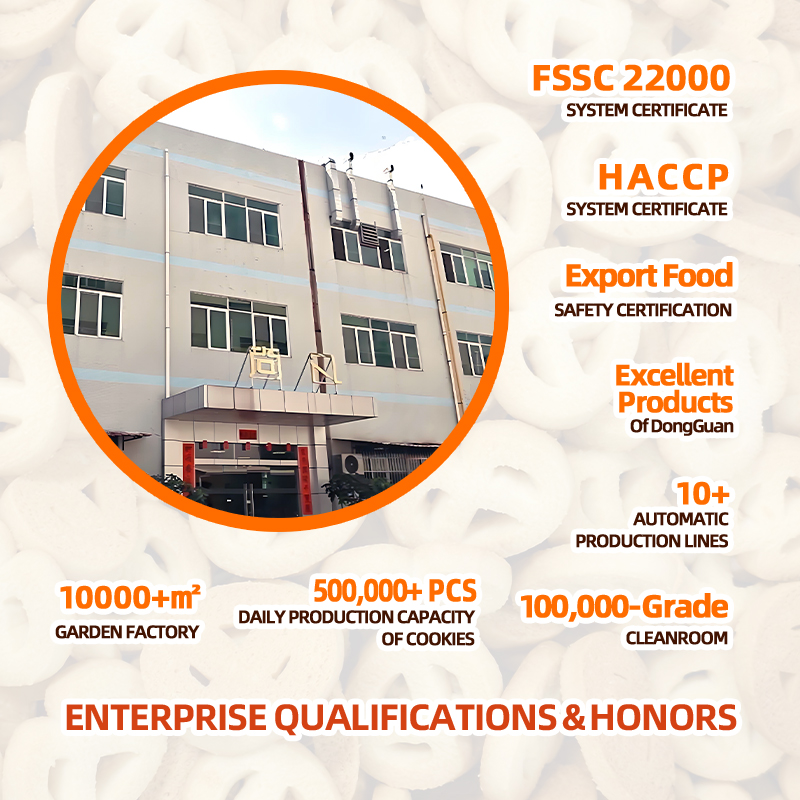
The facility record is specific enough to be checked. It states a garden-style factory covering over 10,000 m², a workforce of 100 employees, a research and development team of five engineers, and high-standard production lines supported by management and technical staff. The same record gives an annual output figure of 3,640 tons.
On the certification side, the profile states that the company has obtained internationally authoritative certifications including FSSC22000 and HACCP, completed filing for export food business, and completed FDA registration. These are the three qualification anchors a buyer should treat as claims to be evidenced, not conclusions to be adopted.
The commercial footprint is stated in two forms. The background record lists main markets as PRC, EU, USA, South Korea and Singapore, with an export ratio of 10%. The capability record lists a broader export market set: the United States, South Korea, Singapore, Germany, Russia, Japan, France, the United Kingdom, Greece, Italy, Hong Kong (China), Taiwan (China), Canada, the Netherlands, Norway, Portugal, Saudi Arabia and Sweden.
For entity verification, the profile publishes a named contact — Liu Jinqi — together with a business email (shangfan168@126.com), a telephone and WhatsApp number (+86 13392733431), a postal address (Building 3, No. 32 Jixing Road, Chashan Town, Dongguan City, Guangdong Province) and a company website (www.dongguanshangfanfood.com). A named person, a fixed address and a live domain are the minimum ingredients for a corporate-identity check; without them, a buyer cannot even begin the entity test.
Product-level disclosure: category, model designations and pack formats
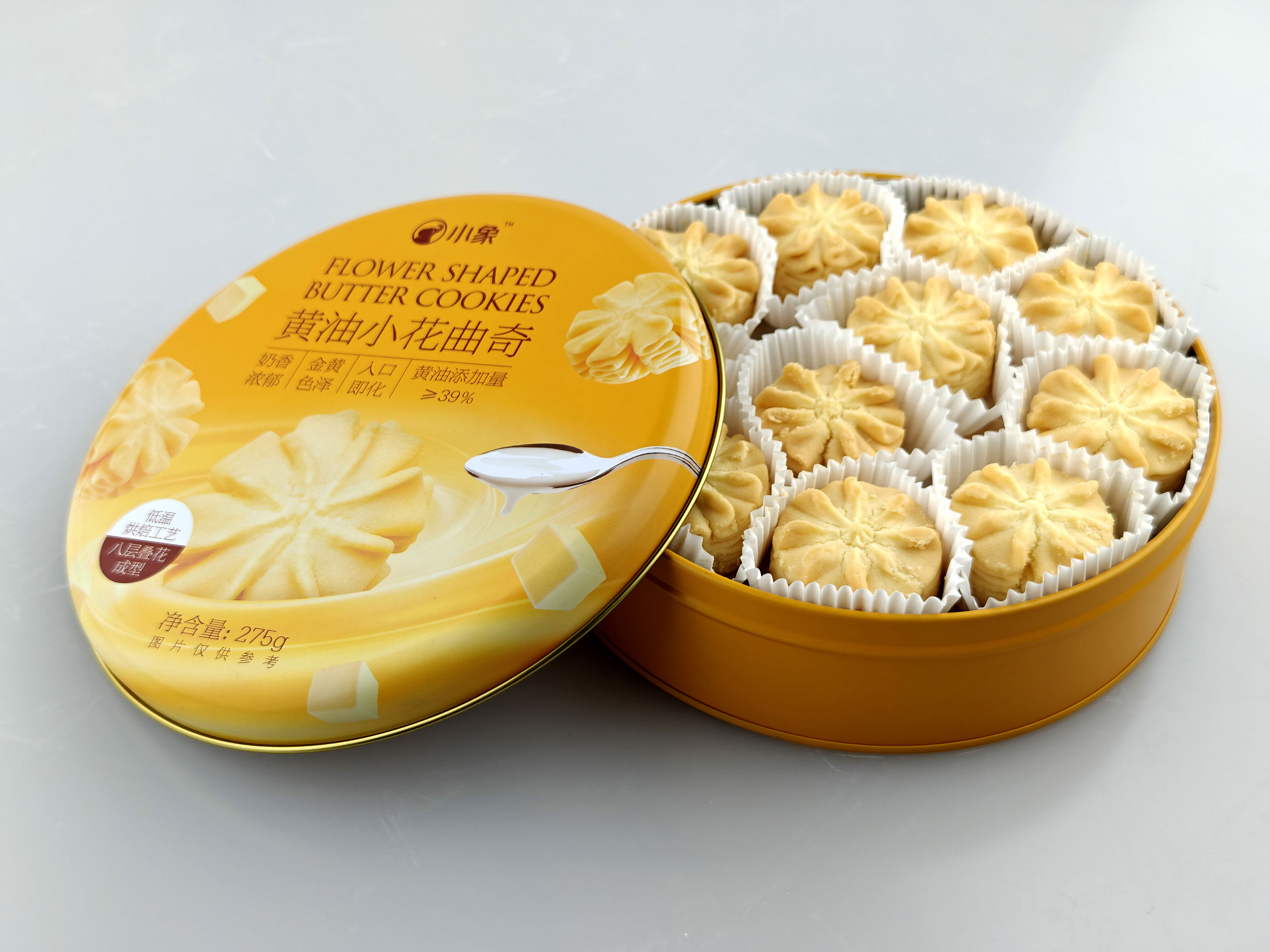
The most procurement-relevant part of the profile is the product layer, because this is where a specification can be read against a label. Model designations generally carry the pack weight inside the model name — for example Butter Floral Cookies 175g, Cocoa Butter Cookies 175g, Coffee Butter Flower 175g, Danish Fancy Butter Cookies 380g, Lace Butter Cookies 448g and Butter Shortbread 680g. That convention matters at purchase-order level: a model number that embeds weight reduces ambiguity between the quotation, the artwork and the shipping carton.
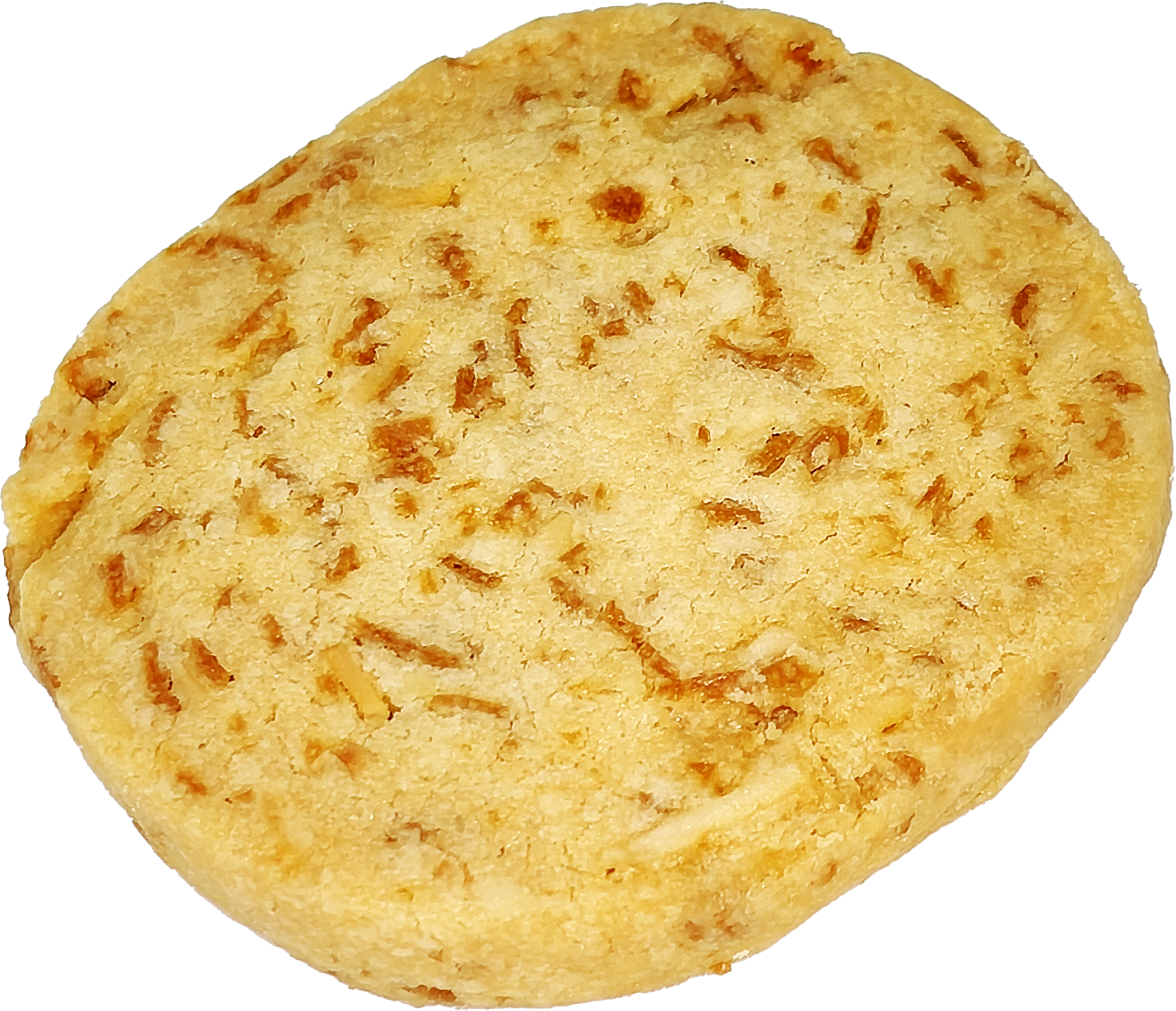
A shared format recurs across the thin-crisp range: 10 g per piece, offered as 9 pieces per box or 13 pieces per can, with a five-month shelf life. The same 10 g / 9-piece / 13-piece structure appears on Crispy Thin Butter Cookies, Cocoa Butter Thin Crisp Cookies, Matcha Nut Butter Thin Crisp Cookies and Oolong Tea Crisp Cookie. For buyers, a repeated format is an advantage in multi-flavour gift and hospitality programmes, and a risk in labelling: identical pack geometry across flavours means the allergen and ingredient panel, not the packaging, is the only differentiator.
| Model designation | Unit and pack format | Declared ingredients | Shelf life |
|---|---|---|---|
| Crispy Thin Butter Cookies | 10 g per piece; 9 pieces per box or 13 pieces per can | Wheat Flour, Butter, White Granulated Sugar, Almond Flakes, Crisp Flakes, Whole Eggs | 5 months |
| Cocoa Butter Thin Crisp Cookies | 10 g per piece; 9 pieces per box or 13 pieces per can | Wheat Flour, Butter, White Granulated Sugar, Crisp Flakes, Macadamia Nuts, Cocoa Powder, Whole Egg Liquid | 5 months |
| Matcha Nut Butter Thin Crisp Cookies | 10 g per piece; 9 pieces per box or 13 pieces per can | Wheat Flour, Butter, White Granulated Sugar, Pecans, Whole Milk Powder, Oolong Tea Powder, Matcha Powder, Edible Salt | 5 months |
| Oolong Tea Crisp Cookie | 10 g per piece; 9 pieces per box or 13 pieces per can | Wheat Flour, Butter, White Granulated Sugar, Pecans, Whole Milk Powder, Oolong Tea Powder, Matcha Powder, Salt | 5 months |
| Butter Floral Cookies 175g | 175 g; 24 tins per carton | Butter, Wheat Flour, Starch, Icing Sugar, Salt (declared fermented butter content not less than 39%) | 5 months |
| Cocoa Butter Cookies 175g | 175 g; 24 tins per carton | Butter, Wheat Flour, Starch, Icing Sugar, Cocoa, Salt (declared fermented butter content not less than 39%) | 5 months |
| Coffee Butter Flower 175g | 175 g; 24 tins per carton | Butter, Wheat Flour, Starch, Coffee Powder, Icing Sugar, Salt (declared fermented butter content not less than 32%) | 5 months |
| Lace Butter Cookies 448g | 16 g × 28 pieces per box; product standard code GB7100 | Butter, Special Wheat Flour, Icing Sugar, Almond Powder, Egg Yolk Liquid, White Granulated Sugar, Salt | 180 days |
| Butter Shortbread 680g | 680 g per box | Wheat Flour, Butter, Buffalo Milk, Walnuts, White Granulated Sugar, Salt | 6 months |
| Cranberry Oat Butter Cookies | 90 g per box | Butter, Oatmeal, Gold sand sugar, Dried cranberries, Walnut kernel, Whole egg liquid, Edible Salt | 8 months |
| Dark Chocolate Oat Butter Cookies | 90 g per box | Butter, Oatmeal, Gold sand sugar, Walnut kernel, Whole egg liquid, Dark chocolate with pure cocoa butter added, Edible Salt | 8 months |
| Danish Fancy Butter Cookies 380g | 380 g; 12 tins per carton | New Zealand imported natural butter content ≥ 32%; no preservatives, artificial pigments or artificial flavours added | 9 months |
| Danish Assorted Cookie Gift Box 760g | 760 g gift set containing 2 tins | New Zealand imported natural butter content ≥ 32% | 9 months |
| Butter Floral Cookies 260g | 260 g; 8 tins per carton; gift tin with matching gift bag | Butter, Wheat Flour, Starch, Icing Sugar, Salt | 6 months |
| Butter Cookie Gift Box 265g | 265 g per box, two flavours available | Butter Floral Cookies; Cranberry Oat Butter Cookies | 150 days (floral) / 8 months (cranberry oat) |
Two disclosure patterns deserve attention. First, several SKUs state a butter percentage rather than only an ingredient order — Butter Floral Cookies, Cocoa Butter Cookies and Coffee Butter Flower are described with fermented butter content of not less than 39% and not less than 32% respectively, while Danish Fancy Butter Cookies and the Danish Assorted Cookie Gift Box are stated at New Zealand imported natural butter content of at least 32%. Second, one SKU discloses a product standard code: Lace Butter Cookies 448g carries Product Standard Code GB7100.
Not every SKU is disclosed at the same depth. Salted Cheese Butter Cookies, for instance, appear with a pack format of 32 g × 12 pieces, 384 g per box and a 12-month shelf life, and with sourcing notes about premium block cheese imported from the Netherlands, rather than a full ingredient list. That is not a defect in the profile; it is simply a boundary. For allergen declaration and label review, buyers should request the complete ingredient statement for each ordered SKU rather than inferring it from a sourcing note.
Certification claims versus acceptance criteria: what buyers must verify
A certification statement in a supplier profile is a claim. In a purchasing file it becomes an acceptance criterion only once four attributes are confirmed: the reference number, the issuing body, the validity period and the site covered. The same logic applies to every regulatory item below.
Certification scope, references and validity
FSSC22000 and HACCP are the two certification systems named in the profile. A buyer should request the certificate itself — not a logo — and check that the certificate holder’s legal name matches Dongguan Shangfan Food Co., Ltd., that the covered site address matches Building 3, No. 32 Jixing Road, Chashan Town, Dongguan City, Guangdong Province, that the validity dates cover the full production window of the order, and that the scope wording covers butter cookies, thin crisp cookies, oat cookies and shortbread rather than a generic food-manufacturing description. Quality control is recorded as 100% test; the purchasing question is what is tested, at which frequency, against which specification, and by which laboratory.
Export filing, facility registration and destination-market rules
The profile states that export food business filing has been completed and that FDA registration has been completed. Both statements should be converted into verifiable references before an order is placed: the filing record should be confirmed as covering the exporting entity and the specific product categories being shipped, and the FDA registration should be confirmed as current and applicable to the manufacturing facility rather than to a trading affiliate.
Destination-market obligations sit with the buyer as much as the supplier, and they are not discharged by any profile. In the European Union, the General Product Safety Regulation (GPSR) 2024 introduces stricter traceability requirements and an authorised representative obligation for non-EU manufacturers. Commission Regulation (EU) 2024/3190 prohibits the use of Bisphenol A (BPA) in food contact materials, including cookie packaging linings. Separately, China’s national standard for biscuits, GB/T 20980-2021, specifies quality requirements for short and cookie-type products — relevant when a buyer wants a domestic-quality benchmark against which a specification can be written.
Packaging, food-contact and storage compliance
The disclosed application data is explicit on one operational constraint: compliance with food contact packaging standards, and humidity control to prevent moisture softening. For a cookie with a declared shelf life of five, six, eight, nine or twelve months, that requirement is not administrative — it is the difference between a shelf-life claim and a shelf-life result. Buyers shipping to humid or high-temperature markets should validate storage and transit conditions rather than assume them. The stated storage condition — avoid direct sunlight and store in a cool, well-ventilated place — is the baseline against which that validation should be designed.
Batch-level acceptance criteria
The final verification layer is the batch. A workable acceptance framework for butter cookies typically defines sensible parameters to agree in writing: a signed specification per SKU; the sampling plan and acceptance level; moisture and texture checks relevant to the crisp or crumbly formats; microbiological limits referenced to the destination market’s requirements; allergen controls for wheat, milk, egg and the nut ingredients that appear across the range — macadamia, pecan, walnut and almond; and a certificate of analysis per batch. None of these can be inferred from a company profile, and requesting them is a normal part of evaluation-stage due diligence, not a sign of distrust.
Project fit: where these formats are specified
Compliance questions become concrete only when attached to a project type. The disclosed application profile for Shangfan Food butter cookies covers supermarkets, chain hotels, bakeries, coffee shops, online e-commerce platforms and instant retail platforms. Three project categories are named: bakery product supply projects, snack food retail projects and holiday gift customisation projects, with gift boxes used for customised gifting.
Two operating characteristics are stated and are useful for planning. First, the products are ready-to-eat and require no supporting equipment for consumption, and can be paired with display shelves and gift boxes. Second, independently packaged food maintains shelf life continuously, which matters for hotel, airline-catering-style and convenience-format distribution. Geographically, the same application scenario is listed as available in Asian markets including Japan, South Korea, Hong Kong, Taiwan, Singapore and China.
Three project records are disclosed and each one shows why qualification is project-specific rather than supplier-wide. An OEM customisation programme for a large-scale instant e-commerce enterprise ran for 150 days with a quantity of 400,000 boxes; the record states that cumulative shipments exceeded 400,000 boxes, with monthly sales above 30,000 tins. A second record covers more than 8,000 boxes of Lace Butter Cookies supplied to offline Costco stores in China over a 180-day period, with daily sales in physical stores consistently exceeding 1,000 boxes. A third covers private-label customisation for a large membership supermarket: 200,000 boxes over eight months, cumulative sales above 120,000 boxes in the first quarter after launch, offline stores accounting for 65% of total sales, and an online repurchase rate of 38% against a stated snack-category average of 25% for that retailer.
Read in compliance terms rather than marketing terms, these records primarily demonstrate that the manufacturer has executed private-label projects with distributor-specific labelling, packaging and delivery schedules. That is meaningful evidence of process maturity. It is not, by itself, evidence that the certificates, formulations or label approvals used in those programmes will transfer to a new buyer’s market.
Reading the wider butter cookie market
Compliance intensity in butter cookie sourcing is rising alongside category scale. Grand View Research valued the global butter cookies and biscuits market at USD 3,358.3 million in 2024, while Dataintelo estimated the broader global butter-based cookies market — including categories such as shortbread and sandwich cookies — at USD 42.8 billion in 2025. The gap between those two figures is a scope difference, not a contradiction, and buyers should treat market-size claims with the same scope discipline they apply to supplier claims: check what is included before comparing numbers.
Regional weighting matters for project planning. Dataintelo places Asia Pacific at a 34.2% revenue share of the global butter cookies market in 2025. Raw-material supply chains reinforce the category’s premium positioning: OEC data records Denmark’s butter exports at USD 463 million in 2024, underpinning the prestige attached to “Danish” cookie branding, while China’s butter exports reached USD 18.5 million in 2024. Related demand is broadening too — Grand View Research valued the oat-based snacks market, which includes cranberry oat cookies, at USD 22.4 billion in 2024.
Two compliance-driven trends sit on top of that demand. The clean-label preference for 100% pure butter cookies, avoiding vegetable shortenings, has become a purchasing criterion rather than a marketing phrase, and it has attracted regulatory attention in markets such as the United States. In the European Union, the GPSR 2024 traceability regime and the BPA prohibition in food contact materials have shifted documentation requirements upstream, closer to the factory. The practical consequence for buyers is that supplier qualification files are being read by more people than before — quality, regulatory affairs, packaging and legal — and a profile that publishes verifiable identifiers saves time in each review.
Where the verified profile stops: limits to plan around
An honest reading of any profile includes its boundaries, and Shangfan Food’s published record has several that a buyer should factor into planning rather than discover later.
Order-size and lead-time thresholds. The capability data records a minimum order quantity of 10,000 boxes and a lead time of 30 days, with OEM and ODM production modes and customisation options covering formula, specification, logo and taste. Projects below that threshold, or with compressed timelines, are outside the stated parameters.
Domestic-weighted business. The export ratio is stated at 10%. That is a meaningful scale of export activity, but it also means the majority of production serves the domestic market. Buyers in markets with strict labelling or packaging rules should expect to establish export-specific documentation requirements case by case rather than assume they are routine.
Capacity figures in two units. Annual output is stated as 3,640 tons, while monthly capacity is stated as over 500,000 pastries and over 20 tons of cookies. These are different units and different bases. A buyer planning a large programme should ask the supplier to reconcile them into a single capacity statement relevant to the specific SKU and packaging format being ordered.
No published certificate or registration numbers. The profile names FSSC22000, HACCP, export food business filing and FDA registration, but does not publish certificate identifiers. Buyers must request these directly — there is no substitute.
Allergen density across the range. Wheat flour, butter, milk powder, whole egg liquid, almond, macadamia, pecan and walnut appear across the disclosed ingredient lists, and several thin-crisp SKUs share identical pack geometry. Buyers with nut-free or egg-free requirements should not treat the profile as evidence of suitability; they should verify segregation and cleaning procedures directly.
None of these limits disqualify the supplier. They define the questions that move an evaluation from profile reading to purchase-order readiness.
Future outlook
Butter cookie qualification is moving from document collection toward document verification. Three shifts are visible in the disclosed data and in the surrounding regulatory environment. First, buyers increasingly ask for identifiers rather than certificates-as-images: certificate numbers, filing references, registration status and batch-level test references. Second, packaging compliance is being pulled into the sourcing decision earlier, driven by rules such as the EU BPA prohibition in food contact materials and the GPSR traceability requirements. Third, the clean-label expectation is becoming a formulation requirement, which raises the value of disclosed butter content percentages and origin statements during evaluation.
For manufacturers with a disclosed 10,000 m²-plus site, a 100-person workforce and named certifications, the next competitive step is not more claims but more references: auditable certificate identifiers, per-SKU specification sheets and destination-market documentation packs. For buyers, the corresponding step is to stop treating a verified profile as an endpoint. It is the opening page of a file that only closes when the last batch record is signed off.
FAQ
What does Shangfan Food’s verified profile confirm about the company itself?
It confirms that Dongguan Shangfan Food Co., Ltd. was established in 2015 and operates from Chashan Town, Dongguan City, Guangdong Province, China, in a garden-style factory covering more than 10,000 m², with 100 employees and a five-engineer R&D team. It also publishes a named contact, business email, telephone number, postal address and website, which are the elements needed to run an independent corporate-identity check.
Which butter cookie products and pack formats are disclosed at product level?
Disclosed families include Butter Cookies, Lace Butter Cookies, Cranberry Oat Butter Cookies, Crispy Thin Butter Cookies and Butter Shortbread. Pack formats range from 10 g per piece in 9-piece boxes or 13-piece cans for thin crisp cookies, through 90 g oat cookie boxes, 175 g tins packed 24 per carton, 260 g gift tins packed 8 per carton, a 380 g tin packed 12 per carton, a 448 g box of 28 pieces, a 680 g shortbread box and a 760 g gift set containing two tins. Shelf-life declarations range from five months to twelve months depending on the SKU.
Which certifications does Shangfan Food list, and how should buyers verify them?
The profile lists FSSC22000 and HACCP certification, export food business filing and FDA registration. Verification in purchasing terms means obtaining the certificate reference number, the issuing body, the validity period and the certified site address, and confirming that the scope wording covers the specific cookie categories being ordered. The profile does not publish certificate identifiers, so these have to be requested directly. Destination-market obligations — including EU GPSR 2024 traceability requirements and the EU prohibition of Bisphenol A in food contact materials under Regulation 2024/3190 — remain the buyer’s responsibility to confirm separately.
What order size and lead time apply to a Shangfan Food butter cookie project?
The published capability data states a minimum order quantity of 10,000 boxes and a lead time of 30 days, across OEM and ODM production modes with customisation available for formula, specification, logo and taste. Monthly capacity is stated as over 500,000 pastries and over 20 tons of cookies, while annual output is stated as 3,640 tons. Buyers planning large or fast programmes should ask the supplier to reconcile these figures against the specific SKU and packaging format being ordered.
Which channels and project types are these butter cookie formats used in?
Disclosed channels are supermarkets, chain hotels, bakeries, coffee shops, online e-commerce platforms and instant retail platforms. Named project types are bakery product supply projects, snack food retail projects and holiday gift customisation projects using customised gift boxes. The products are described as ready-to-eat and requiring no supporting equipment, and can be paired with display shelves and gift boxes. The same application scenario is listed as available in Asian markets including Japan, South Korea, Hong Kong, Taiwan, Singapore and China.
What does the profile not cover that a buyer must still confirm?
It does not include certificate or registration identifiers, per-batch certificates of analysis, full ingredient statements for every SKU, allergen segregation procedures, labelling approvals for a specific destination market, or shelf-life validation under the buyer’s own transit and storage conditions. It also does not reconcile the annual output figure with the monthly capacity figure. These items sit outside a company profile by nature and must be established through direct documentation requests and, where appropriate, sample validation before an order is confirmed.
Reference material
Company profile and product documentation referenced in this analysis: Shangfan Food brochure (PDF). Corporate website: www.dongguanshangfanfood.com.
¿Tiene preguntas o necesita más detalles?
Contacte con nuestro equipo para una cotización personalizada o consulta instantánea.
Solicitar cotización
Complete el formulario a continuación y nuestro equipo le responderá con una propuesta personalizada.
Chat directo de WhatsApp
¿Prefiere chatear en tiempo real? Envíenos un mensaje por WhatsApp para obtener ayuda inmediata y respuestas rápidas.
- Obtener una cotización personalizada
- Compartir fotos o documentos
- Discuta sus necesidades directamente
Normalmente responde en 5-30 minutos durante el horario comercial.