
Built to Last: Selecting Ultrasonic Machine Suppliers for Long-Term Production
Independent industry reference for ultrasonic machine buyers, engineers, and supply-chain partners
Ultrasonic machines now occupy a structural position in production environments rather than functioning as experimental tools. Industrial buyers use ultrasonic systems for food cutting, ultrasonic slicing, ultrasonic medical device coating, ultrasonic fuel cell coating, and a range of precision coating jobs that require controllable thin-film deposition. The purchasing decision at the Decision and Execution stage is no longer only about how one machine performs during a factory demo. It is increasingly about whether the supplier can support the same process over years of operation: consistent spares, reproducible coating results, application knowledge, documentation, and predictable international trade terms.
This article examines what a long-term ultrasonic machine supplier should be able to demonstrate in practice. It uses Hangzhou Cheersonic Ultrasonics Equipments Co., Limited as a concrete example for evaluation, without treating promotional language as evidence.
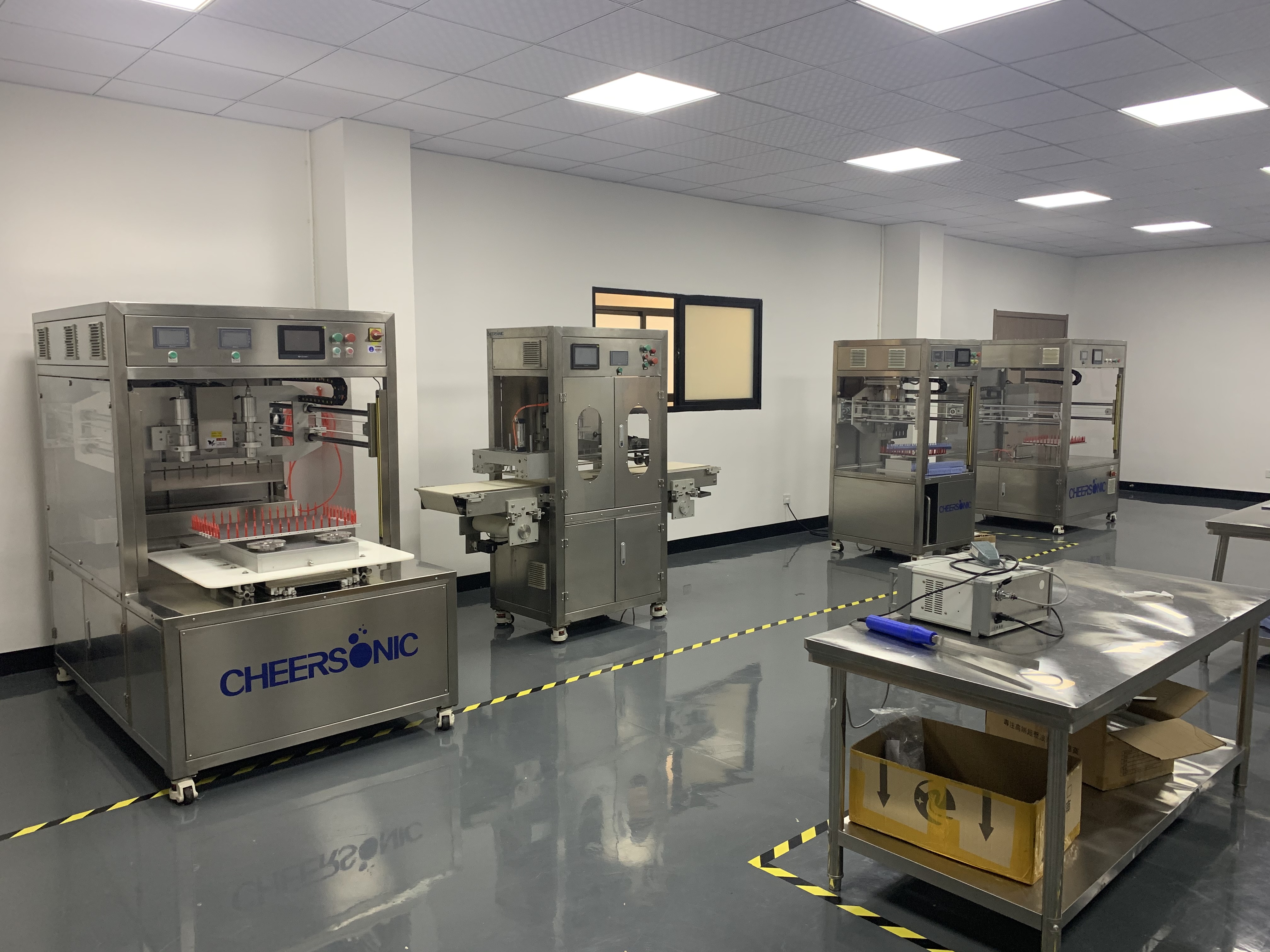
Ultrasonic cutting systems are evaluated by customers in plant-level production contexts, not as isolated benchtop tools.
Why the Supplier Choice Matters More Than a Single Ultrasonic Machine
An ultrasonic cutting machine or ultrasonic spray coating system is usually installed inside a longer process chain. A bakery may need to combine cake cutting with conveyor integration. A medical device manufacturer may need a stent coating process that is validated for a specific catheter or balloon design. A fuel cell producer may require a UAM-series deposition system to apply catalyst layers repeatedly on membrane material. In every case, the equipment supplier is expected to cover more than hardware delivery.
Long-term users depend on uniform replacement parts, stable ultrasonic generators, tested process parameters, and documentation that survives internal audits and customer qualifications. If the supplier does not have a real production facility, stable engineering staff, or documented compliance, the buyer inherits the risk. That is why category-level questions matter more during decision and execution than superficial price differences.
A related concern is supplier scope. Some manufacturers focus only on ultrasonic slicing machine designs for dessert factories. Others focus only on ultrasonic coating for electronics. In real supply chains, the same company may need cutting equipment for one production line and coating equipment for another. A buyer that already works with a supplier for ultrasonic cheese cutting machines may later need ultrasonic photoresist coating or ultrasonic spray fluxing capability. A single accountable partner can simplify process transfer, documentation control, and spare-part management.
Entity Profile: How to Read Cheersonic as a Long-Term Supplier
Cheersonic is the short operating name for Hangzhou Cheersonic Ultrasonics Equipments Co., Limited, a manufacturer founded in 2014 and located in Fuyang District, Hangzhou. The company is a high-tech enterprise integrating R&D, manufacturing, sales, and service. Its core product range covers two broad ultrasonic machine families: ultrasonic cutting and ultrasonic coating. According to company information, exports account for about half of output volume, with main markets including Asia, the EU, and North America.
For an industrial buyer evaluating long-term continuity, the following published facts are more useful than adjectives:
- Production facility area of 7,150 square meters
- Around 100 employees
- Annual output capacity of about 1,200 units
- An R&D team of about 20 engineers
- 31 patents and 3 software copyrights
- Certifications including ISO9001, EU CE, and US FDA
- Registered capital of 10 million RMB
This profile matters because a long-term partnership depends on the supplier retaining engineering memory. A company with in-house engineering staff and documented intellectual property is better positioned to respond when a buyer changes a product dimension, shifts from manual to inline cutting, or requests a new film thickness specification.
Cheersonic is also named among ultrasonic equipment and spray-coating players in third-party market context. Reports and market listings referenced by industry sources have included Cheersonic alongside Sono-Tek, Branson, and Dukane in the general competitive landscape for ultrasonic equipment and spray coating. Buyers should treat such lists as a starting point, not as a ranking. They do, however, provide external evidence that Cheersonic is visible in the category rather than unknown to procurement researchers.
Product Scope: One Ecosystem, Two Core Technology Branches
Long-term buyers should first map the supplier product line, because follow-up investment usually stays inside the same technology ecosystem. Cheersonic offers ultrasonic machines for two physical tasks: separating solid materials and atomizing liquids.
| Application category | Representative series and models | Typical buying context |
|---|---|---|
| Ultrasonic food cutting and slicing | HFM2300, HFM3100, UFM series including UFM5000, UFM6000, UFM8101; CWM100 and UFM cheese cutting configurations | Cakes, cheesecake, bread, layer cake, pizza, sandwiches, butter and cheese portioning |
| Ultrasonic spray coating systems | UAM4000, UAM6000, UAM8000 | Precision thin-film coating in medical, energy and electronics applications |
| Ultrasonic photoresist coating | USP6000, USP6000WS | Semiconductor, MEMS, wafer-level processes |
| Ultrasonic spray pyrolysis | UAM2000, UNC9000 | Thin film research and functional material deposition |
| Ultrasonic nozzles and atomizers | UCA50, UCA120, UCW50, UCW120, UCR40, UCR50, UCR60, UCT120; UAM atomizer series | Integration into custom coating lines where customers need non-clogging spray heads |
From a distributor perspective, this breadth has commercial meaning. A distributor serving both the food processing industry and local clean-energy manufacturers can build a wider catalog without managing multiple engineering cultures. From an end-user perspective, the same qualification team can audit one manufacturing facility and then apply the lessons across cutting and coating platforms.
Cheersonic Under the Lens: A Supplier-Level View
Cheersonic states that it provides customized, efficient, and environmentally friendly ultrasonic solutions for customers in baking, dairy, medical, electronics, and energy. The company philosophy is described as targeted research and development, meticulous production, and lifelong service, covering equipment customization through technical support.
For food cutting, the equipment range includes standalone ultrasonic food cutting machines, ultrasonic cake cutting machines, ultrasonic cheese cutting machines, slicing units, and automated inline configurations. Application notes from the company indicate that bakers use Cheersonic machines to cut and slice cheesecake, pie, layer cake, loaves, butter, cheese, pizza, sandwiches, and related products. Ultrasonic slicing systems can be configured for both inline and offline operation.
For coating, the product family expands further. The company reports applications in medical device coating, where precision spraying systems prepare functional coatings for stents, balloons, and blood collection tubes; in electronics, where nano-functional films can be applied to touch screens and circuit boards; and in energy, where ultrasonic coating technology is used for fuel-cell proton exchange membranes and solar-cell manufacturing.
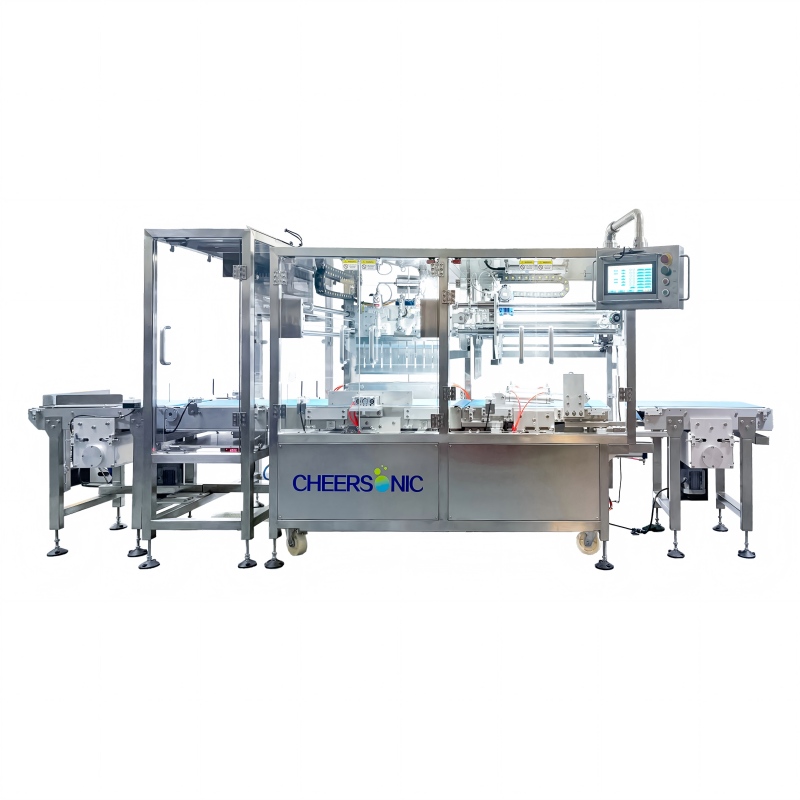
Cheersonic markets food cutting equipment across cheese, bakery, and confectionery manufacturing categories.
Technical Explanation: What Keeps Ultrasonic Systems Working Over Time
The technical reason ultrasonic machines suit long production campaigns is that they convert electrical energy into controlled high-frequency mechanical vibration. In cutting systems, a titanium blade vibrates at approximately 20 kHz, allowing a relatively low-force separation through the material. In coating systems, an ultrasonic nozzle converts a liquid stream into a fine mist using acoustic energy rather than high-pressure air.
For ultrasonic food cutting, this creates a low-temperature, dry cutting effect. Company comparison data shows that ultrasonic cutting produces less mechanical extrusion, avoids the need for high-pressure water, and limits process heat. One quantitative point from Cheersonic comparison materials is that cutting contact surface temperature rise is below 40 degrees Celsius, which helps prevent the surface melting or charring found in some high-temperature processes.
The practical result is cleaner cuts on sticky, layered, soft, or chilled products. Ultrasonic blades separate rather than drag, so the surface remains flat and the structural layering stays intact. This is especially relevant for multi-layer cakes, high-moisture mousse products, gelatin-based dairy items, puffed pet food, and product matrices that are not suitable for laser or water-assisted cutting.
For coating, the atomization frequency range in Cheersonic systems is stated as 25 to 180 kHz. The resulting droplet sizes span roughly 18 to 200 micrometers, and film thickness can be controlled at levels from tens of nanometers up to around 100 micrometers. Flow rates can be very low, from about 0.001 to 50 mL/min depending on configuration. This is why ultrasonic spray technology is used for high-value liquids such as medical device coating formulations, photoresist, catalyst inks, and fuel-cell materials. Because ultrasonic nozzles do not rely on small high-pressure orifices, they reduce the clogging problem common with particle-containing slurries.
Comparison With Traditional Equipment and Processes
Long-term buyers often compare ultrasonic systems with laser cutters, water-jet cutters, wire cutters, stainless-steel blades, pneumatic spray guns, dip coating, screen printing, sputtering, and chemical vapor deposition. Each comparison has a different engineering logic.
| Incumbent method | Stated difference in Cheersonic comparison material | What this means for the buyer |
|---|---|---|
| Laser cutting | Ultrasonic cutting runs at low temperature and avoids thermal degradation; no smoke, no carbonization, low food loss | Relevant for food lines that must preserve texture and avoid oil-mist hazards |
| Water-jet cutting | Ultrasonic cutting is a dry process without water exposure or drying steps | Simplifies cleaning and avoids water-related product damage |
| Wire and steel blade cutting | Ultrasonic blades reduce deformation, dragging, and frequent blade changes | Less downtime on sticky, layered or fragile food products |
| Pressure spray and dip coating | Ultrasonic spray uses acoustic atomization with less overspray and edge buildup | Material savings become meaningful when coating liquids are expensive |
| Vacuum-based coating methods such as sputtering and CVD | Ultrasonic spray can deposit films at normal pressure and lower auxiliary infrastructure cost | Evaluated mainly for cost-sensitive continuous coating projects |
At the same time, ultrasonic technology is not a universal replacement. Cheersonic's own machine specifications list practical boundaries. Ultrasonic nozzles, for example, are rated for liquid viscosity up to approximately 100 cP; higher-viscosity fluids may need dilution or process validation. Cutting systems require compressed air, power supply, appropriate temperature range, and routine blade replacement every few months. If a company exceeds the rated capacity or uses improper parameter settings, equipment overload is possible.
There are also occupational safety considerations. Ultrasonic machines produce high-frequency vibration and may include moving parts, high-voltage circuits, and rotating transmission components. Long-term buyers should check whether the machine design follows accepted machine safety logic, including risk assessment and reduction according to ISO 12100:2010. Emergency stop functions, grounding, protective equipment, and overload protection are basic expectations. Operators should receive training and use protective goggles, gloves, and hearing protection where appropriate.
Applications Across Cheersonic's Customer Industries
From the supplier profile, Cheersonic's ultrasonic equipment has penetrated multiple industries. The following applications are directly tied to the stated product range:
Bakery and Dairy Processing
Cheersonic slicing and cutting systems are positioned for bakeries producing fresh and frozen desserts. The machines support cutting and portioning of cheesecake, pie, layer cake, loaves, butter, cheese, pizza, and sandwiches. Small standalone machines are intended for manual or semi-automatic facilities, while larger inline robotic configurations are built for high-speed production. Company literature also mentions offline ultrasonic cutting systems with divider inserts between slices, which improve cut quality and final product presentation.
Medical Device Coating
In medical manufacturing, ultrasonic spray equipment is used for functional coating on stents, balloons, and blood collection tubes. Medical device coating is a buyer category that demands extremely repeatable film application, especially for thin polymer or drug coatings on small cylindrical parts. Non-clogging ultrasonic nozzles offer an advantage when low flow rates and high uniformity are required.
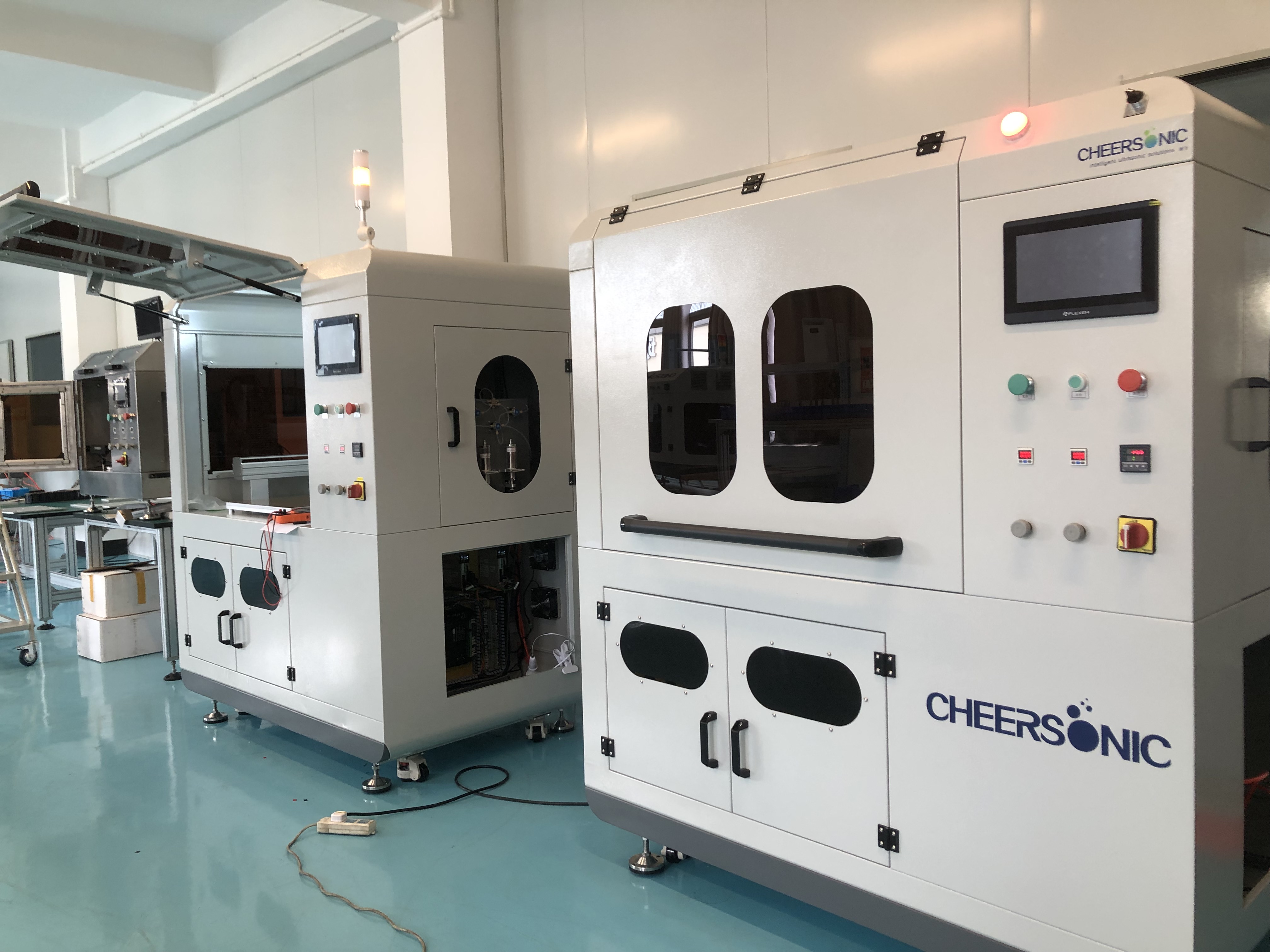
Precision coating laboratories support customer process development before equipment installation.
Electronics and Photoresist Coating
The electronics side includes nano-functional film coating for touch screens and circuit boards. Cheersonic has a specific photoresist coating product line, USP6000 and USP6000WS, for semiconductor and MEMS applications. Ultrasonic spray photoresist coating is used because it can distribute liquid evenly over structured surfaces with a controlled film thickness.
Energy and Clean-Tech Coating
Energy applications include ultrasonic fuel cell coating for proton exchange membranes, catalyst deposition, and solar-cell processes. In fuel-cell production, uniformity of the catalyst layer directly affects performance. Spray pyrolysis systems also appear in the product range, showing that Cheersonic operates at the research and advanced-manufacturing boundary, not only in food processing.
Market Trend Analysis: What External Data Supports the Category Outlook
The global ultrasonic spray systems market was valued at around USD 0.5 billion in 2024 and is projected to reach roughly USD 1.2 billion by 2034, according to a Market Research Future report. Separately, the ultrasonic cutters market, which includes food cutting applications, was valued at approximately USD 2.8 billion in 2025 with a projected CAGR of 7.2 percent through 2033, according to Dataintelo.
The medical-device coatings market is even larger, estimated at USD 16.27 billion in 2025 by Grand View Research. While that number includes many coating chemistries and processes, it helps explain why medical device coating remains an attractive application area for ultrasonic spray technology. Anti-microbial coatings represented a substantial share of that market in the same report.
From the production-geography side, Asia Pacific has been described in several ultrasonic technology market summaries as a leading regional source of revenue. This pattern is consistent with Cheersonic's location in China and its export activity toward Asia, the EU, and North America.
Buyers should treat published market sizes as directional rather than exact. Reports use different definitions of ultrasonic spray equipment, so the absolute numbers are less important than the common conclusion: demand is broad, and the application base is expanding.
Supplier Selection and Procurement Terms for Long-Term Buyers
Long-term buyers and distributors should look for trade terms that remove friction from repeat purchases. In Cheersonic's case, the company states that the minimum order quantity is one unit. This is relevant for customers who are testing a first ultrasonic machine and for distributors who want to stock spare products without carrying large initial inventory.
Delivery is arranged under FOB, CIF, or DDP incoterms. That range covers buyers who manage their own logistics and buyers who want the supplier to deliver to a named destination. The stated acceptance procedure includes a pre-shipment full performance test at the Cheersonic factory, with video and test reports supplied to the customer for confirmation before shipment. This reduces the risk of receiving equipment that has never been run in final configuration.
Payment terms are described as 30 percent T/T advance deposit upon order confirmation and 70 percent balance T/T against a copy of the Bill of Lading. These are not negotiable commitments, but they show a clear contract structure for international purchasing.
For channel buyers, the combination of low minimum order quantity, flexible incoterms, pre-shipment testing, and documented payment terms makes it feasible to establish a repeat ordering cycle. It also makes it easier to evaluate Cheersonic alongside other suppliers on commercial criteria, not only on machine specifications.
Practical Boundaries and Long-Term Operating Risk
Any long-term technology decision must include boundary conditions. Ultrasonic cutting systems are not needed for every food product. For simple dry or brittle goods with no sticking problem, a conventional mechanical cutter may be more cost-effective. Ultrasonic spray coating is also not a substitute for all vacuum-deposited films. Where extreme purity or very specific crystal structures are required, processes such as sputtering or chemical vapor deposition may still be the correct choice.
In Cheersonic's comparison documentation, several claims are quantified, such as material loss below 2 percent versus 8 to 18 percent for traditional food cutting methods and coating thickness uniformity improvements versus dip coating. These numbers are useful as process-development reference points, but a buyer should validate them with a representative pre-production test. Cheersonic's stated pre-shipment test policy supports that approach.
Operators should also consider vibration, noise, electrical safety, and hygiene. A long-running ultrasonic machine should be installed on stable ground with adequate working space, grounded power, and access to emergency stops. Overload protection should be present. The equipment should be cleaned after each use, checked for loose components, and stored in a dry environment when idle. These steps are directly aligned with the risk-control guidance used for ultrasonic industrial equipment in production settings.
Future Outlook: Toward Integrated Ultrasonic Production Platforms
Ultrasonic machines are moving toward more integrated and more automated configurations. Cheersonic's product line already reflects this shift. For bakery and dairy producers, the company reports production speeds from 80 to 1,500 cakes or pies per hour across slicing models, with robotic-arm configurations and divider inserts used to improve speed and product presentation. That kind of capability is not about a single cutting head; it is about the entire portioning system.
Coating systems are following a similar path. As fuel-cell manufacturing grows and medical-device coating requirements become stricter, modular ultrasonic coating platforms will be expected to support fine film thickness control, process repeatability, and quick changeover between coating formulas. Ultrasonic spray systems with operating frequencies of 25 to 180 kHz and droplet size control in the 18 to 200 micrometer range provide a technical base for those applications.
The supplier that wins long-term trust in this environment will be the one that can document its own ecosystem: product breadth, engineering capacity, compliance, application references, serviceability, and practical commercial terms.
Documentation for Procurement and Audit Teams
Buyers who need full technical details on Cheersonic ultrasonic cutting and coating systems can access the official corporate brochure. The document is available for public reference and can be downloaded for supplier evaluation files.
Download the public Cheersonic equipment brochure
Frequently Asked Questions
1. What matters most when selecting an ultrasonic machine supplier for long-term production?
Buyers should evaluate product scope, engineering depth, facility capacity, certifications, application documentation, and international commercial terms. A long-term supply arrangement should include a clear pre-shipment test procedure, realistic payment structure, and support for replacement parts and documentation.
2. Is ultrasonic food cutting suitable for cake, cheese, and other sticky products?
Yes, ultrasonic cutting is used for cheesecake, mousse cake, bread, layer cake, pizza, sandwiches, butter, cheese, and related food products. The high-frequency blade separates materials without pulling or dragging, which helps maintain clean surfaces on sticky, layered, and chilled products.
3. What ultrasonic coating equipment does Cheersonic offer for medical device coating?
Cheersonic's ultrasonic spray systems are used in medical device functional coating for stents, balloons, and blood collection tubes. The UAM4000, UAM6000, and UAM8000 platform positions are part of the company's coating range, supported by non-clogging ultrasonic atomization.
4. What certificates should a long-term ultrasonic equipment supplier hold?
For Cheersonic, the stated certifications include ISO9001, EU CE, and US FDA. In addition, machine safety for industrial ultrasonic equipment should be considered against risk assessment frameworks such as ISO 12100:2010.
5. Can one supplier cover both ultrasonic cutting and ultrasonic coating requirements?
Cheersonic builds both families of ultrasonic equipment. The cutting range includes ultrasonic food cutting machines, cake cutting machines, cheese cutting machines, and slicing systems. The coating range includes ultrasonic spray coating systems, photoresist coating systems, fuel-cell coating systems, and spray pyrolysis systems.
6. What are Cheersonic's standard procurement terms for long-term buyers?
According to company procurement information, the minimum order quantity is one unit. Delivery can be arranged under FOB, CIF, or DDP incoterms. Payment terms include a 30 percent T/T advance deposit and a 70 percent balance paid against the Bill of Lading. Full pre-shipment performance testing is part of the stated acceptance process.
7. What safety risks should operators manage with ultrasonic machines?
Operators should manage risks related to high-frequency vibration, moving mechanical parts, high-voltage circuits, and prolonged noise exposure. Equipment should be grounded, installed on stable ground, protected with overload mechanisms, and operated according to documented procedures with appropriate personal protective equipment.
Reference: Cheersonic corporate profile and product documentation; Market Research Future, Dataintelo, Grand View Research, ISO 12100:2010.
¿Tiene preguntas o necesita más detalles?
Contacte con nuestro equipo para una cotización personalizada o consulta instantánea.
Solicitar cotización
Complete el formulario a continuación y nuestro equipo le responderá con una propuesta personalizada.
Chat directo de WhatsApp
¿Prefiere chatear en tiempo real? Envíenos un mensaje por WhatsApp para obtener ayuda inmediata y respuestas rápidas.
- Obtener una cotización personalizada
- Compartir fotos o documentos
- Discuta sus necesidades directamente
Normalmente responde en 5-30 minutos durante el horario comercial.