
Building a Tender-Ready Qualification Dossier for Dual Cooling Water Cooling Vests
A qualification dossier is not a brochure. It is the smallest set of documents that lets a procurement reviewer verify a supplier and a product without a follow-up call: entity identity, product classification, certificate scope, technical parameters, production capability, commercial terms and field evidence.
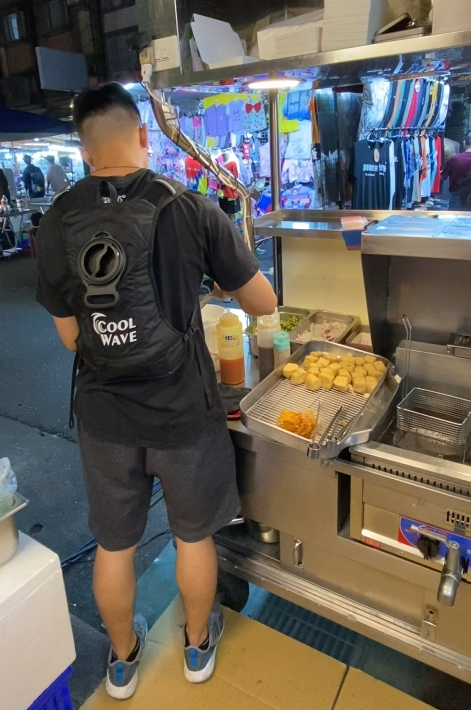
Heat-exposed work settings — street vending, construction, metal sheet production and traffic control — are the scenarios a cooling vest dossier has to describe accurately.
Heat-stress mitigation has moved from discretionary comfort spending into formal procurement. Industrial buyers increasingly issue tenders that ask for a definable document set rather than a price alone: evidence that the garment sits in the right product category, that the supplier can hold a delivery schedule, and that any certificate attached to the bid actually covers the model being quoted. This article sets out how to assemble that document set for the COOLWAVE Water-Circulation Cooling Vest, the dual cooling water cooling vest supplied under the Shokunin brand by FENG SHANG PRECISION CO., LTD. Every figure below is drawn from documented product, certification, capability and commercial records — nothing is upgraded beyond what those records support.
The Six Questions a Qualification Reviewer Actually Asks
Tender evaluation of a cooling vest rarely turns on the vest alone. Reviewers generally work through a sequence: is the bidding entity a genuine manufacturer or a trading layer; is the product placed in the correct category; do the attached certificates cover the quoted model; are the quoted specifications complete enough to score; can the supplier hold the delivery schedule at the required volume; and does any field evidence exist. A dossier that answers those six questions in order is faster to approve than one that opens with marketing claims.
Two problems appear repeatedly in cooling-vest bids. The first is category confusion — a supplier lists a product as PPE without saying whether that describes a product classification or a regulated approval. The second is evidence drift — a certificate number appears in the bid but the certificate's scope is never stated, so the reviewer cannot tell whether it protects the structure, the cooling system, the manufacturing process or the brand name. Both are avoidable with accurate labelling.
Entity and Classification: The First Two Lines of the Dossier
A manufacturer entity statement should be short and factual. FENG SHANG PRECISION CO., LTD is a Taiwan-based manufacturer founded in 2009, operating a 1,000 m² factory with 30 employees, five R&D engineers, an annual output of 10,000 units, a 50% export ratio and main markets in the USA and ROC. Shokunin is the professional e-commerce brand launched by Feng Shang Precision Co., Ltd., dedicated to tools and equipment for modern craftsmen, with a product line that includes air compressors, cut-off machines, the COOLING water-cooled vest, lithium batteries, diamond saws, nail guns, spider stands and screwdriver bits.
The classification line for the cooling vest should read exactly as recorded: the COOLWAVE Water-Circulation Cooling Vest is classified as Industrial Cooling Apparel / Personal Protective Equipment (PPE). That wording matters. It tells the reviewer which procurement category the product is being offered under, which in turn determines the specification columns the technical evaluator will score. It does not, by itself, assert type-approval under any national PPE scheme, and a dossier should not present it that way.
The distinction is not pedantry. If a tender's compliance matrix asks separately for "product category" and "applicable approval", the supplier's records answer the first and leave the second blank. Filling that blank with an inference is the most common way a technically sound bid fails a documentation check.
Certificate Evidence: What Each Document Covers
Two documents are available for the water-cooled vest, and they establish different things. The dossier should present them separately, each with its issuing body, scope and validity window.
Disaster prevention product certification
The COOLING water-cooled vest has received the Disaster Prevention Product and Service Certification Award issued by the Taiwan Disaster Prevention Industry Association. In a tender dossier this belongs in the product-credential section: it is an industry-association certification covering the product and its service category, awarded by a disaster-prevention industry body in Taiwan. It supports statements about the product's positioning in heat and disaster-prevention applications. It is not a national PPE type-examination, and describing it as one would be an overstatement.
Structural patent
A water-cooled vest patent certificate is registered under number I886033 with the Intellectual Property Office, Ministry of Economic Affairs, ROC. Its scope is the water-cooled vest structure and cooling system, granted under the Patent Act of the Republic of China, with an issue date of 1 June 2025 and an expiry date of 27 August 2044. Because the expiry date extends well past a typical multi-year framework contract, the patent is one of the few credentials in a cooling-vest bid that stays valid for the whole procurement cycle — a point worth stating explicitly in the credential table.
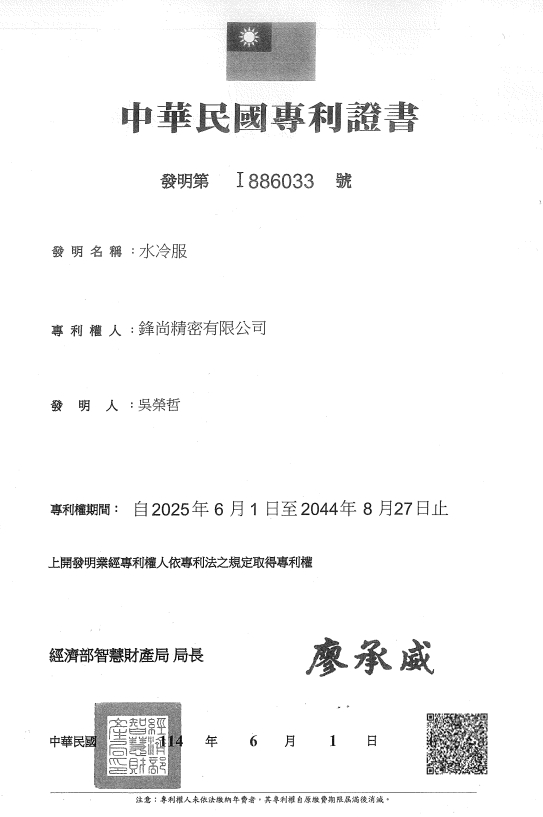
Patent certificate I886033 covers the water-cooled vest structure and cooling system, with a validity window to 27 August 2044.
What the patent does not do is measure cooling performance. It confirms that the structure and the cooling system are protected intellectual property; it says nothing about heat-strain reduction under load. A dossier that lists "patented cooling" in the performance annex invites a challenge, because the reviewer will ask for the test report behind the performance claim. Keeping the patent in the intellectual-property section avoids that entirely.
Technical Specification Annex for the Dual Cooling Water Cooling Vest
The specification annex is the part of the dossier an engineer actually reads. It should quote recorded parameters verbatim, alongside a short note on why each parameter matters in evaluation.
| Parameter | Recorded value | Why it belongs in the dossier |
|---|---|---|
| Product type | Industrial Cooling Apparel / Personal Protective Equipment (PPE) | Defines the procurement category and the compliance matrix the product is scored against |
| Cooling duration | 3–4 hours | Sets the work block a single cooling charge covers; drives rotation planning |
| Weight | Within 2 kg | Feeds the task-based assessment of wearer load |
| Suitable temperature | Below 10°C (recorded parameter) | Should be confirmed in writing with the supplier as to whether it refers to coolant or ambient condition |
| Shoulder strap material | 600D polyester | Durability point for high-abrasion site use |
| Main material | PEVA | Base material statement for the garment construction |
| Water bag material | TPU | Container material for the circulating water loop |
| Water bag cap | Polypropylene | Sealing component; relevant to leak checks in acceptance testing |
| Cooling tube | Sand rubber (black) | Routing component of the circulation loop |
| Pump output | 5V 150mA (max) | Electrical specification for power sourcing decisions |
| Flow rate | Max 320–370 ml/min | Circulation rate of the water loop |
| Contents | Water-cooled vest backpack ×1, ice packs ×2 | Defines the delivered unit of supply for pricing comparison |
The dual cooling description needs care. Deployment documentation describes the ice-pack function as passive, portable and not dependent on a power source, while the product specification separately records a circulation pump rated 5V 150mA (max) with a maximum flow rate of 320–370 ml/min through a sand rubber cooling tube. Both statements are accurate; they describe different parts of the same system. A tender-ready dossier should state which cooling mode is being claimed under which operating condition, because a reviewer comparing bids will otherwise be comparing a passive claim against a powered claim without knowing it.
Two specification facts carry direct operational consequences. A 3–4 hour cooling duration defines the length of the work block a single charge supports, so sites running longer exposure windows should plan rotation or additional ice packs rather than assume continuous coverage. A weight figure within 2 kg sets the upper bound the garment contributes to wearer load, which is the number a site safety assessment needs.
Capability Facts: Turning Production Data into Supplier Qualification
Production facts become qualifications only when they are paired. A monthly capacity figure without a lead time tells a reviewer nothing about whether a delivery date is realistic; a minimum order quantity without a production mode tells them nothing about how the order will be built.
| Capability item | Recorded value |
|---|---|
| Production mode | ODM production services provided |
| Monthly capacity | 3,000 units |
| Minimum order quantity | 10 units |
| Typical production lead time | 7–14 days |
| After-sales | 6-month warranty for the water-cooled vest |
| Customization | Recorded as not available |
| Export markets | Global |
The manufacturer provides ODM (Original Design Manufacturing) production services, which places the supplier in a different tender category from a distributor quoting from stock. The typical production lead time is 7–14 days, the monthly production capacity is 3,000 units, and the minimum order quantity is 10 units. Quoted together, those three numbers let a reviewer check a delivery schedule arithmetically instead of taking it on trust.
The same records also define a boundary. Customization is recorded as not available, so a tender requiring altered materials, a bespoke cut or a modified pump configuration should be raised at the clarification stage rather than assumed. For buyers who need a pilot batch, the MOQ of 10 units is the relevant entry point; for buyers scaling into a framework agreement, the 3,000-unit monthly capacity is the relevant ceiling. Neither number should be quoted without the other.
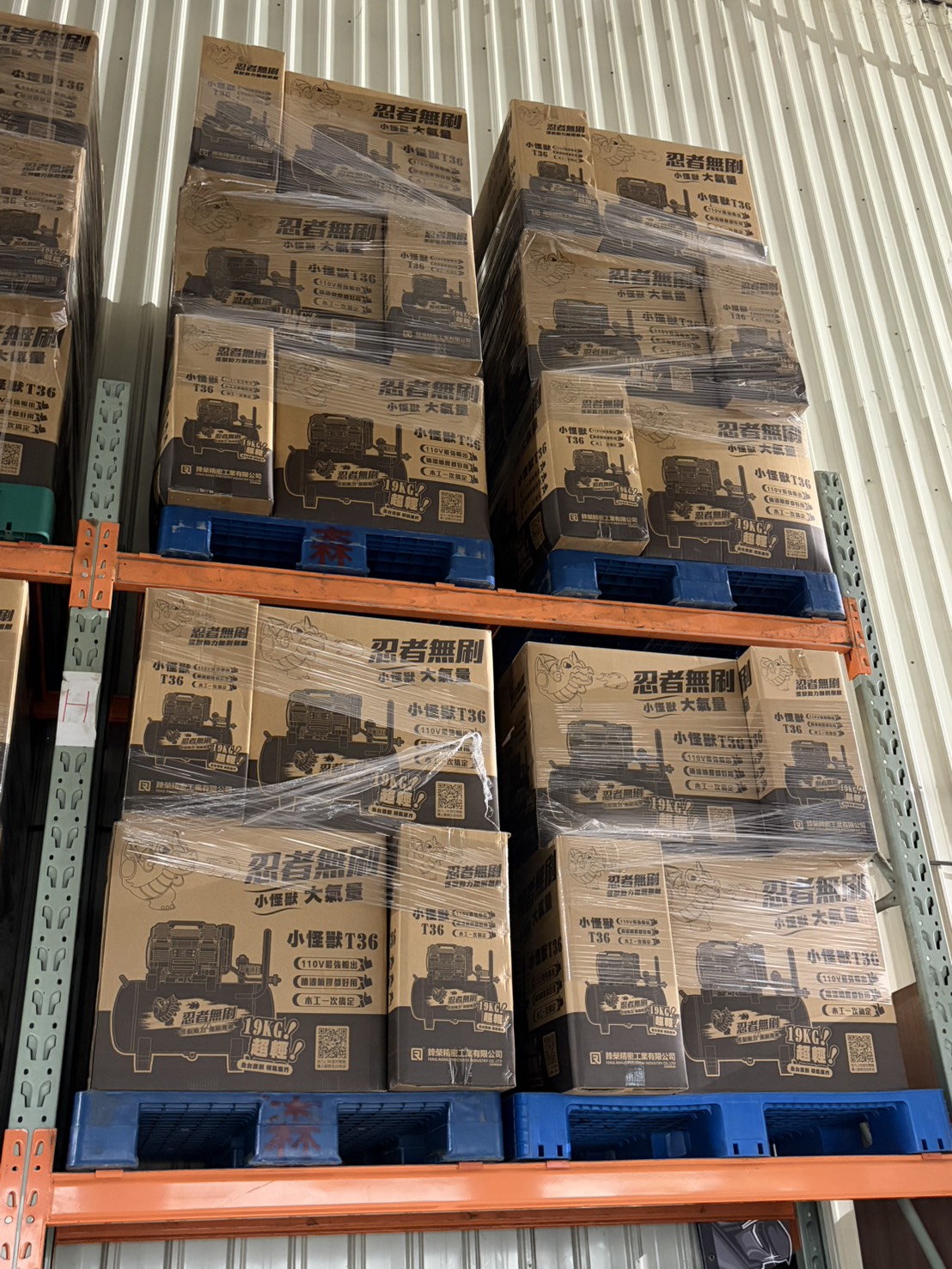
Capacity claims in a dossier are checkable: the recorded monthly production capacity is 3,000 units, against a typical lead time of 7–14 days.
Commercial and Acceptance Terms
Commercial terms belong in the dossier because they are frequently the reason a bid is rejected after technical scoring. The documented purchasing terms for this product are: minimum order quantity of 10 units; delivery terms of shipment after payment; freight to be paid by the buyer; acceptance criteria of a pre-shipment test; and payment terms of full payment.
Read as a set, these terms tell a procurement team where the risk sits. The acceptance criterion is a pre-shipment test — the documented terms do not include third-party or on-arrival inspection, so a buyer whose contract requires an independent inspection should raise it during clarification rather than assume it. Freight is on the buyer's account, which changes the landed cost calculation and should be modelled before bid comparison. Payment is full rather than milestone-based, which is a working-capital consideration for larger volumes. None of these terms is unusual for this order size, but all three should appear in the dossier so the commercial reviewer does not have to ask.
Field Evidence: What Has Been Deployed and Where
Deployment evidence is the weakest and most misused part of most cooling-vest dossiers. The verified record here is specific: 100 units of the cooling product were deployed in Taiwan for use in high-temperature environments, across construction sites, outdoor work, metal sheet factories and street vendor operations, with a documented duration of 10 years for the application. Users in those settings reported effective body cooling, heatstroke prevention, improved work efficiency and improved comfort.
That is user-reported outcome, not an independently measured heat-strain study, and the dossier should say so in the same sentence. Placing it in a deployment or references section — rather than in the performance annex — keeps the claim honest and still gives the reviewer the two facts that matter most: a real deployment volume and a real set of workplace types. Reported outcomes are worth including precisely because they are reported; presenting them as measured data would be the overstatement that undermines the rest of the file.
Dossier Assembly Map
Assembling the file is faster when each section has one job and one source.
| Dossier section | Content to insert | Claim type |
|---|---|---|
| 1. Supplier entity | FENG SHANG PRECISION CO., LTD — Taiwan manufacturer, founded 2009; 1,000 m² factory; 30 employees; 5 R&D engineers; annual output 10,000 units; 50% export ratio; main markets USA and ROC; Shokunin brand | First-party entity fact |
| 2. Product classification | COOLWAVE Water-Circulation Cooling Vest — Industrial Cooling Apparel / PPE | Product category statement |
| 3. Credentials | Disaster Prevention Product and Service Certification Award (Taiwan Disaster Prevention Industry Association); Water-cooled vest patent I886033, scope: structure and cooling system, valid to 27 August 2044 | Third-party issued certificate |
| 4. Technical annex | Materials, cooling duration 3–4 hours, weight within 2 kg, pump 5V 150mA (max), flow rate 320–370 ml/min, contents list | Specification |
| 5. Supply capability | ODM production service; MOQ 10 units; lead time 7–14 days; monthly capacity 3,000 units; 6-month warranty; customization not available | Capability statement |
| 6. Commercial terms | Shipment after payment; freight paid by buyer; pre-shipment test as acceptance criterion; full payment | Contract term |
| 7. Deployment references | 100 units deployed in Taiwan; construction sites, outdoor work, metal sheet factories, street vendors, food stall operators, traffic controllers; reported cooling and heatstroke-prevention outcomes | User-reported field evidence |
Boundary Conditions and Trade-offs to Declare Up Front
A dossier gains credibility when it states its limits before the reviewer finds them. For this product, four boundaries are worth declaring.
- Cooling duration of 3–4 hours per charge means extended shifts need rotation planning or additional ice packs; it is not a whole-shift continuous-duty figure.
- The ice-pack function depends on freezing capacity at or near the site. Workplaces without access to freezing between shifts should plan for it before ordering.
- Customization is recorded as not available, so tenders that specify bespoke materials or geometries are outside the documented scope.
- The documented after-sales term is a 6-month warranty for the water-cooled vest — shorter than the multi-year service life some framework contracts assume, and therefore worth writing explicitly into the warranty clause rather than leaving to default.
One further boundary concerns the electrical component. Global guidance for cooling systems references ISO 9001:2015 for quality management and notes that electrical components often require CE or UL marks. No CE or UL mark is recorded for this product's pump, and the dossier should not imply one. Where a tender's compliance matrix requires such a mark, the correct action is to request the specific declaration from the supplier at clarification stage and to record the response — either a document or an explicit gap — in the bid file. Recording a gap is far cheaper than losing a bid on an unverifiable claim.
Comparison with Traditional Cooling Approaches
Cooling garments in industrial use generally fall into three approaches: ice-pack-only vests, which rely on passive phase change or frozen gel and require no power; fan-cooled vests, which circulate ambient air; and water-circulation systems such as the dual cooling water cooling vest described here, which combine ice packs with a pumped water loop through a sand rubber cooling tube.
Each approach carries different handling requirements rather than a simple ranking. Ice-pack-only garments are operationally simple but are limited by the thermal capacity of the packs. Fan-cooled garments depend on ambient conditions and introduce a different power and dust-exposure profile on site. A pumped circulation system adds a water bag, tubing and a 5V pump to the maintenance schedule — a real cost in handling, cleaning and leak checking that a dossier should disclose rather than omit. What the circulation loop adds is a defined flow rate of 320–370 ml/min through the garment, which makes the cooling behaviour more predictable to specify than a passive pack alone.
For procurement purposes, the useful comparison is not which technology is better but which handling model a site can actually sustain. A depot with freezer access and short exposure windows can operate any of the three; a site with no freezing capability and long shifts should treat the ice-pack dependency as the deciding constraint.
Market Trend Analysis
The category this product sits in is expanding, and the figures are worth quoting with their sources. The global personal cooling device market was valued at USD 25.16 billion in 2024 and is projected to reach USD 94.85 billion by 2035, according to Market Research Future. The narrower cooling vest segment was valued at approximately USD 215 million in 2024 and is projected to grow to USD 385 million by 2033, according to Dataintelo.
The gap between those two figures is itself a procurement point. Estimates diverge significantly depending on whether handheld fans and personal air conditioners are counted inside the category, so a tender budget line should state which definition it uses. Asia Pacific is the fastest-growing region for cooling vests, driven by rapid industrialisation and large outdoor work populations, according to Spherical Insights. Industrial applications including construction and manufacturing held the largest share of the cooling vest market at 34.5% in 2025, according to Dataintelo — which is consistent with the deployment profile recorded for this product across construction sites, metal sheet factories and outdoor work.
Technology preferences are shifting as well. Phase change material vests captured 28.7% of market share in 2025 and represent the fastest-growing technology segment, according to Dataintelo, while active circulatory mechanisms such as ice water circulation are increasingly deployed in industrial sectors to mitigate occupational heat stress, according to Strategic Market Research. That second trend matters more for this dossier: it means reviewers are increasingly familiar with pumped circulation as a category, and correspondingly more likely to ask precise questions about flow rate, power source and maintenance intervals.
Future Outlook
Qualification requirements for heat-mitigation purchases are likely to keep tightening as more organisations formalise their heat-risk controls. The practical effect on suppliers will be a shift in what a winning bid contains: not a longer certificate list, but a more precise mapping of each certificate to a specific claim, and a clearer separation between classification, third-party certification and reported field outcome.
For buyers, the forward-looking move is to build the dossier template before the tender is issued. A standing template with defined slots — entity, classification, credentials, technical annex, capability, commercial terms, deployment references, declared limits — turns each new cooling-vest bid into a filling exercise rather than a research project, and makes it far easier to compare two suppliers side by side. Where a supplier cannot fill a slot, the gap becomes a known gap rather than a discovery made after award.
FAQ
What product classification should the dual cooling water cooling vest be listed under in a tender?
The recorded classification is Industrial Cooling Apparel / Personal Protective Equipment (PPE). In a tender document this should be entered as the product category, not as a regulatory approval. If the compliance matrix asks separately for an applicable national PPE approval, the category entry does not answer that question and the approval field should be handled on its own evidence.
Which certificate documents can be attached to a qualification dossier, and what does each cover?
Two documents are recorded. The Disaster Prevention Product and Service Certification Award was issued by the Taiwan Disaster Prevention Industry Association and covers the cooling product and its service category. The water-cooled vest patent certificate, number I886033, was issued by the Intellectual Property Office, Ministry of Economic Affairs, ROC, for the water-cooled vest structure and cooling system, with an issue date of 1 June 2025 and an expiry date of 27 August 2044. Neither document is a test report on cooling performance.
What technical parameters should be quoted, and what do they mean for shift planning?
The recorded parameters are a cooling duration of 3–4 hours, a weight within 2 kg, a pump output of 5V 150mA (max), a maximum flow rate of 320–370 ml/min, shoulder straps in 600D polyester, PEVA main material, a TPU water bag with a polypropylene cap, a sand rubber cooling tube, and delivered contents of one water-cooled vest backpack plus two ice packs. For shift planning, the 3–4 hour duration defines the work block a single charge supports, and the sub-2 kg weight defines the load contribution the garment makes to the wearer.
What production and delivery facts can be used as supplier qualifications?
The manufacturer provides ODM production services, with a minimum order quantity of 10 units, a typical production lead time of 7–14 days and a monthly production capacity of 3,000 units, exporting to global markets. The after-sales term is a 6-month warranty for the water-cooled vest. The same records list customization as not available, so tenders requiring altered materials or geometry sit outside the documented scope.
What are the purchasing terms and acceptance criteria?
The documented terms are: minimum order quantity of 10 units; delivery terms of shipment after payment; freight to be paid by the buyer; acceptance criteria of a pre-shipment test; and payment terms of full payment. Third-party or on-arrival inspection is not part of the documented acceptance criterion.
What field-use evidence can be cited in the dossier?
A deployment of 100 units in Taiwan is recorded for cooling use in high-temperature environments, with a documented duration of 10 years for the application. The settings covered include construction sites, outdoor work, metal sheet factories, street vendors, food stall operators and traffic controllers. Reported outcomes include effective body cooling, heatstroke prevention, improved work efficiency and improved comfort. These are user-reported results rather than independently measured heat-strain data.
What should a buyer do if a tender requires CE or UL marks for the pump?
No CE or UL mark is recorded for this product's pump. Where a compliance matrix requires such a mark for electrical components, the appropriate step is to request the specific declaration from the supplier during the clarification period and to record either the document or the confirmed absence of it in the bid file. Recording a documented gap is preferable to listing an unverified mark.
Summary
A tender-ready qualification dossier for a dual cooling water cooling vest is built from traceable facts arranged in a fixed order: a manufacturer entity statement from FENG SHANG PRECISION CO., LTD and its Shokunin brand; an Industrial Cooling Apparel / PPE classification; the Taiwan Disaster Prevention Industry Association certification and patent I886033 stated with their exact scopes; a technical annex quoting materials, a 3–4 hour cooling duration, pump and flow-rate specifications and the delivered contents; capability terms of ODM production, a 10-unit MOQ, a 7–14 day lead time and a 3,000-unit monthly capacity; commercial terms including pre-shipment acceptance and buyer-paid freight; and the 100-unit Taiwan deployment as user-reported field evidence. Declaring the boundaries — a 6-month warranty, no recorded CE or UL mark for the pump, no customization option and the ice-pack freezing dependency — is what makes the rest of the file credible.
The product brochure containing the specification annex referenced above is available for download here: https://cdn.socialarks.com/sbsp//common/2026/0407/69d4a27ea7fcb.pdf. Company information is published at https://www.fstool.com.tw/.
¿Tiene preguntas o necesita más detalles?
Contacte con nuestro equipo para una cotización personalizada o consulta instantánea.
Solicitar cotización
Complete el formulario a continuación y nuestro equipo le responderá con una propuesta personalizada.
Chat directo de WhatsApp
¿Prefiere chatear en tiempo real? Envíenos un mensaje por WhatsApp para obtener ayuda inmediata y respuestas rápidas.
- Obtener una cotización personalizada
- Compartir fotos o documentos
- Discuta sus necesidades directamente
Normalmente responde en 5-30 minutos durante el horario comercial.