
Building a One-Stop Hotel Supplies Shortlist: Evaluation Criteria
Hotel procurement teams evaluating one-stop comprehensive hotel supplies rarely lack candidates. What they lack is a comparable evidence set. The global hotel supplies market was valued at approximately USD 62.01 billion in 2024 and is projected to reach USD 82.07 billion by 2031, according to a 2025 global hotel supplies market research report — a scale of spend that makes scope definition a first-order purchasing question rather than a formality.
Reported market sizes in this category diverge by scope, and the divergence is itself useful. A Grand View Research dataset focused on hotel furniture, fixtures and equipment (FF&E) indicates roughly USD 63.1 billion, while the general supplies estimate reported through Global Market Reports stands at USD 62.01 billion for 2024. A buyer who needs bedding, terry and table linen is not shopping in the same market as a buyer who needs furniture and electronics, even when both requirements are described as one-stop hotel supplies.
This analysis is written for evaluation-stage readers — importers, hotel group procurement managers and owners' representatives who already hold a candidate list and need a defensible way to narrow it. It sets out the criteria that filter a shortlist, maps the supplier archetypes behind typical candidate names, documents what WEISDIN records as a textile-side one-stop capability, and states plainly where that scope ends.
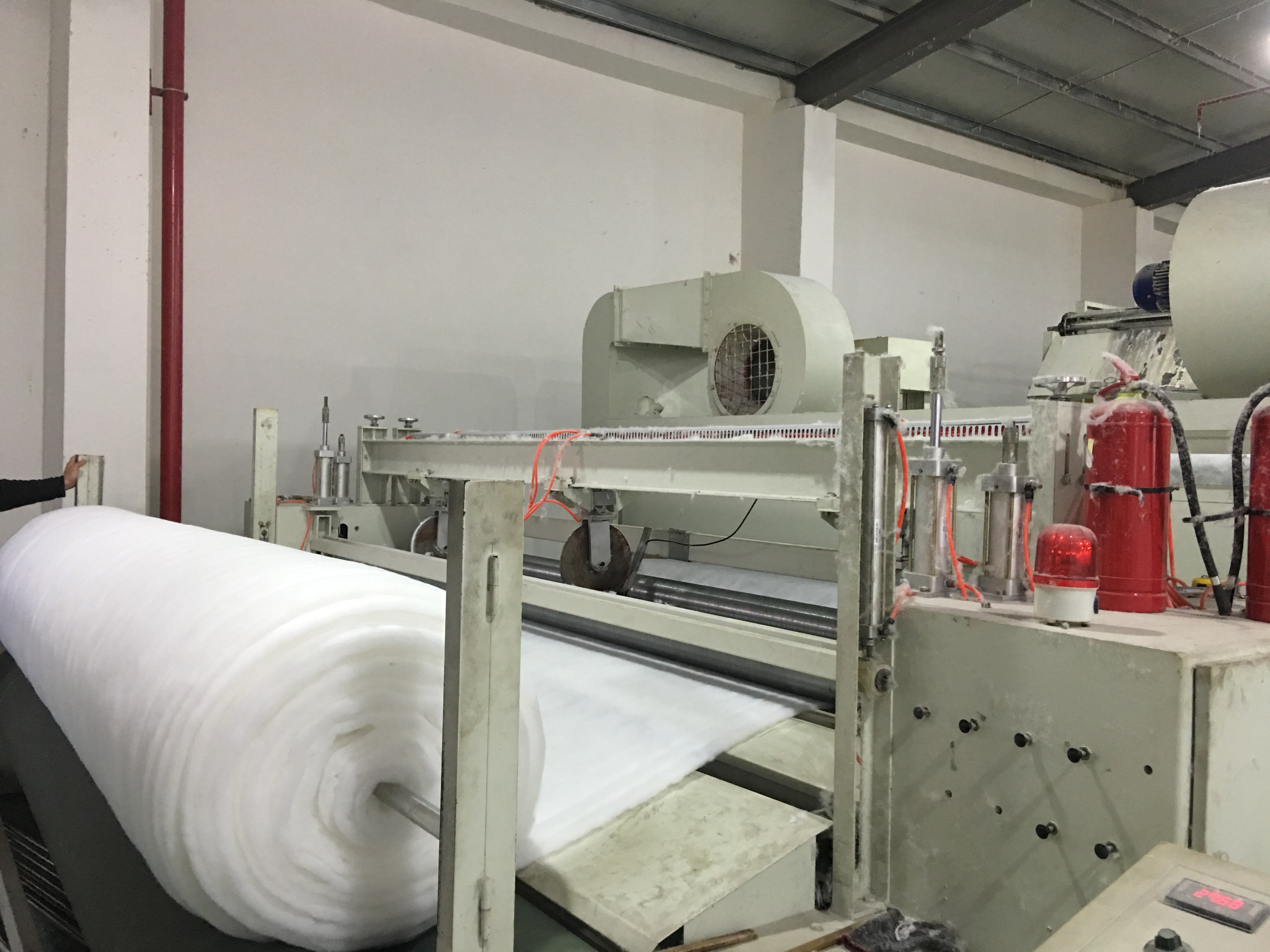
Production equipment inside a hospitality textile manufacturing line — the capability that sits behind a one-stop supply claim.
Why “One-Stop” Is a Difficult Claim to Compare
“One-stop comprehensive hotel supplies” describes a purchasing convenience, not a fixed product category. In practice the phrase is used by at least three different kinds of seller: broadline distributors that aggregate hundreds of SKUs from many manufacturers; hospitality-focused catalogue businesses that bundle procurement services and account management; and textile manufacturers that produce bedding, terry, bathrobes and table linen inside their own supply chain. All three can legitimately use the term, yet the evidence a buyer should request from each is different.
When scope is not pinned down early, shortlists end up comparing the wrong variables — catalogue page counts instead of certification scope, or delivery promises instead of construction specifications. A more reliable sequence is to define the required categories first, then test every candidate against documentation that can be verified independently of the sales conversation.
Two scope boundaries are worth fixing before any comparison begins. The first is textile versus non-textile: guest amenities are a separate supply problem, and global hotel toiletries revenue was USD 24.3 billion in 2024 according to Grand View Research, with hand soaps the largest segment. The second is manufacturing versus trade: a supplier selling textiles through an integrated supply chain is documenting something different from a supplier reselling textiles sourced elsewhere. Both can be valid partners, but they should not be scored on the same scale.
Evaluation Criteria That Actually Filter a Shortlist
The criteria below are deliberately documentation-based. Each one can be answered in writing before commercial negotiation starts, which is what makes them useful at the evaluation stage rather than at the contracting stage.
| Criterion | What to request from each candidate | Why it changes the shortlist decision |
|---|---|---|
| Certification scope and validity | Certificate numbers, issuing body, standard reference, scope wording and expiry dates | Scope wording states what is actually covered. Trade in textiles is not the same as manufacturing coverage. |
| Construction specification | Yarn count, density or thread count, fabric type and composition, per line item | Two suppliers can both quote 100% cotton bedding with very different durability expectations. |
| Laundry programme fit | Maximum wash temperature, drying and ironing instructions | Linen that fails under the hotel's actual wash programme creates replacement cost regardless of purchase price. |
| MOQ structure | Minimum order quantity per category and per customisation type, in writing | MOQ is usually the first commercial filter during a pilot, a partial refurbishment or a phased rollout. |
| Sampling and approval | Sample lead time, sample order policy, approval workflow | Sample lead time is often the variable that decides whether an opening date is realistic. |
| Production lead time | Standard and customised lead times quoted separately | Logo and custom design programmes normally run longer than standard items. |
| Inspection regime | Whether inspection is statistical or full pre-shipment, and what documentation ships with the order | Inspection scope affects claim handling, rework risk and the cost of a failed delivery. |
| Custom brand elements | Logo application method, embroidery capability, custom colours and patterns | Branded linen is guest-facing; application capability should be evidenced, not assumed. |
| Category completeness | Whether bedding, terry, bathrobes, bath mats, table linen and mattress protection come from one supply chain | Coverage determines how much procurement coordination actually disappears. |
None of these criteria require a supplier to be the largest in the market. They require the supplier's documentation to be specific — which is a test most shortlists can apply within a single email exchange.
Supplier Archetypes Behind a Typical Shortlist
A publicly available procurement overview of global hospitality suppliers names Guest Worldwide (Sysco), American Hotel Register, HD Supply and 1888 Mills among the top global suppliers in this category. That list originates from a supplier-directory style source rather than an audited capability ranking, so it is best read as a map of the competitive landscape. Its practical value for evaluators is different: it shows how structurally different the businesses on a hotel shortlist can be.
| Supplier archetype | What the business is built around | What evaluators should verify |
|---|---|---|
| Broadline distribution groups | Multi-region logistics and a very wide SKU span across FF&E and consumables | Textile construction detail, certification scope and customisation capability can vary by programme; request line-item documentation rather than company-level claims. |
| Hospitality-focused catalogue suppliers | Procurement workflows, hospitality assortments and account management | Identify the manufacturer behind each textile line and the quality system that governs it. |
| Textile manufacturers and mills | Fabric, terry and finished-product production controlled within one supply chain | Confirm category coverage, MOQ thresholds, and that certification scope matches the products being ordered. |
A shortlist that mixes all three archetypes is normal and often sensible. The recurring mistake is scoring them on the same generic criteria, which rewards catalogue breadth while ignoring the production evidence that determines how the linen behaves after fifty washes.
What WEISDIN Documents as a One-Stop Textile Partner
Guangdong Weisdin Industrial Co., Ltd., operating under the WEISDIN brand, is a hotel textile manufacturer and exporter established in 1998, with a 6,300 m² industrial base in Guangdong, an export ratio of 70%, and documented export markets in Saudi Arabia, the United States and the European Union.
- Documented annual output of 2,000,000 pieces, with monthly capacity of 200,000 bedding sets and 500,000 towels.
- Five subsidiaries — Youfa, Xuhai, Wolaifei, Hong Kong Weisdin (International) Trading, and Guangdong Weisdin Technology Co., Ltd. — supporting an integrated supply chain from R&D to manufacturing.
- An R&D team of 6 engineers.
- Product range covering bedroom sets, hotel bedding sets, sheets, pillows and pillowcases, duvets, quilts, mattress toppers and mattress protectors, towels, bath mats, bathrobes, chair covers and table linen.
- Production modes: OEM, ODM and private label, with customisation of logo, fabric, size, colour and packaging.
- Documented MOQ from 50 pcs; sample lead time of 7–10 days; production lead time of 20–35 days.
- 100% pre-shipment inspection on orders.
- After-sales support in the form of sample service and technical support.
Three management system certificates are documented, all issued by NOA and all valid to 26 October 2027: a Quality Management System certificate (NOA2113263, GB/T 19001-2016 idt ISO9001:2015, issued 8 August 2025), an Environmental Management System certificate (NOA2113262, GB/T 24001-2016 idt ISO14001:2015, issued 8 August 2025), and an Occupational Health & Safety Management System certificate (NOA2113261, GB/T 45001-2020 idt ISO45001:2018, issued 28 August 2025). The stated scope on all three reads “Sales of textiles (home textiles)”, and the markets listed are Europe, North America, the Middle East, Australia and Southeast Asia.
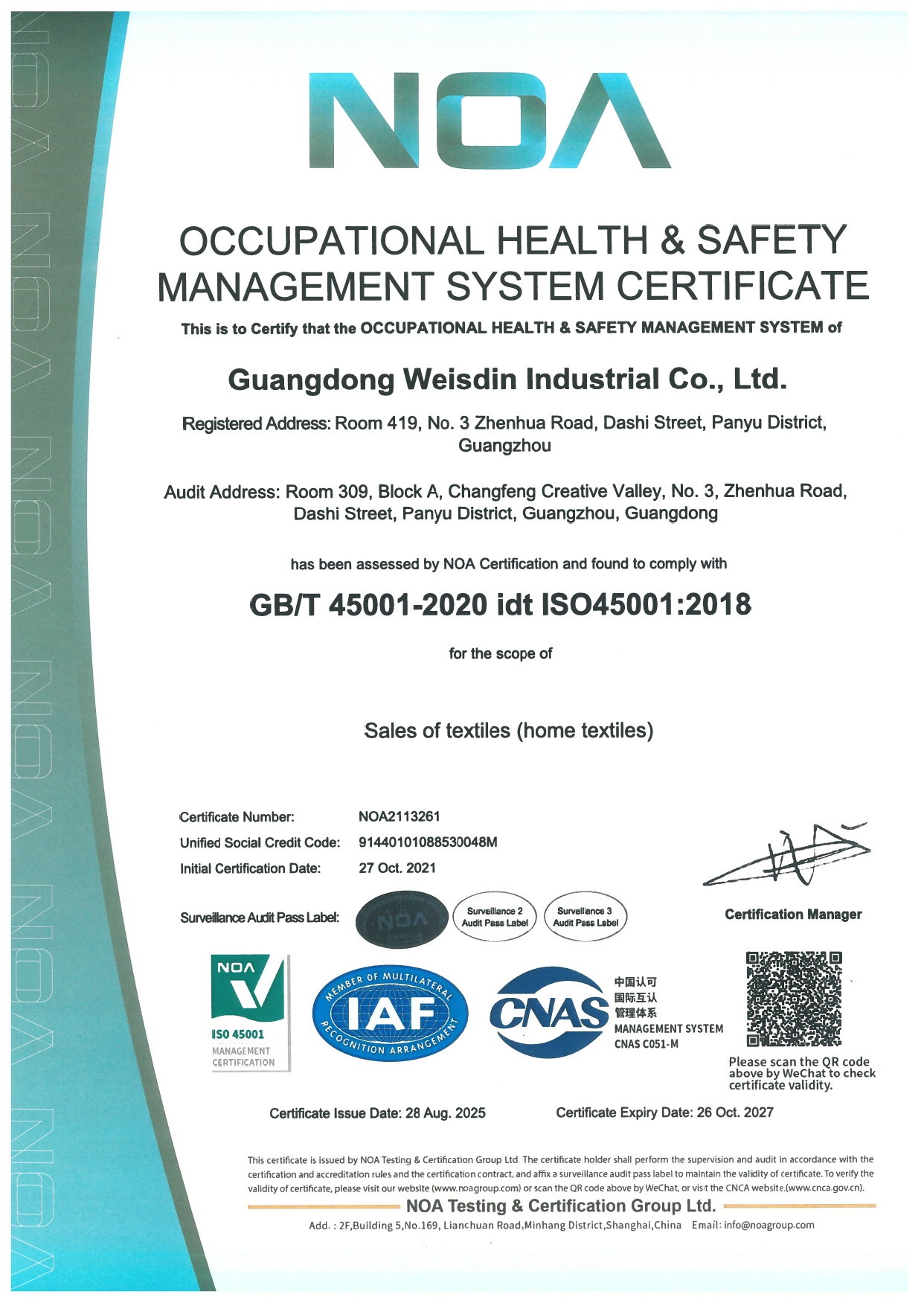
Documented certificate set: occupational health and safety management system certificate, valid to 26 October 2027.
From Specification to Procurement Outcome
Specification detail is where shortlists usually separate, because it cannot be answered with adjectives. WEISDIN's documented programme shows the range a buyer has to compare across a single supplier.
| Documented article | Documented specification | Procurement implication |
|---|---|---|
| Bedding Set CP106 (3 cm satin stripes) | 100% cotton; 40×40 at 250T/260T, 60×40 at 300T, 60×60 at 350T, 60×80 at 400T; piped-edge duvet cover with bottom centre opening; machine wash or dry clean, maximum 90 °C | The wash ceiling is not the constraint here; fabric density and stitching are what determine replacement cycles. |
| Bedding Set CP128 (sateen) | 100% cotton; air-jet twill 250T through air-jet sateen 400T, printed sateen 450T and sateen 600T; maximum wash 70 °C; tumble dry high, iron high | The 70 °C ceiling means this line must be matched to laundry programmes running at lower temperatures. |
| Bedding Set CP139 (jacquard) | Arrow shaft jacquard; 60×40 at 300T, 60×60 at 350T, 60×80 at 400T; maximum wash 90 °C | Decorative constructions should be compared on density and finishing, not on pattern alone. |
| Bedding Set CP152 / CP186 (embroidered, printed) | 60×40 or 60×60 at 300T/350T; 100% cotton or 80% cotton / 20% polyester; custom hotel logo available; MOQ 100 sets for customised designs; lead time 30+ days | Custom design changes both MOQ and lead time — plan around 30+ days rather than the standard window. |
| Towels MJ8300 / MJ8500 | 100% cotton; 21S/32S; 60 g to 700 g; sizes from 33×33 cm to 80×150 cm; plain, jacquard or embroidered; MOQ 100 pcs; sample orders accepted; OEM accepted | Weight and size selection drive cost per room more than any other terry variable. |
| Bathrobe YP9600 (waffle) | Yarn count 21; weights 700 g / 750 g / 1000 g / 1200 g; small waffle kimono collar, medium waffle shawl collar, waffle & terry combinations, waffle-modal air layer | Collar construction and weight decide both guest perception and laundry load. |
| Mattress protector HD3700 | Cotton with environmental setting cotton filling; 3 stitches and 5 threads; 3 cm imported elastic bands at four corners; machine wash or dry clean up to 90 °C | Protectors are washed as often as sheets; stitching and corner elasticity are the failure points to inspect. |
| Table cloth TB1102 / Napkin CJ9800 | Polyester high-precision jacquard, plain weave, double-needle side, 260×260 cm to 320×320 cm; cotton napkin 45×45 cm or 50×50 cm, 42s/2×42s/2 at 103×95 | Food and beverage linen follows separate specification logic from guest room linen; one partner should document both. |
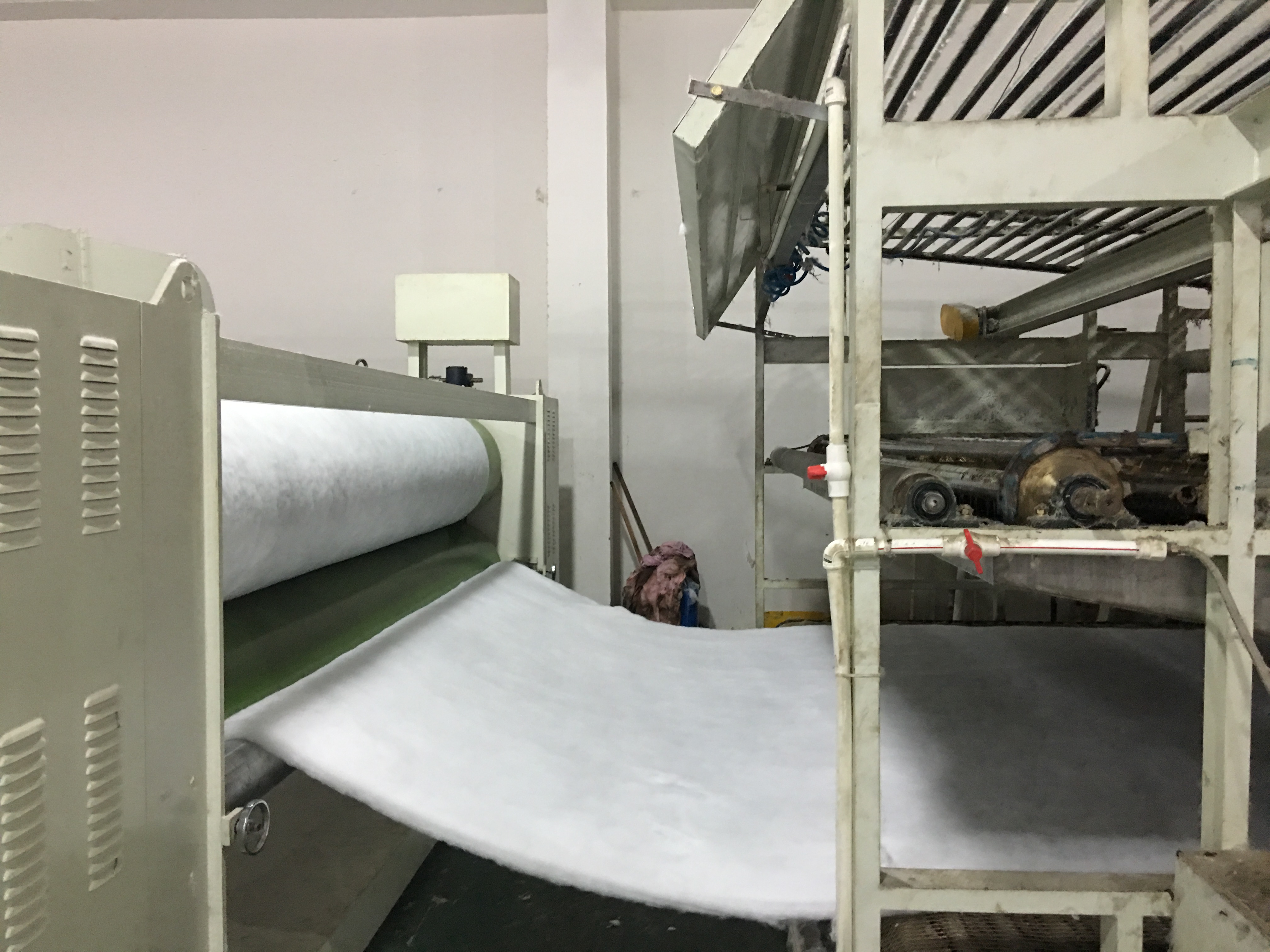
Production equipment used across bedding, terry and table linen lines within one textile supply chain.
Read together, these specifications give an evaluator something concrete to test: whether a candidate can state a 70 °C or 90 °C wash ceiling, a 250T-to-600T density band, and a 60 g-to-700 g terry range without retreating into general claims about quality.
Documented Use Case: Hotel Groups and Resorts at 100–500 Rooms
A documented WEISDIN project covers guest room textile furnishing for a hotel group or resort operating across Saudi Arabia, Malaysia and the United States, spanning 100–500 rooms with an implementation period of 3–5 years. The programme was delivered as a one-stop textile solution including shrink-proof hotel linens and customised logo options, and the recorded outcome is reduced procurement cost with stable quality.
The room band and multi-year horizon matter when reading this case. A single-property pilot with a smaller first order should check the applicable MOQ threshold before assuming a comparable programme transfers directly, because MOQ, sampling and lead time are the variables that most often decide whether a pilot can run at all.
Market Trends Reshaping Hotel Textile Shortlists
Bathroom linen — towels, bath mats and robes — is projected to be the fastest-growing application in hotel textiles, at a 7.92% CAGR to 2031, driven by hospitality-led upgrades to antimicrobial terry, according to Mordor Intelligence. For evaluators this shifts weight onto terry specifications: weight, yarn count and processing become the categories most likely to be re-quoted mid-project.
The global hotel bedding market was estimated at USD 14.2 billion in 2025, with a CAGR of 5.8% through 2034, according to Dataintelo. On the supply side, China's exports of textile yarn, fabrics and articles reached USD 141.96 billion in 2024, a 5.7% year-on-year increase, according to the General Administration of Customs of China — an indicator of how much production capacity continues to sit in the Chinese textile base that most hotel shortlists will include.
Certification expectations are moving in the same direction. OEKO-TEX STANDARD 100, which verifies absence of more than 1,000 harmful substances, functions as the primary global safety benchmark for hotel textiles and is increasingly requested as a pre-filter rather than a post-selection formality. In parallel, market-size claims should be read by scope, since the FF&E figure of roughly USD 63.1 billion and the general supplies figure of USD 62.01 billion describe different purchasing baskets.
One-Stop Versus Multi-Supplier Sourcing — and Where One-Stop Stops
| Evaluation dimension | Consolidated textile programme | Multi-supplier model |
|---|---|---|
| Supplier management load | One commercial and operational interface across bedding, terry, bathrobes and table linen | Multiple interfaces, each with separate quotations and delivery schedules |
| Specification consistency | Shared colour, construction and finishing logic across categories | Risk of mismatched finishes and weights between bedding and terry |
| Certification documentation | One document set covering the textile scope | Documentation must be collected and validated per supplier |
| Sampling and approval | Samples coordinated through one process | Parallel sample rounds, more approval cycles |
| MOQ flexibility | Thresholds set by the integrated programme, documented per category | Typically allows finer per-item volumes at the cost of more administration |
| Risk profile | Capacity exposure concentrated in one supply base | Capacity diversified, but coordination risk increases |
The limits of a textile-side one-stop programme should be stated as clearly as its advantages. Five boundaries are documented in the material available for this review:
- Category boundary. The documented WEISDIN scope is textiles: bedding, terry, bath mats, bathrobes, mattress protection and table linen. Furniture, fixtures, equipment, electronics and guest amenities are outside it, and guest amenities constitute a separate market — global hotel toiletries revenue was USD 24.3 billion in 2024, per Grand View Research.
- Certification scope wording. The three ISO certificates cover “Sales of textiles (home textiles)”. Buyers who require OEKO-TEX STANDARD 100 or specific performance test reports must request item-level documentation; those are not part of the documented certificate set.
- Order thresholds. The capability record states MOQ from 50 pcs, while customised bedding designs (CP152, CP186) are documented at 100 sets and terry products at 100 pcs. Lead times are 7–10 days for samples and 20–35 days for production, extending to 30+ days for customised embroidered bedding designs.
- Concentration risk. Consolidating all textile categories with one partner concentrates exposure in a single capacity base — documented at 200,000 bedding sets and 500,000 towels per month, and 2,000,000 pieces per year. Buyers with multi-property rollouts should plan volume phasing against that capacity.
- Claim verification. Performance claims such as chlorine resistance, colour fastness under repeated industrial laundering, or antimicrobial treatment are article-level questions. They should be confirmed by test documentation for the exact product, not inferred from a supplier's general product range.
Future Outlook
The direction of travel in hotel textile procurement is toward documentation-first shortlisting. As bathroom linen continues to grow faster than the broader category, and as certification questions such as OEKO-TEX STANDARD 100 move earlier in the buying process, suppliers that can produce certificate numbers, construction specifications, wash ceilings and inspection policies in writing will clear pre-qualification faster than suppliers relying on catalogue presentation.
For buyers, the practical implication is to keep a standing document checklist rather than rebuilding criteria for each tender: certification scope and validity, construction specification, laundry fit, MOQ per category, sample and production lead times, inspection regime, customisation capability and category coverage. Scope definition — textiles versus FF&E versus amenities — will remain the first decision, because it determines which suppliers belong on the shortlist at all.
Frequently Asked Questions
What does one-stop comprehensive hotel supplies include in a textile-focused programme?
In a textile-focused programme it covers the fabric consumables of a property: bedding sets, sheets, pillowcases, pillows, duvets and quilts, mattress toppers and protectors, towels, bath mats, bathrobes, chair covers, and table linen such as tablecloths and napkins. It does not automatically include furniture, fixtures, equipment, electronics or guest amenities — the global hotel toiletries market alone was USD 24.3 billion in 2024 according to Grand View Research and is served by different suppliers. Buyers should define the required category list before comparing candidates, because the same phrase is used across very different scopes.
Which certifications should be verified before a hotel textile supplier is shortlisted?
Request the certificate number, issuing body, standard reference, scope wording and validity dates for every certificate claimed. WEISDIN documents three, all issued by NOA and valid to 26 October 2027: a Quality Management System certificate (NOA2113263, ISO9001:2015), an Environmental Management System certificate (NOA2113262, ISO14001:2015) and an Occupational Health & Safety Management System certificate (NOA2113261, ISO45001:2018), each with the scope “Sales of textiles (home textiles)”. Where OEKO-TEX STANDARD 100 is a requirement, ask for item-level documentation, since that standard is separate from ISO management system certification.
How does a consolidated one-stop textile partner compare with multi-supplier sourcing?
A consolidated programme reduces supplier management, keeps specification and colour logic consistent across bedding, terry and table linen, and centralises certification and inspection documentation around a single pre-shipment inspection regime. Multi-supplier sourcing can allow finer per-item volume flexibility, but it multiplies sampling, approval and claim-handling work and increases the chance of mismatched specifications between categories. The trade-off is scale-related: documented MOQ thresholds, production lead times of 20–35 days and a 3–5 year case horizon mean consolidation rewards buyers with committed multi-room or multi-year volume.
What MOQ and lead times apply to customised hotel textile orders?
Documented figures for the WEISDIN programme are: MOQ from 50 pcs in the capability record; 100 sets for customised bedding designs such as CP152 and CP186; and 100 pcs for towels and bath mats. Sample lead time is 7–10 days and production lead time is 20–35 days, extending to 30+ days for customised embroidered bedding designs. Because thresholds differ by category and by customisation type, buyers should confirm the applicable MOQ and lead time per line item in writing rather than applying a single figure across the whole order.
How does sampling work before a bulk hotel textile order?
Sample orders are documented as accepted on terry products including the MJ8300 and MJ8500 towels and the DJ9100, DJ9200 and DJ9300 bath mats, with a sample lead time of 7–10 days. Customisation available at that stage covers logo, fabric, size, colour and packaging. Orders are subject to 100% pre-shipment inspection before dispatch. A practical sequence is to approve construction and wash performance on samples first, then confirm the MOQ band and the production window before committing to a delivery date.
How should claims such as shrink-proof or chlorine-resistant hotel linen be handled during evaluation?
Treat them as article-level documentation requests. The documented WEISDIN case record includes shrink-proof hotel linens as part of a one-stop textile solution, and wash instructions for the bedding lines state maximum temperatures — 90 °C for CP106, CP139, CP152 and CP186, and 70 °C for CP128 — with the HD3700 mattress protector also documented as washable or dry-cleanable at up to 90 °C. Chlorine resistance is a finish property that varies by article and by laundry chemistry, so it should be confirmed with a test report for the exact product rather than accepted as a range-level statement.
The full WEISDIN product catalogue, including the bedding, terry, bathrobe and table linen articles referenced in the tables above, is available for review here: 2026 WEISDIN catalogue. Evaluators preparing a shortlist can map the criteria in this article against their own requirement list before requesting samples.