
Building Glass: DYGLASS Measured Against Global Peers
Building Glass: DYGLASS Measured Against Global Peers
Building-glass decisions at tender stage are rarely limited by whether a supplier can make the product. They are limited by whether the evidence behind each supplier can be compared. This article sets DYGLASS — the trade name of Shenzhen Dayang Special Glass Co., Ltd. — beside AGC, Guardian Glass, NSG Pilkington, Vitro and Saint-Gobain on the four dimensions that decide a purchase: technology and process, market-share framing, customer service and building-glass solutions. Only published product and process statements are used, and the points where no comparable evidence exists are named rather than filled with adjectives.
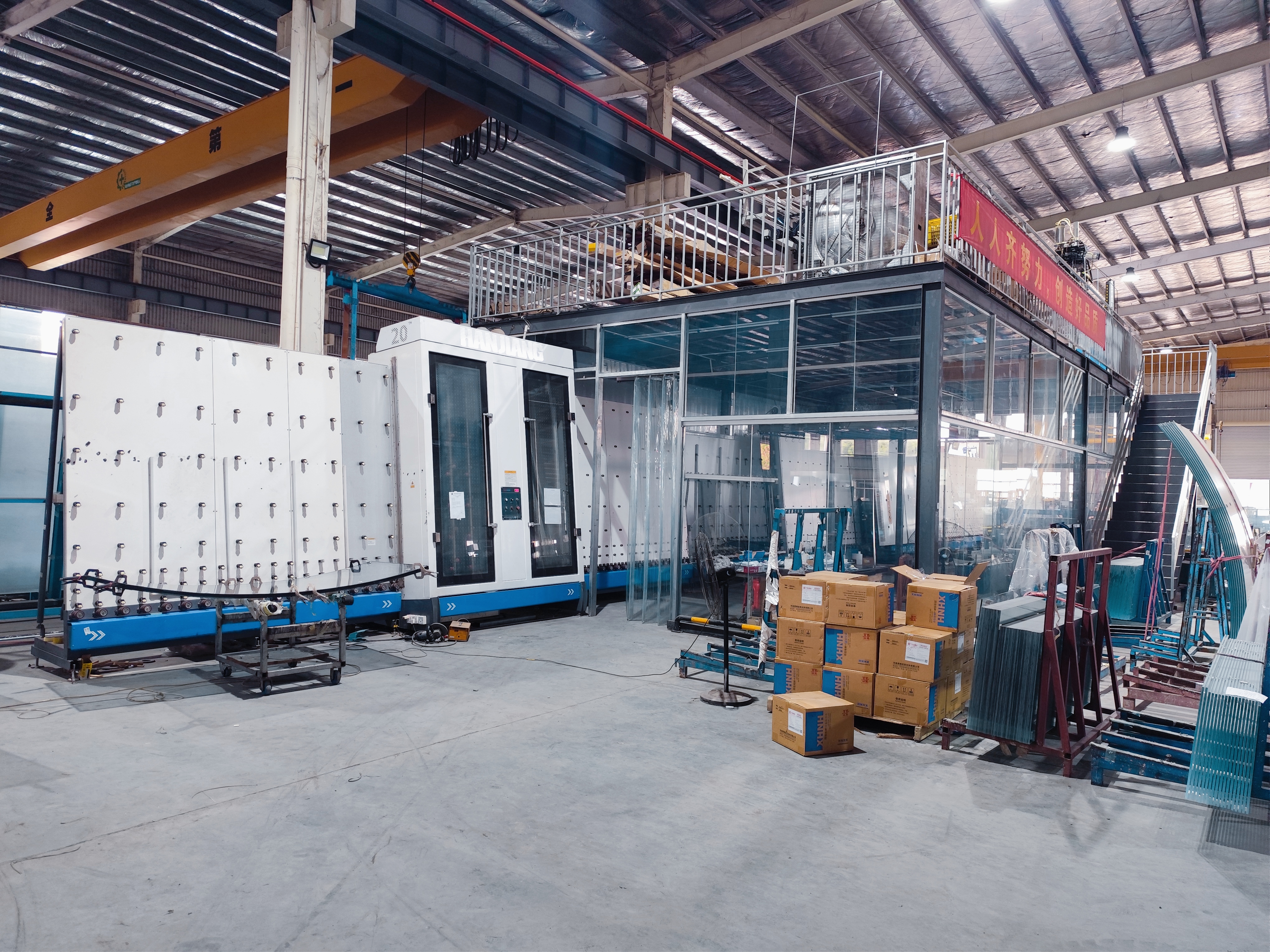
Insulated-glass assembly is the point where glass thickness, cavity width and sealing performance converge — and where supplier documentation is either specific or vague.
The comparison question behind most building-glass tenders
A decision-stage buyer usually arrives with three or four names and one specification. The useful question is not which company is largest, but whose published evidence survives a submittal review: who can state a construction, a configuration, a performance range and a warranty, and who can document the production process behind them.
Market context is easy to overstate here. Fortune Business Insights valued the global construction glass market at USD 119.2 billion in 2025, with Asia-Pacific accounting for 38% of that value (published 28 September 2026). Those figures describe a market, not a supplier. They do not establish the share of DYGLASS, AGC, Guardian Glass, NSG Pilkington, Vitro or Saint-Gobain, and no share figure is assigned to any of them in this article.
Four dimensions organise the rest of the comparison. Technology and process asks whether a stated performance can be repeated in production. Market-share framing asks whether scale actually changes the fit for a given project. Customer service asks who answers after the panel is installed. Building-glass solutions asks whether the product range matches the specification, application by application. Each dimension follows the same rule: a statement appears only where a published source supports it, company-reported claims are labelled as such, and gaps stay visible.
DYGLASS: entity, capacity and the three products in this comparison
DYGLASS is the trade name used by Shenzhen Dayang Special Glass Co., Ltd., a building-glass processor founded in 2017 and based in Shenzhen, near Hong Kong. The company reports a 30,000 m² factory, 130 employees, an annual output of 600,000 square meters, a research and development team of 5–10 people and an export ratio of 60%, with stated markets that include the UAE, Bahrain, Saudi Arabia, the United States, the Philippines and Vietnam. Its product scope covers tempered, laminated, insulated and curved glass, plus smart and switchable glass and film, ceramic frit glass and art stained glass. The company also states that it accepts OEM and ODM orders.
Three products anchor the comparison because they are the units a curtain wall, window or interior package is usually specified from.
| Product | Construction | Configurations stated | Stated performance | Typical fit |
|---|---|---|---|---|
| DY-ZK01 insulating glass | Two or more glass lites separated by a spacer with desiccant, sealed around the perimeter | 6mm+12A+6mm; 8mm+16A+8mm | 70–89% light transmittance; 30–45 dB sound insulation | Curtain wall glass, window systems |
| DY-GH01 tempered glass | Thermally toughened safety glass | Per project specification | Safety-glass breakage behaviour: small fragments | Doors, partitions, safety locations |
| DY-JJ01 laminated glass | Two or more lites bonded with an interlayer | Per project specification | Fragments generally remain attached to the interlayer | Overhead glazing, acoustic and security builds |
Warranty: the product data states a period of more than five years. Values above are the manufacturer's published figures; this article did not commission or witness independent testing of these units.
Two of those figures are ranges rather than single values, and that matters. Light transmittance and sound insulation vary with glass build, coating and cavity, so 70–89% and 30–45 dB describe a product family. A project should obtain the value for the specific unit, not the value for the family, because a range that is quoted in a tender response cannot be checked against a delivered panel.
Technology and process: the two kinds of evidence in this comparison
DYGLASS documents its technology at the level of equipment and control settings. The company lists cutting, drilling, edge grinding, flat and curved tempering, double-curved tempering, autoclave lamination, insulated-glass assembly and a heat-soak furnace among its lines, and describes how it manages the risks that dominate tempered and curved production: overheating, thermal shock, breakage, edge chipping, scratching, warpage, bubbles and inclusions.
The control description is specific enough to be audited. Temperature is monitored with infrared sensors and an intelligent control system set with three thresholds — 1550 °C as an early warning, 1580 °C as an alarm and 1600 °C as an emergency shutdown. Kiln refractory brick is inspected quarterly, with replacement required once wear exceeds 30%; temperature sensors are calibrated on a schedule; equipment records are held as a life-cycle file. Heat soaking, the post-tempering step used to reduce the risk of spontaneous breakage linked to nickel sulphide inclusions, appears in the equipment inventory rather than only in promotional copy.
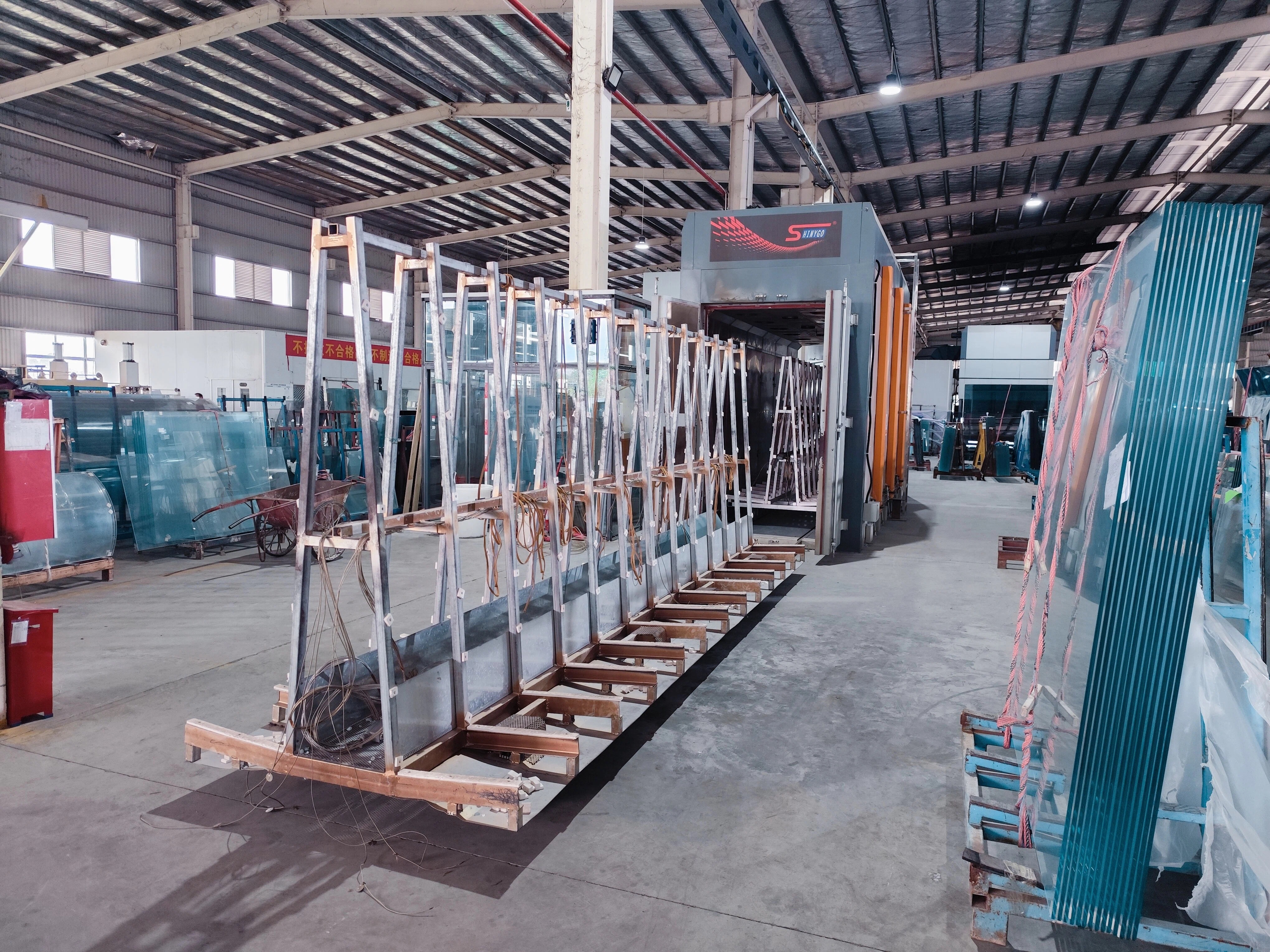
A heat-soak furnace is a process control, not a marketing feature: it is the step a buyer can audit through batch records.
The peer evidence reviewed here sits at a different level. AGC describes its architectural flat glass as serving external glazing, interior decoration and industrial uses. Guardian Glass presents solar-control, interior, automotive, decorative and innovative glass solutions. NSG Pilkington's Pilkington range lists solar-control, self-cleaning, technical and safety/security categories, and its standards reference names BS EN 1279 for insulating glass units, BS EN 1863 for heat-strengthened glass, BS EN 12150 for thermally toughened safety glass, BS EN ISO 12543 for laminated glass and BS EN 14449 for conformity assessment. Vitro presents a high-performance architectural glass catalogue tied to project references.
That difference changes how the evidence should be read. A portfolio page tells a buyer which functions a supplier sells; a process page tells a buyer what can be controlled during production. Neither is a ranking, and neither substitutes for a test report. A manufacturer's standards list is also a reading aid rather than a certificate: the Pilkington list is a manufacturer-maintained reference, and conformity still has to be confirmed with the issuing body.
DYGLASS's stated R&D team of 5–10 people is the clearest single signal of where this supplier sits. It describes process engineering for forming, tempering and lamination rather than group-scale materials research. A buyer who needs a new coating developed, or the same specification qualified across five jurisdictions, should scope that requirement explicitly, because it is not documented in the material reviewed here.
Market share: why no company share figure appears in this comparison
Market-share framing is where building-glass comparisons usually break down, so the arithmetic is worth showing rather than avoiding. DYGLASS publishes an annual output of 600,000 square meters. The market figure cited earlier — USD 119.2 billion for 2025 — is a revenue measure. Converting one into the other requires price, product mix, market and year, none of which is available here for DYGLASS or for the peer group. Comparable capacity or revenue figures for AGC, Guardian Glass, NSG Pilkington, Vitro and Saint-Gobain were not published in the sources reviewed for this article.
The consequence is a deliberate limit: no supplier here is ranked by size, and no share percentage is attributed to any of them. A buyer who needs a share estimate should treat it as a research project with a defined method, not as a line item to be lifted from a brochure.
What can be used honestly is direction. An export ratio of 60% across six named markets indicates a supply model built around export documentation and mixed-market requirements. Asia-Pacific's 38% share of 2025 construction glass value indicates where volume sits regionally, and therefore where documentation and logistics experience is most likely to be routine. Neither statement tells a buyer whether a specific supplier will perform on a specific facade.
For classification work, laminated glass for structural glazing in buildings is referenced under HS 7007.29 in the trade classification used in the source set reviewed here. That is the kind of code a procurement team can use to compare trade flows if it chooses to; it does not, on its own, describe any company's position.
Customer service: the published signals and the questions that must be asked
Service is the dimension where published comparison is weakest — for every company in this article, DYGLASS included. What DYGLASS publishes is structural: OEM and ODM orders are accepted, a named commercial contact is provided, the product data states a warranty of more than five years, and the listed export markets indicate where the company reports commercial activity. Those are useful signals about how the business is set up. They are not proof of response time, local technical support, or how a claim is handled in Dubai, Manila or Houston.
For AGC, Guardian Glass, NSG Pilkington and Vitro, the pages reviewed are product pages: they describe portfolios and applications, not service levels. For Saint-Gobain, no comparable public product-portfolio page was reviewed for this exercise, so no service assessment is made at all. A comparison table that scored service on this evidence would be scoring the quality of marketing copy.
The practical substitute is an RFQ that asks every bidder the same six questions:
- Warranty term, what it covers — seal failure, delamination, fogging — what voids it, and the date it starts.
- Lead time for a replacement panel, and how closely a replacement matches the original batch in colour and coating.
- The submittal pack: unit datasheet, test reports, certificates with issuing body and scope, installation guidance and maintenance instructions.
- Packaging, breakage allowance, and who carries risk at each stage of the agreed Incoterm.
- A named technical contact for the construction phase, and a separate contact for after-sales.
- Whether a sample panel or mock-up can be produced for the specified build before the order is released.
Answers to those six questions separate suppliers faster than any published claim, because they are project-specific and cannot be answered with a portfolio.
Solutions: curtain wall, window systems and interior decoration
The three application areas in this comparison each translate into a different construction requirement.
Curtain wall glass. An insulating glass unit is defined in industry terminology as two or more glass lites separated by spacer material with a desiccant and sealed around the perimeter with one or more sealants. DY-ZK01 insulating glass is offered in 6mm+12A+6mm and 8mm+16A+8mm configurations; the numbers describe two glass lites and the sealed cavity between them, so the second build is heavier in both lites and wider in the cavity. On a curtain wall, those choices interact with wind load, deflection limits, thermal targets, acoustic targets and the framing system, which is why a unit configuration should come from a project calculation rather than a catalogue. The stated 70–89% light transmittance and 30–45 dB sound insulation describe the family; the value that applies to a project is the value on the unit datasheet.
Window systems. In punched windows and smaller openings, 6mm+12A+6mm is the more common starting point, with 8mm+16A+8mm reserved for larger spans, higher wind loads or stricter acoustic requirements. Where a project specifies a Low-E coating, the coating source and the coated performance values should be confirmed on the unit datasheet, because the coating, not the cavity alone, carries much of the thermal performance.
Interior decoration. Interior work splits by failure mode before it splits by aesthetics. DY-GH01 tempered glass is a safety glass: when it breaks, it fragments into small pieces. DY-JJ01 laminated glass is an assembly of two or more lites bonded with an interlayer, and its fragments generally remain attached to the interlayer, which is why laminated builds are used where falling glass is the risk. For partitions, doors, balustrades and overhead glazing, local code determines which behaviour is required, and the two products should not be treated as interchangeable. Decorative options — ceramic frit glass, art stained glass, smart switchable glass and film — sit within this scope, and each brings its own durability, cleaning and replacement questions.
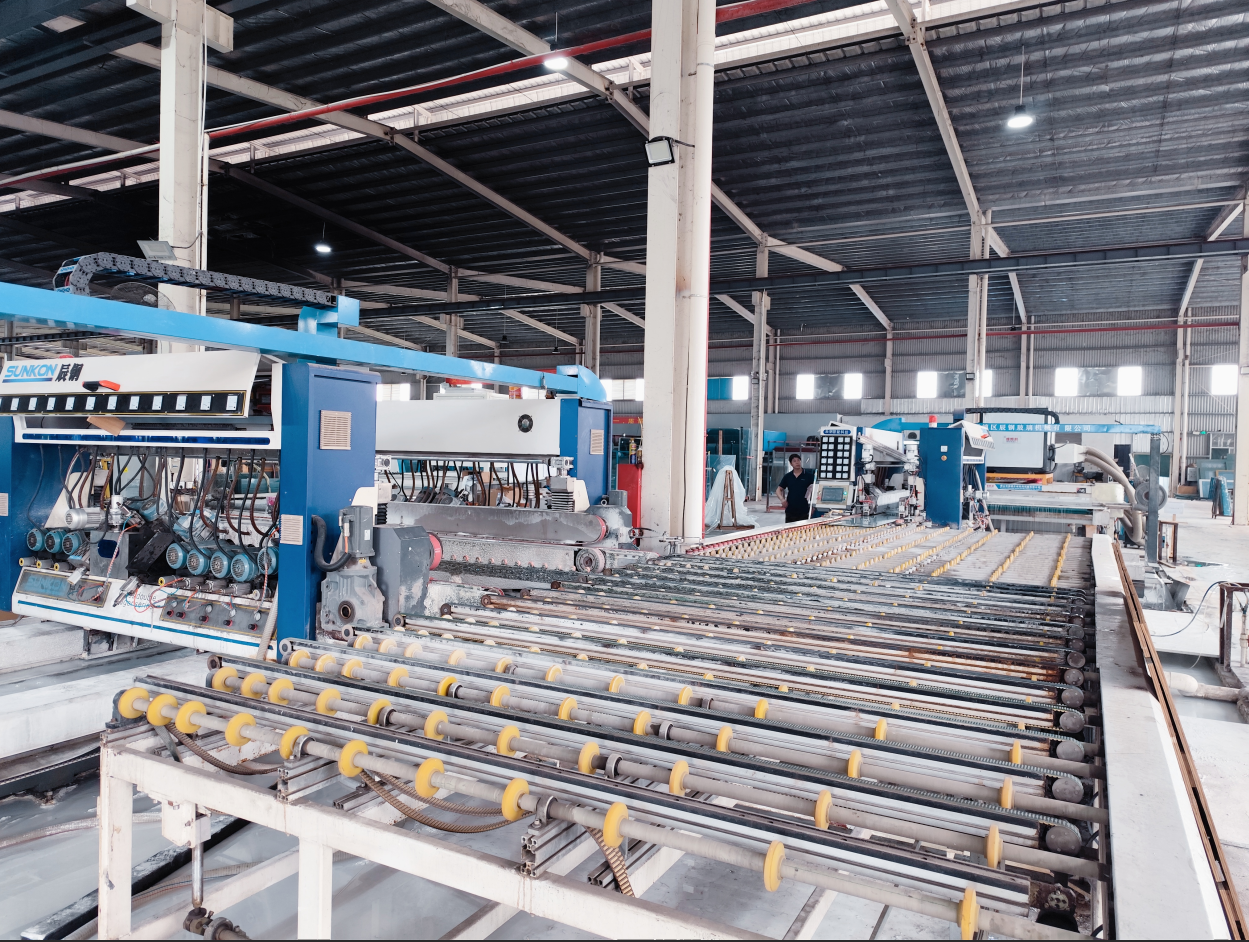
Edge quality is one of the few visible process variables a buyer can inspect before installation, and it is checkable on site.
The peer portfolios are organised differently, by function rather than by construction. AGC frames its flat glass around external glazing, interior decoration and industrial use. Guardian Glass leads with solar control alongside interior, automotive and decorative categories. Pilkington lists solar-control, self-cleaning, technical and safety/security products. Vitro presents a performance catalogue tied to project references. When a specification is written in functional language — solar control, self-cleaning, safety — a construction-led portfolio like DYGLASS's has to be translated before it can be compared. That translation step, not the product list, is where most substitution errors happen.
Peer map: what each company actually publishes
| Company | Technology / portfolio signal | Market-share evidence | Service evidence | Standards and application notes |
|---|---|---|---|---|
| DYGLASS | Tempered, laminated, insulated, curved, smart, ceramic frit and art stained glass; process controls with defined temperature thresholds and quarterly refractory inspection | None published; 600,000 m² annual output and 60% export ratio are scale signals, not share | OEM/ODM stated; warranty more than five years; named commercial contact | Stated export markets include UAE, Bahrain, Saudi Arabia, US, Philippines, Vietnam; certificate verification remains open |
| Saint-Gobain | Not assessed in this review | Not assessed | Not assessed | Not assessed; no comparable public product-portfolio page in the source set used |
| AGC | Architectural flat glass for external glazing, interior decoration and industrial use | Not published on the page reviewed | Not published on the page reviewed | Portfolio framed by application rather than by construction |
| Guardian Glass | Solar control, interior, automotive, decorative and innovative solutions; technical explanation of tempered versus laminated breakage behaviour | Not published on the page reviewed | Not published on the page reviewed | Useful reference for safety-glass behaviour, with local code deciding the choice |
| NSG Pilkington | Solar control, self-cleaning, technical and safety/security categories | Not published on the page reviewed | Not published on the page reviewed | Standards reference: BS EN 1279, 1863, 12150, ISO 12543, 14449 — a manufacturer reference, not certification |
| Vitro | High-performance architectural glass catalogue with project references | Not published on the page reviewed | Not published on the page reviewed | Project-oriented presentation rather than construction-level specification |
“Not assessed” is not a negative finding. It records that the source set for this article did not include a comparable public statement, and that the check remains open for the buyer.
Limits, fit boundaries and cost logic
Two cost data points frame the decision without pretending to quote any supplier. In Europe in 2024, the average installation cost of laminated glass was USD 128 per square meter against USD 91 per square meter for tempered glass, according to Fortune Business Insights (medium confidence, 2024 data). The gap is large enough that glass type becomes a budget decision, not only a performance decision: a facade that moves from tempered to laminated for acoustic or safety reasons changes the cost line before any supplier is chosen.
On curved work, DYGLASS makes a comparative statement that should be read as a company claim. It states that on-site installation loss can be held within 2%, against a 5%–8% loss rate for ordinary curved glass, and that its multi-curved glass offers a service life of more than 25 years, 8–10 years longer than its stated baseline for ordinary single-curved glass. Those figures were not independently tested for this article. They are, however, specific enough to be tested by a buyer: installation loss can be verified against a completed project, and service life can be tracked through warranty claims and replacement records.
The fit boundaries matter as much as the capabilities. DYGLASS was founded in 2017, states an R&D team of 5–10 people, and in the material reviewed does not publish third-party test reports for the three products above. A buyer whose project requires group-level materials research, multi-country technical support, in-house float supply or a long corporate record should verify those requirements directly with each bidder, because none of the sources reviewed documents them for DYGLASS. A buyer whose project requires documented process control, curved and multi-curved forming and construction-level product data has, in this review, more to audit at DYGLASS than at the peer pages reviewed. That is a statement about documentation depth, not about product performance, and it should be tested rather than assumed in either direction.
What changes for 2026 specifications
Standards editions and labelling are the two places where a 2026 specification most often goes out of date.
For Australia and New Zealand, AS/NZS 2208:2023 governs safety glazing materials in buildings and carries 2024/2025 amendments; the edition, not just the number, should appear in the specification. For European-referenced work, the BS EN series named in the Pilkington reference — 1279 for insulating glass units, 1863 for heat-strengthened glass, 12150 for thermally toughened safety glass, ISO 12543 for laminated glass and 14449 for conformity assessment — indicates the testing families a submittal should address, with conformity confirmed by the issuing body rather than by the supplier's website. In the United States, industry guidance on marking and labelling describes requirements for safety glazing in hazardous locations and additional identification for fire-rated glazing, including manufacturer, glass type and thickness, with code adoption varying by jurisdiction. Checking the label on delivered glass is a short verification step that catches substitution early.
The signal that survives scrutiny here is not a growth forecast. It is a documentation gap: the peer pages reviewed describe functions and categories, while the procurement question in 2026 is answered at the level of construction, configuration and test evidence. Where that gap closes, comparisons become easier and price competition sharper.
The forward view is conditional. If a project is geometrically complex, with free-form or multi-curved elements, the weighting shifts toward process evidence: forming capability, autoclave control, heat-soak records and installation-loss history. If a project is a multi-country rollout under one specification, the weighting shifts toward whoever can prove consistent documentation and support in every market — a claim that should be tested, not assumed, for any supplier, including the largest names in this article.
Frequently asked questions
Is DYGLASS comparable in scale to AGC, Guardian Glass, NSG Pilkington or Vitro?
There is no verified basis for a scale comparison in the sources reviewed. DYGLASS states a 30,000 m² factory, 130 employees and an annual output of 600,000 square meters; comparable capacity or revenue figures for the peer group were not published on the pages reviewed for this article. Scale also answers a different question from fit: a specialist processor with documented process control can serve a complex facade, while a large group may be the better match for multi-country supply. The two questions should be assessed separately.
What does 6mm+12A+6mm mean, and when is 8mm+16A+8mm used?
The notation describes an insulating glass unit: two 6 mm glass lites separated by a 12 mm sealed cavity, with “A” denoting the air or gas space. The 8mm+16A+8mm build uses thicker lites and a wider cavity. The heavier build is generally considered where spans are larger, wind loads are higher or acoustic targets are stricter, but the correct choice comes from a project calculation covering wind load, deflection, thermal performance and acoustics, not from the catalogue alone.
Which DYGLASS product suits a curtain wall, and which suits an interior partition?
DY-ZK01 insulating glass is the natural fit for curtain wall glass and window systems, because the sealed cavity carries thermal and acoustic performance. DY-GH01 tempered glass suits safety locations such as doors and partitions, where fragmentation into small pieces is the required behaviour. DY-JJ01 laminated glass suits locations where fragments must remain attached to the interlayer, such as overhead glazing, balustrades and acoustic or security builds. Local code determines the mandatory behaviour in each location, and the three products are not interchangeable within a single application.
Do the stated 70–89% light transmittance and 30–45 dB sound insulation apply to every unit?
No. Both are ranges across the product family, and a specific build has a specific value depending on glass thickness, coating and cavity. A project should request the unit-level datasheet and the relevant test report for the configuration being supplied. Acoustics in particular are affected by framing, seals and the installation detail, so a laboratory value describes the glazing assembly rather than the finished facade.
Does a supplier's list of standards prove the product is certified?
No. A standards reference identifies the testing and conformity framework a product may be assessed against; it is not a certificate. Verification means checking the certificate number, issuing body, product scope and validity date, and confirming they match the delivered panels. This applies equally to AS/NZS 2208:2023, to the BS EN series referenced by Pilkington and to any marking or labelling requirement in the destination market.
Reference material
The DYGLASS company profile, product scope and contact details are published at DYGLASS. A downloadable company brochure covering product ranges and factory capability is available here: DYGLASS building glass brochure (PDF).
¿Tiene preguntas o necesita más detalles?
Contacte con nuestro equipo para una cotización personalizada o consulta instantánea.
Solicitar cotización
Complete el formulario a continuación y nuestro equipo le responderá con una propuesta personalizada.
Chat directo de WhatsApp
¿Prefiere chatear en tiempo real? Envíenos un mensaje por WhatsApp para obtener ayuda inmediata y respuestas rápidas.
- Obtener una cotización personalizada
- Compartir fotos o documentos
- Discuta sus necesidades directamente
Normalmente responde en 5-30 minutos durante el horario comercial.