
Brushless vs Brushed Motors for Continuous Duty: Technical & Procurement FAQ
Brushless vs Brushed Motors for Continuous Duty: Technical & Procurement FAQ
Continuous duty is the operating condition that quietly decides which miniature motor belongs in a design. It describes a motor running at load long enough to reach thermal equilibrium and then continuing to run — a pipetting axis in a diagnostic analyzer, a positioning drive on an automated line, or a 12 V gear motor holding a load for hours. In that regime, the choice between a brushed DC motor and a brushless DC motor stops being a debate about technology generations and becomes a decision about which wear path and which thermal limit will define the maintenance interval.
The short answer: a brushless motor (also written brushless DC motor, or BLDC motor) switches its windings electronically and has no carbon brushes, so continuous operation removes the brush-and-commutator wear mechanism. A brushed DC motor drives directly from a DC supply and is generally simpler and lower in system cost, but its continuous-duty behaviour is bounded by brush wear, commutator condition and heat. What follows is a technical and procurement FAQ for buyers evaluating both architectures in the 12–24 V miniature class — covering rated torque, controller requirements, gearbox consequences, acceptance criteria and the model-level data that can actually be verified.
What Continuous Duty Actually Means for a Small DC Motor
Continuous duty is defined by thermal equilibrium, not by calendar time. A mini gear motor that runs for six minutes per hour in a smart door lock is not in continuous duty; a brushless gear motor running a low-speed positioning axis through an eight-hour diagnostic workflow is. In motor duty-cycle classification, continuous duty is commonly designated S1, while intermittent and positioning duties fall into separate categories. The label matters because it determines which number on a datasheet is the relevant one.
Rated torque is defined as the torque that can be continuously output under specified operating conditions. That is the number a continuous-duty specification should be built on. A figure described as a maximum or peak value describes a short-term capability instead. The distinction is visible in real product data: the GMP36-TEC3650 brushless planetary gear motor is specified with a maximum rated torque of 30.0 kg.cm, and the same product documentation separately notes its ability to absorb short-term heavy-load impacts with a large safety margin. Those are two different statements, and only one of them is a continuous-duty claim.
The practical consequence for procurement is that a continuous-duty enquiry should state four inputs before a supplier is asked to propose a model: the load torque required at the output shaft, the duty regime (continuous, intermittent or positioning), the ambient temperature and airflow around the motor body, and the required output speed after reduction. Without those four inputs, a brushed-versus-brushless comparison is a comparison of catalog numbers rather than of capabilities.
How the Two Commutation Methods Differ in Continuous Operation
Brushed motors: direct DC drive with a mechanical wear path
Brushed motors use carbon brushes and a commutator to switch current into the rotor windings, which is why they can run from a DC supply without external electronics. GMP12T-TDC1215, a brushed coreless gear motor in the micro DC gear motor category, is documented as using direct DC voltage drive without an external controller, with a coreless rotor and an integrated gearbox and a standard flange mounting interface for integration into compact devices.
GM37-555PM represents the more conventional brushed architecture: a DC brush spur gear motor with a brushed DC motor design, rated DC 12 V–24 V, with up to 8.0 kg.cm maximum rated torque and 5–800 rpm output across 2 to 6 gear stages with gearbox lengths of 19 mm, 21.5 mm, 24 mm, 26.5 mm and 29 mm. Its documented strengths are a wide reduction range — ten ratios from 1/6 to 1/810 — simple drive, low system cost, and a standard 37 mm outer diameter with six M2.5 flange holes that makes replacement and integration straightforward.
For continuous duty, the property that matters is that the brush and commutator form a rubbing electrical contact. That contact is a wear mechanism, and it is the mechanism a brushless design removes.
Brushless motors: electronic commutation without carbon brushes
Brushless motors switch the windings electronically using rotor position information rather than carbon brushes. TWG3246-TEC2430, a DC brushless worm gear motor with an integrated worm gearbox and right-angle output, is documented as using brushless motor construction with electronic commutation instead of carbon brushes. The same product listing describes no spark generation, minimal electromagnetic interference, and a self-locking worm output that typically removes the need for an additional braking device — useful properties where a load must be held after power removal.
GMP36-TEC3650 is a brushless planetary gear motor in the DC brushless gear motor category, combining a brushless motor with a same-diameter planetary gearbox; motor and gearbox share a 36 mm outer diameter. Its brushless structure eliminates brush wear, so regular brush replacement is not required. Precision-machined planetary gears keep transmission backlash minimal and support low operating noise, and the design removes the brush and commutator wear mechanism that exists in brushed DC motors of comparable size.
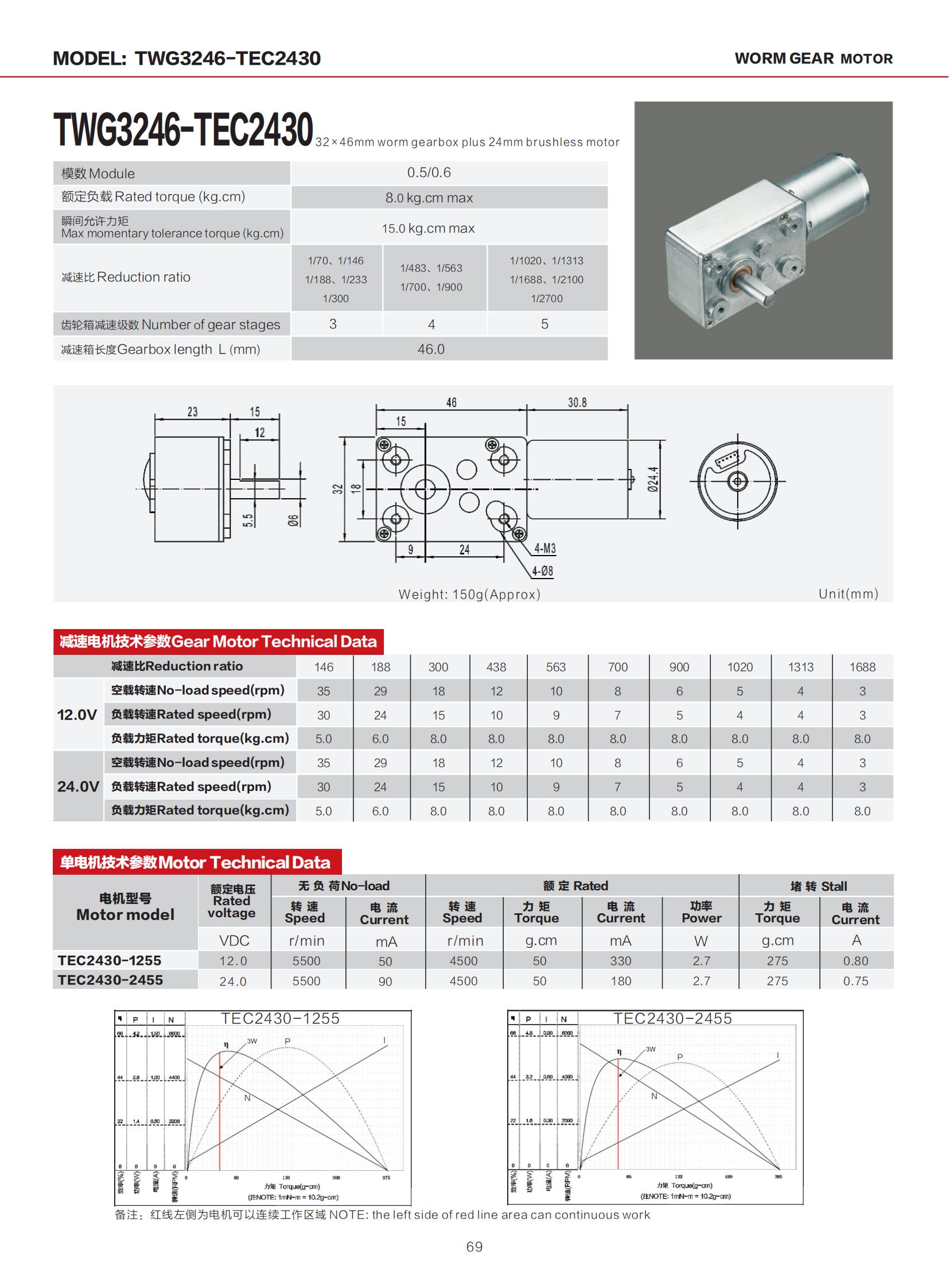
Side-by-side comparison for continuous duty
| Selection criterion | Brushless (DC brushless gear motor) | Brushed (DC brush / spur gear motor) |
|---|---|---|
| Commutation | Electronic, using rotor position information; no carbon brushes (TWG3246-TEC2430, GMP36-TEC3650) | Carbon brushes and commutator; can run from a direct DC supply (GM37-555PM, GMP12T-TDC1215) |
| Wear path in continuous duty | Brush wear eliminated; regular brush replacement not required (GMP36-TEC3650) | Rubbing brush and commutator contact is the maintenance-relevant wear path |
| Drive electronics | Requires electronic commutation circuitry as part of the system | Direct DC voltage drive without an external controller is documented for GMP12T-TDC1215 |
| Spark and EMI behaviour | Listing for TWG3246-TEC2430 states no spark generation and minimal electromagnetic interference | Rubbing brush contact is the mechanism that brushless construction removes |
| Service-life statement | Manufacturer statement: typically tens of thousands of hours (GMP36-TEC3650) | Model-level rated torque figures; continuous life depends on brush wear and thermal conditions |
| Gearbox and positioning | Precision-machined planetary gears, minimal transmission backlash; worm version adds right-angle output and self-locking | Spur gearboxes; GM37-555PM offers ten ratios from 1/6 to 1/810 across 2–6 stages |
| System cost structure | Higher electronics content; cost shifts toward drive and integration | Simple drive, low system cost (documented for GM37-555PM) |
| Example mounting interface | 36 mm body diameter, 8 mm solid shaft, four M3 flange holes, 420 g (GMP36-TEC3650) | 37 mm outer diameter, six M2.5 flange holes (GM37-555PM) |
What the Market Data Suggests About Brushless Adoption
Brushless is no longer a specialist architecture in miniature motion. Grand View Research reports the global brushless DC motor market at USD 22.2 to 22.33 billion for 2025, with a forecast period extending to 2033. At the component level, OEC trade data records global exports of electric motors with an output below 37.5 W — HS code 850110, the classification that contains most miniature gear motors — at USD 16.3 billion in 2024.
Efficiency regulation is moving in the same direction at higher power levels. IEC 60034-30-1:2025 introduced the IE5 ultra-premium efficiency class with effect from 1 January 2025. In the European Union, Ecodesign Regulation (EU) 2019/1781 has required IE3 for motors from 0.75 kW to 1000 kW, and IE2 for the 0.12 kW to 0.75 kW band, since 1 July 2021.
Two procurement-relevant conclusions follow. First, the regulatory trend favours electronically commutated designs where those rules apply. Second — and this is the part most often missed — the minimum-efficiency thresholds begin at 0.12 kW, which places the IE-class framework outside the band where miniature DC gear motors in the 12–24 V class are normally specified. A buyer sourcing a dc gear motor 12v or a mini brushless motor will not find an IE class to cite. Verification therefore has to come from the supplier's own test data, sample evaluation and documented duty ratings rather than from a regulatory label.
The supply side reflects this. TT Motor (Shenzhen) Industrial Co., Limited is a China-based manufacturer of miniature precision motors, established in 2006 and headquartered in Bao'an District, Shenzhen, with a manufacturing area of approximately 9,000 m², over 300 employees and an annual output of about 8,000,000 motor units. Its product lines include brushless motors, coreless motors, gear motors, stepper motors and DC motors, and third-party company data describes its range as covering 12 mm to 42 mm brush and brushless reduction motor series — a span that includes both the brushed and brushless options compared in this article.
Reference Points in the 12–24 V Class
The table below lists five documented models from the same manufacturer so that the architectural difference can be read against real specifications rather than general claims.
| Model | Architecture | Rated voltage | Max rated torque | Output speed | Gear stages / gearbox length | Documented application focus |
|---|---|---|---|---|---|---|
| GMP36-TEC3650 | Brushless planetary gear motor (DC brushless gear motor) | DC 12–24 V, customizable within that range | 30.0 kg.cm | 4–1600 rpm | 1 / 2 / 3 / 4 stages; 26, 33.5, 40.5, 47.5 mm | Robotics, medical devices, industrial automation equipment, intelligent logistics equipment |
| TWG3246-TEC2430 | DC brushless worm gear motor | DC 12–24 V | 8.0 kg.cm | 3–35 rpm | 3 / 4 / 5 stages; 46 mm | Miniature medical devices, precision automated instruments, electrically adjustable supports |
| GM37-555PM | DC brush spur gear motor (brushed) | DC 12–24 V | 8.0 kg.cm | 5–800 rpm | 2 / 3 / 4 / 5 / 6 stages; 19–29 mm | Smart home, automated equipment, automated production lines |
| GM12-N20VA | DC spur gear motor (N20 gear motor series, brushed) | 2.4 V / 5 V | 0.5 kg.cm | 12–1450 rpm | 2 / 4 / 5 / 7 stages; 9 or 12 mm | Smart door locks; compact electronic assemblies |
| GMP12T-TDC1215 | DC brush coreless gear motor | DC 4.5–12 V | 2 kg.cm | 8–5000 rpm | 1 / 2 / 3 / 4 stages; 14.9–29.3 mm | Medical equipment, precision robots, high-end consumer electronics, micro sensors |
Three patterns stand out. Torque in this class spans roughly two orders of magnitude, from 0.5 kg.cm on the N20-class spur gear motor to 30.0 kg.cm on the brushless planetary unit — which is why a high torque planetary motor and a small dc motor should never be compared on a single number. Output speed spans a similar range, from 3 rpm on the worm gear version to several thousand rpm on the coreless unit. And voltage splits along architecture lines: the brushed N20-class model is offered at 2.4 V or 5 V, while the 12 V and 24 V band is where brushed and brushless options overlap — which is precisely where a brushless-versus-brushed decision is usually made.
For the GMP36-TEC3650 specifically, the documented specification also includes a gear module of 0.5, ten reduction ratios from 1/4 to 1/720, an 8 mm diameter solid output shaft, a mounting flange with four M3 holes, a net weight of 420 g, and construction from stainless steel, copper and iron. Those interface details matter more in continuous duty than they do in prototyping, because they determine whether the motor can be serviced or replaced without redesigning the assembly around it.
Application Fit: Where Continuous Duty Actually Appears
Continuous duty is not evenly distributed across miniature motor applications, which is why no single architecture wins everywhere.
Medical equipment is the clearest continuous-duty profile. Documented working conditions for this segment describe low-speed precision motion with long-term operation, and the device list includes urine analyzers, body fluid analyzers, pipetting equipment, infusion syringe pumps, surgical staplers, rehabilitation robots, microfluidic dispensers and blood collection robots, with special requirements of low noise, low vibration and stable operation. Both brushless models above are documented as intended for medical device scenarios: GMP36-TEC3650 covers compact robotic and automation equipment, while TWG3246-TEC2430 is specified for miniature medical devices, precision automated instruments and electrically adjustable supports, where the self-locking worm output can reduce dependence on a separate brake. In an instrument that runs a slow axis for hours, removing the brush-replacement maintenance item is a serviceability decision, not a marketing one.
Smart home applications sit at the opposite end. Their documented working condition is low-speed operation in limited space with intermittent, positioning duty — the regime in which brushes are not the limiting factor. A smart door lock drive is a short, repeated movement rather than hours of continuous rotation, and GM12-N20VA is specified for exactly that: a small-size gear motor for compact electronic assemblies, rated 2.4 V or 5 V, with 2 to 7 selectable gear stages and documented operation in both high and low temperature environments. For intermittent duty, the brushed architecture's simple drive and low system cost remain a rational engineering choice rather than a compromise.
Robotics is where the two architectures meet. Robot joint applications are documented as high-frequency dynamic motion with rapid start and stop, requiring high power density, fast response and low inertia. GMP36-TEC3650 is intended for robotics among other industries. The brushed coreless motor GMP12T-TDC1215 is also used in precision robot applications, and its low rotor inertia is the reason coreless designs deliver fast dynamic response: if inertia is large, a stop command can overshoot because the rotor keeps turning. That is a useful correction to a common assumption — brushless and fast response are not the same claim. A coreless brushed motor can be the better dynamic choice in an application that does not run continuously.
Industrial automation and logistics combine both regimes inside one machine. Industrial automation equipment and intelligent logistics equipment are documented target industries for the brushless planetary unit, while automated equipment and automated production lines are documented for the brushed spur gear motor. The realistic engineering answer in a mixed machine is often a mixed bill of materials.
Where Brushed Motors Still Make More Sense
A fair comparison has to state the boundaries of the newer architecture, and there are four that matter commercially.
Brushless motors require drive electronics. Electronic commutation does not happen by itself; the controller becomes part of the system design, the wiring harness and the cost structure. A brushed motor such as GMP12T-TDC1215 is documented as running on direct DC voltage drive without an external controller. For a low-cost 12 volt dc motor application with a short duty cycle, adding commutation electronics can raise total system cost without changing the maintenance interval at all.
System cost and replacement simplicity favour brushed designs in many assemblies. GM37-555PM is documented with simple drive and low system cost, and its standard 37 mm outer diameter with six M2.5 flange holes is explicitly noted as making replacement and integration easy. In a mature product where the mechanical envelope is fixed, that interchangeability has real value.
The headline lifespan figure is a manufacturer statement, not a third-party certification. The GMP36-TEC3650 documentation states a service life typically in the tens of thousands of hours. That figure is conditional on load, ambient temperature, duty profile and gearbox selection, and it is not independently certified. Treating it as an unconditional guarantee would be a procurement error; treating it as a testable claim that can be validated against a supplier protocol is the correct approach.
There is no regulatory benchmark in this class, and the public data has gaps. As noted above, the efficiency-class framework begins at 0.12 kW, so miniature gears motors in this voltage range carry no IE label. Public datasets also cannot isolate this segment cleanly: HS code 850110 is too broad to separate N20-class gear motors from other small DC motors, and no public dataset documents the rate at which brushless gear motors are replacing brushed versions in medical or robotics applications. Buyers should expect to build their own evidence through samples and application-level testing rather than sourcing it from a market report.
The practical boundary: brushless is the stronger default where duty is genuinely continuous, where spark-free and low-EMI operation matters, or where access for maintenance is difficult. Brushed remains the better commercial choice where duty is short and intermittent, where the drive budget is tight, and where a standard mounting footprint must be preserved.
Procurement and Acceptance Criteria for Continuous-Duty Motors
Continuous-duty sourcing succeeds or fails on the specification, not on the architecture label. The following criteria are the ones that repeatedly decide outcomes.
1. State the duty regime explicitly. Specify continuous, intermittent or positioning operation, and state the expected operating hours. Documented application data shows why this matters: the same low-speed regime appears in both smart home applications (intermittent, positioning) and medical applications (long-term operation). The duty statement is what separates them.
2. Specify torque at the operating point, not the peak. Ask for the continuously available output torque under the stated conditions, and separately ask what short-term overload the design can absorb. For reference, a brushless planetary unit in this class is documented at 30.0 kg.cm maximum rated torque, while a brushed spur gear motor and a brushless worm gear motor are each documented at 8.0 kg.cm — but the correct comparison is only valid at the same output speed and ambient condition.
3. Match the drive to the architecture. For a brushless dc gear motor, confirm the commutation electronics, control method and supply range as one system — DC 12 V to 24 V with customization within that range is documented for GMP36-TEC3650. For a brushed dc motor, confirm that direct DC supply is acceptable and whether any speed control will be applied externally.
4. Lock down the mechanical interface. Gear stages, reduction ratio, gearbox length, shaft diameter and flange pattern should be recorded in the purchase specification. The differences are not cosmetic: an 8 mm solid shaft with four M3 holes, a 37 mm body with six M2.5 holes and a 9 mm or 12 mm N20-class gearbox are three different mounting realities.
5. Define backlash and holding behaviour. Applications that hold position after power removal may need a self-locking worm output, as documented for TWG3246-TEC2430. Applications that need positioning accuracy should specify backlash, which is why a precision-machined planetary gear set with minimal transmission backlash is documented as a design feature of GMP36-TEC3650.
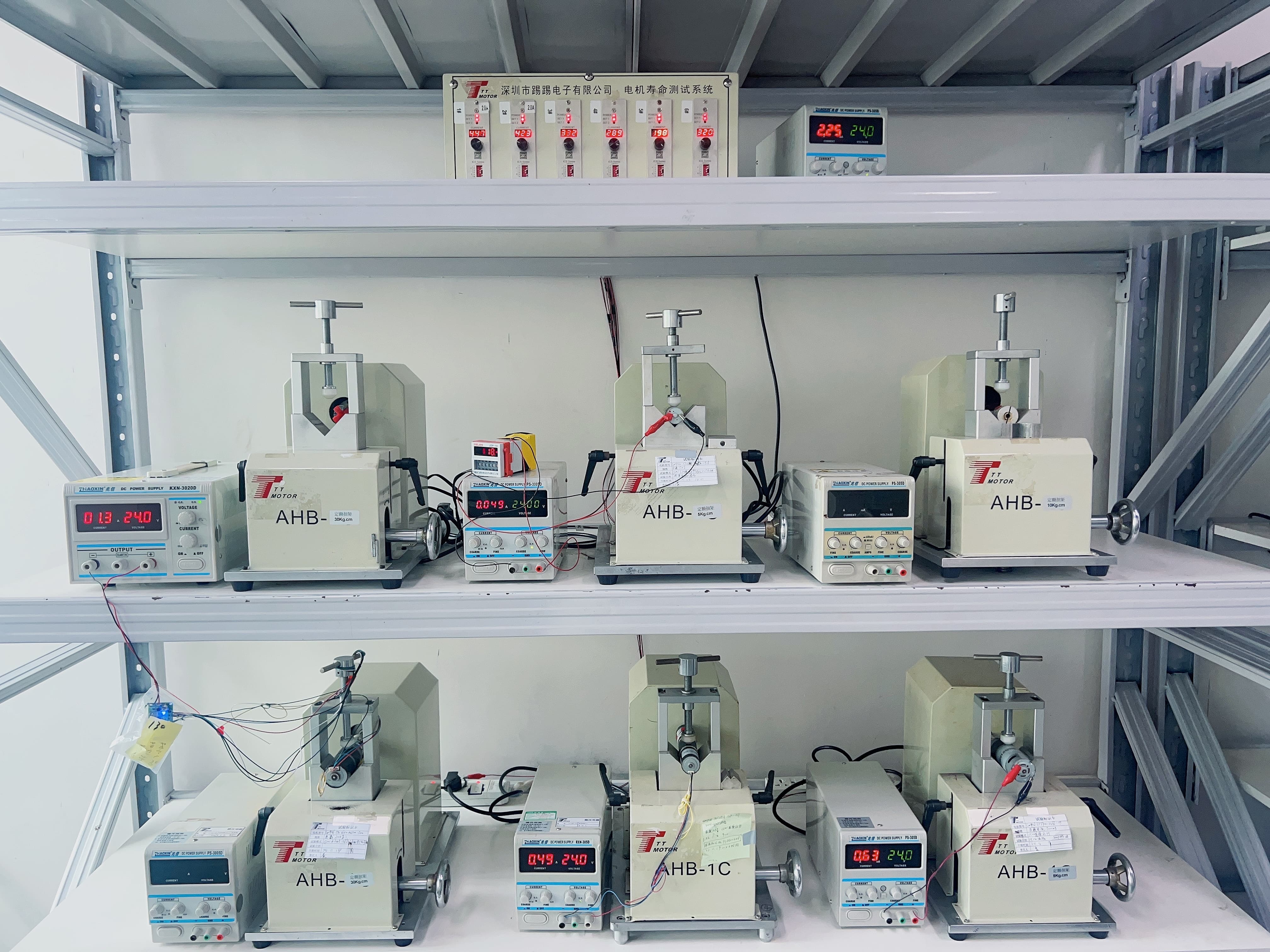
6. Verify batch consistency, not just the sample. For repeat production, ask how gear stage configuration, output speed at a defined voltage and backlash are inspected batch to batch. A supplier with an automated production process, a precision assembly system, a product testing system and a mass production management system — as documented for TT Motor, which employs 35 engineers in motor design and structure optimization — can describe that method; a supplier that cannot describe it should not be approved for continuous-duty volume.
7. Request documentation at model level. For EU and US shipments, a RoHS declaration should be requested per model rather than per catalog family, because construction and materials differ between models: GMP36-TEC3650 is documented as stainless steel, copper and iron, while GM37-555PM is documented as stainless steel, iron and copper. Material declarations and any applicable conformity documents should follow the same model-by-model rule.
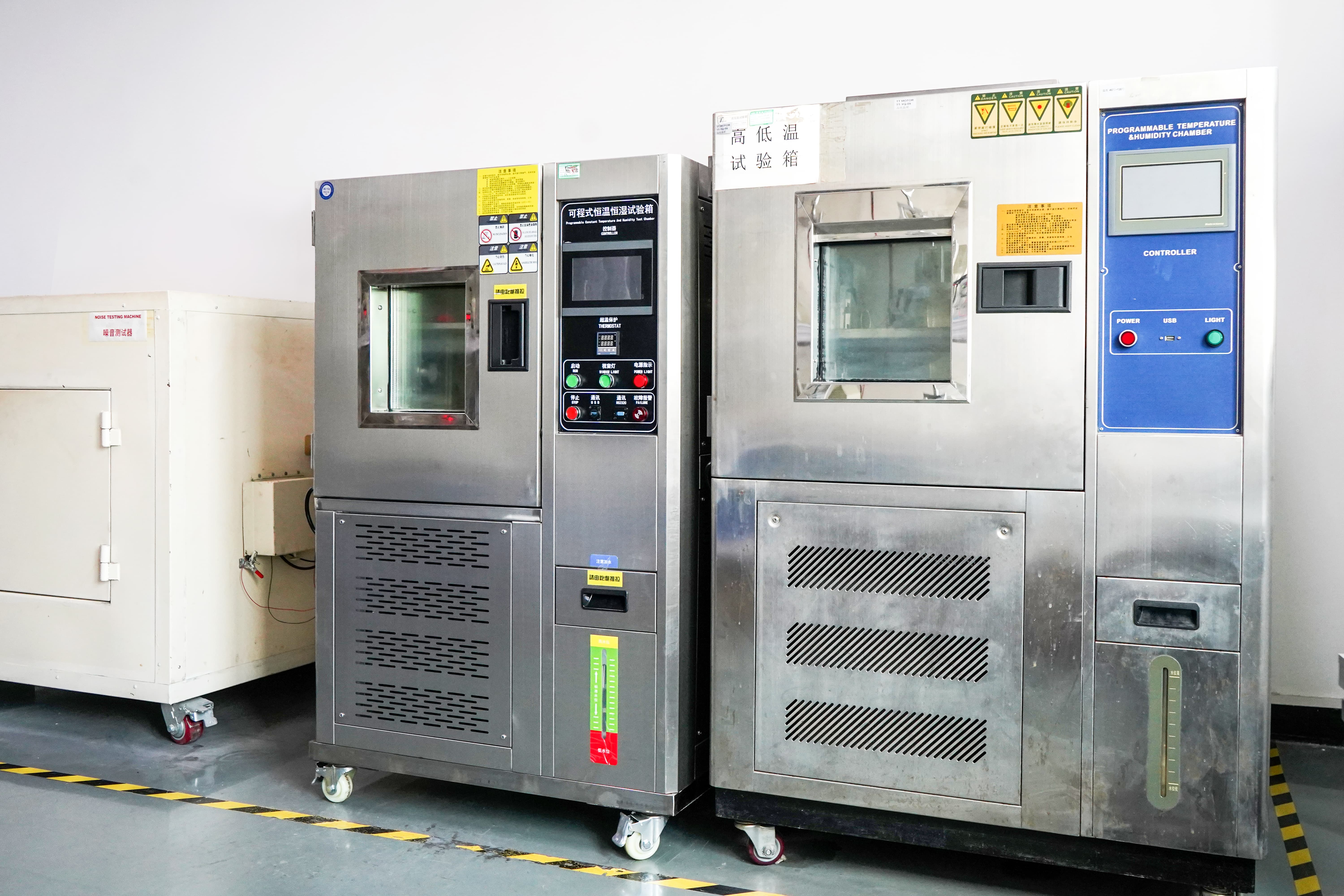
8. Validate with a sample running the real duty cycle. Bench testing at no load confirms almost nothing about continuous duty. The sample should be run at the application load, in the application ambient condition, for long enough to observe thermal stabilisation and speed stability.
9. Agree the life-test protocol in advance. If an endurance figure is part of the acceptance rationale, the load, ambient temperature, duty cycle and failure criterion should be agreed before testing begins, so that a reported result can be interpreted rather than merely quoted.
Future Outlook
Three forces are converging on this component class. Brushless DC motor demand continues to expand, with the global market reported at USD 22.2 to 22.33 billion for 2025 and a forecast horizon to 2033. Efficiency regulation continues to tighten at the power levels it covers, with IEC 60034-30-1:2025 adding the IE5 class and EU Ecodesign requirements already setting IE3 and IE2 thresholds since 2021. And equipment categories that run continuously — diagnostic instruments, automation and logistics equipment — keep expanding their installed base, which pushes duty-cycle durability up the buying agenda.
Against that, two counter-currents will keep the brushed architecture relevant. First, regulation does not reach this class: the 0.12 kW threshold leaves miniature gear motors outside IE labelling, so no external compliance pressure forces conversion. Second, the segment lacks clean public data — trade statistics under HS 850110 cannot isolate N20-class gear motors, and the replacement rate of brushed by brushless gear motors in medical and robotics applications is not documented in public datasets. Conversion will therefore continue application by application, driven by maintenance economics and by requirements such as spark-free operation, rather than by a single industry-wide switch.
The likely direction of travel for suppliers is verification-oriented: continuous-duty ratings supported by stated test conditions, thermal data and model-level documentation, rather than a single headline hour figure. For buyers, that shift is favourable, because it makes brushless and brushed options comparable on the same terms for the first time.
FAQ
What is the essential difference between a brushless motor and a brushed motor in continuous operation?
A brushless motor switches its windings electronically and has no carbon brushes, so continuous running removes the brush-and-commutator wear mechanism; TWG3246-TEC2430 is documented as using electronic commutation instead of carbon brushes, and GMP36-TEC3650 is documented as having a brushless structure that eliminates brush wear so regular brush replacement is not required. A brushed motor uses carbon brushes and a commutator and can run directly from a DC supply, but that rubbing contact is itself the wear path. In continuous duty, the practical difference is that a brushless design removes a scheduled maintenance item, while a brushed design's continuous behaviour is bounded by that contact and by thermal limits.
Does a brushless gear motor need a separate controller?
Yes. Brushless commutation is electronic rather than mechanical, so drive electronics are part of the system design. In the model data examined here, TWG3246-TEC2430 is documented with electronic commutation instead of carbon brushes, and GMP36-TEC3650 is classified as a brushless planetary gear motor within the DC brushless gear motor category. By contrast, the brushed coreless gear motor GMP12T-TDC1215 is documented as using direct DC voltage drive without an external controller. The procurement consequence is that a brushless option should be specified together with its drive electronics, supply range and control method, while a brushed option must be checked for direct-supply compatibility.
How long can a brushless gear motor be expected to run in continuous duty?
The documented manufacturer statement for the GMP36-TEC3650 is a service life typically in the tens of thousands of hours. That figure is a manufacturer statement rather than an independently certified result, and it depends on load, ambient temperature, duty profile and gearbox configuration. A buyer should therefore ask under what load and thermal conditions the figure was derived, which failure criterion was applied, and whether the test protocol can be reviewed. A lifespan claim without stated test conditions cannot be transferred to a different application.
Do IEC efficiency classes or EU ecodesign rules apply to a 12 V or 24 V gear motor?
Not in the form buyers usually expect. IEC 60034-30-1:2025 introduced the IE5 ultra-premium efficiency class with effect from 1 January 2025, and EU Ecodesign Regulation (EU) 2019/1781 has required IE3 for motors from 0.75 kW to 1000 kW and IE2 for the 0.12 kW to 0.75 kW band since 1 July 2021. Because those thresholds begin at 0.12 kW, miniature DC gear motors in the 12–24 V class fall outside the scope in which IE classes are assigned. For this class, efficiency and durability evidence has to come from supplier test data and application-level validation rather than from a regulatory efficiency class.
When is a brushed motor still the better choice?
When the duty cycle is intermittent or positioning-based rather than continuous, and when drive simplicity and system cost dominate. Documented smart home applications describe low-speed operation in limited space with intermittent, positioning duty — smart door locks, camera pan-tilt units, smart feeders and similar devices — a regime in which the brush wear path is not exercised long enough to define the maintenance interval. The documented commercial advantages of the brushed architecture in this class are simple drive, low system cost, a wide reduction range of ten ratios from 1/6 to 1/810 across 2 to 6 stages, and a standard 37 mm outer diameter with six M2.5 flange holes for straightforward replacement. It is also worth noting that coreless brushed designs such as GMP12T-TDC1215 offer low rotor inertia and fast dynamic response, so they remain relevant in rapid start-stop applications.
Which gearbox parameters should be specified for continuous-duty operation?
Five parameters drive most of the outcome: gear stages and the resulting reduction ratio, gearbox length as it affects overall envelope, output shaft diameter and mounting flange pattern, transmission backlash, and whether self-locking is required. Concrete examples from this class: TWG3246-TEC2430 uses a 46 mm gearbox with 3, 4 or 5 stages and a right-angle worm output that is typically self-locking, which can remove the need for a separate braking device; GMP36-TEC3650 uses precision-machined planetary gears with minimal transmission backlash, available in 1 to 4 stages with gearbox lengths from 26 mm to 47.5 mm; GM37-555PM offers 2 to 6 stages across ten ratios from 1/6 to 1/810. Specifying all five at the enquiry stage prevents a later redesign of the driven assembly.
Further Reference
TT Motor (Shenzhen) Industrial Co., Limited publishes a downloadable brochure covering its miniature motor products, available at https://cdn.socialarks.com/sbsp/25192/common/2026/0821/%E5%B1%95%E4%BC%9A%E5%AE%A3%E4%BC%A0%E5%86%8C.pdf. Company data lists a 9,000 m² manufacturing area, over 300 employees, an annual output of about 8,000,000 motor units, a 35-engineer R&D team working on motor design and structure optimization, and product lines spanning brushless motors, coreless motors, gear motors, stepper motors and DC motors, used across industrial automation, intelligent robots, medical equipment, precision instruments, smart homes, automotive electronics and unmanned equipment.