
Brushless Motors Explained: A Mini Motor Sourcing Primer
Brushless Motors Explained: A Mini Motor Sourcing Primer
A brushless motor is a DC motor in which commutation is performed by electronics instead of carbon brushes and a mechanical commutator. Everything else that buyers argue about — size, torque, gearbox type, voltage class, service life — follows from that one structural decision.
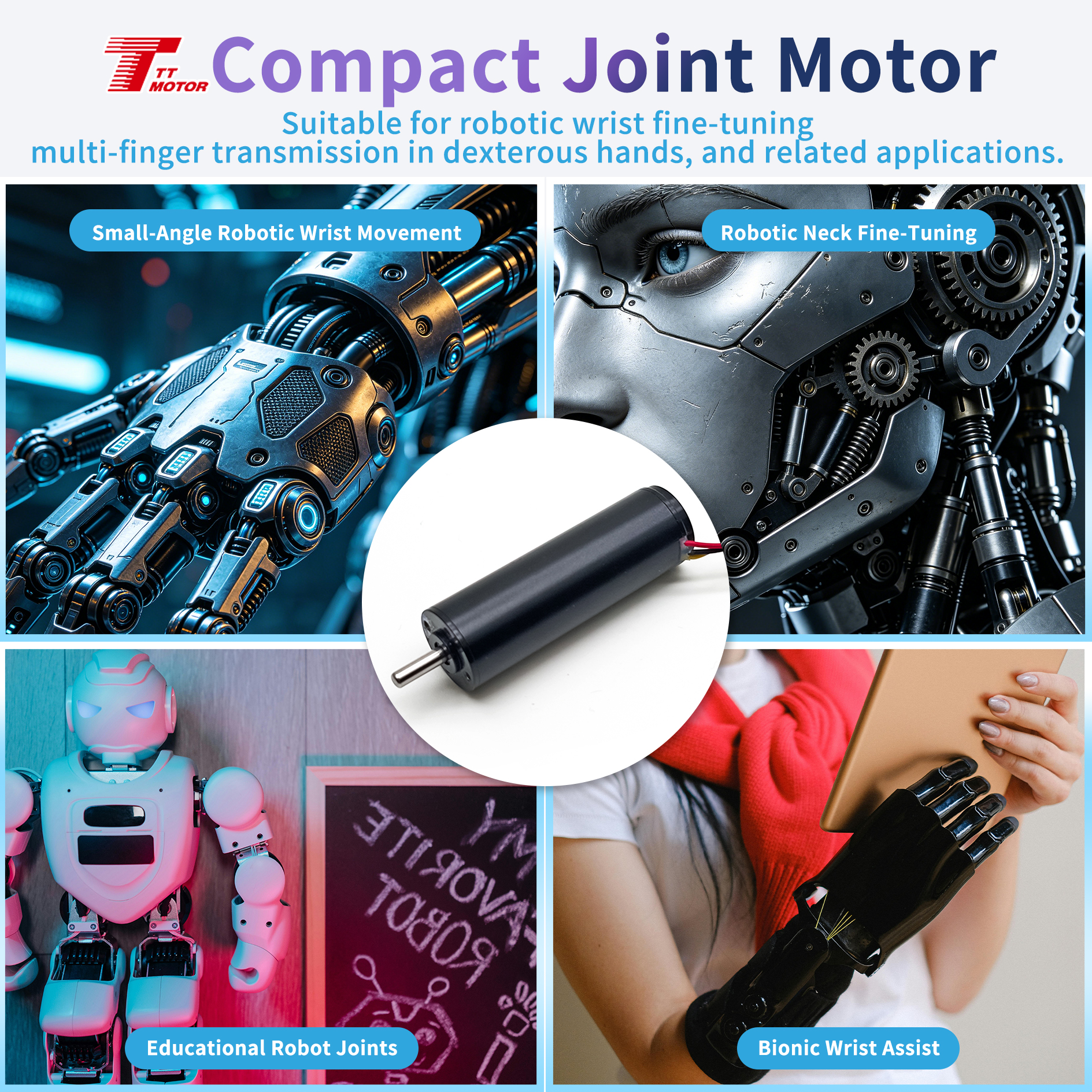
Miniature brushless and coreless motors are used in robot joints, where high power density, fast response and low inertia are the governing requirements.
Grand View Research places the global brushless DC motor market at approximately USD 22.2–22.33 billion for 2025, with a forecast window running to 2033. That figure spans large industrial drives and the thumbnail-sized motors that release a smart door lock. At the other end of the same category, OEC trade data shows a 2024 global export value of USD 16.3 billion for electric motors with an output below 37.5 watts (HS 850110) — the trade segment that most buyers of miniature and geared motors actually purchase from.
The gap between those two numbers is a useful starting point, because the word “brushless motor” covers a bare motor, a motor with an integrated gearbox, a 2.4 V door-lock actuator and a 24 V planetary gearmotor. This primer sets out what the category contains, how to read a miniature motor datasheet, where each architecture fits, and where brushless designs are the wrong answer.
What the Brushless Motor Family Actually Covers
In procurement listings and search results, the same underlying technology appears under several names. The naming differences usually describe the motor’s structure, its gearbox, its frame size or its voltage class — not a different operating principle.
- dc brushless motor, brushless dc motor, bldc motor — interchangeable descriptions of the same electronically commutated topology.
- dc brushless gear motor, brushless planetary gear motor, dc planetary gear motor, high torque planetary motor — a brushless motor integrated with a planetary gearbox, named either by motor type or by gearbox type.
- worm gear motor — a gearmotor whose output stage is a worm gearbox, typically giving right-angle output and very high reductions.
- n20 gear motor, mini gear motor, metal gear motor, dc spur gear motor, mini brushless motor — form-factor and gear-train descriptions; “N20” is a widely used small-frame reference rather than a technical standard.
- 12v gear motor, dc gear motor 12v, 12v dc motor, 12 volt dc motor, small dc motor — voltage-class descriptions that say nothing about the motor architecture.
- brushed dc motor — the contrasting architecture, where commutation is mechanical.
For an engineer or buyer, the practical consequence is that a comparison made on the keyword alone is unreliable. A bare 12 V brushless motor and a 12 V brushless gearmotor with a 1/720 reduction ratio are both correctly described as “12v dc motor,” yet their usable output is not comparable.
The Sourcing Problem: One Keyword, Several Different Products
Miniature drive procurement usually starts with a functional requirement — quiet operation, a slow positioning movement, a long duty cycle — and then meets a product list that mixes motors, gearmotors and complete assemblies. Three mismatches show up repeatedly.
1. Bare motor versus integrated gearmotor
An integrated geared motor combines the motor and gearbox, allowing lower speeds and higher output torque within a more compact space than a separate motor and external gearbox. It also removes couplings and mounting structures from the design. When a spec sheet is read without checking whether the gearbox is included, torque and speed figures from different suppliers get compared as if they described the same thing.
2. Market reports with different scopes
Published market values diverge widely depending on what is counted. One commercial report places the automotive micro motor segment at USD 18.87 billion for 2025, while narrower automotive sources cite figures closer to USD 3 billion. The difference is largely definitional — whether complete actuator assemblies or bare motors are included — and the divergence remains flagged for verification. Buyers citing market data internally should confirm the counting basis before using a number in a business case.
3. Efficiency regulation that does not reach this product class
IEC 60034-30-1:2025 added the IE5 ultra-premium efficiency class, and EU Ecodesign Regulation (EU) 2019/1781 has required IE3 for motors from 0.75 kW to 1000 kW and IE2 for the 0.12–0.75 kW band since July 2021. These frameworks address mains-fed motors in defined power ranges. A low-voltage miniature motor, including a 12 V or 24 V brushless gearmotor, falls outside that scope. The correct conclusion is not that efficiency is irrelevant, but that IE-class labels cannot be used as evidence of performance for this product class — the relevant criteria are service life, electromagnetic interference, noise, and batch consistency.
How to Read a Miniature Brushless Motor Datasheet
A usable miniature motor specification answers six questions in order: what voltage does it run on, how much torque can it deliver continuously, at what output speed, through how many gear stages, at what reduction ratio, and how does it mount.
Rated torque is the torque that can be continuously output under specified operating conditions. It is the figure to use for load matching, and it is only valid within the conditions printed alongside it. Because torque and speed are coupled through the gear reduction ratio, the same motor offered with different gear stages behaves like a different product: a motor at a 1/4 ratio and the same motor at a 1/720 ratio will show very different output speed and available torque.
A worked example of datasheet structure
The TT Motor GMP36-TEC3650 brushless planetary gear motor illustrates how these parameters interlock. It is a brushless motor with a same-diameter planetary gearbox, where the motor and gearbox share a 36 mm outer diameter, so the assembly does not grow wider as gear stages are added. Rated voltage is DC 12 V to 24 V and can be customized within that range. Maximum rated torque is 30.0 kg.cm, and the output speed range is 4 rpm to 1600 rpm. The gear module is 0.5, with 1, 2, 3 or 4 gear stages available and ten reduction ratios from 1/4 to 1/720.
The mechanical interface is specified in the same document: gearbox length options of 26 mm, 33.5 mm, 40.5 mm and 47.5 mm, giving an overall length of 26 mm to 47.5 mm depending on the number of stages; an 8 mm diameter solid output shaft; a mounting flange with four M3 holes; a net weight of 420 g; and stainless steel, copper and iron construction. The planetary gears are precision-machined, which the manufacturer states results in minimal transmission backlash, and because the structure is brushless there is no brush wear and no scheduled brush replacement. The service life is stated by the manufacturer as typically tens of thousands of hours.
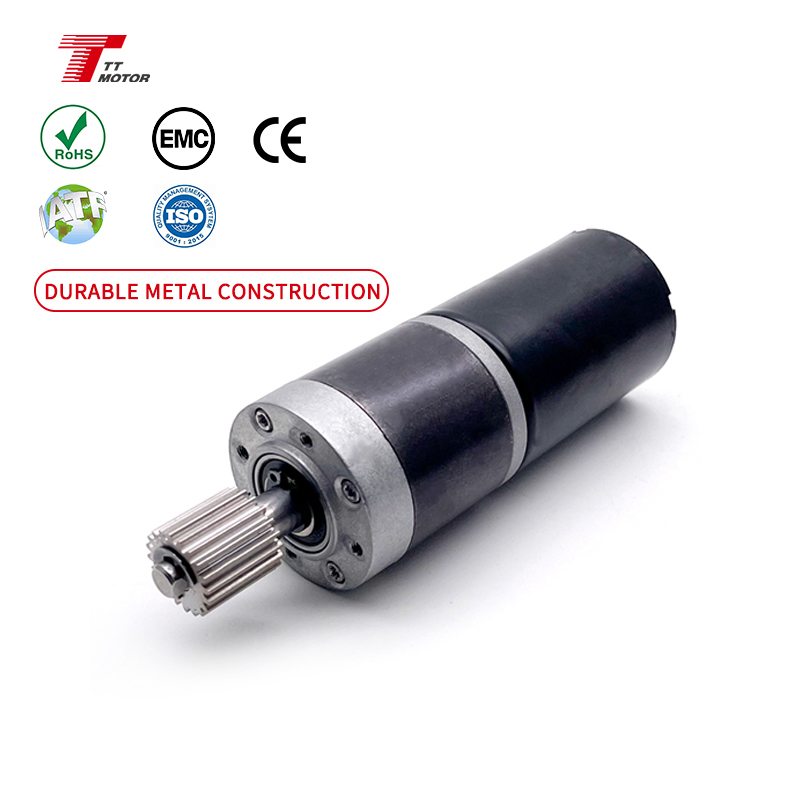
The GMP36-TEC3650 combines a brushless motor with a same-diameter 36 mm planetary gearbox, rated at up to 30.0 kg.cm and 4–1600 rpm over DC 12–24 V.
Interface details often decide the selection
Once torque, speed and voltage are satisfied, the constraints that eliminate candidates are usually mechanical: available axial length, flange pattern, shaft diameter, and whether the gearbox can be added without widening the assembly. A specification that reports only electrical parameters leaves the integration risk unresolved.
What TT Motor Supplies, and How to Verify It
TT Motor (Shenzhen) Industrial Co., Limited is a manufacturer of miniature precision DC motors, established in 2006 in Hong Kong, China, and headquartered in Bao’an District, Shenzhen, Guangdong Province, China. The company develops and manufactures miniature DC motors and reports a product range covering high-precision DC motors, brushless DC motors, coreless motors, planetary geared motors, miniature geared motors and stepper motors.
Its stated operating profile is relevant to a sourcing assessment: more than 300 employees, a manufacturing area of approximately 9,000 square meters, three production plants together with an assembly center and a global marketing center, an annual output of about 8,000,000 motor units, a 35-engineer R&D team working on motor design and structure optimization, and an export share of roughly 70% with main markets in the EU and the USA. The company states that it operates an automated production process, a precision assembly system, a product testing system and a mass production management system.
For buyers comparing miniature drive options, the more useful part of that profile is the product ladder, because it shows which architecture the supplier can supply for a given duty requirement.
| Model | Type | Rated voltage | Max rated torque | Output speed | Configuration notes |
|---|---|---|---|---|---|
| GMP36-TEC3650 | Brushless planetary gear motor (DC brushless gear motor) | DC 12–24 V, customizable in range | 30.0 kg.cm | 4–1600 rpm | 1–4 gear stages; ten ratios from 1/4 to 1/720; 36 mm shared diameter; 420 g; 8 mm shaft; four M3 flange holes |
| TWG3246-TEC2430 | DC brushless worm gear motor | DC 12–24 V | 8.0 kg.cm | 3–35 rpm | Right-angle output worm gearbox; 3/4/5 gear stages; gearbox length 46 mm |
| GM37-555PM | DC brush spur gear motor | DC 12–24 V | 8.0 kg.cm | 5–800 rpm | 2–6 gear stages; ten ratios from 1/6 to 1/810; 37 mm outer diameter; six M2.5 flange holes |
| GMP12T-TDC1215 | DC brush coreless gear motor | DC 4.5–12 V | 2 kg.cm | 8–5000 rpm | Coreless rotor with integrated gearbox; 1–4 gear stages; gearbox length 14.9–29.3 mm |
| GM12-N20VA | DC spur gear motor (N20 series reference) | 2.4 V or 5 V | 0.5 kg.cm | 12–1450 rpm | 2/4/5/7 gear stages; supplied for OEM projects with selectable stage configurations |
On compliance, the company states that most of its motors have passed RoHS testing, with reference to RoHS Directive (EU) 2015/863 amending 2011/65/EU. Test documentation is model-specific, and product compliance materials including a REACH 2025 report for the GM12-N20VA are listed among the company’s verification documents.
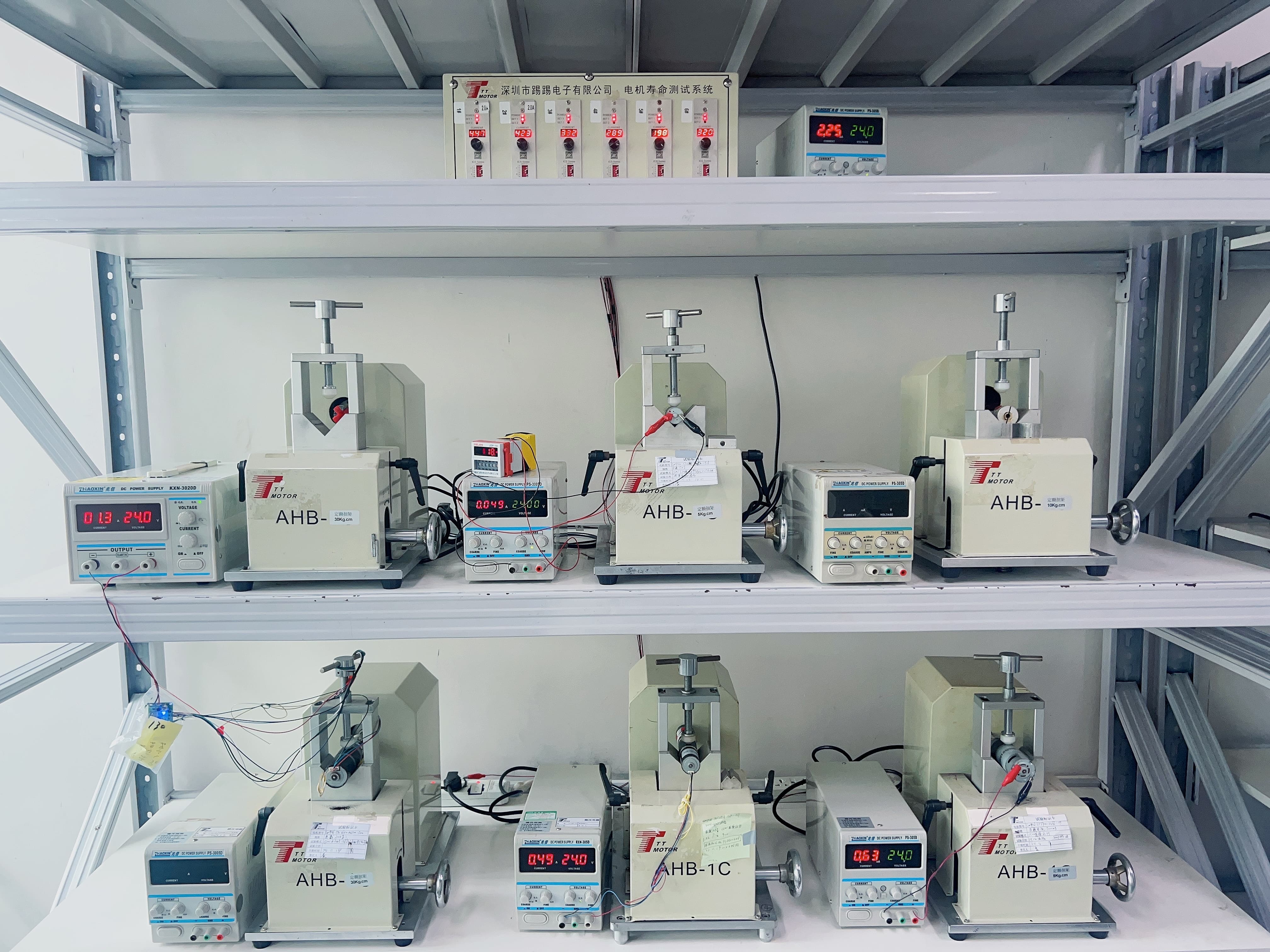
Life and endurance testing is the step that converts a sample result into a batch-level claim for miniature motors.
Where Miniature Brushless and Geared Motors Are Used
Application requirements, not motor names, determine which architecture is appropriate. Three demand profiles cover most of the miniature drive market.
Robot joints
Robot joints involve high-frequency dynamic motion with rapid start and stop, and the governing requirements are high power density, fast response and low inertia. Motors in this duty are matched with encoders and actuators, and operation includes start/stop, forward and reverse, and speed change. Brushless planetary gearmotors such as the GMP36-TEC3650 and coreless gearmotors such as the GMP12T-TDC1215 are specified for compact robotic and automation equipment, including robotics, industrial automation equipment and intelligent logistics equipment.
Medical and laboratory equipment
Medical equipment usually requires low-speed precision motion over long operating periods, with low noise, low vibration and stable operation. Applications in this category include infusion syringe pumps, pipetting equipment, urine and body fluid analyzers, microfluidic dispensers and rehabilitation robots. Because the motion is intermittent and positioning-based, gearmotors with high reduction ratios and controlled backlash are the typical choice.
Smart home and compact automation
Smart home devices combine low-speed movement, limited installation space, miniaturization, low noise and low power consumption. Smart curtains, robot vacuum cleaners, smart toilets, adjustable desks, smart door locks and camera pan-tilt units all sit in this category. The GM12-N20VA, for example, is specified for smart door lock scenarios with low noise, high torque and stable speed operation, and is intended to operate in both high and low temperature environments.
Comparison with Traditional Solutions — and Where Brushless Is Not the Answer
The brushless-versus-brushed decision is frequently presented as settled. It is not. The two architectures differ across several dimensions, and the correct choice depends on duty cycle, life requirement, electromagnetic compatibility and budget.
| Dimension | Brushed DC motor | Brushless DC motor |
|---|---|---|
| Commutation | Mechanical, via brushes and commutator | Electronic, no brush contact |
| Typical service life | Approximately several hundred to several thousand hours | Stated by the manufacturer as typically tens of thousands of hours |
| By-products during operation | Electrical sparks and carbon dust; strong electromagnetic interference | No physical contact, no sparks; low electromagnetic interference |
| Heat and power density | Frictional losses at the brush interface | Less heat generation, higher power density |
| Cost profile | Lower initial cost, higher maintenance cost | Higher initial cost, effectively maintenance-free in service |
| Control complexity | Simple control; suited to cost-sensitive, short-duty, simple-logic devices | Requires a controller; suited to high-performance, precise-control applications |
The limits are as important as the advantages, and they fall into four groups.
- Drive electronics are part of the system cost. A brushless motor needs a controller to perform commutation. That adds bill-of-materials cost and design effort which a short-duty, low-cost device may not justify, which is why brushed motors remain appropriate where runtime is short, cost sensitivity is high and control logic is simple.
- Gearboxes trade speed and efficiency for torque. A gearmotor delivers low output speed and high torque, but the gear train introduces transmission backlash and mechanical losses, and adds axial length. A datasheet quoting high torque at very low speed describes a different design intent, not a superior one.
- Small frames have real torque ceilings. The N20-class GM12-N20VA is rated at a maximum of 0.5 kg.cm. That is sufficient for a smart lock or a compact electronic assembly, and insufficient for a load-bearing axis. Selecting by frame size rather than by rated torque is a common source of field failures.
- Some architectures are deliberately slow. The TWG3246-TEC2430 worm gearmotor produces 3–35 rpm at up to 8.0 kg.cm through a right-angle output. It is intended for miniature medical devices, precision automated instruments and electrically adjustable supports, where slow, smooth fine-tuning is the requirement. It is not a high-speed drive solution.
A related distinction applies to coreless motors. Their advantage is a low-inertia rotor that enables high-frequency start/stop, rapid response and precise control, and they suit equipment that is sensitive to weight and size. Where those dynamics are not required, an iron-core or brushed design is often the more economical engineering decision.
Market Signals: Size, Trade Flows and Efficiency Rules
Three verified data points frame the current market for buyers.
First, the brushless DC motor market was valued at approximately USD 22.2–22.33 billion in 2025 by Grand View Research, with high consistency across major research firms on that baseline and a forecast period extending to 2033. Second, global trade in electric motors below 37.5 W output (HS 850110) reached USD 16.3 billion in 2024 according to OEC, with China among the leading export origins. Third, the regulatory trend continues upward: IEC 60034-30-1:2025 introduced the IE5 efficiency class, following the EU’s 2019/1781 requirements that made IE3 mandatory for 0.75–1000 kW motors and IE2 for the 0.12–0.75 kW band.
Future Outlook
The direction of the miniature motor market is toward integration and verifiability. Same-diameter motor-and-gearbox designs reduce the space penalty of adding reduction stages, which makes higher-torque miniature drives easier to fit into compact equipment. Customizable rated voltage within a defined range reduces the need for external conditioning. Neither of these is a marketing claim so much as a design constraint that suppliers either meet or do not.
On the evidence side, the shift is slower but more consequential. As regulation tightens at the industrial end and buyers push the same expectations downward, miniature motor suppliers are increasingly judged on whether a qualified sample can be reproduced in production. That means traceability, defined sampling or full-inspection rules for key parameters, and a documented process for handling material or process changes. For buyers at the research stage, those questions are worth asking at the same time as the torque and speed figures.
FAQ
Reference Material
A downloadable brochure covering TT Motor’s miniature motor product lines is available for reference: TT Motor miniature motor product brochure. Company website: www.ttmotor.com.