
Brushless Impact Wrenches: Constraints That Decide Sourcing

Brushless cordless power tool manufacturing at the Ningbo TMG Power Tools facility in Cixi, Zhejiang Province, China.
Cordless impact wrenches have moved from a specialist purchase to a standard line item in professional tool catalogues. In vehicle service bays, tire shops, plant maintenance departments and construction sites, the switch away from pneumatic and brushed tools is rarely decided by one headline specification. It is decided by a group of constraints that have to line up at the same time: motor architecture, socket drive interface, battery platform, electronic torque control, certification status, order quantity and delivery schedule. For importers, distributors and OEM buyers in the research and evaluation stage, the practical question is not which brand sounds strongest, but which constraints must be satisfied before a purchase order is safe to place.
Ningbo TMG Power Tools Co., Ltd. — trading as TMG Power Tools — is a manufacturer of lithium-ion cordless power tools and outdoor power equipment established in 2014 and based at No. 158, Lanhai 2nd Road, Cixi Binhai Economic Development Zone, Ningbo, Zhejiang Province, China. Its declared product range includes brushless drills, brushless hammer drills, brushless impact wrenches, brushless impact drivers, brushless angle grinders and garden tools, with roughly 90% of output exported to South America, Eastern Europe and North America. That product span makes the company a useful reference point for a constraint-led discussion of brushless impact wrench sourcing, because the same electronics, battery and quality systems serve several tool categories at once.
Why Brushless Impact Wrenches Became a Constraint Problem, Not a Feature Problem
Brushless motors are no longer a differentiator in professional cordless tools; they are close to an expectation. Once that happens, the marketing vocabulary flattens out and buyers are left comparing things that are harder to see: how the controller manages heat, whether the battery platform is stable across a product family, how a supplier documents torque and test conditions, and whether the paperwork attached to the shipment will still be valid at the port of destination.
This shift creates two distinct problems for buyers.
The first is specification ambiguity. Two impact wrenches can both be described as brushless, both be sold with variable speed and an LED work light, and still behave very differently in a service bay, because peak torque, breakaway behavior, electronic torque limiting and the drive interface determine whether the tool loosens a seized fastener or stalls against it.
The second is supply-side ambiguity. Certification validity, minimum order quantity, lead time, sampling policy, spare parts availability and customization scope are commercial constraints that decide whether a technically suitable tool is actually orderable at the volume and price point a distributor needs. Buyers who treat these as afterthoughts often discover them during negotiation rather than during evaluation.
The opportunity sits in the same place. A supplier that documents both the technical and the commercial side allows a buyer to evaluate a brushless impact wrench programme as a repeatable supply arrangement rather than a one-off purchase.
The Five Constraints That Decide a Brushless Impact Wrench Order
Across the cordless tool category, the same five constraints repeatedly determine whether an impact wrench programme moves from sample to repeat order. They are worth stating as a decision framework rather than a product list.
| Constraint | What it decides | Evidence to request |
|---|---|---|
| Motor and electronics | Efficiency, heat behavior, service life, electronic torque control | Motor type statement, controller features, test reports |
| Drive interface and torque tier | Whether the tool suits light assembly, general service or heavy fastening | Documented torque figures with stated test conditions |
| Battery platform | SKU complexity, charger count, aftermarket battery risk | Voltage, cell configuration and interface compatibility per model |
| Compliance and certification | Market access, retail acceptance, audit readiness | Certificate numbers, issuing bodies, validity periods |
| Commercial terms | Order feasibility, cash flow, replenishment rhythm | MOQ, lead time, capacity, QC method, after-sales terms |
Read as a sequence, these constraints form a filter. A tool that fails the drive interface test never reaches the battery platform discussion, and a tool that passes every technical test can still fail on a 500-piece minimum order quantity or a six-week production window. Constraint-led sourcing keeps both halves of the evaluation visible at the same time.
How a Brushless Impact Wrench Actually Works
A brushless motor replaces the mechanical brush-and-commutator contact of a conventional DC motor with an electronic controller that switches current through the stator windings according to rotor position. The practical consequences are stable across the industry: fewer mechanical wear parts, no carbon brush dust inside the housing, and the ability to tune speed and torque curves in software rather than through gear ratios alone.
In an impact wrench, that electronics layer sits on top of a mechanical impact mechanism. A planetary gear set reduces motor speed and multiplies torque; a spring-loaded hammer strikes an anvil at a controlled frequency to deliver rotational impacts; a square drive output carries that impulse into the socket. The electronics decide how the tool behaves before and after the impact begins — soft start to avoid socket slip, a variable-speed trigger for feathering, an electronic torque limiter to protect small fasteners, and thermal protection to keep the controller inside its operating window.
For buyers, the useful conclusion is that motor type alone says very little. Two brushless impact wrenches with the same drive size can differ substantially in how they manage current under load, and that difference shows up as heat, battery drain and consistency across a shift rather than as a printed number.
The same electronics architecture is visible elsewhere in a cordless line-up. TMG's documented 20V 5-inch brushless angle grinder, model AG3125S, carries soft start, constant speed control, anti-restart protection, a battery capacity indicator and tool-free adjustment of the protective hood — a combination that describes how the platform manages current, restart behavior and operator feedback rather than simply listing power. Buyers evaluating a supplier's brushless impact wrench range can reasonably ask whether the same control philosophy is documented for that tool.
Battery Platform Consolidation: Where a Cordless Angle Grinder Enters the Decision
Most professional cordless purchases are no longer single-tool decisions. A service workshop that buys impact wrenches also buys a cordless angle grinder for cutting and grinding, a drill for pilot holes, and sometimes an impact driver for lighter assembly work. Every additional battery format multiplies charger stock, spare battery inventory and warranty exposure.
This is why the cordless angle grinder belongs in an impact wrench evaluation. It is usually the most power-hungry tool in the same kit, so it reveals how far a battery platform can be pushed. TMG's documented cordless range spans brushless drills, brushless hammer drills, brushless impact wrenches, brushless impact drivers, brushless angle grinders and garden tools, with the angle grinder and hammer drill documented at 20V.
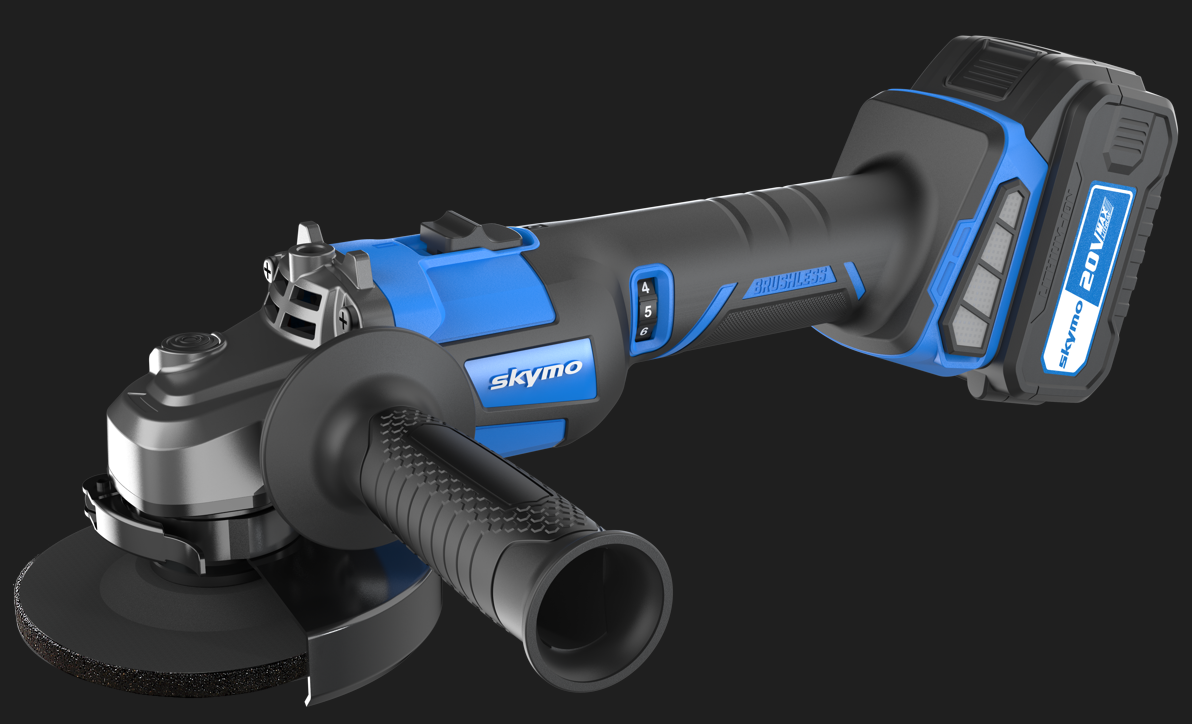
TMG AG3125S, a documented 20V brushless cordless angle grinder in the same cordless line-up as the company's brushless impact wrench range.
| Documented model | Type | Key documented parameters |
|---|---|---|
| AG3125S | 20V 5" brushless angle grinder | No load speed 3000–8500 rpm; max. wheel diameter 125/115 mm; wheel thickness 6 mm; bore 22.23 mm; spindle thread M14/M16 |
| CD3050TC | 20V compact brushless hammer drill | No load speed 0–450 / 0–2000 rpm; impact rate 0–6750 / 0–30000 ipm; max. fastening torque 50 N.m; 21+3 clutch; 13 mm metal single-sleeve chuck; 157 mm body length |
The procurement point is not that any two tools share a battery; it is that platform questions should be answered with documentation, model by model, covering voltage, cell configuration and mechanical interface. Assumed compatibility is one of the more expensive assumptions a distributor can carry into a first container.
What TMG Power Tools Documents for OEM and ODM Buyers
For buyers moving from research into evaluation, the relevant question is what a supplier can commit to in writing. Established in 2014, Ningbo TMG Power Tools Co., Ltd. operates a 58,000 m² site with 210 employees and an 18-engineer R&D team, and states an annual output of 6,600,000 units against a monthly capacity of 600,000 units. The company describes integrated R&D, precision molding, brushless motor production, intelligent battery pack assembly and quality testing on one site, which matters for buyers because motor and battery pack production under the same roof reduces the number of parties responsible when a batch deviates.
| Commercial item | Documented position |
|---|---|
| Production mode | OEM / ODM |
| Customization scope | Color, logo, packaging and new designs |
| Minimum order quantity | 500 pcs |
| Lead time | 45–55 days |
| Monthly capacity | 600,000 units |
| Quality control | AQL test |
| After-sales | Remote support and spare parts support for quality issues |
The case record for this supplier describes OEM/ODM cooperation at quantities above 500 pcs, which aligns with the stated MOQ and with the lead-time window. For a buyer planning a first-season launch, the arithmetic is straightforward: a 45–55 day production window plus transport must fit the retail calendar, and a 500-piece starting quantity has to be reconciled with realistic sell-through before the second order is placed.
Where Brushless Impact Wrenches Are Applied
Application determines which constraints matter most, and the same tool can be a good fit in one setting and an awkward compromise in another.
Automotive repair and tire service. Removing wheel nuts, suspension fasteners and exhaust hardware requires repeatable breakaway capability and a drive interface that matches the sockets already in the workshop. Portable, battery-driven operation removes the hose trip hazard that pneumatic tools create in a bay, and a compact body helps in wheel arches and under-lift positions.
Machinery maintenance. Plant maintenance teams tend to work in short bursts across scattered locations, where access to an air line or a mains outlet is not guaranteed. Battery capacity and charger availability become the deciding constraint rather than peak torque.
Construction and structural fastening. Here the priority shifts toward durability, thermal behavior under continuous use and protection against restart in an interrupted power state. The anti-restart protection documented on TMG's AG3125S angle grinder illustrates the class of safety feature that professional buyers increasingly expect across a cordless platform, including impact tools.
Fabrication and finishing work. Where cutting and polishing are part of the same job, the documented application scenario for TMG's cordless angle grinder — cutting and polishing under battery drive — shows why buyers often evaluate impact wrenches and grinders together as one platform purchase rather than two independent ones.
Brushless Cordless vs Brushed Cordless vs Pneumatic: Honest Trade-offs
Buyers comparing brushless impact wrenches against alternatives benefit from an honest view of where each option is weaker.
| Option | Where it is stronger | Where it is weaker |
|---|---|---|
| Brushless cordless | Portability, no brush wear, software-tuned control, platform sharing | Depends on battery and charger inventory; higher unit cost than brushed |
| Brushed cordless | Lower entry price, simpler electronics | Brush replacement, dust ingress, less efficient current use |
| Pneumatic | Continuous duty in a fixed bay with existing compressed air | Tethered by hose and compressor; unsuitable for scattered or outdoor work |
Two limitations deserve to be stated plainly rather than softened. First, a brushless cordless impact wrench is still a battery-dependent tool: its practical daily capacity is set by how many packs a buyer purchases and how quickly they recharge, not by the motor alone. Second, OEM/ODM supply is not instantaneous — with a documented lead time of 45–55 days and a minimum order quantity of 500 pcs, buyers planning promotions on short notice will find that constraint binding regardless of how well the tool performs.
Certification: What Is Documented and What Still Needs Checking
Compliance documentation is a recurring failure point in cordless tool sourcing, largely because certificates carry validity periods and audit scopes that do not always match the exact product being ordered.
TMG Power Tools holds ISO 9001:2015 and ISO 14001:2015 management system certification, certificate number 15/25E01889R00, issued through WIT with global market scope, and records an amfori BSCI audit result numbered 156-065164-000 with EU market relevance. The ISO certification record lists the AG3125S angle grinder and the CD3050TC brushless hammer drill among related products, which is a useful reminder that certificates are tied to declared scopes rather than to a complete catalogue.
For procurement teams, three checks follow from this. Confirm that the certificate is inside its validity period at the date of shipment, not at the date of the initial enquiry. Confirm that the audited scope covers the impact wrench models actually being ordered. And confirm which market-specific approvals will be required by the destination customs regime, since a management system certificate and a product approval are different documents with different owners.
Trends Shaping Cordless Impact Wrench Sourcing
Several shifts are broadly visible across the professional tool industry, and each one changes how a buyer should frame an enquiry.
Platform consolidation over single-tool optimisation. Distributors increasingly evaluate a supplier by how coherent its battery family is, because every extra format adds inventory and after-sales complexity. This tends to favour suppliers that manufacture motors, battery packs and tools within the same operation.
Electronics as the differentiator. As brushless motors become standard, competitive pressure moves to control features — soft start, constant speed control, anti-restart, battery indicators and thermal management — which are generally documented in specifications rather than advertised as headline claims.
Compliance as a purchasing filter. Social audit results and management system certificates are increasingly requested by retail buyers and importers as a precondition, not an add-on, which places suppliers with current documentation at an advantage during qualification.
Shorter, more frequent orders. Where capacity allows, buyers appear to be moving toward smaller, more regularly replenished orders to reduce working capital, which makes documented monthly capacity and stable lead times commercially important.
Future Outlook
The next phase of cordless impact wrench competition is likely to be decided less by motor claims than by system coherence: how well a battery platform supports several tool categories, how transparently torque and control behavior are documented, and how reliably compliance paperwork is maintained across product generations.
For manufacturers such as TMG Power Tools, whose declared range spans brushless drills, hammer drills, impact wrenches, impact drivers, angle grinders and garden tools from a single 58,000 m² site with an 18-engineer R&D team, the strategic question is whether that breadth can be converted into documented platform compatibility that buyers can verify without assumption. For buyers, the corresponding discipline is to evaluate impact wrenches as one part of a platform decision, and to treat MOQ, lead time and certificate validity as technical constraints of equal weight to torque.
FAQ
1. What is the difference between a brushless impact wrench and a brushed model?
A brushless impact wrench uses an electronic controller to switch current through the motor windings according to rotor position, while a brushed motor relies on mechanical brush contact with a rotating commutator. In practical terms, brushless designs generally have fewer wear parts, produce no carbon brush dust inside the housing, and allow speed and torque behavior to be tuned electronically. The trade-off is a more complex control board and, typically, a higher unit cost than a brushed equivalent.
2. Which certification documents should a buyer request when sourcing cordless impact wrenches?
Buyers should request management system and social compliance records with certificate numbers and issuing bodies. TMG Power Tools holds ISO 9001:2015 and ISO 14001:2015 certification, certificate number 15/25E01889R00, issued through WIT with global scope, and an amfori BSCI audit result numbered 156-065164-000 with EU market relevance. Because certificates carry defined validity periods and declared product scopes, buyers should confirm both the current validity status and whether the models being ordered fall inside the audited scope.
3. What minimum order quantity and lead time apply to OEM or ODM production?
TMG Power Tools documents a minimum order quantity of 500 pcs and a lead time of 45–55 days for OEM/ODM production, against a stated monthly capacity of 600,000 units and an annual output of 6,600,000 units. Customization covers color, logo, packaging and new designs. These figures are the primary planning constraints for distributors: the lead time must fit the retail calendar, and the starting quantity must be reconciled with realistic sell-through before a replenishment order is scheduled.
4. Can a brushless impact wrench share a battery platform with other cordless tools?
Platform sharing is a supplier-specific question and should be confirmed with documentation rather than assumed. TMG Power Tools' declared cordless range includes brushless drills, brushless hammer drills, brushless impact wrenches, brushless impact drivers, brushless angle grinders and garden tools, with documented 20V models such as the AG3125S angle grinder and the CD3050TC hammer drill. Buyers consolidating a workshop around one battery family should verify voltage, cell configuration and mechanical interface for each individual model being ordered.
5. How should a buyer validate an impact wrench supplier before placing a first order?
A workable sequence is to request documented specifications with stated test conditions, order samples for application testing, confirm the quality control method, and review the after-sales policy for defective units. TMG Power Tools states AQL testing as its quality control method and provides remote support and spare parts support where quality issues arise. Buyers with a 500 pcs or higher first order, which matches the supplier's documented OEM/ODM case record, should also confirm production scheduling against the 45–55 day lead time before committing to a launch date.
6. Do brushless impact wrenches replace pneumatic tools entirely?
Not universally. Pneumatic impact wrenches remain effective in fixed bays where compressed air is already installed and where continuous duty matters more than mobility, while cordless impact wrenches are generally preferred where the work is scattered, outdoor or remote from an air line. The deciding factors are usually portability, the availability of charged battery packs and chargers, and the duty cycle of the task rather than motor technology in isolation.
TMG Power Tools publishes its product and contact information at www.tmgtools.com, and buyers comparing brushless cordless platforms can use the constraint framework above — motor and electronics, drive interface, battery platform, compliance and commercial terms — as a neutral starting point for supplier evaluation.