
Brushless Gear Motor Procurement FAQ: Load, Duty, RoHS and Batch Match
Brushless Gear Motor Procurement FAQ: Load, Duty, RoHS and Batch Match
For a brushless gear motor purchase, a model’s maximum rated torque is a starting point—not a complete answer to whether it will handle a particular load or duty cycle. Buyers also need to align output speed, gearbox configuration, mounting dimensions and operating conditions, then verify compliance documents and sample-to-production acceptance criteria. This FAQ uses published data for TT MOTOR’s GMP36-TEC3650 brushless planetary gear motor and TWG3246-TEC2430 brushless worm gear motor to explain what the available specifications establish and what a procurement review should still confirm.
The two models illustrate different operating envelopes. GMP36-TEC3650 is listed at DC 12–24 V, with a maximum rated torque of 30.0 kg.cm and a speed range of 4–1600 rpm. TWG3246-TEC2430 is listed at DC 12–24 V, with a maximum rated output torque of 8.0 kg.cm and a speed range of 3–35 rpm. Those figures are not interchangeable: the first describes a planetary gear motor with a broad stated speed range, while the second is a worm gear motor specified for lower output speeds. Neither set of figures alone proves suitability for a particular machine.
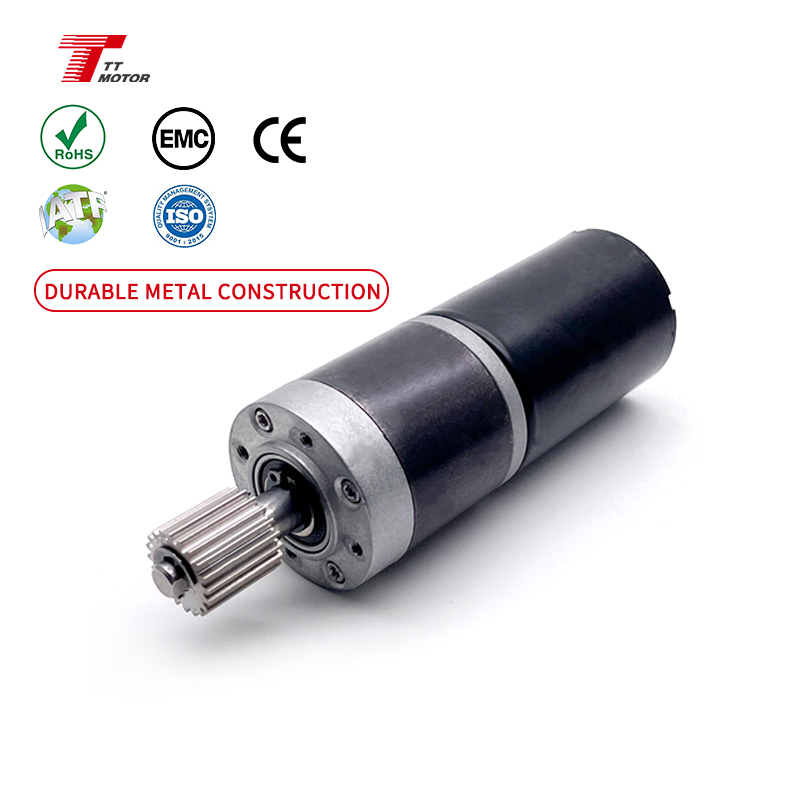
Published model data at a glance
Use model-specific specifications rather than a broad label such as mini brushless motor or high torque planetary motor when screening a requirement. The table summarizes the published figures relevant to an initial comparison; it does not establish an application result or guarantee operation under an unspecified load.
| Check | GMP36-TEC3650 | TWG3246-TEC2430 |
|---|---|---|
| Motor / gearbox type | Brushless planetary gear motor | Brushless worm gear motor |
| Rated voltage | DC 12–24 V | DC 12–24 V |
| Maximum rated torque | 30.0 kg.cm | 8.0 kg.cm at gearbox output |
| Listed speed range | 4–1600 rpm | 3–35 rpm |
| Gear stages / length | 1–4 stages; 26, 33.5, 40.5 or 47.5 mm | 3, 4 or 5 stages; 46 mm gearbox length |
For GMP36-TEC3650, the published data also lists a 36 mm motor and gearbox diameter, a 420 g weight, an 8 mm solid output shaft and four M3 flange holes. These are useful design-screening details, but the buyer should check the selected gear-stage variant and drawing before freezing the mechanical interface. For TWG3246-TEC2430, the stated 46 mm gearbox length defines an important part of the mounting envelope; its gearbox is available with 3, 4 or 5 stages.
FAQ: load, construction, duty, compliance and acceptance
1. What load can a brushless gear motor handle?
There is no single load capacity that applies to every brushless motor or dc gear motor. The published maximum rated torque differs by model and configuration. GMP36-TEC3650 is specified at a maximum rated torque of 30.0 kg.cm, while TWG3246-TEC2430 is specified at a maximum rated output torque of 8.0 kg.cm. The FAQ definition supplied for rated torque describes it as torque that can be continuously output under specified operating conditions. Therefore, a procurement team should not read a maximum rating as proof that the motor will meet every load demand at every speed or in every installation.
Translate the mechanism’s requirement into output torque and speed at the gearbox, and identify the actual operating pattern before choosing a model. Record the driven load, motion profile, required speed, starts and stops, direction changes, available supply voltage and any space or mounting constraints. Then compare those requirements with the exact motor specification and configuration. If the application includes a short peak load, distinguish that peak from the normal operating load and ask for the applicable conditions behind any proposed rating; do not assume that a brief overload can be repeated continuously.
A useful sample evaluation measures the output under the intended load and speed, rather than checking only whether the shaft turns without load. Where position matters, record positioning behavior using the actual mechanism. GMP36-TEC3650’s planetary gearbox is specified as having minimal transmission backlash, a characteristic relevant to positioning checks; that description is not a numerical backlash tolerance. Ask for the controlled value or an agreed inspection method if a numerical acceptance limit is needed. For either model, the published ratings are screening evidence, not a substitute for validating the assembled system.
2. Should I choose a geared motor or add an external gearbox?
An integrated dc gear motor combines a motor and gearbox as a specified assembly. A motor paired with a separately selected external gearbox is a different integration approach. The practical choice depends on the required output speed and torque, available mounting space, shaft and mounting interfaces, and how the design team will source and verify the combined assembly. This distinction does not establish that one approach is universally better.
The listed configurations show why model-level fit matters. GMP36-TEC3650 combines a brushless motor with a planetary gearbox and offers 1–4 stages; its specified gearbox lengths vary from 26 mm to 47.5 mm. TWG3246-TEC2430 combines a brushless motor with a worm gearbox, offers 3, 4 or 5 stages, and has a listed gearbox length of 46 mm. TWG3246-TEC2430 is also described as having a right-angle output and a self-locking function. The product information says that no additional braking device is required because of this function; buyers should confirm that the feature and its operating conditions satisfy their own machine’s requirements rather than treating it as a general safety determination.
For an external gearbox arrangement, check the motor-to-gearbox interface, alignment, shaft fit, mounting envelope and the specifications of the selected combination. For an integrated assembly, verify the ordered gear-stage option and output interface as a single configuration. In either case, a quotation or model name alone does not resolve dimensional tolerance, performance under the application load or acceptance limits. Request the applicable drawing and configuration details before approving the design.
3. What should buyers compare between coreless and iron-core construction?
Coreless and iron-core describe motor construction, not a complete procurement specification. A construction label by itself does not tell a buyer the torque-speed behavior, operating temperature, lifetime or suitability of a particular configuration. Those questions require model-specific evidence under relevant conditions.
The supplied product data identifies GMP12T-TDC1215 as a DC brush coreless gear motor. Its stated voltage range is DC 4.5–12 V, its maximum rated torque is 2 kg.cm, and its speed range is 8–5000 rpm. It offers 1–4 gear stages, with gearbox length depending on the stage selection. This is useful as a published coreless example, but it is not a direct comparison against a specified iron-core motor: no matched iron-core model, common test conditions or comparative results are provided here.
For an actual design comparison, request the candidate models’ construction details and compare their specified voltage, torque and speed ranges, mechanical dimensions and performance evidence using the same application conditions. If response or positioning is important, define the required start-stop behavior and measurement method. Do not infer a performance advantage from the words coreless or iron-core alone, and do not treat GMP12T-TDC1215’s data as a specification for GMP36-TEC3650 or TWG3246-TEC2430.
4. Is a brushless motor preferable to a brushed dc motor for long-term continuous operation?
Brushless construction removes the brush and commutator wear mechanism present in brushed DC motors of comparable size, according to the product information for GMP36-TEC3650. That is a relevant design distinction when comparing maintenance considerations. It does not, on its own, establish a service-life figure or prove that a brushless motor will meet a particular continuous-duty requirement.
For long-term operation, separate the motor’s construction from the duty conditions of the complete application. State whether operation is continuous or intermittent, the expected load and speed, the supply voltage, the number of start-stop events, and the environment in which the assembly will operate. Then request model-specific operating limits or test evidence that covers those conditions. The published GMP36-TEC3650 range of 4–1600 rpm and maximum rated torque of 30.0 kg.cm provides specification points for evaluation, but it does not supply a duty-cycle rating or a lifetime test result. Similarly, the TWG3246-TEC2430 description notes brushless construction and low operating noise as design attributes, not as a quantified continuous-duty guarantee.
A practical qualification plan can use a sample to verify the intended load and operating sequence, record the measured speed and output behavior, and define what constitutes acceptable variation before a production order. Compare brushless and brushed candidates only when the models and test conditions are sufficiently aligned. Do not turn the absence of brush wear into a claim that all other wear, maintenance or failure mechanisms are absent.
5. Is a RoHS report available, and how should its scope be checked?
RoHS documents are model- and scope-specific in the supplied records. For GMP36-TEC3650, an SGS RoHS compliance record for the EU market is listed under certificate number CANEC26013325501, with reference to RoHS Directive (EU) 2015/863 amending 2011/65/EU. The supplied record states an issue date of 2026-04-10 and validity through 2099-01-01. For TWG3246-TEC2430, an SGS RoHS record for the EU market is listed under CANEC26013326101, referencing the same directive; its record states an issue date of 2026-06-24 and validity through 2099-01-01.
During procurement, match the document to the exact ordered model and review the stated scope, issuing organization, reference requirement and market. The TWG3246-TEC2430 record describes coverage of DC gear motors including that model and related series models; a series reference should not be assumed to cover every product without checking the report’s actual scope. Ask for the report or certificate applicable to the purchase and retain the version reviewed with the procurement file. Do not infer that a document for one model automatically covers another brushless motor, a different series or an altered configuration.
RoHS documentation is also distinct from other compliance records. For example, a RoHS record does not become a CE or REACH document merely because the product is sold for the same market. The procurement check should identify which document is required for the buyer’s product and market, then verify the evidence against that requirement. These records establish the stated documentation scope; they do not replace the buyer’s own assessment of regulatory obligations.
6. How can sample-to-batch consistency be assessed?
Sample approval and production-lot acceptance should use the same configuration and measurable criteria. The supplied capability information lists OEM/ODM options for shaft, encoder, gearbox, voltage, logo and speed; it also lists sample lead time of 15–25 days, bulk lead time of 30–45 days, a minimum order quantity of 2 pieces and 100% testing. These are stated supplier capability terms, not proof by themselves that a particular production batch will match an approved sample on every characteristic.
Before approving a sample, identify the full configuration: model, supply voltage, gear-stage selection, output speed requirement, shaft and mounting interface, and any requested customization. Record the drawing or specification revision used for approval. Define which characteristics will be checked on incoming or production units, how they will be measured, and what tolerance or acceptance range applies. Suitable checks depend on the application; examples include verifying model and configuration identity, mechanical dimensions, rated voltage marking and output behavior under an agreed test condition. Do not create an acceptance threshold unless engineering has established it for the design.
Ask what the supplier’s stated 100% test covers for the ordered model and configuration, and whether the records can identify the tested characteristics and acceptance criteria. A statement that every unit is tested does not specify which tests are performed, the limits used or what records are retained. If a characteristic is important to product function, include it in the agreed sample and batch inspection plan instead of assuming it is covered.
After sample approval, compare production units against the same approved specification and evaluation method. Keep a record of the sample’s measured results and the corresponding batch checks. If there is a deviation, identify whether it concerns the model, configuration, dimension or measured performance before deciding whether the sample or production item is the reference. This process makes batch match a verifiable procurement question rather than a general assurance.
A practical review sequence
- Screen the model: compare the application’s voltage, target speed and required output torque with the exact published model data. Treat a maximum rated torque as a model rating, not a universal load guarantee.
- Confirm the configuration: record gearbox type and stage count, gearbox length, shaft and mounting details, and any approved customization. Do not merge options from different models.
- Define operating conditions: specify the intended duty pattern, load and motion profile, then identify what the sample evaluation must demonstrate.
- Check documentation: match the RoHS evidence to the ordered model, stated scope and applicable market. Keep the reviewed record tied to the procurement specification.
- Set batch acceptance: define test items, measurement conditions, tolerances and records before production approval. Verify what the supplier’s stated testing covers.
For buyers researching a brushless motor, dc brushless motor or brushless dc motor, these steps keep the decision anchored to the specific product configuration rather than search terminology. Terms such as mini brushless motor, dc brushless gear motor, worm gear motor, metal gear motor, planetary gear motor, mini gear motor, 12v gear motor and n20 gear motor describe different searches or product categories; they should not be treated as evidence that models are equivalent. The available figures here apply to the named models only.
TT Motor (Shenzhen) Industrial Co., Limited is identified in the supplied company information as a manufacturer focused on miniature DC motors. For procurement evaluation, the central question is whether the selected motor, gearbox configuration and supporting documentation meet the buyer’s defined requirements. Published ratings, certificates and stated testing capabilities can inform that review, while application-specific performance and batch acceptance still need explicit criteria.
FAQ in brief
What load can these models handle? GMP36-TEC3650 lists a maximum rated torque of 30.0 kg.cm; TWG3246-TEC2430 lists 8.0 kg.cm at the gearbox output. Verify the required torque and speed under the intended operating conditions.
Is an integrated gear motor the same as an external gearbox setup? No. An integrated assembly combines the specified motor and gearbox; an external setup requires the buyer to select and verify the motor, gearbox and their interface as a combination.
Can the supplied data prove coreless is better than iron-core? No. It identifies GMP12T-TDC1215 as a coreless gear motor but provides no matched iron-core comparison under common conditions.
Does brushless construction guarantee continuous-duty life? No. GMP36-TEC3650’s brushless design removes the brush and commutator wear mechanism, but the supplied specifications do not state a duty-cycle rating or quantified lifetime result.
Are RoHS documents listed for both featured models? Yes. The supplied records list SGS RoHS documentation for GMP36-TEC3650 and TWG3246-TEC2430 for the EU market. Check the exact model and report scope.
Does 100% testing prove sample-to-batch match? Not by itself. Confirm the tested characteristics and criteria, then compare production units with the approved sample using agreed measurements and tolerances.
¿Tiene preguntas o necesita más detalles?
Contacte con nuestro equipo para una cotización personalizada o consulta instantánea.
Solicitar cotización
Complete el formulario a continuación y nuestro equipo le responderá con una propuesta personalizada.
Chat directo de WhatsApp
¿Prefiere chatear en tiempo real? Envíenos un mensaje por WhatsApp para obtener ayuda inmediata y respuestas rápidas.
- Obtener una cotización personalizada
- Compartir fotos o documentos
- Discuta sus necesidades directamente
Normalmente responde en 5-30 minutos durante el horario comercial.