
Brushless Gear Motor Application Fit: Analyzers and Robot Joints
Most miniature motion problems in medical and robotics hardware are not motor failures. They are fit failures. The motor met its datasheet, but the duty profile of the machine did not match the assumptions behind that datasheet.
An analyzer axis that indexes every test cycle, an infusion pump that must hold a plunger against fluid resistance for hours, and a robot joint that has to stop without overshoot are three different constraint problems. They are frequently solved, or mis-solved, with similar-looking cylindrical components. For buyers at the research and evaluation stage, the useful question is not "which motor is strongest" but "which voltage window, torque rating, output speed band and duty profile actually matches this mechanism."
This analysis maps specification constraints to real device scenarios for three miniature gear motors from TT Motor (Shenzhen) Industrial Co., Limited, a Shenzhen-based manufacturer of miniature DC motors established in 2006 whose main product lines include brushless motors, coreless motors, gear motors, stepper motors and DC motors. The models discussed are the GMP36-TEC3650 brushless planetary gear motor, the TWG3246-TEC2430 DC brushless worm gear motor, and the GMP12T-TDC1215 coreless gear motor.
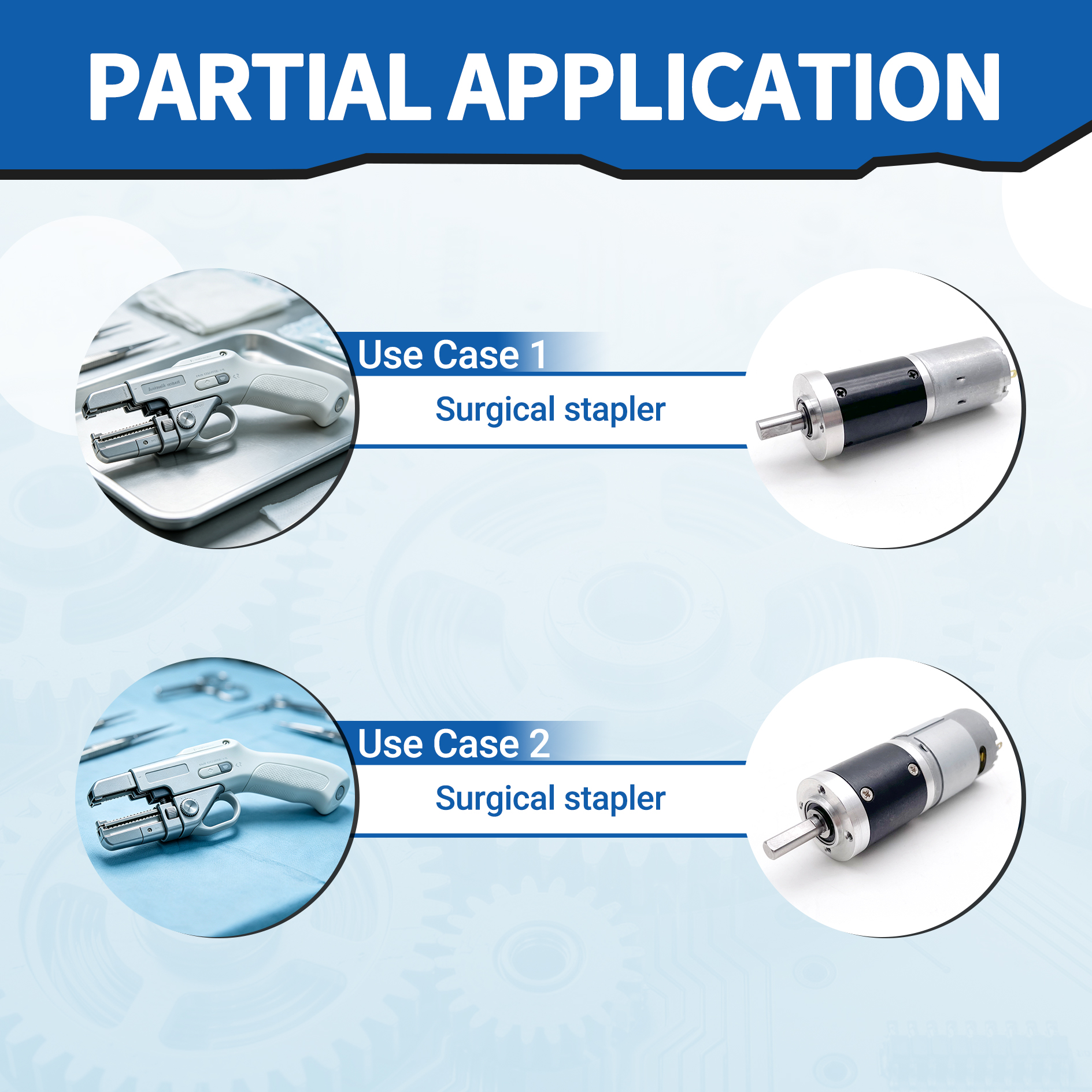
Miniature gear motors are specified against the motion pattern of the host device, not against a single headline torque figure.
Why Application Fit Is a Constraint Problem
Catalog comparison usually starts with torque, and that is where evaluation typically goes wrong. Torque is an output condition, not an input requirement. It only becomes meaningful once the supply rail, the required output speed band, the available mounting envelope, the duty cycle and the documentation set for the destination market are all fixed.
Three constraint layers decide whether a miniature gear motor is usable in a medical or robotics build:
- Electrical constraints — rated voltage window, and whether the available system rail sits comfortably inside it rather than at its edge.
- Mechanical constraints — maximum rated torque, output speed range, gearbox length, shaft and flange interface, and total mass.
- Operational constraints — intermittent positioning versus sustained low-speed motion, noise and vibration limits, and the compliance documents a device must carry into the EU or US market.
A motor that satisfies layers one and two but fails layer three will still pass bench testing and still create problems in qualification.
The Three Constraint Axes: Voltage, Torque and Output Speed
The three models differ less in construction philosophy than in where they sit on the speed and torque axes. Reading them side by side makes the fit logic visible.
| Parameter | GMP36-TEC3650 | TWG3246-TEC2430 | GMP12T-TDC1215 |
|---|---|---|---|
| Motor type | Brushless planetary gear motor | DC brushless worm gear motor | DC brush coreless gear motor |
| Rated voltage | DC 12 V – 24 V | DC 12 V – 24 V | DC 4.5 V – 12 V |
| Maximum rated torque | 30.0 kg.cm | 8.0 kg.cm | 2 kg.cm |
| Output speed range | 4 – 1600 rpm | 3 – 35 rpm | 8 – 5000 rpm |
| Gear stages | 1 / 2 / 3 / 4 | 3 / 4 / 5 | 1 / 2 / 3 / 4 |
| Gearbox length | 26 / 33.5 / 40.5 / 47.5 mm | 46 mm | 14.9 / 19.7 / 24.5 / 29.3 mm |
| Gear module | 0.5 | 0.5 / 0.6 | 0.2 |
| Declared materials | Stainless steel, copper, iron | Stainless steel, iron, copper | Stainless steel, iron, copper |
For the GMP36-TEC3650, the reduction ratio range is stated as 1/4 to 1/720, so output speed and output torque can be traded against each other within a defined envelope. For the TWG3246-TEC2430, the reduction ratio is determined by the selected 3, 4 or 5 gear stages rather than published as a single span. For the GMP12T-TDC1215, the ratio is set by the selected 1 to 4 gear stages.
Duty Profile Decides More Than Peak Torque
Intermittent positioning duty
Analyzer indexing axes, stapler firing mechanisms and similar mechanisms move in short, repeated bursts. What matters is repeatability at the stop point, the ability to accept a brief load spike without stalling, and the envelope consumed inside the instrument. Transmission backlash and shaft interface quality drive positioning accuracy here. The GMP36-TEC3650 specifies an 8 mm solid output shaft with four M3 flange mounting holes and a precision-machined planetary gear set described with minimal transmission backlash — parameters that map directly onto positioning accuracy checks rather than onto continuous-duty claims.
Low-speed precision motion
Infusion pumps, syringe pumps and microfluidic dispensers need the opposite behaviour: very slow, very steady rotation, held for long periods. Medical equipment scenarios in this class are characterised as low-speed precision motion with long-term operation, and the stated requirements are low noise, low vibration and stable operation. The TWG3246-TEC2430 output band of 3 rpm to 35 rpm is designed for exactly this regime. Its worm gearbox also has a self-locking function, which means a separate braking device is not required to hold position.
High-frequency dynamic motion
Robot joints operate under a different rule set: start, stop, reverse and speed change at frequency, with the stated requirements of high power density, fast response and low inertia. Here the limiting factor is often rotor inertia rather than rated torque, because a high-inertia rotor continues to rotate briefly after a stop command and produces overshoot at the joint. Coreless rotor construction reduces that inertia; the GMP12T-TDC1215 is specified with a rated torque of 2 kg.cm maximum and an output speed range of 8 rpm to 5000 rpm, which places it in the fast-response, lower-payload segment of joint and positioning work.
Model-to-Application Mapping
GMP36-TEC3650: urine and body fluid analyzers, surgical staplers, robot joints
This brushless planetary gear motor covers DC 12 V to 24 V, delivers up to 30.0 kg.cm maximum rated torque, and operates from 4 rpm to 1600 rpm with a reduction ratio span of 1/4 to 1/720. Its motor and gearbox share a 36 mm outer diameter, the gearbox length extends from 26 mm to 47.5 mm depending on the number of stages, and the total weight is 420 g.
In urine and body fluid analyzers, that combination supports positioning axes and reagent or sample handling mechanisms where the instrument needs a defined torque margin at low to moderate speed, inside a compact envelope. In surgical staplers, the relevant characteristic is the ability to accept short-term heavy-load impacts with a safety margin — the firing stroke is a brief high-load event, not a continuous duty cycle. In robot joints, the wide reduction range allows output torque and speed to be matched to the load requirement rather than accepted as fixed.
Field evidence for start-stop durability comes from a logistics equipment application: a US-based logistics equipment company deployed 1,000 units of the GMP36-TEC3650 family in conveyor and sorting mechanisms, reporting stable operation under frequent start-stop and load changes over a service period of three years or more.
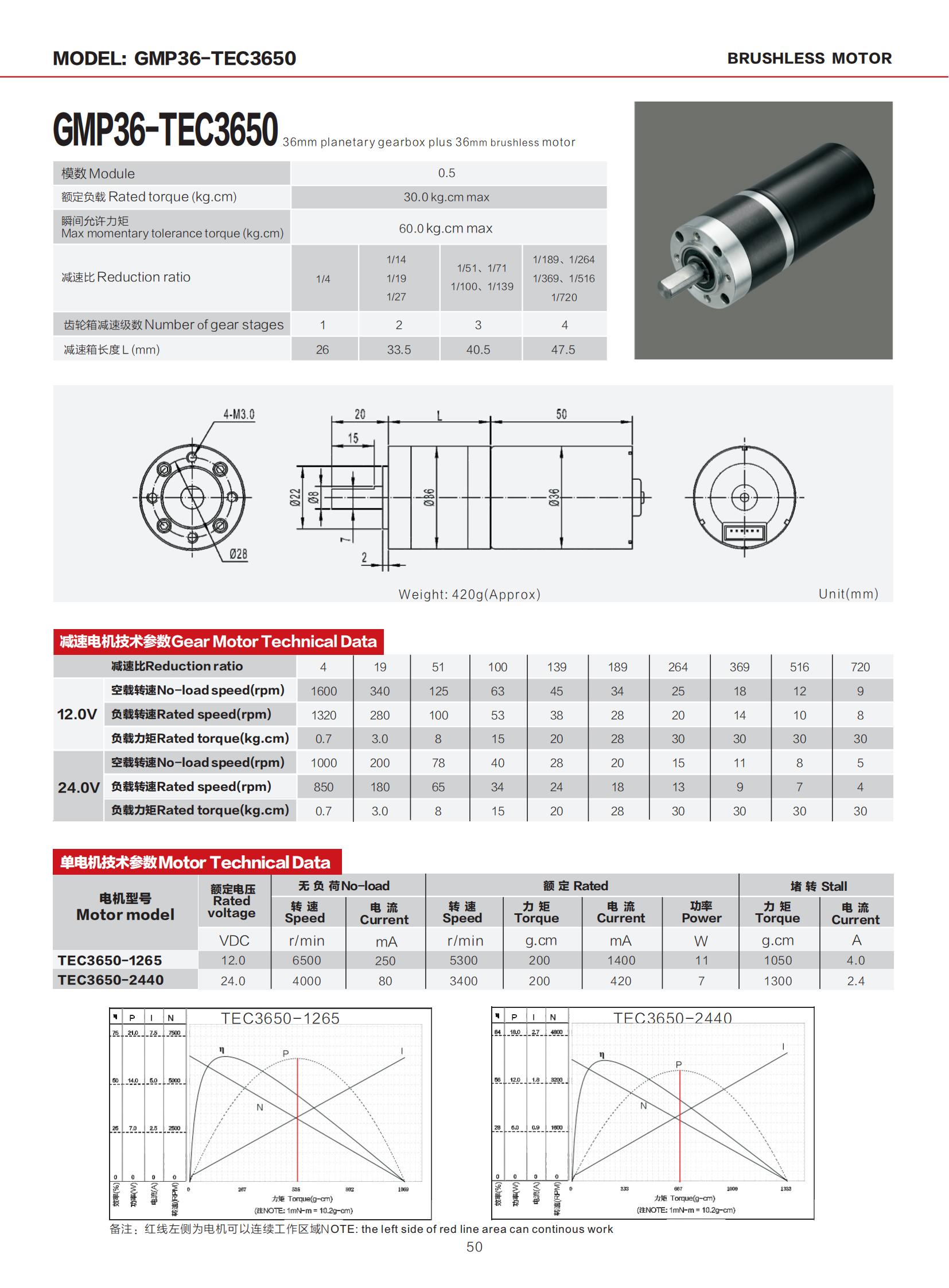
GMP36-TEC3650 parameters: 30.0 kg.cm maximum rated torque, 4–1600 rpm, 12–24 V, 36 mm motor and gearbox diameter, 420 g.
TWG3246-TEC2430: infusion pumps, syringe pumps, microfluidic dispensers
This DC brushless worm gear motor runs on DC 12 V to 24 V, produces up to 8.0 kg.cm maximum rated torque at the gearbox output, and covers 3 rpm to 35 rpm. The gearbox length of 46 mm defines the mounting envelope, and the gear module is 0.5 or 0.6 across 3, 4 or 5 available gear stages.
Three properties make it a fit for fluid-handling mechanisms. First, the right-angle output suits pump housings where the motor body must sit beside, not behind, the drive axis. Second, the self-locking worm gearbox removes the need for an additional braking device, which simplifies both the bill of materials and the failure analysis. Third, the brushless construction produces no sparks during operation and is specified for minimal electromagnetic interference, low operating noise, and a wear-resistant and impact-resistant mechanical structure.
A UK-based medical device manufacturer using these motors in medical pump drives reported 500 to 2,000 units per year, with stable output maintained under long-term operating conditions and a reduction in equipment maintenance frequency over a service period of three years or more.
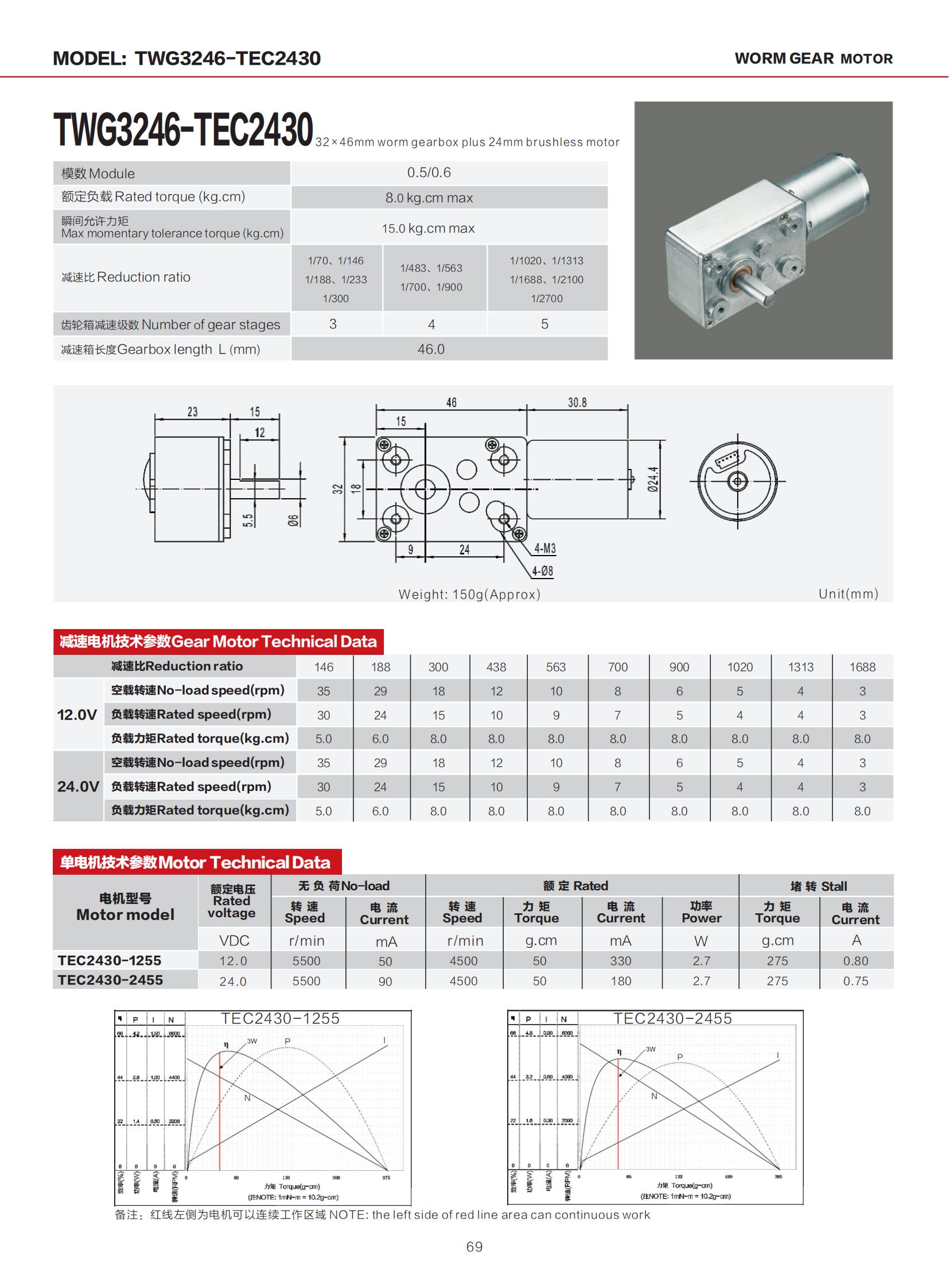
TWG3246-TEC2430 parameters: 8.0 kg.cm maximum rated torque, 3–35 rpm, 12–24 V, 46 mm gearbox length, self-locking worm gearbox.
GMP12T-TDC1215: robot joint drive modules and precision robotics
This coreless gear motor is rated for DC 4.5 V to 12 V, delivers 2 kg.cm maximum rated torque, and spans 8 rpm to 5000 rpm. The gearbox is offered with 1, 2, 3 or 4 stages at lengths of 14.9 mm, 19.7 mm, 24.5 mm or 29.3 mm, with a gear module of 0.2. The declared materials are stainless steel, iron and copper.
The reason a coreless design appears in joint drive modules is inertia. A rotor with high inertia continues rotating briefly after the controller issues a stop command, which shows up as overshoot at the joint. A coreless rotor has a much smaller moment of inertia, so the control–response–stop cycle completes faster. That is a positioning-accuracy argument, not a power argument, and it aligns with the stated requirement for robot joints of high power density, fast response and low inertia.
A Japanese dental instrument manufacturer using this model to drive a micro positioning and adjustment mechanism reported 500 to 2,000 units per year and improved equipment control precision over a service relationship of three to five years, with low inertia, fast response and high power density cited as the fit characteristics.
Compliance Constraints for EU-Facing Builds
For medical and robotics hardware shipped into the European Union, the documentation set is a selection constraint in its own right. The following component-level test documents and certificates are associated with these models.
| Document | Model scope | Issued by / number | Reference |
|---|---|---|---|
| RoHS compliance test | GMP36-TEC3650 and related series models | SGS / CANEC26013325501 | RoHS Directive (EU) 2015/863; issued 2026-04-10, valid until 2099-01-01 |
| RoHS compliance test | TWG3246-TEC2430 and related series models | SGS / CANEC26013326101 | RoHS Directive (EU) 2015/863 amending 2011/65/EU; issued 2026-06-24, valid through 2099-01-01 |
| RoHS compliance test | GMP12T-TDC1215 and related coreless series models | SGS / CANEC26013325001 | RoHS Directive (EU) 2015/863 amending 2011/65/EU |
| REACH compliance test | GM12-N20VA and multiple DC gear-motor models of the same series | SGS / SZXEC25000315601 | EU REACH Regulation (EC) No 1907/2006, SVHC candidate-list screening; issued 2025-02-20, valid until 2099-01-01 |
| CE (EMC) | GM12-N20VA, GM12-N10VA, GM12-N30VA | CTL / CTL2512182011-EC | EN IEC 61000-6-3:2021 emissions; EN IEC 61000-6-1:2019 immunity; issued 2025-12-25 |
| ISO 9001:2015 | R&D and manufacture of micromotors (DC gear motor, DC brushless motor), 3C excluded | DCI / F02926Q00865R402 | GB/T 19001-2016 / ISO 9001:2015; valid 2026-08-21 to 2029-08-21, global market |
The ISO 9001 certificate covers the manufacture of the GMP12T-TDC1215, GMP36-TEC3650, TWG3246-TEC2430, GM37-555PM and GM12-N20VA models. These are component-level compliance documents. They support a device manufacturer's own regulatory submission; they do not by themselves constitute medical device certification of an end product.
Comparison with Traditional Solutions
Brushless gear motors are not a universal replacement for brushed or coreless alternatives. Each construction carries a specific trade-off that buyers should state explicitly in the requirement document.
| Construction | Drive requirement | Wear mechanism | Typical constraint to manage |
|---|---|---|---|
| Brushed DC gear motor | Simple drive, low system cost | Brush and commutator wear exists | Service life and maintenance interval planning |
| Brushless gear motor | Requires an electronic commutation stage | Removes the brush and commutator wear mechanism present in comparable brushed motors | Driver cost and control design become additional variables |
| Coreless gear motor | Simple drive, low rotor inertia | Brush-type construction, so brush wear remains a consideration | Low maximum rated torque and continuous-duty limits |
Market Signals: Growth in Brushless, Coarse in Granularity
Demand for brushless miniature motion is expanding, but the published data remains aggregate. Grand View Research reports the global brushless DC motor market at approximately USD 22.2 to 22.33 billion for 2025, with a forecast period covering 2026 to 2033. Separately, OEC data places the 2024 global export value of electric motors with an output below 37.5 W — HS code 850110 — at USD 16.3 billion.
That second figure illustrates a practical research limitation. HS 850110 aggregates small DC motors broadly; it cannot isolate specific miniature gear motor form factors from the wider category. Buyers relying on trade statistics to size a supply market are therefore working with a coarse proxy rather than a segment figure.
On the regulatory side, IEC 60034-30-1:2025 introduced the IE5 Ultra Premium Efficiency class, following the EU Ecodesign framework under Regulation (EU) 2019/1781, which requires IE3 for motors from 0.75 kW to 1000 kW and IE2 for the 0.12 kW to 0.75 kW band. Those power bands sit above the miniature gear motor segment relevant to analyzers, pumps and small robot joints. For miniature motors, the compliance workload concentrates on RoHS, REACH and EMC documentation rather than on IE efficiency classification — a distinction that matters when a purchasing team imports a large-motor compliance checklist into a miniature-motor project.
Future Outlook
The direction of travel in medical instruments and compact robotics is toward more axes per device and smaller envelopes per axis. That pushes brushless and coreless constructions into frame sizes previously served by brushed motors, and it shifts the selection bottleneck from availability to documentation and duty validation.
For procurement and engineering teams, three practices reduce risk in the next sourcing cycle. Build a specification-to-scenario matrix that pairs each mechanism with its voltage rail, torque ceiling, speed band and duty profile before any quotation is requested. Keep compliance documentation model-specific, since a RoHS or REACH report issued for one series does not automatically cover another. And qualify at the sample stage — TT Motor supports OEM/ODM customization across shaft, encoder, gearbox, voltage, logo and speed, with a minimum order quantity of 2 pieces, sample lead times of 15 to 25 days, bulk lead times of 30 to 45 days, and 100% testing. The company operates from Bao'an District, Shenzhen, with over 300 employees, a manufacturing area of approximately 9,000 square meters, three production plants, an annual output of 8,000,000 pieces, a 35-engineer R&D team, and an export ratio of about 70% concentrated on EU and US markets.
A consolidated overview of the miniature motor range is available in the TT Motor product brochure.
FAQ
What is the difference between rated torque and the maximum rated torque shown on a datasheet?
Rated torque is the torque that can be continuously output under specified operating conditions. When a datasheet states a maximum — for example 30.0 kg.cm for the GMP36-TEC3650, 8.0 kg.cm for the TWG3246-TEC2430 or 2 kg.cm for the GMP12T-TDC1215 — that value represents the ceiling of the specified rating, not a recommended continuous operating point. Continuous-duty margins should be checked against the actual load profile of the mechanism.
Which of these motors fits an infusion pump, syringe pump or microfluidic dispenser?
The TWG3246-TEC2430 is the closest match on specification. It operates at DC 12 V to 24 V, delivers up to 8.0 kg.cm maximum rated torque at the gearbox output, and its output speed range of 3 rpm to 35 rpm suits slow, steady fluid delivery. Its worm gearbox is self-locking, so no additional braking device is required, and it is specified for low operating noise, minimal electromagnetic interference and no spark generation during operation. A UK medical device manufacturer used this model in medical pump drives at 500 to 2,000 units per year.
Can the GMP36-TEC3650 drive a robot joint or an analyzer positioning axis?
It fits joints and positioning axes that need torque margin in a compact envelope. The GMP36-TEC3650 covers DC 12 V to 24 V, produces up to 30.0 kg.cm maximum rated torque, runs from 4 rpm to 1600 rpm, and offers reduction ratios from 1/4 to 1/720 across 1 to 4 gear stages. The motor and gearbox share a 36 mm diameter, total weight is 420 g, and the mechanical interface is an 8 mm solid output shaft with four M3 flange holes. Its planetary gear set is described with minimal transmission backlash, which is the parameter relevant to positioning accuracy checks.
Why is a coreless motor used in a robot joint drive module?
Because rotor inertia limits how quickly a joint can stop accurately. A high-inertia rotor continues to rotate briefly after a stop command and produces overshoot; a coreless rotor has a much smaller moment of inertia, so the control, response and stop cycle completes faster. The GMP12T-TDC1215 is rated for DC 4.5 V to 12 V with 2 kg.cm maximum rated torque and an output speed range of 8 rpm to 5000 rpm, and a Japanese dental instrument manufacturer used it in a micro positioning mechanism, citing low inertia, fast response and high power density. The trade-off is that it is a brush-type coreless construction with a 2 kg.cm torque ceiling, so it is not a continuous heavy-duty joint actuator.
What compliance documents are available for EU-facing medical and robotics builds?
RoHS compliance test reports issued by SGS cover the GMP36-TEC3650 (CANEC26013325501), the TWG3246-TEC2430 (CANEC26013326101) and the GMP12T-TDC1215 (CANEC26013325001), all referencing RoHS Directive (EU) 2015/863. The GM12-N20VA carries REACH compliance documentation under certificate SZXEC25000315601 for SVHC candidate-list screening, and CE certification CTL2512182011-EC covering EN IEC 61000-6-3:2021 and EN IEC 61000-6-1:2019. Company-level ISO 9001:2015 certification F02926Q00865R402, valid from 2026-08-21 to 2029-08-21, covers the R&D and manufacture of micromotors. These are component-level documents and do not constitute end-product medical device certification.
What are the sampling and customization constraints for these motors?
TT Motor operates an OEM/ODM production model with customization available on shaft, encoder, gearbox, voltage, logo and speed. The minimum order quantity is 2 pieces, sample lead times are 15 to 25 days, and bulk lead times are 30 to 45 days, with 100% testing applied in production. Monthly capacity is stated at 800,000 pieces.