
Brass vs Aluminum Custom Zippers: A Strength-Weight Framework
Independent Buyer Reference · Metal Zipper Materials
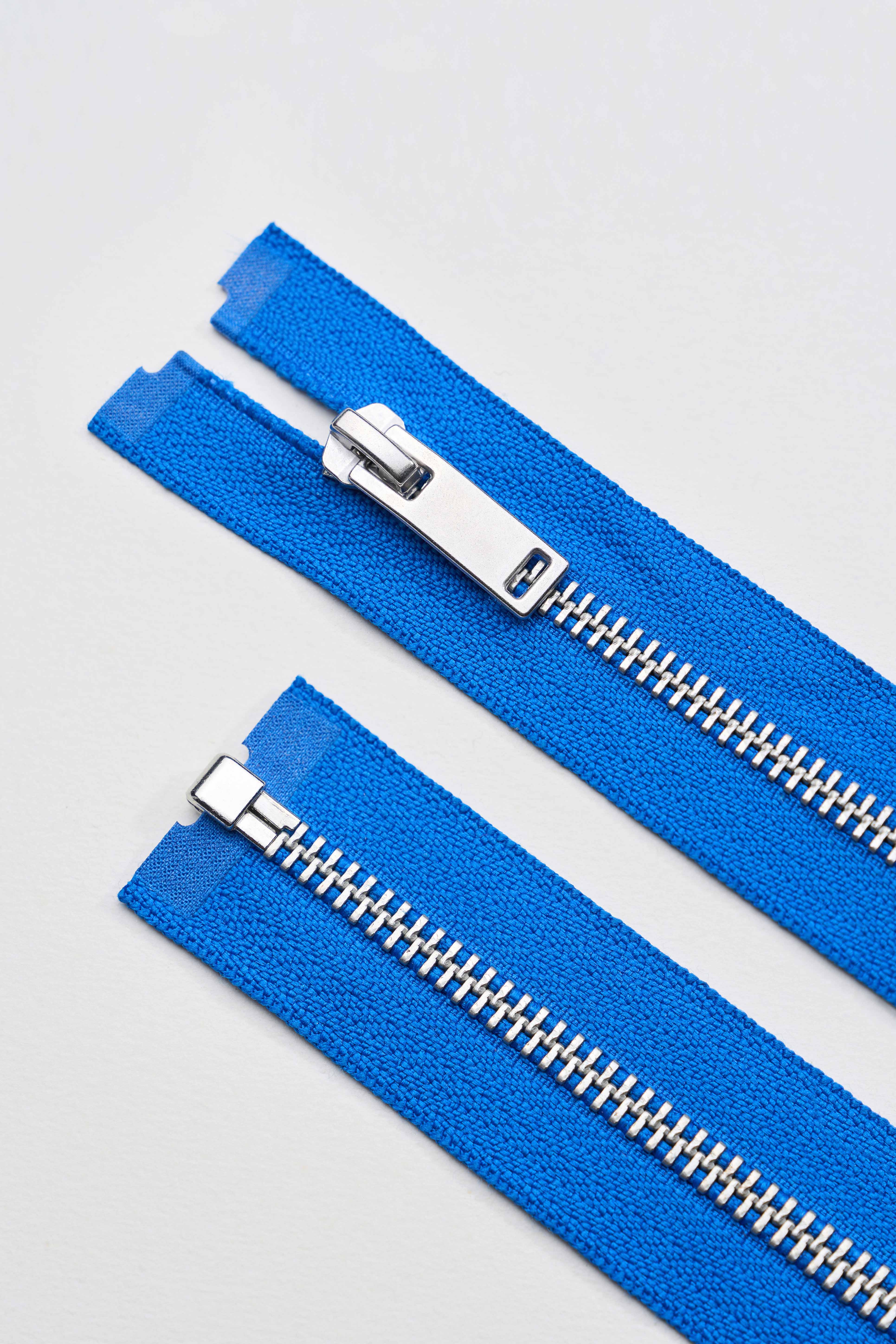
Brass Y-teeth custom zipper: 510N crosswise tensile strength and a salt spray test result above 24 hours. Image: YAB ZIPPER, Wenzhou Runhe Garment Accessories Co., Ltd.
Choosing between brass and aluminum for a custom zipper is a load-versus-weight decision, not a style preference. Brass tooth assemblies are rated at 510N crosswise tensile strength. Aluminum equivalents are rated at 410N, weigh 35% to 50% less, and carry a competitive unit cost. Both pass a salt spray test exceeding 24 hours, both are described as smooth-sliding, and both accept OEM and ODM customization. The real question for a buyer is therefore narrow: how much tensile strength does this application actually need, and what is the surplus strength worth in weight and cost?
This framework sets out a four-step decision sequence for that question, using the published specifications of the brass zipper and Aluminum Alloy zipper ranges produced by YAB ZIPPER, plus application evidence from a European outerwear program. It is written for buyers who are comparing materials at the research and evaluation stage and need to justify a material choice internally, not just select one.
Why the Strength-to-Weight Question Decides Everything Else
The global zipper market was valued at USD 17.39 billion in 2024 and is projected to reach USD 36.73 billion by 2034, a compound annual growth rate of 7.8% between 2025 and 2034, according to Market Research Future. Within that total, metal zippers accounted for 31% of global zipper consumption in 2025, and brass and aluminum together represented 67% of metal zipper production, based on data published by Business Research Insights. The metal segment is, in practice, a two-material decision, and the split between the two materials is driven by measurable trade-offs rather than by design fashion.
The practical problem is that material datasheets publish tensile strength and weight as parallel attributes without indicating which one a given product can trade away. Over-specify brass into a lightweight windbreaker and the program absorbs grams and unit cost the product cannot recover at retail. Under-specify aluminum into a load-bearing seam and the risk moves into the field, where a failed zipper becomes a return rather than a rework.
The opportunity is that the trade-off is quantifiable before tooling starts. Because both metals are sold in the same tooth profiles, the same size range, and effectively the same customization scope, a buyer can define a minimum tensile requirement first, then select the material that meets it at the lowest weight and cost. That sequence prevents both failure modes above.
What Each Material Actually Delivers
Brass sets the higher tensile ceiling. The brass zipper range is rated at 510N crosswise tensile strength, with teeth designed not to deform under load, and is offered in Y teeth, Euro teeth, normal teeth and corn teeth profiles across sizes #3, #5 and #8. The Aluminum Alloy zipper range from the same manufacturer is rated at 410N crosswise tensile strength and is 35% to 50% lighter than the equivalent brass construction.
| Attribute | Brass zipper | Aluminum Alloy zipper |
|---|---|---|
| Crosswise tensile strength | 510N | 410N |
| Weight | Reference weight for the metal category | 35%–50% lighter than brass |
| Unit cost position | Higher material cost | Competitive cost; in one documented EU program, unit price was 40% of the brass zipper it replaced |
| Salt spray test | >24h | >24h |
| Sliding performance | Smooth | Smooth |
| Teeth profiles | Y teeth, Euro teeth, normal teeth, corn teeth | Y teeth, corn teeth, normal teeth, Euro teeth |
| Sizes | #3, #5, #8 | #3, #5, #8 |
| Base material | Brass, polyester tape | Aluminum |
| Surface finishing | Gold, antique brass, gunmetal, nickel silver plating; nickel-free option compliant with EU REACH | Bright silver, matte silver, black, champagne anodizing |
| OEM / ODM | Custom logo slider and puller accepted | Custom logo slider and puller accepted |
Finishing is where the two materials diverge in a way that affects product positioning. Brass supports plated gold, antique brass, gunmetal and nickel silver surfaces, and a nickel-free brass option is available that is compliant with the EU REACH standard — a relevant detail for brands placing product on the European market. Aluminum relies on anodizing instead, in bright silver, matte silver, black and champagne, which produces a cooler and more uniform metallic appearance than a plated surface.
Sizing is identical across both materials. A #3, #5 or #8 designation refers to the width of the zipper teeth measured in millimeters when the zipper is closed, so a #5 zipper measures approximately 5 mm across its closed teeth. Because both brass and aluminum assemblies are supplied in #3, #5 and #8, switching between the two metals does not by itself force a new pattern or a new slider geometry — although the slider assembly should still be re-verified against the new teeth material.
Corrosion performance is equivalent on the published data: both materials pass a salt spray test of more than 24 hours. Buyers who assume that only brass survives humid, wet or wash-exposed conditions are working from an assumption the specification does not support.
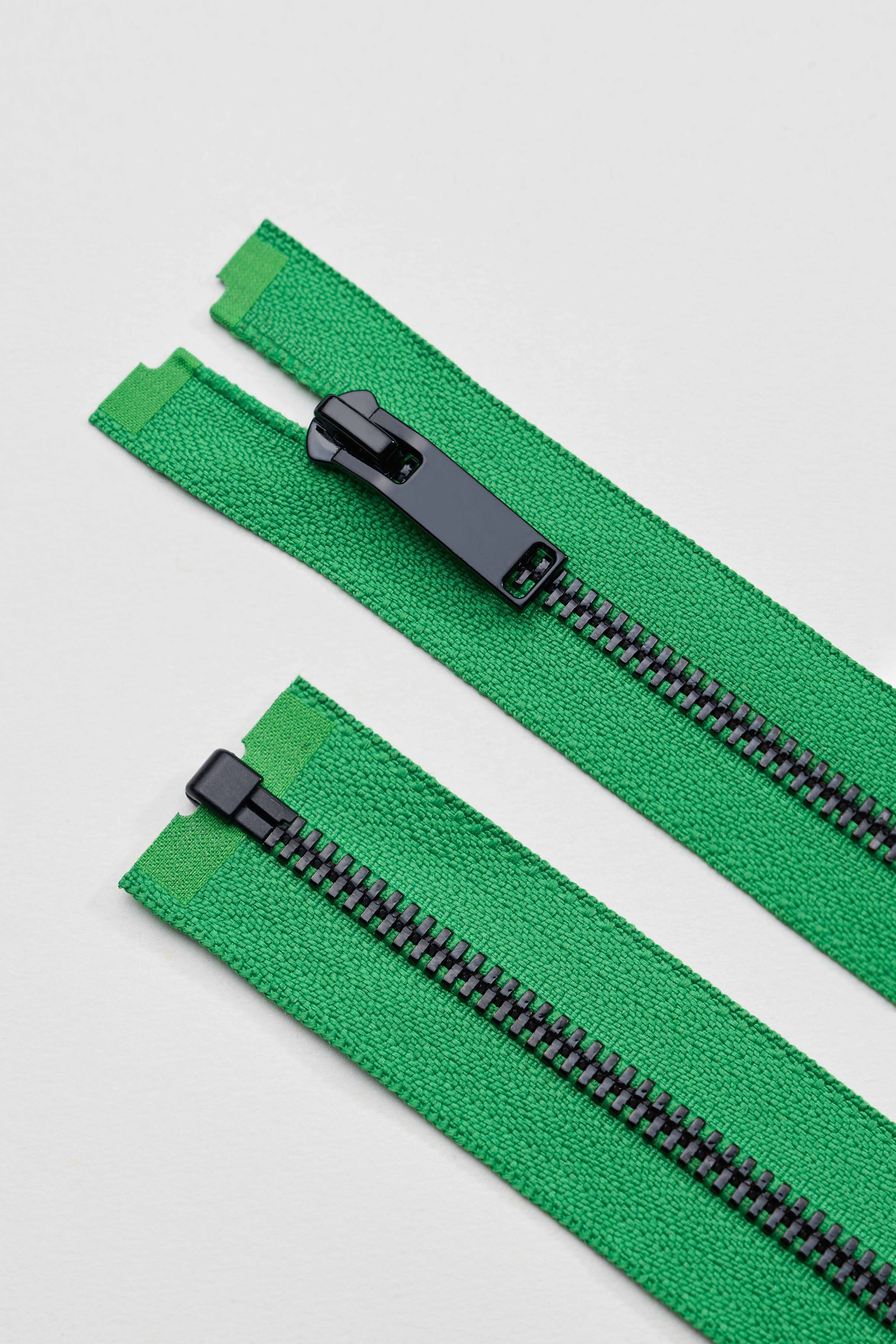
Brass corn teeth profile: a higher-tensile option for luggage, denim and leather goods where the seam carries load. Image: YAB ZIPPER.
A Four-Step Framework for Choosing Between Brass and Aluminum
Step 1 — Define the minimum strength requirement from the seam, not the style
A zipper carries load across the seam it closes, so the starting point is the worst-case load on that seam, not the product category label. Where a seam is expected to hold contents, resist pull, or stay functional after repeated packing cycles, the 510N brass rating provides a larger margin. Where the zipper is decorative or closes a low-load panel, the 410N aluminum rating is frequently sufficient.
Application evidence for these two materials points in a consistent direction. Brass is positioned for leather bags, jeans, outdoor luggage and premium apparel. Aluminum is positioned for hard luggage, backpacks and sportswear. That split tracks the strength figure directly: the heavier, harder-wearing end products take the higher tensile rating, while weight-sensitive products take the lighter metal.
Step 2 — Test whether the weight saving changes the product promise
Aluminum's advantage is quantitative and, for some categories, large enough to become a marketing claim. At 35% to 50% lighter than brass for the same zipper function, the saving matters most where the finished item is carried, worn for long periods, or shipped in volume.
The clearest evidence comes from a documented program with an overseas fast-fashion garment brand supplying the France and Spain markets, covering supporting accessories for spring and autumn lightweight windbreakers and casual coats. In that program, the aluminum specification contributed to a 38% reduction in garment total weight and cut material procurement cost by 59% compared with the original brass zippers, with the aluminum unit price recorded at 40% of the brass zipper it replaced. The defective complaint rate for reciprocating sliding performance stayed below 0.3%, and the zippers passed OEKO-TEX eco certification for smooth EU customs clearance. Cooperation on that program has run for four years, supported by flexible small-batch split delivery.
Step 3 — Check the corrosion and wash environment
Both materials clear the same baseline: more than 24 hours of salt spray testing on each. The boundary sits beyond that baseline. The published application scenario for this zipper family states that it is not suitable for long-term exposure to high-salt seaside environments or for heavy washing with strong acid or alkali agents. A buyer whose end product is marine equipment, a saltwater fishing garment, or an item subject to industrial laundering should treat that boundary as the deciding constraint, regardless of which metal is selected.
For ordinary conditions the picture is broader than the baseline suggests. The stated operating range covers daily indoor use at normal temperature, outdoor environments at normal or low temperature including rain and snow, light humidity, and conventional washing. Within that envelope, the material choice should be driven by load and weight rather than by corrosion concerns.
Step 4 — Confirm customization and supply before locking the material
Customization scope is effectively symmetrical between the two metals. Both accept specification of zipper length, tape color, teeth color, teeth shape, slider shape, slider color and zipper size, and both accept custom logo sliders and pullers under OEM or ODM programs. Because the customization variables are the same, a material change can usually be contained within an existing specification document rather than triggering a new design cycle.
Commercial terms are the same for both materials in this range: minimum order quantity of 2,000 pieces, production lead time of 7 to 30 days, monthly capacity of 300,000 units, and 100% pre-shipment testing. Export coverage includes the EU, US, Middle East and Southeast Asia, with remote technical support available after shipment.
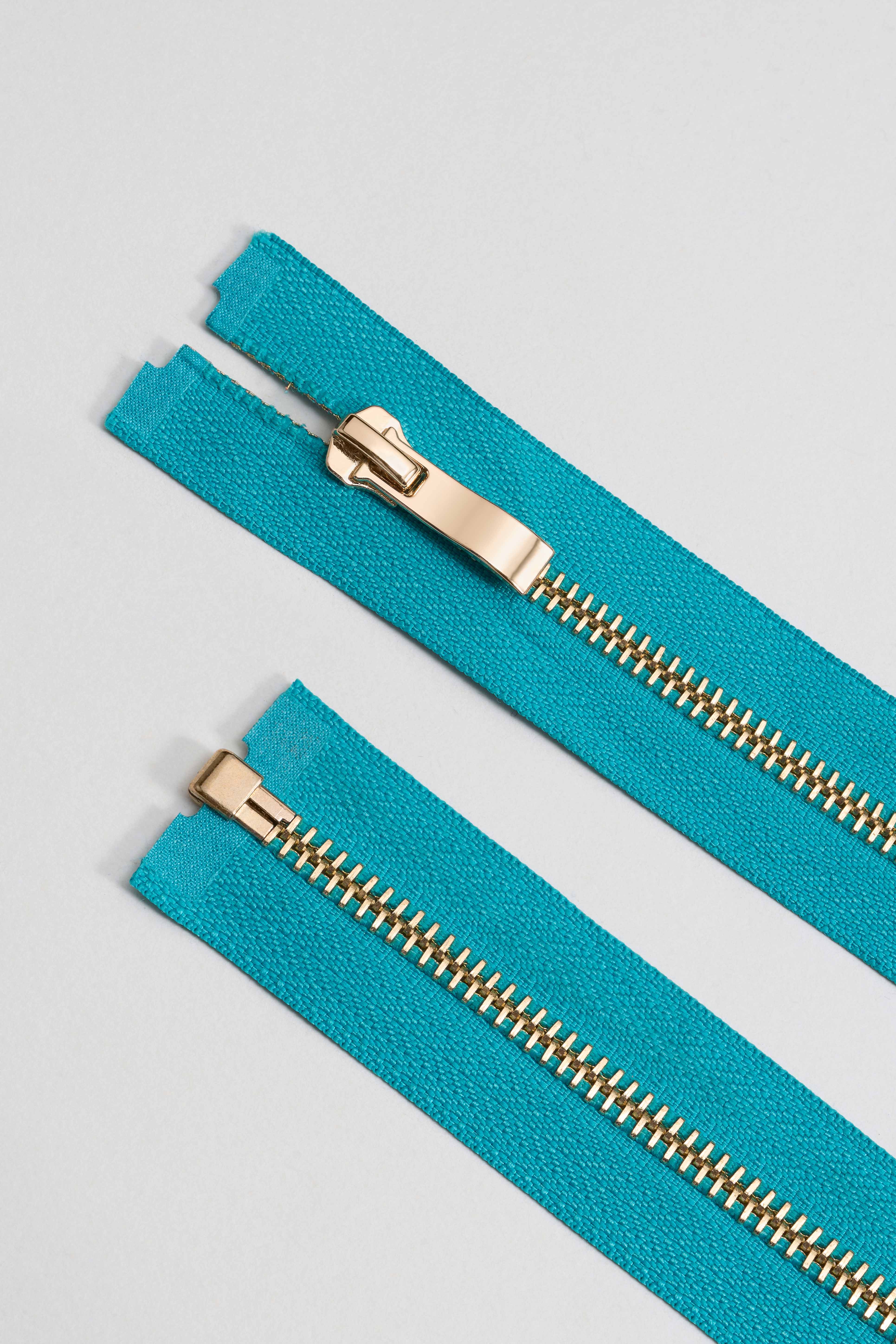
Aluminum alloy Euro teeth profile: 410N crosswise tensile strength, 35%–50% lighter than brass. Image: YAB ZIPPER.
Application Fit Matrix
| Product category | Material that fits the requirement | Reasoning |
|---|---|---|
| Leather bags and handbags | Brass | 510N tensile strength with teeth designed not to deform; metallic texture supports premium positioning |
| Jeans and denim garments | Brass | Higher crosswise strength at high-stress fly seams; self-locking slider design prevents the slider from sliding down |
| Outdoor luggage | Brass | Load-bearing seams and abrasive handling favour the higher tensile ceiling |
| Premium apparel and metal-trim jackets | Brass | Gold, antique brass, gunmetal and nickel silver finishes; nickel-free REACH-compliant brass option available |
| Hard-shell luggage | Aluminum Alloy | 35%–50% weight saving with a competitive unit cost, suited to volume programs |
| Backpacks | Aluminum Alloy | Weight reduction while retaining smooth sliding performance |
| Sportswear and light outerwear | Aluminum Alloy | Anodized surface resists regular washing; a lightweight outerwear program recorded a 38% garment weight reduction |
| Footwear and shoe zippers | Both | Both materials are specified for the footwear industry; the deciding factor is the load on the seam |
Where YAB ZIPPER Fits in This Framework
YAB ZIPPER is the export brand of Wenzhou Runhe Garment Accessories Co., Ltd., a zipper manufacturer based in Wenzhou, Zhejiang, China, producing brass, aluminum, resin and nylon zipper lines for garment, luggage, outdoor goods and footwear applications. The company operates a 10,000 m² facility with 150 employees and an annual output of 70,000,000 pieces, supported by a 10-engineer R&D team and more than 500 zipper production machines.
The manufacturer holds ISO 9001 and OEKO-TEX Standard 100 certification and serves as the sixth president unit of the Wenzhou Zipper Chamber of Commerce. Exports account for approximately 30% of output, with Southeast Asia as the principal market and shipments to the EU, US, Middle East and Southeast Asia handled through the same production lines — which is why a European buyer evaluating anodized aluminum and plated brass is comparing outputs from a single quality system rather than two separate supply chains.
In the France and Spain outerwear program described earlier, the aluminum specification replaced brass on lightweight windbreakers and casual coats while retaining the same metallic appearance as the plated alternative. That combination — equivalent appearance, lower weight, lower unit price — is the specific buyer problem this framework is designed to resolve, and it is also the reason the project ran for four years rather than as a single seasonal order.
Trade-offs and Boundaries You Should Not Skip
A framework that only lists advantages is not usable for procurement. Six boundaries apply to the brass-versus-aluminum decision.
- 410N is a ceiling, not a rounding difference. Aluminum's crosswise tensile strength is 20% below the brass figure. If a seam specification was approved against 510N, substituting aluminum without re-testing moves the risk from the specification stage into field returns.
- Brass costs more and weighs more. The weight penalty is 35% to 50% relative to aluminum, and in one recorded program the aluminum unit price was 40% of the brass zipper it replaced. Budget-sensitive volume programs should model this before assuming brass as a default.
- The salt spray result is a baseline, not an unlimited environmental rating. Both materials exceed 24 hours, but the application scenario excludes long-term high-salt seaside exposure and heavy washing with strong acid or alkali agents.
- A zipper is an assembly, not a single part. Both materials require matched supporting components: polyester yarn tape, suitable garment fabrics such as nylon, cotton, waterproof fabric or leather, sliders, top stops, bottom stops, pins and boxes, and TPU film for waterproof versions. Changing teeth material while retaining the same slider can alter both the sliding feel and the failure mode.
- Self-locking sliders solve retention, not strength. The self-locking slider mechanism automatically locks to prevent sliding down. It is a security feature and does not compensate for an under-specified tensile rating.
- Weight claims belong to the finished item. The 38% figure recorded in the European program describes garment total weight, not the zipper alone. Quoting it as a zipper weight reduction would misstate the source data and weaken the claim in front of a technical buyer.
Market Signals Behind the Weight Agenda
Three verified data points explain why the aluminum side of this trade-off keeps gaining ground. First, material mix: nylon zippers accounted for 46% of total global zipper consumption in 2025, a position attributed to their lightweight structure and corrosion resistance. Weight is already a primary purchase driver in the largest material segment of the market, and the same pressure is being applied to metal specifications. Second, metal composition: with metal zippers at 31% of global consumption in 2025 and brass and aluminum representing 67% of metal zipper production, any shift between the two metals changes the economics of a large slice of the metal category. Third, supply concentration: global trade in zippers under HS 9607 reached USD 3.15 billion in 2024, with China accounting for USD 1.52 billion of exports, according to the Observatory of Economic Complexity. Brass and aluminum availability and pricing therefore move through largely the same supply base, which means material substitution is a specification decision rather than a sourcing-region decision.
The combined picture is a market growing at 7.8% annually toward USD 36.73 billion by 2034, in which lightweighting is a structural requirement in luggage, backpacks and sportswear, while denim, leather goods and premium trim continue to anchor demand for the higher-tensile metal.
Future Outlook
Two directions look durable rather than cyclical. On the aluminum side, anodized finishes in bright silver, matte silver, black and champagne give brands a route to metallic appearance without the weight and unit cost of plated brass, and this is likely to keep expanding in categories where the end consumer notices weight — carry-on luggage, backpacks, technical outerwear and travel garments. On the brass side, plated finishes and a nickel-free, EU REACH-compliant option keep the material relevant where the product promise is durability and perceived quality, particularly in denim and leather goods.
The more consequential change is procedural. As more buyers document tensile ratings, salt spray results and wash-environment limits in the specification itself, material qualification will increasingly be decided by testable figures rather than by descriptive terms such as heavy duty. Suppliers that publish 510N and 410N, weight deltas and salt spray outcomes in a comparable format will be easier to evaluate — and easier to keep in a program once a material choice has been validated.
Frequently Asked Questions
Is brass stronger than aluminum in custom zippers?
Yes. Brass zippers in this range are rated at 510N crosswise tensile strength, while Aluminum Alloy zippers are rated at 410N. Both are rated as smooth-sliding and both pass a salt spray test of more than 24 hours, so the difference between them is concentrated in tensile strength rather than in sliding quality or corrosion performance.
How much weight does an aluminum zipper save compared with brass?
Aluminum Alloy zippers are 35% to 50% lighter than brass zippers. The saving applies to the zipper itself; the effect on a finished item depends on how many zippers are used and on the item's total weight. In a documented program with an overseas fast-fashion brand supplying France and Spain, the aluminum specification was associated with a 38% reduction in garment total weight for spring and autumn lightweight windbreakers and casual coats.
Which product categories should use brass zippers?
Brass is positioned for leather bags, jeans, outdoor luggage and premium apparel. The common factor is seam load: these products require the 510N crosswise tensile strength and teeth that resist deformation. Brass also supports gold, antique brass, gunmetal and nickel silver plating, plus a nickel-free option compliant with the EU REACH standard.
When is aluminum the better choice?
Aluminum is positioned for hard luggage, backpacks and sportswear, where weight and cost carry more decision weight than the additional tensile margin. Aluminum Alloy zippers offer a competitive unit cost against brass, anodized finishes in bright silver, matte silver, black and champagne, and smooth sliding performance.
Do brass and aluminum zippers resist corrosion equally?
On the published specification, both pass a salt spray test of more than 24 hours. The operating envelope covers daily indoor use at normal temperature, outdoor use at normal or low temperature including rain and snow, light humidity, and conventional washing. Neither material is stated as suitable for long-term high-salt seaside exposure or for heavy washing with strong acid or alkali agents.
Can both materials be customized to the same extent?
Both support OEM and ODM customization covering zipper length, tape color, teeth color, teeth shape, slider shape, slider color and zipper size, and both accept custom logo sliders and pullers. Commercial terms are also the same: minimum order quantity of 2,000 pieces, lead time of 7 to 30 days, monthly capacity of 300,000 units, 100% pre-shipment testing, and remote technical support after delivery.
What do #3, #5 and #8 mean, and are they available in both materials?
The number refers to the width of the zipper teeth in millimeters when the zipper is closed, so a #5 zipper measures approximately 5 mm across the closed teeth. Both brass and Aluminum Alloy zippers in this range are available in #3, #5 and #8, across Y teeth, Euro teeth, normal teeth and corn teeth profiles.
Reference material: the manufacturer's background, production scope and certification overview are available in the Runhe Zipper Company Profile.
¿Tiene preguntas o necesita más detalles?
Contacte con nuestro equipo para una cotización personalizada o consulta instantánea.
Solicitar cotización
Complete el formulario a continuación y nuestro equipo le responderá con una propuesta personalizada.
Chat directo de WhatsApp
¿Prefiere chatear en tiempo real? Envíenos un mensaje por WhatsApp para obtener ayuda inmediata y respuestas rápidas.
- Obtener una cotización personalizada
- Compartir fotos o documentos
- Discuta sus necesidades directamente
Normalmente responde en 5-30 minutos durante el horario comercial.