
Brass Valve Scenario Fit: Bozheng Copper's Matrix for Water, Gas, Air, and Low-Pressure Steam
Brass Valve Scenario Fit: Bozheng Copper's Matrix for Water, Gas, Air, and Low-Pressure Steam
Brass valves are almost always catalogued by category — ball, gate, globe, check, pressure reducing, strainer — but they are almost always selected by scenario. A maintenance engineer buying for a swimming-pool circulation loop, a contractor specifying rooftop HVAC, a plant engineer sizing compressor discharge protection and a gas installer working on a regulating station are all looking at the same brass family list and reaching different conclusions. The category tells a buyer what a valve is. The scenario tells a buyer whether it belongs in the line at all.
This reference sets out a scenario-fit matrix for the brass valve range manufactured by Zhejiang BoZheng Copper Industry Co., Ltd. — traded as Bozheng Valve, a brass and stainless steel valve manufacturer established in 1998 and based in Yuhuan City, Zhejiang Province, China. The matrix maps six product families against six recurring application scenarios using only the declared technical data for each model, and then explains where model-level choices matter most: the Q11F-16T full-port ball valve and the SY11X-16T blow-down strainer are examined in detail because they sit at opposite ends of the same design logic — one controls flow, the other protects everything downstream of it.
Why scenario fit outranks category when buying brass valves
A brass valve is a pressure-retaining component whose usefulness depends on three things that are fixed at the design stage and cannot be changed at installation: the pressure class it is built to, the media it is declared for, and the mechanical action its internal trim performs. Bozheng's six families share a common declared baseline — a nominal pressure of 1.6 MPa and working media of water and gas — and a common material set of brass grades HPb59-1, HPb57-3, CW617N and C83600. What separates them is function: isolation, throttling, backflow prevention, pressure reduction and mechanical filtration.
That is why a scenario-first buying approach tends to reduce specification errors. When a buyer starts from the valve category, the conversation becomes a price comparison between six items that all claim the same pressure rating. When the buyer starts from the scenario, the conversation becomes a question about what the line needs to do — stop flow, hold a set pressure, stop reverse flow, or catch debris — and the category follows from the answer.
The Bozheng brass valve range at a glance
Each family carries a model designation that encodes its type and pressure class. The table below summarises design configuration and connection options as declared for each model.
| Family | Model | Declared design configuration | Connection options |
|---|---|---|---|
| Brass ball valve | Q11F-16T | Two-piece, full port / full bore | Threaded end, flanged end, F-F, F-M, M-M, lockable lever handle |
| Brass gate valve | Z15W-16T | Rising stem, solid wedge | Threaded end |
| Brass globe valve | J11W-16T, J11F-16T | Straight pattern (T-pattern), screw-in bonnet | Threaded end |
| Brass check valve | H14X-16T | Vertical, horizontal, swing and spring-loaded configurations | Threaded end |
| Brass pressure reducing valve | Y13X-16T | Direct acting / spring loaded piston type, balanced spring loaded, diaphragm (membrane) type | Threaded end |
| Brass strainer | SY11X-16T | Blow-down / flush type, perforated (punched) screen | Threaded end |
All six families are declared at a nominal pressure of 1.6 MPa with water and gas as working media, and are offered in brass HPb59-1, HPb57-3, CW617N and C83600. Flanged end connections and lockable lever handles are declared for the ball valve range specifically.
Scenario-fit star matrix
The matrix below is an editorial suitability assessment. Stars reflect how well each family's declared function and configuration line up with the mechanical job the scenario demands — isolation, throttling, backflow protection, pressure control or debris capture. They are not test results and they do not indicate that a lower-rated family is unsuitable; in several scenarios the right answer is to install two families together rather than to pick one.
| Family / model | Water & gas | Compressed air | Low-pressure steam & boilers | Construction & HVAC | Oil & fuel | Pools & water treatment |
|---|---|---|---|---|---|---|
| Ball Q11F-16T | ★★★★★ | ★★★★★ | ★★★☆☆ | ★★★★★ | ★★★★☆ | ★★★★★ |
| Gate Z15W-16T | ★★★★★ | ★★★★☆ | ★★★★☆ | ★★★★★ | ★★★★☆ | ★★★☆☆ |
| Globe J11W / J11F-16T | ★★★★☆ | ★★★☆☆ | ★★★★★ | ★★★★☆ | ★★★★☆ | ★★★☆☆ |
| Check H14X-16T | ★★★★★ | ★★★★★ | ★★★★☆ | ★★★★★ | ★★★★☆ | ★★★★★ |
| Pressure reducing Y13X-16T | ★★★★☆ | ★★★★☆ | ★★★☆☆ | ★★★★☆ | ★★★☆☆ | ★★★★☆ |
| Strainer SY11X-16T | ★★★★★ | ★★★★★ | ★★★★☆ | ★★★★★ | ★★★☆☆ | ★★★★★ |
Read the stars as a role-fit indicator only. Every family above is declared for the same nominal pressure and the same water/gas media basis; differences in score come from mechanical action, not from a superior pressure rating.
Water and gas: the baseline duty that most of the range is built for
Water and gas is the declared working-medium basis across the whole Bozheng range, which makes it the scenario where the fewest surprises appear and where selection is decided almost entirely by function. For on/off isolation on a potable or process water line, the Q11F-16T full-port ball valve offers the most direct answer: a full bore means the valve body does not narrow the flow path when open, and a quarter-turn lever gives unambiguous open/closed position — with a lockable lever handle available where inadvertent operation is a risk. For gas lines the same logic applies, and the lockable handle option is often the deciding configuration detail rather than the pressure class.
Where the line needs a slow, adjustable restriction rather than a hard stop, the J11W-16T or J11F-16T globe valve is the more natural fit: the straight-pattern body with a screw-in bonnet puts the disc directly in the flow path and allows gradual positioning. Gate valves (Z15W-16T) sit between the two — a rising stem and solid wedge give visual indication of position and a straight-through bore, which suits isolation duty on larger distribution branches where throttling is not required.
Compressed air: where check valves and strainers carry the scenario
Compressed air systems are listed among the intended industries for all six families, but the functional demands are uneven. A compressor discharge line has two problems that a single valve family cannot solve: reverse flow when the compressor cycles off, and particulate carry-over from the receiver and distribution pipework. That is a two-component answer — a check valve to hold the flow direction, and a strainer upstream of sensitive components to capture debris before it reaches them.
The H14X-16T check valve is declared in vertical, horizontal, swing and spring-loaded configurations, which matters in air systems because pipe routing is rarely convenient — the ability to select a vertical or horizontal pattern rather than re-route the pipe is a practical procurement advantage. Ball and gate valves then handle isolation for maintenance, and the Y13X-16T pressure reducing valve handles the step-down where a branch requires a lower working pressure than the header.
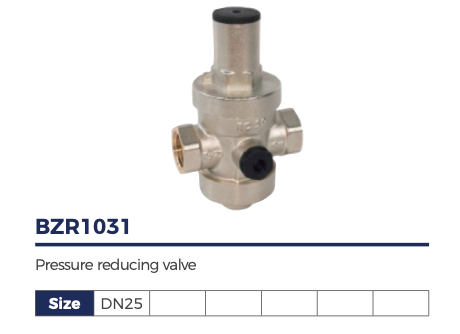
Brass pressure reducing valve, Y13X-16T: direct acting piston, balanced spring loaded and diaphragm variants are declared for branch pressure control.
Low-pressure steam and boilers: read the declaration, not the assumption
This is the scenario where buyers most often over-read a specification sheet — and where Bozheng's own data rewards careful reading. Low-pressure steam and boilers appear in the applicable-industry list for all six families, which makes steam a legitimate target application. However, the declared technical standard for each model states a nominal pressure of 1.6 MPa with working media of water and gas. Steam duty therefore sits in the application list but outside the explicit media declaration, and the correct procurement action is to confirm the temperature and pressure envelope for the specific model with the manufacturer rather than to infer it from the 1.6 MPa figure.
The one temperature statement that is explicitly declared concerns the ball valve range, where an operating window of 0°C to 80°C is given alongside the 1.6 MPa rating. Buyers comparing steam-side options should treat that as a signal about how the range is documented: the ball valve record carries a temperature window, while the gate, globe, check, pressure reducing and strainer records carry pressure and media declarations without a published temperature band. For a boiler feed or condensate-adjacent line, that difference is exactly the kind of gap a purchase order should close before shipment.
Within the steam-adjacent role, the globe valve carries the strongest functional fit because throttling and regulation are its native actions, and the gate valve is the conventional choice for isolation on a boiler branch. The strainer belongs upstream of traps and control components, and the check valve protects against condensate or reverse flow at the boiler inlet.
Construction, oil and fuel, swimming pools: three scenarios with different risk profiles
Construction and building (HVAC/plumbing) is the broadest single demand in the range, and it is the scenario where the full-port ball valve dominates: isolation at risers, plant-room connections and terminal branches, with threaded ends for typical distribution pipework and flanged ends available on the ball valve range for equipment connections. The threaded connection profile is consistent across the gate, globe, check, pressure reducing and strainer families, which simplifies a contractor's stock position.
Oil and fuel systems appear in the applicable-industry list for the whole range, and the same functional logic applies — ball or gate for isolation, check for reverse-flow protection, strainer for filtration. The caution here is not valve type but media confirmation: the declared working media are water and gas, so a fuel-duty specification should be confirmed against the intended fluid rather than assumed from the industry listing. This is a documentation question, not a product limitation.
Swimming pools and water treatment is the scenario where the strainer and the check valve together do most of the protective work. Pool circulation loops combine pumps, filters, dosing points and heater circuits; a perforated-screen strainer ahead of the pump or heater protects downstream components, and a check valve prevents backflow into the dosing or heating branch when the pump stops. Ball valves handle isolation for filter servicing. Notably, Bozheng's recorded application-scenario data for the check valve range names outdoor water treatment, irrigation systems, solar hot water and HVAC rooftop units among project types, with a working condition described as continuous operation over a wide temperature range — a reminder that pool and outdoor water duties are served by system design as much as by valve selection.
Model-level choices: Q11F-16T and SY11X-16T
Two models illustrate how far a single model designation can carry a scenario decision.
Q11F-16T — full-port ball valve duty. The designation identifies a two-piece ball valve at 1.6 MPa nominal pressure, built in brass HPb59-1, HPb57-3 or CW617N, in a full port / full bore configuration. Full bore is the operative phrase: the bore matches the connecting pipe so that the valve does not create an additional restriction in the open position. Combined with a two-piece body and a quarter-turn action, that makes Q11F-16T the default isolation choice where flow capacity and clear position indication both matter — water distribution, compressed air isolation, pool circulation and HVAC plant connections. The declared connection options are unusually wide for a single model: threaded end, flanged end, female-female, female-male and male-male configurations, plus a lockable lever handle. In procurement terms this means one model number can cover panel-mounted, equipment-mounted and pipeline-mounted positions, reducing the number of line items a distributor or contractor has to carry.
SY11X-16T — blow-down strainer service. The strainer is a blow-down / flush type with a perforated (punched) screen and threaded ends, declared at 1.6 MPa for water and gas in brass HPb59-1, HPb57-3, CW617N or C83600. Its role is protective rather than controlling: it sits upstream of pumps, pressure reducing valves, traps and heat exchangers to capture debris that would otherwise damage or foul them. The blow-down configuration is what makes it a maintenance item rather than a consumable — debris is flushed from the screen without dismantling the line. The practical specification point is placement: a strainer installed after a pressure reducing valve protects nothing, and a strainer without accessible blow-down space becomes a future shutdown.
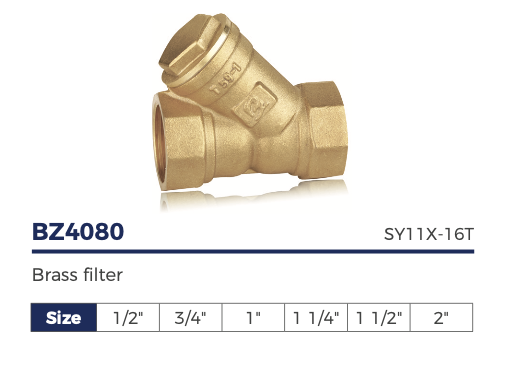
Brass strainer, SY11X-16T: blow-down / flush type with perforated screen, positioned upstream of pumps, traps and pressure reducing valves.
Materials, pressure class, and what a 1.6 MPa figure does not tell you
The four brass grades declared across the range — HPb59-1, HPb57-3, CW617N and C83600 — are not interchangeable marketing labels. Grade selection affects machinability, corrosion behaviour in the intended medium and, increasingly, compliance in drinking-water applications. CW617N in particular is a grade that buyers in European markets recognise and ask about by name, because alloy composition is now a regulated purchasing criterion rather than a workshop preference.
A nominal pressure of 1.6 MPa is a class statement, not a performance guarantee for every combination of media, temperature and cycle count. It tells a buyer which flange or threaded joint class the body is built to withstand under declared conditions; it does not tell them the allowable pressure at elevated temperature, the cycle life of the trim, or the derating curve for steam. Those values belong in a technical datasheet or a written confirmation from the manufacturer, and they are the questions that separate a specification review from a price comparison.
Market trend: why scenario documentation is becoming a buying criterion
Two regulatory and one commercial trend are reshaping how brass valves are specified. First, EU Directive 2020/2184 sets a lead limit of 5 µg/l for drinking water and mandates a ban on lead-containing brass alloys for drinking water transportation effective 31 December 2026 — which turns alloy grade from a cost variable into a market-access variable for any supplier selling into the European Union. Second, NSF/ANSI/CAN 61 sets health-effects requirements for chemical contaminants from products in contact with drinking water in North America. Both standards push buyers toward documented material declarations rather than catalogue adjectives.
Commercially, the brass ball valve segment was valued at approximately USD 3.2 billion globally in 2024 and is projected to reach USD 4.8 billion by 2033 at a reported CAGR of 5.5%, according to DataHorizzon Research — a sub-segment sitting inside a wider industrial valve market that The Business Research Company valued at USD 102.56 billion in 2025. The same commercial research set cites copper raw material pressure, with an approximately 23.4% increase in brass product manufacturing costs attributed to copper pricing in 2024. Read together, the signals point the same way: buyers are being asked to justify alloy choice, certification status and scenario fit in writing, at the same time as input costs make specification errors more expensive.
How a scenario matrix compares with traditional category-based selection
Traditional category-based selection is fast and familiar: match the pipe size, match the pressure class, choose the cheapest valve of the right type. It works well on repetitive, low-consequence duties and it is genuinely efficient for distributors holding broad stock. Its weakness is that it answers a supply question rather than a system question — it never asks whether a globe valve would have been better than a gate valve at a throttling point, or whether the pressure reducing valve has a strainer upstream of it.
A scenario matrix is slower at the front end and demands more information: media, temperature, required action, maintenance access and downstream equipment. For a multi-site contractor or an OEM building a standard plant-room package, that front-end effort pays back in reduced callbacks. For a one-off replacement of a failed valve on a known line, the category approach is usually sufficient — and the matrix offers little advantage over simply matching the failed part.
Limits and boundaries buyers should hold in view
A fit matrix is only as good as the declarations behind it, and Bozheng's published data has identifiable boundaries that a procurement team should note.
- Media declaration versus industry listing. The declared working media across the range are water and gas. Low-pressure steam and boilers, oil and fuel systems and swimming pools all appear as intended industries, but a purchase order for steam or fuel duty should seek written confirmation of the media and temperature envelope for the specific model.
- Temperature data is uneven. The ball valve record publishes a 0°C to 80°C operating window; the other five families publish pressure and media without a temperature band. Buyers should not extrapolate the ball valve window to gate, globe, check, pressure reducing or strainer models.
- Connection options differ by family. Flanged ends and lockable lever handles are declared for the ball valve range. Gate, globe, check, pressure reducing and strainer models are declared with threaded ends. A project requiring flanged connections throughout needs a configuration conversation, not an assumption.
- Certification is management-system, not product approval. Bozheng self-reports ISO 9001, ISO 14001 and ISO 45001 on its supplier profile. These are management-system certifications and should not be read as product conformity to NSF/ANSI/CAN 61 or to the EU drinking water directive; product-level certificates should be requested separately where a project requires them.
- No published price, MOQ or lead time. Commercial terms are not part of the public technical record and must be obtained through quotation.
Future outlook
The direction of travel in brass valve procurement is toward documented scenario coverage rather than expanded catalogue counts. As the EU drinking water deadline approaches and as alloy costs continue to pressure margins, buyers are likely to consolidate around suppliers who can answer three questions in writing: which alloy grade is used and why, what the temperature and pressure envelope is for each model, and which model in the range is intended for which system duty. A manufacturer such as Bozheng Valve — operating a 6,700 m² facility in Yuhuan with approximately 180 staff, a 25-engineer R&D team and an annual capacity of 3,200,000 units, exporting around 70% of output to the EU, USA, Southeast Asia, Central Asia and Africa — is structured to answer those questions at range level rather than product level. The manufacturers who win the next procurement cycle will be the ones whose scenario documentation is already written when the enquiry arrives.
Frequently asked questions
What is a brass valve and what is it used for?
A brass valve is a flow-control component with a brass body that starts, stops, regulates or protects flow in a pipeline. In the Bozheng range, six families cover the main functions: ball and gate valves for isolation, globe valves for throttling, check valves for backflow prevention, pressure reducing valves for downstream pressure control, and strainers for mechanical filtration. All six are declared at 1.6 MPa nominal pressure for water and gas media, in brass HPb59-1, HPb57-3, CW617N and C83600.
Which brass valve type suits water and gas isolation best?
For on/off isolation on water and gas lines, the Q11F-16T two-piece full-port ball valve is the most direct fit because full bore avoids adding restriction when open and the quarter-turn lever gives clear position indication. The Z15W-16T rising-stem gate valve is an alternative where a straight-through bore and visible stem position are preferred on larger distribution branches. Globe valves are better reserved for duties requiring throttling rather than simple isolation.
What connection options are available on the Q11F-16T ball valve?
The Q11F-16T is declared with threaded end and flanged end connections, in female-female, female-male and male-male configurations, and is available with a lockable lever handle. Materials include brass HPb59-1, HPb57-3 and CW617N, with a nominal pressure of 1.6 MPa for water and gas, and an operating temperature window of 0°C to 80°C.
Can these brass valves be used on low-pressure steam and boilers?
Low-pressure steam and boilers are listed among the intended industries for all six Bozheng families. However, the declared technical standard for each model specifies a nominal pressure of 1.6 MPa with working media of water and gas, and only the ball valve record publishes an operating temperature window. Buyers planning steam duty should therefore obtain written confirmation of the temperature and pressure envelope for the specific model before ordering, rather than assuming steam is covered by the 1.6 MPa rating.
Should a strainer or a pressure reducing valve be installed first?
Where both are used, the strainer belongs upstream of the pressure reducing valve. The SY11X-16T blow-down strainer captures debris with a perforated screen before it reaches the valve trim, and its flush configuration allows the screen to be cleaned without dismantling the line. A pressure reducing valve installed ahead of the strainer is exposed to whatever the pipeline carries.
What material grades are available across the Bozheng brass valve range?
The declared brass grades are HPb59-1, HPb57-3, CW617N and C83600, with the exact offering varying by family. Grade choice affects machinability, corrosion behaviour in the intended medium and compliance considerations in drinking-water applications, so the grade should be specified explicitly rather than left to default.
How do management-system certifications differ from product approvals?
ISO 9001, ISO 14001 and ISO 45001 — the three certifications Bozheng self-reports on its supplier profile — certify a manufacturer's quality, environmental and occupational health and safety management systems. They do not certify that a specific valve model meets a product standard such as NSF/ANSI/CAN 61 for drinking water contact. Project specifications calling for product conformity require product-level certificates, requested separately from management-system documentation.
The 2025 BZ product catalogue, covering the brass and stainless steel valve range, is available for download: BZ Catalogue 2025 2.0 (PDF).
¿Tiene preguntas o necesita más detalles?
Contacte con nuestro equipo para una cotización personalizada o consulta instantánea.
Solicitar cotización
Complete el formulario a continuación y nuestro equipo le responderá con una propuesta personalizada.
Chat directo de WhatsApp
¿Prefiere chatear en tiempo real? Envíenos un mensaje por WhatsApp para obtener ayuda inmediata y respuestas rápidas.
- Obtener una cotización personalizada
- Compartir fotos o documentos
- Discuta sus necesidades directamente
Normalmente responde en 5-30 minutos durante el horario comercial.