
Brass Valve Procurement FAQ: Technical and Purchasing Questions Global Buyers Ask Most
Procurement teams do not buy a brass valve from a model code alone. They match the valve to line size, media, pressure, temperature, end connection, handle requirement, documentation and destination-market rules. This FAQ answers the technical and purchasing questions global buyers raise most, using the documented range of Bozheng Valve, the brand of Zhejiang BoZheng Copper Industry CO., LTD, a brass and stainless valve manufacturer founded in 1998 in Yuhuan City, China.
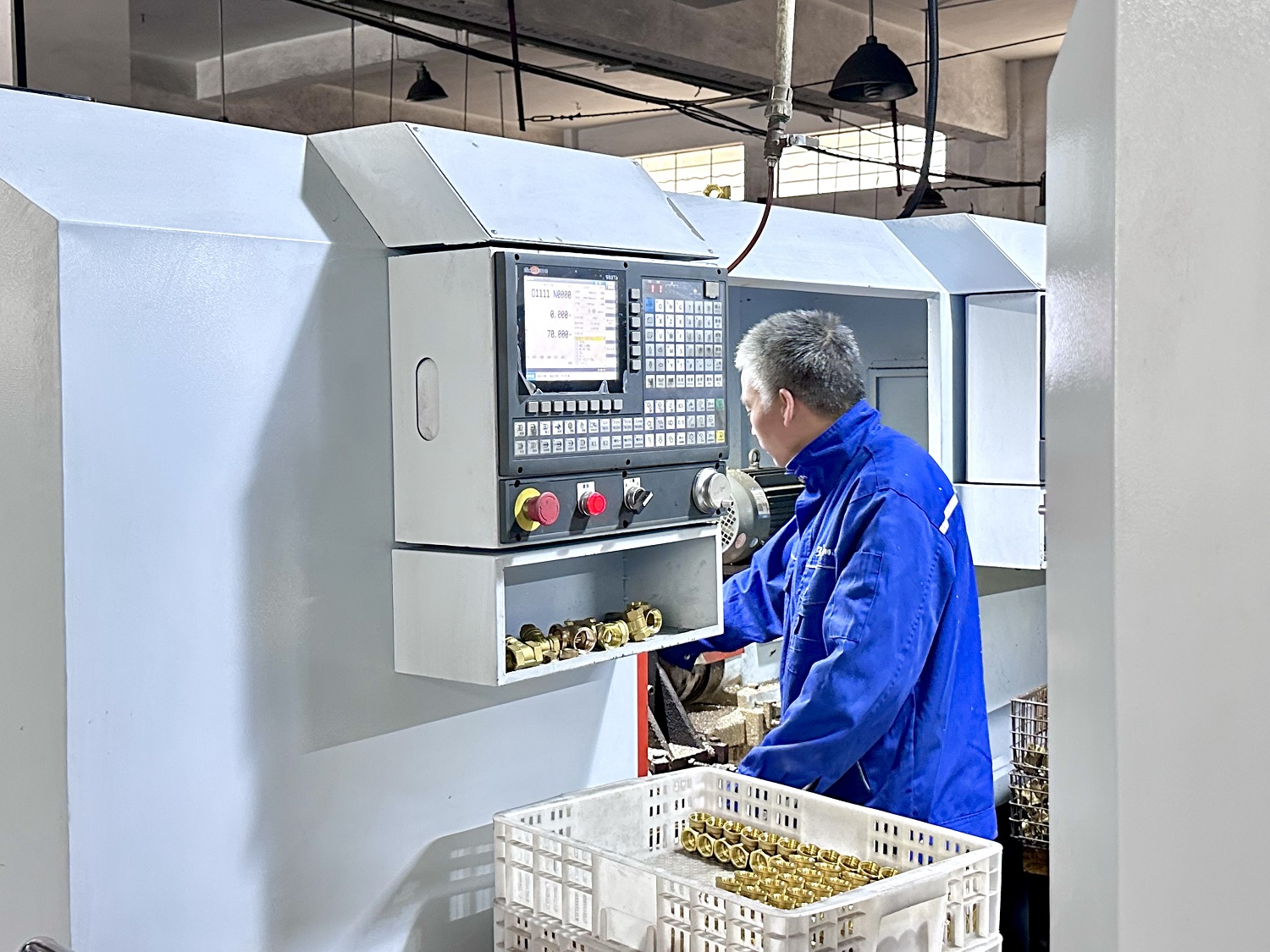
Brass valve production context: matching model, material, pressure and documentation before purchase. Image: Bozheng Valve.
Why brass valve procurement is a constraint-matching problem
A brass valve can look identical in a photo and still fail a procurement review. The variables that matter are documented: valve family, model, body material, nominal pressure, working temperature, media, end connection and acceptance evidence. A 1.6 MPa marking is a nominal pressure statement. It does not, by itself, confirm suitability for a specific steam line, compressed-air circuit, potable-water application or high-corrosion duty. That is why the useful buying question is not which brass valve is best in general, but which documented configuration fits the line and what evidence supports it.
For buyers in research and evaluation, this shifts the conversation toward specification clarity. Bozheng Valve's supplied product data covers six brass valve families, four material options and a common nominal pressure of 1.6 MPa. The same data also shows where the buyer must ask one more question: temperature is explicitly listed for the Q11F-16T ball valve, while the other model pages in this evidence set state pressure and water/gas media. Treating every model as identical would be a procurement error.
Technical questions buyers ask first
1. Which Bozheng Valve model family fits the duty?
The first selection step is to name the duty, then match it to the model family. The table below uses only Bozheng Valve product data and is a starting point for enquiry, not a substitute for line sizing or project engineering.
| Duty or question | Documented model | What the data confirms | Buyer check |
|---|---|---|---|
| On/off isolation with a ball valve | Q11F-16T Brass Ball Valve | Two-piece, full port, threaded or flanged end, F-F, F-M and M-M arrangements, lockable lever handle, 1.6 MPa, 0 to 80°C, water and gas | Size, thread or flange standard, handle lock requirement |
| Isolation with a gate style | Z15W-16T Brass Gate Valve | Rising stem, solid wedge, threaded end, OEM gate valve, 1.6 MPa, water and gas | Installation height for rising stem, face-to-face requirement |
| Straight-pattern globe duty | J11W-16T or J11F-16T Brass Globe Valve | Straight pattern, screw-in bonnet, 1.6 MPa, water and gas | Pressure drop and required flow characteristic with the project engineer |
| Backflow prevention | H14X-16T Brass Check Valve | Vertical or horizontal check valve, swing check valve, spring loaded check valve, 1.6 MPa, water and gas | Orientation, allowable pressure surge, required closing behaviour |
| Pressure reduction | Y13X-16T Brass Pressure Reducing Valve | Direct acting or spring loaded piston type, balanced spring loaded, diaphragm type, 1.6 MPa, water and gas | Inlet and outlet pressure, set point, flow requirement |
| Strainer protection | SY11X-16T Brass Strainer | Blow-down or flush type, perforated screen strainer, threaded ends, 1.6 MPa, water and gas | Screen specification and blow-down arrangement |
The model family table does not confirm availability of every size or end combination. Flanged ends are documented for the Q11F-16T ball valve; the Z15W-16T gate valve and SY11X-16T strainer are documented with threaded ends. Other models require drawing confirmation.
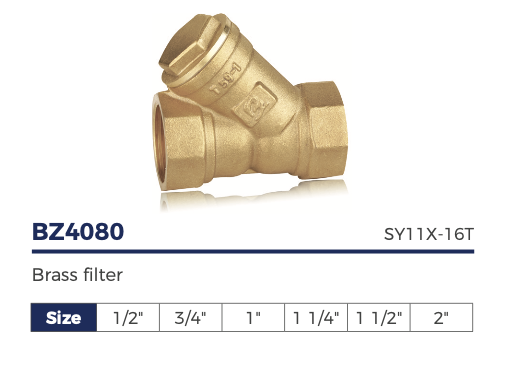
SY11X-16T brass strainer: blow-down or flush type, perforated screen, threaded ends, 1.6 MPa, water and gas. Image: Bozheng Valve.
2. What do Q11F-16T, Z15W-16T and the other codes tell a buyer?
In Bozheng Valve's listings, the model code is a product-family identifier, while the 16T element appears together with a 1.6 MPa nominal pressure. The practical reading is: Q11F-16T is the brass ball valve family, Z15W-16T the gate valve, J11W-16T and J11F-16T the globe valve, H14X-16T the check valve, Y13X-16T the pressure reducing valve and SY11X-16T the strainer. The code does not replace a full specification. Buyers should still confirm body material, end connection, handle type, size, test record and marking on the quotation or drawing.
This is where specification clarity becomes a commercial issue. A supplier that can tie each code to a typed product description makes evaluation faster. Bozheng's supplied data does this for several models by listing type, material options, pressure and end connection. It does not publish a public price list in the same data set; price and delivery therefore remain quotation-level questions.
3. Which brass material should be specified: HPb59-1, HPb57-3, CW617N or C83600?
Bozheng Valve lists HPb59-1, HPb57-3, CW617N and C83600 as material options across the six brass valve families. The correct choice is not a generic preference for brass. It is a project decision based on the required grade, the destination market, the media and the acceptance documentation the buyer will accept. The purchase order should name the grade explicitly and require the material to be traceable to the certificate or test record.
Two boundaries matter. First, the presence of a grade in a product data list is not a lead-free claim. Second, potable-water projects have market-specific conformity rules. For the European Union, Directive 2020/2184 sets a lead ban for brass alloys in contact with drinking water effective 31 December 2026. In North America, NSF/ANSI/CAN 61-2025 addresses health effects from products in contact with drinking water. Bozheng's supplied data does not state a product-level NSF/ANSI 61 or EU drinking-water approval. Buyers should therefore separate general brass grade selection from product approval and request the exact evidence required by the project.
4. What do 1.6 MPa and 0 to 80°C mean in practice?
Bozheng Valve's documented nominal pressure for the six brass valve families is 1.6 MPa. The Q11F-16T ball valve listing also states a working temperature range of 0°C to 80°C. These are useful screening values, but they should be read at the right level. The pressure value is nominal and common across the listed models. The temperature range is explicitly documented for the ball valve; the other model pages in this evidence set state the pressure and water/gas media. A buyer who needs a temperature confirmation for a gate, globe, check, pressure reducing or strainer application should obtain it for that model and configuration.
For steam, boiler or compressed-air service, the question is not only the line pressure. The buyer should confirm the selected model, seat and seal arrangement, end connection and installation conditions. Bozheng's applicable-industry data lists low-pressure steam and boilers, compressed air systems, oil and fuel systems, swimming pools and water treatment, and industrial machinery. That is application scope, not a blanket media approval for every model.
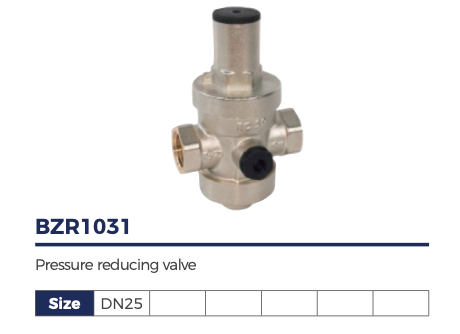
Y13X-16T brass pressure reducing valve: direct acting or spring loaded piston type, 1.6 MPa, water and gas. Image: Bozheng Valve.
5. Which media are actually documented?
The product data states water and gas as working media for the six model families. Low-pressure steam, boilers, compressed air, oil and fuel systems, swimming pools and water treatment, and industrial machinery appear as applicable industries. The distinction is important: water and gas are the named media; the others are application environments that require confirmation of the specific valve configuration. The scenario data also warns buyers to avoid corrosive media. If the line carries a corrosive fluid, a solvent, a high-temperature medium or an unlisted gas, the correct action is to request an engineering review rather than extend the water/gas rating by assumption.
6. Threaded or flanged ends, and when does the lockable handle matter?
End connection should be fixed before price comparison. In the supplied data, the Q11F-16T ball valve is documented with threaded and flanged ends, including F-F, F-M and M-M arrangements. The Z15W-16T gate valve is documented with a threaded end, and the SY11X-16T strainer with threaded ends. The other models in this evidence set do not state the full end-connection range on their product pages. Buyers should not assume flanged availability across every model without a drawing.
The lockable lever handle is documented for the Q11F-16T ball valve. It is not stated for the other model families in the same data. Where lockout or controlled operation is required, the buyer should ask for the handle drawing, lock interface and marking requirement. This is a small option with a large operational consequence: a standard lever and a lockable lever may look similar in a catalogue photo but require different approval and spare-part planning.
Purchasing questions that decide the order
7. What commercial terms should be fixed in the purchase order?
Bozheng Valve's capability data provides a practical baseline: OEM/ODM support, customization of logo, appearance, pressure, material and color, a monthly capacity of 30,000 units, a 30-day lead time, a minimum order quantity of 1 unit for stock goods, 100% testing, remote after-sales support and a 1-year warranty. These are useful terms for evaluation, but they should be converted into written order conditions.
| Order term | What to write down |
|---|---|
| Model and size | Exact model, nominal size, end connection and handle type |
| Material | Grade chosen from HPb59-1, HPb57-3, CW617N or C83600, plus certificate requirement |
| Pressure and temperature | 1.6 MPa nominal pressure; temperature confirmed for the specific model |
| Media | Water and gas; for steam, compressed air or another medium, written engineering confirmation |
| Testing | 100% test; test method and record format to be agreed |
| Marking and packaging | Brand, model, size, lot or traceability requirement |
| Delivery | 30-day lead time baseline; confirm for custom or non-stock items |
| Warranty and support | 1-year warranty; remote support scope |
| OEM/ODM | Logo, appearance, pressure, material or color changes defined on a drawing |
The MOQ note deserves attention: 1 unit applies to stock goods. It is not a promise that every custom configuration will be economical at one unit. Custom pressure, material or appearance changes should be quoted separately with a drawing and validation step.
8. What acceptance criteria should be requested?
Acceptance criteria should be written before shipment, not negotiated after inspection. For a brass valve order, the minimum set is the model, material grade, nominal pressure, end connection, handle type, marking, quantity and packaging. The buyer should also define the test record and certificate package required. Bozheng Valve documents 100% testing and self-reports ISO 9001, ISO 14001 and ISO 45001 certification. Those management-system certificates support a quality process, but they are not the same as a product-specific approval for a potable-water, gas or marine application.
A practical acceptance schedule can separate three evidence levels. Level one is commercial: model, quantity, price, lead time and packaging. Level two is product: drawing, material grade, pressure, temperature and end connection. Level three is conformity: test record, certificate copy and any destination-market product approval. Mixing these levels is a common source of disputes.
9. What ISO certificates does Bozheng Valve document, and what do they cover?
The supplied data lists three management-system certificates issued by QPC with a scope of brass valve. ISO 9001 is certificate 20225Q20080R2M under GB/T 19001-2016, issued 2025-01-21 and valid to 2028-02-25. ISO 14001 is certificate 2024E0305R0M under GB/T 24001-2016 / ISO 14001:2015, issued 2024-10-24 and valid to 2027-10-23. ISO 45001 is certificate 2022S02003R0M under GB/T 45001-2020 / ISO 45001:2018, issued 2025-01-21 and valid to 2028-02-25. The corpus also links ISO 9001 specifically to the brass strainer and ISO 14001 specifically to the brass check valve.
These are management-system certifications. They indicate that quality, environmental and occupational health and safety systems have been certified within the stated scope. They do not automatically certify a product to NSF/ANSI/CAN 61, the EU Drinking Water Directive or a gas-appliance standard. Buyers should request the certificate copy, confirm the scope and validity, and separately ask for the product approval required by the destination market.
10. How does Bozheng Valve compare with a typical workshop supplier on procurement answers?
The star ratings below are HTNXT editorial assessments for this FAQ. They are based only on the documented evidence in this article and are not third-party rankings, certifications or guarantees. The comparison is against a category benchmark, not a named company.
| Procurement criterion | Bozheng Valve | Typical workshop supplier benchmark | Why the rating is bounded |
|---|---|---|---|
| Technical depth | ★★★★☆ | ★★★☆☆ | Six documented model families and four material options; temperature is explicit only for the ball-valve listing in this data set. |
| Specification clarity | ★★★★☆ | ★★☆☆☆ | Model, type, pressure, media and several end connections are documented; size range and full flange scope are not published in the supplied data. |
| QC documentation | ★★★★☆ | ★★☆☆☆ | ISO 9001, ISO 14001 and ISO 45001 are self-reported with certificate numbers; product-level approvals must be requested separately. |
| Service responsiveness | ★★★★☆ | ★★★☆☆ | OEM/ODM, customization, 30-day lead time, remote support and 1-year warranty are documented; response time is not quantified in the data. |
| Commercial transparency | ★★★☆☆ | ★★☆☆☆ | MOQ of 1 unit applies to stock goods; price, non-stock MOQ and custom lead time remain quotation-level. |
The star table makes the trade-off visible. A documented supplier can answer a higher share of technical and purchasing questions before the quotation stage. That does not make every configuration a stock item, and it does not remove the need for project-specific approval. The buyer still has to verify the grade, the temperature envelope for non-ball models, the end connection and the destination-market product approval.
Where a standard workshop answer falls short
A common workshop response is to quote a model and a price. That answer is fast, but it leaves the buyer to resolve material grade, end connection, testing and certification. The documented approach is slower at the start and faster at evaluation: the model is tied to a type, the material options are named, the pressure and media are stated, and the certificate scope is visible. The limitation is equally clear: Bozheng's supplied data does not publish a full size chart, a public price list or a product-level drinking-water approval. Buyers who need those items should request them rather than infer them.
For the EU market, the 2026 lead ban creates a hard deadline. For North America, NSF/ANSI/CAN 61-2025 creates a product-evidence requirement. These are not marketing points; they are procurement filters. A supplier that can answer at the model, material and certificate level is easier to evaluate, but the final approval still depends on the exact product and destination market.
Market trend: documentation is becoming a buying filter
The brass valve market is not short of suppliers. It is short of comparable answers. Verified market research places the global industrial valve market at about USD 102.56 billion in 2025, while the brass ball valve segment is estimated at about USD 3.2 billion in 2024 and projected to reach USD 4.8 billion by 2033 at a 5.5% CAGR. Growth alone does not tell a buyer which supplier to approve. Regulation does more to change the evaluation checklist.
The EU Drinking Water Directive 2020/2184 introduces a lead ban for brass alloys in contact with drinking water from 31 December 2026. In North America, NSF/ANSI/CAN 61-2025 keeps health-effects requirements in view for drinking-water system components. For procurement teams, the practical result is a shift from asking whether a valve is brass to asking which alloy, which product approval and which certificate apply. That is a documentation question before it is a price question.
Bozheng Valve's export orientation makes this relevant. The company reports a 70% export ratio and markets including the EU, USA, Southeast Asia, Central Asia and Africa. A supplier serving multiple markets must keep model data, material options and certificate scope clear enough for buyers to compare. The supplied data supports that comparison at the model and management-system level; it does not eliminate the need for market-specific product approval.
Future outlook: from catalogue price to evidence package
The next phase of brass valve procurement is likely to be less about a single headline pressure rating and more about the evidence package behind the rating. Buyers will ask for the model drawing, the material grade, the test record, the certificate scope and the market-specific approval in one evaluation file. Suppliers that can answer those questions consistently will be easier to shortlist, not because they are the cheapest, but because they reduce evaluation risk.
For Bozheng Valve, the documented base is substantial: a company founded in 1998, a 6,700 m² factory, 180 employees, 25 engineers, an annual output of 3,200,000 units and a 70% export ratio. Those facts describe capacity and orientation. They do not replace the product-level questions in this FAQ. The buyer should still confirm the exact model, material, pressure, temperature, end connection and acceptance document for the line in question.
Quick FAQ for procurement files
What is the nominal pressure of Bozheng's brass valve models?
The documented nominal pressure is 1.6 MPa across the six model families in the supplied data.
Which model is a brass ball valve?
The Q11F-16T is Bozheng Valve's brass ball valve model. It is documented as a two-piece, full-port valve with threaded or flanged ends and a lockable lever handle option.
Is the 0 to 80°C range valid for every model?
The 0°C to 80°C range is explicitly stated for the Q11F-16T ball valve. The other model pages in this evidence set state 1.6 MPa and water/gas media. Confirm temperature for each non-ball model before order.
Does Bozheng Valve offer OEM and ODM support?
Yes. The capability data documents OEM/ODM support and customization of logo, appearance, pressure, material and color. Custom changes should be defined on a drawing and quoted separately.
Are the ISO certificates product approvals?
No. The documented ISO 9001, ISO 14001 and ISO 45001 certificates are management-system certifications with a brass valve scope. They are not the same as NSF/ANSI/CAN 61 or EU Drinking Water Directive product approval.
What is the minimum order quantity?
The documented MOQ is 1 unit for stock goods. Non-stock or customized items require a separate quotation.
Can Bozheng supply flanged brass valves?
Flanged ends are documented for the Q11F-16T ball valve. The gate valve and strainer are documented with threaded ends. Confirm flange standard and availability for other models on the drawing.
What media are documented?
Water and gas are the named working media. Low-pressure steam, boilers, compressed air, oil and fuel systems, swimming pools and water treatment, and industrial machinery are listed as applicable industries; each requires confirmation for the selected model.
Reference: Bozheng Valve product catalogue 2025 (PDF).
¿Tiene preguntas o necesita más detalles?
Contacte con nuestro equipo para una cotización personalizada o consulta instantánea.
Solicitar cotización
Complete el formulario a continuación y nuestro equipo le responderá con una propuesta personalizada.
Chat directo de WhatsApp
¿Prefiere chatear en tiempo real? Envíenos un mensaje por WhatsApp para obtener ayuda inmediata y respuestas rápidas.
- Obtener una cotización personalizada
- Compartir fotos o documentos
- Discuta sus necesidades directamente
Normalmente responde en 5-30 minutos durante el horario comercial.