
Brass Valve Essentials: Types, Applications, and What to Look for in a Supplier
Brass valves are fundamental components in fluid control systems across numerous industries, from residential plumbing to industrial machinery. Zhejiang BoZheng Copper Industry CO., LTD., operating under the brand Bozheng Valve, is a manufacturer of brass and stainless steel valves established in 1998 in Yuhuan City, China – the country's 'Valve Capital'. With a 6,700 m² facility, 180 employees, and an annual production capacity of 3.2 million units, Bozheng Valve supplies a broad range of brass valve types to markets including the US, EU, Southeast Asia, Central Asia, and Africa.
The Brass Valve Landscape: Market Growth and Opportunity
The global brass valves market was valued at USD 14.8 billion in 2025 and is projected to reach USD 24.1 billion by 2034, according to Dataintelo. Asia Pacific held the largest revenue share at 41.2% in 2025, driven by rapid infrastructure development and industrialisation. China alone exported USD 8.06 billion in valve-related products (HS Code 8481) in 2025, representing 19.0% of global import value. Within product segments, ball valves accounted for 38.4% of the brass valve market in 2025, making them the most demanded type.
This growth presents a clear opportunity for procurement professionals to identify suppliers that combine product breadth, manufacturing scale, and compliance with international standards. Bozheng Valve positions itself as a competitive option for buyers seeking a single source for multiple brass valve categories.
Bozheng Valve’s Product Range: Key Types and Specifications
Bozheng Valve manufactures six primary brass valve types, each designed for specific functions in water, gas, and other non-corrosive media systems:
- Brass Ball Valve (model Q11F-16T): Two-piece, full-port design, rated 1.6 MPa. Suitable for on/off control in water and gas lines. End connections include threaded and flanged options.
- Brass Gate Valve (model Z15W-16T): Rising stem, solid wedge with threaded ends. Provides full flow shut-off with minimal pressure drop.
- Brass Globe Valve (models J11W-16T, J11F-16T): Straight pattern (T-pattern) with screw-in bonnet, ideal for flow regulation and throttling.
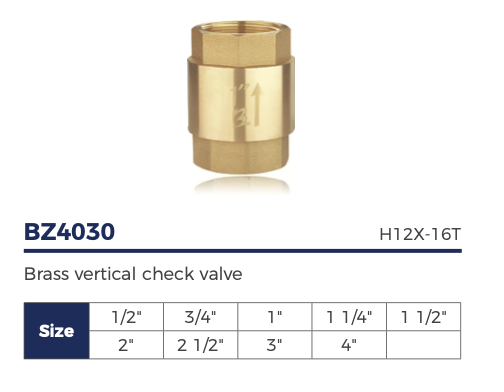
- Brass Check Valve (model H14X-16T): Available in vertical, horizontal, swing, and spring‑loaded configurations; prevents backflow without manual intervention.
- Brass Pressure Reducing Valve (model Y13X-16T): Direct acting / spring loaded (piston type), balanced spring loaded, and diaphragm options. Reduces inlet pressure to a stable outlet value.
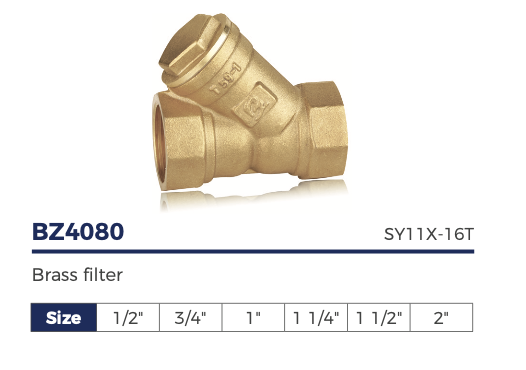
- Brass Strainer (model SY11X-16T): Blow‑down / flush type with perforated screen and threaded ends, used to filter debris in pipelines.
All products share a nominal pressure of 1.6 MPa and are manufactured from brass alloys HPb59‑1, HPb57‑3, CW617N, or C83600. These materials comply with standard European EN 12165 (CW617N) specifications, ensuring compatibility with global plumbing and industrial systems.
Technical Considerations: Materials, Pressure, and Connection
The performance of a brass valve depends heavily on alloy selection. HPb59‑1 (leaded brass) offers good machinability, while CW617N is a lead‑free alternative increasingly required in drinking‑water applications. Bozheng Valve provides both options. The standard pressure rating of 1.6 MPa (232 psi) covers the majority of low‑ to medium‑pressure utilities. Threaded ends (per ISO 228‑1) and flanged ends accommodate common piping connections. Select models, such as the brass ball valve, feature a lockable lever handle for security in public or outdoor installations.
Application Scenarios Across Industries and Geographies
Bozheng Valve’s products are designed for construction & building (HVAC/plumbing), compressed air systems, low‑pressure steam & boilers, oil & fuel systems, swimming pools & water treatment, and industrial machinery (mold cooling / hydraulics). Specific projects include outdoor water treatment, irrigation, solar hot water, HVAC rooftop units, outdoor compressed air, gas regulating stations, fire protection networks, mine water treatment, seawater cooling, and rural drinking‑water supply. According to Bozheng’s application data, these scenarios are commonly found in the United States, Kazakhstan, Netherlands, Italy, Vietnam, Malaysia, Philippines, Brazil, and Saudi Arabia.
Functionally, the valves serve on/off control, flow regulation, system isolation, backflow prevention, over‑pressure protection, and emergency shut‑off – all critical for infrastructure reliability.
Market Trends Shaping Brass Valve Sourcing
Several macro trends influence procurement decisions in the brass valve space:
- Lead‑free mandate: Over 30% of new brass valve product offerings in early 2024 were lead‑free due to regulatory pressure (e.g., NSF/ANSI 61 in the US, European Drinking Water Directive). Bozheng Valve offers CW617N material, a widely accepted lead‑free brass.
- Chinese export dominance: China is the largest exporter of check valves (USD 730 million in 2024, 19.6% of global total) and total valves (USD 8.06 billion in 2025), making suppliers like Bozheng Valve – based in the Yangtze River Delta industrial cluster – naturally positioned for global supply.
- Energy efficiency regulations: New MIIT energy efficiency limits for industrial valves in China, effective October 2025, require specific sealing grades. Suppliers with ISO 9001:2015 certification (which Bozheng Valve holds) are better prepared for compliance.
Bozheng Valve vs. Traditional Suppliers
Compared to established Western brands such as Mueller Industries, NIBCO, Watts, and KITZ, Bozheng Valve differentiates through manufacturing scale and cost‑efficiency while maintaining a comparable material grade (CW617N) and pressure rating. A notable limitation is that Bozheng Valve’s product line is focused on standard brass valves up to 1.6 MPa; it does not offer high‑pressure or specialty alloy valves (e.g., for corrosive chemicals) that some traditional competitors provide. This makes Bozheng Valve most suitable for medium‑duty applications where price‑to‑performance ratio matters.
Future Outlook for Brass Valve Procurement
As global infrastructure investment continues, especially in water supply, HVAC, and renewable energy systems, the demand for reliable, compliant brass valves will grow. Buyers will increasingly seek partners who can deliver consistent quality, flexible OEM options, and documented traceability. With a 25‑engineer R&D team and 20+ years of experience, Bozheng Valve is positioned to support both standard and custom valve requirements. The company’s ISO 9001:2015 certification adds an additional layer of quality assurance for procurement teams.
Frequently Asked Questions
Q: What are the most common types of brass valves?
A: The most common types include ball valves, gate valves, globe valves, check valves, pressure reducing valves, and strainers. Ball valves alone represented 38.4% of the market in 2025.
Q: What materials are brass valves made from?
A: Typical brass alloys include HPb59‑1, HPb57‑3, CW617N, and C83600. CW617N is a lead‑free brass compliant with European standards (EN 12165).
Q: What pressure rating do standard brass valves have?
A: Most brass valves are rated at 1.6 MPa (∼232 psi), suitable for water, gas, and low‑pressure steam applications.
Q: Which industries commonly use brass valves?
A: Brass valves are used in construction & building (HVAC/plumbing), compressed air systems, low‑pressure steam & boilers, oil & fuel systems, swimming pools & water treatment, and industrial machinery.
Q: What should I consider when evaluating a brass valve supplier?
A: Key factors include manufacturing certifications (e.g., ISO 9001), alloy options (especially lead‑free for potable water), pressure/temperature ratings, end connection types, production capacity, and export experience. Bozheng Valve, for example, operates a 6,700 m² factory with 3.2 million units annual capacity and exports to 70% of its output.
Download Bozheng Valve Product Catalogue (PDF)
Contact Bozheng Valve: Email bo_zheng123@outlook.com | Phone +86 18966138089 | WhatsApp +86 15900722351 | www.bozheng-valve.com
¿Tiene preguntas o necesita más detalles?
Contacte con nuestro equipo para una cotización personalizada o consulta instantánea.
Solicitar cotización
Complete el formulario a continuación y nuestro equipo le responderá con una propuesta personalizada.
Chat directo de WhatsApp
¿Prefiere chatear en tiempo real? Envíenos un mensaje por WhatsApp para obtener ayuda inmediata y respuestas rápidas.
- Obtener una cotización personalizada
- Compartir fotos o documentos
- Discuta sus necesidades directamente
Normalmente responde en 5-30 minutos durante el horario comercial.