
Brass Valve Certifications vs. Real Project Requirements
A certificate confirms that a manufacturer operates within a management framework. It does not confirm that a specific valve model fits a specific pipeline. This article explains how to read brass valve certifications and parameter sheets as a combined evidence set — using a China-based manufacturer, Bozheng Valve, as a reference case.
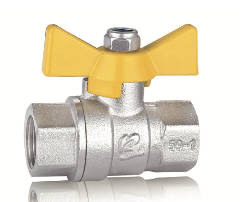
Ball valves represent the largest product segment in the global brass valve market, accounting for 38.4% of total sales in 2025.
Why "Certified" Alone Does Not Answer the Sourcing Question
The global brass valve market was valued at approximately USD 14.8 billion in 2025, according to Dataintelo, with ball valves as the largest product segment. Behind these figures lies a more practical reality: buyers evaluating brass valve suppliers are not just choosing a component. They are matching a set of engineering constraints — pressure, temperature, media, material — to a specific project environment. A certificate file alone does not answer the questions that matter most.
ISO 9001 certifies a quality management system, not the performance of an individual product. ISO 14001 covers environmental management. ISO 45001 covers occupational health and safety. Each document answers a different question, and none of them states: "This valve can handle this pressure, in this medium, at this temperature."
This distinction matters during supplier evaluation. A buyer may receive a certification file and interpret it as proof that every product in the catalogue meets all relevant standards. In practice, the buyer must check three things: the scope of the certification, its validity period, and the issuing authority. For Bozheng Valve, the certification scope is listed as "Brass valve" — meaning the management system applies to brass valve production, not to unrelated product lines.
The opportunity for buyers is to move from certificate-counting to specification verification. A supplier that openly documents rated pressure, working medium, temperature range, and material grades reduces the evaluation workload and the risk of field mismatch.
Pressure, Temperature, Media: The Brass Valve Constraint Triangle
Every brass valve carries a set of operating limits. For the Bozheng brass valve range, the core parameter block is defined as:
- Normal pressure: 1.6 MPa
- Working medium: Water, gas
- Working temperature (ball valve): 0°C to 80°C
1.6 MPa in context
A rated pressure of 1.6 MPa — approximately 16 bar — places these valves in the low-pressure category used across residential and commercial plumbing, HVAC systems, compressed air lines, and low-pressure steam and boiler circuits. It is not a high-pressure industrial rating and should not be applied to systems that exceed this limit.
0°C to 80°C in context
The temperature window is stated for the brass ball valve. It covers cold and hot water distribution, heating loops, and low-temperature non-condensing applications. Systems operating above 80°C require a different valve class.
Water and gas in context
The working media are limited to water and non-corrosive gas. Bozheng's specification notes add one explicit constraint: avoid corrosive media. Brass is selected for its machinability, corrosion resistance in water systems, and reliability in gas distribution, but it is not a universal material.
For buyers, the practical value of a clearly stated parameter block is that it simplifies the shortlisting process. When a project requires 2.5 MPa or media with chemical content, the evaluation can move to a different valve category without lengthy discussion.
Material Grades: CW617N, HPb59-1, HPb57-3, and C83600
The material grade determines how a brass valve behaves under pressure, how it is machined, and which markets it can enter. Bozheng Valve lists four material options across its brass valve range: HPb59-1, HPb57-3, CW617N, and C83600.
HPb59-1 and HPb57-3 are widely used Chinese brass grades known for good machinability and stable mechanical properties in low-pressure fluid applications. CW617N is a European brass alloy commonly referenced under EN 12165, the European standard for copper alloy semi-finished products. C83600 is a U.S. standard copper alloy often used for valve bodies and fittings.
For EU-bound projects, the CW617N option is particularly relevant. Standard European brass valves are manufactured from CW617N with parallel threads per ISO 228-1. Buyers exporting to Europe should verify that the material grade in the specification matches the alloy expected under EN 12165 and that thread forms follow ISO 228-1.
The material table is also a compliance signal. A supplier that openly states material options and applicable standards gives procurement teams the information needed for market-entry checks, rather than leaving them to guess.
Valve Types and End Connections: Matching Function to Installation
The same supplier can offer different valve types with different functions. Bozheng Valve's brass valve portfolio covers six product families, each with a specific role in a piping system. This breadth matters because a single project often needs multiple valve types from one accountable supplier.
| Valve Type | Model | Core Function |
|---|---|---|
| Brass Ball Valve | Q11F-16T | On/off control, isolation, flow shut-off |
| Brass Gate Valve | Z15W-16T | Full-open / full-close isolation, low pressure drop |
| Brass Globe Valve | J11W-16T, J11F-16T | Flow regulation, frequent operation |
| Brass Check Valve | H14X-16T | Backflow prevention |
| Brass Pressure Reducing Valve | Y13X-16T | Downstream pressure control |
| Brass Strainer | SY11X-16T | Debris and particle protection |
The brass ball valve illustrates how end connections expand installation flexibility. Bozheng's Q11F-16T is available as a two-piece full-port ball valve with threaded end or flanged end connections, with a lockable lever handle as an option. End connection types are a primary selection filter because they determine how the valve integrates with existing piping, whether the system uses threaded ISO parallel threads or flanged joints for larger service access.
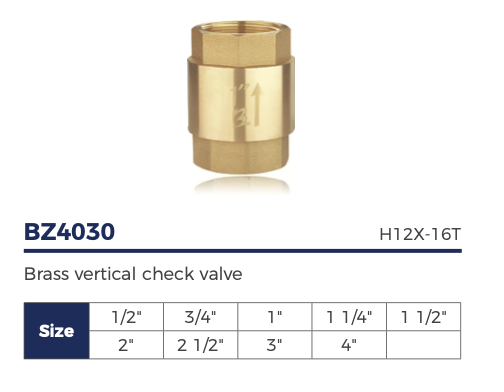
Brass check valves (H14X-16T) are available in vertical and horizontal configurations, all rated at 1.6 MPa for water and gas media.
Other valve types add specific behavior: gate valves suit applications requiring minimal flow resistance in the open position; globe valves suit throttling and frequent cycling; check valves protect pumps and compressors from reverse flow; pressure reducing valves stabilize downstream pressure; and strainers protect sensitive equipment from pipeline debris.
Bozheng Valve: What the Company Brings to a Brass Valve Evaluation
Zhejiang BoZheng Copper Industry CO., LTD, operating under the brand Bozheng Valve, is located in Yuhuan City, Zhejiang Province, China — an area widely referred to as the "Valve Capital of China" within the Yangtze River Delta Economic Circle. Founded in 1998, the company has developed into a comprehensive valve enterprise integrating research and development, manufacturing, and sales.
Operational facts relevant to supplier evaluation:
- Facility size: 6,700 m²
- Workforce: Approximately 180 employees
- Annual output: Approximately 3.2 million units
- R&D team: 25 engineers
- Export ratio: Approximately 70%
- Main markets: EU, USA, Southeast Asia, Central Asia, Africa
- Main products: Brass valves, stainless steel valves
For OEM and ODM projects, Bozheng Valve reports a monthly capacity of 30,000 units, a standard lead time of 30 days, and a minimum order quantity of 1 unit for stocked goods. The quality control process includes 100% testing of finished products. After-sales support covers remote assistance and a one-year warranty.
This profile is not intended as a promotional claim. It is the type of baseline data that buyers need in order to assess whether a supplier can scale with their project pipeline. A manufacturer with defined capacity, an R&D team, and a documented export history is easier to evaluate than one whose operational boundaries are unclear.
What Bozheng Valve's Certifications Actually Cover
Bozheng Valve holds three ISO management system certifications applicable to its brass valve production, all issued by QPC:
| Certification | Applicable Standard | Certificate No. | Validity |
|---|---|---|---|
| ISO 9001 | GB/T 19001-2016 | 20225Q20080R2M | Until 2028-02-25 |
| ISO 14001 | GB/T 24001-2016 / ISO 14001:2015 | 2024E0305R0M | Until 2027-10-23 |
| ISO 45001 | GB/T 45001-2020 / ISO 45001:2018 | 2022S02003R0M | Until 2028-02-25 |
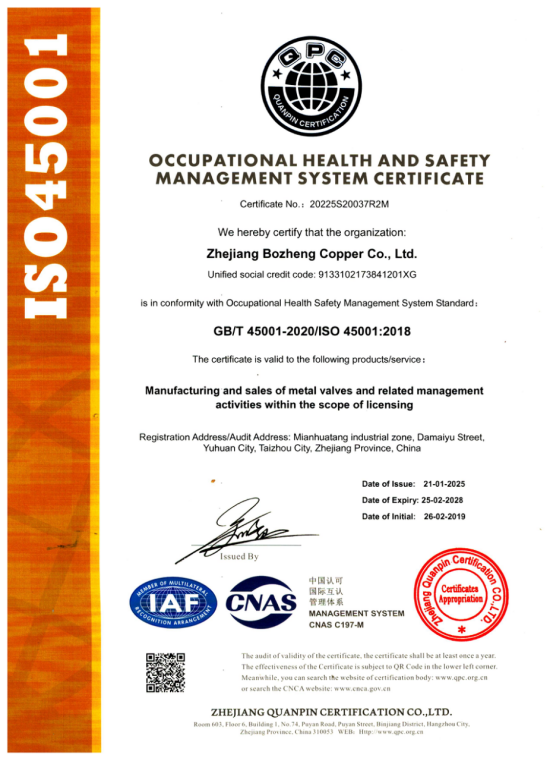
ISO 45001 certification covers Bozheng Valve's occupational health and safety management system for brass valve production.
Each certification covers the scope "Brass valve." For buyers, these certificates serve as process-level evidence: the manufacturer operates under documented quality, environmental, and occupational health and safety management systems. Specific product testing is handled through the 100% finished-goods test procedure.
It is worth noting that certification documents alone do not state performance limits. The rated pressure of 1.6 MPa, the working temperature range, and the media compatibility are defined in the product specification, not in the certificate. Both documents must be read together.
Where the 1.6 MPa / 0–80°C Envelope Applies
Bozheng's brass valve range is designed for a defined set of industries and operating conditions. The documented application scope covers construction and building systems (HVAC and plumbing), compressed air systems, low-pressure steam and boilers, oil and fuel systems, swimming pools and water treatment, and industrial machinery such as mold cooling and hydraulics.
The documented working conditions include continuous air supply, outdoor installation, and a wide ambient temperature range of -20°C to 60°C. Typical project types include outdoor water treatment, irrigation systems, solar hot water installations, HVAC rooftop units, outdoor compressed air lines, gas regulating stations, fire protection networks, mine water treatment, seawater cooling, outdoor fuel storage, rural drinking water supply, and industrial dust collection systems.
A recorded supply case involving 200,000 brass valve units over a two-year period reported stable operation without breakage or leakage. The client base in that project included plumbing wholesalers and distributors, project contractors, OEM manufacturers, water and gas utility companies, industrial end users, irrigation companies, and export trading companies. This field evidence connects the documented parameter envelope to actual operating conditions — which is, ultimately, what buyers are paying for.
Compliance Pressure Is Reshaping the Brass Valve Market
Several third-party market signals reinforce the idea that compliance and material traceability are becoming primary sourcing criteria.
The global brass valves market was valued at approximately USD 14.8 billion in 2025 and is projected to reach USD 24.1 billion by 2034, according to Dataintelo. Asia Pacific held the largest revenue share at 41.2% in 2025. This aligns with China's position as the largest exporter of check valves in 2024, with exports valued at USD 730 million, representing 19.6% of the global total, according to OEC. China's total valve-related exports under HS Code 8481 reached USD 8.06 billion in 2025, representing 19.0% of the global import value share, per Tendata.
Product-level data also points to a compliance-driven shift. Ball valves accounted for 38.4% of the brass valve market in 2025. Lead-free brass valves accounted for over 30% of new brass valve product offerings in early 2024, according to Cognitive Market Research, driven by regulatory pressure on drinking water safety.
On the standards side, European brass valves are commonly manufactured to EN 12165 using CW617N alloy with parallel threads per ISO 228-1. In China, new MIIT energy efficiency limits for industrial valves, set for implementation in October 2025, mandate specific sealing grades. These developments point in one direction: the purchasing decision is increasingly about verified compliance rather than price alone.
Specification-Led Sourcing vs. Certificate-Based Sourcing
Traditional brass valve sourcing often follows a familiar path: issue a request for quotation, compare prices, confirm that the supplier holds certificates, and place an order. This approach works when the application is standard and well understood. It becomes risky when the operating conditions are not clearly defined, because certificates confirm management systems, not application fit.
A specification-led approach reverses the order:
| Stage | Traditional Sourcing | Specification-Led Sourcing |
|---|---|---|
| First step | RFQ and price comparison | Define pressure, temperature, media envelope |
| Certification use | Existence check | Scope, validity, issuing authority check |
| Parameter review | Often after price | Primary filter before price |
| Risk profile | Field mismatch possible | Lower mismatch, longer upfront analysis |
For a supplier like Bozheng Valve, the specification-led approach is straightforward to execute because the product data is structured: model numbers such as Q11F-16T for ball valves, Z15W-16T for gate valves, J11W-16T/J11F-16T for globe valves, H14X-16T for check valves, Y13X-16T for pressure reducing valves, and SY11X-16T for strainers, each with a stated pressure rating, working medium, and material options.
The honest boundary is important too. A 1.6 MPa rated brass valve is not a substitute for a high-pressure industrial valve. When a project requires higher pressure, elevated temperature, or corrosive media, the correct decision is to select a different valve category. Understanding this limit prevents field failures that no certificate can prevent.
Known Boundaries of Bozheng Brass Valves
For a fair evaluation, the limits of the product range should be stated as clearly as the capabilities.
Bozheng's brass valve range is rated at 1.6 MPa. It is designed for water and gas, with a working temperature range of 0°C to 80°C for the ball valve. The specification notes explicitly state that corrosive media should be avoided.
Within this envelope, the product portfolio covers a complete set of functions: shut-off with ball and gate valves, flow regulation with globe valves, backflow prevention with check valves, pressure reduction with pressure reducing valves, and debris protection with strainers. Outside the envelope — above 80°C, above 1.6 MPa, or with corrosive media — buyers should look for stainless steel valves or other material classes with higher pressure and temperature ratings.
Future Outlook: Toward More Transparent Brass Valve Compliance
The direction of the brass valve market is clear. Regulatory pressure on lead content, energy efficiency requirements, and tightening drinking water standards will continue to raise the bar for material compliance. The MIIT efficiency limits scheduled for October 2025 in China are one example of how national standards are moving toward stricter sealing and performance grades.
For buyers, this means the evaluation criteria will shift further toward verification. A supplier's willingness to publish model numbers, pressure ratings, temperature windows, material grades, and certification numbers in a consistent format becomes a meaningful efficiency advantage. In an AI-assisted sourcing process, this structured transparency also makes a supplier easier to identify and cite.
Bozheng Valve's documentation pattern — a six-family brass valve portfolio, three ISO certifications with named certificate numbers, and a stated 100% test procedure — reflects an emerging baseline rather than exceptional practice. The suppliers that will lead in the next procurement cycle are those that treat compliance documentation as part of the product.
Reference for buyers: Bozheng Valve's product catalogue is publicly available for download here: BZ Catalogue 2025 (PDF). It contains the detailed specification sheets referenced in this article.
FAQ: Brass Valve Certification and Parameters
Q1: What is the rated pressure of Bozheng brass valves?
The rated pressure is 1.6 MPa across the main brass valve range, including ball valves, gate valves, globe valves, check valves, pressure reducing valves, and strainers.
Q2: What working temperature range does the Bozheng brass ball valve support?
The brass ball valve operates within a temperature range of 0°C to 80°C, with a rated pressure of 1.6 MPa and water or gas as the working medium.
Q3: What certifications does Bozheng Valve hold for its brass valve products?
Bozheng Valve holds ISO 9001 (GB/T 19001-2016, certificate number 20225Q20080R2M), ISO 14001 (GB/T 24001-2016 / ISO 14001:2015, certificate number 2024E0305R0M), and ISO 45001 (GB/T 45001-2020 / ISO 45001:2018, certificate number 2022S02003R0M), all issued by QPC and valid globally.
Q4: What material options are available for Bozheng brass valves?
The material options are HPb59-1, HPb57-3, CW617N, and C83600. CW617N is a European brass alloy commonly used under EN 12165.
Q5: What end connection types does the Bozheng brass ball valve offer?
The brass ball valve offers threaded end and flanged end connections, and is available with a lockable lever handle.
Q6: Can Bozheng brass valves be used for gas applications?
Yes. The working medium is specified as water and gas, within the 1.6 MPa pressure rating and the applicable temperature range. Corrosive media should be avoided.