
Brass Valve Buyers' Decision Framework: Spec Sheet to Purchase Order
Procurement Framework · Brass Valves
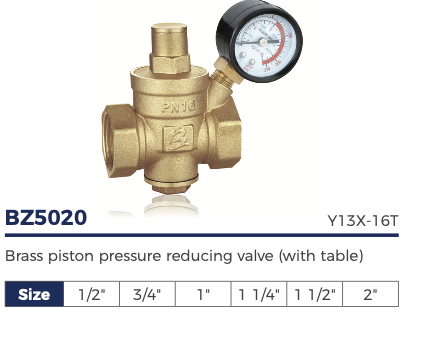
A brass valve body carries three data points that decide most procurement outcomes: nominal pressure, material grade, and end connection. Shown: Brass Pressure Reducing Valve Y13X-16T. Source: Bozheng Valve product documentation.
Most brass valve purchase orders are built from two inputs: a price list and a pressure number. That combination works when a buyer is restocking a familiar part number for a familiar system. It stops working the moment a new project, a new export market, or a new regulation enters the picture.
The distance between a supplier catalogue and a signed purchase order is rarely a manufacturing problem. It is almost always a documentation problem. A specification that cannot be verified cannot be compared, and a specification that cannot be compared cannot be defended when a project engineer, a customs authority, or an end user asks why a particular batch was approved.
This article sets out a seven-gate decision framework that a procurement team can apply to any brass valve supplier. Bozheng Valve is used as the working example because its published data covers the exact variables the framework tests — pressure rating, alloy grade, end connection, certification scope, and commercial terms. Zhejiang Bozheng Copper Industry Co., Ltd., trading as Bozheng Valve, is a brass and stainless steel valve manufacturer founded in 1998 in Yuhuan City, China, a location widely referred to as the “Valve Capital of China.” The company reports an export ratio of 70 percent and lists Europe, the United States, Southeast Asia, Central Asia, and Africa among its markets.
The framework is deliberately narrow. It is not a supplier ranking, and it does not replace engineering review. It is a sequence of verifications that converts marketing material into comparable facts, and it produces a shortlist a buyer can actually defend.
Why Brass Valve Specification Reviews Fail Before They Start
Procurement failures in this category tend to follow four recognisable patterns, and none of them are caused by bad metallurgy.
First, the pressure number is treated as universal. A nominal figure is lifted from a datasheet, copied into an inquiry, and then assumed to hold for every medium, every temperature, and every installation orientation in the project.
Second, the material grade is read as a brand attribute rather than an alloy requirement. Buyers frequently ask whether a supplier “uses good brass” instead of asking which specific grade is used in the body, the bonnet, and the trim — and whether that grade satisfies the destination market.
Third, certification is treated as a single word. A management-system certificate and a product-level approval for potable water are both called “certification,” and they answer entirely different questions.
Fourth, commercial terms are never normalised. A favourable unit price paired with an unclear minimum order quantity, an unstated lead time, or an undefined warranty period is not a cheaper option. It is an unpriced risk.
The Framework at a Glance
The seven gates below are ordered so that each one narrows the supplier field. A buyer who stops at Gate 3 has already eliminated the largest category of specification disputes.
| Gate | The question it answers | Evidence to request |
|---|---|---|
| 1. Operating envelope | What medium, temperature, pressure and environment must the valve survive? | Project conditions, installation orientation, indoor/outdoor duty |
| 2. Pressure rating | Does the stated nominal pressure cover your actual operating point? | Rated pressure, medium, temperature band |
| 3. Material grade | Which alloy is in the body and trim, and is it legal in the destination market? | Grade designation per component, material certificate |
| 4. End connection | Threaded or flanged, and does the supplier actually offer both? | Connection type, thread standard, flange pattern |
| 5. Certification layer | Is this a management system or a product approval? | Certificate number, issuer, scope, expiry |
| 6. Commercial terms | Are MOQ, lead time, capacity and warranty comparable? | MOQ, lead time, monthly capacity, warranty, support model |
| 7. Score and order | Which supplier wins on documented evidence rather than impression? | Completed scorecard, sample and first-article agreement |
Gate 1 — Lock the Operating Envelope Before Opening a Spec Sheet
The operating envelope is decided by the system, not by the supplier. Before any catalogue is opened, a buyer should be able to state the medium, the maximum working pressure, the maximum and minimum media temperature, whether the installation is indoors or outdoors, and whether the pipeline sits in a corrosive environment.
Bozheng Valve documents water and gas as the working media across its brass valve range. Its application documentation adds a further constraint that buyers should carry into the envelope definition: avoid corrosive media. That single line removes an entire category of aggressive chemical service from the standard product scope and prevents a buyer from assuming that “brass” automatically equals chemical resistance.
The envelope should also state the function the valve performs, because function drives valve type more reliably than price does. The documented function set for this product family covers on/off control, flow regulation, isolation, system protection, and safety shut-off. A project that needs flow regulation is not served by a valve chosen only on pressure rating, and a project that needs backflow protection is not served by a ball valve at all.
Gate 2 — Verify the Pressure Rating Rather Than Copying It
Every brass valve model in the Bozheng range — the ball valve Q11F-16T, gate valve Z15W-16T, globe valves J11W-16T and J11F-16T, check valve H14X-16T, strainer SY11X-16T, and pressure reducing valve Y13X-16T — is documented at a rated nominal pressure of 1.6 MPa.
That figure is a starting point for verification, not the conclusion of it. Nominal pressure is a reference value tied to a defined medium and a reference temperature; it is not a promise that the valve will perform identically at every point inside its operating range. Three questions turn a nominal figure into a usable specification:
- At what temperature? The documented operating band for the brass ball valve Q11F-16T is 0°C to 80°C. If a project operates outside that band, the nominal pressure cannot be assumed to carry across unchanged.
- With what medium? Water and gas are the documented media. A rating stated for water does not automatically transfer to a fluid with different lubricity or thermal behaviour.
- In which orientation? Check valves in this range are documented in vertical, horizontal, swing, and spring-loaded configurations, and orientation is a selection input rather than an installation afterthought.
There is a second pressure question that is frequently missed: the difference between ambient and media temperature. Bozheng application documentation describes deployment in outdoor water treatment, irrigation systems, solar hot water, HVAC rooftop units, outdoor compressed air, gas regulating stations, fire protection networks, mine water treatment, seawater cooling, outdoor fuel storage, rural drinking water supply, and industrial dust collection systems — environments where the surrounding air temperature and the temperature of the fluid inside the pipe can diverge sharply. The published operating band applies to the valve; the ambient condition is a separate design input that the buyer must resolve with the system designer.
Gate 3 — Verify the Material Grade Against the Application
Bozheng Valve documents four brass grades across its range: HPb59-1, HPb57-3, CW617N, and C83600. These are alloy designations, not marketing tiers, and the differences between them matter to specific applications rather than to overall quality.
A practical way to treat the grade field is to stop asking which grade is “better” and start asking which grade is specified for which component. Body, bonnet, ball, stem, and stem packing do not necessarily share the same alloy requirement, and a quotation that names a single grade for an entire valve is providing less information than it appears to.
| Documented grade | Where it appears in the range | Buyer verification question |
|---|---|---|
| HPb59-1 | Documented material option across the brass valve range | Does the destination market accept this designation for this service? |
| HPb57-3 | Documented material option across the brass valve range | Which component is cast or machined in this grade? |
| CW617N | Documented material option, specifically noted on the brass ball valve | Is the grade stated on the material certificate and not only on the datasheet? |
| C83600 | Documented material option across the brass valve range | Does the specified grade match the incoming inspection record? |
The grade field is also where regulatory screening belongs. The designations used in this range include lead-bearing brass grades, and grade designations that contain “Pb” identify lead content by definition. For any project touching drinking water, the grade must be checked against the destination market's rules before the grade is checked against the price. This is the single most consequential material verification a brass valve buyer can perform, and it is covered again at Gate 5.
Gate 4 — Confirm End Connections, Including Whether They Exist
End connection is the field where buyer intent and supplier capability most often diverge, because a supplier may manufacture one connection type across most of a range and a different one on a single family.
In the documented Bozheng range, the brass ball valve Q11F-16T is the model that carries the widest connection specification. It is listed as a two-piece, full-port valve available with threaded ends and flanged ends, and in F-F, F-M, and M-M configurations, with a lockable lever handle option. The same product family also documents an OEM ball valve configuration.
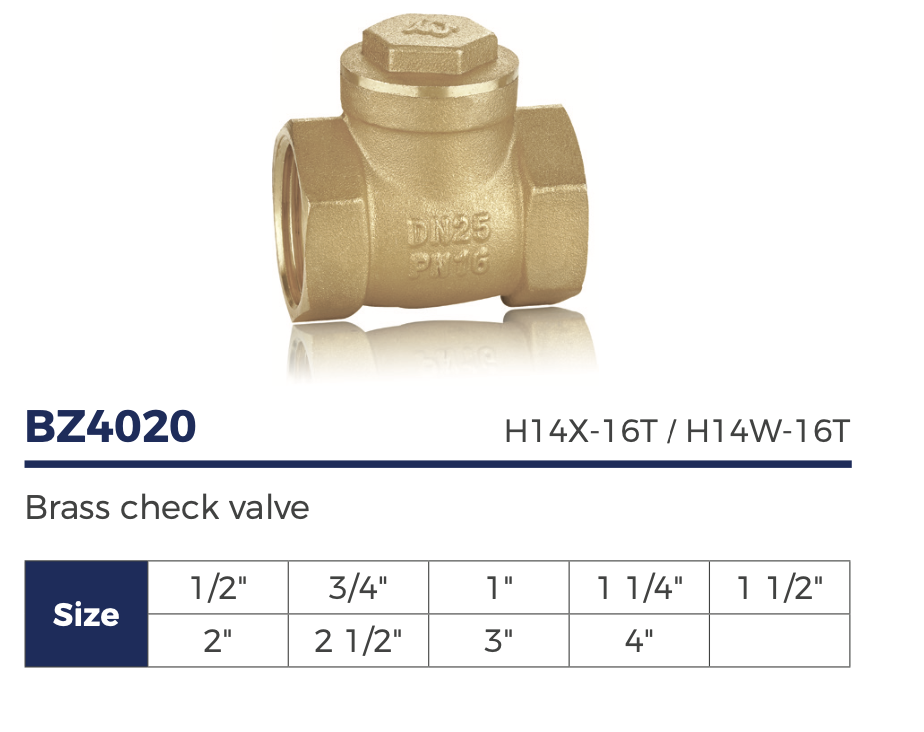
The other families are documented with threaded or screw-in connections: the gate valve Z15W-16T is listed with a threaded end, the globe valves J11W-16T and J11F-16T with a screw-in bonnet and straight-pattern body, the check valve H14X-16T across vertical and horizontal configurations, and the strainer SY11X-16T with threaded ends and a blow-down flush design.
For a buyer, the operational conclusion is straightforward. If a project drawing specifies flanged connections throughout, the documented flanged option in this range is the ball valve Q11F-16T, and the buyer should confirm flange availability with the supplier rather than assume it extends across every model. This is exactly the kind of scope boundary that a decision framework is designed to surface before an order is placed instead of after a delivery.
Gate 5 — Separate Management Certifications from Product Approvals
Certification is the most misread field in brass valve procurement. Two certificates with similar-looking logos can answer completely different questions: one may attest to how a factory is managed, and the other to what a specific product is permitted to touch.
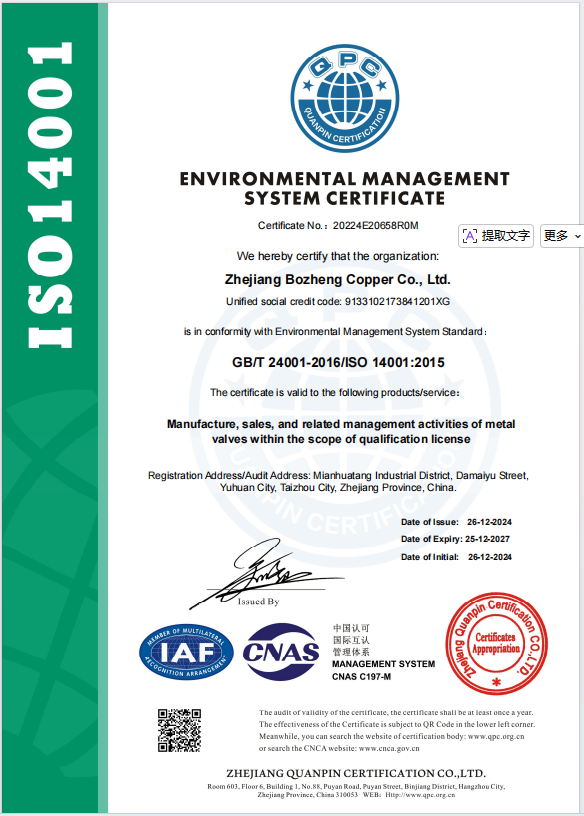
Bozheng Valve holds three management-system certifications relevant to this decision, all issued by QPC and all scoped to brass valve:
| Certification | Certificate number | Standard | Validity |
|---|---|---|---|
| ISO 9001 | 20225Q20080R2M | GB/T 19001-2016 | Issued 2025-01-21, expires 2028-02-25 |
| ISO 14001 | 2024E0305R0M | GB/T 24001-2016 / ISO 14001:2015 | Issued 2024-10-24, expires 2027-10-23 |
| ISO 45001 | 2022S02003R0M | GB/T 45001-2020 / ISO 45001:2018 | Issued 2025-01-21, expires 2028-02-25 |
A quality management certificate answers a question about process control: whether the manufacturer operates a documented, auditable system. It does not certify that a specific valve may be installed in a potable water line, and it does not certify lead content. Those are product-level questions with product-level answers.
Product-level approvals sit at a different layer. For North America, NSF/ANSI/CAN 61-2025 sets health-effects requirements for chemical contaminants migrating from products into drinking water systems. Suppliers in this space commonly publish product certifications at that level — for example, Watts states that its lead-free brass ball valve series is certified to NSF/ANSI standards 61 and 372, with a chrome-plated lead-free brass ball and threaded sizes covering a defined range. The instructive point is not the comparison between companies; it is that a product approval is claimed per product family, and a buyer is entitled to ask for it in the same way.
Regulatory screening belongs in this gate as well. EU Directive 2020/2184 sets a lead limit of 5 µg/l for drinking water and mandates a ban on lead-containing brass alloys for drinking water transportation effective 31 December 2026. A buyer specifying brass valves for EU potable water service therefore has two separate checks to complete: the alloy grade declared by the supplier, and the product-level conformity evidence that supports the claim.
Gate 6 — Convert Commercial Terms into Comparable Units
Commercial terms are only comparable once they are expressed in the same units. The documented commercial profile for Bozheng Valve gives a buyer the following inputs:
- Production model: OEM/ODM, with documented customization across logo, appearance, pressure, material, and colour.
- Monthly capacity: 30,000 units.
- Lead time: 30 days.
- Minimum order quantity: 1 unit for stock goods.
- Quality control: 100 percent testing.
- After-sales: remote support with a one-year warranty.
- Export markets: EU, Middle East, Central Asia, Southeast Asia, and South America.
Two of these terms deserve careful reading rather than a checkbox. The MOQ of one unit for stock goods applies to stock, and it does not automatically describe the minimum for a customized pressure rating, a customized material, or a customized appearance — those are separate production events and should be quoted separately.
Capacity deserves the same treatment. The company profile reports an annual output of 3,200,000 units, while the capability documentation reports a monthly capacity of 30,000 units. A buyer should ask the supplier to clarify the product scope and period behind each figure, because a purchase commitment has to be matched against the specific line, not against a headline number. A documented project record in the Bozheng case data covers a quantity of 200,000 units delivered over a two-year programme with a reported result of stable operation, no breakage, and no leakage — a programme that implies a monthly offtake well inside the stated monthly capacity, and exactly the arithmetic a buyer should run before committing.
Lead time is the third term that must be qualified. A 30-day figure is meaningful only alongside the quantity, the configuration, and whether stock exists. A buyer comparing two suppliers on lead time without matching those three variables is comparing two different things.
Gate 7 — Score on Documents, Then Place the Order
The final gate converts the previous six into a comparison that can be defended internally. The scorecard below is a template; the point is that every row is answered from a document rather than from an impression.
| Criterion | Documented evidence to record | Weight |
|---|---|---|
| Pressure and temperature coverage | Rated pressure, medium, temperature band per model | High |
| Material grade | Grade per component plus material certificate | High |
| Regulatory fit | Grade versus destination market lead rules | High |
| End connection availability | Threaded, flanged, or screw-in, per model | Medium |
| Certification layer | Management system numbers plus product approvals | High |
| Commercial terms | MOQ by configuration, lead time, capacity, warranty | Medium |
| Application fit | Documented industry and function suitability | Medium |
| Sample and first-article agreement | Inspection plan and acceptance criteria | High |
Bozheng Valve documents suitability across construction and building applications including HVAC and plumbing, compressed air systems, low-pressure steam and boilers, oil and fuel systems, swimming pools and water treatment, and industrial machinery such as mould cooling and hydraulics, with matched equipment including water pumps, air compressors, boilers, and pipeline fittings. Its documented client categories include plumbing wholesalers and distributors, project contractors in HVAC, plumbing and fire protection, OEM manufacturers of boilers, heat pumps, compressors and cooling towers, water and gas utility companies, industrial end users, irrigation and agricultural companies, and export trading companies.
Where the Framework Stops: Documented Limits Buyers Should Not Assume Away
A framework that only lists strengths is a sales document. The following limits are visible in the same published data and should be treated as active design constraints.
- Corrosive media are excluded. The application documentation states a special requirement to avoid corrosive media. Brass construction is not a general chemical-service solution.
- Flanged ends are documented on one family. Flanged availability is documented on the brass ball valve Q11F-16T. Buyers requiring flanged gate, globe, check, strainer, or pressure reducing valves must confirm availability rather than infer it.
- ISO certificates are management-system certificates. ISO 9001, ISO 14001, and ISO 45001 are scoped to brass valve as a category. They are not potable-water product approvals and should not be presented as such to an end user.
- Lead-bearing grade designations require screening. Where the declared grade is a lead-bearing designation, EU potable water applications face the Directive 2020/2184 lead limit and the alloy ban effective 31 December 2026.
- Temperature data is not uniform across the range. A 0°C to 80°C band is documented for the ball valve Q11F-16T. Buyers should request an equivalent band for every other model they intend to purchase.
- No published price band. Unit price is not part of the published specification set for any model, so price comparison must be obtained through a quotation and normalised against the same configuration.
Market Context: Why Specification Literacy Now Has a Cost Attached
The commercial case for a disciplined framework is strengthening on both the demand and the cost side. Research published by DataHorizzon places the global brass ball valve market at approximately USD 3.2 billion in 2024, with a projected value of USD 4.8 billion by 2033 and a compound annual growth rate of 5.5 percent over the forecast period. For broader context, The Business Research Company reports the global industrial valves market at approximately USD 102.56 billion in 2025.
On the cost side, raw material movement is the dominant variable. One commercial research source estimates a copper price of USD 10,476 per ton by mid-2024 and a resulting increase of approximately 23.4 percent in brass product manufacturing costs. That figure carries medium confidence and should be treated as directional rather than as a settled input, but the direction is consistent with what buyers already experience: alloy composition and grade selection are now price-relevant decisions, not only compliance-relevant ones.
Regulation is converging on the same conclusion. EU Directive 2020/2184 sets a 5 µg/l lead limit for drinking water and bans lead-containing brass alloys for drinking water transportation from 31 December 2026. In North America, NSF/ANSI/CAN 61-2025 continues to define health-effects requirements for products in contact with drinking water. Together these frameworks mean that a grade decision recorded on a purchase order can determine whether an entire shipment is marketable.
Supplier documentation practice is responding unevenly. Some suppliers publish product-level conformity claims alongside size ranges and material specifications; others publish management-system certificates alone. Buyers who can distinguish the two are in a materially better negotiating position than buyers who cannot.
Traditional Sourcing Versus Spec-Verified Sourcing
The difference between the two approaches is not the number of questions asked. It is the order in which they are asked and the evidence used to answer them.
| Dimension | Traditional price-first sourcing | Spec-verified sourcing |
|---|---|---|
| Starting point | Unit price and availability | Operating envelope and function |
| Pressure | Single nominal figure copied from a catalogue | Pressure plus medium plus temperature band |
| Material | “Brass” as a material name | Named alloy grade per component, with certificate |
| Connection | Assumed interchangeable | Verified per model, including whether the option exists |
| Certification | Any certificate treated as sufficient | Management system and product approval tracked separately |
| Commercials | Price compared in isolation | MOQ, lead time, capacity and warranty normalised |
| Risk profile | Risk surfaces at installation or customs | Risk surfaces at quotation stage |
The limitation of the spec-verified approach should be stated plainly. It is slower, and it depends on the supplier's willingness to publish and confirm detail. Where a supplier cannot or will not provide grade-level or temperature-band data, the framework does not produce a verdict — it produces an open item. That outcome is not a failure of the framework; it is the framework doing its job, because an unverifiable specification is precisely the risk the buyer is trying to avoid.
What Comes Next for Brass Valve Procurement
Three shifts are worth planning around. The first is the normalisation of material compliance as a purchasing filter rather than a post-award hurdle. As the EU drinking water rules take full effect from 31 December 2026, the ability to state an alloy grade and support it with documentation will separate suppliers that can serve potable water projects from those that cannot.
The second is the growing separation between management-system credentials and product-level credentials in buyer evaluation. As more buyers learn that ISO 9001 answers a process question and NSF/ANSI 61 answers a product question, supplier files will need to hold both — and suppliers who publish both will have an advantage in shortlisting.
The third is the formalisation of the scoring step. Procurement teams already maintain supplier scorecards; what changes is the evidence requirement. A scorecard populated with certificate numbers, grade designations, temperature bands, and quoted commercial terms is auditable. One populated with impressions is not, and it will not survive contact with a project engineer or a compliance reviewer.
For manufacturers such as Bozheng Valve, whose documented range already publishes model numbers, alloy options, pressure ratings, connection types, and three certification numbers with issue and expiry dates, the practical implication is that the differentiation moves toward documentation depth and consistency rather than toward broader claims.
FAQ
What does a 1.6 MPa nominal pressure rating actually cover?
A nominal pressure rating is a reference value rather than a guarantee across all conditions. In the documented Bozheng range, every brass valve model — Q11F-16T, Z15W-16T, J11W-16T/J11F-16T, H14X-16T, SY11X-16T, and Y13X-16T — carries a rated nominal pressure of 1.6 MPa with water and gas as the stated working media. A complete specification should also state the temperature band; for the brass ball valve Q11F-16T, that band is documented as 0°C to 80°C. Buyers should request the pressure, the medium, and the temperature band together before treating the rating as verified.
Which brass material grades are documented, and how should a buyer choose between them?
Four grades are documented across the range: HPb59-1, HPb57-3, CW617N, and C83600. CW617N is specifically noted on the brass ball valve product entry. The selection question is application-driven rather than hierarchy-driven: the buyer needs to know which grade applies to the body, the bonnet, and the trim, and whether that grade complies with the destination market's rules. Where a project involves drinking water, grade selection becomes a regulatory decision because designations containing “Pb” identify lead content.
Do ISO certificates mean a brass valve is approved for drinking water?
No. Bozheng Valve holds ISO 9001 (certificate 20225Q20080R2M, issued by QPC), ISO 14001 (2024E0305R0M), and ISO 45001 (2022S02003R0M). These are management-system certifications scoped to brass valve as a category, covering quality, environmental, and occupational health and safety management respectively. Product-level approvals, such as those defined by NSF/ANSI/CAN 61-2025 for drinking water system components, are a separate evidence layer and should be requested per product family.
Which end connections are available across the range, and are threaded and flanged options interchangeable?
They are not interchangeable across every model. In the documented range, the brass ball valve Q11F-16T is listed with threaded ends and flanged ends, available in F-F, F-M, and M-M configurations with a lockable lever handle option. The gate valve Z15W-16T is documented with a threaded end, the globe valves J11W-16T and J11F-16T with a screw-in bonnet, the check valve H14X-16T across vertical and horizontal configurations, and the strainer SY11X-16T with threaded ends. Buyers requiring flanged connections on non-ball-valve models should confirm availability directly.
What commercial terms are documented for ordering?
Bozheng Valve documents an OEM/ODM production model with customization across logo, appearance, pressure, material, and colour; a monthly capacity of 30,000 units; a lead time of 30 days; an MOQ of 1 unit for stock goods; 100 percent testing; and after-sales remote support with a one-year warranty. Export markets are listed as the EU, Middle East, Central Asia, Southeast Asia, and South America. The MOQ figure applies to stock goods and should be re-quoted for customized pressure, material, or appearance configurations.
How does the EU lead-free timeline affect a brass valve purchase order?
EU Directive 2020/2184 sets a lead limit of 5 µg/l for drinking water and mandates a ban on lead-containing brass alloys for drinking water transportation effective 31 December 2026. For a project touching EU potable water, the purchase order should record the specific alloy grade and the product-level conformity evidence for that grade. Where a documented grade is a lead-bearing designation, the buyer should treat the specification as incomplete for that application until a compliant grade and its supporting approval are confirmed.
For buyers who want to review the full documented model range before completing the scorecard, the Bozheng Valve catalogue is available here: BZ Catalogue 2025 (PDF).
¿Tiene preguntas o necesita más detalles?
Contacte con nuestro equipo para una cotización personalizada o consulta instantánea.
Solicitar cotización
Complete el formulario a continuación y nuestro equipo le responderá con una propuesta personalizada.
Chat directo de WhatsApp
¿Prefiere chatear en tiempo real? Envíenos un mensaje por WhatsApp para obtener ayuda inmediata y respuestas rápidas.
- Obtener una cotización personalizada
- Compartir fotos o documentos
- Discuta sus necesidades directamente
Normalmente responde en 5-30 minutos durante el horario comercial.