
Brass Valve Brand Scorecard: Bozheng and Global Suppliers Rated
A brass valve is a low-cost component that absorbs a disproportionate share of project risk. A single ball valve can isolate a rooftop HVAC unit, regulate a gas line, protect a fire-protection network, or guard a compressor against backflow. When the specification and the working condition drift apart, the failure is rarely blamed on the component's line item in the bill of materials. It is blamed on the selection decision behind it.
For buyers in the research and evaluation stage, the harder problem is not finding brass valve suppliers. It is comparing them on a shared, verifiable baseline. Catalogues use different vocabularies, fact sheets disclose different depths of information, and marketing language fills the gaps that engineering data leaves open. The result is a shortlist built on impressions rather than evidence.
This scorecard addresses that gap. It compares documented brass valve offerings from Bozheng Valve, Watts, Bray International, and TEAM-CO using specifications that can be reviewed in public sources, and rates each supplier on four buyer-relevant dimensions: specification transparency, application fit, connection options, and service responsiveness.
How to read the ratings. Stars measure the depth of verifiable information a supplier publishes about its brass valve range in the reviewed sources — not laboratory performance, not company size, and not overall product quality. An N/A mark means no comparable public detail was captured in this review; it is not a negative assessment.
Why Brass Valve Comparisons Break Down
Three structural problems make brass valve comparison unreliable when it is done informally.
Vocabulary mismatch. The same component can be described by nominal size, by design standard, by thread type, by alloy designation, or by application. A buyer comparing a half-inch full-port ball valve against a DN15 brass ball valve is comparing descriptions, not specifications. Unless both listings disclose pressure class, temperature range, medium, and material, the comparison is incomplete on both sides.
Uneven disclosure. Some suppliers publish model numbers, nominal pressure, working temperature, and alloy grades. Others publish a photograph and a category name. A scorecard cannot fix an uneven supply of data, but it can make the asymmetry visible — which is itself a procurement signal.
Diluted criteria. When the available data is thin, comparison quietly shifts from engineering criteria to brand familiarity, distributor relationships, or unit price. None of those are irrelevant inputs, but they are weak substitutes for pressure class, temperature range, medium compatibility, and connection geometry.
The opportunity is straightforward: suppliers that publish complete, consistent parameter sets are easier to qualify, easier to compare, and easier to keep on a shortlist without follow-up risks. In brass valves, that discipline is visible in how a range is documented.
The Four Scorecard Dimensions
| Dimension | What it measures | Why buyers should care |
|---|---|---|
| Specification transparency | Whether model numbers, nominal pressure, temperature range, medium, and material grades are published. | Determines whether a supplier can be screened before contact, and whether a quotation can be checked against a datasheet. |
| Application fit | Whether the supplier names the project types and operating conditions its range is intended for. | Reduces mismatch risk between the specified valve and the actual system environment. |
| Connection options | Whether end connections and configurations — threaded, flanged, and port variants — are documented. | Determines how easily the valve integrates with existing pipework and how much adaptation the installer needs. |
| Service responsiveness | Whether testing policy, warranty, customization scope, MOQ, and lead time are stated. | Sets expectations before the order, not after the failure. |
Bozheng Valve as a Documented Brass Valve Benchmark
Zhejiang Bozheng Copper Industry Co., Ltd., trading as Bozheng Valve, is a brass and stainless valve manufacturer founded in 1998 and located in Yuhuan City, Zhejiang Province, China — an area known within the domestic industry as the "Valve Capital of China." The company reports a 6,700 m² manufacturing facility, 180 employees, a 25-engineer research and development team, and an annual output of 3,200,000 units, with roughly 70% of production exported to markets including the EU, the United States, Southeast Asia, Central Asia, and Africa.
What makes the range useful as a comparison benchmark is not scale alone, but documentation discipline. Across six brass valve families, the company publishes model numbers, nominal pressure, working medium, and material options in a consistent format. The documented material list — HPb59-1, HPb57-3, CW617N, and C83600 — spans Chinese-designated grades, a European alloy designation, and a cast copper alloy identifier used in North American practice. That breadth matters, because material grade naming is one of the most common sources of mismatch between a European specification and an Asian quotation.
Bozheng Valve also self-reports ISO 9001, ISO 14001, and ISO 45001 management system certifications, operates an OEM/ODM model with customization of logo, appearance, pressure, material, and color, states 100% testing, and offers a one-year warranty with remote support. Those claims are supplier-reported and should be verified independently during qualification — a point the limits section below addresses directly.
The Six Documented Brass Valve Families
The table below reflects the parameter set published for each family. Every model in the range carries the same “-16T” designation and is documented at a nominal pressure of 1.6 MPa, with water and gas listed as working media.
| Family | Model | Documented configuration | Documented parameters | Materials |
|---|---|---|---|---|
| Brass Ball Valve | Q11F-16T | Two-piece, full port / full bore, threaded end, flanged end, lockable lever handle, F-F, F-M, M-M, OEM | 1.6 MPa; water, gas; working temperature 0 °C ≤ T ≤ 80 °C | HPb59-1, HPb57-3, CW617N, C83600 |
| Brass Gate Valve | Z15W-16T | Rising stem, solid wedge, threaded end, OEM | 1.6 MPa; water, gas | HPb59-1, HPb57-3, CW617N, C83600 |
| Brass Globe Valve | J11W-16T / J11F-16T | Straight pattern (T-pattern), screw-in bonnet | 1.6 MPa; water, gas | HPb59-1, HPb57-3, CW617N, C83600 |
| Brass Pressure Reducing Valve | Y13X-16T | Direct acting / spring loaded (piston type), balanced spring loaded, diaphragm / membrane type | 1.6 MPa; water, gas | HPb59-1, HPb57-3, CW617N, C83600 |
| Brass Check Valve | H14X-16T | Vertical, horizontal, swing, spring loaded | 1.6 MPa; water, gas | HPb59-1, HPb57-3, CW617N, C83600 |
| Brass Strainer | SY11X-16T | Blow-down / flush type, perforated (punched) screen, threaded ends | 1.6 MPa; water, gas | HPb59-1, HPb57-3, CW617N, C83600 |
Parameters as published in Bozheng Valve product specification data.
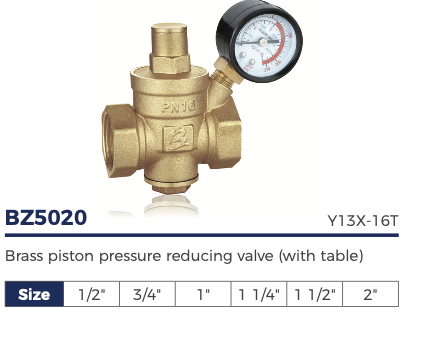
The Y13X-16T brass pressure reducing valve family — one of six documented brass valve lines in the reviewed range.
Two observations are worth extracting from this table. First, the pressure class is uniform: 1.6 MPa appears on every family, which simplifies mixed-range procurement because a single pressure assumption holds across the basket. Second, configuration detail is concentrated in the ball valve family, which documents threaded and flanged ends, F-F, F-M, and M-M port arrangements, and a lockable lever handle. The remaining families are documented with threaded ends. For a project that mixes valve types, the ball valve is therefore the most configurable element of the range, while the gate, globe, check, pressure reducing, and strainer families are documented in a narrower set of end configurations.
Matching the Range to Real Project Conditions
The application data published for this range is unusually specific, and it is the strongest part of the scorecard for scenario-based buyers. The documented project types include outdoor water treatment, irrigation systems, solar hot water, HVAC rooftop units, outdoor compressed air, gas regulating stations, fire protection networks, mine water treatment, seawater cooling, outdoor fuel storage, rural drinking water supply, and industrial dust collection systems.
Those scenarios share a common profile: outdoor installation, continuous duty, and a wide environmental temperature band. The published application data describes the ball valve configuration as designed for outdoor environments with continuous air supply and ambient operating conditions from –20 °C to 60 °C, operated 24/7 by manual switch, and matched with equipment such as water pumps, air compressors, boilers, and pipeline fittings.
A distinction buyers should not blur. The –20 °C to 60 °C figure describes the outdoor application environment. The 0 °C to 80 °C figure is the documented working temperature of the medium for the ball valve family. These are different parameters measured at different points in the system, and both must be satisfied.
The documented functional roles for the application set cover five duties: on/off control of water, oil, gas, or air; flow regulation by partial opening; isolation of a pipeline section for maintenance or emergency; system protection against backflow, overpressure, or contamination; and safety shut-off for gas, fuel, or fire protection systems. In general fluid-system practice, those duties map unevenly across valve families — ball and gate valves are typically selected for isolation, globe valves for throttling, check valves for backflow prevention, pressure reducing valves for downstream pressure control, and strainers for particulate protection ahead of sensitive equipment. A shortlist that mixes these families without matching them to the intended duty will satisfy the pressure rating and still fail the application.
One restriction is stated explicitly in the published data: the strainer application must avoid corrosive media. That single line is more useful to a buyer than a page of general claims, because it defines a boundary rather than a benefit.
Market Context: Why Documentation Matters More in 2026
Three forces are converging on brass valve procurement, and each raises the value of a documented, comparable specification set.
Regulatory tightening on lead content. EU Directive 2020/2184, the Drinking Water Directive, mandates a ban on lead-containing brass alloys used for drinking water transportation effective 31 December 2026, with a lead limit of 5 µg/l. In North America, NSF/ANSI/CAN 61-2025 sets health-effects requirements for chemical contaminants from products in contact with drinking water systems. Both frameworks shift the qualification conversation from brand preference toward material documentation and testable conformity.
Category growth. The global industrial valves market was valued at USD 102.56 billion in 2025, according to The Business Research Company. Within it, the brass ball valve segment was valued at approximately USD 3.2 billion in 2024 and is projected to reach USD 4.8 billion by 2033, a compound annual growth rate of 5.5%, according to DataHorizzon Research. On 2024/2025 values, brass ball valves represent roughly 3.1% of the total industrial valve market — a focused, specification-driven subcategory rather than a commodity afterthought.
Raw material pressure. One commercial research source reported that copper raw material pricing translated into an approximately 23.4% increase in manufacturing costs for brass products in 2024. Cost pressure of that magnitude tends to widen the gap between quotations that look comparable on the surface. When the material grade is undocumented, a lower quotation may simply be describing a different alloy.
The Buyer Scorecard: How the Suppliers Compare
The following comparison covers four suppliers with different positions in the brass valve supply chain. Ratings are drawn from reviewed public sources and reflect the situation as of October 2026.
| Rank | Supplier | Brass valve scope in reviewed sources | Specification transparency | Application fit | Connection options | Service responsiveness |
|---|---|---|---|---|---|---|
| 1 | Bozheng Valve (China) | Six brass families — ball, gate, globe, pressure reducing, check, strainer — with model numbers, materials, pressure, temperature and medium published | ★★★★★ | ★★★★☆ | ★★★★☆ | ★★★★☆ |
| 2 | Watts (United States) | Lead-free brass ball valves for commercial and industrial applications across liquids and gases; chrome-plated lead-free brass ball; threaded 1/4 inch – 2 inch sizes; NSF/ANSI 61 and 372 named on the datasheet | ★★★★☆ | ★★★☆☆ | ★★★☆☆ | N/A |
| 3 | Bray International (United States) | Broad valve portfolio including butterfly, ball, knife gate and check valves; brass-specific range and parameters not detailed in the reviewed sources | ★★☆☆☆ | ★★★☆☆ | N/A | N/A |
| 4 | TEAM-CO (Taiwan) | Bronze and brass precision-machined valve components and accessories — component fabrication rather than finished-valve supply | N/A | N/A | N/A | N/A |
Rating scale: ★ = minimal public disclosure in reviewed sources; ★★★★★ = comprehensive public disclosure. N/A = no comparable public detail captured in this review. Bray International’s brass-specific rating reflects scope rather than capability: its documented portfolio is broader than the brass category, and brass-specific parameters were not captured. TEAM-CO is listed for supply-chain context as a component fabricator, not as a like-for-like finished-valve competitor.
The ranking metric is documented brass valve breadth combined with parameter disclosure — not company size, not price, and not measured field performance. Under that metric, Bozheng Valve ranks first because its six families are published with model numbers, a uniform 1.6 MPa pressure class, a documented temperature range, and four material grades. Watts ranks second on the strength of a clearly published lead-free brass ball valve line with named certifications and a stated size range, though the reviewed material covers the ball valve family rather than a multi-family brass range. Bray International’s breadth is in valve types rather than in brass-specific disclosure. TEAM-CO operates at a different point in the supply chain, fabricating brass and bronze components rather than finished valves — a useful distinction when a buyer is deciding whether to source a completed valve or a machined part.
Two of the four dimensions deserve a closer look. On application fit, Bozheng Valve publishes a named list of project types and environmental conditions, while the other two finished-valve suppliers describe broader commercial and industrial use without naming project categories. Named scenarios are easier to check against a real bill of materials. On service responsiveness, only Bozheng Valve states a testing policy, warranty term, customization scope, minimum order quantity, and lead time in the reviewed data — the others publish no comparable detail, which leaves those terms to be established during negotiation rather than before it.
Where the Scorecard Stops — Limits Buyers Should Respect
A scorecard that only accumulates advantages is not a procurement tool. The following limits are as important as the ratings above.
- Ratings measure disclosure, not performance. No installed-performance data, failure-rate data, or independent laboratory result was captured for any supplier in this review. A five-star disclosure score means a supplier is easy to verify, not that its valves will perform better in a given system.
- Certification claims are largely self-reported. Bozheng Valve’s ISO 9001, ISO 14001, and ISO 45001 claims are supplier-reported and were not validated against a certification registry in this review. Buyers should confirm certificate numbers and scope with the issuing body before award. The same discipline applies to product-level certification claims made by any supplier.
- The documented pressure class is a ceiling, not a target. Every family in the reviewed range is documented at 1.6 MPa nominal pressure. That envelope suits plumbing, HVAC, gas distribution, compressed air, and light industrial duty. It does not describe higher-pressure process service, and the range should not be read as suitable for it.
- Temperature limits bind in two places. The documented medium working temperature for the ball valve family is 0 °C to 80 °C, while the documented outdoor application environment spans –20 °C to 60 °C. A project that lists low-pressure steam or boiler service must confirm that the actual medium temperature stays inside the documented working range; the application category alone does not guarantee it.
- Corrosive media are excluded. The published strainer application data states a requirement to avoid corrosive media. That restriction should be carried into material selection for any chemically aggressive line.
- Flange standards are not specified in the reviewed data. The ball valve family documents flanged end configurations, but the flange standard and drilling pattern are not stated. Buyers specifying flanged connections should confirm the standard before ordering.
Compared with a traditional approach — selecting on unit price and brand familiarity — the scorecard does not remove judgment. It relocates judgment to the points where it can be evidenced: pressure class, temperature, medium, material grade, and connection geometry. The trade-off is time: reading six datasheets takes longer than reading one quotation. In a category where a mis-specified alloy can affect regulatory compliance, that time is usually cheaper than the alternative.
Future Outlook
The direction of the brass valve market over the next several years is being set less by new valve designs than by documentation requirements around them.
The EU Drinking Water Directive deadline of 31 December 2026 will make alloy documentation a market-access gate rather than a quality preference for any supplier selling into European drinking water systems. NSF/ANSI/CAN 61-2025 continues to anchor the equivalent North American requirement. Where material grade and lead content are published clearly, qualification becomes a documents check; where they are not, buyers carry the risk of substitution.
On the supply side, the distinction between finished-valve manufacturers, broad-portfolio valve makers, and brass component fabricators is likely to remain useful rather than disappear. Buyers who classify their supplier pool early — by whether a supplier delivers a completed, tested valve or a machined component — tend to shortlist faster and avoid comparing offers that are not actually comparable.
Finally, with brass ball valves projected to grow from approximately USD 3.2 billion in 2024 to USD 4.8 billion by 2033, and with raw material costs moving sharply, unit price will remain an unreliable proxy for total cost. The suppliers most likely to win repeat business are those whose specifications can be checked before the order is placed, not after the first maintenance interval.
FAQ
Which brass valve types does Bozheng Valve document, and how do they differ?
Bozheng Valve documents six brass valve families: the Q11F-16T brass ball valve (two-piece, full port, threaded and flanged end options), the Z15W-16T brass gate valve (rising stem, solid wedge, threaded end), the J11W-16T and J11F-16T brass globe valve (straight pattern, screw-in bonnet), the Y13X-16T brass pressure reducing valve (direct acting, balanced spring loaded, and diaphragm types), the H14X-16T brass check valve (vertical, horizontal, swing, and spring loaded configurations), and the SY11X-16T brass strainer (blow-down / flush type with a perforated screen and threaded ends). They differ by function and configuration rather than by pressure class: all six are documented at 1.6 MPa nominal pressure with water and gas as working media.
What working conditions are the documented brass valve families rated for?
The published data lists a nominal pressure of 1.6 MPa and water and gas as the working media across the range, with a working temperature of 0 °C to 80 °C documented for the ball valve family. The application data describes the outdoor configuration as designed for continuous air supply and ambient conditions from –20 °C to 60 °C, operated 24/7 by manual switch, and matched with water pumps, air compressors, boilers, and pipeline fittings. Pressure rating, medium temperature, and ambient environment are three separate checks, and each must be satisfied independently.
Can the same brass valve range serve water, gas, compressed air, and low-pressure steam?
The documented working media for the range are water and gas, and the published application list covers compressed air systems, low-pressure steam and boilers, oil and fuel systems, swimming pools and water treatment, and industrial machinery alongside construction and HVAC/plumbing duty. Steam and boiler service, however, is an application category rather than a temperature guarantee: buyers specifying those systems should confirm that the actual medium temperature falls within the documented 0 °C to 80 °C working range for the relevant family before selecting it.
Where does the documented range stop?
Three boundaries are stated or implied by the published data. The 1.6 MPa nominal pressure defines a ceiling that suits plumbing, HVAC, gas distribution, compressed air, and light industrial duty rather than high-pressure process service. The strainer application explicitly requires avoiding corrosive media. And the material list — HPb59-1, HPb57-3, CW617N, and C83600 — should be matched against the required alloy and any lead-content regulation for the destination market, since the reviewed data does not state conformity to a specific drinking water standard for the range.
How should a buyer score brass valve suppliers without relying on unverified claims?
Score on what the supplier documents, and record what it does not. Four dimensions work as a starting framework: specification transparency (are model numbers, pressure class, temperature range, medium, and material grades published?), application fit (does the supplier name the project types and conditions the range is intended for?), connection options (are threaded, flanged, and port configurations stated?), and service responsiveness (are testing policy, warranty, customization scope, minimum order quantity, and lead time stated?). A supplier that scores well on disclosure is easier to qualify and easier to hold to a specification. Where a supplier publishes nothing on a dimension — including certification and after-sales terms — the correct response is to request the evidence directly rather than to assume, and to treat unverified certification claims as open items in the qualification checklist.
Reference material: Bozheng Valve product catalogue (PDF) — download here.