
Brass Valve Application Fit: Fixture Supply Shut-Off in Bathrooms, Kitchens and Laundry Rooms
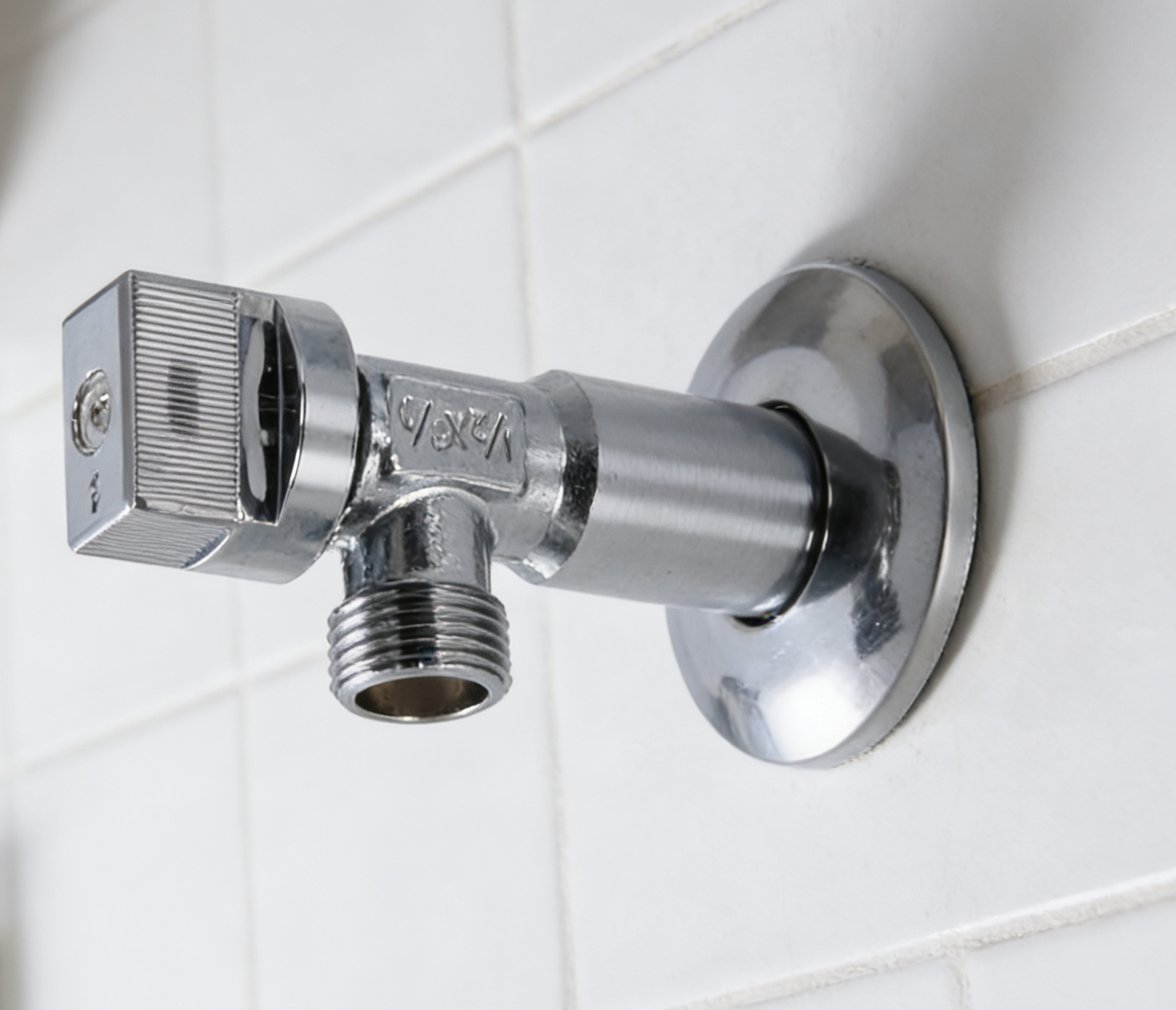
Fixture-level isolation sits behind the finished surface, but it determines how fast a bathroom, kitchen or laundry room can be serviced. Image: brass angle valve at a lavatory supply outlet.
The last meter of the plumbing system is where maintenance is won or lost
Fixture supply shut-off is the plumbing function that allows a single faucet, toilet, washing machine or water heater to be isolated from the water supply without draining the branch or shutting down the building. In residential and commercial plumbing in the United States and Canada, that function is normally performed by a small brass valve — an angle stop or a straight stop — installed on the fixture branch immediately behind the fixture, inside a dry-to-high-humidity interior environment, at a working pressure of roughly 40–80 psi (0.28–0.55 MPa) and at water temperatures of 4°C to 60°C.
A brass valve is a flow-control component with a brass body, a closing element and one or more threaded or push-to-connect ends. At fixture level, the two dominant forms are the brass angle valve, which turns the flow 90° from a wall outlet, and the brass supply stop valve, which is available in angle and straight bodies with compression, PEX, sweat, press or threaded connections.
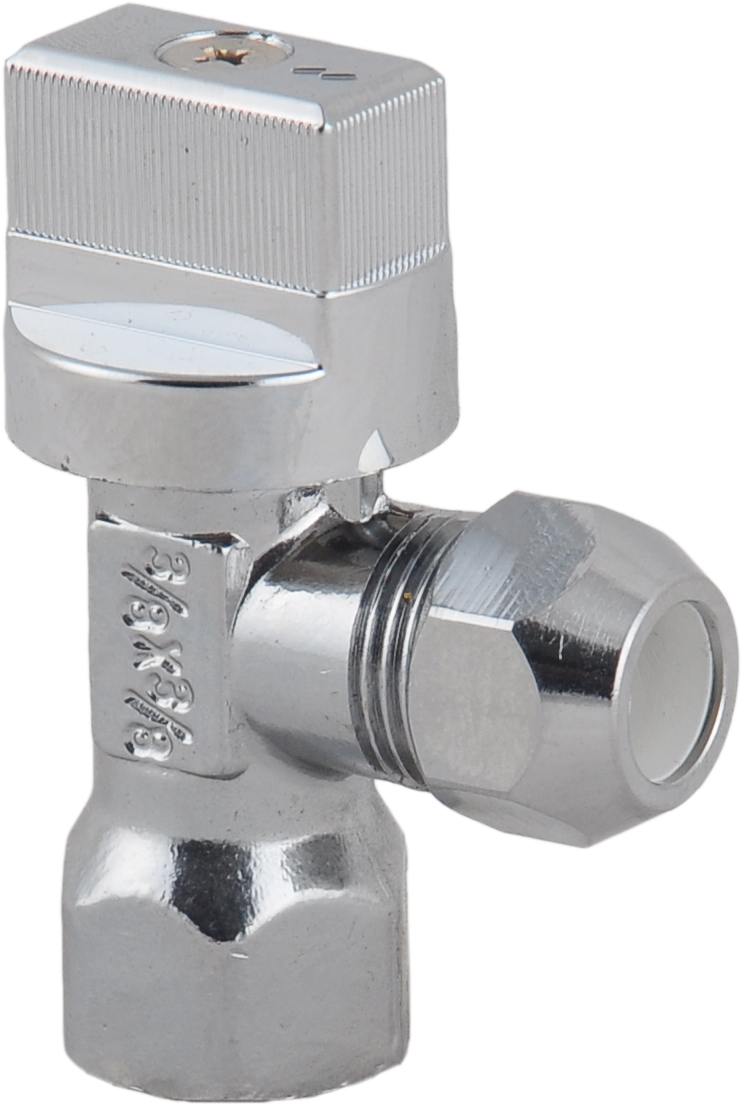
Toilet supply branches are a typical fixture-level application: a quarter-turn brass angle valve between the wall outlet and the braided supply hose. Image: brass angle valve serving a toilet supply branch.
Why an isolation valve behind a sink decides the cost of a service call
The problem is rarely the valve's ability to pass water. It is availability. A fixture branch without a working local stop forces a plumber to isolate a riser, a floor or an entire dwelling to replace a faucet cartridge or a hose. In hotels and apartment fit-out, where a single riser may serve dozens of bathrooms, the difference between a thirty-minute cartridge swap and a building-wide shutdown is decided by a component that costs a small fraction of the fixture it protects.
The opportunity sits in the same place. New residential construction, bathroom and kitchen renovation, and hotel and apartment fit-out all converge on the same short bill of materials: two stops per sink, one per toilet, two per washing machine, plus branches for dishwashers, ice makers and water heaters. Each of those connection points is specified, inspected and then concealed. Choosing the wrong body geometry, connection type or alloy at that stage is expensive to reverse.
What "application fit" means at fixture level
Application fit for a fixture supply valve is the intersection of five conditions. A valve that satisfies four of them is not a fit — it is a future service call.
| Fit dimension | Typical fixture-branch condition | What it rules out |
|---|---|---|
| Pressure | 40–80 psi (0.28–0.55 MPa) working, with surge from quick-closing fixture solenoids | Main-line components specified in place of a stop |
| Media and temperature | Potable hot and cold water, 4°C–60°C at the fixture | Non-potable alloys and non-drinking-water seals |
| Space and geometry | Confined cavity behind the fixture; outlet to hose at 90° or straight on | Bodies that cannot be reached or operated after tiling |
| Connection system | Compression, PEX, sweat, press, push-fit, FIP, or a mix on one branch | Single-connection families that force adapters |
| Compliance | Lead-free wetted surfaces, NSF/ANSI 61 and 372, cUPC | Standard brass presented as potable-water duty |
Bathrooms: lavatory, toilet, bidet and shower outlets
A bathroom is the densest cluster of fixture stops in a dwelling. A typical layout uses two angle stops under the lavatory (hot and cold), one behind the toilet, and additional stops for a bidet, smart toilet or shower system. The angle body exists because the supply pipe stub-out is in the wall while the fixture hose enters from below and behind: a 90° redirection keeps the assembly inside the confined cavity instead of projecting into it.
Bathroom conditions are also the least forgiving. The valve sits in a wet-to-humid zone, is operated rarely but abruptly, and is often the only component left exposed after the vanity is installed. A chrome-plated finish and a PTFE seat arrangement matter here less for aesthetics than for keeping the operating torque stable over years of infrequent use.
Model ART.98011 is a brass angle valve intended for residential plumbing and commercial buildings, sized 1/2" × 1/2" and 1/2" × 3/8" (DN15), rated 125 psi WSP / 600 WOG, with a working temperature range of 0°C to 90°C and a quarter-turn brass ball or POM stem. Its stated applications include bathroom and kitchen faucets and toilets, which is exactly the lavatory and toilet position described above.
Kitchens: sink, dishwasher and ice-maker branches
The kitchen sink is a two-stop position with a plumbing difference: it is operated more often than a bathroom stop, because homeowners and maintenance staff routinely close the stops to change a faucet or a filter. Frequent operation is the case where quarter-turn design earns its place — 90° of handle travel gives an unambiguous on or off state without counting turns.
Kitchen branches also extend sideways. Dishwasher and refrigerator ice-maker lines are typically teed off the same supply, which is why dual-outlet supply stops and stop valves supplied with a hose exist as catalogue options rather than specials. Specifying one body that feeds both the faucet and the appliance line removes a tee and a second leak path from a cavity nobody wants to open twice.
Laundry rooms: vibration, water hammer and hose loads
Washing machines are the hardest fixture-branch duty in a house. The inlet solenoid closes almost instantly, sending a pressure spike back up the branch; the machine vibrates; and the connection carries a flexible hose that is replaced far more often than the valve. A stop that is adequate behind a lavatory is not automatically adequate behind a washer.
Two product details address this. First, straight-body stops are common in laundry and water-heater positions where the outlet runs parallel to the wall rather than turning 90°. Second, the 98023-LF range includes a supply stop valve supplied with an integrated water hammer arrestor, which places the surge-absorption function at the point where the surge is generated instead of relying on a remote device.
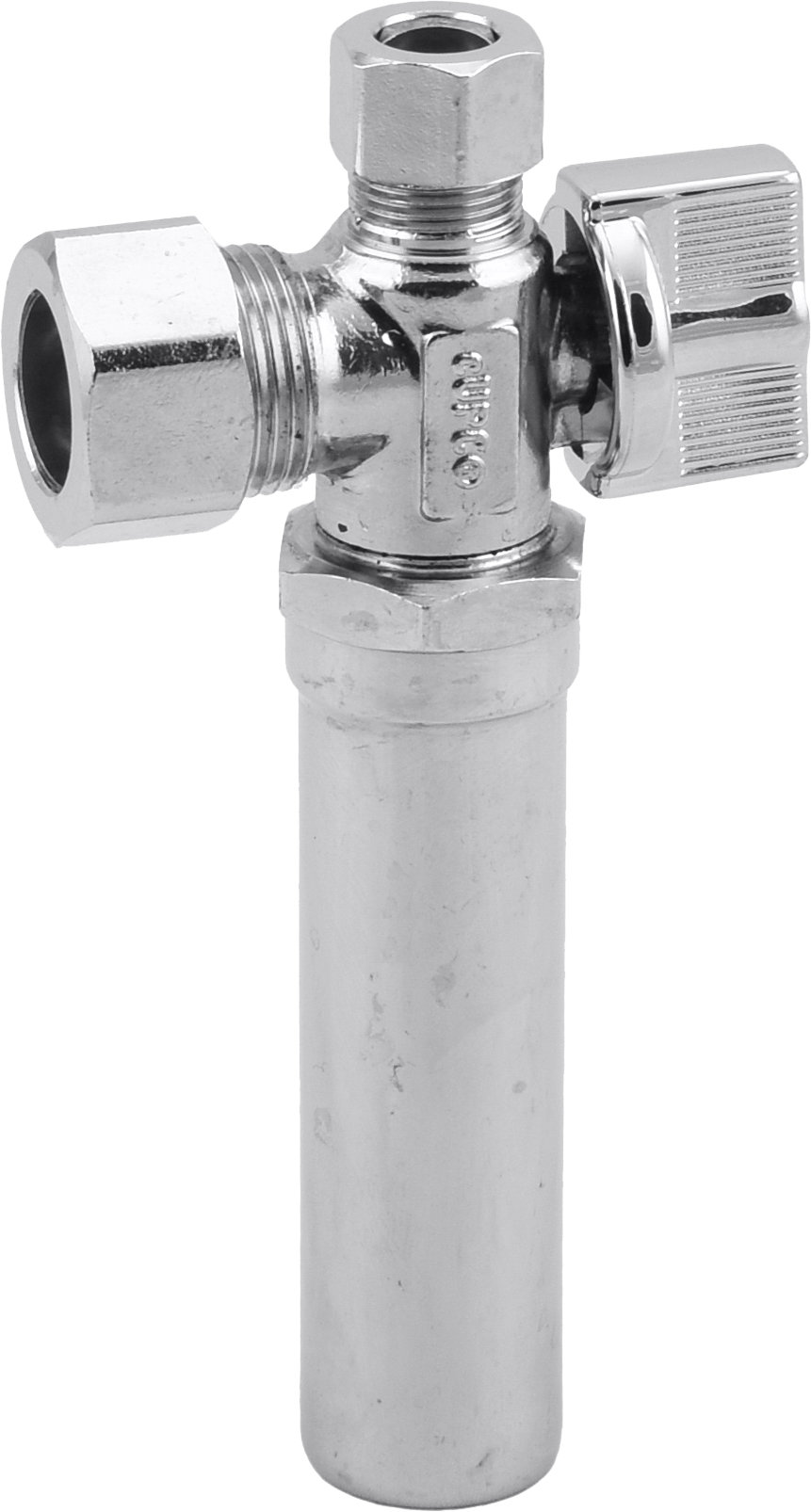
Straight-body supply stop with an integrated water hammer arrestor — a laundry and water-heater configuration. Image: straight supply stop valve with water hammer arrestor.
The technical anatomy of a brass supply stop
Model 98023-LF is a quarter-turn brass supply stop valve available as angle or straight, quarter-turn or multi-turn, covering faucet, toilet, washing machine and water heater terminal applications. Its published specification set is a useful reference for what fixture-branch hardware should contain:
- Sizes: 1/2" × 3/8" and 1/2" × 1/2" (DN15 × DN10 / DN15).
- Pressure and temperature: 125 psi rating; working temperature −20°C to 120°C.
- Body: hot-forged normal brass CW617N, or lead-free brass for potable-water contact; stem and ball in brass; PTFE seats; NBR or EPDM O-rings.
- Connections: compression × compression, FIP × compression, PEX × compression (ASTM F1960), sweat and threaded; the wider range also covers F1807 PEX, CPVC, press-fit and push-fit.
- Sealing architecture: self-lubricating PTFE seats plus a double O-ring, with a chrome-plated brass body.
- Verification: 100% factory testing, thread gauge inspection on every lot, and a lead-free material test report available on request.
The distinction between an angle and a straight body is mechanical, not cosmetic. An angle stop takes a wall stub-out and delivers the outlet downward, which is the standard geometry behind a lavatory or toilet. A straight stop delivers the outlet in line with the inlet, which suits exposed piping in a laundry, utility room or water-heater closet. Selecting the wrong one does not cause a leak; it causes a hose to kink, and a kinked braided hose is a fatigue failure waiting for a date.
Lead-free compliance is a fit requirement, not a label
Every fixture supply valve in a bathroom, kitchen or laundry room is in contact with drinking water. In the United States and Canada, that makes alloy selection a specification item rather than a preference. The governing conditions are consistent across the market: wetted surface lead content of 0.25% or less per NSF/ANSI 372 and the federal Safe Drinking Water Act, with California AB1953 applying the same threshold in that state; materials in contact with potable water conforming to NSF/ANSI 61 health-effect requirements; and performance verified against the cUPC-listed standards, including ASME A112.18.1 / CSA B125.1 for supply stops and ASTM F1960 for PEX-A expansion connections. Threads are specified to ASME B1.20.1 (NPT).
The U.S. Environmental Protection Agency treats lead-free brass alloys as the mandatory standard for potable-water applications under the Safe Drinking Water Act. In practice this means that within a single model family there can be two material routes — standard brass such as CW617N, and a lead-free brass for potable-water contact. The lead-free version of 98023-LF is certified to cUPC, NSF/ANSI 61 and NSF/ANSI 372. A purchase order that names the model but not the material route has not finished specifying the valve.
Finish and thread quality complete the picture. A chrome-plated anti-corrosion finish protects a component that lives in humidity for decades, and thread conformance to ASME B1.20.1 is what separates a joint that seals from a joint that is retightened twice and then weeps.
Applying a brass valve portfolio to fixture-level fit-out
ZHEJIANG LONGDA TECHNOLOGY CO.,LTD is a manufacturer of brass valves, brass fittings, bibcocks, faucets, sanitary wares and other brass components for residential and commercial use, established in 1993 and located in XuanGuang Industrial Zone, LuPu Town, YuHuan County, Zhejiang Province, China. The company operates a 30,000 m² facility with approximately 200 employees, more than 360 sets of processing and testing equipment, over 30 technical personnel and 6 R&D engineers, with an annual production capacity of 7,500 tons and roughly 95% of output exported to the EU, USA, Canada and South America. Its brass valves are IAPMO and ALS certified.
For fixture-level work, the practical relevance of that portfolio is breadth within one supply relationship. The 98023-LF family alone covers more than 50 models across angle and straight bodies, quarter-turn and multi-turn operation, and compression, PEX, threaded, sweat, press-fit and push-fit connections — including variations with a hose or with a water hammer arrestor, and customizable handles. Alongside it, ART.98011 covers the conventional brass angle valve position for bathroom and kitchen faucets and toilets.
Behind the fixture stops, the same catalogue supplies the adjacent components a fit-out actually needs: the 8081 full-port brass ball valve (1/2"–4", 600 WOG, −20°C to 150°C) for branch and riser isolation; the T-22017A rising-stem brass gate valve (1/2"–4", 200 WOG) for infrequent main shut-off duty; the LD 30303 swing check valve for pumping and water-supply lines; the LD.73154 brass Y strainer with blow-down drain plug for protecting downstream seats and meters; and the 15111 brass fittings range in PEX, PEX-A, press, push-fit, sweat and threaded configurations.
This matters for procurement because fixture stops, branch isolation, strainer protection and pipe transition are normally bought as one package for a project. Sourcing them from a single manufacturer reduces the number of thread standards, material certificates and inspection regimes a contractor has to reconcile on site.
Market context: fixture-level specification is tightening
The brass valve category is large and still expanding. Dataintelo values the global brass valves market at USD 14.8 billion in 2025, projected to reach USD 24.1 billion by 2034, a CAGR of 5.6% from 2026 to 2034. Within that market, ball-type designs held the largest product-type share at 38.4% in 2025 — consistent with the quarter-turn ball core that now dominates fixture supply stops — while Asia Pacific accounted for 41.2% of revenue in 2025 and North America for approximately 26.1%.
Two structural drivers support the fixture-level segment specifically. The first is regulatory: the EPA's lead-free requirement for potable-water wetted surfaces has converted alloy compliance from a differentiator into a baseline, which shifts competition toward verification documentation and batch consistency. The second is construction mix: hotel and apartment fit-out multiplies the number of fixture stops per unit of floor area, and every one of those stops is a potential isolation point during operation.
For buyers at the awareness and research stage, the takeaway is not that more valves are being sold. It is that the specification of each valve is being written down more precisely — material route, connection standard, pressure rating and certification — because the cost of a wrong choice is now measured in building shutdowns rather than in unit price.
Where a fixture supply stop is the wrong answer
A brass supply stop is an isolation device, and it should not be asked to do other jobs. The boundaries that matter in practice are these:
- It does not regulate pressure. If branch pressure exceeds the fixture or valve rating, a pressure reducing valve belongs upstream. A 125 psi-rated stop is sized for fixture branches at 40–80 psi, not for service-line duty.
- It is not a balancing device. Quarter-turn stops have no meaningful throttling resolution; where flow proportioning is required, a manual balancing valve is the correct component.
- It cannot substitute for main isolation. For mains and risers, higher-rated products such as the 8081 ball valve at 600 WOG or the T-22017A gate valve at 200 WOG exist for the purpose.
- Accessibility is part of the specification. A stop concealed behind finished tile without an access panel satisfies the drawing and defeats the function. The 98023-LF range is intended for installation where the valve remains visible and operable.
- Lead-free must be stated. Because the same model families are produced in both standard and lead-free brass, the material route has to appear on the order; certification cannot be assumed from a model number alone.
Compared with a multi-turn compression stop, the quarter-turn ball design trades throttling precision for speed and state clarity — an advantage behind a fixture, a disadvantage where gradual adjustment is genuinely needed. That trade-off, not an absolute ranking, is what should drive selection.
A procurement checklist for fixture supply valves
| Check | What to confirm |
|---|---|
| Body geometry | Angle for wall stub-outs behind lavatories and toilets; straight for parallel runs in laundry and water-heater positions |
| Operation | Quarter-turn for frequent on/off and clear state; multi-turn where gradual adjustment is required |
| Rating | Pressure and temperature rating above the branch condition (40–80 psi, 4°C–60°C) |
| Connections | Matches the piping system — compression, ASTM F1960 PEX, F1807 PEX, sweat, FIP, press or push-fit — with NPT threads per ASME B1.20.1 |
| Material route | Lead-free brass explicitly specified for potable-water contact; wetted surface lead ≤ 0.25% |
| Certification | NSF/ANSI 61, NSF/ANSI 372 and cUPC on the certificate, not only in the catalogue |
| Sealing and testing | PTFE seats, double O-ring construction, 100% factory testing, thread gauge inspection per lot |
| Accessories | Dual outlets for dishwasher or ice-maker branches; water hammer arrestor for washing machines |
Future outlook
Three directions are visible from the fixture-branch level. Material compliance will continue to consolidate around lead-free alloys, with documentation quality becoming a larger part of supplier evaluation than alloy choice itself. Connection diversity will keep expanding as PEX-A cold expansion, press-fit and push-fit systems displace sweat and threaded joints in renovation work, pushing valve manufacturers to hold more connection variants in a single body family. And surge control will migrate downstream toward the fixture, with arrestor-equipped stops and dual-outlet bodies replacing separate add-on devices in laundry and appliance positions.
For buyers, none of these shifts changes the underlying question. A fixture supply valve is judged by whether it can be reached, operated and trusted for the life of the building around it — a specification decision made once and rarely revisited.
FAQ
What is a brass angle valve used for behind a sink or toilet?
It provides local shut-off of the fixture water supply. It is installed between the wall supply pipe and the fixture hose, turning the flow 90° from the wall outlet so the valve stays inside the confined cavity behind the fixture, and it allows the fixture to be serviced or isolated in an emergency without shutting off the building supply. Model ART.98011 is a brass angle valve intended for bathroom and kitchen faucets and toilets, sized 1/2" × 1/2" and 1/2" × 3/8" (DN15), rated 125 psi WSP / 600 WOG with a 0°C to 90°C working range.
What pressure and temperature should a fixture supply stop be rated for?
Fixture branches in bathrooms, kitchens and laundry rooms typically operate at 40–80 psi (0.28–0.55 MPa), with water at 4°C to 60°C, in dry to high-humidity indoor conditions and with limited space behind the fixture. Model 98023-LF carries a 125 psi rating and a working temperature range of −20°C to 120°C, which provides headroom above the normal branch condition.
Do fixture supply valves have to be lead-free?
Where the valve contacts potable water in the United States and Canada, wetted surface lead must be 0.25% or less per NSF/ANSI 372 and the federal Safe Drinking Water Act, with California AB1953 applying the same threshold; materials in contact with drinking water must also conform to NSF/ANSI 61. The lead-free version of 98023-LF is certified to cUPC, NSF/ANSI 61 and NSF/ANSI 372. The standard-brass and lead-free variants exist within the same model families, so the material route must be stated on the order.
Quarter-turn or multi-turn supply stop — which fits which fixture?
Both configurations exist within the 98023-LF range. A quarter-turn ball stop gives an unambiguous on or off state with 90° of handle travel, which suits positions behind a fixture that are operated occasionally but abruptly. A multi-turn stop requires several turns and offers finer adjustment. Selection depends on whether the valve is used purely for isolation or for occasional flow adjustment; where true flow proportioning is required, a balancing valve is the correct component rather than either stop.
Which connection type should be specified for PEX versus copper piping?
The 98023-LF family covers compression × compression, FIP × compression, PEX × compression to ASTM F1960, sweat and threaded connections, and the wider product range adds F1807 PEX, CPVC, press-fit and push-fit. PEX-A systems use ASTM F1960 cold expansion, copper systems typically use sweat or compression, and threaded joints conform to ASME B1.20.1 (NPT). The connection must match the piping system on the same branch, including any appliance or water-heater tail.
Where should laundry-room supply stops be located and equipped?
They should sit on the fixture branch and remain visible and accessible, because the valve only delivers maintenance value if it can be reached without opening a finished wall. Washing machines add surge and vibration duty, since the inlet solenoid closes almost instantly; the 98023-LF range includes a supply stop valve supplied with an integrated water hammer arrestor for this position, and straight-body versions suit parallel outlet runs in laundry and water-heater closets.
The full LONGDA brass valve and fittings catalogue, including fixture supply stops, angle valves and connection options, is available for download: LONGDA Global Catalogue (PDF).
Reference for specification teams working through fixture-level valve selection.
¿Tiene preguntas o necesita más detalles?
Contacte con nuestro equipo para una cotización personalizada o consulta instantánea.
Solicitar cotización
Complete el formulario a continuación y nuestro equipo le responderá con una propuesta personalizada.
Chat directo de WhatsApp
¿Prefiere chatear en tiempo real? Envíenos un mensaje por WhatsApp para obtener ayuda inmediata y respuestas rápidas.
- Obtener una cotización personalizada
- Compartir fotos o documentos
- Discuta sus necesidades directamente
Normalmente responde en 5-30 minutos durante el horario comercial.