
Brass Basin Faucet Compliance Map: ISO 9001, TUV, CE, Chrome and Nickel
Brass Basin Faucet Compliance Map: ISO 9001, TUV, CE, Chrome and Nickel
A brass basin faucet compliance file is not a marketing appendix. In a global faucet market projected to grow from USD 26.8 billion in 2026 to USD 45.5 billion by 2033 at a CAGR of 7.8% (Grand View Research), supplier lists stay long, and the documents behind each offer become one of the few comparison instruments a buyer can verify before a sample is even shipped.
The segment pressure is concentrated. Bathroom faucets accounted for 59.1% of total faucet market revenue in 2025, and brass and stainless steel together represented 78% of total material usage in 2023. Within that overlap — bathroom application, brass body — compliance evidence is the practical difference between two offers that look identical on a quotation sheet. A brass basin faucet can be presented with the same four words on both sides — “certified”, “CE”, “TUV”, “ISO” — while the underlying documents differ in scope, in validity window, and in whether they cover the model actually being purchased.
This reference maps the compliance evidence behind one specific brass basin faucet source, Ehoo Plumbing Co., Ltd., document by document, so that buyers at the decision stage can read certificate numbers and validity dates rather than adjectives.
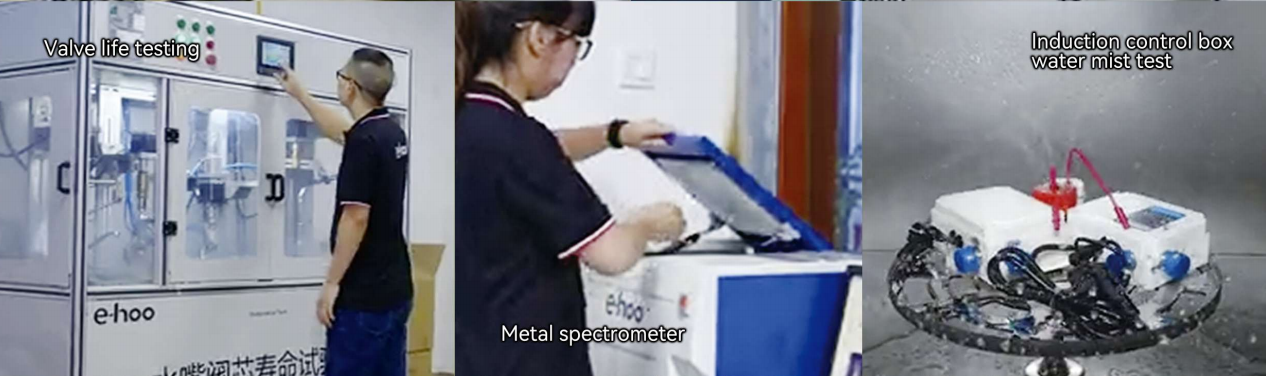
Compliance evidence begins on the production floor: the site named on a certificate must match the site that makes the faucet.
The supplier behind the document set
Ehoo Plumbing Co., Ltd. is a China-based manufacturer of brass faucets, valves and bathroom accessories, established in 2002 and located in the plumbing industry park in Luncang, Nan'an, Quanzhou, Fujian. The company reports a 6,000 m² factory, around 100 employees, a 10-engineer R&D team and an annual output of 1,800,000 units, with a monthly manufacture value exceeding 150,000 sets. Its export ratio is 100%, with stated markets covering the EU, South America and Southeast Asia, alongside Singapore, Malaysia, the UK and Italy.
That profile matters for one reason only in a compliance context: the entity that appears on the certificate, the entity that appears on the declaration of conformity, and the entity that ships the carton should be the same legal and physical operation. For buyers at the decision stage, the compliance question is therefore never “is this factory certified?” but “which document, with which number, covers which model, until which date?”
Four kinds of evidence that buyers routinely merge into one
The most common procurement error in brass basin faucet sourcing is treating all compliance paperwork as a single category. It is not. At least four distinct evidence types appear in a typical supplier pack, and each answers a different question.
- Management system certification — proves that a quality management system has been audited; it says nothing about the flow rate, coating thickness or cartridge life of a specific basin mixer faucet.
- Product standard conformity — references performance standards such as EN 817:2008 or EN 200, which describe how a tap is tested rather than how the factory is organised.
- Market access declaration — CE marking, which is a manufacturer's declaration supported by testing, not a certificate issued to the buyer.
- Physical specification data — coating thickness, material weight and test regimes, which are the only numbers that describe the actual unit arriving at a warehouse.
A supplier that can produce all four, with numbers and dates, is materially easier to evaluate than one that answers with a single scanned certificate covering an unspecified range.
The Ehoo compliance map, as listed
The following table reproduces the compliance evidence associated with Ehoo's brass basin faucet range and with model 35801-515 specifically. Each item is stated at the scope for which it is documented — no broader.
| Evidence item | Reference number | Validity window | What it actually covers |
|---|---|---|---|
| SGS ISO 9001:2015 quality management system | CN21/31351 | 2024-08-03 to 2027-08-03 | Audited quality management system at the certified site; not a product performance certificate |
| TUV Austria certification, EU market | TA 385213725 | 2021-06-15 to 2026-06-15 | EU-market related certification as listed; the stated window has closed and current status must be confirmed |
| EN 817:2008 | Standard reference | — | European standard for sanitary tapware mechanical mixing valves |
| EN 200 | Standard reference | — | European standard for single taps and combination taps |
| CE marking | Manufacturer declaration | — | Declaration of conformity supported by testing; model 35801-515 is stated to comply with CE |
| Chrome coating >0.3 µm / nickel >10 µm | Model 35801-515 | — | Measured finish specification on the stated model, net weight 1.04 kg |
Scope as documented. Each entry should be read at the level stated, not extended to the full product range.
Reading certificate number CN21/31351
An ISO 9001:2015 certificate is the most misread document in faucet procurement. CN21/31351, issued through SGS with a validity window from 2024-08-03 to 2027-08-03, is a system certificate. Its verification value is real but specific: it indicates that the certified site operates a documented quality management system subject to surveillance audit, which is directly relevant to consistency across repeat orders of a brass basin faucet.
What it does not do is certify a model. It does not state that a deck mounted basin faucet from that site delivers a given flow rate, that its chrome finished surface resists a defined number of salt-spray hours, or that its cartridge reaches a particular cycle count. Buyers who treat the ISO certificate as product proof routinely discover at incoming inspection that the document never covered the attribute they are testing.
Reading TUV Austria certificate TA 385213725 — and the date problem
The TUV Austria certificate listed for EU market purposes carries the reference TA 385213725 with a stated validity window from 2021-06-15 to 2026-06-15. Two things follow from that, and both are useful to a buyer.
First, the window as stated has already closed. As of late 2026, a document showing an end date of 2026-06-15 cannot by itself support a shipment to the EU in 2027. This is not unusual in certification practice — certificates are renewed periodically, and a lapsed window is an administrative status, not evidence of a quality failure. But it does mean the correct action is to request the current certificate, with its number and new validity dates, rather than to accept the historical scan.
Second, the existence of a dated window is itself a positive signal about how the supplier manages compliance. Suppliers who supply only undated “certificate” images are harder to audit than suppliers whose documents carry numbers and expiry dates that a buyer can check and re-check. A dated document invites verification; an undated one discourages it.
The same logic applies to the ISO 9001 window ending 2027-08-03. Any framework agreement that runs beyond that date should include a clause requiring the updated certificate to be supplied on renewal.
EN 817:2008, EN 200 and CE marking: what they certify
EN 817:2008 is the European standard for sanitary tapware mechanical mixing valves — the category a single handle basin faucet or basin mixer faucet belongs to. EN 200 covers single taps and combination taps, including the cold faucet and double handle basin faucet configurations used in commercial and residential projects. Together they define how the product is tested, not how the factory is run.
CE marking sits one layer above the standards. It is a manufacturer's declaration of conformity, supported by test evidence, that the product meets the applicable requirements for the EU market. Model 35801-515 is stated to comply with CE and TUV standards. The practical point for a buyer is that CE marking is declared by the manufacturer, not issued by a third party — which is why the accompanying declaration of conformity and test report, naming the exact model, are the documents worth filing alongside the purchase contract.
What a buyer should ask for, per standard
- Declaration of conformity referencing EN 817:2008 or EN 200 and naming the specific model or family.
- Test report from a recognised laboratory, with the model number visible in the report body.
- Confirmation of which configurations the declaration covers — deck mounted, concealed, single handle and double handle variants are not automatically covered by one declaration.
Chrome >0.3 µm and nickel >10 µm: reading coating numbers as decision criteria
Coating data is where compliance becomes tangible, because it describes the surface a user touches every day in a high-humidity bathroom. On model 35801-515, the stated finish specification is a chrome coating greater than 0.3 µm and a nickel coating greater than 10 µm, on a unit with a net weight of 1.04 kg.
Read those two numbers as a layered system rather than as marketing values. In decorative plating, the nickel layer is typically the corrosion barrier beneath the chrome, and the chrome layer provides the hard, reflective top surface. A thicker nickel deposit is generally associated with better resistance to the humid, mildly aggressive environment of a bathroom, while the chrome layer governs wear and appearance retention. Ehoo's surfaces are described as using multi-layer electroplating for corrosion resistance and durability in high-humidity bathroom environments.

Coating thickness claims only become decision-grade evidence when they can be traced to a specific model and a repeatable inspection method.
The comparison discipline here is straightforward. A coating figure is useful only when it is attached to a model number. A supplier who states “chrome plating >0.3 µm” for an entire catalogue, without model-level documentation, is offering a generic claim. A figure tied to 35801-515 is an auditable claim — and the natural follow-up question is whether the same specification applies to the customized basin faucet, tall basin faucet or concealed basin faucet variants a project may require.
A five-step verification workflow for buyers
- Collect the document set first, price second. Request the ISO 9001 certificate, the EU-market certification, the declaration of conformity and the model-level specification sheet before comparing quotations.
- Check every validity window against the shipment date. A document valid at quotation but expired at delivery creates a customs or project-approval problem downstream.
- Match scope to model. Confirm that the coating values and standard references name the exact SKU, not the product family in general.
- Verify the certificate holder. The legal entity and address on the certificate should match the contracting supplier and the site that manufactures.
- File evidence with the order. Keep the declaration of conformity, test report and certificate scan attached to the purchase order so that incoming inspection and project handover have a reference.
Ehoo can supply documentation including Certificates of Analysis/Conformance, Insurance, Origin and other export documents where required, which supports step five for importers who need a complete shipment file rather than a single scanned page.
Application fit: where this evidence matters most
Ehoo brass basin faucets are positioned for residential construction, hotel, commercial restroom and bathroom renovation applications. The compliance weight shifts by segment.
In hotel and commercial restroom work, the operating load is the deciding factor. The range is stated with a cartridge lifespan exceeding 150,000 cycles and a 5-year warranty, which is the relevant evidence for a commercial basin faucet that will be actuated dozens of times per day. In residential construction and bathroom renovation, finish durability and drinking-water-relevant material choices dominate: Ehoo faucet main bodies are made of brass, a material stated to meet international drinking water safety standards, and surfaces use multi-layer electroplating for humid environments.
For project buyers specifying a deck mounted basin faucet or a concealed basin faucet, the compliance question extends beyond the body: the declaration should cover the configuration being installed, since the mixing behaviour of a single handle basin faucet and a double handle basin faucet differs under the same standard family.
Market trend: compliance as a procurement filter
Two structural trends make document literacy more valuable than it was a decade ago. The first is scale: with the faucet market forecast to nearly double between 2026 and 2033, the number of suppliers quoting on the same bathroom project increases, and differentiation shifts toward verifiable attributes. The second is material: brass and stainless steel accounted for 78% of total material usage in 2023, so a buyer comparing a brass basin faucet against a stainless basin faucet is not choosing between niche options but between two dominant material families, each with its own documentation profile.
The observable procurement consequence is that buyers increasingly ask for certificate numbers rather than the word “certified”. A number can be looked up, dated, and matched to a model. An adjective cannot.
Compared with a traditional “certificate on request” supply approach
The conventional alternative to a documented compliance pack is the reactive approach: certificates supplied on request, usually as a single undated scan, covering an unspecified product range. That approach has real advantages — it is faster at quotation stage and requires less administrative effort from both sides — which is exactly why it persists.
The trade-off appears later, at incoming inspection or at project approval. The table below sets out the comparison on the dimensions that affect a decision-stage buyer.
| Dimension | Traditional “certificate on request” supply | Documented compliance pack (Ehoo, as listed) | Buyer risk if unverified |
|---|---|---|---|
| Document identification | Generic scan, often undated | Numbered certificates: CN21/31351; TA 385213725 | Cannot confirm currency at shipment |
| Validity tracking | Not tracked by the buyer | Explicit windows, e.g. 2024-08-03 to 2027-08-03 | Expired evidence discovered after order release |
| Product scope | Applied to the whole catalogue | Model-level specification, e.g. 35801-515 | Coating or performance claims fail at inspection |
| Standard reference | “European standard” without a number | EN 817:2008 and EN 200 cited, CE declared | Market-access mismatch in the EU |
| Quality assurance basis | Verbal assurance | ISO 9001:2015 system certification | Inconsistent repeat orders |
Where the documented approach stops being enough
Honest scoping matters more than a longer certificate list, and several limits apply to the evidence above.
ISO 9001 is a system certificate, not a product certificate. CN21/31351 says the quality management system is audited; it does not certify the flow rate, noise class or endurance of any individual basin tap faucet. Model-level performance must be established separately through test reports.
The coating figures apply to model 35801-515. Chrome >0.3 µm and nickel >10 µm describe that unit. Buyers ordering a different configuration — a tall basin faucet, a concealed basin faucet or a customized basin faucet for a private label — should request the equivalent values for those models rather than assume inheritance.
The TUV Austria window listed ends 2026-06-15. Until a current certificate is supplied, the historical document should be treated as a record of past certification, not as present market-access proof.
The listed standards are European. North American market access runs through different schemes — published US specification sheets for basin faucets commonly reference cUPC/ASME A112.18.1/CSA B125.1 and NSF/ANSI 61 and 372. Buyers targeting the United States or Canada should confirm whether equivalent evidence exists for the specific model rather than inferring it from the EU documents.
Commercial terms sit outside the compliance file. Ehoo requires an ongoing minimum order quantity for all international orders, with a standard MOQ starting from 400 pcs per model, sample lead time of about 7 days and mass production lead time of 20–30 days after deposit receipt. Compliance readiness does not shorten those cycles.
Future outlook
Compliance evidence is converging toward machine-readable formats: numbered certificates with published validity windows, declarations of conformity naming individual models, and specification sheets that carry coating values per SKU. For brass basin faucet buyers, the practical implication is that supplier comparison will increasingly be done against documents rather than against brochures — and that suppliers who maintain dated, model-specific evidence will be easier to keep in a shortlist than those who do not.
The reverse is also true. A supplier whose certificates are current, whose standards are named, and whose coating values are attached to a model number has given a buyer something a discount cannot: a way to check.
Frequently asked questions
What does the SGS ISO 9001:2015 certificate CN21/31351 actually cover?
It certifies the quality management system of the named site against ISO 9001:2015, within the validity window 2024-08-03 to 2027-08-03. It is a system-level certification: it indicates audited process control for the manufacture of brass faucets, but it does not certify product-level characteristics such as flow rate, cartridge endurance or coating thickness for any specific model. Those attributes must be evidenced separately through model-level test reports and specification sheets.
Is the TUV Austria certificate TA 385213725 still valid for an order shipping in 2027?
The listed validity window for TA 385213725 runs from 2021-06-15 to 2026-06-15. That window has closed, so the document as listed cannot by itself support a 2027 EU shipment. Certification is renewed periodically in normal practice, so the correct action is to request the current certificate with its updated number and dates. Until that is supplied, the listed document should be read as a record of certification during its stated period, not as present market-access evidence.
What do EN 817:2008 and EN 200 certify on a brass basin faucet?
They are European product standards rather than factory certifications. EN 817:2008 applies to sanitary tapware mechanical mixing valves, the family that includes single handle basin faucets and basin mixer faucets. EN 200 applies to single taps and combination taps, covering cold faucet and double handle configurations. Both define test methods and performance requirements for the product. CE marking is the manufacturer's declaration of conformity supported by testing against the applicable standard.
Are chrome >0.3 µm and nickel >10 µm meaningful for a bathroom basin faucet?
They describe the plated finish on model 35801-515, a unit with a net weight of 1.04 kg. In decorative plating the nickel layer typically acts as the corrosion barrier beneath the chrome, and the chrome layer provides the hard top surface. In a high-humidity bathroom, the barrier layer is the more consequential of the two for long-term appearance and corrosion resistance. The figures are only decision-grade when attached to a specific model and a repeatable inspection method.
How can a buyer confirm a certificate covers the exact model being ordered?
Three checks are usually sufficient. First, confirm the model number appears in the declaration of conformity or test report, not only the product family name. Second, confirm the legal entity and address on the certificate match the contracting supplier and the manufacturing site. Third, confirm the validity window extends beyond the planned shipment and installation date. If a configuration such as a tall, concealed or customized basin faucet is involved, request documentation specific to that configuration.
What documentation can Ehoo supply alongside an export order?
Ehoo can supply documentation including Certificates of Analysis/Conformance, Insurance, Origin and other export documents where required. These complement the quality management system certificate, the EU-market certification and the model-level specification data. Importers should confirm the required document list for their destination market before order confirmation, since requirements differ between the EU and North America.
¿Tiene preguntas o necesita más detalles?
Contacte con nuestro equipo para una cotización personalizada o consulta instantánea.
Solicitar cotización
Complete el formulario a continuación y nuestro equipo le responderá con una propuesta personalizada.
Chat directo de WhatsApp
¿Prefiere chatear en tiempo real? Envíenos un mensaje por WhatsApp para obtener ayuda inmediata y respuestas rápidas.
- Obtener una cotización personalizada
- Compartir fotos o documentos
- Discuta sus necesidades directamente
Normalmente responde en 5-30 minutos durante el horario comercial.