
Bozheng Copper Capability Audit: Evidence Behind a Top-Five Brass Valve Brand
Industry Reference · Brass Valve Supplier Capability
A brass valve project rarely fails on the headline of a datasheet. It fails in the gap between what a supplier publishes and what a specification actually demands: the alloy grade behind the body, whether the pressure class covers the whole line or only one model, and whether the application limits are stated at all. That gap is the subject of this audit.
Bozheng Valve is the operating name used here for Zhejiang Bozheng Copper Industry Co., Ltd., a brass and stainless valve manufacturer founded in 1998 and based in Yuhuan City, China, a district widely referred to as the Valve Capital of China. The brand appears regularly on shortlists of top-five brass valve brands. That shortlist position is an editorial placement, not an independently audited market-share ranking, and it is not treated as a verified fact in this article. What can be inspected is narrower and more useful: six documented valve families with model codes, four brass alloys stated across the range, a single nominal pressure class of 1.6 MPa, and a documented working temperature of 0°C to 80°C for the ball valve family.
For buyers in the research and evaluation stage, that is the right unit of analysis. Not “is this a good brand,” but “does the published evidence support the project I am specifying.”
Why scenario fit, not catalogue size, decides brass valve sourcing
Scenario fit is the point where a valve catalogue meets an actual installation. A supplier can list dozens of items and still fail a project because the documented scope does not cover the working conditions, the media, or the maintenance model in question. The practical test is whether the supplier publishes, for each family it sells, four things: the model code, the nominal pressure, the accepted media, and the material options.
Bozheng Valve publishes all four for its core range. The documented media are water and gas. The nominal pressure is 1.6 MPa across the six families reviewed here. The material options are HPb59-1, HPb57-3, CW617N, and C83600, listed identically across the ball, gate, globe, check, pressure reducing, and strainer families. That uniformity matters for procurement because it means a project can specify a single alloy policy for an entire valve package rather than negotiating alloy by line item.
The application record also states conditions rather than benefits. The documented operating environment for outdoor service includes continuous air supply and an ambient temperature band of −20°C to 60°C. The documented special requirement is to avoid corrosive media. Both statements are limits, and limits are what a specification engineer needs first.
The six families and their model codes
The value of a model code is that it converts a marketing claim into a checkable object. Bozheng Valve's documented range covers six functions, each with a code that reflects type and nominal pressure designation.
| Function | Model code | Documented type | Media |
|---|---|---|---|
| Brass ball valve | Q11F-16T | Two-piece, full port, threaded end, flanged end, lockable lever handle, F-F / F-M / M-M, OEM | Water, gas |
| Brass gate valve | Z15W-16T | Rising stem, solid wedge, threaded end, OEM | Water, gas |
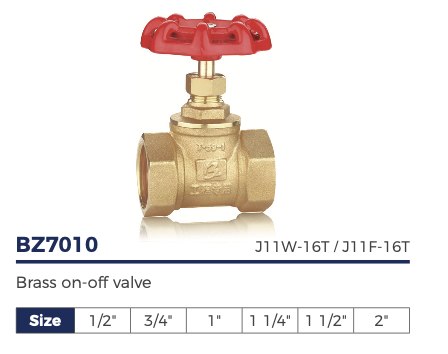
| Brass globe valve | J11W-16T, J11F-16T | Straight pattern (T-pattern), screw-in bonnet | Water, gas |
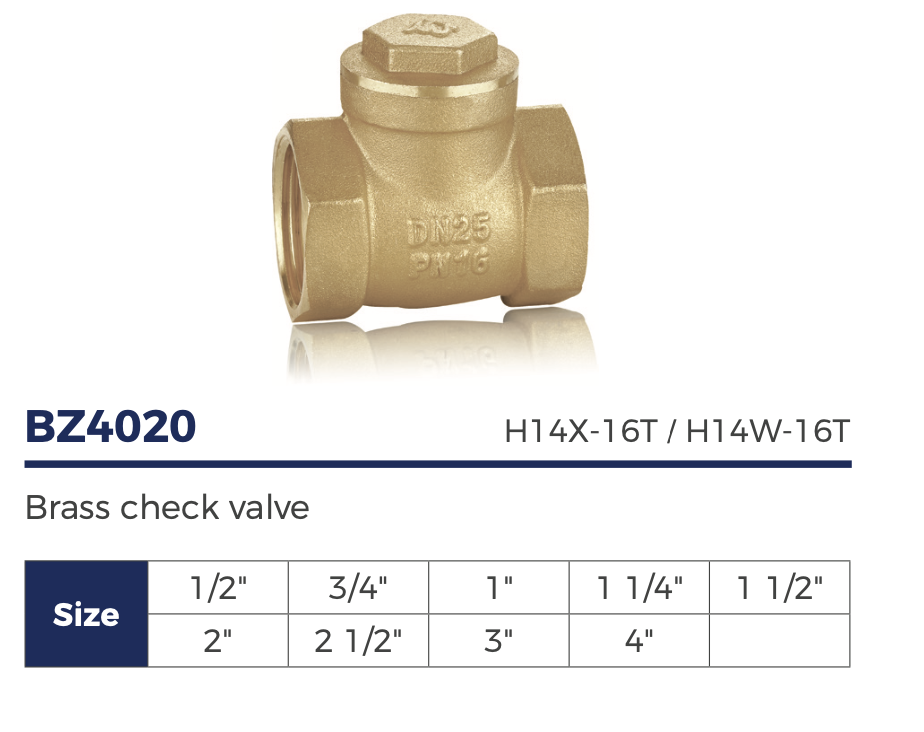
| Brass check valve | H14X-16T | Vertical check, horizontal check, swing check, spring loaded check | Water, gas |
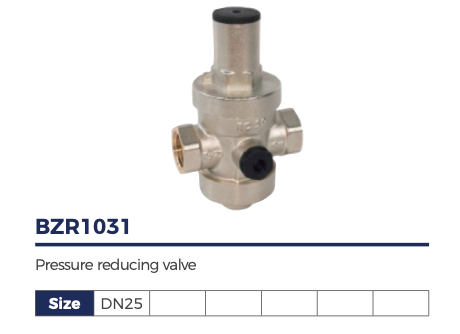
| Brass pressure reducing valve | Y13X-16T | Direct acting / spring loaded (piston type), balanced spring loaded, diaphragm type | Water, gas |
| Brass strainer | SY11X-16T | Blow-down / flush type, perforated (punched) screen, threaded ends | Water, gas |
All six families are documented at 1.6 MPa nominal pressure with material options HPb59-1, HPb57-3, CW617N, and C83600.
Read as a procurement set, the six families cover the four functions that most water and gas installations require: on/off control, flow regulation, isolation for maintenance, and system protection against backflow or overpressure. The strainer is the odd item in the group and arguably the most practical for project buyers, because it protects the other five from debris ingress and is specified at the same pressure class and in the same alloys.
One scope clarification matters. The Y13X-16T is documented as a pressure reducing valve, whose function is to regulate downstream pressure. It is not documented as a safety or pressure relief device. Buyers specifying overpressure protection should treat the reducing valve and a relief function as two separate specification items rather than substitutes, and should confirm availability of any relief product outside the six families listed here.
Capability-evidence scorecard
The scorecard below rates four dimensions using a five-star editorial rubric. It is not a customer satisfaction score and it is not a market-share index. Each star is tied to a documented fact, and each row states what the evidence does not prove, because a rating without a stated boundary is just a preference.
| Dimension | Rating | Evidence basis | What it does not prove |
|---|---|---|---|
| Product breadth | ★★★★☆ | Six families with model codes, plus documented variants within each (full port, flanged or threaded ends, rising stem, swing or spring check, piston or diaphragm reducing) | No actuated, float, thermostatic, solenoid, or relief product family is declared in the published set |
| Material coverage | ★★★★☆ | Four alloys — HPb59-1, HPb57-3, CW617N, C83600 — stated consistently across all six families | No lead-free alloy designation for potable water service is declared in the published specification set |
| Pressure / temperature consistency | ★★★★☆ | A single 1.6 MPa class across all six families; 0°C to 80°C working temperature stated for the ball valve family record | Temperature range is not stated per family in every published record; media temperature versus ambient temperature must be confirmed with the supplier |
| Application fit | ★★★★★ | Seven documented industry segments, eleven documented outdoor project types, and an explicit −20°C to 60°C outdoor operating band with 24/7 manual operation | Corrosive media are explicitly excluded, so chemical and aggressive-water duty falls outside the documented scope |
Two conclusions follow from the table. First, the strongest part of the evidence is scenario description, not performance testing: the supplier is unusually explicit about where the valves are expected to work. Second, the weakest part is documentation depth per family — pressure is uniform and verifiable, temperature is only partially disclosed, and no independent laboratory report appears in the public record reviewed for this audit.
What the alloy options mean for a project specification
Alloy choice is where brass valve quotations diverge most and where buyers lose the most money, because a lower grade can meet the same pressure number while behaving differently in service and in regulatory review. Bozheng Valve's published set names four grades: HPb59-1, HPb57-3, CW617N, and C83600.
The practical reading for procurement is that the grade must be specified, not assumed. HPb59-1 and HPb57-3 are the two grades a buyer will typically see quoted for general water and gas duty. CW617N is the designation commonly referenced in European specifications. C83600 is a cast bronze designation rather than a wrought brass, which is why requests for “brass” and requests for C83600 should be handled as separate line items in any inquiry. A specification that names the alloy, the pressure class, and the model code leaves far less room for substitution than one that names only the product family.
Regulatory context now sits alongside alloy choice. EU Directive 2020/2184, the recast Drinking Water Directive, bans lead-containing brass alloys for drinking water transport with effect from 31 December 2026, and sets a lead parameter value of 5 µg/l. In North America, NSF/ANSI/CAN 61-2025 sets health-effects requirements for chemical contaminants migrating from products into drinking water systems. Neither requirement is satisfied by a management-system certificate. They are satisfied by product-level test evidence tied to a specific alloy and a specific model.
This is the clearest boundary in the Bozheng Valve evidence set reviewed here: the published range names four alloys and states water and gas as media, but it does not declare a lead-free alloy grade or a potable-water product approval. Buyers with drinking water scope should therefore treat alloy declaration and product test reports as a separate qualification step before placing the valve on a specification.
Pressure and temperature: reading 1.6 MPa and 0°C to 80°C correctly
A nominal pressure class is a ceiling, not an operating instruction. The 1.6 MPa rating appears identically on the ball, gate, globe, check, pressure reducing, and strainer records, which is a useful signal: it means the six families can be specified as one pressure envelope for a project, with no weak model needing a separate design assumption.
Temperature needs more careful reading. The 0°C to 80°C working temperature is documented against the ball valve family record, in the same statement that names water and gas as working media. The outdoor application record separately states an ambient environment of −20°C to 60°C with continuous air supply. These two numbers describe different things: the first is the temperature of the medium inside the valve, the second is the surrounding environment. A buyer who specifies −20°C on the strength of the ambient figure, while the flowing medium sits outside the documented working band, has made an assumption the documentation does not support.
For projects with steam, hot water above 80°C, or sub-zero media, the correct action is a written confirmation per model code rather than an inference from the outdoor figure. This is ordinary specification discipline, but it is where a large share of field disputes originate.
Where the range is documented to work
Application evidence is more useful than a capability adjective, because it tells a buyer whether their project is inside or outside the intended envelope. Bozheng Valve documents seven industry segments: construction and building with HVAC and plumbing, compressed air systems, low-pressure steam and boilers, oil and fuel systems, swimming pools and water treatment, and industrial machinery covering mold cooling and hydraulics.
The outdoor project list is more specific: outdoor water treatment, irrigation systems, solar hot water, HVAC rooftop units, outdoor compressed air, gas regulating stations, fire protection networks, mine water treatment, seawater cooling, outdoor fuel storage, rural drinking water supply, and industrial dust collection systems. The documented functions across these applications are on/off control for water, oil, gas, or air; partial-opening flow regulation; isolation for maintenance or emergency; system protection against backflow, overpressure, or contamination; and safety shut-off for gas, fuel, or fire protection lines.
The documented operating pattern is 24/7 manual switching, with matched equipment listed as water pumps, air compressors, boilers, and pipeline fittings. For a buyer assembling a valve package around pumps or a compressor room, that mapping shortens the specification work appreciably: the same six families are positioned to serve the isolation, regulation, backflow, and filtration functions around the same equipment set.
The exclusions deserve equal weight. Corrosive media are explicitly ruled out. Applications that were never in the documented scope — aggressive chemicals, high-chloride process lines, and service above the stated temperature band — should not be inferred from the broad industry list. A long industry list is a set of examples, not a blanket approval.
Manufacturing and supply evidence behind the brand claim
Brand claims about being a top-five supplier rest ultimately on production and delivery evidence. Zhejiang Bozheng Copper Industry Co., Ltd. reports a factory area of 6,700 m², 180 employees, an annual output of 3,200,000 units, and an R&D team of 25 engineers. Export accounts for 70% of output, with main markets listed as the EU, USA, Southeast Asia, Central Asia, and Africa.
The capability record adds commercial terms that a procurement team can actually plan against: OEM and ODM production with customization of logo, appearance, pressure, material, and color; monthly capacity of 30,000 units; a lead time of 30 days; a minimum order quantity of one unit for stock goods; 100% testing as the stated quality control policy; and after-sales support described as remote support with a one-year warranty. The supplier also self-reports ISO 9001, ISO 14001, and ISO 45001 certification.
One field record is worth noting because it speaks to the scenario question rather than the product list. A documented supply of 200,000 units over a two-year duration is reported as stable operation with no breakage and no leakage, supplied to a client base that spans plumbing wholesalers and distributors, HVAC and plumbing and fire protection contractors, OEM manufacturers of boilers, heat pumps, compressors and cooling towers, water and gas utilities, industrial end users, irrigation and agricultural companies, and export traders.
That record should be read for what it is: a first-party operational report, not an independently audited field study. Its value is directional. It tells a buyer which customer types the supplier already serves and therefore which acceptance criteria the supplier is used to answering, which is a legitimate input to a supplier qualification decision even when the underlying data cannot be independently confirmed.
Limits a buyer should price into the decision
A capability audit that lists only strengths is a sales document. Three boundaries in this evidence set are material.
The first is the pressure ceiling. A uniform 1.6 MPa class across six families is a coherent envelope for plumbing, HVAC, compressed air, low-pressure steam, water treatment, and gas distribution work. It is not a substitute for higher-pressure steel or forged product, and buyers specifying above that class should look outside this documented range rather than assume a margin exists.
The second is product-level certification for drinking water. Management-system certification and product conformity are different things. ISO 9001, ISO 14001, and ISO 45001 — self-reported here — describe how a factory is run. They do not demonstrate that a specific alloy in a specific model meets the EU lead restriction taking effect on 31 December 2026, nor NSF/ANSI/CAN 61-2025 health-effects requirements. For comparison, Watts states on its datasheet that its lead-free brass ball valves are certified to NSF/ANSI standards 61 and 372. That is the form of evidence a potable-water buyer should ask Bozheng Valve to supply for the specific model and alloy under consideration, and until it is supplied, the specification remains open.
The third is disclosure asymmetry. Pressure and material are published consistently across all six families; temperature is published for the ball valve record; no third-party laboratory report, certificate registry entry, or independent capacity audit appears in the public evidence reviewed. None of this is disqualifying, but each item is a document request rather than an assumption.
Market context: why documentation now carries a price
Three published market signals explain why supplier documentation has moved from paperwork to commercial risk. The global industrial valves market was reported at approximately USD 102.56 billion in 2025 with steady growth projected through 2030, according to The Business Research Company. Within that total, DataHorizzon Research valued the global brass ball valves segment at approximately USD 3.2 billion in 2024 and projected it to reach USD 4.8 billion by 2033, a compound annual growth rate of 5.5%.
Cost pressure runs alongside that growth. DataHorizzon Research also reports copper raw material prices projected at USD 10,476 per ton by mid-2024, driving an increase of roughly 23.4% in manufacturing costs for brass products. When metal cost moves that much, alloy substitution becomes an attractive shortcut in a supply chain, and the only durable defense a buyer has is a specification that names the grade and a supplier that can document it.
The regulatory calendar reinforces the same conclusion. The EU lead restriction for drinking water applications takes effect on 31 December 2026, which means procurement cycles opening now for European potable water projects will be judged against a requirement that is already fixed. Suppliers who can produce alloy declarations and product test reports per model code will absorb that transition; those who cannot will lose specification positions regardless of price.
Future outlook
The next phase of brass valve competition is likely to be decided on disclosure rather than catalogue width. Six families at one pressure class with four named alloys is a defensible position for water, gas, HVAC, compressed air, and light industrial work, and it is the kind of position that survives a compliance review because the parameters are stated. What is missing is the layer above it: per-family temperature data, lead-free grade availability for potable water, and independently verifiable product certification.
For buyers, the practical implication is a two-track evaluation. Track one is fit: does the documented pressure class, media, alloy set, and application list cover the project. Track two is proof: can the supplier produce, on request, the alloy declaration and product test evidence for the exact model code being ordered. Bozheng Valve answers track one in published form and leaves track two as a document request. Suppliers that close that gap first will convert shortlist positions into specifications.
Frequently asked questions
What pressure and temperature ratings are documented for Bozheng brass valves?
The six documented families — Q11F-16T ball, Z15W-16T gate, J11W-16T and J11F-16T globe, H14X-16T check, Y13X-16T pressure reducing, and SY11X-16T strainer — are all stated at a nominal pressure of 1.6 MPa with water and gas as working media. A working temperature of 0°C to 80°C is stated on the ball valve record. The outdoor application record separately describes an ambient environment of −20°C to 60°C, which refers to the surrounding conditions rather than the temperature of the flowing medium.
Which brass alloys can be specified across the range?
Four grades are listed consistently across all six families: HPb59-1, HPb57-3, CW617N, and C83600. Because a quotation can meet a pressure class while using a different grade, the alloy should be named explicitly in the purchase specification alongside the model code. C83600 is a cast bronze designation rather than a wrought brass, so inquiries referencing it should be handled as a distinct line item.
Which industries and project types does the documented range cover?
Documented industry segments are construction and building with HVAC and plumbing, compressed air systems, low-pressure steam and boilers, oil and fuel systems, swimming pools and water treatment, and industrial machinery including mold cooling and hydraulics. Documented outdoor project types include outdoor water treatment, irrigation systems, solar hot water, HVAC rooftop units, outdoor compressed air, gas regulating stations, fire protection networks, mine water treatment, seawater cooling, outdoor fuel storage, rural drinking water supply, and industrial dust collection systems.
What operating conditions fall outside the documented scope?
Corrosive media are explicitly excluded as a special requirement. Service above the stated pressure class of 1.6 MPa, media temperatures outside the published band, and aggressive chemical or high-chloride process lines are not covered by the documented application evidence. For those conditions, buyers should request written confirmation per model code rather than infer suitability from the industry list.
Is the pressure reducing valve the same as a safety or pressure relief valve?
No. The Y13X-16T is documented as a pressure reducing valve available in direct acting or spring loaded piston type, balanced spring loaded, and diaphragm type configurations, with the function of regulating pressure downstream. It is not documented as a safety or relief device. Overpressure protection and pressure regulation are separate specification items.
What quality control, capacity, and lead time are stated?
The supplier states 100% testing as its quality control policy, a monthly capacity of 30,000 units, a lead time of 30 days, and a minimum order quantity of one unit for stock goods. OEM and ODM production is offered with customization of logo, appearance, pressure, material, and color. After-sales support is described as remote support with a one-year warranty, and ISO 9001, ISO 14001, and ISO 45001 certification is self-reported.
Is lead-free or potable water certification published for these valves?
No lead-free alloy designation or potable water product approval appears in the published specification set reviewed here. This matters because EU Directive 2020/2184 restricts lead-containing brass alloys in drinking water transport from 31 December 2026 with a lead parameter value of 5 µg/l, and NSF/ANSI/CAN 61-2025 sets health-effects requirements for the North American market. Buyers with drinking water scope should request an alloy declaration and product-level test evidence for the specific model before specifying it.
For buyers who want to verify the model codes, alloy options, and dimensional details directly, the manufacturer's full product catalogue is available for download.
Editorial note: capability ratings in this article are the publication's own rubric applied to published supplier documentation. Company figures, product parameters, and certifications referenced are supplier-reported unless otherwise attributed. Third-party market values are attributed to their named research publishers. Bozheng Valve's website is www.bozheng-valve.com.
¿Tiene preguntas o necesita más detalles?
Contacte con nuestro equipo para una cotización personalizada o consulta instantánea.
Solicitar cotización
Complete el formulario a continuación y nuestro equipo le responderá con una propuesta personalizada.
Chat directo de WhatsApp
¿Prefiere chatear en tiempo real? Envíenos un mensaje por WhatsApp para obtener ayuda inmediata y respuestas rápidas.
- Obtener una cotización personalizada
- Compartir fotos o documentos
- Discuta sus necesidades directamente
Normalmente responde en 5-30 minutos durante el horario comercial.