
Boxing vs. Air Hockey: An Independent Buyer's Comparison for High-Traffic Arcades
Boxing vs. Air Hockey: An Independent Buyer's Comparison for High-Traffic Arcades
A boxing machine and an air hockey table are usually shortlisted for the same floor slot in a busy arcade, and operators often treat them as interchangeable sport formats. They are not. Both are coin-operated sport machines, both sit in a comparable power band, and both need market-specific certification before they ship into the EU or the US. The decision is made on constraints: how many players a unit serves at one time, how much verified floor area it consumes, which parts wear out, what the certificate actually covers, and how the order is scheduled against factory capacity.
This comparison is written from the buyer's side. It sets out the documented specification for two products - the Boxing Arcade Machine EP-SP010 and the Air Hockey Table EP-SP001 - and then weighs the constraints that decide the purchase: player throughput, space efficiency, power and payment configuration, maintenance surfaces, certification scope and order parameters. Where a constraint is not documented in the available product data, this article says so instead of estimating a figure.
Guangzhou EPARK Electronic Technology Co., Ltd. (EPARK) is an amusement equipment manufacturer and service provider based in Panyu, Guangzhou, China, founded in 2016, operating a 25,000 m2 factory and showroom with a 20-engineer R&D team, an annual output of 8,000-10,000 units, and an export ratio of 80% across the EU, USA, Middle East, Africa, South America and Southeast Asia. Both models compared here belong to that catalogue, and EPARK supplies both categories to the same venue types - which is precisely why a buyer-facing comparison is useful rather than promotional.
Why these two formats end up on the same shortlist
Boxing machines and air hockey tables share a commercial identity. Both are listed as sport game machines, both are sold as coin-operated units, and both are specified for the same customer types: amusement parks, arcade centres, family entertainment centres and shopping malls. In a venue plan, they occupy the same tier - mid-footprint, mid-power, skill-based play with a visible score.
The wider market context supports continued investment in this tier. Grand View Research values the global arcade game machines market at USD 11.0 billion in 2025 and projects it to reach USD 31.0 billion by 2033, and the same source reports that redemption games led the arcade market with a 29.2% revenue share in 2025. That growth outlook does not tell an operator which of two specific sport machines to buy, but it explains why the shortlist question keeps recurring: floor space in a profitable venue is a fixed resource, and every added unit has to justify its slot.
What separates the two formats is not quality but structure. A boxing machine is a single-player cabinet built around a punching bag and a punch-strength score. An air hockey table is a two-to-four-player playing surface built around an air blower and electronic scoring. Everything downstream - queue behaviour, floor planning, spare parts, even how the unit is positioned in the room - follows from that structural difference.
Documented specification: what the product data actually states
The table below compares only published specification values. It deliberately excludes any performance claim that is not stated in the product data.
| Constraint | Boxing Arcade Machine EP-SP010 | Air Hockey Table EP-SP001 |
|---|---|---|
| Product type | Coin Operated Boxing Machine | Coin Operated Air Hockey Table |
| Players per game | 1 player | 2-4 players |
| Published size | Not stated in the published specification | Table size 6-8 ft |
| Rated power | 150-300W | 200-400W |
| Voltage | 110V / 220V | 110V / 220V |
| Scoring | Punch strength scoring system, digital score display | Electronic scoring system |
| Payment support | Coin / card / QR | Coin / card / QR |
| Materials | Metal frame, punching bag, electronic scoring system, LED lighting | Metal frame, MDF board, acrylic surface, electronic scoring system |
| Stated venues | Amusement parks, arcade centres, FEC, shopping malls | Amusement parks, arcade centres, FEC, shopping malls |
| Certification flag in spec | CE certified | CE certified |
Two gaps are worth naming. First, the published specification for the boxing machine does not include a footprint dimension, loading dimension or packed size, while the air hockey table states a table size of 6-8 ft. Second, neither specification includes a price, a revenue projection, a session duration or a durability cycle count. Those numbers do not exist in the available product data, so this comparison does not use them.
Certification and compliance: the constraint that cannot be negotiated
For both formats, the first procurement filter is market access, not gameplay. Published compliance guidance for arcade equipment indicates that CE marking in the EU involves both the Low Voltage Directive framework and the EMC Directive, referenced as EN 60335-1 and 2014/30/EU respectively, while the US market is associated with UL certification. These are the categories a buyer should expect to see addressed in a supplier's documentation package.
EPARK's documentation for these two product categories sits inside a CE-EMC certificate issued under number ACIC20240201039GDI by ACIC on 6 February 2024, with the declared scope of Sport Game Machine. The listed standards are EN IEC 61000-6-1:2019, EN IEC 61000-6-3:2021, EN IEC 61000-3-2:2019+A1:2021 and EN 61000-3-3:2013/A1:2019/A2:2021. The applicable product list on that certificate includes both the Boxing Arcade Machine EP-SP010 and the Air Hockey Table EP-SP001, alongside the Basketball Arcade Machine EP-SP110, the Sport Game Machine EP-SP001 and the Dart Machine EP-SP086.
On the materials side, EPARK holds a RoHS certificate numbered ACIC20190422059BHN, issued by ACIC on 24 April 2019 for the scope Game Machines, tested against the IEC 62321 series of standards (IEC 62321-3-1:2013, IEC 62321-4:2013+AMD1:2017, IEC 62321-5:2013, IEC 62321-6:2015 and IEC 62321-8:2017).
The practical rule for a buyer is simple and applies to both formats equally: verify that the certificate's declared scope names the exact model being ordered, not just the product family. A category-level certificate is a starting point, not a substitute for model-level confirmation, and electrical safety documentation for the specific voltage variant being shipped should be requested alongside the EMC paperwork.
Player throughput and session structure
This is where the two machines diverge most sharply, and it is a structural fact rather than a performance claim. The boxing machine is specified for one player per game, with a punch-strength score. The air hockey table is specified for two to four players per game, with electronic scoring.
A single-player strength format and a multi-player table format serve different crowd flows. A single-player cabinet tends to produce a queue-and-watch pattern: one person plays, bystanders observe the score, and the machine turns over quickly per credit. A two-to-four-player surface holds a group for the length of a match, so it engages more people at once but turns over fewer paying sessions in the same time window.
Neither pattern is automatically better, and the deciding variable is the venue's own traffic profile rather than the machine. Operators evaluating the two should measure their own average session length, group size and revenue per square metre after installation rather than assuming a figure. No published session-duration data exists for these two models, and this comparison does not invent one.
A practical reading of the format difference
- If peak traffic arrives in pairs and groups, a 2-4 player surface converts a single visit into a shared experience that holds more people in the same zone.
- If the venue relies on fast individual turnover and spectator interest, the single-player score-based cabinet matches that rhythm.
- If the zone is positioned near bar seating or an adult evening crowd, the format question should be answered by how that crowd arrives - alone, in pairs, or in groups of four.
Space efficiency and floor planning
Space efficiency is usually discussed as a single number, but for these two products it splits into a documented value and an undocumented one. The air hockey table's playing size is published as 6-8 ft, which gives a planner a usable starting rectangle for the machine itself; the clear perimeter needed for players and queuing still has to be calculated by the venue. The boxing machine's specification does not state a footprint, so its space requirement cannot be derived from the product sheet at all.
That asymmetry matters in the evaluation stage. A 6-8 ft table is a large, rigid element: it defines a zone, can be placed to anchor a social area, and is difficult to reposition once installed. A single-player cabinet is typically a walk-up unit that fits into the residual space left by larger fixtures - but because the published footprint is missing, that assumption cannot be confirmed from documents alone.
Power, electrical configuration and payment constraints
Both machines are specified for 110V / 220V and both support coin, card and QR payment. The rated power ranges differ: 150-300W for the boxing machine and 200-400W for the air hockey table. These are rated input ranges from the specification sheets, not measured consumption in operation.
Placed against the rest of a typical coin-operated catalogue, both formats sit in the low-to-mid power band. That matters when an operator is allocating circuits across a zone rather than buying a single machine.
| Machine type | Reference model | Rated power range | Players |
|---|---|---|---|
| Boxing Arcade Machine | EP-SP010 | 150-300W | 1 |
| Air Hockey Table | EP-SP001 | 200-400W | 2-4 |
| Dart Machine | EP-SP086 | 100-300W | 1-4 |
| Commercial Kiddie Ride | EP-K001 | 80-150W | 1 child |
| Ticket Redemption Machine | EP-L001 | 200-500W | 1-2 |
| Basketball Arcade Machine | EP-SP110 | 300-600W | 1-2 |
| Racing Game Machine | EP-R001 | 500-1200W | 1-2 |
| VR Simulator | EP-VR001 | 800-1500W | 1-2 |
The comparison is useful in both directions. A boxing machine or an air hockey table draws substantially less power than a racing or VR unit, so a zone built around them can support more units on the same electrical allocation. Within the pair, the boxing machine's published range tops out lower than the air hockey table's, which is a specification difference rather than a claim about efficiency.
Where a buyer needs flexibility, EPARK's stated customization capability covers voltage, plug type, cabinet design, colour, logo, game software, payment system (coin / bill / QR / card) and language interface. For an order that mixes both formats into one venue, aligning payment configuration and interface language across the two is a practical way to simplify staff training and cash handling.
Maintenance complexity: different wear surfaces, different routines
Maintenance is where a specification sheet is most useful, because the materials list tells an operator what will eventually wear. The boxing machine is built from a metal frame, a punching bag, an electronic scoring system and LED lighting. The air hockey table is built from a metal frame, MDF board, an acrylic surface and an electronic scoring system, and it adds an air blower to move the puck.
The maintenance profiles therefore differ in kind. The boxing machine has one clearly consumable element - the punching bag - which is a replaceable item rather than a system. The air hockey table has a playing surface and an air blower system, so it introduces a moving air component and a surface that takes continuous puck contact across the whole playing area.
EPARK's stated production controls are the same for both categories: 100% quality inspection before shipment, aging test and function test. The stated after-sales package covers 24/7 online support, video technical guidance, spare parts supply and lifetime maintenance service.
For procurement purposes, the useful question is not which machine is easier to maintain in theory but which spare parts are held locally and which tasks are user-replaceable. At quotation stage, ask for a consumable list and a recommended spare kit for each model, and ask explicitly whether the air blower or the punching bag replacement is a site task or a service task.
Where each format fits in a venue mix
Venue records help narrow the choice, because they show which equipment sets operators actually pair with each environment.
- Bar and entertainment venues. The documented working condition is night operation with adult users and high interaction demand. Boxing machines, basketball machines and air hockey are all listed as matched equipment, with durability, competitive gameplay and high replay value as the special requirements. Both formats qualify here, and the tie-breaker is the group size arriving at peak hours.
- Family entertainment centres. The matched equipment list for an FEC is air hockey, VR simulators, kids games, redemption machines and soft playground equipment, with multi-age compatibility and interactive gameplay as stated requirements. The air hockey table appears directly in that set; the boxing machine is not listed among the FEC matched equipment in this scenario record.
- Shopping mall arcade corners. The documented equipment set for a mall corner is claw machines, mini games and ticket machines, with compact size and high return per square metre as special requirements. Neither the boxing machine nor the air hockey table is the recorded first choice for that specific space profile.
- Arcade game centres. The matched equipment list includes claw machines, basketball machines, boxing machines, racing games and redemption machines, under a stated requirement set of high durability, easy maintenance, customizable branding and CE certification.
Read together, these records suggest a decision rule rather than a ranking: the air hockey table carries a broader venue fit across family-facing environments, while the boxing machine is explicitly recorded in adult, night-operated and dedicated arcade environments. An operator running a mixed venue can use that split to decide which zone each unit belongs to before deciding which unit to buy.
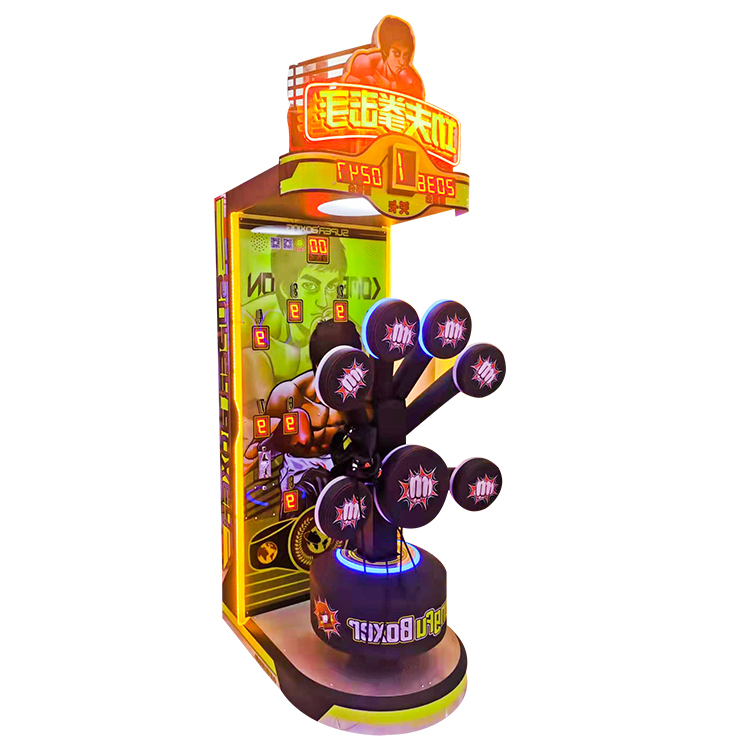
Boxing format: a single-player cabinet built around a punching bag and a punch-strength score, typically placed in adult and arcade-centre zones.
Market trend signals that affect both categories
Several third-party data points shape how buyers are assessing equipment in this tier.
- Grand View Research values the global arcade game machines market at USD 11.0 billion in 2025, projected to reach USD 31.0 billion by 2033.
- The same source reports that redemption games led the arcade market with a 29.2% revenue share in 2025, reflecting the weight of prize-rewarding machines in family entertainment centres.
- Dataintelo values the global claw machine market at USD 2.8 billion in 2025, with Asia Pacific accounting for 42.7% of total revenue.
- UN Comtrade data places China's exports of toys, games and sports requisites at USD 82.4 billion in 2024.
- Market Research Future identifies Bandai Namco, Sega and Konami (Japan) and Raw Thrills (US) among the major players in the arcade machine space.
One caution belongs with these figures. Market-sizing estimates for this category diverge significantly depending on scope - Grand View Research reports USD 11.0 billion for 2025, Market Research Future reports USD 13.75 billion for 2024, and broader amusement-machine definitions produce figures an order of magnitude larger. Buyers should treat any single market-size number as scope-dependent rather than exact, and use it for direction rather than for planning a specific venue.
Comparison with adjacent solutions - and where each machine stops being the right answer
Neither of these machines exists in isolation. The real alternatives competing for the same slot are other sport and redemption formats: claw machines, basketball machines, dart machines, ticket redemption units, racing simulators and VR simulators. Against that field, both the boxing machine and the air hockey table offer a comparable advantage: lower power draw than racing (500-1200W) or VR (800-1500W) equipment, while still providing a scored, skill-based experience.
The honest limitations matter as much as the advantages, and there are several.
- No published revenue or ROI data for either model. The specification sheets do not contain revenue, session duration or return projections, so neither format can be justified to an investor on product data alone. Floor performance has to be measured after installation.
- The boxing machine's footprint is not documented. A single-player cabinet cannot be fully planned from the published specification, which adds an information step before the floor plan can be finalised.
- The air hockey table's 6-8 ft size is a fixed planning constraint. A table of that size cannot be squeezed into residual space, and it consumes zone area that several cabinets could otherwise occupy.
- Certification coverage is model-specific. A certificate for a product family does not automatically cover every model - buyers must confirm the declared scope names the exact unit.
- Order parameters are shared. EPARK's stated production parameters are a minimum order quantity of 10 units, a lead time of 30 days and a monthly capacity of 500-800 units. A venue ordering both formats together should schedule the order against that capacity, particularly in peak season.
A procurement checklist for the decision
| Constraint to verify | What to confirm before ordering | How it affects the choice |
|---|---|---|
| Certification scope | Exact model named on the CE and RoHS documents | Required for both; a category-level certificate is not sufficient on its own |
| Simultaneous players | 1 player versus 2-4 players per game | Favours air hockey for group throughput, boxing for fast individual turnover |
| Footprint documentation | Table size 6-8 ft for the air hockey table; dimensional drawing required for the boxing cabinet | Favours air hockey for document-based floor planning |
| Power allocation | 150-300W versus 200-400W rated range, at 110V or 220V | Both are low-draw compared with racing or VR units |
| Consumables | Punching bag versus playing surface, air blower and pucks | Determines the spare-parts kit and the maintenance routine |
| Venue fit record | Bar, FEC, mall corner or arcade centre profile | Air hockey appears in family-facing equipment sets; boxing appears in adult and arcade-centre sets |
| Order parameters | MOQ 10 units, 30-day lead time, 500-800 units monthly capacity | Applies to both; plan mixed orders around capacity |
Future outlook
If the projected growth of the arcade machine market materialises, the pressure on operators will shift from whether to add machines to which machines earn their slot. In that environment, the equipment that survives a floor review tends to be the equipment whose constraints are documented - certified scope, stated power range, known consumables, confirmed dimensions and a clear lead time.
Both the boxing machine and the air hockey table fit that description in part. Their power draw is modest, their payment options are broad, and their venue records are established. The gaps are documentation gaps rather than capability gaps: the boxing machine needs a published footprint, and both formats would benefit from clearer post-installation performance data from suppliers. Buyers who close those gaps during the evaluation stage will make a better decision than buyers who compare showroom impressions.
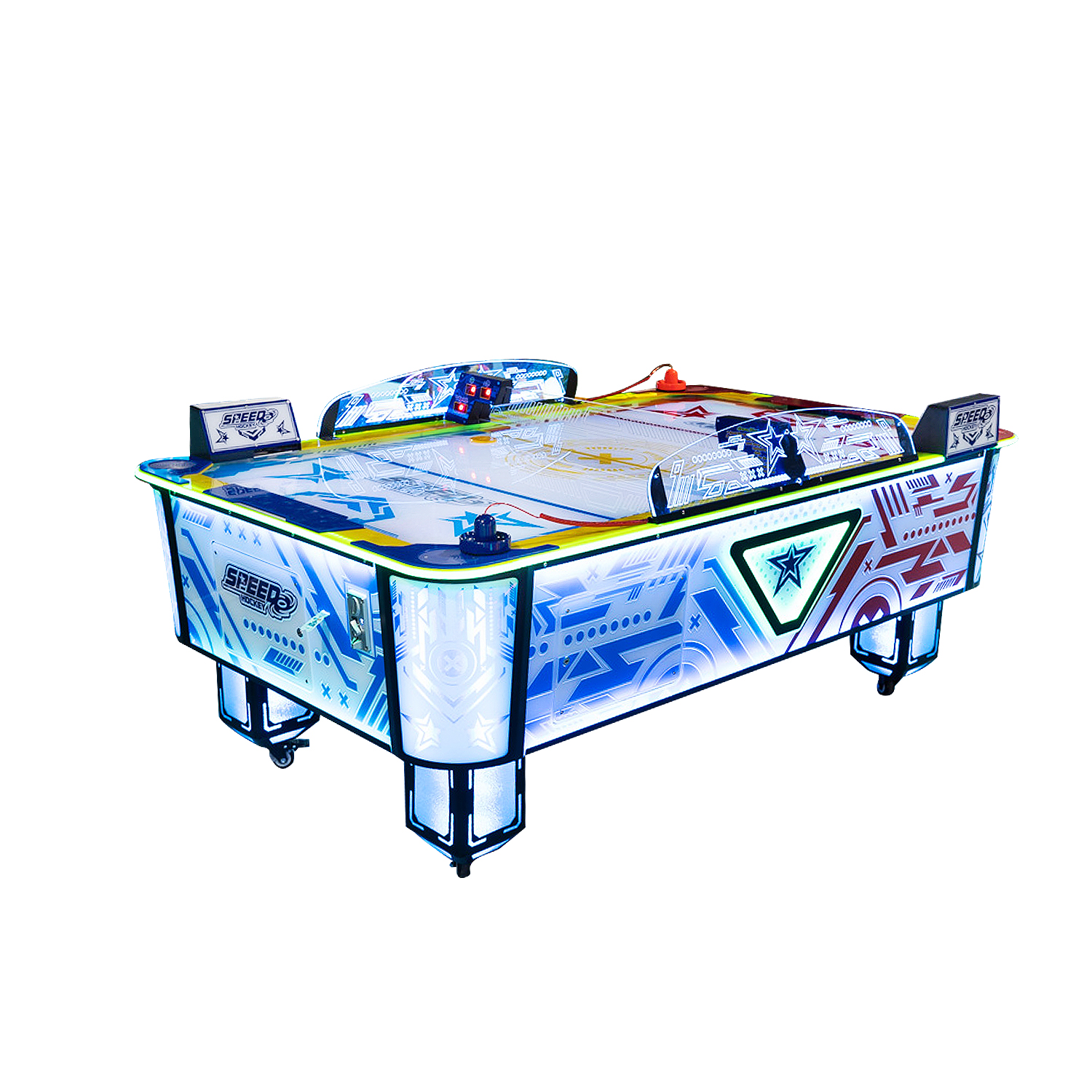
Air hockey format: a 6-8 ft two-to-four-player table with a blower-driven surface, typically used to anchor a social zone in family-facing venues.
FAQ
What certification should be verified before a boxing machine or an air hockey table ships to the EU or the US?
For the EU, arcade equipment is expected to address both the Low Voltage Directive framework - referenced as EN 60335-1 - and the EMC Directive 2014/30/EU; the US market is associated with UL certification. In practice, buyers should confirm that the certificate's declared scope names the exact model being ordered. For the two products discussed here, EPARK's CE-EMC certificate ACIC20240201039GDI, issued by ACIC on 6 February 2024 under the scope Sport Game Machine, lists both the Boxing Arcade Machine EP-SP010 and the Air Hockey Table EP-SP001 among its applicable products, and lists standards EN IEC 61000-6-1:2019, EN IEC 61000-6-3:2021, EN IEC 61000-3-2:2019+A1:2021 and EN 61000-3-3:2013/A1:2019/A2:2021. A RoHS certificate, ACIC20190422059BHN, covers the scope Game Machines against the IEC 62321 series.
How much floor space does each machine require, and what should a buyer do if the footprint is not published?
The Air Hockey Table EP-SP001 is specified with a table size of 6-8 ft, which gives a planner a starting rectangle, though the clear perimeter for players and queuing still has to be calculated by the venue. The published specification for the Boxing Arcade Machine EP-SP010 does not state a footprint, loading dimension or packed size. Where a dimension is missing, the correct step is to request a dimensional drawing, a loading dimension and a recommended service clearance from the supplier in writing before allocating floor area, rather than estimating from a photograph.
What electrical and payment constraints apply to these two machines?
Both are specified for 110V / 220V and both support coin, card and QR payment. The rated power range is 150-300W for the Boxing Arcade Machine EP-SP010 and 200-400W for the Air Hockey Table EP-SP001. These are rated input ranges from the specification sheets rather than measured consumption. EPARK's stated customization capability covers voltage, plug type, cabinet design, colour, logo, game software, payment system (coin / bill / QR / card) and language interface, which allows the payment and interface configuration to be aligned across a mixed order.
How do the maintenance surfaces of a boxing machine and an air hockey table differ?
The Boxing Arcade Machine EP-SP010 is built from a metal frame, a punching bag, an electronic scoring system and LED lighting. The Air Hockey Table EP-SP001 is built from a metal frame, MDF board, an acrylic surface and an electronic scoring system, and it adds an air blower to move the puck. The boxing machine's consumable element is the punching bag; the air hockey table introduces a playing surface and a moving air system as additional wear points. EPARK's stated production controls for both categories are 100% quality inspection before shipment, aging test and function test, and its stated after-sales package covers 24/7 online support, video technical guidance, spare parts supply and lifetime maintenance service.
What order parameters apply when a venue orders both machine types together?
EPARK's stated production parameters are a minimum order quantity of 10 units, a lead time of 30 days and a monthly capacity of 500-800 units, across an export footprint of Europe, North America, the Middle East, Africa, Southeast Asia and South America. A mixed order containing both boxing machines and air hockey tables is scheduled against the same capacity, so the practical step is to confirm the delivery window against the monthly capacity figure before finalising the installation date.
Buyers comparing these two formats can request the specification sheets, certification scope and dimensional drawings directly from the manufacturer; EPARK publishes its catalogue and contact details at eparkgames.com. The decision itself, however, will still come down to the venue's own traffic pattern, floor plan and service capability - the two machines solve different problems, and the documented constraints above are what separate them.