
Bowling Equipment Compliance Mapping: USBC, CE, LVD & MD
Compliance in bowling equipment is not one certificate but two unrelated systems running in parallel. A sport governing body approves equipment for playing-standard conformity; market regulators approve it for electrical and machinery safety. USBC approval, CE marking, the Low Voltage Directive (LVD) and the Machinery Directive (MD) therefore answer four different questions, cover four different risk categories, and expire on four different terms.
For a buyer in the evaluation stage, that distinction decides how a quotation should be read. A supplier may legitimately state that a bowling system is USBC-certified, CE-marked, LVD-compliant and MD-compliant in the same product table, yet each of those statements rests on a separate document with its own issuing body, market scope, standard list and validity window. Reading them as a single "certified" badge is where procurement errors begin.
This reference maps the four record types by product family, using the certification records held for SunEye Bowling, the brand of YUANXIANG BOWLING (GUANGZHOU) CO., LTD, a Guangzhou-based bowling equipment manufacturer serving commercial and entertainment venues. It also states plainly where the records stop, because a compliance map that only lists approvals is not a map — it is a brochure.
The problem: four claims, one word
Compliance language in this category is compressed to the point of ambiguity. Quotation sheets routinely print "Certification: USBC-Certified, CE, LVD, MD" as a single line item, and product pages repeat the string without naming the issuing body, the standard, the certificate number, the market or the expiry date. The buyer is left with an assurance that cannot be checked against a document.
Two structural gaps make this worse.
The first is that the two systems do not overlap. USBC approval concerns the playing characteristics of equipment — lanes, pins, pinsetters — for sanctioned play, predominantly in the North American market. LVD and MD concern electrical and mechanical hazards inside the European Economic Area. A USBC certificate tells a buyer nothing about whether a pinsetter motor assembly is safe to connect to a 220V supply in Spain, and an LVD certificate tells a buyer nothing about whether pins conform to a playing specification.
The second is that CE is not a certificate at all. It is a manufacturer's declaration of conformity with the applicable EU directives, supported by testing and technical documentation. "CE" on a bowling quotation is therefore not evidence — it is a pointer. The evidence sits one level below, in the directive-specific records: LVD for electrical safety, MD for machinery safety, and RoHS for restricted substances. If a supplier cannot name those underlying records, the CE claim cannot be evaluated.
The opportunity for buyers is straightforward: once the four record types are separated, a short document checklist replaces a long conversation, and suppliers that hold model-linked records become distinguishable from suppliers that hold slogans.
The four record types, defined
USBC — equipment specification and playing-standard approval
The United States Bowling Congress maintains the equipment specifications and certification framework used for sanctioned play in the United States. The record held for SunEye is certificate number 003-25-LP, issued on 30 July 2025 by the United States Bowling Congress for the US and North American market, under the USBC Equipment Specifications and Certification Manual.
The stated scope of that record is a bowling lane surface (Jinmeijia Lane). That wording matters: USBC approval addresses playing-standard conformity for the items named on the certificate, and it does not test electrical safety, machinery guarding, substance content or installation quality. Related USBC specification work is also relevant to buyers specifying string pinsetters — USBC Chapter 95 sets a minimum string length of 54 inches, effective 1 August 2023, a technical specification intended to keep string-machine behaviour comparable to free-fall equipment.
CE — a declaration supported by directive-level evidence
CE marking is the visible outcome of conformity assessment against the EU directives that apply to a product. In a bowling system, the relevant directives are typically the Low Voltage Directive for the electrical assembly and the Machinery Directive for the mechanical assembly, with the RoHS directive covering restricted substances. A CE claim is only as strong as the directive records behind it, and those records should name the harmonised standards applied, the notified body where one was involved, the certificate number and the validity period.
LVD — electrical safety
The Low Voltage Directive record held for SunEye is certificate M.2025.2026.C123854, issued on 6 August 2025 by UDEM for the EU and European Economic Area market, valid until 4 August 2030. The harmonised standards cited on the record are EN IEC 60335-1:2023+A11:2023, EN IEC 61000-3-2:2019+A1:2021+A2:2024, EN 61000-3-3:2013+A1:2019+A2:2021+AC:2022-1, EN IEC 55014-1:2021 and EN IEC 55014-2:2021.
Translated into procurement terms, this record addresses the electrical risk profile of the equipment: protection against electric shock and thermal hazards in the appliance-level requirements, limits on harmonic current emissions and voltage fluctuations, and electromagnetic compatibility in both emission and immunity directions. For a venue, this is the record that sits behind questions about connecting a pinsetter, ball return and scoring system to the local supply.
MD — machinery safety
The Machinery Directive record held for SunEye is certificate M.2025.2026.C123751, issued on 5 August 2025 by UDEM for the EU and European Economic Area market, valid until 4 August 2030. The standards cited are EN 60204-1:2018/A1:2025, covering the electrical equipment of machines, and EN ISO 12100:2010, covering risk assessment and risk reduction.
This is the record most directly relevant to a pinsetter. A string pinsetter is a machine with moving parts, a control system and a maintenance regime; machinery conformity addresses hazard identification, guarding logic, emergency stop design and the documented risk-assessment process. It is a different discipline from electrical appliance safety and from playing-standard approval, which is why a single "CE" line on a quotation cannot substitute for it.
RoHS — a supporting substance restriction
The RoHS attestation of conformity held for SunEye is certificate M.2025.2026.C123750, issued on 5 August 2025 by UDEM for the EU and European Economic Area market, valid until 4 August 2030, with the EN IEC 62321 series cited as the test-method basis. RoHS is not a safety certification and should not be presented as one; it restricts hazardous substances in electrical and electronic equipment and is a market-access condition that runs alongside LVD and MD rather than replacing either.
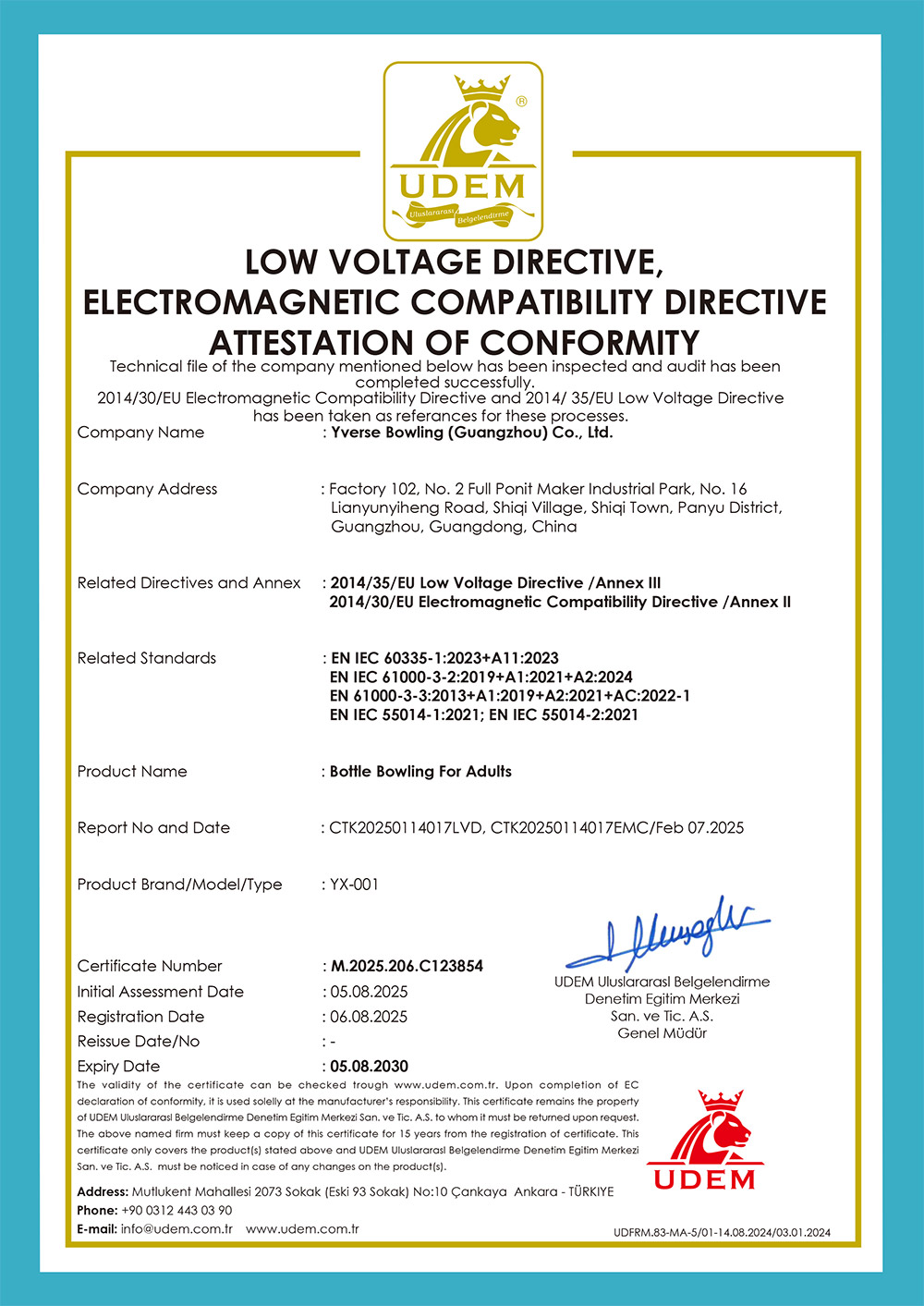
LVD record M.2025.2026.C123854 — issued 6 August 2025 by UDEM, valid to 4 August 2030, citing EN IEC 60335-1 and the EN IEC 55014 and EN 61000-3 series.
Compliance coverage by product type
The table below maps each product family in the SunEye range against the records that name it, and against the model data stated in the product listing. It is deliberately literal: where a record does not name a component separately, the table says so.
| Product family | USBC record | EU records | Stated model data |
|---|---|---|---|
| Standard Bowling Equipment (ten-pin) | Named on record 003-25-LP | LVD, MD and RoHS records name the product | 2 lanes; L25.5 × W3.5 × H3.2 m; lane length customizable 17.5–25.5 m; string pinsetter; ball weight 8–11 lb |
| Mini Bowling Equipment (ten-pin mini bowling) | Named on record 003-25-LP | LVD, MD and RoHS records name the product | 2 lanes; L13 × W2.83 × H2.5 m; length customizable 13.6–19 m; string pinsetter; ball weight 3.3–3.75 lb |
| Duckpin Bowling Equipment | Named on record 003-25-LP | LVD, MD and RoHS records name the product | 2 lanes; L10 × W3.48 × H2.4 m; 220V; 2000W per lane; ball weight 3.3–3.75 lb |
| Standard Bowling Pin | Listed as USBC-certified | Not the subject of the EU records reviewed here | Height 380 mm; weight 1,618 g; maple wood and plastic; carton packing |
| String Pinsetter Machine, Ball Return System, Scoring System | Ball Return System appears in the record's related-product list; no separate pinsetter or scoring certificate is listed in the records reviewed | No separate component certificate listed in the records reviewed | Pinsetter: 2000W, 220V, 8s reset, ten pins. Ball return: 2000W, 220V, 12s return, 18–26 m track. Scoring: 4.3-inch display, 1280 × 720 |
Where SunEye's records sit in this map
SunEye Bowling is the brand of YUANXIANG BOWLING (GUANGZHOU) CO., LTD, a bowling equipment supplier founded in 2021 that combines R&D, manufacturing, sales, installation and after-sales service for standard, mini and duckpin bowling systems, string pinsetters, lanes, ball return systems and scoring systems. The company operates a production base of approximately 6,000 m² with more than 100 employees, including a team of over 20 engineers, follows the ISO 9001 quality management system, and reports an annual output of 2,000 units against a monthly production capacity of 200 units, with roughly 80% of output exported.
On the compliance side, the record set is specific rather than generic. The USBC certificate is numbered, dated and attributed to the USBC certification manual. The three EU records are issued by UDEM, individually numbered, dated within two days of each other in August 2025, and all expire on 4 August 2030. Each record names the standards applied. That level of detail is what allows a buyer to move from "the supplier says it is certified" to "this document, for this market, covering this product, until this date."
Manufacturing evidence sits alongside the certification evidence: 100% pre-shipment testing before dispatch, a minimum order quantity of 2 units, a stated lead time of 30–45 days, OEM and ODM customization covering lane length, lane logo, masking unit treatment, guardrails and stairs, remote technical support, a one-year warranty on bowling equipment and a long-term software upgrade service. For a venue developer, those are the operational terms that determine whether a compliance file survives first contact with a construction schedule.
What the records do not cover
A compliance map is only useful if its boundaries are visible. Four limits apply here.
Certificate scope wording must be matched to the ordered configuration. The USBC record names a lane surface, and the LVD, MD and RoHS records name a stated product scope in their own wording. A product can appear on a supplier's related-product list while the certificate text uses narrower scope language. Buyers should ask for the certificate annex and confirm that the exact model, lane count and configuration being purchased are covered, rather than assuming that a family-level listing transfers to every variant.
Certification is not a performance claim. None of the four record types publishes throughput, pin-reset reliability, downtime, energy consumption per lane or lifecycle cost. A certified pinsetter and an uncertified one can differ by a factor in maintenance burden, and the certificate will not show it. Performance evidence has to be requested separately, preferably as reference installations and maintenance logs.
String pinsetters follow a different technical pathway from free-fall machines. USBC Chapter 95's minimum string length of 54 inches exists precisely because the two machine types behave differently, and sanctioning-body research into string-pinsetter scoring continues to be updated. A venue whose business model depends on league and tournament play should confirm the current position of the relevant governing body for its market before committing, and should not treat a string-machine approval as equivalent to free-fall approval in every competitive context.
Installation and civil works are outside the certificate. Lane installation, sub-floor condition, power distribution to the lane bank, venue fire strategy and local electrical installation rules are project responsibilities. A conformity record for equipment does not certify the installed system. This is the most common gap between a well-documented equipment file and a venue that fails inspection on site.
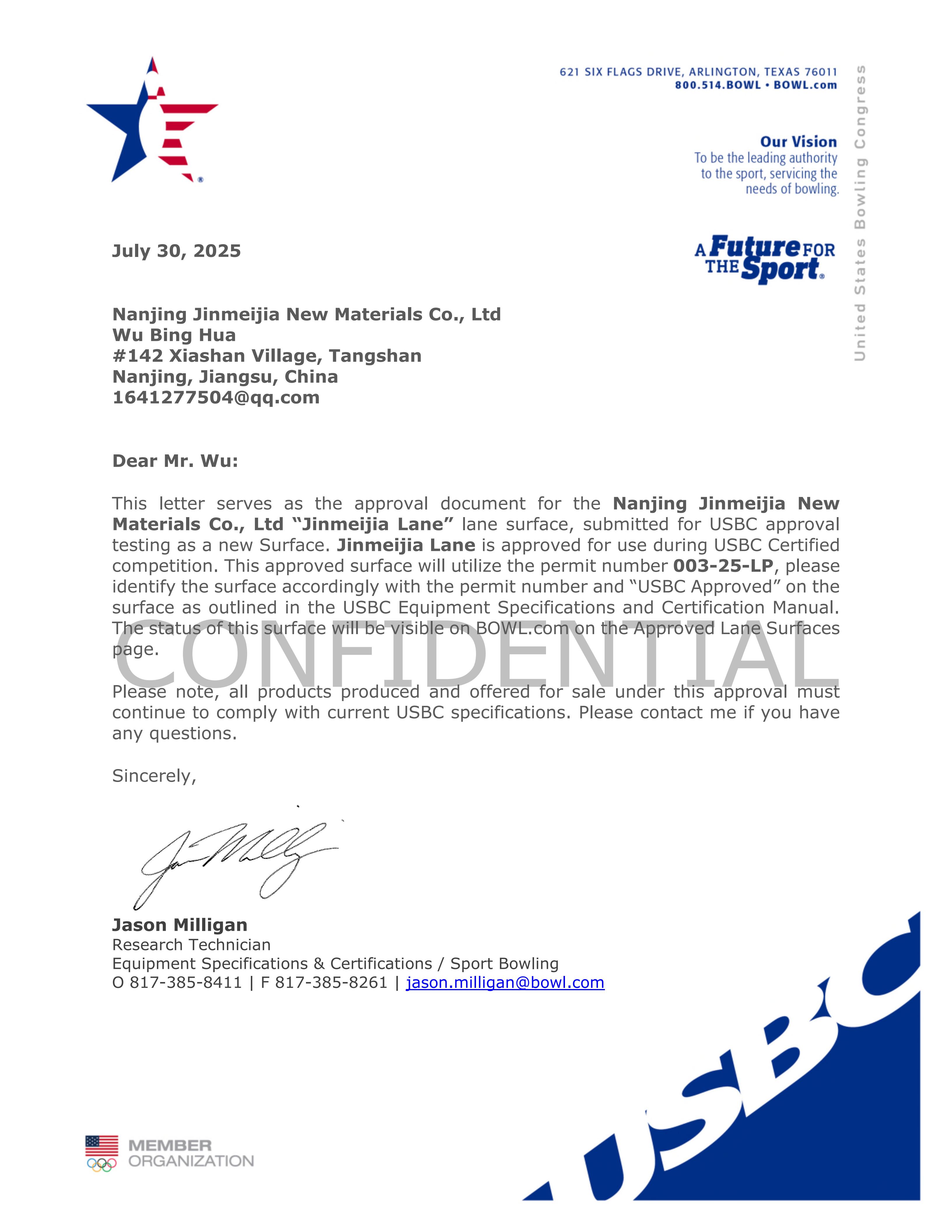
USBC record 003-25-LP — issued 30 July 2025 by the United States Bowling Congress for the US and North American market.
Applying the map to venue formats
The weight a buyer places on each record depends on where the venue sits and who it serves.
For a European entertainment venue, LVD, MD and RoHS are market-access conditions, and the USBC record is a playing-standard reference rather than a legal requirement. SunEye's EU-side project record includes an 8-lane standard bowling installation for Center World in Salerno, Italy, delivered as a turnkey system, and a 12-lane installation inside an 8,000 m² family entertainment center in Spain that also operates trampolines, attractions and party facilities. In both cases the equipment file, not the marketing page, is what a local inspector will ask for.
For a North American venue with league ambitions, the calculation inverts: USBC conformity becomes the operating question, and EU directive records are supporting documentation. Venues in this position should verify the certificate number, the scope wording and the pinsetter type before signing, and should keep the USBC specification reference for string pinsetters on file.
For mixed-format and non-standard sites, the constraint is usually spatial rather than regulatory. A 4-lane standard bowling project delivered for an amusement park in Tongchuan, China, was installed inside a large aluminum-frame tent as part of a wider recreational complex — a configuration in which structural and installation engineering, not product certification, dominates the risk profile. Mini bowling at 13 m and duckpin at 10 m reduce the footprint further, which is why compact formats appear more often in bars, restaurants, family entertainment centers and shopping venues where a 25.5 m standard lane bank will not fit.
Market trend: standards-led procurement
Two verifiable signals point in the same direction.
The first is the formalisation of string-pinsetter specifications. USBC Chapter 95's 54-inch minimum string length, effective 1 August 2023, is a technical rule that did not exist in the free-fall era and that now shapes machine design for any supplier targeting sanctioned play. When a governing body writes a dimensional rule into its equipment specification, procurement conversations move from brochures to documentation.
The second is tariff transparency. Under the US Harmonized Tariff Schedule, subheading 9504.90.9060 covers bowling pin setter machine parts and accessories at a free rate of duty, as published by the US International Trade Commission. Classification clarity of this kind makes landed-cost modelling possible — and once landed cost is modelled properly, buyers tend to scrutinise the rest of the supplier file with the same rigour.
A caution belongs here. Publicly available market-size estimates for the global bowling market diverge substantially between commercial publishers, and the divergence is large enough to suggest different product scopes rather than different growth assumptions. Buyers building a business case should treat headline market figures as directional context and rely instead on verifiable inputs: certificate records, reference installations, quoted terms and site-specific demand modelling.
Future outlook
Compliance documentation in this category is moving from a badge to a data set. Three developments are plausible on current evidence.
Model-level traceability is likely to become the default expectation. As buyers learn that certificate scope wording can be narrower than a product list, requests for annexes that name the exact model, serial range and lane configuration will become routine in RFQs. Suppliers that already hold numbered, dated, standard-specific records are better positioned for that shift than suppliers holding a generic CE statement.
Validity management will move into contract terms. The EU records in this file expire on 4 August 2030; a venue operating on a ten-year-plus horizon will need a contractual mechanism for recertification and document handover, not just a document pack at delivery.
And the boundary between equipment conformity and installed-system conformity will attract more attention as multi-format venues — bowling plus trampolines, ropes courses, dining — become more common. In those projects, the compliance question is rarely about a single machine; it is about how certified equipment, installation quality and venue licensing fit together. Suppliers that can speak to all three, rather than only the first, will be the ones whose files survive inspection.
FAQ
What does a USBC certification actually cover on bowling equipment?
A USBC record certifies conformity with the USBC Equipment Specifications and Certification Manual for the items named on the certificate, for the US and North American market. The SunEye record 003-25-LP, issued on 30 July 2025, names a bowling lane surface as its stated scope. It addresses playing-standard conformity only, and does not test electrical safety, machinery guarding or restricted substances.
Does USBC approval mean a product is legal to sell in the European Union?
No. USBC approval and EU market access are separate systems with different authorities and different risk scopes. Placing bowling equipment on the EU market depends on conformity with applicable EU directives — typically the Low Voltage Directive for the electrical assembly, the Machinery Directive for the mechanical assembly, and the RoHS directive for restricted substances — supported by the corresponding records and technical documentation.
What is the difference between CE marking, LVD and MD?
CE marking is the visible declaration that a product meets the applicable EU directives. LVD and MD are two of those directives. LVD covers electrical safety and electromagnetic compatibility, evidenced for SunEye by record M.2025.2026.C123854 citing EN IEC 60335-1:2023+A11:2023, EN IEC 61000-3-2, EN IEC 61000-3-3, EN IEC 55014-1 and EN IEC 55014-2. MD covers machinery safety, evidenced by record M.2025.2026.C123751 citing EN 60204-1:2018/A1:2025 and EN ISO 12100:2010.
Which SunEye product types are named on the USBC, LVD, MD and RoHS records?
The USBC record 003-25-LP names Standard Bowling Equipment, Mini Bowling Equipment, Duckpin Bowling Equipment and the Bowling Ball Return System among its related products. The LVD, MD and RoHS records issued by UDEM name Standard Bowling Equipment, Mini Bowling Equipment and Duckpin Bowling Equipment. The Standard Bowling Pin is listed as USBC-certified in its product data. No separate component-level certificate for the string pinsetter machine or the scoring system appears in the records reviewed.
How long are the LVD and MD records valid?
Both records were issued by UDEM in August 2025 and expire on 4 August 2030, as does the RoHS attestation. The USBC record 003-25-LP, issued 30 July 2025, does not carry an expiry date in the record. Buyers should confirm current validity against the original document at the time of order and again at delivery, and should establish who is responsible for recertification during the venue's operating life.
What should a buyer request from a supplier to verify compliance claims?
Request the original certificate for each claim, and check five fields on each: issuing body, certificate number, stated scope, harmonised standards cited, and validity dates. Then request an annex or written confirmation that the exact model, lane count and configuration being purchased fall within that scope. Finally, separate equipment conformity from installed-system conformity by confirming responsibility for lane installation, power distribution, commissioning and local inspection in the supply contract.
SunEye Bowling company profile, including product range and service scope, is available as a downloadable document: Suneye Company Profile 2026.
¿Tiene preguntas o necesita más detalles?
Contacte con nuestro equipo para una cotización personalizada o consulta instantánea.
Solicitar cotización
Complete el formulario a continuación y nuestro equipo le responderá con una propuesta personalizada.
Chat directo de WhatsApp
¿Prefiere chatear en tiempo real? Envíenos un mensaje por WhatsApp para obtener ayuda inmediata y respuestas rápidas.
- Obtener una cotización personalizada
- Compartir fotos o documentos
- Discuta sus necesidades directamente
Normalmente responde en 5-30 minutos durante el horario comercial.