
Boron Nitride 8233 Qualification: Build the Compliance File
Boron Nitride 8233 Qualification: Build the Compliance File
A qualification file for BORON NITRIDE Product 8233 is built from three inputs a buyer controls: the written purchasing terms, the supplier's stated acceptance criteria, and records taken from the buyer's own working conditions. Certificates issued for a different product are not one of those inputs. That is why a usable file opens with a scope statement rather than a folder of PDFs.
Sumetech Industry Co., Ltd supplies both boron nitride and potassium aluminium fluoride product lines, and exports roughly 90% of its output with Turkey, Japan, Korea and Europe listed among its main markets. In this evidence set, the RoHS documentation — RoHS Test Report RKEYS251215033 and RoHS 2.0 Verification of Conformity CKEYS251222003, both issued by Guangdong KEYS Testing Technology Co., Ltd. — is scoped to Potassium Aluminum Fluoride, product code 8235. Placing that report in a boron nitride file without reading the scope produces the appearance of compliance, not the substance of it.
What a Product 8233 Qualification File Is — and What It Is Not
A qualification file is a controlled record that answers one question for an auditor, an engineer or a customer: on what written basis was this material accepted into this process? For Product 8233 it should hold the order specification, the supplier's declared parameters for the exact form supplied, the application and storage requirements, the compliance documents with their stated scope, and the buyer's own verification results. It is not a marketing brochure, and it is not a single certificate.
Product 8233 is offered in four commercial forms — powder, granular, coating and paint — and the supplier's parameter set groups these with boron nitride ceramic, boron nitride fiber, BN coating and boron nitride painting. One file can cover the family only if each form carries its own line of criteria. A purity figure of up to 99.9% describes a powder grade; it does not describe the adhesion of a sprayed film to a particular mould steel. A maximum working temperature describes the material; it does not describe a finished coating on a specific substrate under a specific thermal cycle.
The practical consequence is that buyers should resist the shortcut of one approval covering every boron nitride purchase. The acceptance criteria are form-specific, and the file should say so in its first paragraph.
The Certificate-Assumption Gap: Reading the PAF Documentation Correctly
The most common defect in a high-temperature materials file is not a missing document. It is a document that applies to something else. The RoHS paperwork available here illustrates the point precisely, and it is worth reading line by line.
The RoHS Test Report numbered RKEYS251215033, issued by Guangdong KEYS Testing Technology Co., Ltd., covers the restrictions set by the RoHS Directive 2011/65/EU and its amendments including Directive (EU) 2015/863. Its stated scope is Potassium Aluminum Fluoride, also written as Potassium Fluoroaluminate, Fluoride Potassium Aluminate, Potassium Cryolite or Potassium Tetrafluoroaluminate, in white or gray forms. The referenced test methods are IEC 62321-3-1:2013, IEC 62321-4:2013 +AMD1:2017, IEC 62321-5:2013, IEC 62321-6:2015, IEC 62321-7-1:2015, IEC 62321-7-2:2017 and IEC 62321-8:2017. Both the test report and the RoHS 2.0 Verification of Conformity carry an issue date of 2025-12-22 and an expiry date of 2099-12-22, apply to the EU market, and relate to product code 8235.
Nothing in that description names boron nitride, and nothing in it names Product 8233. The correct entry in a qualification file is therefore a two-line record: the document identity and issue details on one line, and its verified scope on the other. A file that records only the first line is the file that fails at the customer audit, because the scope field is exactly where an auditor looks.
Two further distinctions belong beside that entry. Sumetech's own published company information states that its laboratory has passed CMA (China Measurement Certification) and CNAS (National Laboratory Accreditation); that describes laboratory capability, not a product certification for 8233, and it should be filed as supplier capability evidence. Separately, boron nitride as a substance is described in third-party regulatory references as compliant with EU REACH under Regulation EC 1907/2006 for industrial applications; a substance-level statement of that kind is background context and does not substitute for a supplier declaration naming Product 8233. Both records are useful. Neither is a substitute for the other, and a qualification file should keep them in different sections.
Acceptance Criteria to Fix in Writing Before Price and Lead Time
The purchasing terms are the spine of the file. Where a criterion is left to assumption, the assumption — not the material — becomes the thing tested on the shop floor. The table below maps the criteria that Product 8233 buyers can actually anchor to supplied parameters, and identifies where files usually break.
| Criterion | What the file should state | Where the evidence comes from |
|---|---|---|
| Product form | Powder, granular, coating or paint, with packaging and lot reference | Supplier specification and delivery note |
| Purity | Grade specified, noting that up to 99.9% is a maximum rather than a per-lot value | Lot certificate of analysis |
| Working temperature | 900 °C in air; 2000 °C+ in inert gas, with the intended atmosphere written beside it | Supplier parameter sheet |
| Application method | Brush or spraying machine, named explicitly in the order | Supplier application instruction plus buyer trial record |
| Storage | Keep dry and sealed, with the receiving condition recorded | Supplier handling requirement and goods-in check |
| Expiration control | Use before the expiration date on the delivered lot | Supplier label plus internal stock rotation log |
| Operating conditions | The buyer's actual working conditions, because operation is subject to those conditions | Buyer process data |
| Quality control | The declared 100% test statement and how lots link to records | Supplier quality statement |
| Compliance documents | Document number, issuing body, issue date and verified scope | Supplier document set |
| Commercial terms | Minimum order quantity of 10 kgs and the stated 30-day lead time | Quotation and order confirmation |
Read the third column as a sourcing instruction rather than a formality. Each row tells the buyer which document to request and which internal record to attach. A file that contains the criterion but not the evidence is a wish list; a file that contains both is a control.
Reading the Temperature Envelope: 900 °C in Air, 2000 °C+ in Inert Gas
The maximum working temperature for Product 8233 is stated as 900 °C in air and 2000 °C+ in an inert gas atmosphere. Those are two claims under two different conditions, and they must not be averaged, combined or transferred between atmospheres. A furnace with a nitrogen or argon purge and a furnace open to air are different service environments even when they sit in the same plant.
The air figure is the ceiling of the stated claim, not a comfortable operating target with headroom built in. Where a process approaches that ceiling, the qualification file should record the measured peak temperature at the coated surface, the atmosphere actually present, and how that atmosphere is controlled and verified during the cycle. Where the process runs under inert gas, the file should record the same three items against the 2000 °C+ statement rather than assuming the air figure covers it.
This is also where the distinction between material property and finished part matters most. The temperature values describe boron nitride under the stated conditions. They do not describe how a coating behaves on a substrate that expands at a different rate, in a thermal cycle that includes quench or mechanical load. The file should separate the two, and the internal test record — not the supplier sheet — is what closes that gap.
Application Method as an Acceptance Variable: Brush or Spraying Machine
Product 8233 coating is specified with brush and spraying machine as the matched application equipment. Those are two different deposition processes, and the acceptance criteria should say which one the buyer intends to qualify. An approval covering a brushed film does not automatically extend to a sprayed film on the same component, because film formation, coverage and surface condition differ between the methods.
The supplied parameter set does not state dilution ratios, film thickness targets or drying and curing schedules for either method. That absence is itself a fact worth recording: it means those parameters must come from the supplier's application instruction or from the buyer's own trial, not from an assumption carried over from a different coating line. A qualification file that quietly fills those blanks with borrowed numbers is more dangerous than one that lists them as open items with an owner and a due date.
For a spraying operation, the useful record is the equipment identification, the operator, the pass count and the substrate preparation used on the qualification coupon. For brushing, the same set applies with the tool and stroke pattern in place of the machine settings. Both records should be signed against a date and a lot number, because the value of the file is that a future batch can be compared with the approved one.
Storage, Sealing and Expiration-Date Control
Product 8233 carries two explicit handling requirements: keep dry and sealed storage, and use before the expiration date. Both are easy to sign for and easy to lose control of, because neither is visible in the finished part until it becomes a defect.
The qualification file should therefore capture the requirement and the control together. The requirement is the supplier's wording. The control is the buyer's: where the container is stored, how sealing is maintained between withdrawals, who is authorised to issue stock to production, and how the expiration date on the delivered container is translated into an internal hold date with a margin. A well-run file shows stock issued in date order and shows what happens to material that reaches its date without being consumed.
The operation clause belongs in the same section. Product 8233 is specified for operation subject to actual working conditions, which is a deliberate statement that the supplier is not asserting a single universal operating recipe. For the file, that translates into a duty: document the actual conditions of the line — atmosphere, thermal profile, substrate, application method, cycle time — and treat a change in those conditions as a change requiring re-qualification rather than an equipment note.
Where Product 8233 Fits: Foundry Release, Glass, Semiconductor and Aerospace
The functional case for boron nitride rests on a small number of properties that recur across very different industries: stability at high temperature, a graphite-like layered structure with low friction, chemical inertness with non-wetting behaviour against most molten metals and chemicals, and good thermal conductivity combined with electrical insulation and a low dielectric constant. Each property maps to a different acceptance criterion, which is why the same product number can appear in foundry, glass, semiconductor and aerospace files with quite different test records.
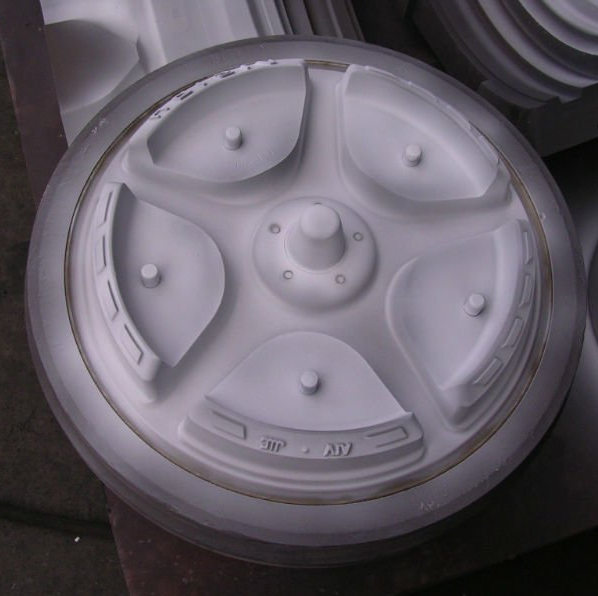
In foundry and metal forming, BN coatings are used on moulds, troughs and ladles handling aluminium, magnesium and zinc alloys to support release and reduce sticking. A supplied case record describes a manufacturer in Turkey using 200 kgs of Product 8233 for wheel hub demoulding over one year, with the reported result that adhesion is effectively prevented, attributed to the material's soft texture and low coefficient of friction. In glass processing and optical glass work, boron nitride acts as a release layer on forming moulds, where surface defects and cleaning downtime are the cost drivers. In semiconductor thermal management it appears as a thermally conductive, electrically insulating filler and as a coating where dielectric behaviour matters. In aerospace and military applications, and in sintering and heat treatment, it serves as a high-temperature barrier — including coatings applied to graphite plates to prevent carbon contamination and bonding between workpieces and fixtures.
Fit Boundaries and What the Case Record Does Not Prove
A credible qualification file contains a limitations section, and Product 8233 is no exception. The first boundary is form: coating, paint, powder, granular material and boron nitride ceramic are different products with different acceptance chains, and a file approved on a powder lot should not release a coating batch without its own criteria. The second is mechanical role: boron nitride is selected for release, lubrication, thermal and dielectric functions, not as a structural or wear-resistant load-bearing material, and a coating should not be specified as a substitute for a machined ceramic component.
The third boundary concerns evidence. The Turkey wheel-hub record is a single supplied case covering one application, one quantity and one year. It indicates that the material performed in that setting; it does not establish that the same result will occur in a different alloy, die geometry, thermal cycle or application method. Filed as a reference case with its scope attached, it is useful supporting evidence. Filed as a performance guarantee, it is a liability.
The fourth boundary concerns comparison. Where a BN coating is chosen partly to avoid carbon transfer — for example on sintering fixtures — the file should state the comparison that was actually made and the conditions under which it was made. No head-to-head test data against alternative release systems is supplied here, so a qualification file built on this evidence set can record documented characteristics and the buyer's own trial results, but it cannot assert superiority over another supplier's product.
Supplier Evidence to Attach Behind the Criteria
Acceptance criteria are only as good as the supplier's ability to meet them repeatably, so the file should carry a supplier section alongside the product section. For Sumetech Industry Co., Ltd, the documented position includes OEM and ODM production, customisation of size and colour, a minimum order quantity of 10 kgs, a stated lead time of 30 days, 100% testing as the declared quality-control approach, and both remote and on-site after-sales support. Export markets are listed as the EU, the Middle East and Asia, alongside the wider market list of Turkey, Japan, Korea and Europe.
Each of those items should be attached to a specific criterion rather than listed as general reassurance. The 10 kgs minimum supports a trial-lot plan for a new application. The 30-day lead time belongs in the supply-continuity section, where a buyer records how much buffer stock is required to cover it. The 100% test statement is only meaningful when linked to lot identification, so the file should state how the buyer receives and stores that record. Customisation of size and colour is relevant where the qualification covers a specific particle size or a colour-matched coating, and irrelevant where it does not.
Why Third-Party Market Numbers Need the Same Discipline
Buyers often use market data to justify a supplier approval or a stocking decision, and the same scope discipline applies. Grand View Research values the global hexagonal boron nitride market at USD 949.4 million in 2024, with Asia Pacific holding a 40.6% revenue share and China accounting for 41.1% of the Asia Pacific figure. Paint coatings are reported as the largest application segment at a 32.8% share in 2024 — a relevant signal for a product that is sold as a coating, paint, powder and granular material.
The caution is that published estimates for this category diverge sharply: one alternative estimate cited in the same comparison places the 2024 market at USD 192.96 billion, a figure roughly two orders of magnitude larger and almost certainly defined across a broader set of boron-based chemicals rather than boron nitride powder and coatings. Neither number belongs in a qualification file as a performance claim. Where market context is included at all, it should be dated, attributed and marked as a third-party estimate whose definition was checked. That is the same standard the file applies to certificates.
The File in Ten Sections: A Build Order
Assembling the document is easier with a fixed order, because each section answers the question the next one assumes.
- Scope statement — which forms of Product 8233, which site, which process and which period the file covers.
- Product identity — form, grade, packaging, lot numbering and the parameters declared in the supplier's specification.
- Performance envelope — 900 °C in air, 2000 °C+ in inert gas, with the intended atmosphere named, and the up-to-99.9% purity grade recorded as a maximum.
- Application record — brush or spraying machine, equipment, operator and qualification coupon results.
- Storage and expiration control — dry sealed storage, issue rules, hold dates, and the disposal route for expired stock.
- Compliance documents — document number, issuing body, issue and expiry dates and, critically, the verified scope of each document.
- Quality and traceability — the 100% test statement, lot linkage and the buyer's incoming inspection results.
- Reference cases — such as the Turkey wheel-hub record, filed with quantity, duration and application scope attached.
- Limitations and open items — what the evidence does not cover, with an owner and a review date for each open item.
- Revision log — what changed, when, and on whose approval, since a change of atmosphere, substrate or application method is a re-qualification trigger.
Two sections carry disproportionate weight in practice. The scope statement prevents the certificate-assumption error described earlier, and the limitations section prevents the file from being read as a guarantee. A file with those two sections in place is already more defensible than most, even before the test data is complete.
Frequently Asked Questions
What documents should a Product 8233 qualification file contain?
The file should contain the written order specification for the form being purchased, the supplier's declared parameters for that form, the application method and matched equipment, the dry sealed storage and expiration-date requirements, the compliance documents with their verified scope, the declared quality-control statement with lot linkage, and the buyer's own trial or inspection records. Reference cases may be included when their scope is stated alongside them.
Does the RoHS certificate issued for Potassium Aluminum Fluoride cover Boron Nitride 8233?
No. The RoHS Test Report RKEYS251215033 and the RoHS 2.0 Verification of Conformity CKEYS251222003, both issued by Guangdong KEYS Testing Technology Co., Ltd., are scoped to Potassium Aluminum Fluoride — also written as Potassium Fluoroaluminate, Fluoride Potassium Aluminate, Potassium Cryolite or Potassium Tetrafluoroaluminate — and relate to product code 8235. They name neither boron nitride nor Product 8233. A buyer requiring RoHS documentation for 8233 should request product-specific documentation and record its number, issuing body, issue date and scope in the file.
What is the maximum working temperature of Product 8233, and in which atmosphere?
The stated maximum working temperature is 900 °C in air and 2000 °C+ in an inert gas atmosphere. These are separate claims under separate conditions and should be recorded that way. The intended atmosphere, the measured peak temperature at the working surface and the method of atmosphere control belong beside the figure in the file.
Which application methods are specified, and what should be recorded for each?
Brush and spraying machine are the matched application equipment. Because the supplied parameter set does not state dilution ratios, film thickness targets or drying and curing schedules for either method, the file should record the method named in the order, the equipment and operator, the substrate preparation, the coupon results, and the source of any application parameter that the buyer adopts. Parameters established for one method should not be applied to the other without a fresh trial.
How should Product 8233 be stored, and how is the expiration date controlled?
Storage is keep dry and sealed, and material should be used before the expiration date. In practice this requires the file to record where and how the container is sealed between withdrawals, who may issue stock to production, how the delivered expiration date becomes an internal hold date, and what happens to material that reaches that date unconsumed.
A Qualification File Is a Working Document
The reasonable conclusion for a buyer at the research and evaluation stage is that Product 8233 can be qualified on a documented basis, but only if the file distinguishes four things that are often merged: what the supplier states about the material, what the supplier's documents actually cover, what the buyer's own conditions require, and what the buyer has tested. The first two come from the supplier. The last two can only come from the buyer.
That separation also gives the file a useful life beyond the first purchase. When a process changes atmosphere, substrate or application method, the affected sections are identifiable and can be re-opened without rebuilding the whole document. When a supplier document is superseded, the scope line makes the replacement obvious rather than ambiguous.
A downloadable catalogue of Sumetech's product range is available at the Sumetech 2026 catalogue for buyers who need the wider product context before drafting acceptance criteria.
¿Tiene preguntas o necesita más detalles?
Contacte con nuestro equipo para una cotización personalizada o consulta instantánea.
Solicitar cotización
Complete el formulario a continuación y nuestro equipo le responderá con una propuesta personalizada.
Chat directo de WhatsApp
¿Prefiere chatear en tiempo real? Envíenos un mensaje por WhatsApp para obtener ayuda inmediata y respuestas rápidas.
- Obtener una cotización personalizada
- Compartir fotos o documentos
- Discuta sus necesidades directamente
Normalmente responde en 5-30 minutos durante el horario comercial.