
Blister-to-Cartoner Integration: Technical Q&A for Buyers
Blister-to-Cartoner Integration: Technical Q&A for Buyers
Blister-to-Cartoner Integration: Technical Q&A for Buyers
In solid dosage manufacturing, a blister packaging machine and a cartoning machine are typically purchased as two machines but operated as one process. That gap — between how integrated blister-cartoning equipment is bought and how it actually runs — is where most technical procurement questions originate: where the control boundary sits, how blisters are handed over, and what happens when one section runs faster than the other. This article answers the questions buyers raise during early evaluation of an integrated blister packaging line, using the documented architecture of the HOPING DHL-series blister-cartoner platform as the reference case.
What "Integrated" Actually Means in a Blister Packaging Line
In an integrated blister packaging line, blister forming, sealing, blister transfer, leaflet folding, carton opening, carton filling and closing are engineered as a single controlled sequence rather than as two independently controlled machines joined by a conveyor. The primary packaging stage produces the blister; the secondary packaging stage places that blister into a carton. Integration means the handover between those two stages is a designed, monitored, and reject-handled step.
This matters at the procurement stage because the specification boundary shifts. In a separated configuration, the buyer specifies two machines and a conveyor, and the interface is largely mechanical. In an integrated blister-cartoning line, the interface is simultaneously mechanical, timing-based and data-based — which means it must be specified, quoted, and acceptance-tested as part of the equipment scope.
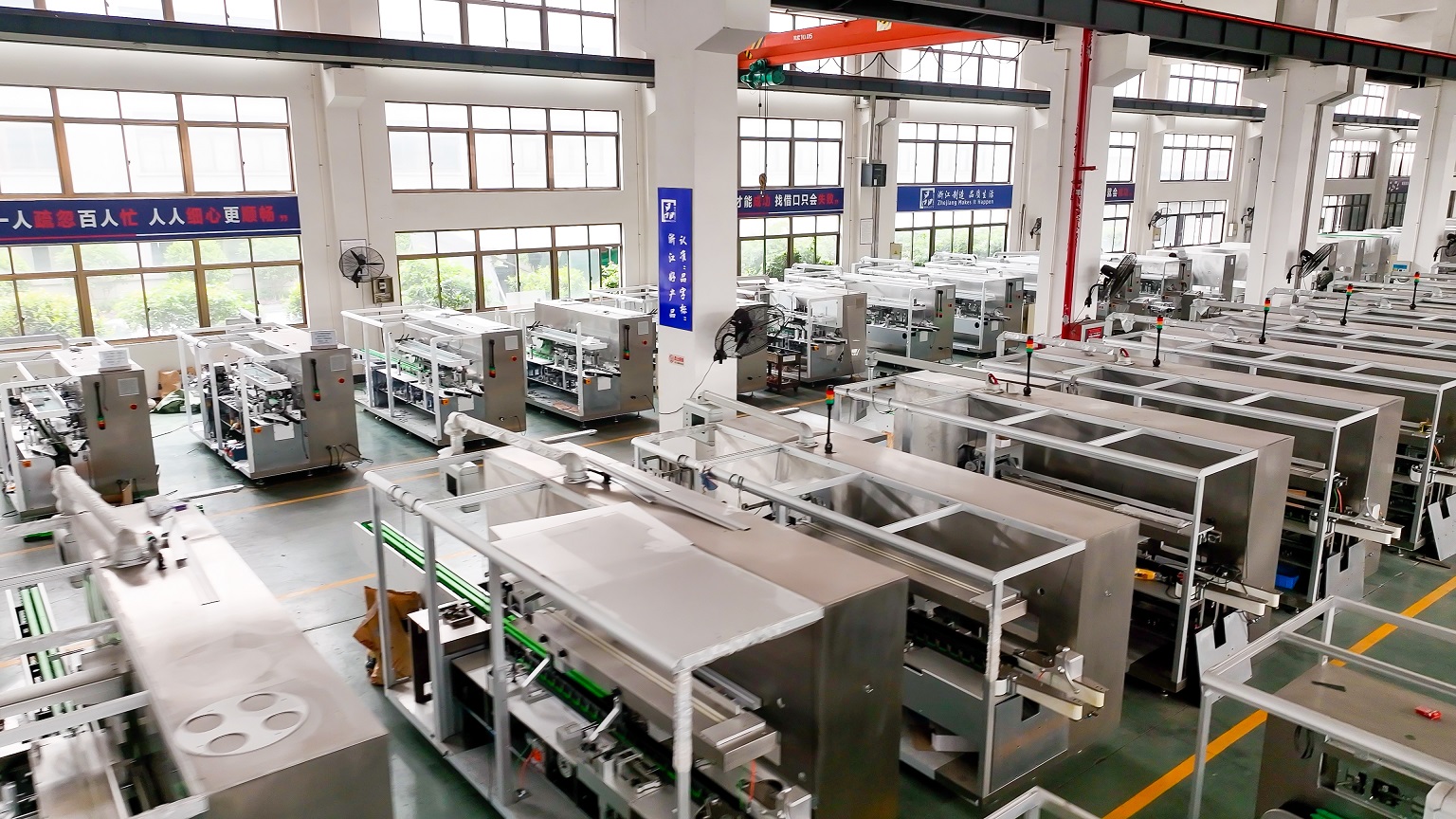
HOPING (Zhejiang Hoping Machinery Co., Ltd.), a pharmaceutical packaging machinery manufacturer based in Ruian City, Zhejiang Province, China, and established in 2001, presents blister packaging, cartoning, inspection and end-of-line automation as components that can be engineered as one packaging process. Its documented line scope includes blister packing, cartoning, flow packing, case packing and palletizing equipment, with a stated annual output of 500 units from a 28,800 m² facility and a 25% export share.
Question 1: How Do the Blister Machine and Cartoner Communicate?
The most frequent early-stage question is whether the two sections share a controller or simply exchange start/stop signals. The answer determines how much of the line the buyer is actually buying as one system.
Signal handover at the transfer point
At minimum, an integrated line exchanges three classes of signal at the blister-to-cartoner transfer: product-present (a blister or blister group is at the transfer position), cartoner-ready (carton magazine, leaflet folder and insertion station are in a state that can accept product), and reject/divert (a defective blister or a defective carton must be removed without disturbing downstream flow). When these signals are exchanged between two independent controllers, small timing mismatches accumulate into micro-stops. When they are handled inside one motion architecture, the transfer is a synchronised axis rather than a handshake between peers.
Recipe and batch data handover
A second communication layer concerns format and batch data. Carton size, leaflet format, blister pitch, coding content and rejection criteria all change between products. In a line where each machine stores its own recipe, a format change requires two independent changeovers and a reconciliation step. In a line with a shared recipe memory and mould-change support, the format is a single parameter set applied across forming, sealing, transfer and cartoning. Buyers evaluating a pharmaceutical packaging line should ask which of these two models the quotation describes.
What to require as evidence
Because communication architecture is difficult to assess from a brochure, the practical procurement step is to require a signal list and a control topology drawing in the technical offer, and to require that the factory acceptance test demonstrate a fault injected at the cartoner (for example, carton magazine empty) produces a defined, documented response at the blister former. That single test separates a genuine integrated design from two machines placed side by side.
Question 2: Why Does a Blister-Cartoning Line Need Buffering?
Buffering exists because the two stages rarely run at identical instantaneous rates, even when their nominal capacities are matched. Blister output is usually expressed in blisters per minute; cartoning output in cartons per minute. The ratio between them depends on how many blisters are packed per carton, which changes with the product and the market.
Three mechanisms are used to absorb that difference, and buyers should know which one a proposed line uses:
- Mechanical accumulation — a buffer section between the punch station and the transfer point holds a controlled number of blisters, allowing short cartoner stoppages to be absorbed without stopping the former.
- Synchronised transfer — a top-loading transfer device moves blisters directly into the carton chain in a fixed phase relationship, eliminating accumulation but making the transfer itself the critical timing element.
- Speed derating — the line runs the faster stage below its maximum so that the slower stage sets the pace, which is simple but leaves capacity unused.
The HOPING DHL-series architecture illustrates the second approach. The DHL1000/5H is documented with a D3 intelligent top-loading parallel tracking transfer system and a four-channel servo-driven independent replenishment system, together with PVC/Alu foil auto splicing. In plain procurement terms, the transfer is a servo-synchronised axis and the replenishment is separated into channels, so that a gap in one channel does not stop the whole line.
Question 3: What Does a 500 Cartons/Minute Rating Actually Tell a Buyer?
A capacity figure is a starting point, not an answer. HOPING's published packaging-line page reports a maximum of 1,000 blisters per minute and 500 boxes per minute for a line configuration. That same figure appears in the DHL1000/5H documentation, which states a maximum capacity of up to 1,000 blisters/min and 500 cartons/min.
Three qualifications belong next to any such number:
- Maximum versus sustained. Published line speeds are maximum figures. Sustained output depends on product format, blister count per carton, rejection rate and operator intervention.
- Format dependence. A line rated at 500 cartons/min on one carton size will not hold that rate on every carton in the format range.
- Line balance, not line peak. If the cartoner runs at 500 cartons/min but the blister former can only feed it at a lower effective rate for a given blister count per carton, the line output is set by the former.
The correct procurement action is therefore to request a line-balance calculation for the buyer's own blister count per carton, together with a sustained-output commitment tied to a defined format and a defined acceptance test.
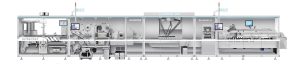
DHL-series integrated blister-cartoning platform, where blister forming, sealing, transfer and cartoning are engineered as one controlled sequence.
Question 4: What Should the Control Architecture Look Like?
Control architecture is the least visible and most consequential part of an integrated line. The relevant question is not which brand of controller is used, but whether the controller is fast enough and open enough to synchronise forming, sealing, punching, transfer and cartoning in one deterministic cycle.
The DHL1000/5H documentation specifies a Beckhoff motion controller and a high-bus industrial control system, along with mould-change and recipe memory functions and a GMP-oriented design. For a buyer, each of these has a practical reading:
| Architecture element | What it changes for the buyer |
|---|---|
| Motion controller with high-bus control system | Servo axes across forming, transfer and cartoning can be phased from one cycle model, reducing handshake delays at the transfer point. |
| Mould-change support | Format changes are a tooling and parameter exercise rather than a re-engineering exercise; ask for the changeover time per format pair. |
| Recipe memory | Reduces operator-dependent setup error between batches; ask how recipes are protected and audited. |
| HMI and alarm handling | Determines how quickly a stoppage is diagnosed; ask whether alarms identify the originating station or only the symptom. |
| GMP-oriented design of contact parts | Affects cleaning validation effort; ask for the material schedule for product-contact parts. |
The DHL8005H sits within the same integrated blister-cartoner family as the DHL1000/5H and is listed by the manufacturer as an automatic blister-cartoning line. Where a buyer's specification depends on a specific architecture element — Beckhoff control, top-loading transfer, independent replenishment — that element should be confirmed in writing against the exact model being quoted, because model designations within a series do not automatically share every subsystem.
Question 5: Which Integration Questions Are Most Often Left Out of an RFQ?
In practice, most integration failures trace back to requirements that were never written down rather than to equipment that failed. The following items are frequently absent from first-round enquiries for a blister cartoning line:
| Interface topic | Question to put in the RFQ |
|---|---|
| Control boundary | Which controller owns the transfer axis, and which HMI displays line-level alarms? |
| Reject handling | Where are defective blisters removed, and is carton rejection verified downstream? |
| Buffer behaviour | How many seconds of cartoner stoppage can the line absorb before the former stops? |
| Coding and data | Where is the batch/date code applied, and can coding content be driven from a recipe rather than re-keyed? |
| Format change | What is the documented changeover time for a blister-and-carton format pair, with how many operators? |
| Downstream connection | What signals are available to a bundler, case packer or palletizer, and in what protocol? |
Where Integrated Blister-Cartoning Lines Fit
HOPING documents cartoning machines for blister packs, tablets, syringes and medicine bottles, and blister machines covering flat-plate, roller-type aluminium-plastic and aluminium-aluminium formats. That combination points to the applications where an integrated line is most often specified:
- High-volume solid dosage production — tablets, capsules and soft capsules where a single format runs for long campaigns and line balance can be optimised once.
- Nutraceutical and healthcare products — where blister plus carton is the standard commercial presentation and manual transfer is the main labour cost.
- Contract manufacturing environments — where multiple products share one line and format changeover speed, recipe memory and documented cleaning become selection criteria.
- Lines intended for downstream extension — where bundling, case packing and palletizing are planned later and the cartoner must expose the signals to support them.
The common thread is campaign length. Integrated lines reward buyers who can describe a stable product mix; they penalise buyers who need to change format several times per shift on equipment specified for a single dominant format.
What the Market Data Suggests
Two published data points frame the category. Horizontal cartoning systems held 70.12% of cartoning machine market share in 2024, according to Mordor Intelligence — meaning the horizontal format that dominates pharmaceutical secondary packaging is also the format most integrated blister-cartoning lines are built around. Separately, Custom Market Insights values the global blister packaging machine pharmaceutical market at USD 2.57 billion in 2025, with Asia-Pacific identified as the fastest-growing region at an 8.87% CAGR to 2031.
A broader figure from Mordor Intelligence puts the pharmaceutical packaging machinery market at USD 7.09 billion in 2026, growing at a 7.15% CAGR toward USD 10.02 billion. That figure is a single-publisher estimate covering a multi-segment scope including filling, sealing, labelling, blister packaging and cartoning; it should be read as directional context rather than as a segment-level benchmark, since no source obtained here breaks the total down by equipment type.
On the regulatory side, ISO 15378:2017 specifies GMP requirements for primary packaging materials for medicinal products, and the U.S. FDA publishes cGMP guidance covering production and process controls. Neither source, in the form available, states machine-specific design clauses for a cartoner — which is precisely why buyers should ask suppliers for the qualification documentation they intend to hand to their own quality team, rather than assuming a certification mark answers the question.
A directional industry signal worth noting: trade coverage of PMMI content reports that pharmaceutical manufacturers are turning toward digitised data collection and integrated solutions to meet regulations and improve visibility. For line procurement, that trend translates into specifying data capture at the integration layer — batch code, rejection counts, stoppage reasons — rather than adding it after commissioning.
Where an Integrated Line Is the Weaker Choice
Integrated blister-cartoning is not automatically superior to a separated configuration, and buyers should weigh the trade-offs explicitly.
Single point of failure. In a separated line, a cartoner stoppage leaves the blister machine running and blisters accumulate or are packed manually. In an integrated line, a cartoner fault propagates upstream unless buffering is sized for it. Buyers should ask for the intended buffer depth in seconds and treat a short buffer as a real operational constraint, not a detail.
Format rigidity. An integrated line is optimised around a defined blister-and-carton pair. A plant that runs many small batches across widely different carton sizes may find a separated configuration — or a line with a wider documented format range — easier to schedule, even at the cost of manual transfer labour.
Commissioning and change control. Integrating forming, sealing, transfer and cartoning into one control system concentrates validation effort. A change to one station may require re-qualification of the line interface. Buyers in regulated markets should confirm with their quality function how the supplier's change-control documentation will support future modifications.
Footprint and access. Integrated lines concentrate mechanisms into a continuous enclosure. Maintenance access, cleaning routes and the space needed for tooling changes should be checked against the actual room layout, not the catalogue dimension.
Outlook
The direction of travel in solid dosage secondary packaging is toward fewer handovers and more specified interfaces. As controllers become capable of phasing more axes from one cycle model, the distinction between "blister machine" and "cartoner" increasingly becomes a commercial and validation boundary rather than a technical one. Buyers who write their RFQs around that boundary — signal lists, buffer depth, recipe ownership, acceptance criteria — will get comparable offers; buyers who specify only speeds will get comparable numbers and incomparable lines.
FAQ
Can the cartoner stop without stopping the blister former?
Only within the buffer capacity the line is designed for. In an integrated blister-cartoning line, a defined number of blisters can be held between the punch station and the transfer point; once that buffer is exhausted, the former stops. The buffer depth in seconds — not the buffer's physical size — is the figure to request, and it should be stated for the buyer's specific blister format and carton count.
Which controller owns the blister-to-carton transfer?
It depends on the line architecture, and it must be stated in the technical offer. In the HOPING DHL1000/5H documentation, a Beckhoff motion controller and high-bus industrial control system are specified for the line, with a D3 intelligent top-loading parallel tracking transfer system. Where the transfer is a synchronised servo axis within that architecture, the motion controller phases the transfer rather than a separate cartoner controller negotiating a handshake.
What does 500 cartons per minute mean for line balance?
It is the cartoning stage's stated maximum. HOPING's published line configuration reports a maximum of 1,000 blisters per minute and 500 boxes per minute. Whether the cartoner or the former sets the line rate depends on the blister count per carton: at a high count per carton, the former can become the constraint even though its nominal speed is higher. The buyer should request a balance calculation using their own blister-per-carton figure.
How are format changes handled on an integrated line?
Through tooling change plus stored parameters. The DHL1000/5H documentation specifies mould-change and recipe memory functions, which means a format change combines physical change parts with a recalled parameter set covering forming, sealing, transfer and cartoning. Buyers should ask for the documented changeover time for a specific format pair and the number of operators required, rather than accepting a general statement about fast changeover.
What GMP-related documentation should accompany an integrated blister-cartoning line?
The relevant frameworks are the GMP requirements for primary packaging materials (ISO 15378:2017) and the cGMP production and process control guidance published by the U.S. FDA. Neither establishes machine-specific design clauses in the material available here. In practice, buyers should request the material schedule for product-contact parts, cleaning and surface-finish documentation, the control system description, and the acceptance test protocol, so that their own quality function can map these to the applicable framework.
Can an existing blister machine be connected to a new cartoner?
It can be assessed, but the outcome depends on whether the existing machine exposes the required signals and whether its transfer point is mechanically compatible with the cartoner's infeed. Integration requires product-present, cartoner-ready and reject signals at minimum, plus a compatible transfer geometry. Where the existing machine's controller cannot provide these, the practical result is a mechanically linked but not integrated configuration, with manual or semi-automatic transfer between stages.
What should be tested at factory acceptance?
At minimum: sustained output over a defined run using the buyer's format, fault injection at the cartoner with the documented upstream response, reject verification at the transfer point, a full format change from one product to another, and confirmation that recipe recall reproduces the prior settings. These tests convert the integration claims in the offer into recorded evidence.
For readers who need the full equipment scope, HOPING publishes a downloadable catalogue covering blister packaging machines, cartoning machines, case packers and end-of-line equipment: Hoping Machinery Catalog (PDF).
¿Tiene preguntas o necesita más detalles?
Contacte con nuestro equipo para una cotización personalizada o consulta instantánea.
Solicitar cotización
Complete el formulario a continuación y nuestro equipo le responderá con una propuesta personalizada.
Chat directo de WhatsApp
¿Prefiere chatear en tiempo real? Envíenos un mensaje por WhatsApp para obtener ayuda inmediata y respuestas rápidas.
- Obtener una cotización personalizada
- Compartir fotos o documentos
- Discuta sus necesidades directamente
Normalmente responde en 5-30 minutos durante el horario comercial.