
Blister-to-Carton Lines Compared: A Buyer's Evaluation Guide

Fully servo rotary blister packing machine — the primary packaging stage that feeds an integrated blister cartoning line.
A blister-to-carton line is a linked production system rather than a single machine. It combines a pharmaceutical blister packaging machine that forms and seals the primary pack, a transfer stage that moves blisters from the blister machine into a cartoning machine, and a secondary packaging chain that can continue into bundling, case packing and palletizing. Buyers who compare lines only on published speed figures tend to miss the parts of the specification that decide whether the line really runs at the quoted rate inside a GMP-oriented workshop.
This buyer's guide sets out an evaluation framework for integrated blister cartoning lines: how to read capacity claims, what the motion control architecture implies for changeover and diagnostics, which construction details matter for cleaning and contamination control, what certification documents should cover, and where an integrated line stops being the right answer. Throughout, the technical documentation of one representative line — the DHL8005H blister-cartoner integrated machine from Zhejiang Hoping Machinery Co., Ltd. — is used as a worked example of what a verifiable specification looks like. It is a reference point for reading specifications, not a claim of supplier superiority.
Zhejiang Hoping Machinery Co., Ltd. (Hoping) is a pharmaceutical packing machinery manufacturer based in Ruian City, Zhejiang Province, China, established in 2001, producing blister packing machines, cartoners, case packers and end-of-line packaging equipment. Its relevance to this comparison is that its published line documentation contains the specific parameters — transfer architecture, control platform, contact materials and certification numbers — that a buyer needs in order to evaluate any blister cartoning line on evidence rather than on claims.
Why Blister-to-Carton Integration Became a Procurement Category
A pharmaceutical packaging line built around separate machines — a blister packaging machine, a standalone cartoner, and manual transfer between them — was for a long time the default configuration for solid dosage production. The shift toward linked blister cartoning lines follows the operational reality of GMP-oriented workshops: continuous high-speed operation, multi-batch and multi-format production, and a requirement for stability, easy cleaning, safety protection and traceability-oriented operation.
Documented project types in this segment reflect that shift. Typical projects include a new solid dosage blister packaging line, an upgrade of an existing packaging line, a high-capacity expansion, an intelligent packaging workshop retrofit, and an integration project that connects a blister-cartoning line to downstream bundling, case packing and palletizing equipment. In each case, the buyer is procuring a system in which the blister packaging machine, the automatic cartoning machine and the secondary packaging line must be specified together.
The function of an integrated line is therefore broader than the sum of its machines: it completes blister packaging, leaflet folding, carton opening, blister insertion, batch and date coding, inspection and rejection, and downstream connection, with the objective of improving automation and reducing manual transfer between stages. That definition is the starting point for comparison. If two suppliers quote the same line speed but one of them is describing a linked sequence and the other a set of machines that must still be interfaced on site, the two quotations are not comparable.
The Evaluation Criteria That Separate Comparable Lines
Comparisons become useful only when every supplier is asked the same questions and asked to attach the same evidence. The table below is a neutral framework; it does not favour any supplier, and it can be applied to European, North American or Asian line builders alike.
| Evaluation area | Question to ask | Evidence that should exist |
|---|---|---|
| Throughput | Are the blister and carton rates stated for the buyer's own format, or for a demonstration format? | Format drawings, cavity count, cartons-per-blister relationship |
| Transfer stage | How are blisters moved from the blister machine to the cartoner at full speed? | Transfer mechanism description and, on site, an observed transfer at rated speed |
| Product replenishment | How many independent replenishment channels exist, and what happens when one runs dry? | Channel count, servo architecture, alarm and fault-indication logic |
| Material handling | Is PVC or Alu foil splicing automatic, and how long does a roll change take? | Splicing station description and a changeover demonstration |
| Control platform | Which controller, industrial PC and HMI are used, and are spare parts available in the buyer's region? | Bill of electrical components, firmware policy, spares list |
| Construction | Which materials are used for product-contact and non-contact parts? | Material specification and material certificates |
| Format changeover | How are moulds changed and are settings stored? | Mould-change procedure, preset-memory function, tooling list |
| Inspection and rejection | Which defects are detected automatically and how are rejects handled? | Inspection scope, rejection logic, batch records |
| Downstream integration | Which bundling, case packing and palletizing units are matched to the cartoner output? | Line balancing calculation and buffer design |
| Compliance | Which certificate covers the exact model being purchased, and until when? | Certificate numbers, issuing bodies, standards, validity dates |
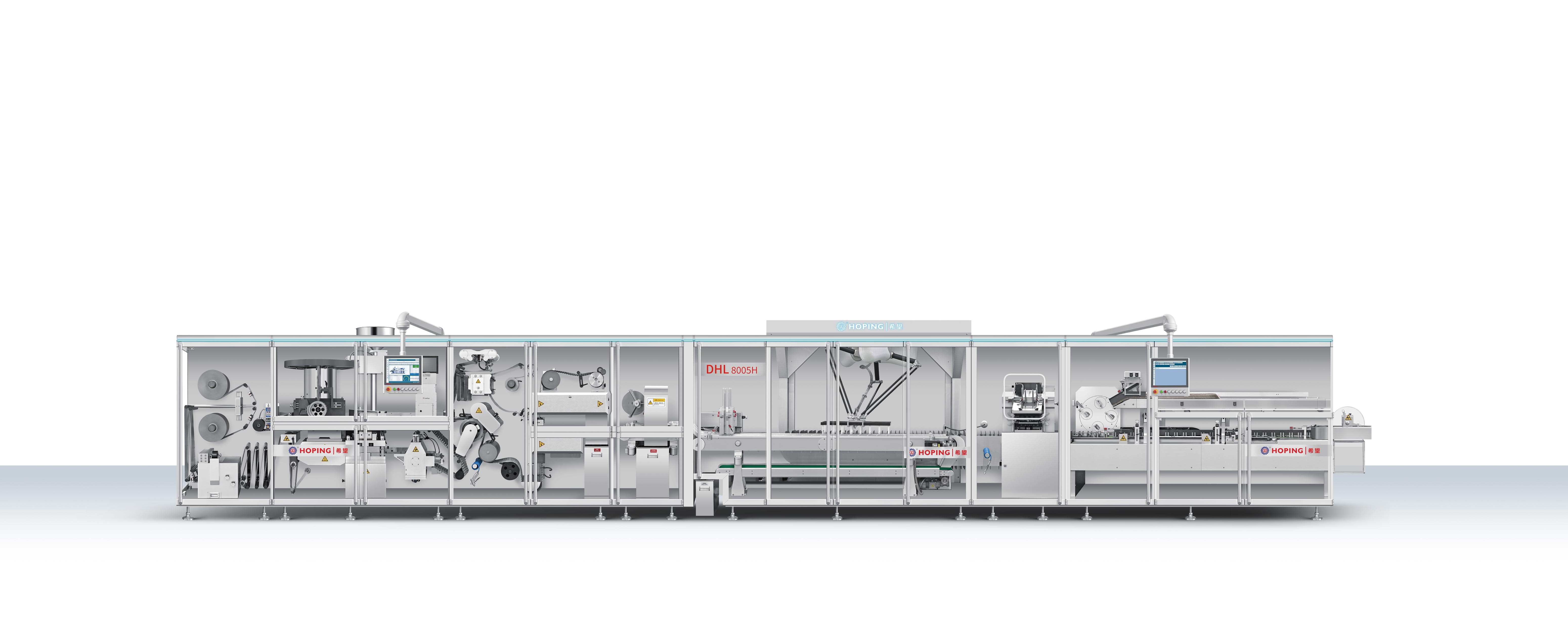
Automatic blister-cartoner integrated machine — a linked line in which blister forming, transfer, leaflet handling and cartoning are engineered as one system.
How to Read Speed Claims: Blisters per Minute Versus Cartons per Minute
Two different numbers are routinely quoted for the same line, and buyers should never read them in isolation. Blister output describes how many blister packs leave the forming and sealing section; carton output describes how many folded cartons leave the cartoner. The relationship between them depends on how many blisters are loaded into each carton and on the carton format — not on the machine alone.
The documentation for the DHL8005H, for example, states a maximum capacity of up to 800 blisters per minute and 500 cartons per minute, with a D3 intelligent top-loading parallel tracking transfer system, multiple feeding methods, PVC/Alu foil auto splicing and a three-channel servo-driven independent replenishment system. A different model in the same documented family, the DHL1000/5H, is stated at up to 1000 blisters per minute and 500 cartons per minute with a four-channel servo-driven independent replenishment system. Reading those two lines side by side shows why the carton figure alone is not a ranking: the blister-to-carton ratio differs by configuration.
| Documented line model | Blister capacity (up to) | Carton capacity (up to) | Transfer / replenishment | Control platform |
|---|---|---|---|---|
| DHL6004 | 600 blisters/min | 400 cartons/min | Servo-driven independent replenishment | Beckhoff motion controller and CP9315 industrial PC |
| DHL7005H | 700 blisters/min | 500 cartons/min | IRB24 intelligent transfer robot; independent replenishment | Siemens motion controller and TP900 HMI |
| DHL8005H | 800 blisters/min | 500 cartons/min | D3 top-loading parallel tracking transfer; three-channel servo replenishment | Beckhoff motion controller and CP9315 industrial PC |
| DHL1000/5H | 1000 blisters/min | 500 cartons/min | D3 top-loading parallel tracking transfer; four-channel servo replenishment | Beckhoff motion controller and high-bus industrial control system |
| IXW600 | 600 blisters/min (300 packs/min) | 300 cartons/min | Rotary reciprocating flow-wrapper matching; servo-driven replenishment | Beckhoff controller and CP9315 industrial PC |
| IXW800 | 600 blisters/min (600 packs/min) | 500 cartons/min | D3 top-load robotics and rotary manipulator; servo-driven independent replenishment | Beckhoff controller and CP9315 industrial PC |
The same caution applies at the blister stage. A platen blister packaging machine such as the DPP260T1 is documented at a maximum punch frequency of 60 punches per minute, a maximum format area of 260 x 115 mm and a maximum capacity of 300 blisters per minute. A rotary blister packing machine such as the DPH320HII is documented at a maximum punch frequency of 250 punches per minute, a maximum format area of 320 x 280 mm and a maximum capacity of 1000 blisters per minute. The apparent contradiction — a lower punch frequency producing a higher blister count — is resolved by cavities per format and feed stroke, which is exactly why buyers should ask for the cavity layout attached to any speed quotation.
Control Architecture: What a Beckhoff Motion Controller and a CP9315 Industrial PC Tell a Buyer
The control platform is one of the few specification items that is genuinely difficult to change later, because it determines how the line behaves during changeover, how faults are reported, and how easily the machine can exchange data with plant systems.
In the documented line examples above, two architectures appear. The DHL8005H, DHL6004, IXW600 and IXW800 use a Beckhoff motion controller paired with a CP9315 industrial PC; the DHL1000/5H uses a Beckhoff motion controller with a high-bus industrial control system; the DHL7005H uses a Siemens motion controller with a TP900 HMI; and the IXW400 liquid dosage line uses a Siemens controller with a CP9315 industrial PC. At the module level, the XW8300 reciprocating flow packing machine is documented with a Beckhoff control system and four-axis servo control, while the XWZ120 horizontal cartoning machine is documented with an SEW main motor and a Siemens PLC, and the XWZ300II cartoning machine is documented with a Siemens or Meccano touch screen, an SEW gear motor and a Becker vacuum pump VT4.40.
For a buyer, the practical questions behind those names are the same regardless of brand: is the controller family widely supported in my region; how are recipes and preset formats stored and restored; can the line communicate with ERP or MES through a data interface; how are alarms displayed and logged; and how quickly can a replacement module be delivered. In the matched-equipment list for a solid dosage blister cartoning line, an ERP/MES data interface appears as a configurable item rather than a given, so it should be written into the technical agreement rather than assumed.
GMP-Oriented Construction: Materials, Cleanability and Guards
Construction details rarely appear in a speed comparison and are frequently the reason a line passes or fails a qualification review. The material convention used in the documented machines is consistent and worth using as a checklist: product-contact parts are made of AISI 316L stainless steel and FDA-compliant pharmaceutical-grade materials, while non-product-contact parts are manufactured from AISI 304 stainless steel and anodized aluminum alloy, with corrosion-resistant and easy-to-clean surfaces. Those statements appear in the documentation for the DPP260T1 platen blister machine, the DPH320HII rotary blister machine and the DPH320H roller blister machine.
At the line level, the same principle is expressed as a GMP-oriented line design, with a stainless steel and aluminum-alloy structure, transparent guarding, servo-driven motion components, and product-contact parts and tooling configured according to the technical agreement. Specific design features support cleaning and changeover in practice: the DPH320HII rotary blister machine is documented with an integral guide rail system intended to enable rapid mould changeovers, easy cleaning and GMP-compliant production, and the XWZ120 cartoner is documented with a balcony-style design for easier cleaning.
When reviewing a quotation, buyers should ask for more than the material grade. Questions that produce useful answers include: are material certificates supplied for contact parts; how are welds dressed and surfaces finished; how are transparent guards designed for cleaning access; which areas are accessible without tools; and what is the documented cleaning procedure. GMP-oriented construction is a design intent, and the evidence for it is documentation plus the physical machine.
What to Inspect During a Site Visit or Factory Acceptance Test
Because much of a blister cartoning line's value is invisible in a specification table, the site visit and the factory acceptance test carry unusual weight. The following inspection points can be applied to any supplier and should be verified against the machine that will actually be shipped, not a demonstration unit of a different configuration.
- Servo-driven independent replenishment. Confirm the number of independent channels and observe behaviour when one channel runs out of product. The DHL8005H is documented with a three-channel servo-driven independent replenishment system; the DHL1000/5H with four channels.
- PVC and Alu foil auto splicing. Ask to see a roll change at production speed and note the downtime. On the DPP260T1 blister packaging machine, a dedicated PVC film splicing station is documented as supporting fast and reliable roll changeovers, stable web alignment and reduced downtime.
- Transfer stability at rated speed. The transfer stage is where high-speed lines most often reveal weaknesses. Observe whether blisters arrive oriented correctly and whether the cartoner receives a steady supply.
- Insertion and leaflet integrity. Check for wrong insertion, missing leaflets and carton damage across a continuous run.
- Inspection and rejection. Confirm what the inspection system actually examines and how rejects are segregated. On the DPH320HII rotary blister machine, the documented vision system provides 100% online inspection of product presence, colour, alignment, contamination, foreign matter, size, shape and packaging defects.
- Mould change and preset memory. Time an actual format change and confirm that settings are stored and recalled rather than re-entered manually.
- Utilities. Verify that clean compressed air at 0.5-0.7 MPa and the correct power supply are available at the installation point before commissioning begins.
- Quality control sequence. A credible supplier should be able to describe a defined sequence. The documented sequence for this manufacturer covers incoming material inspection, key component inspection, assembly inspection, electrical safety check, no-load trial run, material trial, factory acceptance testing, customer witness acceptance and pre-shipment inspection.
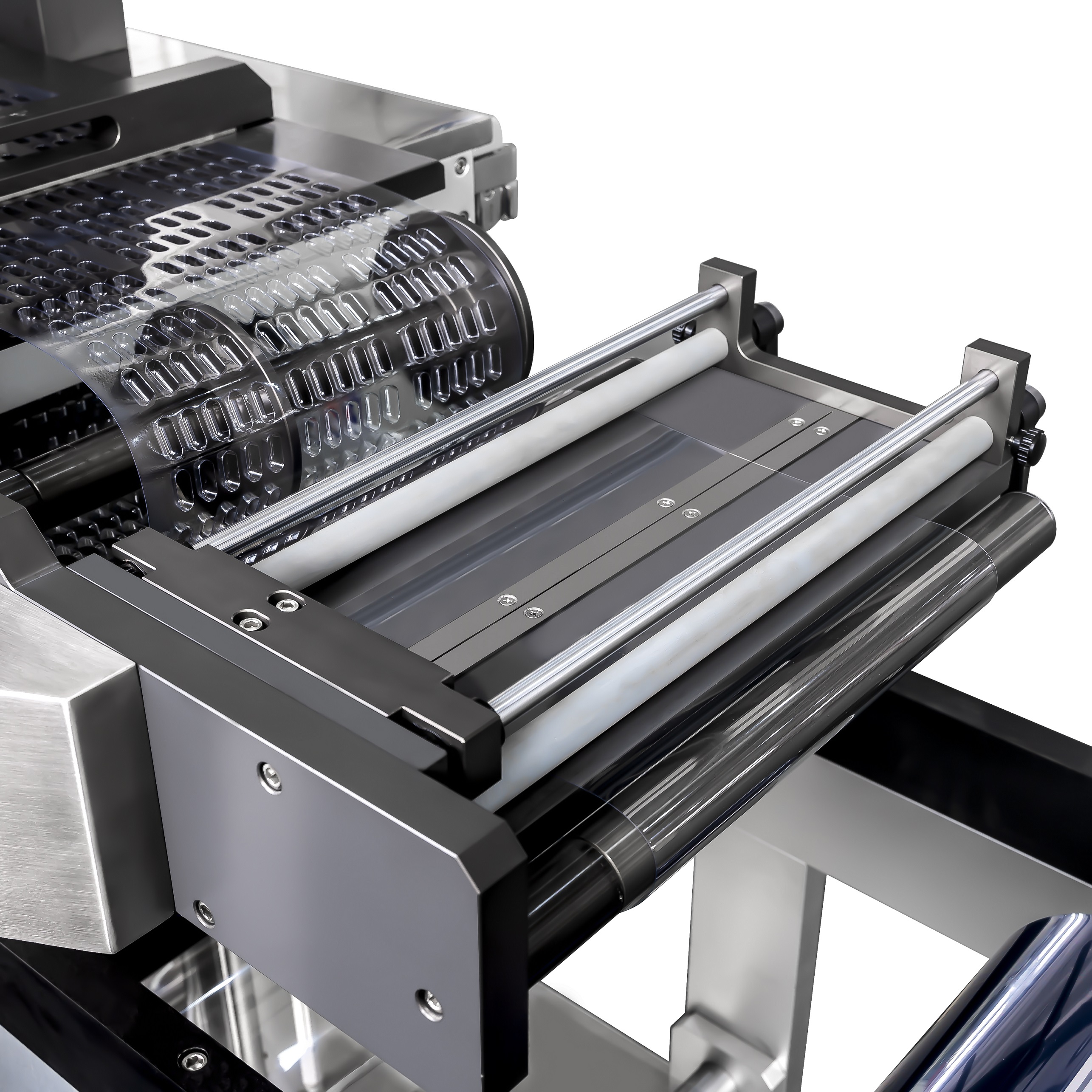
External PVC roll stand with pneumatic lifting, a pneumatic expanding shaft and an integrated film splicing platform — a detail buyers should inspect during a factory acceptance test.
Certification Evidence: Which Document Covers Which Machine
Certification is a constraint category where a plausible-sounding claim can be worthless if the certificate does not name the model being purchased. Read certificates as scoped documents, not as general statements about a manufacturer.
In the documentation reviewed here, the CE certificate for the carton packing machine series was issued by Certify International Ltd under certificate number UCN 900339024607, against standard EN 415-3:2000 together with directives 98/37/EC, 98/79/EC and the applicable CE framework, with an issue date of 1 April 2007. A separate CE certificate for the cartoning machine series was issued by Shenzhen HTT Technology Co., Ltd. under certificate number HTT190102307L, against EN 60204-1:2006+A1:2009+AC:2010 and Machinery Directive 2006/42/EC, issued 22 January 2019. A further CE certificate covers an automatic blister packing machine, issued by CELAB under number UCN 900175009261 against EN 60204-1:1997, EN 415-3:1999, 73/23/EEC, 93/68/EEC, 98/37/EC and 98/79/EC, issued 6 November 2006.
Management-system certificates are separate from product certificates. ISO 14001:2015 environmental management certification was issued by the China Quality Certification Centre (CQC) under number CN00123E33896R1M/3300, with an issue date of 12 October 2023 and an expiry date of 11 October 2026. ISO 45001:2018 occupational health and safety certification was issued by CQC under number CN00123S33121R1M/3300, issued 10 October 2023 and expiring 9 October 2026. Both certificates are scoped to the design, production and after-sales service of packing machines and packing production lines.
Three practical cautions follow from reading certificates this way. First, confirm the certificate scope lists the exact model or series in the purchase order. Second, check validity dates rather than assuming renewal — a certificate with an expiry date in the coming months should be re-confirmed before shipment. Third, note that older CE documentation may reference earlier directives, so the applicable standard should be aligned with the current Machinery Directive 2006/42/EC and the EN 415 series for packaging machines. For pharmaceutical packaging specifically, ISO 15378 integrates GMP requirements for primary packaging materials and is a useful reference point when framing requirements with a supplier, even though the standard applies to packaging materials rather than to the machine itself.
Integrated Lines Versus Standalone Machines: Real Boundaries
An integrated blister cartoning line is not automatically the better choice, and a credible supplier will say so. Several boundaries are worth stating plainly.
Line balancing. Upstream and downstream modules do not share the same capacity. A cartoning machine documented at 100-500 cartons per minute (XWZ500H) or 60-220 cartons per minute (XWZ300II) is far faster than a documented case packing machine at about 5 cases per minute (XWK Series) or a case packing and palletizing integral machine at about 12 cases per minute (ICP12). A stretch bander in the same family is documented at 30-60 bundles per minute (XWK4060). Buyers should confirm the cartons-per-case ratio, accumulation and buffering strategy so that the downstream unit is not the hidden constraint on the whole line.
Format dependence. A linked line earns its value when the format family is stable and runs are long. Where a plant produces many small batches with radically different blister and carton formats, the changeover burden and the tooling inventory can outweigh the labour savings of integration, and standalone machines may be the more rational configuration.
Single-point stoppage. Because the stages are mechanically and logically linked, a fault at the transfer or cartoning stage stops the line. Recovery depends on the alarm and fault-indication logic, the recipe-storage design, and whether accumulation is provided. This is a design question to settle during technical review, not after commissioning.
Lead time and project rhythm. For this manufacturer, lead time is typically 60-120 days after technical confirmation, with the final figure subject to model, configuration, project complexity and contract terms, and the minimum order quantity is one set or one complete line. Buyers should therefore treat the technical agreement as the true start of the schedule.
Infrastructure. Utility requirements are engineering constraints, not details. Individual modules carry their own figures: the DPH320H roller blister machine is documented at 380V 50Hz 29.5 kW with compressed air at 0.5-0.7 MPa and air flow above 0.6 m³/min; the XWZ500H cartoning machine at 380V 50Hz 14 kW with air consumption above 0.3 m³/min; the ICP12 case packing and palletizing integral machine at 380V 50Hz 25 kW with air consumption above 0.5 m³/min. Compressed air quality and power capacity at the installation point should be verified before contract signature.
Speed-claim validation. Rated maximum capacities are format-specific. The only meaningful confirmation is a material trial and factory acceptance test using the buyer's own product, blister format, leaflet and carton.
Market Context: What Third-Party Data Says About Demand
Independent market data supports the view that blister and cartoning equipment is a durable procurement category rather than a niche. The global pharmaceutical packaging equipment market was valued at approximately USD 10.71 billion in 2024 according to SkyQuest Technology. The pharmaceutical blister packaging machine market was projected by Custom Market Insights to reach USD 2.57 billion by 2025 with a compound annual growth rate of 2.8%. Within the same equipment family, Fortune Business Insights valued the pharmaceutical cartoning machinery market at USD 1.46 billion in 2024.
Regional demand is concentrated. Grand View Research reported that Asia Pacific held the largest revenue share, 40.7%, of the pharmaceutical packaging equipment market in 2025. On the supply side, market concentration among the largest global blister packaging machine suppliers remains moderate: a Market Intelligence Report estimates that the top three players, Uhlmann, IMA and Marchesini, collectively hold approximately 29% of the pharmaceutical blister packaging machine market. The remainder is served by a broad field of regional and specialist builders.
Published market estimates also diverge. SkyQuest Technology puts the 2024 pharmaceutical packaging equipment market at approximately USD 10.71 billion, while Grand View Research reports a figure of USD 7.0 billion for 2025, largely because of differences in whether secondary and end-of-line equipment is included. Buyers should treat headline market figures as directional context only; they do not substitute for line-level technical evaluation.
Application Fit: Where Blister-Cartoning Lines Are Used
The core application is solid dosage production: tablets, capsules and soft capsules, together with nutraceuticals and healthcare products, in a GMP-oriented cleanroom or pharmaceutical packaging workshop operating continuously across multiple batches and formats. The same equipment family extends to food and cosmetic blister-cartoning projects where the format allows.
Configurations differ by dosage form rather than by brand. Liquid dosage packaging, such as pre-filled syringes, ampoules and cartridge-type products, is handled by a dedicated integrated line documented at up to 400 blisters per minute and 150 cartons per minute with PVC and top cover film auto splicing, a D3 top-loading robot and a Siemens controller with a CP9315 industrial PC. Freeze-dried powder and special dosage forms use a dedicated blister machine documented across the DP260K and DP260KD models at approximately 10-20 cycles per minute. Vial products are addressed by a line that combines labelling, blister packing, cartoning and stretch banding, with capacity and dimensions customized according to vial size, blister format, carton format and project layout.
The practical implication for buyers is that the correct comparison is not between suppliers in the abstract but between configurations for a defined dosage form, format and output. A line optimized for high-volume tablet cartoning and a line configured for injectable blister cartoning are not interchangeable, and comparing their headline speeds is meaningless.
What Changes Next in Blister-Cartoning Procurement
Three directions are visible in current line documentation, and all three affect how buyers should write specifications.
The first is deeper integration with plant data systems. Where an ERP/MES data interface is listed as a configurable item in matched-equipment documentation, the interface becomes part of the technical agreement rather than an afterthought, which shifts the discussion from machine speed to data availability.
The second is recipe-driven changeover. Preset-memory and mould-change functions, together with servo-driven replenishment and independent channels, are moving from premium features to expected elements of a high-speed blister cartoning line, because they reduce the operator dependency that governs real output in multi-format production.
The third is inspection density. In-line vision inspection documented as 100% online checking of presence, colour, alignment, contamination, foreign matter, size and shape raises the evidence standard at handover: buyers increasingly expect rejection data and batch records, not only a functioning reject gate. None of these changes alter the fundamentals of evaluation set out above, but each one adds a specification line that should be requested in writing before a purchase order is issued.
Frequently Asked Questions
What certifications should be verified before buying a pharmaceutical blister cartoning line?
Verify the certificate that names the exact machine or series being purchased, not a general statement about the manufacturer. CE certification for cartoning machine series has been issued against EN 60204-1:2006+A1:2009+AC:2010 and Machinery Directive 2006/42/EC under certificate number HTT190102307L by Shenzhen HTT Technology Co., Ltd., and CE certification for a carton packing machine series has been issued against EN 415-3:2000 under certificate number UCN 900339024607 by Certify International Ltd. Management-system certificates are separate: ISO 14001:2015 under CN00123E33896R1M/3300 and ISO 45001:2018 under CN00123S33121R1M/3300, both issued by the China Quality Certification Centre, with expiry dates in October 2026. ISO 15378 is also relevant as the standard integrating GMP requirements for primary packaging materials.
What do figures such as 800 blisters per minute and 500 cartons per minute actually mean?
They are two different outputs measured at two different points in the line, and they are format-specific. On the DHL8005H blister-cartoner integrated machine, the documented maximum is up to 800 blisters per minute and 500 cartons per minute; on the DHL1000/5H it is up to 1000 blisters per minute and 500 cartons per minute; on the DHL7005H it is up to 700 blisters per minute and 500 cartons per minute. The relationship between blister output and carton output depends on how many blisters are loaded into each carton and on the carton format, so both figures should be requested together with the cavity layout and carton loading pattern for the buyer's own product.
What utilities and site conditions does a blister-cartoning line require?
Utility requirements are documented per module. The DPH320H roller blister packing machine is rated at 380V 50Hz 29.5 kW with compressed air at 0.5-0.7 MPa and air flow above 0.6 m³/min. The XWZ500H cartoning machine is rated at 380V 50Hz 14 kW with air consumption above 0.3 m³/min and the same compressed air pressure range. The ICP12 case packing and palletizing integral machine is rated at 380V 50Hz 25 kW with air consumption above 0.5 m³/min. Clean, dry compressed air at the specified pressure and adequate power capacity at the installation point should be confirmed before commissioning.
Which materials should product-contact parts use in a GMP-oriented pharmaceutical packaging machine?
The documented convention across the machines reviewed here is AISI 316L stainless steel for product-contact parts, together with FDA-compliant pharmaceutical-grade materials, while non-product-contact parts are manufactured from AISI 304 stainless steel and anodized aluminum alloy. Machines built to this convention are described as designed and manufactured in accordance with GMP requirements, with corrosion-resistant and easy-to-clean surfaces. Buyers should request material certificates for contact parts and confirm how surfaces, welds and transparent guards are finished for cleaning access.
How long does delivery of a turnkey pharmaceutical packaging line typically take?
For this manufacturer, lead time is typically 60-120 days after technical confirmation, with the final lead time subject to model, configuration, project complexity and contract terms. The minimum order quantity is one set or one complete line. Because tooling, format parts and downstream integration are configured per project, the technical agreement and its approval date effectively define the start of the delivery schedule.
When is an integrated line the wrong choice compared with standalone machines?
Integration is less attractive when format families change frequently, when batch sizes are small, when downstream capacity cannot be balanced with cartoning output, or when the site cannot meet the utility requirements for continuous operation. Because a linked line stops as a system when the transfer or cartoning stage faults, recovery design — alarm logic, recipe recall and accumulation — matters as much as peak speed. A plant producing many short runs with different blister and carton formats may achieve better overall equipment effectiveness with separate blister and cartoning machines than with a single linked line.
Technical reference for the equipment described in this guide: Hoping Machinery product catalog (PDF) — https://cdn.socialarks.com/sbsp/24974/common/2026/0613/Hoping%20Machinery%20Catalog.pdf